
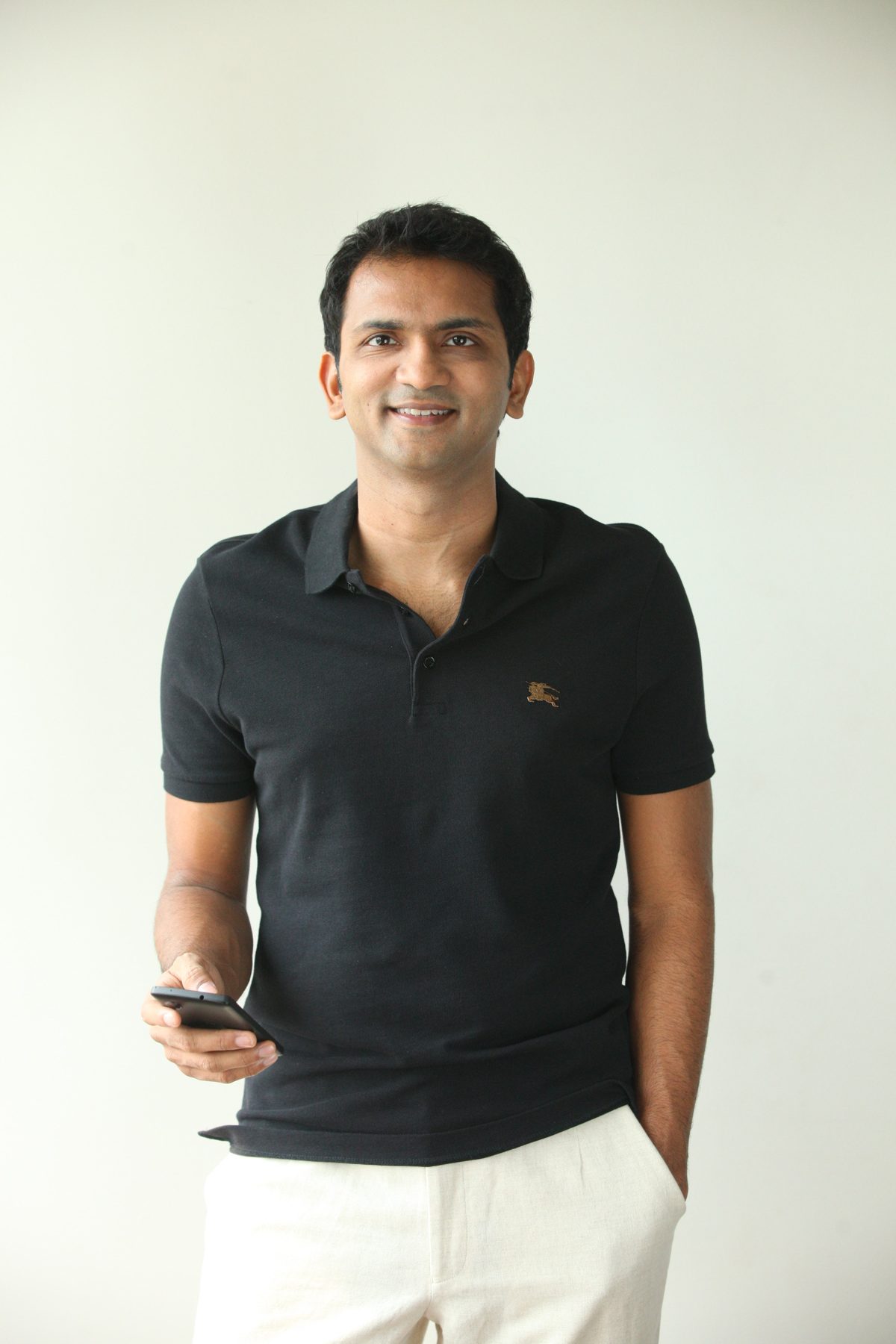
| Key facts | |
|---|---|
| Born | 21 December 1979, Mumbai, Maharashtra [1][2] |
| Family roots | Gujarati Jain family from Bhavnagar and Surendranagar, settled in Mumbai; father Mahendra Turakhia, a chartered accountant, ran a tax and audit practice [3][4][5] |
| Education | Arya Vidya Mandir, Bandra; left the science stream at D.G. Ruparel College; B.Com, Sydenham College, Mumbai [1][6][7] |
| Family | Younger brother and co-founder Divyank Turakhia (born 1982) [3][8] |
| Companies | Directi (1998), Radix (2012), Flock (2014), Zeta (2015), Titan (2018), Neo (2026); earlier businesses sold to Endurance International (2014) and, with Divyank, Media.net sold for US$900 million (2016) [9][10][11] |
| Wealth | Rs 10,800 crore, IIFL Wealth Hurun India Rich List 2022, the last list to publish an individual figure for him; Forbes last listed the brothers jointly at US$1.54 billion in 2019. He does not appear in the published top-100 of the Hurun lists of 2025 or 2026 [12][2][13] |
| Known for | Bootstrapping a web-hosting business from a Rs 25,000 loan into two nine-figure exits, then founding Zeta, a US$2 billion banking-technology company [8][14] |
In 1989, a boys’ school in Bandra, Mumbai, installed a room of thirteen IBM-compatible computers. Only twelve pupils chose the new computing elective, so each child got a machine to himself. One of them was a nine-year-old from Andheri named Bhavin Turakhia, who had never touched a computer before. “It was love at first sight,” he would say decades later [15][16][17].
The family could not afford a computer at home, so the boy stayed back after the final bell. The computer teacher got into the habit of leaving him the keys to the lab. He spent two or three hours there every afternoon teaching himself GW-BASIC on MS-DOS, often missing the school bus, and was soon teaching other students, and then the teachers [3][18][19]. “I couldn’t wait for the sun to rise and spend every minute with the computer all over again,” he recalled [19].
Nine years later he and his younger brother borrowed Rs 25,000 from their father to lease a server in America. The company they started with it, Directi, never raised a rupee of outside capital and eventually produced two sales worth more than US$1 billion between them. Bhavin then did something few Indian founders with that kind of money do: he put a large part of it into a string of new companies, one of which, Zeta, is now valued at US$2 billion and is trying to replace the mainframe software that still runs much of the world’s banking [8][14].
This is the story of a self-taught programmer who built, lost, pivoted and built again, mostly with his own money, and mostly out of the headlines. It is also a story about what bootstrapping can and cannot do, and about the moment a lifelong sceptic of venture capital finally took a cheque from SoftBank.
Where it began
Bhavin Turakhia was born on 21 December 1979 in Mumbai into a middle-class Gujarati Jain family [1]. His parents had both come from Gujarat, his father from Bhavnagar and his mother from Surendranagar, and settled in the city before the children were born [3][4]. His father, Mahendra Turakhia, was a chartered accountant who ran a small practice in tax consulting, audit and company incorporations; his mother was a law graduate who never practised and gave her time to social work [3][5][4].
Money was tight. For Bhavin’s first seven years the family lived in a single room in a house shared with his father’s elder brother; at one point ten people shared a home with two bedrooms [20][18]. His father worked “nine to nine” to make ends meet and the family had no car, relying on public transport [21][3]. Later they moved to a two-bedroom flat in suburban Andheri, which is where Directi would be born [8].
What the house lacked in space it made up for in books. Mahendra Turakhia gave up luxuries but spent heavily on reading material for his sons: when Bhavin showed an interest in computers, his father bought him 35 to 40 programming books, and when a school subject interested him, four or five extra books by different authors on the same topic [18][22]. Between Class 6 and Class 10 Bhavin also worked through dozens of business biographies, of Microsoft, IBM, Apple, Xerox, McDonald’s and General Electric among others. “That’s where my passion for entrepreneurship came from,” he told FactorDaily [4][7].
The father’s other gift was a sentence. “The one piece of advice he used to keep repeating all the time in our childhood was, ‘You can achieve anything you set your mind to,’” Bhavin told the BBC in 2019. “Sometimes we’d be like, ‘Dad, we know.’ But the number of times it was repeated, you really internalise it” [21].
Divyank, two years younger, caught the same bug in the same computer room. By the time Bhavin was 15 and Divyank 13, the brothers had spent the better part of a year writing a business-simulation game in GW-BASIC for a school project. The game opened with an animation in which a partner cheats the hero out of his company; the player then has to build a rival business from nothing and manage money, staff and budgets [23][24]. Before the internet reached India in 1995, they ran a small bulletin-board system on a 2,400-baud modem so that friends could dial in [23][5].
By 16 Bhavin was earning pocket money as a consultant, setting up websites, email and internet gateways for Mumbai businesses [24][23]. Then came the failures. A hardware venture called Bits and PCs, in which he assembled computers and sold them door to door, lost money [7][19]. In early 1996, at 16, he built what he describes as an artificially intelligent engine for matching job vacancies to resumes, and spent about 18 months trying to sell it. Small-business owners gave him three or four hours of their time and never bought. “I was way ahead of my time,” he said; he had mistaken curiosity about the internet for willingness to pay, and had “over built and over engineered” the product while ignoring how it would reach customers [7][18]. The lesson, that go-to-market matters as much as the product, is one he still cites [22].
School ended in 1994. Bhavin enrolled in the science stream at D.G. Ruparel College with the IIT entrance exam in mind, then dropped it: he had already taught himself most of a computer-science curriculum and did not want to spend four years on a degree. “Everybody told me I was doing the biggest mistake of my life,” he said [19][15]. His parents insisted on some degree, so he signed up for a B.Com at Sydenham College, which he says he attended for perhaps 12 to 16 weeks across three years while building his business [7][6]. Divyank did his B.Com at Narsee Monjee [1].
The first break
Directi was set up in late 1998, when Bhavin was 18 and Divyank 16, in the family flat in Andheri. Accounts of exactly where differ: Quartz says the brothers’ shared bedroom, The Economic Times says a corner of the kitchen, and Forbes India says a single computer in their father’s office [8][24]. The capital was a loan from their father, which Bhavin has put at Rs 25,000, “to pay for the first quarter for the server” [18][25]. Divyank has described the same sum as US$600, which is what Rs 25,000 bought in 1998 [5].
The model was simple and, for India in 1998, unusual. Rather than build custom websites for a few clients, the brothers leased a server in the United States for a couple of hundred dollars a month, carved it into small shared-hosting plans with a control panel, and resold the space at three or four times cost. Domain names bought from Network Solutions for about US$35 were sold on for US$40 to US$50 [7]. “We decided to play in volumes,” Bhavin said [23]. The business was deliberately global and automated from the start, built so that it “wouldn’t require them to be personally available to every customer” [5].
They signed 40 customers in the first month and repaid the loan within the first quarter [7][3]. Early clients, won by phoning everyone the brothers had met during the consulting years, included Nasscom, the Centre for Monitoring Indian Economy and a political party; within two years, Divyank has said, “nearly every large site at that time was hosting with us” [5][26]. First-year turnover was modest all the same: Bhavin puts it at Rs 4 to 5 lakh, and has corrected interviewers who assumed the brothers made a million dollars in year one [7][23].
The break came at a Nasscom conference in New Delhi in 1999. Directi could not afford an exhibitor’s booth, so Bhavin spent two days walking from stall to stall. “Instead of listening to their pitch, I reverse sold my services,” he said: hosting packages and domain names to the very companies that had paid to exhibit. The haul from those two or three days exceeded the previous three months’ revenue [25][18]. At the same event, the industry body found that nobody knew how to set up its leased internet lines, and asked “the two college kids” to do it; from then on, when a large company had a connectivity problem, Nasscom pointed them to Directi [26][8].
Cash collection was the hard part. In the first two years Bhavin spent 30 to 40 per cent of his time chasing payments, sometimes waiting four hours in a corporate reception [27]. Most growth came from abroad, where customers paid by card; the Indian market, Divyank said, “was very nascent” and produced single-digit revenues [3].
In 2001 Directi became India’s first ICANN-accredited domain registrar, through PublicDomainRegistry.com, a milestone funded in part by selling about 15,000 discount domain coupons at another Nasscom event [7][16]. Revenue crossed US$1 million within four to five years and US$10 million by 2005 [28]. Bhavin was 25 and still taking almost all final interviews himself.
Building the empire
Directi: a group built from the inside
What followed was not one company but a stack of them, each built on the one before. Around the registrar grew ResellerClub, which sold domains and hosting wholesale to web designers and small hosts; LogicBoxes, software that let other companies run their own registrars; BigRock, a retail brand; and a payment gateway, Transecute, which the brothers later shut [26][23]. Divyank started Skenzo, a domain-parking and advertising business, in 2005, and from it grew Media.net, a contextual-advertising company best known as a partner of the Yahoo-Bing search network, which he ran from Dubai and New York from 2010 [29][10].
The group’s internal culture became something of a Mumbai legend. Candidates were asked to solve a Rubik’s cube, estimate how many diapers Mumbai buys in a day, build a working web app, or design a spice rack for the blind [30]. Bhavin took most final interviews personally and says he still spends 20 to 30 per cent of his time on hiring [7][3]. “You have to hire above the mean,” he says, screening for people who are smart, get things done and have “humility-slash-niceness” [31]. Spending priorities, he told Inc42, are “people, product and then promotion. Everything else comes later” [16].
In 2009 Directi launched CodeChef, a not-for-profit competitive-programming platform that ran free monthly contests for students; it would become one of the best-known coding communities in India [16][32]. By 2013 the Directi group had more than 1,000 employees, about a million customers and more than 50,000 channel partners, all without outside funding [33][24].
The first exit: Endurance, 2014
In August 2013 Endurance International Group, the US owner of HostGator and Domain.com, agreed to buy Directi’s web-presence businesses: ResellerClub, LogicBoxes, BigRock, webhosting.info and the PDR registrar. Endurance’s own IPO filing described a price of US$100 million to US$110 million, payable in cash or a mix of cash and shares and tied to financial targets, plus up to about US$62 million of further payments linked to new domain-extension auctions [33]. The deal closed on 29 January 2014; Domain Incite reported the mix as US$25.5 million in cash with the rest in shares and a promissory note [34][9]. The Turakhias have consistently described the total as US$160 million, and Forbes India and TechCrunch have used that figure; the two versions are reconcilable if the contingent payments were earned [28][8].
Radix, the registry business, was carved out and kept.
The second exit: Media.net, 2016
On 22 August 2016 the brothers announced that Media.net had been sold for US$900 million in cash to a consortium led by Zhang Zhiyong, chairman of Beijing Miteno Communication Technology, a company listed on Shenzhen’s growth board. US$426 million was paid at closing and the rest was due in instalments [10][35]. Media.net had revenue of US$232 million in 2015 and more than 800 staff; seven bidders had competed. TechCrunch noted it was the only one of the brothers’ eleven companies ever to have taken outside investment, a minority stake sold to Ashmore in 2008 [10][28].
Media.net was Divyank’s company. “Div bootstrapped Media.net in its entirety,” Bhavin says [29]. But the brothers have never divided their fortunes. “We don’t differentiate between businesses as Bhavin’s or mine,” Divyank told Quartz; the proceeds went into “a common pool” [8]. “In my mind and in Bhavin’s mind, we both own everything,” he told Forbes India [24]. That November, Forbes India put “Bhavin & Divyank Turakhia” on its rich list for the first time, at number 95 with a joint US$1.3 billion [24]. Divyank, at 34, was widely described as India’s youngest self-made billionaire; Bhavin, who was 36, had the quieter profile and has kept it [8].
Post-sale, Bhavin was blunt about the position: “We have so much cash we don’t know what to do with it” [17]. He announced that the brothers would put about US$110 million into four new ventures. For a man who had never raised money, it was the start of a very different second act [16].
Radix: owning the roads
Radix was founded in 2012 to bid for the new generic top-level domains that ICANN was releasing, the first new endings since .com. The brothers considered 600 strings, applied for 31 and ended up with ten, funded with about US$25 million of their own money [36][37][38]. The prize was .tech: in September 2014 dot Tech LLC beat Google, Donuts and others at an ICANN auction with a bid of US$6.76 million, and Radix bought the string from the winner a month later, the first time one new registry had purchased another [39]. Four strings, .host, .press, .space and .website, were uncontested; .online, .store and .site were won in private auctions, with .online estimated by trade press to have cost more than US$10 million [37].
A registry is a toll road: once the extension exists, every registration and renewal pays a fee. Radix’s revenue went from US$12 million in 2017, when it was already profitable, to US$21 million in 2019 and US$38 million in 2021 [37][40][36]. Sandeep Ramchandani, a long-time Directi executive, became chief executive in January 2018 with Bhavin as executive chairman [3]. By August 2025 Radix had about 10 million domains under management across 11 extensions and announced it would move its technical back-end to Tucows; it has applied for 46 more strings in ICANN’s 2026 round [41].
Flock, Ringo and the discipline of failing
Not everything worked. In May 2014 the group launched Ringo, an app for cheap international calls routed over local phone lines rather than data. In November 2015 it added domestic Indian calls at 19 paise a minute, well below operator rates. Within a week the mobile operators had blocked its routes and complained to the regulator [42][43]. The dispute is described in the controversies section below; the India service never came back, and by 2018 Forbes India described Ringo as “at a pause” [28].
Flock, launched on 25 September 2014, was Bhavin’s attempt to build a messaging tool for workplaces before Slack became a verb in India [44]. He put US$25 million into it in March 2017 and, by The Ken’s count, about US$45 million in total; Forbes India later put the figure at US$30 million [4][45][38]. By mid-2017 it had around 25,000 business customers and over 50,000 weekly active users, respectable numbers that were nonetheless a rounding error against Slack [4]. In early 2019 trade publications reported layoffs in India and a possible fire sale to Dropbox; The Ken asked, “Has Flock failed to fly?” [45]. Bhavin replied in a blog post that there were “no ongoing discussions with Dropbox or anyone regarding a sale or merger”, while conceding that the India team was being “restructured” into two cities [46]. His view at the time was that there was “no point in killing something that has not been adopted in less than 1% of the world” [4].
What saved the bet was a side project. In March 2018 the Flock team launched Titan, a business email service sold not to end users but through web hosts and domain registrars, the channel Bhavin knew better than anyone [14][47]. In August 2021 Automattic, the owner of WordPress.com, invested US$30 million in Titan at a US$300 million valuation, which its chief executive Matt Mullenweg called “our largest strategic investment to date” [48]. Titan signed Name.com, GMO Internet and Newfold, and in August 2025 GoDaddy, the world’s largest registrar, agreed to offer it to customers in India, Brazil and other emerging markets; Bloomberg reported 2.3 million active mailboxes, double the figure two years earlier [49][50]. In October 2026 a deal with Squarespace put “Essential Email by Titan” at US$3 a month in front of what the company says is 40 per cent of all newly registered domains worldwide [47].
Zeta: the moonshot
The biggest bet began in 2015, when Bhavin and Ramki Gaddipati, who had been his chief technology officer at Directi, founded Zeta [18][51]. The first product was unglamorous: digital meal vouchers and tax-saving employee benefits for Indian companies, replacing paper coupons. By 2019 the platform had more than two million users and 14,000 corporate clients, including Amazon, and the founders had put in about US$40 million of their own money [51][38].
But the real target was underneath. Working with banks on cards and benefits had shown Bhavin how old the plumbing was. “Banking technology has been, funnily enough, the last frontier in terms of disruption,” he said; “all banks globally continue to use legacy technology platforms that have been around since the 1970s” [52]. “If you talk to any bank today, not a single bank will tell you they love their technology” [53]. Zeta pivoted to building Tachyon, a cloud-native platform for issuing credit cards, running accounts and processing payments that a bank could adopt whole rather than patching its mainframe. “Banks need to replace their foundational primary platform instead of patching it,” he argued [53].
In July 2019 Sodexo, the French benefits group and Zeta’s partner since 2017, bought a minority stake at a US$300 million valuation; the amount was not disclosed, though TechCrunch cited a source putting it under US$60 million [51]. Then, on 24 May 2021, SoftBank’s Vision Fund 2 led a US$250 million round at a US$1.45 billion valuation, making Zeta a unicorn in what Bhavin called its first real round. Ten banks and 25 fintechs were customers [54][52].
It was a notable reversal for a man who had spent two decades arguing that “diluting the equity is the most expensive way to grow” [55]. “This is the first time I have raised institutional money,” he told Business Standard [52]. His explanation was that this was strategic rather than survival capital: SoftBank “has made huge inroads into fintech companies and several banks across the globe”, and “is well-positioned to open the doors for us in various markets and across the banks” [53]. Mastercard followed in March 2022 with a five-year partnership and an investment Bloomberg put at about US$30 million at a roughly US$1.5 billion valuation [56][57].
The anchor Indian client was HDFC Bank. After the Reserve Bank of India barred the country’s largest private bank from launching new digital products for 15 months over repeated outages, HDFC’s digital factory brought in Zeta to rebuild its PayZapp payments app and build a second credit-card platform, according to The Ken; the bank later chose Zeta for its Credit Line on UPI product [58][59]. In the United States, Sparrow Financial launched a credit card for non-prime borrowers on Tachyon in October 2023, going live in under six months [60].
The economics were brutal for years. Zeta’s Indian entity, Better World Technology, lost Rs 43 crore on revenue of Rs 297 crore in FY2021 [61]. It turned a first profit of Rs 21.9 crore on Rs 816 crore in FY2023, and in FY2024 made Rs 119.8 crore on Rs 893 crore, with employee costs of Rs 616 crore [62][63]. Bhavin cautions that the Indian filings capture only part of a group spread across Singapore, Dubai, the US and India [64].
In February 2025 the US healthcare group Optum invested US$50 million at a US$2 billion valuation. Zeta then had about 1,700 employees, 25 million accounts live and contracts for 25 million more, and had spent roughly US$400 million building its platform [14][57]. Bhavin said the group’s cash burn had fallen from US$60 to 70 million a year to about US$22 million, that it aimed for zero burn by March 2026, and that revenue would be US$100 to 200 million in FY2026 with the United States becoming the majority market. “In all likelihood, this $50 million is going to sit in the bank,” he said, and there would be no IPO “for the next several years” [14][64]. Whether the March 2026 target was met has not been publicly confirmed as of this writing.
Neo: the fifth company
In July 2026 Bhavin announced Neo, an AI-native work platform combining project management, documents, files and AI assistants, built in Bengaluru by a team of about 45 and funded with US$30 million of his own money [11][65]. The first version was built in roughly three months, something he says would have taken more than a year before generative AI, and was deployed across Zeta and Titan first [65]. “If you want to build an iPhone, you can’t take the parts of a Nokia and somehow convert it into an iPhone,” he said of trying to bolt AI onto existing office suites. “Even if we end up with 2% to 5% market share, that’s larger than anything I’ve built so far” [65].
How the wealth is held
Bhavin’s fortune sits mainly in private companies: his founder stake in Zeta, whose size has never been disclosed; Radix, which he and Divyank own outright; the bulk of Titan, in which Automattic holds about 10 per cent; Flock; Neo; and the investment funds that received the Media.net proceeds [35][48]. Because none is listed, published wealth figures are estimates and have been sporadic. Forbes listed the brothers jointly at US$1.3 billion in 2016, US$1.55 billion in 2018 and US$1.54 billion in 2019, after which their combined figure fell below the Forbes India 100 cutoff [24][66][2]. Hurun lists them separately. Its 2022 India list put Bhavin at Rs 10,800 crore and Divyank at Rs 11,200 crore; that is the last published individual figure for Bhavin [12]. In 2025 Hurun ranked Divyank 98th at Rs 30,680 crore under a new vehicle, Ai.Tech, but Bhavin did not appear in the top 100 [67]. The 2026 M3M Hurun list, released on 23 September 2026 with 1,810 names, had a top-100 cutoff of Rs 33,000 crore; neither brother appears in its published top-100 coverage [13].
Since 2017 Bhavin has been based mainly in London, which he says “gives me the best of both worlds. I get up at 5:30 in the morning and it’s 10:30am in India”, while splitting the month between Mumbai, Dubai and Bengaluru, where Zeta and Neo have their engineering teams [4][20].
The setbacks and failures
Bhavin’s record includes more shutdowns and stalls than his billionaire billing suggests, and he talks about them more readily than most founders.
The first were the teenage ventures: Bits and PCs, the hardware business that lost money, and the job-matching engine that took 18 months to fail. He describes the latter as “a disaster in terms of success” and says ignoring go-to-market has been “one of my fundamental mistakes multiple times over” [18]. Transecute, an early payment gateway, was shut; Divyank has said the fraud-detection algorithms the brothers built for it “could have been patented” [5][23].
Ringo was the most public failure. A product that worked in 100 countries was switched off in its home market within a week of launch, after the operators moved against it; the licences Directi’s group company later obtained did not help, because the operators declined to interconnect [68]. Flock absorbed about US$45 million and years of effort for a product that reached a small fraction of the market it was built for, and had to be restructured in 2019 [45][46]. Zeta burned US$60 to 70 million a year at its peak and took a decade to approach break-even; its pivot from employee benefits to core banking was a bet-the-company decision taken while the first business was still growing [64].
CodeChef is a gentler kind of setback. Bhavin funded it as a non-profit for eleven years; in June 2020 it moved to Unacademy, on whose board he had sat since 2017, for an undisclosed sum [69]. In March 2023, as the edtech downturn bit, Unacademy let CodeChef go independent with a one-time investment and a roughly 30 per cent stake. CodeChef’s own statement said its finances “had not been viable” and that it had relied on Directi and Unacademy; it now charges for a Pro tier [70][32].
Bhavin’s own framing of all this is that the failures were tuition. “Every adversity is an opportunity in disguise,” he says, and, less loftily, that founders should “validate fast and validate always” [71][72].
Controversies and allegations
Bhavin Turakhia’s record is unusually clean for a man who has operated internet infrastructure for 28 years. We found no proceedings against him or his companies by SEBI, the RBI, the Enforcement Directorate, the CBI or the Competition Commission, no criminal case, and no dispute with investors or co-founders. The matters below are the ones documented by courts, regulators or multiple major publications.
The 2008 “phantom registrar” allegations
Allegation: In August and September 2008 the US anti-spam group KnujOn and the security researcher Jart Armin of HostExploit alleged that Directi operated about 48 “phantom” ICANN-accredited registrars with no real presence, that its resellers supported illegal online pharmacies, that it was linked to the Estonian registrar EstDomains, and that its PrivacyProtect.org WHOIS-masking service shielded spammers. eWeek, The Register and the Washington Post’s security blog covered the claims [73][74].
Response: Directi called the KnujOn report “factually inaccurate and baseless” and sent takedown demands. Bhavin argued that ICANN’s registrar agreement did not require registrars “to suspend domains, police the Internet, or respond to abuse complaints”, a position security researchers criticised [73]. Within weeks, however, the company cut off privacy and hosting services to EstDomains, which Bhavin called “the right move morally”, issued a joint statement with HostExploit, and in October 2008 suspended about 175,000 domains for abuse and switched off privacy protection on roughly 500,000 reseller domains [75][76].
What happened next:
- ICANN’s compliance team confirmed the 48 registrars were legally incorporated where they claimed to be and said ICANN did not require registrars to disclose incorporation locations [73].
- No ICANN breach notice or regulatory action against any Directi registrar followed [75][76].
Status: Closed. No regulatory finding was ever made against Directi; the episode was reputational, and the company’s abuse policies tightened as a result.
Blocking domain transfers for the City of London Police, 2013-14
Allegation: In late 2013 the City of London Police asked registrars to suspend domains it said were used for music piracy. Directi’s registrar refused to let three such domains transfer to the Canadian registrar EasyDNS, which complained that a police request, without a court order, gave no legal basis to hold a customer’s domain [77].
Response: Directi did not comment publicly.
Status: Closed. In January 2014 a National Arbitration Forum panel ruled that under ICANN’s transfer policy only a court order justified denying a transfer, and ordered the domains released. It was an adverse finding against the registrar, which was sold to Endurance weeks later [77].
Ringo versus the telecom operators, 2015
Allegation: After Ringo launched domestic calling at 19 paise a minute in November 2015, the Cellular Operators Association of India complained to the Telecom Regulatory Authority of India that the app was exploiting the gap between fixed-line and mobile interconnect charges, masking caller identities, and operating beyond the scope of its licence [43][42].
Response: Bhavin said Ringo was “fully legal, compliant, and follows all aspects of the Department of Telecom and TRAI regulations” and that operators had blocked it “without notice”. Ringo paused Indian calls and refunded credits [43][42].
What happened next:
- TRAI’s chairman said in December 2015 that the regulator would “examine it and take suitable decision soon” [78].
- Ringo’s group company obtained access and long-distance licences in February 2016 but said Airtel, Vodafone and Idea refused to interconnect; TRAI held consultations on internet-telephony interconnection in 2016 [68].
Status: No order was passed against Ringo and no penalty imposed. The service never resumed in India, and the company let it lapse [28].
The Media.net buyer’s collapse in China
Allegation: No allegation has been made against the Turakhias in this matter; it concerns the buyer. Chinese disclosures show the US$900 million purchase was financed by a fund controlled by Miteno’s chairman Zhang Zhiyong, partly with a 12 per cent trust loan, with roughly half the price deferred as a performance-linked earn-out to 2019 [79][80]. Miteno, renamed Shuzhi Technology, then bought the holding company for RMB 6.3 billion after a nine-month share suspension and a Shenzhen Stock Exchange inquiry. In December 2020 Shuzhi wrote off RMB 5.6 billion of goodwill on Media.net, citing US-China tensions, India’s 2020 restrictions on Chinese investment and an Indian GST dispute, and the Beijing securities regulator censured Zhang for diverting more than RMB 1.2 billion of listed-company funds, partly towards the acquisition payments [81][80].
Response: Neither brother has commented publicly. Divyank moved from chief executive to adviser in October 2018, with Media.net’s CTO Vaibhav Arya taking over [82].
Status: Shuzhi was delisted from Shenzhen on 30 June 2022 after auditors disclaimed its accounts, and Zhang faced a proposed market ban [83]. Media.net continues to operate under the delisted group. Chinese filings record that the earn-out targets were cumulatively met; we found no report, Indian or international, that the Turakhias went unpaid, and no litigation involving them.
Titan Company v Directi: the “Titan” trademark suit
Allegation: In December 2022 Titan Company, the Tata group watch and jewellery maker, sued Directi Internet Solutions in the Delhi High Court, alleging that Titan email and the titan.email domain infringe its well-known TITAN trademark and amount to passing off [84].
Response: Directi has contested the suit and applied for summary dismissal, arguing that an email service and a watch brand are unrelated; the court recorded the question as whether the defendants can use TITAN for email services [85].
Status: Pending. No interim injunction has been granted in almost four years and Titan email continues to operate and expand. On 7 October 2026 the court took written submissions and listed the injunction and summary-judgment applications to be heard together on 3 December 2026 [86].
Tax disputes
Allegation: Directi has had a run of routine disputes with India’s tax authorities. In 2014 the service-tax department sought to tax Directi’s payments to ICANN and its reseller income as “franchise” services with penalties for suppression [87]. In 2024 the income-tax department disallowed depreciation on office floors Directi had given rent-free to Media.net, a related party [88].
Response: Directi contested both.
Status: The service-tax demand was set aside in full by the Customs, Excise and Service Tax Appellate Tribunal in August 2014 [87]. The depreciation disallowance was upheld by the Income Tax Appellate Tribunal in March 2024; Directi’s appeal was admitted for listing by the Bombay High Court in April 2026 and is pending [88][89]. Note that PDR Ltd, the registrar now facing Delhi High Court directions on domain-name abuse, has belonged to Endurance (now Newfold) since 2014 and is not a Turakhia company.
As of 4 November 2026, that is the full documented record.
Giving back
Bhavin Turakhia is not on India’s philanthropy lists, has not signed the Giving Pledge, and does not publicise donations; we found no major-press record of personal gifts to universities or relief funds. His giving has taken a different, founder’s form.
CodeChef is the main example. For eleven years Directi paid for a free platform on which, by 2023, more than two million people had taken part in over 10,000 algorithmic contests, and which fed a generation of Indian programmers into competitive coding and good jobs [32]. It never charged users while he owned it. The stated rationale was the one he repeats most often: “I live by one fundamental idea – it’s our moral obligation to make an impact directly proportional to our potential” [16][31].
The other channel is the companies themselves, which he describes as the point. Zeta’s pitch is that cheaper, modern banking infrastructure lowers the cost of credit for ordinary customers; Sparrow’s card, built on Zeta, targets Americans with poor credit histories, and HDFC’s Credit Line on UPI brings small-ticket credit to UPI users [60][59]. Whether that counts as giving back is for the reader to judge; it is how he frames it.
Succession
At 46, Bhavin Turakhia is in no sense a retiring founder, and he has not spoken publicly about personal succession or a family holding structure. What is visible is a pattern of handing operating control early. Radix has been run by Sandeep Ramchandani since 2018; Media.net passed from Divyank to Vaibhav Arya in the same year; Zeta has a co-founder and CTO in Ramki Gaddipati, a chief operating officer, Abhishek Sen, who also oversees Flock and Radix, and country and US presidents [3][82][51]. “A company that relies on my intelligence and knowledge will only scale so far,” Bhavin has said [31].
The brothers remain the unusual constant. Two decades after they stopped working on the same company, they still describe a single pool of wealth and a division of temperament rather than assets. “Bhavin likes building things, I like managing risk,” Divyank says [28]. On Zeta, Bhavin has said the eventual goal is a public listing, “but we will not really exit the company. It is a long journey and we have only started. The only company I have exited meaningfully is Directi” [53].
What their journey teaches
1. Build the thing that does not need you in the room. The brothers’ first design decision, in 1998, was to sell standard hosting plans in volume rather than custom websites to a few clients, so that the business would not depend on their personal attention. That choice let two teenagers serve a million customers and set up every later toll-road business, from Radix’s domain extensions to Titan’s reseller-only email [5][41].
2. A great product without a route to customers is a hobby. Bhavin’s 1996 job-matching engine was, by his account, technically ahead of its time and commercially dead because he never worked out who would pay or how to reach them. Flock, two decades later, rhymed with it. Titan, which sold only through hosts and registrars that already had the customers, is what he built when he applied the lesson [18][47].
3. Bootstrap by default, but know what money is for. For 20 years he argued that “diluting the equity is the most expensive way to grow” and funded Radix, Flock and Zeta’s first US$40 million himself [55][22]. He took SoftBank’s and Mastercard’s money only when it brought something cash alone could not: introductions to the banks Zeta needed to sell to. Founders such as Sridhar Vembu and Nithin Kamath have made similar choices with different endings; the common thread is treating capital as an input, not a trophy. “Fundraise is an input, not an outcome,” Bhavin says [71].
4. Pick industries that have not changed in decades. “I pick areas which haven’t seen innovation in a long period of time and where existing incumbents are not very innovative,” he says, and spends eight to twelve months studying a sector before entering it [16][17]. Domains in 1998, team chat in 2014 and core banking in 2015 were all stale markets with large incumbents; two of the three paid off.
5. Sell where the buyers already are. The Nasscom story is the whole method in miniature: when he could not afford a booth, he walked the hall and sold hosting to the exhibitors. Titan’s distribution through GoDaddy and Squarespace is the same move at scale [25][49].
6. Hire above the mean, and do it yourself. From taking 90 to 95 per cent of final interviews in Directi’s early years to spending a third of his time on recruiting as a billionaire, Bhavin has treated hiring as the founder’s job, not HR’s. “The worst thing you can do to fail is to compromise on the quality of the talent you hire” [7][16].
Bhavin Turakhia has spent his adult life proving that an Indian company can be built for the world from a Mumbai flat without a venture capitalist in sight, and then, in his forties, learning the uses of the capital he had always avoided. The score so far is two large exits, one failed app, one stalled one, one unicorn still racing for profitability, and a 46-year-old who has just started again with US$30 million of his own money. For readers tracking how India’s new-economy fortunes are actually made, CapitalVia’s Insights section follows the companies and markets in which stories like this one are still being written.
A profile for general reading, based on public records and reporting as of 4 November 2026. Not investment, tax or legal advice.
Sources (89)
- Bhavin Turakhia - Wikipedia, Nov 2026
- Bhavin & Divyank Turakhia (profile) - Forbes, Oct 2019
- Business as unusual: the Turakhia brothers - The Week, Apr 2017
- Bhavin Turakhia: The man who is building a Slack killer - FactorDaily, Jun 2017
- Cover story: Divyank Turakhia - DNJournal, Sep 2008
- Interesting facts of Bhavin Turakhia, founder and CEO of Directi - Business Insider India, Mar 2020
- Directi: A Bootstrap Launched By A Teenager, Now Worth $300 Mil (interview transcript) - Mixergy, Dec 2010
- The world's newest billionaires are two brothers from India who started out as nerds - Quartz, Aug 2016
- Endurance International Group completes Directi acquisition (press release) - OnlineDomain, Jan 2014
- Media.net acquired for $900M in mega ad tech deal - TechCrunch, Aug 2016
- Zeta founder Bhavin Turakhia launches enterprise AI startup Neo - Inc42, Jul 2026
- Byju Raveendran, Nithin Kamath, Kunal Shah among 100 start-up founders in IIFL Hurun Rich List 2022 - Business Today, Sep 2022
- India's richest in 2026: Adani tops the list, 27 new billionaires emerge - Business Standard, Sep 2026
- Zeta valued at $2B in new funding - TechCrunch, Feb 2025
- Master Bootstrapper with a Billion Plus in Exits: Bhavin Turakhia, Part 1 - Sramana Mitra, Apr 2017
- It's Our Moral Obligation To Make An Impact Directly Proportional To Our Potential: Bhavin Turakhia - Inc42, Jan 2017
- From Bootstrap To Billions - Entrepreneur India, Sep 2016
- Learnings from Serial Entrepreneur Bhavin Turakhia, Part 1 (podcast transcript) - Z47 / Matrix Partners India, Aug 2021
- Choose a career in something you will gladly do for free, says Bhavin Turakhia - YourStory, Nov 2010
- The making of a tech billionaire - BusinessCloud, Jun 2019
- Family matters: Bhavin Turakhia credits his father, humble beginnings for success - The Economic Times, Dec 2019
- Matrix Moments: Bhavin Turakhia on his learnings from building and exiting four companies - YourStory, Oct 2020
- The winner takes it all - The Asian Age, Nov 2016
- Meet the technology whiz kids Bhavin and Divyank Turakhia - Forbes India, Nov 2016
- Master Bootstrapper with a Billion Plus in Exits: Bhavin Turakhia, Part 2 - Sramana Mitra, Apr 2017
- Meet Turakhia brothers: Unknown internet entrepreneurs who turned millionaires - The Economic Times, Feb 2014
- Bhavin Turakhia, Founder, DirectI - YourStory, Feb 2010
- Turakhia brothers: Getting it right, time after time - Forbes India, Nov 2018
- Learnings from Serial Entrepreneur Bhavin Turakhia, Part 2 (podcast transcript) - Z47 / Matrix Partners India, Aug 2021
- This Indian tech company has one of the most fun hiring processes ever - Business Insider India, Aug 2016
- Ben Walker meets the King of Code: Bhavin Turakhia - Duke Corporate Education, Mar 2020
- CodeChef hives off from parent firm Unacademy amid funding crunch - Business Standard, Mar 2023
- Endurance files for $400M IPO, buys Directi for $110M, commits up to $62 million in new gTLD auctions - TheDomains, Sep 2013
- Directi joins Domain.com family in $100m deal - Domain Incite, Jan 2014
- Chinese consortium acquires Media.net for $900 million in 3rd largest ever adtech deal - Forbes, Aug 2016
- 10 Years of Radix (infographic) - DNJournal, Sep 2022
- Radix to generate $12 million revenue in 2017 - Domain Name Wire, Dec 2017
- After 20 years of bootstrapping, is Bhavin Turakhia switching from value to valuation game? - Forbes India, May 2021
- 1st official new gTLD registry purchase as Radix acquires .tech - TheDomains, Oct 2014
- Radix: $21M in total revenue for 2019 - TheDomains, Mar 2020
- Radix to migrate 10 million domains to Tucows Registry (press release) - Radix, Aug 2025
- Ringo pauses India calling after telcos block backend - MediaNama, Dec 2015
- Why telcos are crying foul over Ringo - Business Standard, Dec 2015
- Bhavin Turakhia launches Flock, a messaging app for teams - YourStory, Sep 2014
- Has Flock failed to fly? - The Ken, Feb 2019
- Quick note: Flock is going places, but it's not for sale (Bhavin Turakhia) - Flock blog, Jan 2019
- Bhavin Turakhia strikes a deal with Squarespace that will put Titan Email in front of 40% of new domain owners worldwide - DNJournal, Oct 2026
- Titan raises $30M from Automattic at a $300M valuation to re-invent professional email (press release) - Business Wire, Aug 2021
- Titan inks deal to offer email services to GoDaddy customers - Domain Name Wire, Aug 2025
- India tycoon partners US firm on $2 AI email rival to Outlook - Bloomberg, Aug 2025
- Zeta raises funding from Sodexo at a $300M valuation - TechCrunch, Jul 2019
- How Zeta acquired unicorn status in the very first round of funding - Business Standard, Jun 2021
- SoftBank is well-positioned to open doors for us in different markets: Bhavin Turakhia, Zeta - Inc42, May 2021
- Zeta becomes a unicorn with $250M SoftBank-led round - TechCrunch, May 2021
- 4 lessons from an entrepreneur who became a self-made billionaire before turning 40 - Entrepreneur, Apr 2019
- Zeta and Mastercard partner to power next-gen credit processing for banks and fintechs (press release) - Business Wire, Mar 2022
- Zeta raises $50 Mn at $2 Bn valuation - Entrackr, Feb 2025
- HDFC rescue mission gives wings to Zeta's banking tech ambitions - The Ken, Mar 2022
- HDFC Bank partners Zeta for Credit Line on UPI - Finextra, Aug 2024
- Zeta powers Sparrow's industry-leading credit card for the underserved (press release) - Zeta, Mar 2024
- Zeta India revenue touches Rs 300 Cr in FY21, losses surge over 2X - Entrackr, Sep 2022
- Zeta India turns profitable in FY23, posts PAT of INR 21.94 Cr - Inc42, Nov 2023
- Zeta India's profits jump 5.4X to Rs 120 Cr on rising revenues and lower costs - YourStory, Nov 2024
- Aggressive growth, not an IPO, is Zeta's priority: CEO Bhavin Turakhia - YourStory, Feb 2025
- Indian tech tycoon bets $30M of his own money to build AI alternative to Microsoft Office - TechCrunch, Jul 2026
- Forbes India Rich List 2019: Ambani retains top spot, Adani gains big - Cafemutual, Oct 2019
- Hurun India Rich List 2025: names of top 100 richest Indian tycoons - LatestLY, Oct 2025
- Ringo gets licences but telcos refuse interconnection - MediaNama, Oct 2016
- Edtech startup Unacademy acquires programming platform CodeChef - YourStory, Jun 2020
- Bhavin Turakhia's CodeChef splits from Unacademy - Inc42, Mar 2023
- Even after Zeta turns unicorn, founder Bhavin Turakhia believes it's still day one - YourStory, May 2021
- A serial entrepreneur's framework for building large SaaS businesses: Bhavin Turakhia (podcast transcript) - Prime Venture Partners, Dec 2020
- Tracking the phantom registrar debate - eWeek, Sep 2008
- Anonymous domain registration nixed amid fraud complaints - The Register, Sep 2008
- Registrar bends to pressure from researchers - eWeek, Sep 2008
- Directi takes down 175,000 domains, turns privacy off for more than 500,000 domains - TheDomains, Oct 2008
- Cops can't block domain transfers without court order, NAF rules - Domain Incite, Jan 2014
- Will examine Ringo, take action: TRAI - Deccan Herald (PTI), Dec 2015
- China is the new ultimate (opaque) ad tech exit - AdExchanger, Aug 2016
- Shuzhi Technology writes off RMB 6 billion of goodwill overnight - Sina Finance / Time Weekly, Dec 2020
- Announcement 2020-119 on goodwill impairment (Beijing Shuzhi Technology Co.) - Shenzhen Stock Exchange, Dec 2020
- Media.net announces leadership changes: founder Div Turakhia transitions to advisor, CTO Vaibhav Arya appointed CEO - Media.net, Oct 2018
- Shuzhi Technology delisted; CSRC proposes penalties - Securities Market Weekly via Sohu, Jun 2022
- Titan Company Ltd v Directi Internet Solutions Pvt Ltd, order of 23 Dec 2022 - Delhi High Court via Indian Kanoon, Dec 2022
- Titan Company Ltd v Directi Internet Solutions Pvt Ltd, order of 4 Dec 2023 - Delhi High Court via Indian Kanoon, Dec 2023
- Titan Company Ltd v Directi Internet Solutions Pvt Ltd, order of 7 Oct 2026 - Delhi High Court via Indian Kanoon, Oct 2026
- Directi Internet Solutions Pvt Ltd v Commissioner of Service Tax - CESTAT Mumbai via Indian Kanoon, Aug 2014
- Directi Internet Solutions Pvt Ltd v ITO - ITAT Mumbai via Indian Kanoon, Mar 2024
- Directi Internet Solutions Pvt Ltd v ITO - Bombay High Court via Indian Kanoon, Apr 2026