
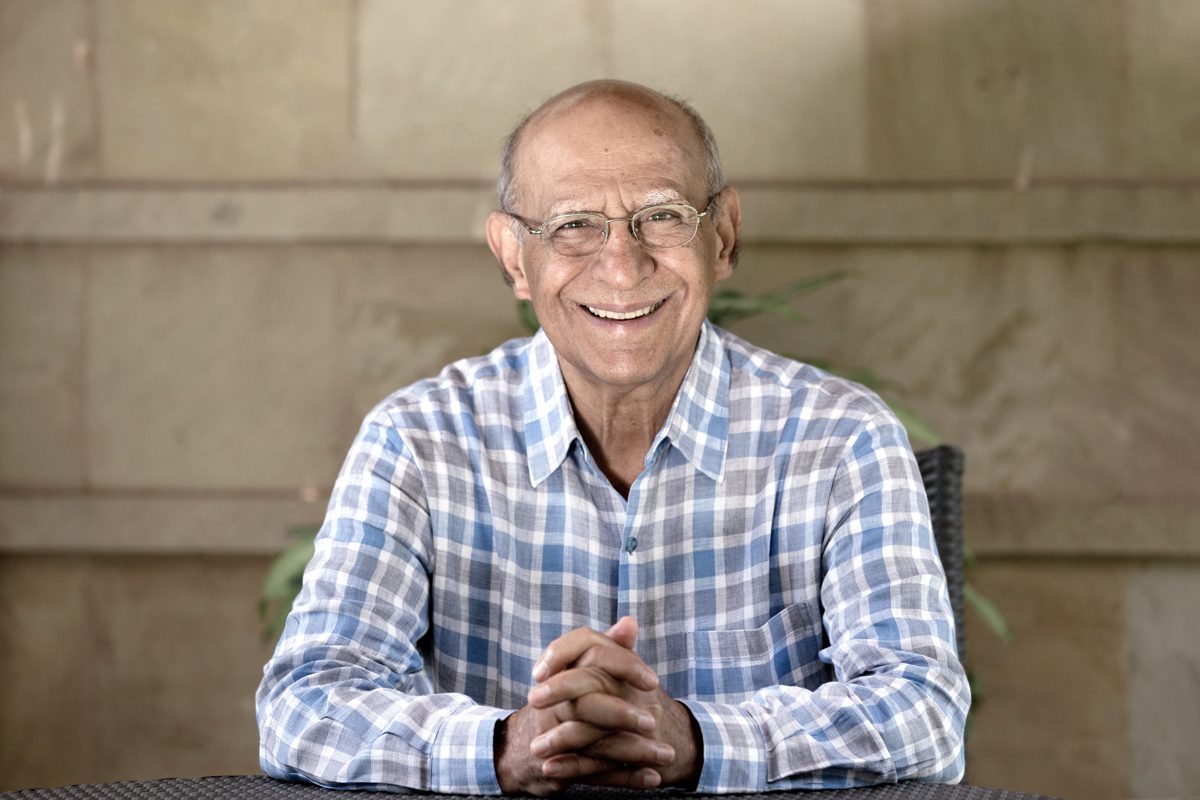
| Key facts | |
|---|---|
| Born | 12 November 1942; Forbes India and Mint place his birth in what is now Khyber Pakhtunkhwa, Pakistan (Wikipedia says Delhi) [6] [38] |
| Family roots | A Hindu family from Dera Ismail Khan and Dera Ghazi Khan; father an army doctor; moved to India at Partition when he was five [38] [39] |
| Education | BE in electrical engineering, University of Roorkee (now IIT Roorkee); MBA, Asian Institute of Management, Manila [30] [31] |
| Family | One of six children; unmarried; lives in Koramangala, Bengaluru [31] [35] [69] |
| Company | Founder, Chairman & Chief Mentor, Happiest Minds Technologies; co-founder and first chairman, Mindtree (1999-2011); President, Wipro Infotech (1984-99) [19] [32] [33] |
| Wealth | Forbes: US$1.1 billion (April 2022); Hurun India Rich List 2020 debut at Rs 3,700 crore (rank 282); promoter group holds 44.21% of Happiest Minds, about Rs 2,070 crore at 3 November 2026 prices, of which 22.1% is being sold to ITC Infotech for Rs 1,330 crore [69] [68] [11] [92] [1] |
| Known for | Building two listed IT companies after the age of 56, the second at 68; pledging Rs 600 crore to medical research on ageing |
On 5 April 2011, a 68-year-old man in Bengaluru marked his mother’s 94th birthday in an unusual way: he announced that he was starting a company [18]. Five days earlier he had walked out of Mindtree, the IT firm he had co-founded and chaired for 12 years, after a parting that the company’s next chairman would call “a little unprofessional” [55]. Most people in his position would have written a memoir. Ashok Soota wrote a business plan.
Nine years later that company, Happiest Minds Technologies, listed after an IPO subscribed about 151 times, and its shares more than doubled on day one [66]. He was 77; Bloomberg called it hitting “the IPO jackpot a second time” [67]. In August 2026, at 83, he agreed to sell half his stake to ITC Infotech for about Rs 1,330 crore and fold the company into ITC’s software arm [1] [3].
That is the short version. The long version runs through Partition, 12 schools in 12 years, a loss-making refrigerator factory in Hyderabad, 15 years as Azim Premji’s most trusted lieutenant, one bitter boardroom split, two IPOs, and a late-life decision to give most of what he made to research on how Indians grow old. It also has rough edges: a failed handset business, penalties in 1990s customs cases, institutional shareholders voting against him, and a sale price that left minority investors unhappy.
Where it began
Ashok Soota was born on 12 November 1942 [6]. By the account he gave Mint in 2010, as quoted by Forbes India, that was in what was then the North-West Frontier Province of British India and is now Khyber Pakhtunkhwa in Pakistan (Wikipedia, without a source, says Delhi). “My parents came from Dera Ismail Khan and Dera Ghazi Khan and were part of the small Hindu community there,” he said [38]. His father was a doctor in the British Indian army. When Partition came in 1947, the family left for India; Soota was five. He has recalled that their house was burnt down within hours of their departure. “But we learnt to move on in life,” he said [38].
He was one of six children, “right in the middle”, as his later co-founder Subroto Bagchi put it. Bagchi, who knew him for decades, described the father as a mercurial man, loved by the rank and file but with “a contentious relationship with his superiors and peers”, and the mother as “always calm, accepting and making the most of everything, so that the children could cope with change” [39]. Soota himself credits the household with two habits: sharing, and reading. “My love for reading came early on, from reading the books that my elder sisters read. I learnt agility from all the moving around we did as a family, because my father was in the Indian Army,” he said in a 2023 interview [40].
The moving was relentless. “Owing to transfers, I changed 12 schools by the time I was 12,” he told Entrepreneur India. “I saw a large part of the country, and it made me more agile” [37]. He finished school in Lucknow and, according to a 1994 Dataquest profile, stood first in Uttar Pradesh in the Senior Cambridge examination [31]. Bagchi later drew out the psychological effect of that childhood: Soota told him he had “the capacity to not get too deeply and emotionally involved” with friends when the family moved on, and that he “flourished with the speed of change” [39].
He went to the University of Roorkee, today’s IIT Roorkee, for a degree in electrical engineering. The institute’s donor records give his graduating year as 1963; other accounts say 1964 [30]. He was in the top tenth of his class, played squash for the university all four years, and also played tennis, cricket and bridge [31]. Years later, while already working, he went to the Asian Institute of Management in Manila for an MBA and topped his batch [31] [37].
The first break
His first job, in 1964, was as a management trainee with Burmah Shell. He left within a year. “It was a highly paid job but I realized there was no challenge in it,” he said [37].
He joined the Shriram group, the DCM family’s industrial empire, as a senior management trainee in 1965 and stayed 19 years. Charat Ram, who ran the group, had a habit of giving young people responsibility. Soota was sent to Sri Lanka to run a small joint venture for three years, handling everything from marketing to the factory floor. “In a small unit, I was given a wide responsibility,” he recalled. He became general manager and chief executive of that factory at 30, and at 34 was a chief executive within the group [37]. He has said that early breadth gave him “an idea of how to run the show very early in life” [34].
The making of his reputation came in Hyderabad. From 1978 to 1984 he was chief executive of Shriram Refrigeration Industries, which made compressors, diesel engines and water coolers [33] [40]. When he took over, the company had lost money for five consecutive years. He turned it around within a year, and did it with the same team minus one person [36]. By his own account it went from negative net worth to profitable market leadership [88]. “My stint at Sriram Group is one of my biggest achievements till now,” he told Business Standard in 2011, long after he had built far larger businesses [36].
Then came the call that changed his life. In 1983 Azim Premji was looking for someone to run Wipro’s fledgling computer business. A friend of Premji’s who knew Soota well suggested his name; Soota has also described it as “amazing coincidences” involving a Roorkee batchmate [36] [34]. “Where would I have ever sought out a job like this?” he asked rhetorically years later [34]. Shriram Refrigeration was then much bigger than the whole Wipro group. “But I saw the potential of the IT industry and felt challenged,” he said [31].
Building the empire
Wipro: Rs 7 crore to a Rs 2,000 crore business
Soota joined Wipro Infotech as president in 1984, aged 42 [31] [33]. (A few later accounts, including Wikipedia, say 1985; the contemporaneous Dataquest profile and Wipro’s own 1999 announcement both support 1984 [31] [32].) The business had revenue of about Rs 7 crore and ranked below Nelco, DCM, ORG and ICIM in the small Indian computer industry [31].
The next decade is the best-documented stretch of his career, because Dataquest named him “IT Man of the Year” in 1994 and devoted a cover story to it. By then Wipro Infotech had revenue of Rs 337.2 crore, second only to HCL-HP, having grown at a compound rate of about 54% a year for ten years [31]. He had split the company into business units each run by a “virtual CEO”, signed tie-ups with Tandem, Sun, Apple and Nokia, and insisted on in-house R&D. The magazine noted that he knew 80% of the company’s 2,260 employees by face and half by name [31]. His own verdict was modest: “I have received more recognition than I deserve… I won’t take credit for the success of the company” [31].
In 1991 Premji also handed him the software business, which was almost entirely exports [37] [40]. That was the bet that made Wipro what it is. “Not many people know that though Wipro was a late entrant, we overtook Infosys to become the no. 2 software company in India at one point of time,” Soota said in 2015 [88]; he dates that overtaking to 1997 [37]. In the financial year ending March 2000, the year after he left, Wipro’s IT revenue crossed Rs 2,000 crore [93]. Soota’s own shorthand for the 15 years is a US$2 million business becoming a US$500 million one [38].
His relationship with Azim Premji is the subject of some of his warmest comments. “We would start from Bengaluru before 6.00 a.m. and reach by 8.00 a.m. when the factory opened. He didn’t cut himself any slack just because he was the chairman of the company,” Soota told Outlook Business. Premji, he said, would test your conviction and then not overrule you, so that accountability stayed with the CEO; Premji’s phrase for it was “I want to ensure that monkey remains on your back” [41].
There was also a less flattering paper trail from those years, set out below: two sets of 1990s customs orders that imposed small personal penalties on him as Wipro Infotech’s president, both stayed or set aside on appeal [24] [26].
By the late 1990s he was vice-chairman of Wipro Limited and, in Dataquest’s words, “one of the most successful and most admired CEOs of corporate India” [32] [33]. Then he left. By Bagchi’s account, a self-discovery exercise on a Lakshadweep holiday had made him write down an unfulfilled desire: to be an entrepreneur [39]. Soota’s own explanation is plainer: “In 1997, we overtook Infosys. Then I thought it was a logical step to start something on my own. When the dotcom boom came, it was too good an opportunity to grab” [37].
On 7 July 1999 Wipro announced that Vivek Paul would replace him as vice-chairman. Premji’s parting statement read: “Ashok’s contribution to building Wipro’s Information Technology business has been significant… It has been a privilege knowing Ashok and working with him. I wish him every success” [32].
Mindtree: ten founders and a US$9.5 million cheque
Mindtree began operations in Bengaluru in August 1999 with ten founders: seven from Wipro, including Soota, Bagchi, Krishnakumar Natarajan and Rostow Ravanan, and three from the US consultancy Cambridge Technology Partners [43] [32]. The structure was unusual. Natarajan’s group had a plan and were investing their Wipro stock-option money; Walden International, the Silicon Valley venture firm, argued they could “pitch and think on a much larger scale if we had a guy like Ashok on our team”, as Natarajan later recalled [103]. Soota says eight co-founders came together within a week of that introduction, “a marriage made in heaven” [34]. He had already lined up the capital, and he changed the plan in three ways, the most consequential being a refusal to buy land. “Had we put our money into land and buildings, we would have burnt half our money,” he said in 2015 [88].
The first round, US$9.5 million from Walden International and Global Technology Ventures, came in August 1999 [42]. GTV was the venture arm of V.G. Siddhartha, the Cafe Coffee Day founder, a connection that would matter greatly a decade later. A second round of US$14.4 million led by the Capital Group closed in 2001, “days before September 11”, as Soota put it [42] [34].
That timing was the difference between survival and failure. Mindtree had been set up to ride internet and telecom technologies; within months the dotcom crash took out much of its market. Soota later said the company “lost about two and a half years in its early stages to the 2001 meltdown” [43]. It pivoted toward R&D services for industrial and consumer-electronics clients, and lived off its cash. “Mindtree survived because we had enough money to see us through,” he said [88].
The company’s logo was painted by Chetan K.S., a student with cerebral palsy at the Spastics Society of Karnataka, after children were asked to render “imagination, action and joy” [94]. Soota’s philosophy of the business fitted in one line to Wharton in 2009: “There is no shortcut to creating a services company. You grow step by step, customer by customer, brick by brick” [43].
The bricks added up. Revenue crossed US$100 million, or Rs 448.8 crore, in the year to March 2006, which the company said made it the fastest Indian IT firm to that mark [44] [47]. In February 2007 Mindtree went public, offering shares at Rs 365-425 and pricing at the top. The issue was subscribed about 103 times and raised Rs 237.72 crore [45]. On listing day, 7 March 2007, the stock opened at Rs 627 on the NSE, a 47.5% premium [46]. Soota’s 11.76% stake was worth about Rs 187 crore at the issue price [47].
Growth continued through acquisitions, the largest being Aztecsoft, a 2,200-person testing company bought in 2008 for around Rs 400 crore [48]. Revenue for the year ending March 2011 was Rs 1,509 crore [95]. On 1 April 2009 Natarajan became CEO and managing director and Soota moved to executive chairman, a transition Soota described as “a significant milestone in MindTree’s journey towards becoming a $1 billion organization” [96].
It never got there under him. The reasons are the subject of the next two sections.
Happiest Minds: starting again at 68
Happiest Minds Technologies was incorporated on 30 March 2011, the day before Soota’s last day at Mindtree [2]. He announced it on 5 April, and the company’s own release gave the name a purpose: “happiest people” would make “happiest customers” [18]. The name came from years of private reading. “I have been researching the subject of happiness, built up a huge library on it,” he told Business Standard that October [35]. He later elaborated: “I had been researching on happiness for a while then and believe that happiness is the meaning and purpose of life and to be happy is the aim of human existence. The name Happiest Minds came from the heart” [40].
The money, at first, came mostly from him. Business Standard reported initial funding of about Rs 200 crore, “with a majority coming from Soota” [36]. In November 2011 Canaan Partners and Intel Capital joined him in a US$45 million Series A round [17]. He assembled a 12-member founding team, including Vikram Gulati as CEO and Joseph Anantharaju, and called it “the strongest start-up team for an IT services company” [16] [36]. The pitch was built around what the industry then called SMAC: social, mobile, analytics and cloud, plus security [17].
His framing of the age question was dry. “If I was a late stage entrepreneur at 58, I was a late-late stage serial entrepreneur at 69,” he said in 2015, rounding both ages up [37]. His general principle: “It is a myth that entrepreneurs have to be young” [87].
It was not a smooth ride. The company still lost about Rs 22.5 crore in the year to March 2018, before earning Rs 14.2 crore in FY19 and Rs 71.7 crore on Rs 698 crore of revenue in FY20 [15]. By then almost all of its revenue came from digital services, a rare pure-play story when the IPO window opened in the middle of the pandemic [67].
The IPO ran from 7 to 9 September 2020 at a price band of Rs 165-166 a share. The Rs 702 crore issue combined a Rs 110 crore fresh issue with an offer for sale by Soota (84.14 lakh shares, about Rs 140 crore) and by CMDB II, a JPMorgan private-equity vehicle that held 19.43% [65] [67]. Bids came in for 3.51 billion shares against 23.3 million on offer, a subscription of about 151 times [66] [67]. On 17 September the stock opened at Rs 351 on the BSE, a 111% premium, and closed at Rs 371, giving the company a market value of Rs 5,448 crore [66]. Soota held 40.90% directly and a further 12.22% through Ashok Soota Medical Research LLP, for a promoter holding of 53.25% [10].
Twelve days later the Hurun India Rich List 2020 listed him for the first time, at rank 282 with Rs 3,700 crore [68]. In April 2022 Forbes put him on its world billionaires list at US$1.1 billion [69]. “A succession plan for the management has also been made,” he said at the time of the IPO, a line that would come back in 2025 [65].
The growth that followed was steady rather than spectacular. Revenue rose from Rs 773 crore in FY21 to Rs 1,094 crore in FY22, Rs 1,429 crore in FY23, Rs 1,625 crore in FY24, Rs 2,061 crore in FY25 and Rs 2,315 crore in FY26; reported profit went from Rs 162.5 crore in FY21 to a peak of Rs 248 crore in FY24 before dipping to Rs 185 crore in FY25 and recovering to Rs 213 crore in FY26 [13] [14] [12]. Headcount reached about 6,500 and the client count 306 [12]. Management likes to point out that the company has shown sequential revenue growth in every quarter since listing [12].
Acquisitions did much of the heavy lifting from 2024. The largest was PureSoftware of Noida, bought for US$94.5 million, about Rs 779 crore, with roughly 1,200 staff and a banking software platform called Arttha [70]; smaller deals included Sri Mookambika Infosolutions in 2023, Aureus Tech Systems in 2024 and the Middle East business of GAVS Technologies in 2025 [22]. In February 2024 the company reorganised into six industry groups and set up a generative-AI business unit, with Soota tying the structure to a target of US$1 billion in revenue by 2031 [21].
The cost showed up in margins. Operating margin, 24.1% in FY23, fell to 17.4% in FY26 [14] [12]. The share price, which had touched about Rs 1,580 in 2021, spent most of 2025 and 2026 below Rs 500 [81].
Scaling back: the share sales and the ITC Infotech deal
From 2023, Soota began converting paper wealth into funding for his philanthropy. In September 2023 he sold about 1.11% of the company, saying it was “primarily done to fund the capital requirements of SKAN” and Happiest Health, and that he would keep his stake at not less than 40% [72]. In June 2024 he sold 6% in block deals at an average of Rs 834.87 a share, about Rs 762 crore; the stock fell 9.4% that day [71].
The bigger move came in 2026. On 13 July the exchanges asked about a report that ITC Infotech was the frontrunner to buy a majority stake; the company replied only that it “keeps exploring various strategic opportunities” [23]. Seven weeks later, on 31 August 2026, the board approved a two-step transaction. First, Soota and Ashok Soota Medical Research LLP would sell 3,36,61,700 shares, 22.106% of the company, to ITC Infotech in two tranches: 11% at Rs 390 and 11.106% at Rs 400, for a total of Rs 1,329.72 crore [1]. Second, Happiest Minds would merge into ITC Infotech, with shareholders receiving 25 ITC Infotech shares for every 81 Happiest Minds shares; ITC Ltd would own about 73.4% of the merged, listed entity and Soota’s group would be reclassified as public shareholders with roughly 7.6% [2]. The sellers accepted non-compete and non-solicit obligations [1].
“We believe that ITC Infotech is the best partner for Happiest Minds to fulfil its destiny and we are pleased that our team will have a welcoming new home,” Soota said [3]. Managing director Venkatraman Narayanan was franker about the motive: Soota “was looking to scale down his investments” to fund SKAN’s new campus, costed at about Rs 350 crore, and Happiest Health’s hospital plans, at Rs 300-400 crore, and a strategic sale was chosen over block deals that “would hurt the share price” [82] [83].
As of today, shareholders have approved the registered-office shift to West Bengal, Saudi Arabia’s competition authority has cleared the deal, Competition Commission of India approval is expected in November 2026, and the company’s timeline runs through SEBI review, an NCLT filing in January 2027 and the listing of ITC Infotech in about November 2027 [5] [84]. For the quarter ended 30 September 2026, Happiest Minds reported revenue of Rs 645.43 crore, up 12.5%, and profit of Rs 62.19 crore after Rs 3.98 crore of merger costs [4] [5]. Soota, now styled Chairman & Chief Mentor, called the merger “a significant opportunity to create a stronger, more capable and more relevant enterprise for our customers” [4].
The setbacks and failures
Soota’s record has a shape: long periods of steady building, punctuated by a few decisions that went badly wrong and which he has mostly discussed openly.
The first was the handset business at Mindtree. In September 2009 Mindtree bought Kyocera Wireless’s India R&D centre, about 600 engineers, for US$6 million upfront plus earn-outs, with the intention of launching its own 3G Android smartphones [49]. Soota, who had kept strategy and M&A when he handed day-to-day operations to Natarajan, set a target of US$100 million of revenue from the business by 2014 [52]. Within a year it was clear the capital required was several times the US$10 million budgeted. In October 2010 Natarajan announced the business would be wound down after US$4.5 million had been sunk in two quarters: “this is a business that requires substantial capital infusion” [50]. The restructuring charge came to Rs 16-17.5 crore, and the wireless products business lost about US$8 million over the year [51] [95]. Soota’s defence was procedural: “The decision to enter the phone product business was debated and became a board approved project” [52]. His own later verdict was tougher. “In retrospect, I shouldn’t have done it,” he told Business Today in 2015 of his decision to keep strategy after stepping back as CEO. “Because I was associated so strongly with the company, it continued to be seen as my company” [61].
The second was the US$1 billion target itself, set in 2006 for 2012 and pushed to 2014; Mindtree’s revenue was flat at around US$270 million between 2008 and 2010, and the gap between ambition and delivery was, in Forbes India’s account, one of the pressures that cracked the founding group [43] [52].
The third is more recent. In May 2024 Soota told Business Standard that “FY25 is poised to be our best-ever year since IPO”, with growth guidance of 35-40% [73]. Three months later the stock was down 16.7% for the year after first-quarter profit fell 12.5% [74]. FY25 revenue did grow about 27%, almost entirely through the PureSoftware acquisition, but reported profit fell 26% and margins compressed [14]. At the July 2025 annual meeting a retail shareholder asked why the stock had fallen from Rs 832 to around Rs 620 while the chairman’s pay rose 13%; the managing director declined to comment on the share price [9].
And then there is the one that still colours how he is written about: the 2011 departure from Mindtree, which also “cost the company some key people”, as Mindtree’s CFO Rostow Ravanan later acknowledged. “Not everybody left under pleasant circumstances” [97].
Controversies and allegations
Ashok Soota has never been charged with or found liable for any serious wrongdoing. The matters below are the disputes, legal entries and criticisms that appear on the public record, set out with each side’s position and the status as of 4 November 2026.
The 2011 Mindtree split
Allegation: That Soota’s exit from Mindtree, announced on 28 January 2011 “for personal reasons”, was in fact the result of a falling-out with his co-founders over strategy and the failed handset business, and that it was handled badly. Business Standard reported the next day that he was “disappointed by the company’s performance… and by its failure to capitalise on the acquisition of Kyocera Wireless’s captive R&D unit”, under the headline “Soota quits bruised MindTree”; the stock fell 3.47% [53] [54]. Forbes India’s reconstruction described three years of strain after the 2007 IPO over strategy and roles, with Bagchi disputing the acquisition strategy and Natarajan uncomfortable with the products business but silent “out of deference to Soota” [52]. Mindtree’s incoming chairman, Albert Hieronimus, said in April 2011: “I found the way he exited a little unprofessional”, and remarked that Soota “was part of MindTree, but he was not MindTree” [55]. Natarajan said in 2014 that there were “strategic differences among the founders” and that “it was not easy (to go against) Ashok… I had to take some tough decisions and I did” [60].
Response: Soota said the decision was “well-considered” and that “there were really no negative undertones”; he declined to discuss reasons beyond wanting a new venture [53] [56]. He said he had no non-compete or non-poaching agreement with Mindtree; Hieronimus said he had one but it had expired [56] [55]. In 2015 Soota conceded he should not have kept strategy after handing over as CEO [61]. Bagchi said in 2012: “The exit of Ashok (Soota) is a big loss for me at personal level” [62]. At the July 2025 Happiest Minds AGM Soota referred to “very unusual circumstances behind the Mindtree share sale” without elaborating [9].
What happened next:
- Soota sold his 11.14% stake in three tranches in 2011-12, all to entities of V.G. Siddhartha: 2.2 million shares at Rs 433 for Rs 94 crore in June 2011, 8.23 lakh shares for Rs 36.2 crore in July 2011, and 13.54 lakh shares at Rs 475 for about Rs 64.3 crore in January 2012, roughly Rs 195 crore in all [57] [58] [59].
- Siddhartha sold his accumulated stake to Larsen & Toubro at Rs 980 a share in March 2019, triggering India’s first hostile takeover of an IT company [63]; Mindtree became part of LTIMindtree in November 2022 [64].
- Mindtree sent legal letters to former employees who joined Happiest Minds, according to a 2017 review of Soota’s book [98].
Status: Closed. No litigation between Soota and Mindtree or its founders is on record. The dispute is a matter of competing accounts, with Soota maintaining that the parting was amicable and most contemporaneous reporting and later founder comments describing strategic differences.
Customs penalties on Wipro Infotech in the 1990s
Allegation: In three orders dated 10 May 1993, the Collector of Central Excise, Bangalore, held that Wipro Infotech had under-declared the value of 139 consignments of software diskettes and manuals imported between 1986 and 1991, demanded duty of about Rs 64.89 lakh, imposed penalties of Rs 14 lakh on the company and personal penalties totalling Rs 1.3 lakh on “President Shri Ashok Soota” [24]. In a separate order of 16 July 1997, the Commissioner of Customs treated imports of Acer PC components in 1994-95 as complete computers in knocked-down form, demanding Rs 1.54 crore of duty with equal penalty and fines, and imposed a personal penalty of Rs 2 lakh on Soota as group president [26].
Response: Wipro contested both. In the diskette case the appellate tribunal in January 1994 ordered a pre-deposit of about Rs 40 lakh and stayed recovery of the penalty from Soota; the Karnataka High Court upheld that order in September 1994 [24] [25]. In the Acer case the tribunal in October 1998 set the commissioner’s order aside entirely, finding multiple infirmities, and sent it back for fresh adjudication [26].
Status: The final outcomes on merits do not appear in the published record we could find. Both matters were classification and valuation disputes of a kind common in 1990s Indian IT; neither involved any allegation of personal enrichment.
The 2019 US discrimination lawsuit against Happiest Minds
Allegation: In September 2019 Tami Sulzberg, a former director of business development at Happiest Minds’ US arm, filed a class action in the US District Court for the Northern District of California alleging that the company favoured South Asian and visa-dependent workers in hiring and retention, in breach of US civil-rights law. She cited 52 US hires between 2014 and 2018, 56% of them South Asian and half on visas, and said she was replaced by an L-1 visa holder [89]. Soota was not named personally.
Response: The company moved to dismiss; in December 2019 Magistrate Judge Susan van Keulen denied the motion, allowing the case to proceed [27]. The company did not comment publicly in the Indian press.
Status: The final disposition is not in the public record we could find; similar suits were filed in the same period against several large Indian IT firms.
Guidance, promoter share sales and shareholder dissent (2023-25)
Allegation: Some investors criticised a sequence of events: the May 2024 “best-ever year” guidance followed by a profit decline [73] [74]; the promoter’s sale of 6% at Rs 834.87, about Rs 762 crore, weeks after that guidance, which knocked 9.4% off the stock in a day [71]; and the terms of his continued executive role. At the June 2024 AGM, a special resolution re-appointing Soota, then 81, as whole-time director and executive chairman until March 2029 at proposed remuneration of Rs 1.98 crore a year passed with 97.4% of all votes, but 22.72% of public institutional votes were cast against it; the same meeting saw 61% and 71% institutional opposition to two other resolutions [6] [7]. At the July 2025 AGM, 16.24% of institutional votes opposed his re-appointment by rotation [8].
Response: The company said the September 2023 sale was to fund SKAN and Happiest Health and that Soota would keep at least 40% [72]; no stated reason accompanied the June 2024 filing [71]. At the 2025 AGM the managing director declined to discuss the share price [9]. In March 2025 Soota stepped back to Chairman & Chief Mentor, which the company described as “planned succession” [19].
Status: All resolutions passed; no regulatory action or shareholder litigation followed. No SEBI order, show-cause notice or insider-trading finding involving Soota or Happiest Minds appears on the public record.
The ITC Infotech sale and merger (2026)
Allegation: Minority investors and analysts criticised the August 2026 deal on three counts: price, structure and leadership clarity. Soota’s two tranches, at Rs 390 and Rs 400, were both below the previous close of Rs 406.95, and the stock fell as much as 12% on 1 September 2026 [1] [81]. Because the stake sold stays under 25%, no open offer to public shareholders was triggered [81]. HDFC Securities’ Amit Chandra said investors “would’ve been happier if they got a 15-20% premium”; PhillipCapital’s Karan Uppal noted “no clarity in terms of the leadership post the merger”; The Ken described it as a “backdoor listing” for ITC Infotech [81] [99]. Entrepreneur India reported that earlier talks had stalled when the asking price exceeded Rs 3,000 crore [100].
Response: The company and ITC presented the combination as complementary and said no layoffs would follow; Anantharaju said ITC had stipulated “that each and every Happiest Mind continues” [83]. Narayanan said a strategic sale was preferred because block deals “would hurt the share price” [82]. Independent valuers PwC and Grant Thornton set the swap ratio, and the October 2026 postal ballot on the registered office passed with 99.63% in favour [5].
Status: Pending. As of 4 November 2026 the share purchase awaits Competition Commission of India approval and the merger awaits SEBI, exchange, NCLT and shareholder approvals, with completion targeted for late 2027 [5] [84]. No litigation has been filed.
A note on what is not there
Court and regulator records show no personal case against Soota other than the 1990s customs appeals and a 2026 Karnataka High Court petition in which SKAN Research Trust, with Soota as co-petitioner, sought an arbitrator over a consultancy agreement; the court appointed one and left all claims open [28]. There are no reported tax, property or defamation disputes, and no widely discussed rumour about him that would merit addressing here.
Giving back
Soota has said he is “primarily an institution-builder” [38], and his philanthropy follows that pattern: one large, long-dated bet rather than many small cheques.
On 4 April 2021, almost exactly ten years after announcing Happiest Minds, he launched SKAN, which stands for Scientific Knowledge for Ageing and Neurological ailments, with a commitment of Rs 200 crore: half for partner institutions, including St John’s Medical College, the Centre for Brain Research at IISc, NIMHANS and IIT Roorkee, and half for SKAN’s own projects. “It will take 10 years to build a world class institution for Ageing and Neurological research,” he said [75]. Two months later SKAN gave IIT Roorkee Rs 20 crore for a chair professorship, fellowships and a wet lab; “There is negligible private funding towards medical research in India,” he said [76]. By the end of 2022 the pledge had been tripled to Rs 600 crore, about US$75 million, to be released over ten years, and Forbes Asia named him one of its Heroes of Philanthropy [78] [38]. In December 2024 SKAN received government recognition as a research association and a scientific and industrial research organisation, with work spanning ageing, neurology, cardiovascular disease, diabetes remission and the gut microbiome [77]. The 2022 EdelGive Hurun India Philanthropy List put his donations that year at Rs 26 crore, 33rd in the country [79].
The choice of cause is not accidental. He has spent much of his later life studying how to age well; he was described in 2011 as jogging and cycling in his late sixties, and lists trekking, yoga, tai chi and meditation among his pursuits [35] [40]. In July 2022, at 79, he launched Happiest Health, a health and wellness knowledge enterprise that has since added a clinic and diagnostics in Bengaluru, with the stated ambition of a third IPO [80].
The scale of the giving is best understood against his holdings. Part of his Happiest Minds stake sits in Ashok Soota Medical Research LLP, a co-seller in the ITC Infotech deal [1] [11]. He has no spouse or children; Dataquest described him in 1994 as “a happy bachelor” and Forbes lists him as single [31] [69]. His managing director’s explanation for the 2026 sale, a Rs 350 crore SKAN campus and Rs 300-400 crore of hospitals, is as close as the record gets to a statement of where his wealth is going [82].
His other public service was more conventional: president of the Confederation of Indian Industry in 2002-03, president of the hardware body MAIT, and a member of the Prime Minister’s IT task force [31] [101]. IIT Roorkee gave him its Distinguished Alumnus Award in 2007 [29]. In December 2024 Hurun’s list of India’s top self-made entrepreneurs noted him, at 81, as the oldest founder on it [90].
Succession
Soota has been planning his own exit, in stages, for longer than most founders half his age. “A succession plan for the management has also been made,” he said at the 2020 IPO [65]. That November, Joseph Anantharaju, a founding member who ran product engineering, became executive vice-chairman and Venkatraman Narayanan managing director and CFO [20].
On 19 March 2025 the company announced what it called “apex-level organizational changes”: Soota became Chairman & Chief Mentor, Anantharaju Co-Chairman & CEO with responsibility for all operating businesses, and Narayanan MD & CFO with finance, talent and governance functions. “Joseph has been the key driver of Happiest Minds growth and profitability since its inception,” Soota said; the board described the move as “planned succession planning and organization transformation” [19] [91]. “I want to step back and take a look at the IT industry,” he told Business India [102].
The ITC Infotech transaction completes the arc. Once the merger is effective, ITC Ltd becomes the promoter, Soota’s group becomes a small public shareholder, and the business he founded at 68 becomes part of a company founded in 1910 [2]. His own role after the merger has not been stated; what he has said is that the money goes to SKAN and Happiest Health [82].
He has also left two books: Entrepreneurship Simplified: From Idea to IPO, with S.R. Gopalan (Penguin, 2016), a practical manual with a chapter on failures [85], and Busted, with Peter de Jager and Sandhya Mendonca (HarperCollins, 2023), which takes aim at 17 management myths [86].
What their journey teaches
It is never too late, but the second time you must know exactly what you are doing. Soota’s two start-ups were founded at 56 and 68. The second was funded largely by himself, staffed by people he had worked with, and aimed at a market he had studied for a decade. “Whatever you want to do is never too late. You don’t have to feel you have to start hanging up your boots,” he says [40]. Experience converts into speed only when it is paired with capital, a team and a thesis.
Raise money before you need it, and keep it. Mindtree closed its second round days before 11 September 2001 and then lost two and a half years to the dotcom bust; it survived because the cash was in the bank [34] [43]. Soota’s refusal to spend the first round on land and buildings is the other half of the same lesson [88]. His stated rule: “you have to take decisions based on cash flow” [35].
Entrepreneurship is about minimising risk, not performing it. “People often get macho about entrepreneurship; that ‘I am a risk-taker’,” he has said. “Risk is inevitable in any business, but in my mind, the entrepreneur is one who is working towards minimising risk.” He is equally dismissive of the fashionable alternative: “We are not in favour of what they call ‘fail fast’. We think that’s a dreadful strategy” [87]. The one time he took an unhedged product bet, the Mindtree handset, it cost the company about US$8 million and, arguably, cost him the chairmanship [50] [95].
If you hand over the job, hand over the whole job. The most useful thing Soota has said about his failures is this: “In retrospect, I shouldn’t have done it… I would have certainly not retained strategy” [61]. Keeping strategy and M&A while a new CEO ran operations left both men with half a mandate. At Happiest Minds he did it differently, moving to Chief Mentor and giving his successor all the operating businesses at once [19].
Decide early what the money is for. By the time Happiest Minds listed, the LLP that would fund medical research already held 12.22% of it [10]. The 2023 and 2026 sales were each explained in terms of SKAN and Happiest Health [72] [82]. A declared purpose did not spare him criticism of the 2026 price, but it made the decision legible: he was converting a company into an institution, and said so.
Culture is a strategy, not a poster. From a logo painted by a child with cerebral palsy to a mission statement built around happiness, Soota has treated how people feel at work as a business variable [94] [40]. Happiest Minds reports attrition in the low-to-mid teens and features regularly in Great Place to Work rankings [4] [5]. His line on it: “We do not see our role as making people happy, but enabling happiness so that people make the choice to be happy” [88].
Readers interested in the wider industry he helped build may also find our Insights pieces on India’s US$221 billion software exports and the shift in IT hiring toward AI roles useful, along with our profiles of Azim Premji, N. R. Narayana Murthy and Nandan Nilekani.
A profile for general reading, based on public records and reporting as of 4 November 2026. Not investment, tax or legal advice.
Sources (103)
- Regulation 30A seller intimation: share purchase agreement with ITC Infotech - NSE filing, Aug 2026
- Strategic combination of ITC Infotech and Happiest Minds, Regulation 30 disclosure and investor deck - ITC Ltd, Aug 2026
- Happiest Minds Technologies announces merger with ITC Infotech - Happiest Minds press release, Aug 2026
- Press release, Q2 FY27 results - Happiest Minds, Nov 2026
- Investor presentation, Q2 FY27 - Happiest Minds, Nov 2026
- Notice of the 13th Annual General Meeting - Happiest Minds, Jun 2024
- Voting results and scrutiniser's report, 13th AGM - Happiest Minds, Jun 2024
- Voting results, 14th AGM - Happiest Minds, Jul 2025
- Transcript of the 14th Annual General Meeting - Happiest Minds, Aug 2025
- Shareholding pattern as at 30 September 2020 - Happiest Minds, Oct 2020
- Happiest Minds shareholding pattern, quarter ended September 2026 - Trendlyne, Oct 2026
- Happiest Minds reports FY26 revenues of Rs 2,315 crore - Happiest Minds press release, May 2026
- Happiest Minds FY21 total income grows 11.7% to Rs 798 crore, recommends maiden dividend - Happiest Minds press release, May 2021
- Investor presentation, Q4 FY25 - Happiest Minds, May 2025
- Investor presentation, Q4 FY21 - Happiest Minds, May 2021
- Ashok Soota announces founding team of Happiest Minds - Happiest Minds press release, Aug 2011
- Happiest Minds secures $45M Series A funding led by Canaan Partners, Intel Capital and Ashok Soota - Happiest Minds press release, Nov 2011
- Ashok Soota announces his new business venture - Happiest Minds press release, Apr 2011
- Happiest Minds announces apex-level organizational changes - Happiest Minds press release, Mar 2025
- Happiest Minds announces appointments of Executive Vice Chairman and Managing Director - Happiest Minds press release, Nov 2020
- Happiest Minds announces new verticalization org structure - Happiest Minds press release, Feb 2024
- Mergers and acquisitions, Integrated Annual Report 2024-25 - Happiest Minds, Jul 2025
- Clarification on market rumour regarding ITC Infotech - Happiest Minds BSE filing, Jul 2026
- Wipro Info Tech Ltd. and Anr. v. Collector of Customs - CEGAT Madras via Indian Kanoon, Jan 1994
- Wipro Infotech Ltd. v. C.E.G.A.T. - Karnataka High Court via Indian Kanoon, Sep 1994
- Wipro Ltd. v. Commissioner of Customs - CEGAT Chennai via Indian Kanoon, Oct 1998
- Sulzberg v. Happiest Minds Technologies Pvt. Ltd., order on motion to dismiss - CourtListener (N.D. Cal.), Dec 2019
- Skan Research Trust & Ors v. Anjali Parmanand Kusumbe - Karnataka High Court via Indian Kanoon, Apr 2026
- Minutes of the 21st Senate meeting (Distinguished Alumnus Awards 2007) - IIT Roorkee, Oct 2007
- Top donors of IIT Roorkee - IIT Roorkee Office of Resources and Alumni Affairs, Nov 2026
- IT Man of the Year 1994: Ashok Soota - Dataquest (scan via itihaasa), Dec 1994
- Premji replaces Soota with Vivek Paul on Wipro board - CIOL, Jul 1999
- Ashok Soota: profile - Dataquest, Jan 2000
- Lunch with BS: Ashok Soota - Business Standard, Jul 2006
- Lunch with BS: Ashok Soota - Business Standard, Oct 2011
- Ashok Soota's second act - Business Standard, Sep 2011
- The turnaround specialist: Ashok Soota - Entrepreneur India, Jan 2016
- Ashok Soota: Thinking big and taking the path less travelled, even with philanthropy - Forbes India, Feb 2024
- Ashok Soota, former MindTree chairman, on self-awareness (Zen Garden, by Subroto Bagchi) - Forbes India, Feb 2012
- Happiest people lead to happiest customers: interview with Ashok Soota - Hurun Report India / 360 ONE Wealth, May 2023
- The Boss: Azim Premji - Outlook Business, Jul 2015
- MindTree secures $14.4 million second round funding - CIOL, Aug 2001
- MindTree: Growing beyond a start-up - Knowledge at Wharton, Jul 2009
- MindTree's revenue crosses $100 million mark - OneIndia/UNI, Apr 2006
- MindTree IPO price fixed at Rs 425 a share - Business Standard, Feb 2007
- MindTree lists at 47% premium - Business Standard, Mar 2007
- MindTree plans Rs 200 crore IPO - Business Standard, Feb 2007
- MindTree set to buy Aztecsoft for Rs 400 crore - Business Standard, May 2008
- MindTree buys Kyocera Wireless' Indian unit - domain-b, Sep 2009
- MindTree to rejig wireless business on cost overrun - CIOL, Oct 2010
- MindTree to convert product business to services - Business Standard, Dec 2010
- Why Ashok Soota quit MindTree - Forbes India, Feb 2011
- MindTree exec chairman Soota quits to start new venture - Business Standard, Jan 2011
- Soota quits bruised MindTree - Business Standard, Jan 2011
- Q&A: Albert Hieronimus, Chairman, MindTree - Business Standard, Apr 2011
- Soota decides to trace old steps in new journey - Business Standard, Apr 2011
- Soota sells half his stake in MindTree - Business Standard, Jul 2011
- Coffee Day chief raises MindTree stake - Business Standard, Jul 2011
- Ashok Soota sells 1.35 million MindTree shares - Business Standard/PTI, Jan 2012
- Best Indian CEOs 2014: Krishnakumar Natarajan, Mindtree - Business Today, Dec 2014
- 'Should have given more space to CEO': Ashok Soota - Business Today, Dec 2015
- Constant gardener helps MindTree grow - Business Standard, May 2012
- L&T mounts hostile bid for Mindtree, eyes 67% stake for Rs 10,733 crore - Business Standard, Mar 2019
- LTI and Mindtree to start operating as a merged entity from November 14, 2022 - Nasdaq/BusinessWire, Nov 2022
- All you need to know about Ashok Soota's Happiest Minds IPO - BloombergQuint, Sep 2020
- Happiest Minds share closes 123% higher than issue price on listing day - Business Today, Sep 2020
- With Happiest Minds, 77-year-old Ashok Soota hits IPO jackpot a second time - Business Standard/Bloomberg, Sep 2020
- Ashok Soota debuts in Hurun India rich list with Happiest Minds bumper IPO - Business Standard, Sep 2020
- Ashok Soota: billionaire profile - Forbes, Apr 2022
- Happiest Minds to acquire Noida-based PureSoftware for $94.5 million - Business Standard, Apr 2024
- Happiest Minds Tech block deal: shares fall 9%, Ashok Soota likely seller - Business Standard, Jun 2024
- Ashok Soota sells 1.11% of Happiest Minds shares to fund SKAN and Happiest Health - BioSpectrum India, Sep 2023
- FY25 poised to be the best year for Happiest Minds since IPO: Ashok Soota - Business Standard, May 2024
- Happiest Minds Technologies shares fall on Q1FY25 results, down 16% YTD - Business Standard, Aug 2024
- Ashok Soota launches SKAN medical research trust for ageing and neurological disorders, commits Rs 200 crore - PR Newswire, Apr 2021
- Ashok Soota-promoted SKAN medical research trust provides a grant of Rs 20 crore to IIT Roorkee - PR Newswire, Jun 2021
- SKAN Research Trust secures two major government recognitions - PR Newswire, Dec 2024
- Forbes Asia names Ashok Soota one of Asia's 2022 Heroes of Philanthropy - Asian Institute of Management (AIM Leader), Dec 2022
- EdelGive Hurun India Philanthropy List 2022, press release - EdelGive Foundation / Hurun India, Oct 2022
- Ashok Soota launches health and wellness knowledge enterprise Happiest Health - ThePrint/PTI, Jul 2022
- Happiest Minds shares tank 9% on swap ratio; ITC Infotech to list after merger - Business Today, Sep 2026
- Ashok Soota: The serial entrepreneur who refuses to hang up his boots - Business Standard, Sep 2026
- ITC Infotech-Happiest Minds merger won't lead to layoffs, management says - People Matters, Sep 2026
- Happiest Minds-ITC Infotech merger on track, listing expected in a year - Business Standard, Nov 2026
- Entrepreneurship Simplified: From Idea to IPO, by Ashok Soota and S.R. Gopalan - Penguin Random House India, Oct 2016
- Management adages vs contextual reality: review of Busted - Business Standard, Sep 2023
- Why being 'macho' about entrepreneurship is not a good strategy: Ashok Soota - YourStory, Oct 2016
- How to scale your business: serial entrepreneur Ashok Soota shares his story - YourStory, Jun 2015
- Indian IT company Happiest Minds accused of discrimination against non-Indians - Gulf News/PTI, Sep 2019
- Hurun list 2024: from Zepto's 21-year-old founder to Happiest Minds' 81-year-old tech leader - Business Today, Dec 2024
- Happiest Minds appoints Joseph Anantharaju as CEO and Co-Chairman - Business Standard, Mar 2025
- Happiest Minds Technologies share price - Upstox, Nov 2026
- Wipro: The soft transform (DQ Top 20) - Dataquest, Aug 2000
- About MindTree: the logo painted by Chetan - EDN, Apr 2008
- Huge forex loss hits MindTree net in fiscal 2010-11 - SiliconIndia/IANS, Apr 2011
- Krishnakumar Natarajan to be MindTree CEO and MD - CIOL, Mar 2009
- Rebooting Mindtree: Not thinking 'mid-tier' any more - Forbes India, Sep 2014
- Wise men's words: review of Entrepreneurship Simplified - Business Today, Jan 2017
- ITC Infotech-Happiest Minds merger: misery loves company - The Ken, Sep 2026
- Soota's Happiest Minds to merge with ITC Infotech - Entrepreneur India, Sep 2026
- Ashok Soota: Entrepreneur CEO - Dataquest, Dec 2006
- Change of guard at Happiest Minds - Business India, Apr 2025
- Krishnakumar Natarajan on founding MindTree: interview - Sramana Mitra, Nov 2008