
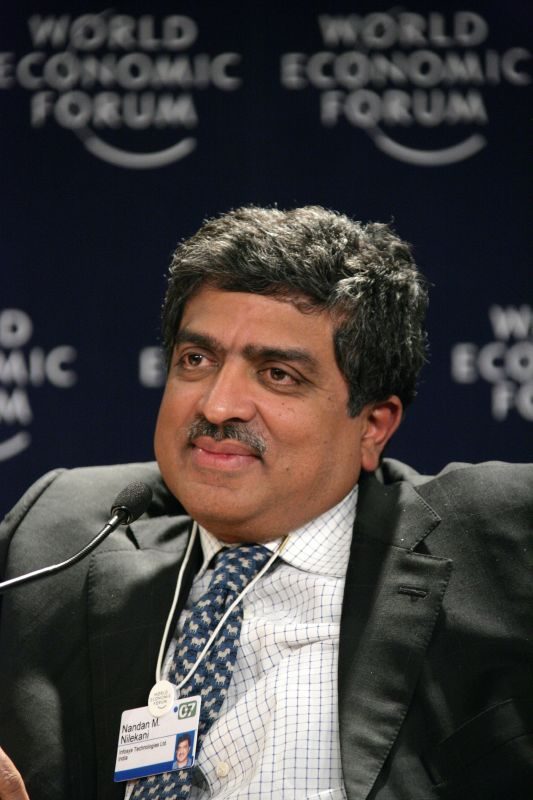
| Key facts | |
|---|---|
| Born | 1955, Bangalore (now Bengaluru), Karnataka; widely given as 2 June 1955 [1][2] |
| Family roots | Konkani-speaking Chitrapur Saraswat family from Sirsi; father Mohan Rao Nilekani was a textile mill manager [20] |
| Education | Bishop Cotton Boys’ School, Bengaluru; Karnatak College, Dharwad; B.Tech (Electrical Engineering), IIT Bombay, 1978 [1][21] |
| Family | Wife Rohini Nilekani (philanthropist, former journalist); children Nihar and Janhavi [16] |
| Company | Co-founder of Infosys (1981); CEO 2002–07; non-executive chairman since 2017 [2][10] |
| Wealth | About US$2.5 billion, Forbes real-time estimate, 17 October 2026 [24] |
| Known for | Co-building Infosys; founding chairman of UIDAI, which created Aadhaar; a leading voice of India’s “digital public infrastructure” |
On 29 September 2010, in Tembhli, a tribal village in Maharashtra’s Nandurbar district, Prime Minister Manmohan Singh handed a woman named Ranjana Sonawane a printed letter with a 12-digit number on it. She was the first person in India to receive an Aadhaar number [11]. Standing on the same stage was a 55-year-old software entrepreneur who, 15 months earlier, had walked away from the company he co-founded to take a government job.
“The Aadhaar number will be able to fill this void,” Nandan Nilekani told the villagers, talking about the millions of Indians who had no proof of who they were [11]. Sixteen years later UIDAI reports more than 145 crore Aadhaar numbers generated [12]. The number now sits behind bank accounts, mobile SIMs, tax filings, ration shops and UPI payments.
Few Indian businessmen have had two careers this large. Nilekani helped turn Infosys from a seven-man startup with Rs 10,000 of borrowed capital into a company that crossed US$20 billion in revenue in FY26 [3][17]. He then helped build the identity layer of the world’s most populous country, and he became the most visible advocate of what the world now calls India’s digital public infrastructure. He is also a polarising figure. To his admirers, Aadhaar is one of the great public-policy achievements of the century. To his critics, it is a surveillance risk that pushed some of India’s poorest people out of the welfare system.
This is the story of how a mill manager’s son from Dharwad got there, where he stumbled, and what both his supporters and his critics have right.
Where it began
“I was born in Bangalore in 1955, which I think was a good year for computer guys,” Nilekani joked in a long oral history he recorded for the Computer History Museum in 2019 [1]. Bill Gates and Steve Jobs were born the same year.
His family was Konkani-speaking and traced its roots to Sirsi, in the forests of Uttara Kannada [20]. His father, Mohan Rao Nilekani, was a manager at Minerva Mills, a textile company. “My father was a textile mill manager, Murthy’s father was a high school teacher. Raghavan’s father was a lighthouse keeper,” Nilekani said, describing the modest homes the Infosys founders came from [1]. When the mill company ran into trouble, his father took mill jobs in other towns: Davanagere, and then Nirmal in what is now Telangana [20].
The father was an idealist. A 2008 profile in Mint Lounge described him as a Fabian socialist who wrote letters to newspaper editors and the prime minister, took corrupt officials to court, and filled the family home in Sirsi with poor relatives and orphans [20]. His mother, Durga, was the steady centre of the family [20]. His only brother, Vijay, was eight years older, so “when I grew up it was almost like being an only child,” Nilekani said [1].
He was, in his own words, “sort of a nerd,” reading Enid Blyton, Isaac Asimov and Arthur C. Clarke at the British Council library [1]. He went to St. Anthony’s and then Bishop Cotton Boys’ School in Bangalore [1].
At 12, his life changed. With his father moving for work, he was sent to Dharwad to live with an uncle’s family. He studied at St. Joseph’s School and then did two years of pre-university at Karnatak College [1]. “The first turning point was moving as a 12-year-old from Bangalore to Dharwad,” he said. “I learned to be self-sufficient” [1]. Decades later he paid for a Rs 4 crore auditorium at the college [22].
IIT Bombay
In 1973, at 18, he got into IIT Bombay to study electrical engineering. His father had telegrammed him to take chemical engineering at IIT Madras instead. “At the age of 18 you want to do the opposite of what your father tells you,” Nilekani said [1].
IIT was where he discovered computers, through professors such as J. R. Isaac and Deepak Phatak [1]. It was also where he found he liked organising people: he ran the cultural festival Mood Indigo and stood for election as general secretary [1]. “I am what I am because of IIT Bombay,” he told students in 2023 [26].
In 1977, representing IIT at a quiz at Elphinstone College, he met a French literature student named Rohini. “Obviously, we won the quiz,” he recalled [23]. Rohini later became a journalist, an author and one of India’s largest philanthropists [49].
He finished his B.Tech in November 1978, having taken a few extra months [1][21].
The first break
Nilekani’s plan was to do an MBA. Then, as Business Today recounted, he fell ill on the day of the IIM entrance exam, and there was no money to study abroad [25].
So he went looking for a job. At Patni Computer Systems, the Indian agent for the American company Data General, he was interviewed in a small cabin at Nariman Point by the head of the software group, N. R. Narayana Murthy (profiled here on CapitalVia). “His style is to give you puzzles, and he hired me on the spot – a very unusual way to hire someone,” Nilekani said [1]. Murthy has since said that the young graduate got a perfect score on his problem-solving test, the only one he had ever seen [27]. (Accounts differ on small details: Nilekani remembers starting around January 1979, Murthy recalls 18 February 1979.)
“If he had asked me to jump off a cliff, I would have done it,” Nilekani said of Murthy in 2024 [28]. Within two years, Murthy asked him to do something almost as risky.
Infosys, 1981
On 2 July 1981 Infosys Consultants was incorporated in Pune with paid-up capital of Rs 10,000, which the company’s own 30th-anniversary annual report says was “reportedly borrowed by N. R. Narayana Murthy from his wife,” Sudha Murty [3]. Infosys today describes it as US$250 in capital [4]. There were seven founders: Murthy, Nilekani, S. Gopalakrishnan (Kris), S. D. Shibulal, K. Dinesh, N. S. Raghavan and Ashok Arora [4].
None of them came from business families. “We, in some sense, are the first startup in India,” Nilekani said. “None of our parents were businesspeople” [1]. The India of 1981 was hostile to startups. “In 1981 to be an entrepreneur in India was a brave decision… You couldn’t get foreign exchange to go abroad. You couldn’t get a phone for two years,” he recalled [1]. “It took us over two years to get our very first computer” [29].
Their first client was Data Basics Corporation in New York [4], and the young founders often worked on client sites abroad while Murthy “was holding the fort” in India [1]. In 1983, after landing a deal with MICO (Bosch) in Bangalore, the company moved to Bangalore [1][4].
From 1981 to 1987 Nilekani lived mostly in the United States, handling development and selling to clients [1][21]. In 1987 Infosys opened its first overseas office, in Boston, and Nilekani returned to Bangalore to run worldwide sales and marketing [4][21]. In 1988 he drove the company’s first banking software product, Bancs 2000, which later became Finacle, and the same year he was among the founders of the industry body NASSCOM [25][2].
It was slow work. Nilekani later described “the first ten years where we grew slowly” [1]. “When we were a $3-5 million company, we talked about becoming a $100 million company,” he said in 2019 [30].
Building the empire
A shaky IPO and a Nasdaq first
The turning point was 1991, when India opened up its economy. Infosys went public in February 1993 at Rs 95 a share. The issue “almost bombed,” Business Today later wrote, and was rescued only when Morgan Stanley picked up a 13% stake [31]. Infosys’s own annual report calls it “a difficult issue that barely sold” [3]. Revenue that year was only about US$5 million [3].
Then came the decade of “rocket speed,” as Nilekani called it [1]. On 11 March 1999 Infosys became the first Indian company to list on Nasdaq, selling American Depositary Shares at US$34 under the ticker INFY and raising about US$70 million [5][3]. The shares opened at US$51 [3].
Nilekani had become the operating head. In February 1999 Murthy became chairman and CEO and Nilekani became managing director, president and chief operating officer, earlier than first announced. “I am quite happy with the smooth transitioning of the responsibility of day-to-day operations to Nandan,” Murthy said [6].
The Friedman moment
In the early 2000s, Nilekani became the face of Indian IT abroad. On a visit to Infosys in Bangalore, he told New York Times columnist Thomas Friedman that the global playing field was being “levelled”. Friedman turned the remark into the title of his bestseller The World Is Flat. When TIME named Nilekani one of its 100 most influential people in 2006, it was Friedman who wrote the entry: “Bangalore has Nandan” [32]. “I had given the thought to Tom Friedman which led to the book,” Nilekani said later [1].
CEO, 2002–2007: the glory years
Nilekani became CEO, president and managing director on 31 March 2002, at 46 [7][22]. It was a hard time to take over. The dot-com bust had hit tech spending, and Mint Lounge described it as the biggest test of his tenure [20]. In 2003 he warned investors of “fog on the windscreen” in the outlook, and the stock fell 40% in two days [3].
Then the growth returned, and how. The numbers from the company’s own results announcements:
| Year (to March) | Revenue | Employees |
|---|---|---|
| FY2002 | US$545 million (Rs 2,604 crore) | 10,738 |
| FY2007 | US$3.09 billion | 72,241 |
Sources: Infosys results press releases [7][8] and an IIM Indore case study [33].
Revenue grew almost six times and staff almost seven times in five years. Infosys crossed US$1 billion in revenue in FY2004 and US$2 billion in 2006 [4]. “Our revenues grew by around US$ 1 billion this year,” Nilekani said with the FY2007 results [8]. Forbes Asia named him Businessman of the Year in 2006, and he told the magazine: “Business is being taken away from legacy players and given to us because we are better” [34]. Murthy later put the compound annual growth during his five years as CEO at 38% [25].
“I was the CEO from 2002-2007, glory years,” Nilekani said [1].
In June 2007, under Infosys’s planned succession, he handed the CEO job to fellow founder Kris Gopalakrishnan and became co-chairman [35][33]. TIME described the hand-over as part of a meritocracy model in which founders deliberately stepped aside [35].
Imagining India
As co-chairman he had time to write. Imagining India, published by Penguin in late 2008, was a 500-page argument about which ideas would shape the country: English, entrepreneurship and IT on one side; cities, schools, labour laws and caste on the other [36]. The first printing of 30,000 copies nearly sold out within weeks [37]. In February 2009 he presented its argument at TED. “In the ’60s and ’70s we thought of people as a burden,” he said. “Today we talk of people as an asset” [38]. He warned that “if you don’t really invest in the human capital, the same demographic dividend can be a demographic disaster” [38].
One chapter argued for a single ID for every citizen. “In that book I talked about digital IDs and how an ID for everyone would make a big difference,” he said [1]. Within months, he got to build it.
Aadhaar: from Infosys to a Cabinet-rank job
In May 2009, he says, he got a call from Rahul Gandhi asking whether he would join the government as HRD minister. “At the last minute, they said – not possible because it’s a big job,” he recalled in 2025. Prime Minister Manmohan Singh then offered him a different role [39]. On 25 June 2009 Infosys announced that Nilekani would become chairperson of the new Unique Identification Authority of India, with the rank and status of a Cabinet minister. His resignation from Infosys took effect on 9 July 2009 [9].
“My only identity is Infosys,” he told colleagues as he left. “I leave to lead a programme which gives identity to every Indian” [40].
UIDAI was a startup inside the state. Nilekani paired with Ram Sewak Sharma, an IAS officer from the Jharkhand cadre who became director general [40], and pulled in technologists from the private sector. The design was deliberately thin: a random 12-digit number linked to a few basic details, fingerprints, iris scans and a photograph, with online authentication that could answer only “yes” or “no”.
The launch at Tembhli came in September 2010 [11]. Enrolment then grew at a speed few government programmes have matched. Aadhaar crossed 100 crore numbers on 4 April 2016 [41], and by 28 September 2026 UIDAI’s dashboard showed 145.32 crore generated [12]. (That figure is cumulative and includes people who have since died, which is why it exceeds the living population.) The government told the Lok Sabha that Rs 8,537.92 crore had been spent on the scheme up to February 2017 [13].
The India Stack
Nilekani’s bigger idea was that the ID was only the first layer. In June 2010 the finance ministry made him chairman of the Technology Advisory Group for Unique Projects (TAGUP), which looked at the IT systems for tax, pensions and the goods and services tax [42]. In 2011 the state finance ministers approved, in principle, a GST Network built on his group’s recommendations [43].
On 11 April 2016, when RBI Governor Raghuram Rajan launched the Unified Payments Interface (UPI) in Mumbai, Nilekani was there as adviser to the National Payments Corporation of India, presenting its uses [14]. He also co-founded Beckn, the open-protocol project that underpins the government’s Open Network for Digital Commerce, and in 2021 joined ONDC’s advisory council [44]. From January 2023 he co-chaired the G20 task force on digital public infrastructure with Amitabh Kant; its report in July 2024 argued that DPI is “a necessity rather than an option” [45]. In 2024 TIME put him on its list of the 100 most influential people in AI [2].
He has explained his role simply: “I am a plumber and I fix things” [25].
Politics: a 2.28 lakh-vote defeat
In early 2014 Nilekani left UIDAI and joined the Congress party to fight the Lok Sabha election from Bangalore South. “The worst case is I might lose, but risk-taking is part of life,” he said [46]. His affidavit showed family assets of about Rs 7,710 crore, which made him the richest candidate in the country, according to an analysis by the Association for Democratic Reforms [47].
He lost heavily to the BJP’s Ananth Kumar: 6,33,816 votes to 4,05,241, a margin of 2,28,575 [48]. “I concede defeat and congratulate Ananth Kumar,” he said on counting day [92]. He has not contested again.
EkStep, Fundamentum and the next bets
He went back to building, this time with his own money. In 2015 he and Rohini funded the EkStep Foundation with co-founder Shankar Maruwada, to help children learn to read and count [15]. Its open-source platform, Sunbird, became the base of the government’s DIKSHA platform for teachers, launched in 2017 [15]. In 2019 he set up Fundamentum Partnership, a venture fund, with Sanjeev Aggarwal; its second fund closed at US$227 million in 2022 [50]. He also published two more books: Rebooting India (2015, with Viral Shah) and The Art of Bitfulness (2022, with Tanuj Bhojwani), a guide to using technology without being used by it [51][52].
The return to Infosys, 2017
In August 2017 Infosys was in crisis. Narayana Murthy had spent months publicly attacking the board over governance, CEO Vishal Sikka’s pay and the US$200 million acquisition of the Israeli company Panaya. On 18 August Sikka resigned, blaming “malicious and increasingly personal attacks” [53]. On 24 August, after the chairman and two other directors stepped down, the board named Nilekani non-executive chairman, effective immediately [10]. “I am happy to return to Infosys, now in the role of non-executive chairman,” he said [10].
His task was to calm a feud between the founders and the board. On 2 December 2017 Infosys named Salil Parekh, a Capgemini veteran, as CEO and managing director from 2 January 2018 [54]. The selection committee was chaired by Kiran Mazumdar-Shaw (her story here) [54].
Under Nilekani and Parekh, Infosys reported FY26 revenue of US$20.16 billion, its first year above US$20 billion, with more than 3.25 lakh employees [17]. Nilekani remains chairman in 2026 [2].
How the wealth is held
Nilekani’s fortune is mostly Infosys stock. In June 2021 the company’s shareholding filing showed Nandan with 0.96% of Infosys, Rohini 0.81%, and their children Nihar and Janhavi 0.30% and 0.28%, about 2.35% in all [16]. The whole promoter group, all the founding families together, held about 13% in 2025 [55]. On 17 October 2026, Forbes estimated his real-time net worth at about US$2.5 billion [24]. Because the wealth tracks the Infosys share price, the estimate moves with the stock. In the 2014 affidavit, according to The Pioneer, nearly 80% of the couple’s assets were Infosys shares [56].
The setbacks and failures
Nilekani’s career has had real stumbles.
The 1993 IPO almost failed. Infosys’s first public issue barely found buyers [31]. In 2003 his “fog on the windscreen” warning knocked 40% off the share price in two days [3].
The 2014 election was a heavy defeat. He lost by more than 2.28 lakh votes in his home city [48]. His bet that a technocrat’s reputation could carry an election did not work.
Aadhaar’s first law was rejected. UIDAI began under an executive order, without a law of its own. In December 2011 a parliamentary standing committee chaired by the BJP’s Yashwant Sinha rejected the National Identification Authority of India Bill as “unacceptable in its present form,” and said the project had been “conceived with no clarity of purpose” [57]. Aadhaar ran for five more years before Parliament passed the Aadhaar Act in 2016.
The tax portal embarrassment. Infosys won a Rs 4,242 crore contract to build the new income-tax e-filing portal, which launched on 7 June 2021 with widespread glitches. Finance Minister Nirmala Sitharaman tagged him publicly: “Hope @Infosys & @NandanNilekani will not let down our taxpayers” [58]. Nilekani replied that Infosys “regrets these initial glitches” [59]. The government later summoned CEO Parekh and set a deadline to fix the problems [60].
Controversies and allegations
Most of the serious criticism of Nilekani is about Aadhaar, the project most closely linked to him. Several other matters concern Infosys, the company, during his time as CEO or chairman. They are separated below.
Aadhaar: privacy, legality and the Supreme Court
Allegation: Petitioners, led by retired judge K. S. Puttaswamy, argued that Aadhaar’s central biometric database violated privacy, enabled surveillance, lacked a legal basis until 2016, and that the Aadhaar Act had been wrongly passed as a “money bill” so that the Rajya Sabha could not block it [61][62].
Response: Nilekani has consistently defended Aadhaar as privacy-protecting by design, collecting minimal data and backing a strong data-protection law. “Aadhaar is being demonised because it’s so transparent,” he told Quartz in 2017 [63].
What happened next:
- On 24 August 2017 a nine-judge bench of the Supreme Court ruled unanimously that privacy is a fundamental right [61].
- On 26 September 2018 a five-judge bench upheld Aadhaar by 4:1, calling it a “document of empowerment,” but struck down Section 57, which had let private companies use it, and ended mandatory linking to bank accounts, mobile numbers and school admissions [62].
- Justice D. Y. Chandrachud dissented. He held the money-bill route unconstitutional and said exclusion through biometric failure was “violative of human dignity” [62].
- In January 2021 the court dismissed review petitions by 4:1, again with Justice Chandrachud dissenting [64].
Status: Aadhaar remains legal for welfare, tax and other uses permitted by law. The wider question of how the money-bill route can be used was referred to a larger bench in 2019; as of October 2026, CapitalVia could not confirm that bench has ruled.
Aadhaar: data security and the Tribune report
Allegation: In January 2018 The Tribune reported that its reporter, Rachna Khaira, had paid an “agent” Rs 500 over WhatsApp for a login that showed Aadhaar holders’ names, addresses, phone numbers and photos [65]. Earlier, in 2017, reports had said details of up to 135 million people had leaked through government websites [61].
Response: UIDAI said its biometric database was secure and filed a police complaint naming the reporter and the sellers, which press groups condemned [65]. Nilekani said: “There is hundred per cent an orchestrated campaign to see how Aadhaar gets maligned,” and praised UIDAI’s new virtual ID as “really makes the case against it go away” [66].
What happened next:
- UIDAI introduced a virtual ID and limited KYC to reduce how often the full number is shared [66].
- Delhi Police later filed a closure report in the case against the reporter, citing insufficient evidence; a senior officer said the database had not been accessed illegally [65].
Status: No court has found that UIDAI’s central biometric database was breached. The case against the reporter was closed. Debate about leaks through linked databases continues.
Aadhaar: exclusion and hunger deaths
Allegation: Economists Jean Drèze and Reetika Khera and other researchers argued that compulsory biometric checks at ration shops shut out genuine beneficiaries. In late September 2017, 11-year-old Santoshi Kumari died in Simdega, Jharkhand; her family said she had gone days without food after their ration card was cancelled for not being linked to Aadhaar [67]. Drèze wrote that about 20% of cardholders in Ranchi were failing to get rations each month [68]. The 2019 book Dissent on Aadhaar collected these and other criticisms [69].
Response: The Jharkhand government said the girl died of malaria [67]. Supporters of Aadhaar argue it removed duplicate and fake beneficiaries and made direct benefit transfers possible.
Status: How far Aadhaar caused these deaths remains disputed. The Supreme Court’s 2018 majority upheld its use for welfare, while Justice Chandrachud’s dissent addressed exclusion directly [62].
Infosys governance feud, 2017
Allegation: Narayana Murthy accused the Infosys board of governance lapses over the Panaya deal, Vishal Sikka’s pay and a large severance paid to former CFO Rajiv Bansal [53].
Response: An investigation by law firm Gibson Dunn and Control Risks “did not find any evidence whatsoever of wrongdoing” in the Panaya deal [70]. After his return, Nilekani’s board reaffirmed that finding; he said he was “fully persuaded,” but refused Murthy’s demand to publish the full report, citing whistleblower confidentiality [71].
What happened next:
- In February 2019 Infosys paid Rs 34.35 lakh to settle SEBI proceedings over disclosures related to the Bansal severance, without admitting wrongdoing [72].
Status: Closed.
The 2019 whistleblower complaint
Allegation: In October 2019 an anonymous group calling itself “Ethical Employees” accused CEO Salil Parekh and CFO Nilanjan Roy of inflating profits through accounting practices. Infosys shares fell about 16% in a day, and US law firms filed class actions [73].
Response: Chairman Nilekani ordered an audit-committee investigation with law firm Shardul Amarchand Mangaldas and PwC. In January 2020 it reported no evidence of financial impropriety or executive misconduct, and Nilekani said there was “no wrongdoing by the Company or its Executives” [74].
What happened next:
- Infosys disclosed in March 2020 that the US SEC had closed its inquiry [75].
- The US class action was voluntarily dismissed in May 2020 [76].
Status: Closed.
Infosys visa cases in the US
Allegation: In 2013 the US Department of Justice alleged that Infosys misused B-1 business visitor visas for skilled work and had violations in its employment-eligibility records for 2010–11 [19]. In 2019 California’s Attorney General alleged that about 500 Infosys workers had been brought in on B-1 visas instead of work visas between 2006 and 2017 [18].
Response: Infosys settled both civil matters without admitting the allegations, paying US$34 million to the DOJ in October 2013 and US$800,000 to California in December 2019 [19][18].
Status: Settled. These concern the company. The DOJ conduct dates from after Nilekani left in 2009; the California period overlaps partly with his time as CEO. No allegation was made against him personally.
The “anti-national” attack, 2021
Allegation: After the tax-portal glitches, Panchjanya, a weekly linked to the RSS, ran a cover story asking whether “anti-national forces” were trying to hurt the economy through Infosys. The article itself admitted it had no evidence [77].
Response: The RSS distanced itself; its spokesperson said Infosys had made a significant contribution to the country and the article was the author’s own opinion [78].
Status: No action followed. The claim was never substantiated.
The Rs 32,403 crore GST notice, 2024
Allegation: In July 2024 Karnataka’s tax authorities issued Infosys a pre-show-cause notice claiming Rs 32,403 crore in GST on services from its overseas branches between 2017 and 2022 [79].
Response: Infosys said GST did not apply to these expenses under government rules and that it had paid all GST dues [79].
Status: Karnataka withdrew its notice, and in June 2025 Infosys said the central DGGI had closed the matter [79][80].
The exam-reform task force, 2026
Allegation: On 26 July 2026, after the NEET-UG paper-leak protests, Prime Minister Narendra Modi named Nilekani to head a six-member task force on reforming public exams [81][82]. Congress’s Jairam Ramesh called it a “damage control exercise,” noting that an earlier committee had already covered most of its terms of reference [83].
Response: The criticism was aimed at the government. CapitalVia found no public reply from Nilekani.
Status: As of 18 October 2026, the task force’s report had not been published.
Giving back
In November 2017 Nandan and Rohini Nilekani signed the Giving Pledge, committing to give away at least half their wealth. “Wealth comes with huge responsibility and is best deployed for the larger public interest,” they wrote [84]. Their letter quoted the Bhagavad Gita: “We have a right to do our duty but no automatic right to the fruits from the doing” [85].
The biggest single gift has gone to his old college. In June 2023, to mark 50 years since he entered IIT Bombay, he gave Rs 315 crore, on top of Rs 85 crore given earlier for hostels, the school of information technology and India’s first university incubator [86][91]. “This donation is more than just a financial contribution; it is a tribute to the place that has given me so much,” he said [86].
The EdelGive Hurun India Philanthropy List ranked him sixth in 2024, with Rs 307 crore given in a year, and sixth again in 2025 with Rs 365 crore [87][88]. Rohini, who gives separately through Rohini Nilekani Philanthropies, was named India’s most generous woman in 2025, with Rs 204 crore that year [49]. Together they have also given Rs 50 crore to NCAER, the economic think-tank whose governing body he heads [89].
Much of their giving is organised around an idea they call “societal platforms”: open, shared digital tools that many groups can build on, like EkStep in education [15].
Succession
Nilekani is a non-executive chairman with a small personal stake, not a controlling owner, so there is no family succession at Infosys of the kind seen at groups run by Mukesh Ambani or Gautam Adani. Day-to-day leadership rests with CEO Salil Parekh. Infosys is run as a professionally managed company, and the founding families hold about 13% between them [55]. As of October 2026, Infosys had not announced who will eventually follow Nilekani as chairman.
His children’s shareholdings are part of the family stake [16].
What their journey teaches
A missed exam can open a better door. Nilekani planned an MBA. Illness on exam day sent him to Patni, to Murthy, and to Infosys. He has said: “Serendipity has played a big role in my career” [25]. What mattered was saying yes when a good opportunity came.
Pick the person before the plan. He followed Murthy out of a stable job into a company with no money, no phone and no computer. Early-career choices about whom to learn from matter more than titles or salaries.
Scale comes from systems, not heroics. Infosys grew from about 10,700 to 72,000 people in five years under him [7][8]. Aadhaar enrolled 100 crore people in under six years [41]. Both were built on repeatable processes and simple designs, not one-off brilliance.
Build the base layer, let others build on top. His biggest idea, from Aadhaar to UPI to Beckn, is that a country needs shared rails that anyone can use. The same logic works inside companies: a good platform multiplies everyone else’s work.
Take criticism seriously, even when you are sure you are right. The Supreme Court’s 2018 ruling upheld Aadhaar but cut back several of its uses [62]. Builders of large systems are not always the best judges of the costs those systems impose on the weakest users.
Wealth can be a tool for public goods. He and Rohini have pledged most of what they made to building institutions [84]. “Combine your dreams for personal success with a commitment to public good,” he told IIM Bangalore graduates in 2016 [90].
For more on how India’s markets and companies work, see CapitalVia Insights. The stories of his fellow IT founders Azim Premji and Shiv Nadar show the same industry from different angles.
A profile for general reading, based on public records and reporting as of 18 October 2026. Not investment, tax or legal advice.
Sources (92)
- Oral History of Nandan Nilekani - Computer History Museum, Jan 2019
- Nandan M. Nilekani: Co-founder and Chairman of the Board - Infosys, Oct 2026
- Annual Report 2010-11 (30 years of Infosys) - Infosys, Jun 2011
- Our history - Infosys, Oct 2026
- Infosys ADS offering on Nasdaq, press release - Infosys, Mar 1999
- Nandan Nilekani takes over as MD, President and COO, press release - Infosys, Feb 1999
- FY2002 results press release - Infosys, Apr 2002
- FY2007 results press release (US GAAP) - Infosys, Apr 2007
- Nandan Nilekani appointed Chairperson of UIDAI, press release - Infosys, Jun 2009
- Nandan Nilekani appointed Non-Executive Chairman, press release - Infosys, Aug 2017
- National launch of the Aadhaar project, press note - UIDAI, Sep 2010
- Aadhaar enrolment dashboard - UIDAI, Oct 2026
- Lok Sabha unstarred question 4373 on UID expenditure - UIDAI / Lok Sabha, Mar 2017
- UPI launched by RBI Governor, press release - NPCI, Apr 2016
- EkStep origin story - EkStep Foundation, 2021
- Shareholding pattern as of 30 June 2021 - Infosys, Jul 2021
- Infosys FY26 results: revenue crosses $20 billion - Infosys via AAP, Apr 2026
- Attorney General Becerra announces $800,000 settlement against Infosys - California Attorney General, Dec 2019
- Infosys to pay $34 million to settle visa and immigration allegations - US Department of Justice (copy), Oct 2013
- Nandan Nilekani profile - Mint Lounge (Shoba Narayan), Aug 2008
- Distinguished alumnus: Nandan Nilekani - IIT Bombay Alumni, 2023
- Lunch with BS: Nandan Nilekani - Business Standard, Feb 2004
- Nandan Nilekani on wife Rohini - Business Today, Sep 2024
- Nandan Nilekani profile and real-time net worth - Forbes, Oct 2026
- How Nandan Nilekani helped transform India into an IT powerhouse - Business Today, May 2023
- Nandan Nilekani's visit to IIT Bombay - InsightIITB, Jul 2023
- Narayana Murthy reveals how he hired Nandan Nilekani - OfficeChai, Dec 2022
- Nandan Nilekani: I would have jumped off a cliff if Narayana Murthy had asked - VARINDIA, Nov 2024
- Infosys at 40: journey of the IT giant - The Week, Jul 2021
- Accel podcast: Nandan Nilekani with Anand Daniel - YourStory, Aug 2019
- Year 1993 round-up - Business Today, Jan 2011
- TIME 100 2006: Nandan Nilekani, by Thomas Friedman - TIME, May 2006
- Infosys: Transition at the Top (case study) - IIM Indore Management Journal, Jul 2011
- Forbes Asia names Nilekani Businessman of the Year - OneIndia, Dec 2006
- Meritocracy is the model - TIME, Dec 2007
- Review: Imagining India - The Tribune, Feb 2009
- Business books go sky-high in India - Christian Science Monitor, Dec 2008
- Ideas for India's future (transcript) - TED, Feb 2009
- Rahul Gandhi first offered me HRD minister role, Nilekani recalls - Business Today, Oct 2025
- History of Aadhaar: how Nandan's core team came together - YourStory, Jul 2017
- Aadhaar enrolment crosses 1 billion mark - Voice&Data, Apr 2016
- Nilekani to head FinMin's technical advisory group - Governance Now, Jun 2010
- Panel of state FMs approves creation of IT platform for GST - Governance Now, Aug 2011
- Government sets up advisory council for ONDC - Medianama, Jul 2021
- Report of India's G20 task force on digital public infrastructure released - Governance Now, Jul 2024
- I don't plan to lose the election: Nandan Nilekani - Business Standard, Feb 2014
- Nilekani richest candidate in 2014 polls - Business Standard, Apr 2014
- Bangalore South Lok Sabha 2014 result - IndiaVotes, May 2014
- Hurun India Philanthropy List 2025: Rohini Nilekani India's most generous woman - Business Today, Nov 2025
- Nandan Nilekani and Sanjeev Aggarwal's Fundamentum closes second fund - TechCrunch, Aug 2022
- Nandan Nilekani: books - Penguin India, Oct 2026
- How Nandan Nilekani learnt to use tech mindfully - Founding Fuel, Mar 2022
- Infosys names former chief Nilekani as chairman, defusing feud with founders - CNBC / Reuters, Aug 2017
- Infosys appoints Salil S. Parekh as CEO and Managing Director - TelecomTV, Dec 2017
- Nandan Nilekani, Sudha Murty among Infosys promoters skipping Rs 18,000 crore buyback - The Hans India, Oct 2025
- IT czar Nandan Nilekani is the richie rich of Indian politics - The Pioneer, Mar 2014
- House panel rejects National Identification Authority Bill - Governance Now, Dec 2011
- Nirmala Sitharaman tags Nandan Nilekani over income tax portal glitches - Medianama, Jun 2021
- Infosys regrets initial glitches on new ITR e-filing portal: Nilekani - Swarajya, Jun 2021
- I-T portal glitches: FM sets September 15 deadline for Infosys - The News Minute, Aug 2021
- India's top court rules privacy is a fundamental right - Al Jazeera, Aug 2017
- Aadhaar verdict: a middle path - Oxford Human Rights Hub, Nov 2018
- Nandan Nilekani: Aadhaar is being demonised because it's so transparent - Quartz, Apr 2017
- SC dismisses Aadhaar review petitions - SabrangIndia, Jan 2021
- Delhi Police closes case against Tribune journalist over 2018 report - Newslaundry, Apr 2021
- There's an orchestrated campaign to malign Aadhaar: Nilekani - Business Standard (PTI), Jan 2018
- Jharkhand death: family says ration card cancelled for lack of Aadhaar link - The Wire, Oct 2017
- Chronicle of a starvation death foretold - Scroll (Jean Drèze), Oct 2017
- Dissent on Aadhaar: review - Firstpost (via CIS), Feb 2019
- Probe into Panaya deal finds no evidence of wrongdoing: Infosys - Business Standard, Jun 2017
- Infosys gives Vishal Sikka a clean chit in Panaya deal - Business Today, Oct 2017
- Infosys pays Rs 34 lakh to SEBI to settle former CFO's severance case - The News Minute, Feb 2019
- Infosys tumbles 16% as whistleblowers allege unethical practices - Business Standard, Oct 2019
- Infosys whistleblower allegations: audit panel finds no proof of impropriety - Business Today, Jan 2020
- SEC probe over, expect no further action: Infosys - The Quint, Mar 2020
- Class action lawsuit against Infosys dismissed - YourStory, May 2020
- RSS mouthpiece attacks Infosys - The Wire, Sep 2021
- RSS distances itself from article against Infosys - The Week, Sep 2021
- Infosys gets a breather as Karnataka withdraws Rs 32,403 crore GST notice - Outlook Business, Aug 2024
- Infosys gets relief as DGGI closes Rs 32,400 crore pre-show-cause notice - YourStory, Jun 2025
- Nandan Nilekani picked by PM Modi to fix national public examination system - Business Today, Jul 2026
- PM Modi announces Nandan Nilekani-led task force on NTA exam reforms - ThePrint, Jul 2026
- Nilekani-led task force a damage control exercise, says Congress - Deccan Herald, Aug 2026
- Nandan and Rohini Nilekani join the Giving Pledge - Business Today, Nov 2017
- The Giving Pledge of Nandan and Rohini Nilekani - Global Indian, Jul 2022
- Nandan Nilekani donates Rs 315 crore to IIT Bombay - Business Today, Jun 2023
- India's philanthropy list 2024 - Outlook Money, Nov 2024
- Shiv Nadar tops EdelGive Hurun Philanthropy List 2025 - NewsKarnataka, Nov 2025
- Nandan M. Nilekani - NCAER, Oct 2026
- IIM Bangalore annual convocation 2016 - MBAUniverse, Mar 2016
- Nandan Nilekani's massive donation to alma mater IIT Bombay - Onmanorama, Jun 2023
- Nilekani concedes defeat as counting progresses - The Assam Tribune (PTI), May 2014