
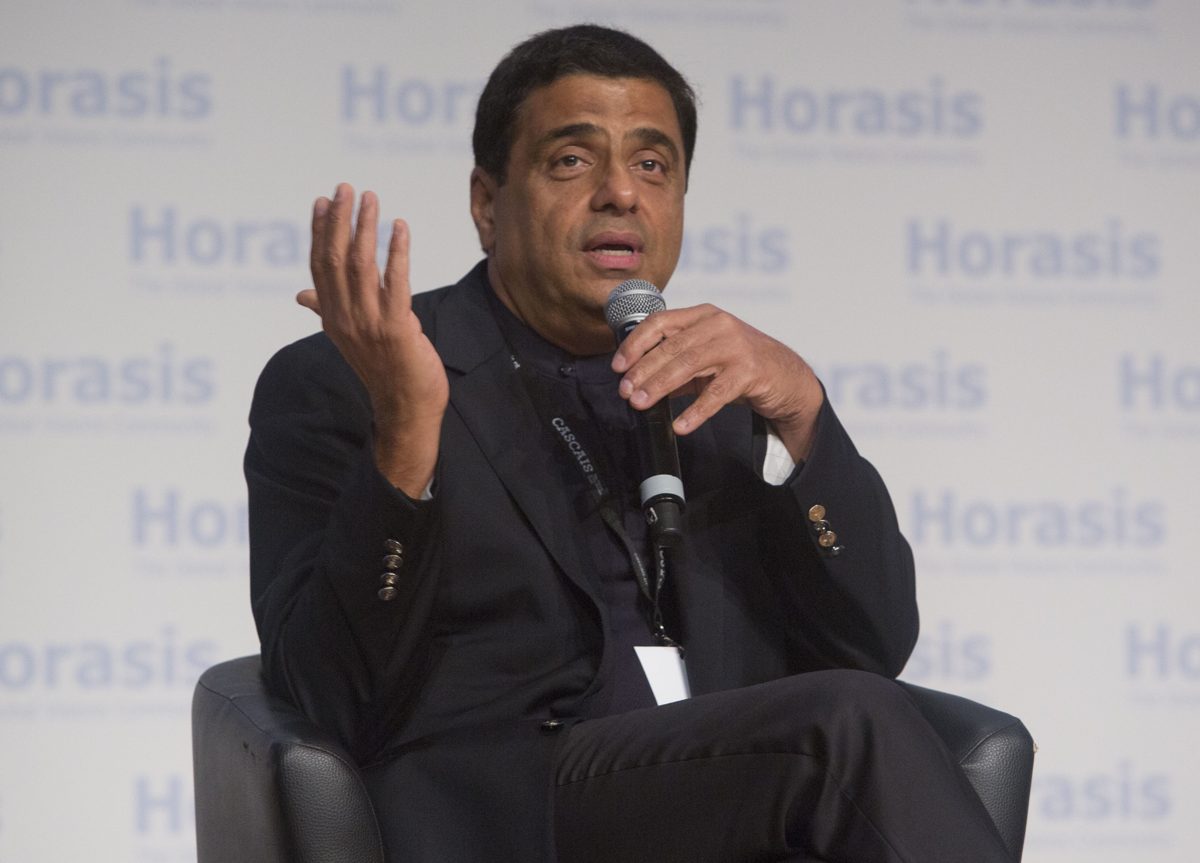
| Key facts | |
|---|---|
| Born | 8 September 1956, Bombay (now Mumbai) [7][8] |
| Family roots | Parsi family from Grant Road, south Bombay; father a corporate executive who rose to managing director of J L Morison [9][10] |
| Education | Cathedral & John Connon School; B.Com, Sydenham College, Bombay [10][11][9] |
| Family | Wife Zarina Screwvala (née Mehta), UTV co-founder and co-founder of the Swades Foundation [12] |
| Company/Group | upGrad (co-founder), RSVP Movies, Unilazer Ventures, U Sports (U Mumba); earlier founder of UTV, sold to Disney |
| Wealth | About US$1.7 billion (Forbes real-time, November 2026) [13]; about Rs 13,300 crore on the Hurun India Rich List 2025 [14][15] |
| Known for | Building UTV from a Rs 37,500 start into a studio Disney bought; producing Rang De Basanti, Swades, Uri; co-founding upGrad |
In the early 1980s, a young man in his mid-twenties stood in the lobbies of apartment buildings in Cuffe Parade, south Bombay, with two television sets and a video player. He was trying to show residents something none of them had seen at home: a private channel of films, piped in by cable. It took close to a year to win the first customer, and after that, door-to-door selling, building by building [9]. The monthly fee was Rs 200 [16][10].
That cable-wallah was Ronnie Screwvala. Three decades later, he had sold the company that grew out of that hustle, UTV, to The Walt Disney Company in a deal the Wall Street Journal valued at about US$454 million for the half Disney did not already own [17]. He would go on to produce some of the most talked-about Hindi films of the century, co-found the edtech company upGrad, and pour a large slice of his fortune into lifting villages in Maharashtra out of poverty.
His is not a story of one big bet. It is a story of many small ones, several failures he likes to talk about more than his wins, and an almost stubborn habit of starting again. “Failure is a comma, not a full stop,” he wrote in his 2015 book [18].
Where it began
Rohinton “Ronnie” Screwvala was born in Bombay on 8 September 1956 [7][8]. He grew up in a Parsi family in a four-bedroom flat in an old building on Grant Road, where his mother and aunts played the piano and gave piano lessons [9]. The Caravan described him as “the son of a Parsi businessman from South Bombay” [10]; his father worked his way up to become managing director of the pharmaceutical and consumer company J L Morison, and the family later moved to Warden Road near Breach Candy [9].
Screwvala has always described his roots as modest. “Coming from a lower middle-class background just roots you in a very different way,” he wrote in a 2018 diary series for Outlook Business [9]. In another interview he said the first 15 years of his life were the most influential, and that his parents “taught me to be flat on the ground” [19].
The instinct to sell showed up early. As a boy he staged small play-cum-concerts for the residents of his building, and he sold “balcony seats” to people who wanted a view of film stars arriving at premieres at the cinema across the road [20].
He studied at Cathedral & John Connon School, where he acted in student plays [10][11], and then took a commerce degree at Sydenham College [9][11]. He was not a model student. “The easy-going attitude cost me a year at college, much to the disappointment of my parents,” he admitted [9]. He also feared being pushed into chartered accountancy, the safe career of choice for many middle-class Bombay families [21].
The stage and the microphone
The real education happened in theatre. In his early twenties he acted in English plays staged by Alyque and Pearl Padamsee, then the leading names of Bombay’s English stage, playing Happy Loman in Death of a Salesman and Cassio in Othello [10]. He was paid about Rs 500 a show, and from the age of 18 he also earned money doing voice-overs and jingles for advertisements [9]. Pearl Padamsee remembered him as “a taskmaster” who “paid attention to detail” [10].
“It was a hobby, it gave me self confidence, a sense of focus, the ability to innovate and think on my feet,” he later said of the stage [22]. Looking back, he saw a pattern: “Theatre was a hobby for me, so I took what I thought was a cluster of hobbies and made it into a profession” [9].
The first failure
His first venture as an organiser flopped. In the mid-1970s he put on a rock concert at Shanmukhananda Hall in Bombay; it filled only about half the hall’s roughly 3,000 seats [23]. He lost about Rs 50,000, a large sum for a college student at the time, and repaid it by borrowing from family and friends [9]. He then started organising shows under the name “Lazer Productions.” “My start-up funding was absolutely zero,” he wrote [9].
The first break
Cable TV, 1981
The idea that changed his life came from an unlikely place: the closed-circuit televisions at Bombay’s race course. If a race could be piped to screens, why not films into homes? In June 1981 he launched a cable service called “Network,” a three-hour movie channel for buildings in Cuffe Parade, at Rs 200 a month [16]. Several sources date the start to 1981 [16][21][11].
Media accounts often call it India’s first cable TV service. The Caravan’s more careful version is that the Sea Lord building, an early customer, was “the fourth residential building in the country to receive cable television,” with about 30 flats signing up at first and the network later spreading to more than 15 buildings [10]. Hotels became a key market [9]. Early backing came from Suresh Nanavati of Western Outdoor Advertising [10].
He ran the cable business for several years (he has said four, other accounts say six) and had sold it by 1988 [9][21][10]. “Those four years in cable TV gave me an incredible insight into consumers,” he wrote. “Everyone calls it vision and clarity but, at that time, there was no clarity” [9].
Toothbrushes on the side
His most unexpected business came from a trip to England with his father. At a brush factory there he saw two nearly new machines about to be scrapped and asked the owner, “Could you hold these for me for 60 days?” He went back to India, won a contract from Colgate-Palmolive, imported the machines and set up a manufacturing unit at Kalyan, near Bombay [9]. He brought in partners so the business would need only about an hour and a half of his time each week. “I was pretty clear that it is not something I want to run, it is not going to be my primary business,” he said [9].
The toothbrush unit grew into one of India’s largest, reportedly making more than 6 million brushes a month with Colgate-Palmolive as a major client [16][11]. It ran quietly in the background for years, and early UTV even shared its office [10]. Pearl Padamsee recalled, “We thought it was funny that he left and started making toothbrushes” [10]. Years later, he sold the toothbrush business partly to help fund the buyback of News Corp’s stake in UTV [24].
UTV is born, 1990
In June 1990, Screwvala incorporated United Software Communications, a private company [9][25], with Zarina Mehta and Deven Khote among the co-founders. Zarina later became his wife. The starting capital was about Rs 37,500 [22][23]. (The popular “Rs 37,000” figure is a rounding.)
“When I set up UTV, my ambitions were quite low,” he told Mint in 2015 [23]. “Media was serendipity to me… I was clear that I wanted to be an entrepreneur,” he said in another interview [21].
The first break came from his theatre network. Alyque Padamsee, then running the ad agency Lintas, brought him a Hindustan Lever-sponsored show. The first branded show, Surf Mashoor Mahal, was shot in a theatre because UTV had no studio [9][25]. More Doordarshan shows followed, including Contact and The Mathemagic Show [25].
Building the empire
Television: from Zee to Shanti
When Zee TV launched in 1992 as India’s first private Hindi satellite channel, UTV pitched it 10 shows and won a contract for 520 episodes. That deal brought UTV its first private equity investor. “It was people who came knocking at our door, rather than us chasing capital,” he wrote [25].
In 1994 UTV produced Shanti, India’s first daily soap, for a Doordarshan afternoon slot sponsored through a Procter & Gamble agency. It ran for about 780 episodes [26]. To make it, UTV converted a basement next door, vacated by State Bank of India, into a studio with 19 sets [25]. Screwvala’s management style was set early: “I am a person who judges a company by the state of the loo,” he once wrote, recalling that in those days he worried more about “power cuts and the state of the loo” than strategy [25].
UTV also built a dubbing business, which later carried Disney’s cartoons into Hindi, Tamil and Telugu under a deal that began in March 2004, alongside work for Nickelodeon, National Geographic and History [27]. It was an early link to the company that would one day buy UTV.
Rupert Murdoch walks in
In 1995 News Corp, which owned Star TV, took equity in UTV, one of the first major foreign investments in Indian media [22]. The Caravan put the investment at US$5 million [10]. Screwvala tells the story of Murdoch visiting UTV’s basement office and UTV being invited to BSkyB in London; News Corp wanted a significant minority stake without control [25]. By March 2002, News Corp’s holding had reached 49%, and it sold 12% to Warburg Pincus, which already held 24% [28]. Screwvala later bought out News Corp’s stake, helped by the sale of his toothbrush business; he recalls James Murdoch telling him, “You screwed us” [24].
Buying and selling channels
UTV’s first acquisition came in 1998: Vijay TV, the Tamil channel, bought “like buying a house on EMI,” paid off over 36 months [24]. In 2001 UTV sold 51% of Vijay to Star for about Rs 20 crore and later exited completely [24][16].
Then came Hungama TV, a Hindi children’s channel. Screwvala admits it was “a disaster in the first year” [24]. It recovered, and in July 2006 Disney bought Hungama for about US$30.5 million and, in the same transaction, took a 14.9% stake in UTV for about US$14 million [2][22][10]. The Caravan noted this valued UTV at just under US$100 million [10].
In September 2007 UTV launched Bindass, a youth entertainment channel [29], and it later ran movie channels including UTV Movies, UTV Action and World Movies [30]. It also moved into gaming, taking control of Indiagames in 2007 [31].
Going public
UTV Software Communications listed on the BSE and NSE on 17 March 2005, after an IPO priced at Rs 130 a share that raised about Rs 91 crore [5][32]. The promoter stake fell from about 57% to 44% [32]. “Our strategy is to establish UTV as a truly diversified media and entertainment company,” Screwvala said at the time [32].
Films: from five disasters to Rang De Basanti
UTV’s movie arm began in 1996, when Doordarshan commissioned made-for-TV films [10]. The start was rough. “Our first five movies were complete disasters, and the first one was an absolute disaster,” he wrote [9]. He blamed making films without bound scripts [24].
The turnaround came in the 2000s. UTV produced or co-produced Swades (2004), Rang De Basanti (2006), Jodhaa Akbar (2008), Fashion (2008), A Wednesday! (2008), Dev.D (2009), Barfi! (2012) and Kai Po Che! (2013) [7]. Screwvala credits Rang De Basanti with giving UTV’s film business credibility [24]. Newsweek called him the “Jack Warner of India,” and Fortune named him among “Asia’s 25 Most Powerful” [33]. In 2008, under his formal name Rohinton Screwvala, he won the EY Entrepreneur of the Year award in the services category [34].
Swades, Ashutosh Gowariker’s film about an NRI scientist returning to an Indian village, became more than a credit. Years later its name would be borrowed for Screwvala’s philanthropic foundation.
Disney moves in
On 18 February 2008, Disney agreed to invest about US$200 million in UTV through a preferential allotment, raising its holding to 32.1% on a fully diluted basis, and about US$30 million more for 15% of UTV’s broadcasting arm [3]. In rupees, the total came to about Rs 924 crore [16][11]. Disney, Screwvala and his family entities then made a joint open offer at Rs 860.79 a share, which closed in October 2008 with their combined holding at about 83% [35].
By mid-2011 Disney held about 50.4% of UTV, and Screwvala and Zarina together about 19.8% [36]. When he sought money for broadcasting and films, Disney offered to fund it, and the question of dilution became a question of control. “It was just one of those moments when Disney felt it made sense to consolidate and own 100% of the company,” he wrote [9].
The sale
In July 2011 Disney announced it would buy out the remaining shareholders and delist UTV, at up to Rs 1,000 a share, about Rs 2,000 crore for the whole company [36]. The Wall Street Journal valued the purchase of the remaining stake at about US$454 million [17]; The Caravan reported the same figure and said it valued UTV at more than US$900 million [10].
The delisting ran through a reverse book-building process in January 2012, with a floor price of Rs 835.03 [37]. Public shareholders held out for more, and the discovered price was Rs 1,100 a share, which Disney accepted [38][39]. UTV stopped trading on the NSE from 9 March 2012 [40]. Business Today estimated Screwvala’s personal payout at about Rs 800-850 crore [41].
Screwvala became managing director of The Walt Disney Company India, reporting to Disney executive Andy Bird [4]. It did not last long. In October 2013 Disney announced he would step down, handing over to his long-time UTV colleague Siddharth Roy Kapur from 1 January 2014, and stay on to help the transition until mid-2014 [42]. “It’s been a fantastic seven-year working relationship with Disney,” he said [42]. “I am never good at implementing somebody else’s vision,” he wrote later [24].
Life after Disney: investor, sports owner, producer again
For the next few years he stayed away from film production and became an investor. His family office, Unilazer Ventures, set up in 2012, had backed more than 30 Indian startups by 2020, including Lenskart, ShopClues, Zivame, DailyObjects, Niki.ai and the content platform Arré, with exits from ShopClues, Zivame and Micro Housing Finance Corporation [43]. “After selling UTV, I did the whole PE investor thing for a while,” he told Business Standard, adding, “I chose to invest everything in my own private companies” [44].
He also bought into sport. Unilazer Sports, later U Sports, owns U Mumba in the Pro Kabaddi League and has interests in football training and e-sports [7].
He returned to film-making with RSVP Movies, which launched around 2017-18. He picked the name, he said, “because no one in the business does RSVP” [44]. Its early slate included Kedarnath, Sonchiriya, Karwaan and Uri: The Surgical Strike [45]. Uri (January 2019) was the breakout: it grossed about Rs 342 crore worldwide by trade tracker Sacnilk’s count [46] and won four National Film Awards [47]. RSVP followed with The Sky Is Pink, Raat Akeli Hai, Rashmi Rocket and, in December 2023, Meghna Gulzar’s Sam Bahadur, which the makers said crossed Rs 100 crore worldwide [48]. At the 71st National Film Awards, announced in August 2025, Sam Bahadur won three awards and RSVP’s Malayalam film Ullozhukku won two [49]. “We strive to make cinema that leaves an impact,” he said [49].
upGrad: the biggest second act
In 2015 Screwvala co-founded upGrad, an online higher-education company, with Mayank Kumar, Phalgun Kompalli and Ravijot Chugh [50]. The pitch was simple: millions of working Indians needed new skills and degrees without leaving their jobs.
Growth was slow until the pandemic pushed learning online. In 2021 Temasek led a round that valued upGrad at about US$1.2 billion, making it a unicorn; the round totalled about US$185 million with IFC and IIFL also investing [51]. In 2022 upGrad raised about US$210 million more at a valuation reported at US$2.25 billion, from investors including ETS, James Murdoch and Uday Shankar’s Bodhi Tree, and the family offices of the Bhartis and Lakshmi Mittal; the founders put in US$12.5 million to keep their combined stake above 50% [52][53].
Then came a burst of buying. In 2022 alone upGrad acquired Harappa Education (about Rs 300 crore), INSOFE, Work Better, Wolves India and Centum Learning [52][54]. In 2026 it took a 90% stake in Internshala through a share swap [55] and, after a false start, bought Unacademy.
In January 2026 upGrad called off talks to buy the test-prep company Unacademy over valuation [56]. Two months later the talks were back on, as an all-share deal. “They disrupted the sector once, and now with AI they plan to do it again,” Screwvala said of Unacademy [57]. The Competition Commission of India cleared the deal in July 2026, and it closed around September 2026 at a valuation of about US$200-206 million, more than 90% below the roughly US$3.4 billion Unacademy was worth at its 2021 peak; co-founder Gaurav Munjal stayed on as CEO [58][59]. “We raised at a peak, but sold at a fraction of that,” Munjal said [59].
The losses were heavy at first. upGrad’s total EBITDA loss in FY23, including one-time costs, was about Rs 1,142 crore [60]. The net loss fell to about Rs 560 crore in FY24 and Rs 274 crore in FY25, on operating revenue of about Rs 1,569 crore [50]. For FY26, upGrad reported gross revenue of about Rs 2,070 crore, Ind-AS EBITDA of Rs 123 crore and a net loss of about Rs 130 crore [55].
Screwvala has led much of the money himself. In March 2023 he led a Rs 300 crore rights issue [61]. As of December 2024, he and his family held about 45% of the company, with Temasek at about 20.5% [60]. When co-founder Mayank Kumar stepped back in October 2024 to start a new venture, Screwvala took a more hands-on role [62]. In December 2025 he said: “We are very clear about the year 2027 for us to list” [63].
He also became a household face beyond business circles as one of the “sharks” on Shark Tank India Season 3 in 2024 [64]. In November 2025 he set aside a personal pool of about US$50 million for early-stage AI, deep-tech and space-tech startups, while predicting that 90-95% of AI startups would fail [65].
How the wealth is held
Unlike many Indian billionaires, Screwvala’s fortune does not sit in a listed company. It is spread across his large upGrad stake, RSVP Movies, U Sports, the Unilazer portfolio and the money from the UTV sale. That makes estimates vary widely. Forbes’s real-time tracker put him at about US$1.7 billion in November 2026, describing his wealth as “self-made” from edtech and entertainment [13]. The Hurun India Rich List 2025 put him at about Rs 13,300 crore, the richest person from the Hindi film world that year, ahead of Shah Rukh Khan [14][15]. Valuations of private stakes like upGrad’s are estimates, not market prices.
The setbacks and failures
Screwvala talks about failure more readily than most Indian business leaders. His 2015 book, Dream with Your Eyes Open, lists his own: the rock concert, the early UTV films, a home-shopping venture that failed, and films such as Chance Pe Dance and Joker that he saw going wrong mid-production but could not stop [18]. “Failure is more interesting and instructive than success,” he wrote [18]. And: “Your worst failure is never the worst because there is always the possibility of another” [9].
UTV’s lean quarters. The film business made UTV’s profits swing. In the June 2009 quarter, the company reported a consolidated net loss of about Rs 23 crore, against a profit of about Rs 20 crore a year earlier [66]. It posted another small loss in the June 2011 quarter [67].
Hungama’s first year. The children’s channel he later sold to Disney was, in his words, “a disaster in the first year” [24].
RSVP flops. Not every RSVP film worked. Tejas (October 2023), starring Kangana Ranaut, collected only about Rs 6 crore in India, and a trade estimate reported by ETV Bharat put the producers’ loss at about Rs 50 crore; RSVP did not comment [68][69]. Weeks later, the war film Pippa skipped cinemas and premiered directly on Prime Video [70].
upGrad’s hard years. The post-pandemic edtech slowdown hit upGrad too. The company’s FY23 losses ran past Rs 1,100 crore, including a large write-down of goodwill on acquisitions [60]. A planned Rs 125 crore acquisition of Exampur collapsed in late 2022 [71]. Its subsidiary Harappa cut about 30% of staff in December 2022, and upGrad’s India CEO Arjun Mohan left in January 2023 [72]. A second round of about 120 job cuts followed in March 2023 [73].
A deal that fell apart, then came back. In January 2026 upGrad called off talks to buy Unacademy, with Screwvala saying, “We are not proceeding due to valuation differences” [56][74]. Two months later the talks were revived, and the deal eventually closed at a fraction of Unacademy’s peak value (see above).
Controversies and allegations
Measured against many people on Indian rich lists, Screwvala’s legal record is light. Our research found one regulatory settlement involving him personally, a handful of court cases in which his company was the one suing, sector-wide regulatory warnings, and public spats. No court has found him guilty of any offence, and we found no credible reports of ED, CBI, SFIO or income-tax enforcement action against him.
SEBI settlement over UTV warrants (2013)
Allegation: After examining UTV’s affairs, the Securities and Exchange Board of India (SEBI) found that Screwvala, then UTV’s managing director, sold 7,50,000 UTV warrants off-market to Delta Corp on 26 February 2008 at Rs 660 each, but received payment in three tranches between February and September 2008. SEBI said that because payment came later than the law allows, the deal was not a valid “spot delivery contract,” allegedly breaching Sections 2(i), 13 and 18 of the Securities Contracts (Regulation) Act [1].
Response: Screwvala applied for a settlement through SEBI’s consent process in April 2013 and offered to pay Rs 6,80,000 [1].
Status: Closed. SEBI passed a consent order on 19 August 2013, settling the matter without Screwvala admitting or denying guilt [1]. It was a technical breach of contract rules, not a finding of insider trading or fraud.
The UTV delisting price (2011-12)
Allegation: When Disney moved to buy out UTV’s public shareholders, some minority investors felt the indicated price of up to Rs 1,000 a share was too low, and pushed for a premium in the reverse book-building process [38].
Response: Disney, which by then controlled UTV, accepted the price discovered by the process [39].
What happened next:
- Bids in January 2012 discovered a price of Rs 1,100 a share, about 10% above Disney’s indicated cap and well above the Rs 835.03 floor [38][37].
- Disney accepted it, and UTV was delisted in March 2012 [39][40].
Status: Concluded in 2012 through the statutory process. We found no SEBI order or court case over the delisting price.
Edtech regulators and degree partnerships
Allegation: upGrad’s business relies heavily on partnerships with Indian and foreign universities. In January 2022 the University Grants Commission (UGC) and AICTE warned colleges against offering degrees through franchise arrangements with edtech companies [75]. In December 2023 UGC warned the public against edtech-foreign university “franchise” degrees that it said were not recognised [76]. These advisories did not name upGrad.
Response: No upGrad response was carried in the reporting on the January 2022 notice that we found [75].
Status: No regulator has issued any finding against upGrad specifically, as of November 2026. The advisories remain a sector-wide risk for online-degree providers.
Student criticism and the defamation case
Allegation: A man named Lavangiri Ansar Basha posted online that upGrad misled students and sold poor-quality content, calling the company a “fraud” and a “scam” [6].
Response: upGrad sued for defamation in the Delhi High Court [6].
What happened next:
- In July 2025 the Delhi High Court restrained him from calling upGrad a “fraud” or a “scam” while the case was heard [6].
Status: Pending as far as public reporting shows; we found no final judgment as of November 2026. The case shows that some students were unhappy with upGrad; an interim order is not a ruling on whether their complaints were true.
upGrad v Scaler (2021)
Allegation: upGrad sued rival edtech Scaler in the Delhi High Court in November 2021, alleging that Scaler used upGrad’s trademark in Google search advertising, and sought more than Rs 3 crore in damages [77].
Response: Scaler said it “vehemently” denied the charge [77].
Status: upGrad won an ad-interim injunction on 29 November 2021 [77]. We could not find a reported final outcome.
Public spat with BYJU’S (2023)
Allegation: In June 2023, as BYJU’S fought its US lenders in court, Screwvala attacked the company on social media, writing that it had “ZERO Content… not even a Netflix or HBO will buy it,” and accusing it of “sullying India’s name as a great investment destination.” He also questioned the “fiduciary duties” of its former board [78].
Response: We found no public response from BYJU’S to these remarks. (For BYJU’S own story, see our profile of Byju Raveendran.)
What happened next:
- In November 2025 upGrad itself filed an expression of interest to bid for assets of BYJU’S insolvent parent, Think & Learn, in the insolvency process [79].
Status: A war of words, not a legal matter. We found no reported outcome of upGrad’s BYJU’S bid as of November 2026.
As of 2 November 2026, none of these matters involves a pending criminal or regulatory case against Screwvala.
Giving back
In 2013, as he was leaving Disney, Screwvala and Zarina set up the Swades Foundation, building on their earlier SHARE Foundation and named after the UTV film [12]. They chose Raigad district in coastal Maharashtra, a few hours from Mumbai, and a big goal: Zarina recalls Ronnie proposing, “Let’s lift a million people out of poverty!” [12].
At launch he outlined a plan to spend about Rs 1,000 crore over five years, half from his own pocket, and said: “Whatever one makes from the business, 10-15% should always go back to society.” He stressed that the money was “from our personal wealth and it has nothing to do with CSR” [80].
The first model did not work. Swades offered Rs 20,000 per toilet if a household put in Rs 5,000, and found little interest; many villagers shut their doors on the team [81]. The foundation switched to community-written three-year village plans in which villagers contribute at least 10%, while tapping government schemes for much of the funding [81].
By January 2025 Swades had certified 200 “Dream Villages” meeting more than 40 criteria, 199 of them in Raigad, and had signed a letter of intent with the Maharashtra government aiming for 1,000 villages [82]. The foundation reports building 792 drinking-water schemes and 39,222 toilets and training about 1,03,000 farmers across five districts; these are its own figures [83]. In 2024 Swades raised Rs 10 crore on the NSE’s Social Stock Exchange, then the largest listing on that platform [84].
He is blunt about the old Indian debate between profit and purpose: “This balance between impact and making money is a guilt complex, and it won’t get you anywhere,” he said in 2024. “The minute you know how the other half lives, it just is a levelling process for you” [85].
He also writes for a wider audience: Dream with Your Eyes Open (Rupa, 2015) [86] and Skill It, Kill It (2021) [87]. In a December 2025 convocation address in Bengaluru he told graduates that “India is the place to build” and that “life is to be lived in a zigzag manner” [88].
Succession
Screwvala is 70, and there is no publicly announced succession plan for his businesses. upGrad is professionally managed with co-founder Phalgun Kompalli, and an IPO targeted for 2027 would, if it happens, give it a public shareholder base [63][50]. Zarina Screwvala co-leads the Swades Foundation as co-founder and trustee [12]. For now, Screwvala remains the main shareholder and the public face of upGrad, RSVP and Unilazer.
What his journey teaches
Small, cheap experiments first. The cable network was demonstrated on two TV sets in building lobbies; UTV started with Rs 37,500. He tested ideas before betting big, which meant his failures were survivable.
Keep a cash engine running in the background. The toothbrush unit, run for about an hour and a half a week, paid its way for years and later helped fund the News Corp buyback. A boring business can buy freedom for an exciting one.
Sell at the right moment, even if it hurts. He let Disney in step by step: 14.9%, then 32%, then control. When the economics pointed to a full sale, he took about US$454 million for the remaining stake rather than keep raising money to stay in charge.
Talk openly about failure. Five failed films, a home-shopping venture and a costly first year at Hungama did not end his career. Treating failure as “a comma” let him keep starting.
Put your own money in when you ask others to. At upGrad he led the 2022 founder top-up and the 2023 rights issue himself. Investors notice when a founder puts in his own money.
Philanthropy needs a business plan too. Swades’s first toilet subsidy failed; it worked only after villagers had to put in their own money and write their own plans. That is a lesson that also applies to business.
For more stories of how Indian businesses and markets work, see CapitalVia Insights. Other media founders in our series include Kalanithi Maran of Sun TV and Ajay Bijli of PVR.
A profile for general reading, based on public records and reporting as of 2 November 2026. Not investment, tax or legal advice.
Sources (88)
- Consent order in respect of Rohinton Screwvala in the matter of UTV Software Communications - SEBI, Aug 2013
- The Walt Disney Company to acquire Hungama TV, makes strategic investment in UTV - The Walt Disney Company, Jul 2006
- The Walt Disney Company increases strategic investment in UTV - The Walt Disney Company, Feb 2008
- Disney to acquire controlling interest in UTV Software Communications - The Walt Disney Company, Feb 2012
- UTV Software Communications IPO details (BSE/NSE listing, Mar 2005) - Chittorgarh, Mar 2005
- Delhi High Court restrains man from making derogatory comments against upGrad - Bar & Bench, Jul 2025
- Ronnie Screwvala - Wikipedia, Nov 2026
- Happy birthday Ronnie Screwvala - NewsBytes, Sep 2022
- In life, you cannot time your success or your failure (Secret Diary of an Entrepreneur, part 1) - Outlook Business, Nov 2018
- The Interpreter: why Disney bought Ronnie Screwvala - The Caravan, Jun 2012
- The saga of Screwvala - Business Standard, Mar 2013
- Zarina and Ronnie Screwvala on the Swades Foundation - YourStory, Jan 2019
- Ronnie Screwvala profile and real-time net worth - Forbes, Nov 2026
- Not Shah Rukh Khan: richest Bollywood celebrity on Hurun India Rich List 2025 - India TV, Oct 2025
- Not Shah Rukh Khan; meet the richest person of Bollywood with Rs 13,000 crore fortune - WION, Oct 2025
- Ronnie Screwvala sells UTV to Walt Disney for Rs 2,000 cr - Business Today, Jul 2011
- Walt Disney to buy $454M India's UTV stake (Wall Street Journal report) - Institutional Investor, Jul 2011
- Screw failure, just stay the course: Ronnie Screwvala - YourStory, May 2015
- Ag Talk: Up, close and personal with Ronnie Screwvala - Adgully, Mar 2015
- Book review: Dream With Your Eyes Open - Business Today, Jun 2015
- Always wanted to be an entrepreneur: Ronnie Screwvala (PTI) - YourStory, Jan 2016
- March of a media mogul - Business Standard, Oct 2006
- Ronnie Screwvala: The disruptive entrepreneur (Mint, republished) - Parsi Khabar, Feb 2015
- You have to withstand the pressure if you believe in something (part 3) - Outlook Business, Nov 2018
- I am a person who judges a company by the state of the loo (part 2) - Outlook Business, Nov 2018
- Shanti, the iconic woman character from DD's 1994 series - ThePrint, Nov 2020
- Kids channels boost UTV's dubbing business - Indiantelevision, Jan 2005
- News Corp won't part its stake in UTV - Indiantelevision, Mar 2002
- UTV's Bindass to go on air on Sept 17 - afaqs!, Aug 2007
- UTV on fast-forward - Business Standard, Jul 2010
- UTV acquires controlling interest in Indiagames - Oneindia, Dec 2007
- UTV's Rs 91 crore public issue to open on Feb 21 - Business Standard, Feb 2005
- Ronnie Screwvala author page - Rupa Publications, Nov 2026
- EY Entrepreneur of the Year 2008 winners - EY India, Nov 2008
- Does Disney hold a majority stake in UTV after the open offer? - MediaNama, Dec 2008
- Walt Disney to pay Rs 2,000 crore for 100 per cent stake in UTV - afaqs!, Jul 2011
- Disney delisting offer for UTV shareholders begins Jan 16th - MediaNama, Jan 2012
- Investors seek 10% premium in UTV delisting - Business Standard, Jan 2012
- Disney to buy UTV scrip at or below Rs 1,100 apiece - Business Standard, Feb 2012
- UTV Software to stop trading on NSE from 9th March - Moneylife, Mar 2012
- Walt Disney-UTV: what Screwvala gets - Business Today, Feb 2012
- Ronnie Screwvala to step down as MD of Disney UTV - Business Standard, Oct 2013
- Ronnie Screwvala's investments range from edtech to e-commerce and media - Business Insider India, Aug 2020
- Years after selling UTV, Screwvala explains his shift to online education - Business Standard, Nov 2019
- Ronnie Screwvala, Siddharth Roy Kapur reunite for Pihu - MediaInfoline, May 2018
- Uri: The Surgical Strike box office collection, worldwide - Sacnilk, Apr 2019
- RSVP Movies - Wikipedia, Nov 2026
- Meghna Gulzar's Sam Bahadur crosses Rs 100 crore mark at global box office - The Week, Dec 2023
- Ronnie Screwvala celebrates National Award wins of Sam Bahadur, Ullozhukku - Bollywood Hungama, Aug 2025
- upGrad halves FY25 loss to INR 273.7 Cr, revenue up 6% - Inc42, Dec 2025
- India's upGrad enters unicorn club with $185 million fundraise - TechCrunch, Aug 2021
- upGrad raises $210 mn funding, eyes acquisitions in US, Southeast Asia - Business Standard, Aug 2022
- Edtech unicorn upGrad doubles valuation with $225 mn funding round - Business Standard, Jun 2022
- Edtech unicorn upGrad acquires corporate training startup Centum - Inc42, Sep 2022
- upGrad's gross revenue crosses Rs 2,000 Cr in FY26, loss narrows 52% - Inc42, Aug 2026
- upGrad drops proposed Unacademy deal, cites valuation mismatch - Storyboard18, Jan 2026
- upGrad U-turns to acquire Unacademy in 100% share swap - The PIE News, Mar 2026
- upGrad completes Unacademy acquisition at $206m valuation - The PIE News, Sep 2026
- upGrad wraps up Unacademy acquisition at $200M - YourStory, Sep 2026
- upGrad posts Rs 1,876 Cr gross revenue in FY24, EBITDA losses down by 50% - Entrackr, Dec 2024
- upGrad raises Rs 300 crore in rights issue led by co-founder Ronnie Screwvala - Deccan Herald, Mar 2023
- upGrad cofounder and MD Mayank Kumar steps down to launch new startup - Storyboard18, Oct 2024
- upGrad 'very clear that 2027 is its listing year': Screwvala - Mint, Dec 2025
- Shark Tank India Season 3: upGrad's Ronnie Screwvala, Edelweiss' Radhika Gupta join as sharks - Inc42, Nov 2023
- Ronnie Screwvala earmarks $50M to back AI, deeptech, spacetech start-ups - NewsBytes, Nov 2025
- UTV Software Communications June qtr net loss at Rs 23 cr - Business Standard, Jul 2009
- UTV Software Q1 loss at Rs 3 cr - Business Standard, Aug 2011
- Tejas tanks at box office; producers likely to face Rs 50 crore in losses - ETV Bharat, Nov 2023
- Tejas box office collection - NewsBytes, Nov 2023
- Pippa to release directly on Prime Video on November 10 - Bollywood Hungama, Nov 2023
- upGrad's plans for Exampur acquisition fall through - YourStory, Dec 2022
- upGrad CEO Arjun Mohan quits amid growth-related challenges - Business Today, Jan 2023
- Job cuts continue at upGrad with 120 employees laid off in second round - People Matters, Mar 2023
- upGrad-Unacademy deal called off - Business Today, Jan 2026
- UGC, AICTE notice on edtech franchise degrees - MediaNama, Jan 2022
- UGC warns against edtech companies' tie-ups with foreign universities - MediaNama, Dec 2023
- Scaler denies trademark infringement charges of upGrad - Inc42, Dec 2021
- upGrad's Ronnie Screwvala attacks BYJU'S after lawsuit against lenders in US - Business Today, Jun 2023
- upGrad joins bidding fray for BYJU'S parent company - Inc42, Nov 2025
- Ronnie Screwvala puts profit first in social impact ventures (Economic Times) - NextBillion, Jul 2013
- Giving at scale - Fortune India, Dec 2025
- Swades Foundation reaches 200 Dream Villages in Maharashtra - India CSR, Jan 2025
- Our impact - Swades Foundation, Nov 2026
- Swades Foundation's Rs 10 crore Social Stock Exchange listing - YourStory, Aug 2024
- Ronnie Screwvala on balancing profit and impact - YourStory, Sep 2024
- The upside of failure (review of Dream With Your Eyes Open) - Business Standard, May 2015
- 13 key soft skills from Ronnie Screwvala's Skill It, Kill It - YourStory, Jul 2021
- 'India is the place to build': Ronnie Screwvala at convocation - Business Today, Dec 2025