
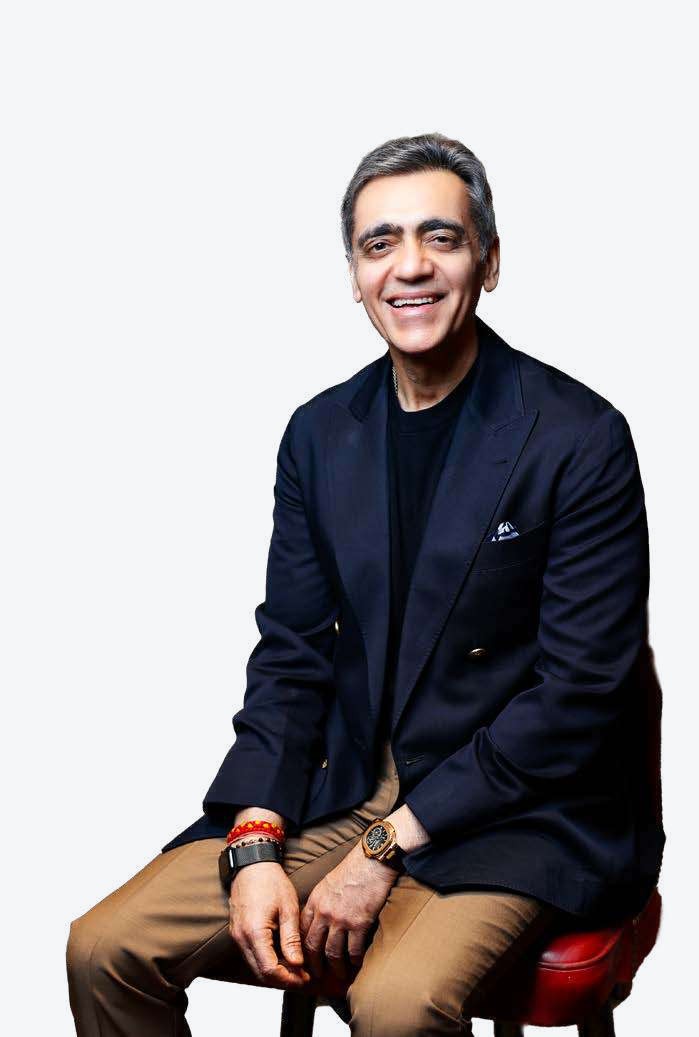
| Key facts | |
|---|---|
| Born | 1967, Delhi (Wikipedia gives 8 February 1967) [28] [11] |
| Family roots | Amritsar, Punjab; grandfather founded Amritsar Transport Company in 1939 [11] [14] |
| Education | Modern School, New Delhi; B.Com (Hons), Hindu College, Delhi University (1988); Owner/President Management programme, Harvard Business School [10] [15] |
| Family | Wife Selena; children Niharika, Nayana and Aamer; brother Sanjeev Kumar Bijli, Executive Director of PVR INOX [10] [60] |
| Company | PVR INOX Ltd (Managing Director), India’s largest cinema chain: 1,797 screens in 114 cities as of 30 September 2026 [57] |
| Wealth | No published rich-list figure; holds about 5.6% of PVR INOX personally, the Bijli family a little over 10% [59] |
| Known for | Opening India’s first multiplex, PVR Anupam, Saket, in June 1997 |
On a summer day in June 1997, a renovated old cinema in Saket, south Delhi, reopened as something India had not seen before: four screens under one roof, with a computerised box office and 24 shows a day [7] [19]. The new owners had fought among themselves over the ticket price. They settled on Rs 75, at a time when a cinema seat in Delhi typically cost Rs 25 to Rs 30 [23].
They need not have worried. “There were kilometer-long queues when we opened,” Ajay Bijli remembered years later. “And our campaign was very explicit: Four cinemas under one roof, 24 shows a day, multiple cinema complex” [19].
Bijli was 30. Three years earlier, a fire had gutted a warehouse of his family’s trucking firm and left him, by his own account, “devastated” [17]. His mother and wife had told him to stop trying to run a business he did not love and to follow the one that made him happy [15]. PVR Anupam was that bet.
Almost three decades later, the company he started runs about 1,800 screens and sells more than 4 crore tickets a quarter [57]. Its 2023 merger with INOX Leisure created a business that dominates India’s multiplex trade, and that dominance has brought a new kind of scrutiny, from viral popcorn bills to a Competition Commission investigation [74]. This is the story of how a Delhi boy who was bored by trucks built India’s cinema habit, and what has gone right and wrong along the way.
Where it began
A trucking family from Amritsar
The Bijli name was not the family’s original surname. According to India Today, Ajay Bijli’s grandfather, Lala Sain Dass, earned the nickname “Bijli Pehalwan” for relief work during the Partition, and the family took the name from him [11]. Business Standard records the grandfather as “Lala Sai Das Mehra” [13] [14]; the two spellings appear in different profiles.
The grandfather ran a trucking business, Amritsar Transport Company, which Bijli has said was started in 1939 [17] [15]. By the 2000s it was reported to run around 500 trucks across north India [14] [12]. On a 2023 podcast with Nikhil Kamath, Bijli said people wrongly assumed his grandfather was a wrestler; in fact, he promoted wrestling [20]. (Our profile of Nikhil Kamath tells the story of the host.)
Ajay Bijli was born in 1967 and brought up in Delhi, though the family’s roots remained in Amritsar [11]. Wikipedia gives his date of birth as 8 February 1967 [28]; we found no primary document confirming the exact date, but every contemporary profile gives an age consistent with 1967 [10] [11].
His father, Krishan Mohan Bijli, ran the family business from Delhi and was, in Mint’s words, “very passionate about the family business… and had no real interest in cinema” [10]. What the son remembered most was his father’s attitude to customers. “If there was any fault at our end, my dad would immediately compensate customers. No questions asked,” Bijli wrote in a 2018 first-person diary for Outlook Business [17].
The cinema the family happened to own
The cinema came into the family almost by accident. Bijli’s father was often asked to arbitrate in business and family disputes, and through one such arbitration he took over Priya cinema in Vasant Vihar, south Delhi [20] [17]. Most accounts date the purchase to 1978 [10] [19]; Bijli’s own 2018 diary says 1977 [17].
It was a time of controlled ticket prices. “My father had bought a cinema house at a time when ticket prices were controlled - you could only charge Rs 8,” Bijli told The Economic Times in 2012 [16].
For the boy, it was a playground. “I used to spend the whole day at our cinema, Priya, located at Vasant Vihar, with cousins, watching show after show of the same movie (Enter the Dragon was a favourite), seated in the family box. I guess I fell in love with films,” he told Mint in 2007 [10].
School, college and a rock band
Bijli studied at Modern School in New Delhi and then at Hindu College, Delhi University, graduating in commerce in 1988 [14] [10]. He was not a scholar by temperament. Business Standard’s profilers joked twice that he graduated “with honours in basketball” [13] [14]. He sang in a college band. “I was the lead singer in a college band called Modus Operandi. We even cut an original album,” he said in 2010 [15].
Later, on the advice of Bharti founder Sunil Bharti Mittal, whom he met at a bowling alley, he attended the Owner/President Management programme at Harvard Business School [13] [15]. “That is when I realised the model was scaleable,” he told Business Standard [13].
The first break
Bored by trucks
After college, in 1988, Bijli joined the family trucking business [10]. It did not take. “Within a year of joining the family business, I was bored with it. I wanted to do something where I was 100% in control,” he told Mint [10]. On the Kamath podcast he was blunter: he ran trucking for about two years and “made a disaster of it” [20].
He asked his father to let him run Priya alongside, a cinema he described as “a little decrepit” [20]. “Our trucking business… was too well established for me to make a clear difference to,” he said in 2010. “Besides my father was very hands-on so I thought it was best to get out of his hair. Luckily he had the foresight to buy Priya cinema… Dad gave me some seed capital to upgrade Priya” [15].
Dolby in Vasant Vihar
In 1990, at 23, Bijli married Selena, his school sweetheart [10]. On their honeymoon in Orlando, USA, he saw his first multiplex [11].
Back home, he began rebuilding Priya. His father had one question: “Ajay, agar Dolby lagayega to log ayenge?” (Ajay, if you install Dolby, will people come?) [10]. The son installed Dolby sound, a new projector, new seats, carpets and air conditioning, cleaned up the toilets and put staff in uniforms [10] [20]. He decided to show only Hollywood films, reasoning from the neighbourhood around him. “I didn’t have much of an education, but common sense told me that maybe English movies would do well since the demographics of the area–RK Puram, Vasant Vihar, and Som Vihar–pointed to that,” he told CNBC-TV18 [19].
The refurbished Priya reopened in 1991 at a cost Mint put at almost Rs 30 lakh [10]; Business Standard said his father gave him Rs 40 lakh [12]. Getting films was hard. “In the early days, I spent hours cooling my heels in the receptions of Hollywood studio offices such as Warner Bros. in Mumbai, trying to convince them to give us movies,” he recalled [10]. In time Priya became one of Delhi’s best-known single screens, and the Basant Lok market around it filled with McDonald’s, Pizza Hut and Nirula’s [12] [19].
The year everything changed
Then the ground shifted. Krishan Mohan Bijli died in 1992 [14] [15]. The trucking business was suddenly without a leader.
“When my father passed away in 1992 I had started off with my work with Priya and the trucking business was suddenly left with a leadership void. I was torn between the needs of that business and following my dream. I left cinema for some time, and then in 1994, a big fire broke out in the trucking company’s godown and we incurred huge losses. That’s when my mother and wife stepped in and said: enough, now you really need to follow your dream” [15].
In his Outlook Business diary, he wrote that he “broke down and told my mother that I couldn’t do this anymore” [17]. He settled the claims of customers whose goods had burnt, which he credited to his father’s example [17] [14]. His mother’s words, as he told Kamath, were: “When you go to the cinema, your face lights up, and when you go to the trucking company, the entire weight of the world comes down on your shoulders” [20].
He handed day-to-day trucking to relatives in Amritsar [14]. The business was not shut; in 2010 he said the family still owned 95% of it and that it was profitable [15].
A partner from Australia
The idea of a multiplex reached him through Hollywood. A visiting associate of Universal Pictures suggested he look at multi-screen cinemas and at Village Roadshow, an Australian cinema group [10] [12]. “In 1995, I went to Singapore to meet Village Roadshow’s Asia MD, John Crawford,” he wrote [18].
The joint venture was signed with the family’s company, Priya Exhibitors, holding 60% and Village Roadshow 40% [14] [19]. The company, Priya Village Roadshow Ltd - PVR - was incorporated on 26 April 1995 [7]. The Australians brought know-how; PVR’s key staff were trained at Village Roadshow cinemas in Australia and Singapore [8]. The catch, Bijli wrote, was that he had to fund 60% of every new cinema, and he struggled to find the money [18].
The first site was Anupam, a loss-making cinema in Saket leased from the Ansal family [13] [18]. “With an investment of around Rs 7 crore, I converted it into a four-screen multiplex,” Bijli told Business Standard in 2003 [12]. It opened in June 1997 and broke even in about two years [12] [7]. Bijli later bought the property in his personal capacity because, he said, he was “attached to it” [10].
By 2001, PVR had added Priya, Naraina and Vikaspuri in Delhi, about a dozen screens in all [18] [19].
Building the empire
The partner walks out
The first real test came from his partner. After the 11 September 2001 attacks in the US, Village Roadshow decided to pull out of India and told him by fax. Bijli called it “a defining moment in my life” and wrote that he was “suddenly staring all of that going to zero!” [18]. He spent six months trying to change their minds. “They didn’t budge” [18].
He had already committed himself. “By 2001, I had already committed myself to projects worth Rs100 crore, including the 11-screen multiplex at the then under-construction Forum Mall in Bangalore. I had a reputation to maintain, and did not want to be seen as a flash-in-the-pan operator,” he said [10].
In March 2002, Business Standard reported that Village Roadshow had sold its 40% stake to Bijli; the PVR brand stayed with the Indian company [21]. The price was not disclosed. The company was renamed PVR Ltd on 28 June 2002 [7]. “Partnerships have a shelf life,” Bijli said later. “We had an amicable settlement and I bought their 40% stake” [16].
ICICI Venture backs the bet
He now needed growth capital. On Sunil Mittal’s advice, he looked to private equity [10] [19]. In March 2003, ICICI Venture’s India Advantage Fund, led by Renuka Ramnath, invested about Rs 38 crore in PVR [22] [7]. Reports put the stake at between 30% and 38% [12] [7]. The money was part of a Rs 100 crore expansion plan funded with equity, Rs 40 crore of debt and internal cash [22].
Bijli matched it with borrowing. “I could match the Rs40 crore equity with Rs40 crore raised through debt on my own,” he told Mint [10]. In his diary he wrote that he mortgaged his house and Priya to raise the debt [18].
The timing was right. India’s mall boom was beginning, and malls needed a crowd-puller on the top floor. The company set out to become a national brand. “We are at the infant stage of the multiplex boom,” Bijli said in 2003. “All said and done, we are a Delhi brand” [12].
Listing on the stock market, 2006
PVR’s initial public offer opened in December 2005. It was priced at Rs 225 a share, raised about Rs 173 crore, and was subscribed 11.67 times [9]. Of the 77 lakh shares on offer, 57 lakh were new and 20 lakh were sold by ICICI Venture [24]. The shares listed on 4 January 2006 and closed the first day about 31% above the issue price [9].
The company was still small: in FY05 it earned total income of Rs 70.66 crore and a net profit of Rs 3.64 crore, and food and drink already made up 20-25% of revenue [24]. That second number would matter later.
Into films, and back out
Flush with IPO money, PVR tried to become a film company as well as a cinema chain. PVR Pictures, set up in 2002 as a distributor, moved into production [26]. In 2007 Sanjeev Kumar Bijli, Ajay’s younger brother and then joint managing director, told Screen Daily the company would start with “five-six films” from a budget of about Rs 100 crore [25].
PVR co-produced or presented a run of films including Taare Zameen Par (2007), Jaane Tu… Ya Jaane Na (2008), Aisha and Lamhaa (2010) and Shanghai (2012) [26]. By 2013, though, PVR Pictures was mainly a distributor of 25-30 films a year, nearly all Hollywood, and earned less than 5% of group revenue [29]. The production push had quietly faded.
The luxury play
Bijli kept trying to sell a better seat. In October 2011 PVR opened Director’s Cut at Ambience Mall, Vasant Kunj: four small auditoriums, 282 recliner seats in all [30]. “DC brings an unmatched luxury cinema viewing experience, something which has never been seen in the country before,” he said at the launch [30]. IMAX, 4DX and PVR’s own large-format P[XL] screens followed over the next decade [27].
Buying Cinemax, 2012
By 2012, PVR had slipped. Inox and Reliance’s BIG Cinemas had grown faster, a deal to buy DLF’s DT Cinemas had fallen through in 2009, and Inox had beaten PVR to Fame [31]. Bijli’s answer was to buy.
On 29 November 2012, PVR agreed to buy the Kanakia family’s 69.27% stake in Cinemax India for Rs 395 crore, with an open offer that could take the total above Rs 560 crore [31]. Cinemax brought 138 screens [27]. To pay for it, L Capital (backed by LVMH) and Multiples, the new fund of Bijli’s old ICICI backer Renuka Ramnath, put in Rs 235.3 crore for 15% of PVR; lenders added Rs 240 crore; and Bijli himself put in Rs 25 crore [31]. His family’s stake fell from 40.2% to 32% [31].
“I have no money (because) I have paid everything to the Kanakias,” he joked to Business Standard. Then, more seriously: “You cannot rest on your laurels; what matters is what you are today, not what you were in 1997” [31]. By June 2013 PVR and Cinemax together had 365 screens [29].
DT Cinemas and the CCI’s conditions, 2016
PVR finally got DT Cinemas in 2016, but not on its own terms. In May 2016 the Competition Commission of India (CCI) cleared the deal only with conditions: PVR could take 32 of DT’s 39 screens, leaving out DT’s South Delhi properties at Saket and Savitri, could not open new screens in South Delhi for five years or in Noida and Gurgaon for three, and had to cancel two development agreements [32]. The final price was Rs 433 crore, Rs 100 crore of it contingent [33]. PVR then had about 551 screens in 46 cities [33].
Warburg Pincus and SPI Cinemas
In January 2017, US private equity firm Warburg Pincus bought 14% of PVR for about Rs 820 crore, from Multiples and the founders [34]. PVR had 562 screens in 48 cities; the founders retained “over 20%” [34]. Warburg exited fully in March 2023, earning about 1.35 times its money over six years [35].
In August 2018, PVR completed the purchase of 71.69% of Chennai’s SPI Cinemas, owner of the famous Sathyam, for about Rs 633 crore in cash, adding 76 screens [36]. It was PVR’s ticket into south India, where cinema-going is strongest.
COVID: the year the screens went dark
Then came 2020. Cinemas were among the first businesses to shut and among the last to reopen. In the January-March 2020 quarter PVR swung to a net loss of Rs 74.61 crore and announced a Rs 300 crore rights issue [38]. In FY21, its revenue fell 91.8% to Rs 280 crore and it lost Rs 747.79 crore [39]. It raised Rs 800 crore more through a qualified institutional placement in February 2021 [40].
Bijli kept his faith in the big screen. “I still believe human nature is not designed in such a way to be incarcerated,” he said in October 2021. “We have been in touch with our workers, as we have this confidence and belief that audiences will come back” [41]. Later he admitted that the pandemic changed him: “putting all your eggs in one basket sometimes can be an out-of-shape scrambled egg as well” [20].
The INOX merger, 2022-23
The crisis also made a deal possible. On 27 March 2022, PVR and INOX Leisure, rivals for two decades, announced an all-share merger: 3 PVR shares for every 10 INOX shares [42]. PVR brought 871 screens and INOX 675; together they would run 1,546 screens in 109 cities [42]. Ajay Bijli would be Managing Director, Sanjeev Kumar Bijli Executive Director, and INOX’s Pavan Kumar Jain non-executive Chairman [42] [43].
“Creating scale to achieve efficiencies is critical for the long term survival of the business,” Bijli said [42]. In an August 2022 interview he described how it started: “I realised if I talk to them, may be, they would be happy to merge with me” [44].
Because INOX’s pandemic-hit turnover was below the legal threshold, the deal did not need CCI approval [46]. The consumer group CUTS complained anyway; the CCI rejected the complaint in September 2022, and the appeals tribunal NCLAT dismissed CUTS’s appeal in August 2023 [45] [46]. The merger took effect on 6 February 2023 [47] [48]. The merged company started with roughly 1,600 screens and a stated aim of 3,000 within five years [48].
Pruning, then profit
The first two years were hard. In May 2023, PVR INOX said it would shut about 50 screens that were loss-making or in ageing malls [49]. In FY24 it closed 85 screens and opened 130, and planned to close about 70 more in FY25 [50]. “The number of closures seems high because we are doing it for the first time as a combined entity,” Bijli said [50]. FY24 still ended in a loss, reported at Rs 32.7 crore by PTI and Rs 114.3 crore by Business Standard, depending on the measure used [51] [50].
FY25 was worse. With an uneven run of Hindi releases, PVR INOX lost Rs 280.9 crore on total income of Rs 5,953.6 crore [51].
The company changed its model. Instead of paying for every new cinema, it shifted to “capital-light” screens, where mall developers share the cost, and to cheaper cinemas for smaller towns. Bijli explained in December 2025 that the new affordable screens cost about Rs 2 crore each, against Rs 3.5 crore or more for a normal screen, and would have “lower ticket as well as F&B prices” [52]. In January 2026, PVR INOX agreed to sell its 93.27% stake in the gourmet popcorn brand 4700BC to Marico for Rs 226.8 crore in cash; Bijli called it a way to “monetise a non-core asset” [53].
The turn showed in the numbers. In FY26, revenue from operations rose 16.6% to Rs 6,646.2 crore and the company reported a consolidated net profit of Rs 332.8 crore, helped by the 4700BC gain; net debt fell to Rs 161.9 crore [54] [55]. By June 2026, PVR INOX had net cash of Rs 80.7 crore, against net debt of Rs 1,430 crore at the merger [2]. “Q1 FY’27 reflects the structural strength we have built over the last three years,” Bijli said [2].
In September 2026 the company completed its first share buyback, Rs 300 crore at Rs 1,450 a share [56]. In the July-September 2026 quarter, it reported its highest-ever quarterly revenue of Rs 2,105.1 crore and a net profit of Rs 263.1 crore, with 4.63 crore admissions, an average ticket price of Rs 298 and food spend per head of Rs 153 [57].
How the wealth is held
Unlike many founders, Ajay Bijli does not control his company. The merger diluted both founding families. At 31 March 2024, the whole promoter group, Bijlis and Jains together, held 27.84%, and Ajay Bijli personally 5.88% [1]. In August 2024 he sold 3.25 lakh shares in the open market [58]. After the 2026 buyback, his stake stood at about 5.57%, his brother’s at about 4.19%, and the wider Bijli family’s at a little over 10% [59]. The INOX side, mainly through GFL Ltd, holds about 17% [59].
We found no net-worth figure for Bijli in the Hurun or Forbes rich lists. His wealth is mainly this listed stake, plus the family’s private businesses such as the trucking company and Bijli Realty [60] [15].
The setbacks and failures
Bijli’s story has as many stumbles as wins.
The trucking years. By his own account, he was a poor trucking executive: two years in, he had “made a disaster of it” [20]. The 1994 warehouse fire cost the family heavily [15].
Being dropped by a partner. Village Roadshow’s 2001 exit almost sank PVR before it had a dozen screens [18].
Losing ground in the 2000s. By the late 2000s Inox and BIG Cinemas had overtaken PVR, the first DT deal collapsed and Fame went to Inox [31]. Only the Cinemax deal put PVR back on top.
Film production. The Rs 100 crore production plan of 2007 did not turn PVR into a studio; by 2013 distribution was its main film business, at under 5% of revenue [25] [29].
Non-core ventures. In 2017, PVR sold its premium bowling business bluO to Smaaash for about Rs 86 crore, as part of a plan to “divest all non-core assets” [37]. The 4700BC sale in 2026 completed a similar exit [53].
COVID. FY21 revenue fell more than 90% and the company lost Rs 747.79 crore [39].
Post-merger closures. Between FY24 and the first half of FY27, PVR INOX closed about 200 screens, many of them loss-making, while opening new ones [50] [51] [55] [57].
Bijli tends to describe these years with a lesson he says he learned: “Every time I got carried away, it hasn’t gone well” [17].
Controversies and allegations
No court, regulator or government body has found wrongdoing by Ajay Bijli personally, and we found no SEBI or other enforcement action against him or his family. The matters below concern PVR or PVR INOX as a company, or industry bodies of which it is a member.
Food and drink prices
Allegation: Customers and commentators have repeatedly accused multiplexes, PVR INOX most visibly, of charging excessive prices for popcorn, soft drinks and water. In July 2023, a journalist’s post of an Rs 820 bill from PVR at Noida’s Mall of India, including Rs 460 for cheese popcorn, went viral [61]. In November 2025, while hearing a case brought by the Multiplex Association of India, Supreme Court Justice Vikram Nath remarked orally on “Rs 100 for water, Rs 700 for coffee” and warned that cinema halls could empty [67] [68]. These were oral remarks, not part of an order.
Response: In 2022, Bijli acknowledged that consumers had grounds to criticise prices but argued that multiplexes cost far more to run than single screens, according to reports of his interview with The Economic Times [63]. In July 2023, PVR INOX announced price cuts of up to 40% on some food combos, and Sanjeev Kumar Bijli said the company had listened to feedback [62]. In December 2025, Ajay Bijli told critics to “do their homework”, saying popcorn “starts at Rs 159”, that the Rs 400 tub was a premium item with unlimited refills, and “I don’t think ticket prices are high at all” [64].
What happened next:
- In January 2023 the Supreme Court ruled that cinema owners may bar outside food but must provide free, clean drinking water [65] [66].
- In September 2025, the Karnataka High Court stayed a state rule capping cinema tickets at Rs 200 on petitions including the Multiplex Association’s [69]; in November 2025 the Supreme Court stayed some conditions the High Court had attached [67].
Status: Food pricing remains a public debate, not a legal finding against PVR INOX. Food and drink brought in Rs 668.2 crore in the July-September 2026 quarter alone [57]. As of 29 October 2026 we found no final outcome of the Karnataka ticket-price litigation.
Long advertisements before films
Allegation: Two district consumer commissions have held that playing long advertisements after the advertised show time was a deficiency in service. In February 2025, a Bengaluru commission ruled on a complaint that a screening of Sam Bahadur started after about 25 minutes of ads; it awarded the complainant Rs 20,000 for mental agony plus Rs 8,000 costs, and ordered Rs 1 lakh in punitive damages to a consumer welfare fund [70] [71]. In a separate case reported in October 2026, a Hyderabad commission found that ads delayed a June 2025 show of Kubera by about 22 minutes, and awarded Rs 20,000 compensation, Rs 5,000 costs and Rs 50,000 punitive damages [72] [73].
Response: After the Bengaluru order, PVR INOX said: “we have a strong case… we intend to challenge the decision before the appropriate legal forum” [70]. In Hyderabad, PVR argued that screening ads and public-service messages was part of its right to carry on business under Article 19(1)(g) of the Constitution and that no law prohibited it [72].
What happened next:
- In March 2025, the Karnataka High Court stayed the Bengaluru order on a petition by the Multiplex Association of India, saying the commission had prima facie acted without jurisdiction [71].
Status: The Bengaluru order was stayed; we could not find its final outcome. Whether PVR has appealed the Hyderabad order was not reported as of 29 October 2026.
The virtual print fee investigation
Allegation: The Film and Television Producers’ Guild of India complained to the CCI that PVR INOX abused a dominant position by charging producers a “virtual print fee” (VPF) for screening films digitally. On 30 September 2025, the CCI found a prima facie case and ordered its Director General to investigate. It noted that around 70% of Hollywood releases were not charged VPF while Indian producers were, which could amount to discrimination [74] [3].
Response: PVR INOX told the stock exchanges that it was “merely a prima facie order”, that it was taking legal advice and would cooperate [3]. Its CFO said VPF was an industry-wide practice and “an important revenue stream” [75].
What happened next:
- In December 2025, the Delhi High Court asked the CCI to hear quickly an equipment makers’ body that wanted to join the case [76].
- In September 2026, PVR INOX offered commitments under the Competition Act’s settlement provisions. It proposed to end VPF and all upfront charges within 120 days of the CCI accepting the offer, with producers instead choosing a fixed exhibition service charge or a revenue-share cut of no more than 7.5%. The CCI invited public comments by 1 October 2026 [77] [78].
Status: Pending. As of 29 October 2026, we found no report that the CCI had accepted or rejected the commitments. The investigation is not a finding of wrongdoing.
Tax disputes
Allegation: Tax authorities have raised several demands on PVR and INOX from the service-tax era, before GST. These include service tax on food sold in cinemas, and a demand with penalty of Rs 17.06 crore raised in April 2024 on the renting of immovable property [4] [5] [6].
Response: The company has contested the demands. It disclosed each order to the stock exchanges and said it would appeal where it lost [5] [6].
What happened next:
- CESTAT New Delhi set aside a food-related demand of about Rs 36.66 crore in PVR’s favour; CESTAT Mumbai upheld a Rs 53 crore demand on the INOX side in October 2023, which the company said it would appeal [4] [5].
- In August 2024, the Supreme Court declined to interfere in the Rs 17.06 crore matter and sent PVR INOX to the tribunal [79].
- In July 2025, the Bombay High Court quashed Maharashtra government orders that had banned convenience fees on online movie tickets, on petitions including PVR INOX’s [80].
Status: Several appeals are pending; we found no final outcome for the Rs 53 crore and Rs 17.06 crore demands as of 29 October 2026.
Insider-trading penalties on former executives
Allegation: In September 2022, SEBI fined three PVR officials a total of Rs 6 lakh for trading in PVR shares during closed trading windows, or without pre-clearance, between 2014 and 2017 [81].
Response: The cases concerned the individuals, not the company or Bijli. The profits were remitted under SEBI’s rules [81].
Status: Closed with the penalties. Ajay Bijli was not named.
Disputes with producers
Allegation: Multiplexes and producers have fought over revenue sharing for years. In 2009, producers stopped releasing films to multiplexes; on the multiplexes’ complaint, the CCI in 2011 fined 27 producers and distributors for collectively withholding films [82]. In 2019, the CCI dismissed a complaint by Unilazer Ventures alleging a cartel among four multiplex chains, finding no prima facie case [83]. In April 2024, PVR INOX briefly stopped screening new Malayalam films during a dispute with Kerala producers, then resumed within days [84].
Response: In 2009-11 it was the multiplex owners, PVR’s side of the industry, who complained to the CCI; in 2019 the chains, PVR among them, were cleared.
Status: These matters are closed; the VPF case above is the live one.
Giving back
PVR’s charitable arm, PVR Nest, was set up in 2006 and describes itself as India’s first cinema CSR trust [1]. Its programmes include “Pink Toilets” for women, run with the Municipal Corporation of Delhi; Garima Grih sanitation and skilling centres in slums; and child-safety centres at railway stations and in poor neighbourhoods [85] [1]. The company’s 2023-24 annual report claimed about 10 lakh annual users of its government-partnered centres and 5,000 women trained in livelihood skills [1].
The money involved is modest. In FY24, because of past losses, PVR INOX had no legal obligation to spend on CSR, but spent Rs 62.26 lakh through PVR Nest anyway [1].
Bijli’s public recognition has come mostly from his industry. He won the EY Entrepreneur of the Year award for business transformation in 2013 [86], was named International Exhibitor of the Year at CineAsia in Hong Kong in 2017 [87], and received the IIFA award for Outstanding Contribution to Indian Cinema in 2024 [88].
Succession
No successor to Ajay Bijli has been named. The business is already run by two brothers: Ajay as Managing Director and Sanjeev Kumar Bijli as Executive Director [43]. Their roles, and Pavan Kumar Jain’s as Chairman, were set for five years from the merger in February 2023 [47].
The next generation is inside the company. According to Entrepreneur India, his elder daughter Niharika works on film production strategy, his younger daughter Nayana on distribution and licensing at PVR Pictures, and his son Aamer on international film programming and marketing [60]. Bijli says he did not push them in: “You can’t impose anything on anybody these days, let alone your family members” [60].
Succession here is not simply a family matter. With the Bijlis holding a little over 10% and the Jain family about 17% [59], the future leadership of PVR INOX will be decided by a board shared between two families and many institutional shareholders.
What their journey teaches
Start with the asset you already have. Bijli did not begin with a grand plan; he began with a run-down family cinema and Rs 30-40 lakh. Priya proved there was demand for a better experience before he risked anything larger [10] [12].
Borrow know-how, then own it. The Village Roadshow partnership taught PVR how to run a multiplex. When the partner left, Bijli already had the skills and the brand, and he chose to buy them out rather than shrink [18] [21].
When you bet the house, know why. Bijli says he mortgaged his home and Priya to match ICICI’s equity [18]. It worked because he had projects already committed and a model that had been tested.
Scale is a strategy, and it invites scrutiny. Cinemax, DT, SPI and INOX made PVR INOX the market leader. They also brought conditions from the CCI in 2016, a complaint in 2022 and an investigation in 2025 [32] [45] [74]. Size changes how regulators, customers and suppliers treat you.
Know your core. Film production, bowling and a popcorn brand were all tried and exited [29] [37] [53]. The money came back to screens, tickets and food.
Price is a public question in a consumer business. Food and drink became one of PVR INOX’s biggest earners, and also its biggest reputational problem [57] [61]. Bijli’s own response has shifted from defence to cheaper combos and cheaper cinemas [62] [52].
A profile for general reading, based on public records and reporting as of 29 October 2026. Not investment, tax or legal advice.
Sources (88)
- PVR INOX Annual Report 2023-24 (CSR report, shareholding, PVR Nest) - BSE filing, Aug 2024
- PVR INOX Q1 FY27 results press release - NSE filing, Jul 2026
- PVR INOX disclosure on CCI order under Section 26(1) - NSE filing, Oct 2025
- PVR INOX disclosure on CESTAT New Delhi order - BSE filing, Dec 2023
- PVR INOX disclosure on CESTAT Mumbai order - BSE filing, Oct 2023
- PVR INOX disclosure on service tax demand of Rs 17.06 crore - BSE filing, Apr 2024
- PVR INOX Ltd company history - IIFL (India Infoline), 2026
- PVR Ltd IPO note - Motilal Oswal, Dec 2005
- PVR IPO details: price, subscription and listing - Chittorgarh, Jan 2006
- Ajay Bijli: The original Mister Multiplex - Mint, Oct 2007
- The PVR man - India Today, Jun 2009
- The screen sultan - Business Standard, Nov 2003
- The star of cineplexes - Business Standard, Apr 2005
- Lunch with BS: Ajay Bijli, the reluctant visionary - Business Standard, Oct 2008
- Ajay Bijli: Bound to entertainment - The Economic Times, Sep 2010
- How Ajay Bijli, the man behind PVR, cracked the movie theatre business in India - The Economic Times, Aug 2012
- How conscientious my dad was about service had a lasting impression on me (Ajay Bijli's secret diary, part 1) - Outlook Business, Oct 2018
- The biggest blunder an entrepreneur can do is to get carried away (Ajay Bijli's secret diary, part 2) - Outlook Business, Oct 2018
- From Priya Village Roadshow to PVR: how Ajay Bijli built India's largest multiplex chain - CNBC-TV18, Oct 2020
- 'Your face lights up': PVR's Ajay Bijli on his mother's push to leave the family firm - Business Today, Aug 2023
- Village Roadshow exits from PVR - Business Standard, Mar 2002
- ICICI picks up equity in PVR cinemas - SiliconIndia (IANS), Mar 2003
- PVR Anupam multiplex: end of an era, beginning of a new one - The Week (PTI), Oct 2019
- Multiplex pricing (PVR IPO review) - Business Standard, Dec 2005
- Indian distributor-exhibitor PVR ramps up production - Screen Daily, 2007
- PVR Inox Pictures - Wikipedia, accessed Oct 2026
- PVR INOX - Wikipedia, accessed Oct 2026
- Ajay Bijli - Wikipedia, accessed Oct 2026
- PVR focuses on merged theatre biz - Business Standard, Jun 2013
- PVR's Director's Cut opens in New Delhi - afaqs!, Oct 2011
- Making of the multiplex king - Business Standard, Dec 2012
- CCI clears PVR-DT deal, with riders - Business Standard, May 2016
- PVR, DLF shares gain on Rs 433 crore DT Cinemas deal - Business Standard (PTI), Jun 2016
- PE firm Warburg buys $121 million stake in Indian cinema operator PVR - Reuters via Business Standard, Jan 2017
- Warburg Pincus exits PVR, registers 1.35x return - Venture Intelligence, Mar 2023
- PVR completes acquisition of 71.6% stake of SPI Cinemas - Business Standard (PTI), Aug 2018
- PVR sells bluO to Smaaash for around Rs 86 crore - IndianTelevision.com, Aug 2017
- PVR posts Q4 net loss, announces rights issue - Business Today, Jun 2020
- PVR reports consolidated net loss of Rs 289.12 crore in the March 2021 quarter - Business Standard, Jun 2021
- PVR raises Rs 800 crore through QIP - BestMediaInfo, Feb 2021
- Have confidence audiences will come back to cinemas, says PVR head Ajay Bijli - ThePrint, Oct 2021
- PVR, INOX Leisure ink merger deal to create largest multiplex chain in India - The Week (PTI), Mar 2022
- PVR and INOX announce merger, Ajay Bijli to be MD of combined entity - The News Minute, Mar 2022
- Will launch 150 screens, invest Rs 500 crore every year: PVR's Ajay Bijli - Business Today, Aug 2022
- CCI rejects complaint against proposed merger of multiplex chains PVR, INOX - Business Standard, Sep 2022
- NCLAT sets aside CUTS petition seeking CCI probe in PVR-INOX merger - Outlook Business, Aug 2023
- PVR announces change in directorate - Business Standard, Feb 2023
- PVR, INOX Leisure fix February 17 as record date for amalgamation - Business Today, Feb 2023
- PVR INOX to shut down 50 screens in the next six months - Business Today, May 2023
- PVR INOX to close 70 non-performing screens in FY25 - Business Standard, Sep 2024
- PVR INOX FY25 results - The Week (PTI), May 2025
- Culture of watching movies is stronger in south: PVR INOX MD - Business Standard, Dec 2025
- PVR INOX to sell 4700BC to Marico in Rs 226.8 crore all-cash deal - The Week (PTI), Jan 2026
- PVR INOX swings to Rs 186 crore net profit in Q4, revenue rises 26% - Outlook Business (PTI), May 2026
- PVR INOX posts Q4 FY26 profit on box office recovery, net debt falls sharply - PL Capital, May 2026
- PVR INOX buyback: key dates, price and eligibility - Kotak Neo, Sep 2026
- PVR INOX Q2 profit up 2-fold at Rs 263.1 crore on strong box office performance - Business Standard (PTI), Oct 2026
- PVR INOX's Ajay Bijli sells 3,25,000 equity shares in open market - Storyboard18, Aug 2024
- PVR INOX Ltd latest shareholding pattern - Trendlyne, Oct 2026
- How the next generation is powering the PVR legacy: meet the Bijlis - Entrepreneur India, Aug 2024
- A viral bill of popcorn at PVR Noida brings back the question of cinema food prices - DailyO, Jul 2023
- PVR INOX slashes food and beverage prices by up to 40% - Outlook Business, Jul 2023
- PVR chairman Ajay Bijli breaks silence on criticism of expensive popcorn - Bollywood Hungama, Aug 2022
- 'Do your homework': PVR MD hits back at critics, defends ticket and popcorn prices - Business Today, Dec 2025
- Cinema theatres can prohibit outside food but must provide free drinking water: Supreme Court - LiveLaw, Jan 2023
- SC rules cinemas can set terms for sale of food and beverages inside halls - Business Today, Jan 2023
- 'Rs 100 for water bottle, Rs 700 for coffee': Supreme Court flags multiplex rates - LiveLaw, Nov 2025
- Rs 700 for coffee, Rs 100 for water: Supreme Court says cinema halls will be empty - Business Today, Nov 2025
- Karnataka HC stays Rs 200 cinema ticket cap - Business Standard, Sep 2025
- PVR INOX to fight Bengaluru consumer court order over lengthy ads - afaqs!, Feb 2025
- Karnataka High Court stays consumer court order against PVR INOX over long advertisements - LiveLaw, Mar 2025
- Movie delayed by 22 minutes due to ads: consumer commission orders PVR, PVR INOX to pay Rs 20,000 compensation - LiveLaw, Oct 2026
- Consumer court orders PVR INOX to pay for delaying film screening by playing ads - Bar & Bench, Oct 2026
- PVR INOX's VPF charge on filmmakers prima facie violates Competition Act: CCI orders probe - LiveLaw, Oct 2025
- No sunset yet on VPF: PVR INOX justifies revenue stream amid CCI probe - Storyboard18, Oct 2025
- Delhi High Court asks CCI to expeditiously hear cinema equipment makers' plea in VPF probe against PVR - LiveLaw, Dec 2025
- CCI invites public comments on PVR INOX proposal to discontinue VPF charges - Business Standard, Sep 2026
- CCI invites public comments on PVR INOX's proposal - Film Information, Sep 2026
- Supreme Court declines PVR INOX plea in Rs 17 crore service tax dispute - Bar & Bench, Aug 2024
- Win for PVR, BookMyShow as Bombay High Court allows convenience fees on online movie tickets - Bar & Bench, Jul 2025
- PVR case: SEBI penalises 3 individuals for violating insider trading norms - Business Standard, Oct 2022
- CCI slaps fine on 27 film producers - Business Standard, May 2011
- CCI dismisses petition against multiplex chains - LiveLaw, Jul 2019
- Explained: PVR INOX to now screen Malayalam films following tiff with producers - The Quint, Apr 2024
- Deepa Menon on building PVR Nest - YourStory, Feb 2022
- EY Entrepreneur of the Year 2013 winners - EY India, 2013
- Ajay Bijli of PVR receives Exhibitor of the Year award at CineAsia 2017 - Boxoffice Pro, Dec 2017
- NEXA IIFA Awards 2024 popular awards - IIFA, Sep 2024