
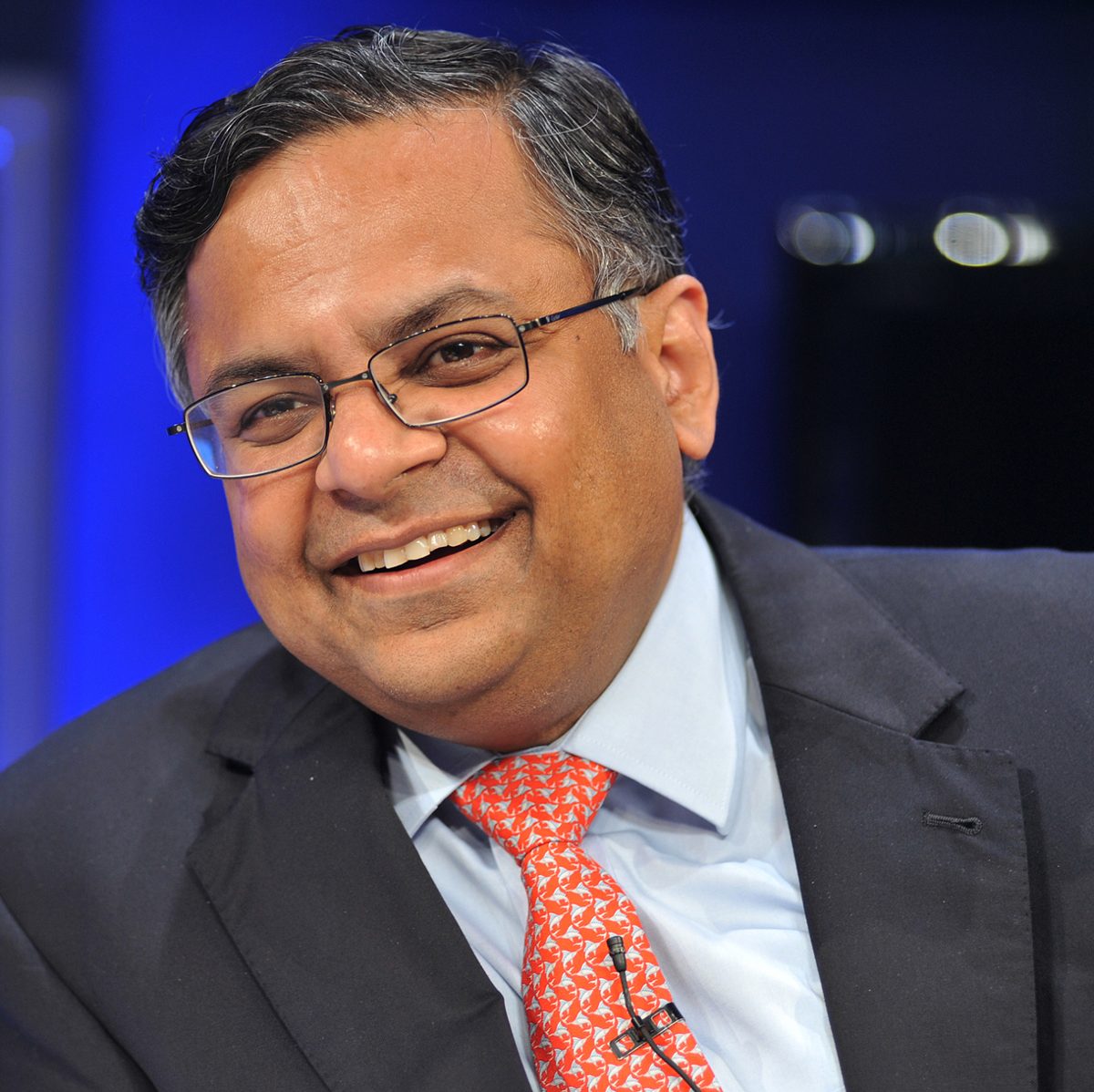
| Key facts | |
|---|---|
| Born | 2 June 1963, Mohanur, Namakkal district, Tamil Nadu [22][23] |
| Hometown/Family roots | A farming family on the banks of the Cauvery in Mohanur. His father, a lawyer, gave up practice at the Madras High Court to run the family farm; his mother Meenakshi was a homemaker [24][25][26] |
| Education | Tamil-medium government school, Mohanur; BSc Applied Science, Coimbatore Institute of Technology; Master of Computer Applications, Regional Engineering College Tiruchirappalli (now NIT Trichy), 1986 [24][25][1] |
| Family | Wife Lalitha, son Pranav. Youngest of three brothers; brother N. Ganapathy Subramaniam was COO of TCS [1][27][25] |
| Company/Group | Chairman of Tata Sons since 21 February 2017; earlier CEO and managing director of Tata Consultancy Services, 2009-2017 [28][29] |
| Pay | No credible published net worth (he is a professional manager, not a founder-owner). Tata Sons paid him Rs 155.81 crore for FY25 and about Rs 158.7 crore for FY26, as reported from its annual reports [30][31] |
| Known for | Taking TCS from about US$6 billion to more than US$16 billion in revenue; buying back Air India; the group’s push into electronics, semiconductors and batteries; a contested 2026 fight over a third term [2][3][32][33] |
On 27 January 2022, in New Delhi, a soft-spoken man from a village in Tamil Nadu formally took charge of an airline. Air India, the carrier JRD Tata had founded in 1932 and lost to nationalisation in 1953, was back with the Tatas after 69 years. “We are delighted to have Air India back at the Tata Group and are committed to making this a world-class carrier,” Natarajan Chandrasekaran said that day [32].
He had not been born to the Tata name, or to any business name. He grew up in a farming family in Mohanur, walked several kilometres a day to a Tamil-medium government school, and as a young man spent five miserable months on his father’s fields before deciding that agriculture was not for him [25][26]. In 1987 he walked into Tata Consultancy Services as an intern. Thirty years later he was running the whole Tata group, the first chairman of Tata Sons who was neither a Tata nor a Parsi [27][28].
The story of “Chandra” is not a rags-to-riches tale. It is a rarer one in Indian business: how an employee, with no family capital and no business-school degree, rose by patient performance to run one of the world’s oldest and most complicated business families’ empires. It is also, as of November 2026, a story without an ending. A board fight over whether he should get a third term is unresolved, and the Tata group faces the prospect of listing its holding company for the first time in its 158-year history.
Where it began
Natarajan Chandrasekaran was born on 2 June 1963 in Mohanur, a small town on the Cauvery in Namakkal district, about 415 km southwest of Chennai [22][24]. He grew up in the village’s agraharam, the old Brahmin quarter, where friends and family still call him “Chandru” [24]. He was the youngest of three brothers and had three sisters [27][25].
The family had roots in the soil and in local institutions. His grandfather, Srinivasa, helped found a primary cooperative bank in the village and set up a modern rice mill in the 1950s [24]. His father was trained as a lawyer and practised at the Madras High Court before returning to Mohanur to farm. “My father was a lawyer by training, but when my grandfather died, he had to give that up to manage the family farm,” Chandrasekaran told The New York Times [26]. The family grew bananas, rice and sugarcane [26][34]. Sources differ on how much land it held: Business Standard reported about 100 acres, while Chandrasekaran himself has spoken of about 15 [24][26].
His father ran the household on a strict principle of accounting. “My father would say that you need to know the value of everything you get - value of money, and value of time,” he recalled [26]. The children had to write down every rupee they spent [35][34]. Years later, asked for the best advice of his life, he quoted his father again: “You are doing incredibly well, and God has been kind to you. The only thing I’ll tell you is, be humble, always” [36].
He studied in a Tamil-medium government school in Mohanur up to Class 10, walking three to four kilometres each way, and switched to English medium for higher secondary [25][22]. He was good at mathematics, captained the agraharam’s cricket team as a left-handed batsman and spinner, and was class leader and badminton captain [25][24][26]. When he had surgery in Class 6 and missed two weeks of school, his class teacher stepped in. “My class teacher, Kannammal, kept complete notes of every subject for me,” he said decades later [35]. A classmate summed him up to The Week: “He would never give up easily” [25].
A detour through the fields
He left home for the first time to study for a BSc in applied science at the Coimbatore Institute of Technology, graduating in 1981 [24]. Then he went back to the farm. “I did a science degree and then went back. After five months, I started feeling miserable, he started feeling bad and then we had a chat,” he said of his father [26]. He briefly considered chartered accountancy [25]. His CIT principal, M. Gurusamy, later said he nudged the young man towards computer applications when he was “seriously considering taking up agriculture” [25]. Father and son agreed he would go back to studying, this time for a master’s degree in computers [26].
He joined the first batch of the Master of Computer Applications programme at the Regional Engineering College in Tiruchirappalli, now NIT Trichy, and finished in 1986 [25][24]. (Britannica gives the year as 1987; most other sources, including Tata’s own profile, say 1986 [23][1].) He never went to business school [34].
The first break
His final-year project took him to TCS in Mumbai. “I came to TCS to do my college project. Then I was interviewed by F.C. Kohli,” he recalled, referring to the engineer often called the father of the Indian software industry [35]. He joined in 1987, aged 24, as an intern; Business Standard reported he was TCS’s first hire with a computer-applications degree, and that he was told he was a “test case” for hiring more [27][24]. “My first job was at TCS, when the company had about 500 employees,” he said [26].
The next 15 years were spent mostly with clients. He worked in Mumbai and on assignments in California, Stockholm and the United Kingdom [37]. Quartz counted about a decade spent at client sites in the US, the UK and Sweden [27]. In 1993 he moved to the United States, built a team from scratch and grew the account he served into one of TCS’s five largest global customers [37]. Around 2000 he helped drive an e-business unit that, according to The Federal, reached US$500 million in revenue within five years [38].
He had caught the eye of S. Ramadorai, Kohli’s successor as CEO. “I spotted him (Chandrasekaran) way back in 1996, and knew that he had the potential,” Ramadorai said in 2009 [27]. In 2002 Chandrasekaran became head of global sales [37]. On 7 September 2007 he was promoted from executive vice president and head of global operations to chief operating officer and joined the TCS board [39]. As COO he was described as the architect of a 2008 reorganisation and was instrumental in TCS’s roughly US$505 million purchase of Citigroup Global Services that year [37].
He also picked up the habit that would define his public image. Partly because of a family history of diabetes, he started running in his forties [40][27]. “Running gives you the time to think,” he said in 2010. “I don’t like indoor gyms, so we try and work outdoors as much as possible” [40]. He has since finished all six World Marathon Majors - Tokyo, Boston, London, Berlin, Chicago and New York - and is an avid photographer [1][4]. He was candid about his pace: “I am just completing the marathon” [40].
Building the empire
CEO of TCS, 2009-2017
On 26 May 2009, TCS named Chandrasekaran CEO-designate, and on 6 October 2009 he took over as CEO and managing director at 46, with Ramadorai staying on as vice-chairman [29][37]. The company he inherited had about 1.4 lakh employees [29]. “In a few days time, we will have a vision statement but it will not be about numbers,” he said on his first day. Acquisitions, he added, would “not be just to add revenue but something that will add capabilities” [41].
He broke TCS into 23 smaller business units, each with its own profit-and-loss account, chief and HR team, so that decisions were taken close to the customer [42][43]. He pushed into cloud services for small businesses with iON in February 2011, and into Japan in April 2014 by combining TCS Japan with Mitsubishi Corporation’s IT Frontier, a venture with more than US$600 million in revenue and 2,400 staff in which TCS held 51% [5][6]. “This strategic transaction signifies our serious commitment to the Japan market,” he said [6]. TCS also built a digital business early: by FY16 it brought in US$2.3 billion, about 16% of revenue [43].
The numbers over his seven-and-a-half years tell the story.
| TCS | When he took over | When he left |
|---|---|---|
| Revenue (US$) | About US$6.0 billion (FY09) [2] | US$16.54 billion (FY16); US$17.58 billion in FY17, the year he handed over [3][7] |
| Revenue (Rs) | Rs 27,813 crore (FY09) [44] | Rs 1,08,646 crore (FY16) [44] |
| Net profit | Rs 5,256 crore (FY09) [44] | Rs 24,292 crore (FY16) [44] |
| Employees | 1,43,761 (March 2009) [2] | 3,87,223 (March 2017) [7] |
TCS crossed US$10 billion in annual revenue in FY12 [42]. On 30 December 2011 its market value of Rs 2,28,153 crore edged past Reliance Industries’ Rs 2,27,083 crore, making it India’s most valuable company for the first time; the two swapped places several times after that [45]. On 23 July 2014 TCS became the first Indian company worth more than Rs 5 lakh crore [44]. By the time he left in January 2017 its market value was about Rs 4.43 lakh crore, and it was by far the largest cash generator in the Tata group [44][24].
He collected honours along the way: Institutional Investor’s best CEO in its Asian rankings every year from 2010 to 2015, Business Today’s best CEO in 2013 and 2014, and The Economic Times’ Business Leader of the Year for 2016 [8][9]. He chaired the industry body NASSCOM in 2012-13, and in 2016 the government nominated him to the central board of the Reserve Bank of India [1][46].
The call from Bombay House
On 24 October 2016, the Tata Sons board removed Cyrus Mistry as executive chairman, and Ratan Tata came back as interim chairman [10]. Chandrasekaran had joined the Tata Sons board that month [1]. On 12 January 2017 the board named him chairman, and he took charge on 21 February 2017, at 53 [27][28]. He was the first non-Parsi to lead the group in a line that ran back to the founder Jamsetji Tata [27].
The group he took over had revenue of about US$103 billion and more than 100 operating companies [28][47]. It was also bruised. The European steel business was bleeding, the telecom arm was piling up losses, the boardroom fight with Mistry was in court, and Tata Motors’ passenger-vehicle market share had fallen to an all-time low of 5.2%, with a Rs 1,052 crore loss in the December 2016 quarter [48]. “We will work together to deliver business performance which is industry leading in all our businesses,” he said on his first day [28].
One Tata: cutting weight before running faster
His diagnosis was simple. The group had too many companies doing too many things. His plan, which he called “One Tata”, was to fold more than 100 companies into a handful of clusters. Before trying to run faster, he told colleagues, “you have to bring your weight down” [47][49].
The first year was a clean-up. Tata Sons approved Rs 36,400 crore of fresh funding for group companies, mostly to pay down the telecom business’s debt, and Tata Steel approved a Rs 12,800 crore rights issue [48]. The group settled a long dispute with Japan’s NTT DoCoMo over its telecom venture, paying about US$1.2 billion [48]. Then, on 12 October 2017, it handed its consumer mobile business - about 4 crore subscribers in 19 circles - to Sunil Bharti Mittal’s Bharti Airtel on a “debt-free, cash-free” basis. Airtel took only a small part of the unpaid spectrum dues; Reuters described the deal as Airtel getting the business “virtually free” [50]. It was a painful exit, but it stopped the bleeding. By the December 2017 quarter Tata Motors was back in profit, with Rs 184 crore, and its layers of management had been cut from 14 to five [48].
Steel was next. On 18 May 2018, a Tata Steel subsidiary completed the purchase of a 72.65% controlling stake in the insolvent Bhushan Steel under the new Insolvency and Bankruptcy Code, paying Rs 35,200 crore to its financial creditors [11]. It was the first big resolution under the IBC and gave Tata Steel a large, modern plant in Odisha. In September 2022 the group announced it would merge seven metal companies, including Tata Steel Long Products, Tata Metaliks and Tinplate Company of India, into Tata Steel [51]. In consumer goods, Tata Chemicals’ food business was merged into Tata Global Beverages, which was renamed Tata Consumer Products in February 2020 with turnover of about Rs 10,000 crore [12].
Air India: the homecoming
The biggest bet was emotional as much as commercial. On 8 October 2021, the government announced that Talace, a Tata Sons company, had won Air India with an offer of Rs 18,000 crore: Rs 15,300 crore of debt taken over and about Rs 2,700 crore in cash [52]. The rival bid, from a consortium led by SpiceJet’s promoter, was Rs 15,100 crore [32]. Air India’s total debt was Rs 61,562 crore, most of which the government kept in a separate holding company [52]. On 27 January 2022 the Tatas took over 100% of Air India and Air India Express and half of the ground-handling firm AISATS [32].
Then came scale. On 14 February 2023 Air India ordered 470 aircraft - 250 from Airbus and 220 from Boeing - at a list price of more than US$70 billion, one of the largest orders in aviation history. Chandrasekaran called it the “most significant moment” for the airline [53]. AirAsia India and Air India Express were merged on 1 October 2024, and Vistara, the Tata-Singapore Airlines joint venture, was folded into Air India on 12 November 2024. Singapore Airlines took 25.1% of the enlarged airline, which ran more than 5,600 flights a week and held about 29% of the domestic market [54]. That put the Tatas in direct competition with Rahul Bhatia’s IndiGo.
Groceries, gadgets and chips
A second push was into consumer technology. In May 2021 Tata Digital, set up in 2019, bought a majority of the online grocer BigBasket; competition regulators cleared a stake of up to 64.3% [55]. The group later launched its Tata Neu “super-app”, an effort that would draw criticism for its losses (see below).
The third and largest push was into hardware. On 27 October 2023 Tata Electronics bought Wistron’s iPhone factory in Karnataka for about US$125 million (about Rs 1,040 crore), becoming the first Indian company to assemble iPhones [56]. In January 2025 it bought 60% of Pegatron’s Indian unit [57]. On 29 February 2024 the Union Cabinet approved two Tata semiconductor projects: a Rs 91,000 crore chip fabrication plant at Dholera, Gujarat, with Taiwan’s Powerchip (PSMC), designed for 50,000 wafers a month, and a Rs 27,000 crore chip assembly and testing plant in Assam [58]. The same day, the group’s battery company Agratas picked Somerset in England for a £4 billion, 40 GWh gigafactory, alongside a plant planned in Sanand, Gujarat [59][13].
In the UK, Tata Steel agreed a £1.25 billion shift at Port Talbot from blast furnaces to an electric arc furnace, with the British government putting in a £500 million grant and Tata £750 million. The switch cost jobs but, the company said, preserved about 5,000 [14].
Unlocking value and the 2025 restructuring
From 2025 the group began to reshape its listed companies. Tata Capital raised Rs 15,512 crore in the largest Indian IPO of 2025 and listed on 13 October 2025 [60]. Tata Motors split into two listed companies with effect from 1 October 2025: a passenger-vehicle company that holds Jaguar Land Rover and the EV business, and a commercial-vehicle company that listed on 12 November 2025 [61]. The commercial-vehicle business then agreed to buy Italy’s Iveco for about €3.8 billion [62]. In November 2025 TCS and the private-equity firm TPG set up HyperVault, a 1-gigawatt AI data-centre business with about Rs 18,000 crore of combined equity [63].
By his account in January 2026, Tata had 2.5 lakh EVs on Indian roads and had built ten new factories in a year, with six more planned, all designed to be “AI-first” [13].
The scorecard
Under Chandrasekaran the group roughly doubled in size. Group revenue rose from Rs 7.89 lakh crore in FY20 to Rs 16.24 lakh crore in FY26, and profit after tax from about Rs 32,000 crore to about Rs 1.71 lakh crore [64][31]. “Revenue is 2.1x, and profits are 5.4x their FY20 levels,” he wrote in the FY26 annual report [31]. The combined market value of listed Tata companies grew from about US$130 billion when he took over to about US$277 billion in March 2026, according to Outlook Business [47]. At the holding-company level, Tata Sons repaid more than Rs 20,000 crore of debt in 2024 and reported a standalone profit of Rs 26,232 crore in FY25 [65][30].
He has been paid accordingly. Tata Sons paid him Rs 155.81 crore for FY25, of which Rs 140.69 crore was commission linked to profit [30]. For FY26 the total was about Rs 158.7 crore, with commission unchanged; The Economic Times had reported that he declined a pay rise for that year, though the annual report showed his fixed salary rising [31][66]. There is no credible published estimate of his personal net worth from Hurun, Forbes or Bloomberg. Figures that circulate online are not attributed to any reliable source, and we do not repeat them.
The setbacks and failures
The record is not a straight line.
Telecom was written off, not fixed. The 2017 Airtel deal ended the group’s two-decade mobile adventure at enormous cost, with Tata Sons pumping in tens of thousands of crores to clear debts before the exit [48][50].
Air India has burned cash. The airline lost Rs 10,859 crore in FY25 and, according to Singapore Airlines’ disclosures as reported by Outlook Business, about US$2.8 billion in FY26, the year of the Ahmedabad crash. Chief executive Campbell Wilson resigned, and Chandrasekaran was reported to have taken direct charge of day-to-day operations [67]. The Tata Trusts questioned how much capital the airline was consuming [67].
The digital bets lost money. Losses at BigBasket and the Tata Neu platform, along with Air India, were among the concerns Noel Tata reportedly raised in early 2026 [68].
2025 was, in his words, “humbling”. A cyberattack shut Jaguar Land Rover’s UK factories for about six weeks from late August 2025. JLR posted a £485 million pre-tax loss in the July-September quarter, against a profit a year earlier, and the UK government guaranteed a £1.5 billion loan to protect its suppliers [69][70]. The UK’s Cyber Monitoring Centre called it “the most economically damaging cyber event to hit the UK”, with an estimated cost of £1.9 billion [71]. “2025 has been a humbling year, unrelenting in its unpredictability,” he wrote to employees. The JLR attack, he said, “emphasised that while growth is a focus, resilience has to be a long-term theme” [13].
TCS lost momentum. Over the year to October 2025, a roughly 30% fall in TCS shares wiped about Rs 6.9 lakh crore off the group’s market value, and in July 2025 TCS said it would cut about 2% of its workforce, roughly 12,000 people [72][73].
Controversies and allegations
The Cyrus Mistry dispute and the NCLAT ruling (2016-2022)
Allegation: After Cyrus Mistry was removed as executive chairman on 24 October 2016, two Shapoorji Pallonji group companies that together own about 18% of Tata Sons filed a petition alleging oppression and mismanagement. The National Company Law Tribunal in Mumbai dismissed it in July 2018. On 18 December 2019, the appellate tribunal (NCLAT) declared Mistry’s removal illegal, restored him as executive chairman for the rest of his term, and declared that the “consequential appointment” of the person who replaced him was illegal - a ruling that, in effect, put Chandrasekaran’s position in question [10][74].
Response: Mistry called the NCLAT order “a victory for the principles of good governance and minority shareholders’ rights”. Tata Sons appealed, arguing that the tribunal had gone “completely overboard” in “annulling the appointment of the new Chairman N. Chandrasekaran” [74][10].
What happened next:
- The Supreme Court stayed the NCLAT order in January 2020 [10].
- On 26 March 2021 a three-judge bench led by Chief Justice S.A. Bobde ruled for Tata Sons on every question of law, set aside the NCLAT order and dismissed the Shapoorji Pallonji petition [10].
- A review petition by the Shapoorji Pallonji group was dismissed in 2022 [75].
- Cyrus Mistry died in a road accident near Palghar, Maharashtra, on 4 September 2022, aged 54 [76].
Status: Closed in Tata Sons’ favour. The Supreme Court also upheld the special voting rights of directors nominated by the Tata Trusts - a point that matters again in the 2026 dispute below [10]. (The story of the Mistry family’s long ties with the Tatas is told in our profile of Pallonji Mistry.)
The Air India Flight AI171 crash (2025)
Allegation: On 12 June 2025, Air India Flight AI171, a Boeing 787-8 bound for London, crashed shortly after take-off from Ahmedabad, killing 260 people, including 19 on the ground; one passenger survived [67][77]. The Aircraft Accident Investigation Bureau’s preliminary report in July 2025 found that both engines’ fuel control switches had moved from RUN to CUTOFF about one second apart shortly after liftoff; on the cockpit recording, one pilot asks the other why he cut off the fuel, and the other says he did not [77]. The crash brought scrutiny of Air India’s safety culture. In June 2025 the aviation regulator DGCA ordered the removal of three officials over crew-rostering breaches and issued a show-cause notice, and a DGCA audit reported by Reuters in July 2025 found 51 safety lapses [78][79].
Response: Chandrasekaran told staff it was “the most heartbreaking” crisis of his career [80]. In a television interview he said, “I deeply regret that this accident happened in a Tata-run airline,” and added: “This particular aircraft had a clean history… we must wait for the black box and recorders to tell the story” [81]. Air India said it had complied with the DGCA’s orders and was “fully transparent” with the regulator [78][79]. The Tatas announced Rs 1 crore for each family of the dead and set up the AI-171 Memorial and Welfare Trust with Rs 500 crore, half from Tata Sons and half from the Tata Trusts [15].
What happened next:
- In September 2025, families of four passengers sued Boeing and Honeywell, not Air India, in a US court, alleging faulty fuel switches; Boeing declined to comment [82].
- Families’ lawyers criticised final settlement offers that required them to waive claims; Air India said there was no deadline or pressure on families [83].
- In July 2026 the Supreme Court, hearing petitions including one from the pilot’s father, allowed the final report to be filed in a sealed cover [84]. The AAIB has said the final report will be published only after the full investigation and international review [85].
Status: The cause has not been officially determined. As of 2 November 2026 the AAIB’s final report had not been made public.
The 2025-26 Tata Trusts rift and the third-term fight
Allegation: This is the defining controversy of his later career. The Tata Trusts own about 66% of Tata Sons, and their nominee directors have special voting rights on its board [86][10]. In 2025 the trustees split. In September 2025 a group of trustees blocked the renewal of former defence secretary Vijay Singh as a Trust nominee on the Tata Sons board; in October the government’s home and finance ministers met Noel Tata, Chandrasekaran and others; and in late 2025 trustee Mehli Mistry lost a vote on his own renewal and left, writing that “Nobody is bigger than the institution it serves” [87][88]. In the same period the Trusts had backed Chandrasekaran for a third term, setting aside an age-65 rule for executive roles [72].
By 2026 the relationship between Noel Tata, chairman of the Trusts, and Chandrasekaran had soured. On 24 February 2026 the Tata Sons board deferred a vote on his third term. Reports citing unnamed sources said Noel Tata, the only director not to back him, wanted written commitments that Tata Sons would not list, would stay debt-free and would contain losses at Air India and BigBasket [68][89]. Separately, Maharashtra’s Charity Commissioner restrained the Sir Ratan Tata Trust from holding a board meeting in May 2026 after a complaint about its trustee structure; the Trusts said the order was issued “ex parte, with no notice being given” [16].
Response: “I recommended that it should be deferred,” Chandrasekaran said after the February meeting [89]. On 12 August 2026 he told the board he would not seek reappointment when his term ended on 20 February 2027. “It has been 6 months since that Board meeting, and no resolution has been reached till date,” he said, adding that he had “completed 40 years of professional life at the Tata Group” [64][90]. “In the absence of unanimous support, I chose to defer the decision,” he told the board [91]. The Trusts said they respected his decision and began a search for a successor [90].
What happened next:
- 18 August 2026: the Tata Sons AGM was adjourned for lack of quorum, apparently for the first time in its history; the Registrar of Companies later gave Tata Sons three more months to hold it [92][93].
- 11 September 2026: the RBI rejected Tata Sons’ application to give up its registration as a core investment company. As an “upper layer” NBFC, Tata Sons must now list its shares [86][94]. Shapoorji Pallonji group chairman Shapoor Mistry, whose family wants to sell part of its stake, welcomed the decision [95].
- 17 September 2026: the Tata Sons board voted 4-1 to reappoint Chandrasekaran for five more years from 21 February 2027, with Noel Tata voting against, and approved steps towards listing. Both decisions need shareholder approval [33][96].
- The Trusts called the resolution “illegal” and a “legal nullity”, arguing that under the company’s articles it needed the support of the Trust-nominated directors, and that his August decision had “attained finality” [17].
- In letters in September and October 2026, Noel Tata challenged how the vote was held, including the absence of a selection committee and an alleged undisclosed conflict of interest involving a fellow director’s business dealing with a company reported to be linked to Chandrasekaran’s family. Tata Sons has said the resolution is valid and the relevant disclosures were made. No court or regulator has ruled on these claims [97][98].
- 25 October 2026: Chandrasekaran and Noel Tata met; the talks reportedly ended without a resolution [99].
Status: Unresolved as of 2 November 2026. A Tata Sons board meeting is scheduled for 26 November 2026, where Noel Tata wants options to restructure the company to avoid listing, and a Shapoorji Pallonji funding request, discussed [100]. Chandrasekaran remains chairman until at least 20 February 2027. Whether he stays beyond that depends on a shareholder vote the Trusts are contesting.
TCS in US courts (Epic Systems and CSC/DXC)
Allegation: In April 2016, during his time as TCS chief, a Wisconsin jury found that TCS staff working for a hospital client had downloaded confidential documents from Epic Systems’ customer portal, and awarded Epic US$940 million [101]. In November 2023 a Texas jury found TCS had misappropriated trade secrets of Computer Sciences Corporation (now DXC) and awarded US$210 million [102].
Response: In the Epic case TCS said it “did not misuse or derive any benefit from downloaded documents” [101]. In the DXC case it maintained that the information was not confidential [103].
What happened next:
- Epic: the award was cut on appeal to US$280 million; the US Supreme Court declined TCS’s appeal in November 2023 and TCS booked a provision of about US$125 million [104].
- DXC: in November 2025 a US appeals court upheld about US$56 million in compensatory and US$112 million in punitive damages, finding TCS acted “willfully and maliciously” [18][19]. The US Supreme Court declined to hear TCS’s appeal in June 2026, and TCS took a further charge of about US$70 million [103].
Status: Both cases are concluded against TCS.
TCS layoffs, bias complaints and cyber incidents (2025)
Allegation: In April 2025 Bloomberg reported that the US Equal Employment Opportunity Commission was examining complaints from American workers, mostly over 40 and not of South Asian origin, who alleged that TCS let them go while keeping Indian visa holders [105]. In July 2025 TCS’s plan to cut about 12,000 jobs drew complaints from IT unions, and a Karnataka union raised an industrial dispute [73]. UK MPs wrote to TCS about its role as an IT supplier to Marks & Spencer and JLR after cyberattacks on both [106].
Response: TCS called the bias allegations “meritless and misleading” [105]. It said the job cuts were part of becoming “future-ready” [73]. On M&S, TCS said it found no sign that its own network was compromised and called a report linking a lost contract to the attack “misleading” [107]. Chandrasekaran told the TCS AGM in June 2026: “There is no downsizing of staff. That is not planned at all. We just want to have the right talent” [108].
Status: No public finding has been made against TCS in the EEOC matter or over the cyberattacks, as far as we could find. The union dispute has no reported outcome.
Tata Steel IJmuiden prosecution (Netherlands, 2026)
Allegation: On 8 July 2026 Dutch prosecutors said they would prosecute Tata Steel IJmuiden, the group’s Dutch steelworks, for the alleged intentional and unlawful release of harmful substances, among other offences, following a 2021 complaint on behalf of about 800 local residents [109][110].
Response: Tata Steel called the allegations “fundamentally unjustified” and said incidents had fallen 98% since 2020 [110].
Status: Pending; a first hearing was set for 20 November 2026 in Amsterdam [110]. The case concerns the company; no allegation has been made against Chandrasekaran personally.
Giving back
Chandrasekaran is not a philanthropist in the way founders such as Azim Premji are, because the wealth he runs is not his. The Tata group’s giving flows through the Tata Trusts, which own about two-thirds of Tata Sons and receive most of its dividends; he is not a trustee [86]. We found no reported personal philanthropy on a large scale. His public contribution has been through institutions and ideas.
In 2019 he co-wrote Bridgital Nation: Solving Technology’s People Problem with Tata economist Roopa Purushothaman, released by Prime Minister Narendra Modi on 20 October 2019 [20]. Its argument is that India should not let technology replace workers but use it to “bridge” them into better jobs, with “digitally literate and technology augmented workers” taking on tasks that skilled professionals cannot reach, from healthcare to logistics [111].
He has held a long list of public roles: director on the RBI’s central board from 2016, chair of the B20 during India’s 2023 G20 presidency, co-chair of the India-US CEO Forum, and member of advisory councils in Singapore and Japan [46][1]. He received the Padma Bhushan in 2022, France’s Légion d’honneur in 2023, and an honorary KBE, whose insignia the British High Commissioner presented in New Delhi on 18 March 2026 [112][1][21]. “This honour is not mine alone,” he said [21].
He speaks often to students. “Life is a marathon race, not a sprint. It is about becoming better by the day, not overtaking others,” he told graduates in Chennai in September 2026. “Don’t fear downs, and do not turn your confidence into arrogance” [113]. On artificial intelligence, he called it in February 2026 “the next big infrastructure… the infrastructure of intelligence” [114].
Succession
For most of his tenure, succession at Tata was a question about who would follow Chandrasekaran around 2027. In 2026 it became a question about Chandrasekaran himself.
After he said in August he would not seek another term, Business Today reported a shortlist that included Tata Steel’s chief executive T.V. Narendran, Tata Sons’ group finance chief Saurabh Agrawal and the National Stock Exchange’s chief Ashish Chauhan [115]. The board’s September vote to reappoint him pre-empted that search, but the Trusts dispute it [33][17]. He turns 65 in June 2028; Noel Tata has reportedly pushed for an age limit of 65 for executive roles [100].
Since a 2022 change to Tata Sons’ articles, one person cannot chair both the Tata Trusts and Tata Sons, which rules out Noel Tata himself [116]. Noel’s children, Leah, Maya and Neville, hold management roles in group companies, but none has been named as a candidate for the top job [116].
What their journey teaches
Depth beats speed in a long career. He spent 30 years in one company and 15 of them mostly with clients before running anything big. His own line is that “everything is long-haul. Nothing happens overnight” [27]. The village boy who spent five months on a farm before finding computers did not rush; he compounded.
Fix the balance sheet before you chase the story. His first Tata year was spent selling the telecom business for almost nothing, paying off DoCoMo and recapitalising Tata Steel - unglamorous work that made the later bets on Air India and semiconductors possible [48][50].
Write it down. His father made the children record every rupee they spent [35]. The same habit of counting shows in how he talks about the group: a few clear numbers (2.1x revenue, 5.4x profit), reported every year [31].
Performance earns a seat, but governance decides whether you keep it. Chandrasekaran’s results did not stop a dispute with the group’s controlling shareholder in 2026. For any professional manager, the lesson is that relationships with owners, and the rules in a company’s articles, matter as much as the numbers.
Own the bad day in public. After the Ahmedabad crash he said, “I deeply regret that this accident happened in a Tata-run airline” [81]. Saying sorry plainly, and setting aside Rs 500 crore for the families, did not answer every question about Air India’s safety, but it showed what a leader owes people in a crisis [15].
Big bets come in bundles. Electronics, chips, batteries and aircraft were not separate gambles but a single wager on India’s manufacturing future. How they pay off will define his legacy more than anything he did at TCS.
For more on how India’s IT industry was built, read our profiles of N. R. Narayana Murthy and Shiv Nadar, and for market explainers, see CapitalVia Insights.
A profile for general reading, based on public records and reporting as of 2 November 2026. Not investment, tax or legal advice.
Sources (116)
- Chairman profile: N Chandrasekaran (PDF) - Tata.com, Feb 2025
- TCS FY09 revenues record USD 6B, up 23 percent - TCS press release, Apr 2009
- Annual revenues cross trillion rupees in 2015-16 - TCS press release, Apr 2016
- N Chandrasekaran, Chairman, Tata Sons - Tata.com leadership page, Nov 2026
- iON brings power of world-class technology to India's SMBs - TCS press release, Feb 2011
- TCS and Mitsubishi Corporation's IT Frontier Corporation to combine in Japan - TCS press release, Apr 2014
- Q4 2016-17 Fact Sheet - TCS Investor Relations, Apr 2017
- Profile: Mr Natarajan Chandrasekaran (convocation) - IIT Kanpur, Nov 2026
- N Chandrasekaran wins Business Leader of the Year award - TCS newsroom, Dec 2016
- Tata Consultancy Services Ltd v Cyrus Investments Pvt Ltd, Supreme Court judgment - Indian Kanoon, Mar 2021
- Tata Steel completes acquisition of Bhushan Steel (press release) - Tata Steel, May 2018
- Tata Consumer Products to spearhead FMCG ambitions - Tata Consumer Products, Feb 2020
- Chairman Chandrasekaran's New Year 2026 message - Tata.com, Jan 2026
- Tata Steel signs £500 million grant funding agreement with UK Government - Tata Steel Europe, Sep 2024
- AI-171 Memorial and Welfare Trust - Tata.com, Jul 2025
- Statement from the Tata Trusts, 15 May 2026 - Tata Trusts, May 2026
- The Tata Trusts maintain that the resolution to re-appoint Mr N Chandrasekaran is illegal - Tata Trusts, Sep 2026
- Computer Sciences Corp v Tata Consultancy Services, No. 24-10749 - US Court of Appeals for the Fifth Circuit, Nov 2025
- DXC welcomes US appeals court decision affirming award in trade secrets case vs TCS - DXC Technology, Jan 2026
- PM's address at the release of the book Bridgital Nation - PMIndia, Oct 2019
- Tata Group Chairman receives Honorary Knighthood insignia - GOV.UK, Mar 2026
- From TCS intern to Tata Sons chairman: N Chandrasekaran's journey - Business Today, Sep 2026
- Natarajan Chandrasekaran - Encyclopaedia Britannica, Nov 2026
- How Mohanur's 'Chandru' ran to success - Business Standard, Jan 2017
- The N. Chandrasekaran story, from a Tamil Nadu village to Tata's top chair (archive, first published Jan 2017) - The Week, Aug 2026
- Natarajan Chandrasekaran in The New York Times 'Corner Office' (interview by Adam Bryant, reproduced) - bobmorris.biz, Mar 2015
- Farmer, intern, aide to CEO, and group chairman: marathoner N Chandrasekaran has seen it all - Quartz, Jan 2017
- Tatas will lead, not follow: Chandrasekaran - Business Standard (PTI), Feb 2017
- N Chandrasekaran takes over as TCS CEO - Business Standard, Oct 2009
- Tata chairman N Chandrasekaran's compensation up 15% at Rs 156 crore in FY25 - Business Standard, Jul 2025
- N Chandrasekaran's Rs 685 crore pay in 5 years - Business Today, Jul 2026
- Tata Group takes over loss-making Air India - The Tribune, Jan 2022
- India's Tata Sons board approves fresh five-year term for chairman Chandrasekaran (Reuters) - ThePrint, Sep 2026
- Eight fascinating facts about new Tata Sons chief Natarajan Chandrasekaran - Business Today, Jan 2017
- Setting a target can be the most limiting thing: TCS CEO N. Chandrasekaran - Business Today, Dec 2013
- Stay humble, learn on the job: N Chandra and Harsh Mariwala on their fathers' advice - Business Today, Nov 2022
- Newsmaker: Natarajan Chandrasekaran - Business Standard, Oct 2009
- 15 highlights from Chandra's 40-year Tata career - The Federal, Aug 2026
- TCS rejigs top brass, inducts 4 directors - Business Standard, Sep 2007
- Running the show - Business Standard, Nov 2010
- 'We will come out with a vision statement soon' - Business Standard, Oct 2009
- The marathon-runner leads the sprint - Business Standard, May 2013
- N Chandrasekaran: Marathon runner takes the leap - Business Standard, Jan 2017
- TCS market capitalisation jumped over three-fold under N Chandrasekaran - Business Standard, Jan 2017
- TCS overtakes RIL as country's most valued firm - Business Standard, Dec 2011
- N. Chandrasekaran re-nominated as director, RBI - Banking Frontiers, Jun 2020
- How Chandrasekaran turned legacy Tata into a new-age powerhouse - Outlook Business, Aug 2026
- N Chandrasekaran's one year as Tata Sons chairman - Business Today, Feb 2018
- Six months of Chandra: One Tata and more - Business Standard, Aug 2017
- Bharti Airtel to acquire Tata's mobile business for free - Business Standard (Reuters), Oct 2017
- Tatas to merge seven metal companies into Tata Steel - The Tribune, Sep 2022
- After 67 years, Air India heads back to founder Tata group - Business Today, Oct 2021
- Air India orders 470 planes, 250 from Airbus and 220 from Boeing - Business Standard, Feb 2023
- Air India-Vistara merger complete; new entity to run 5,600 weekly flights - Business Standard, Nov 2024
- Tata Digital acquires majority stake in BigBasket - YourStory, May 2021
- Tata acquires Wistron's India operations for about Rs 1,040 crore - Free Press Journal, Oct 2023
- Tata acquires 60% stake in Apple partner Pegatron's India unit - TechCrunch, Jan 2025
- Cabinet approves three more semiconductor units including two by Tata - Business Today, Feb 2024
- Agratas confirms Somerset will be home to £4bn gigafactory - EIC, Feb 2024
- Tata Capital lists flat after 2025's biggest IPO - Free Press Journal, Oct 2025
- Tata Motors CV shares to list on November 12 after demerger - Business Standard, Nov 2025
- Tata Motors takes over Iveco Group - Sustainable Bus, Jul 2025
- TCS signs up with TPG for Rs 18,000 crore data centre play - Outlook Business, Nov 2025
- N Chandrasekaran resigns as Tata Sons chairman, to stay till Feb 2027 - Business Standard, Aug 2026
- Tata Sons repays over Rs 20,000 crore in debt to avoid mandatory listing - Business Today, Aug 2024
- Tata Sons chairman declines pay hike for FY26 - Business Today, Jun 2026
- A year after AI171 Air India crash: investigation, losses and leadership change explained - Outlook Business, Jun 2026
- Tata Sons puts Chandrasekaran's reappointment on hold after board differences - Business Today, Feb 2026
- JLR reports £485m quarterly loss after cyberattack - Computing, Nov 2025
- Government issues £1.5bn loan guarantee to JLR after cyberattack halts production - Computing, Sep 2025
- JLR cyberattack led to £1.9 billion loss, impacted over 5,000 companies - Business Today, Oct 2025
- 3rd term for Chandrasekaran: Tata Trusts sidesteps retirement rule - Business Today, Oct 2025
- TCS summoned by Labour Ministry over mass layoffs - Business Today, Jul 2025
- Tata vs Mistry: NCLAT restores Cyrus Mistry as executive chairman - Business Standard, Dec 2019
- Tata Sons v Cyrus Mistry: Supreme Court dismisses review petition - Bar & Bench, May 2022
- Former Tata Sons chairman Cyrus Mistry killed in road accident near Mumbai - Business Standard, Sep 2022
- Air India plane's fuel switches were cut off before crash, report says - CBS News, Jul 2025
- Air India ordered to remove 3 officials, gets show-cause notice - ThePrint, Jun 2025
- Air India audit finds 51 safety lapses (Reuters) - Insurance Journal, Jul 2025
- Chandrasekaran calls Air India crash 'most heartbreaking' of his career - Storyboard18, Jun 2025
- 'This aircraft had a clean history': Tata's N Chandrasekaran says sorry for Air India crash - Business Today, Jun 2025
- Families sue Boeing, Honeywell over June Air India crash - Al Jazeera, Sep 2025
- Air India asks Ahmedabad crash victims' families to waive right to legal action - The Wire, Jun 2026
- Air India plane crash: Supreme Court orders AAIB report be submitted in sealed cover - LawBeat, Jul 2026
- Final AI171 crash report only after full probe, international review: AAIB - Business Standard, Jun 2026
- RBI asks Tata Sons to go in for immediate listing - Business Standard, Sep 2026
- The crisis atop the Tata empire, explained - The Week, Oct 2025
- 'Nobody is bigger than the institution': Mehli Mistry ends Tata Trusts standoff with a letter - Business Today, Nov 2025
- Noel Tata vs Chandrasekaran plays out at Tata Sons' helm - The Week, Feb 2026
- 'Respect Chandrasekaran's decision': Tata Trusts begin process to pick new chairman - Business Today, Aug 2026
- Tata Sons chairman N Chandra says won't seek reappointment after term ends in Feb (PTI) - ThePrint, Aug 2026
- Tata Sons AGM adjourned over quorum gap: what next for Chandrasekaran - Outlook Business, Aug 2026
- Registrar of Companies grants three months to Tata Sons for AGM - Business Standard, Aug 2026
- Tata Sons listing may be inevitable after RBI rejection to deregister as CIC - Business Today, Sep 2026
- Shapoor Mistry backs Tata Sons listing - Telangana Today, Sep 2026
- Tata Sons board for Chandra's reappointment, moves to list co - Outlook Business, Sep 2026
- Noel Tata renews challenge to Tata Sons board vote reappointing N Chandrasekaran - Outlook India, Oct 2026
- Tata Sons chairman vote tainted by undisclosed TVS deal, Trusts claim - Tech Times, Sep 2026
- Noel Tata, Chandra meet to discuss Tata Sons deadlock; talks end without resolution - Free Press Journal, Oct 2026
- Three letters set the tone for Tata Sons board meeting on November 26 - Business Standard, Oct 2026
- Wisconsin jury awards $940M to Epic Systems in Tata trade secret case - Insurance Journal, Apr 2016
- Jury orders Tata to pay $210 million for trade secret misappropriation - Jenner & Block, Nov 2023
- TCS to take $70 million hit after US Supreme Court rejects appeal in DXC trade secrets case - Business Today, Jun 2026
- US Supreme Court rejects Indian IT company's appeal in Epic trade secrets case - Fierce Healthcare, Nov 2023
- EEOC probes US workers' bias claims against TCS - Staffing Industry Analysts, Apr 2025
- MPs press outsourcer TCS over Jaguar cyber attack - Computer Weekly, Sep 2025
- TCS refutes UK media report on losing M&S contract, calls it misleading - IANS, Oct 2025
- N Chandrasekaran resignation: 6 quotes on growth, risk, technology and leadership - Business Today, Aug 2026
- Tata Steel prosecuted for intentional, unlawful pollution, prosecutor announces - NL Times, Jul 2026
- Dutch prosecutors summon Tata Steel over alleged air pollution offences - Business Standard, Jul 2026
- Bridges to the digital mainstream (review of Bridgital Nation) - Business Standard, Dec 2019
- Padma Awards announced - ETV Bharat, Jan 2022
- 'Enjoy the journey, do not turn confidence into arrogance': Chandrasekaran on life lessons - Business Today, Sep 2026
- AI is nothing artificial but it is intelligent, says Chandrasekaran at the AI summit - Business Today, Feb 2026
- Tata Sons chairman race heats up: T V Narendran, Saurabh Agrawal, Ashish Chauhan in contention - Business Today, Sep 2026
- Life after Chandra: could a next-gen Tata be groomed? - YourStory, Aug 2026