
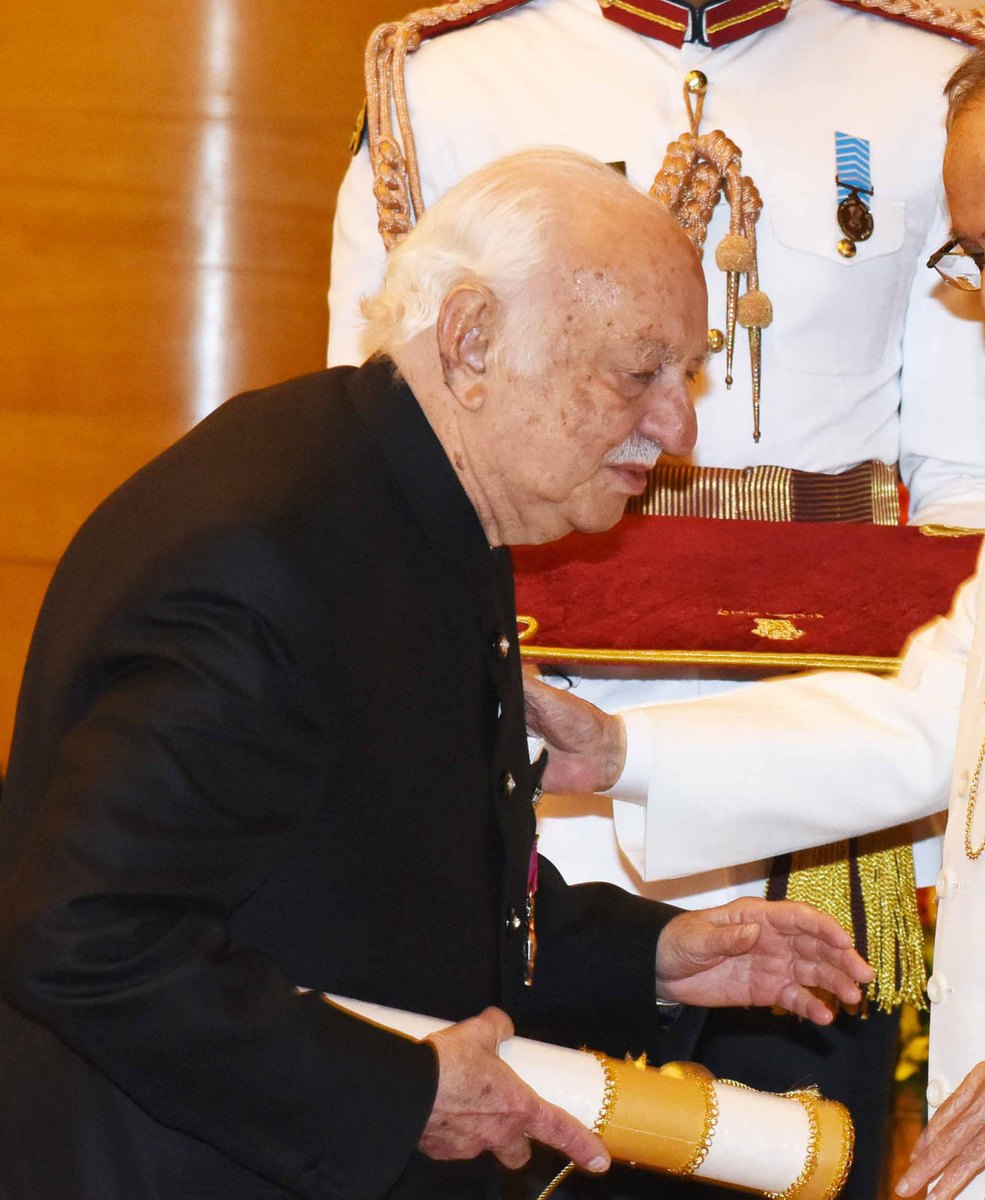
| Key facts | |
|---|---|
| Born | 1 June 1929, Bombay (now Mumbai) [1] |
| Died | 28 June 2022, Mumbai, aged 93 [1] [46] |
| Family roots | Parsi family of builders; grandfather Pallonji Mistry founded the firm in 1865 [1] [15] |
| Education | School and college in Bombay [1] |
| Family | Wife Patsy Perin Dubash; sons Shapoor and Cyrus (1968-2022); two daughters [1] [12] |
| Company/Group | Shapoorji Pallonji Group: construction, engineering, real estate, infrastructure, water and energy; about 18.4% of Tata Sons [1] [2] |
| Wealth | About US$15 billion (Forbes, April 2022); Bloomberg estimated almost US$29 billion at his death, June 2022 [57] [10] |
| Known for | Building much of modern Mumbai and Muscat; the “Phantom of Bombay House”; his family’s long partnership, and later legal battle, with the Tatas |
On 6 June 1980, the minutes of a Tata Sons meeting recorded an awkward moment. JRD Tata, then the most admired industrialist in India, had asked Pallonji Mistry for a promise: that if the Mistry family companies holding Tata Sons shares were ever sold, those shares would first be offered back to the Tatas. The minutes noted that Pallonji “did not show any positive response, but at least said he would consider the matter” [14].
That single line of reported speech is among the very few records of what Pallonji Shapoorji Mistry actually said in a business setting. For more than seven decades he ran one of India’s oldest construction houses, put up the Reserve Bank of India’s headquarters and the Sultan of Oman’s palace, and quietly owned the largest single block of shares in Tata Sons outside the Tata trusts. Yet he almost never gave interviews. Obituaries in 2022 noted that he left behind no on-record quotes worth the name [10] [13].
He was called the “Phantom of Bombay House”, after the Tata headquarters he so rarely visited despite owning nearly a fifth of the company [10] [12]. Forbes valued him at about US$15 billion in 2022 [57]. In 2010 an Irish rich list named him the richest man in Ireland, a country he had reportedly perhaps never visited [50].
This is the story of how a builder’s son from Bombay turned a family contracting firm into a multinational, and how his family’s trust in the Tatas, built over generations, ended in one of the most bitter corporate fights in Indian history.
Where it began
Pallonji Shapoorji Mistry was born on 1 June 1929 in Bombay, into a Parsi family that had been building the city for more than 60 years [1] [11]. (One newspaper gave 18 June; the group’s own obituary note, Wikidata and most reports give 1 June.)
The business was started by his grandfather, also named Pallonji Mistry, in 1865. Working with an Englishman named Littlewood, the founder’s firm, Littlewood Pallonji, took small public-works jobs in colonial Bombay. Its early work included paving at Girgaum Chowpatty and the reservoir on Malabar Hill, which supplied water to the city for more than a century [15] [10]. (Sources differ on the details. Open magazine credits the Chowpatty footpath to Pallonji’s father in 1902, and some accounts date the Littlewood partnership to 1887 rather than 1865 [13].)
His father, Shapoorji Pallonji Mistry, joined the firm in 1902 and made it one of the big contractors of the British-era city [13]. Under Shapoorji the firm built many of the grand buildings that still define south Mumbai’s Fort district: banks such as the Reserve Bank of India, State Bank of India, HSBC, Grindlays and Standard Chartered; the Taj Mahal Palace hotel; Brabourne Stadium; and Mumbai Central railway station, which Business Today reports was completed in 21 months for Rs 1.6 crore [15] [1]. Shapoorji also had a taste for spectacle. He famously financed K. Asif’s epic Mughal-e-Azam (1960) [47].
Shapoorji’s other great bet was on the Tatas. The families’ working relationship went back to the 1920s, according to Bloomberg [10], and in the decades that followed Shapoorji began acquiring shares in Tata Sons, the unlisted holding company of the group. How exactly that happened is disputed, and it matters to the story, so we return to it below.
Pallonji grew up in this world of contracts, site visits and Parsi Bombay. The group’s own account says only that he “attended school and college” in the city [1]. (Some profiles say he studied at Cathedral & John Connon School and Imperial College London; we could not confirm this from a reliable source, and at least one outlet attributes Imperial College to his son Cyrus instead.)
In 1947, the year India became independent, the 18-year-old Pallonji joined the family firm “under the watchful eyes of his father” [1] [12].
The first break
For almost three decades Pallonji worked in his father’s shadow. He took charge of Shapoorji Pallonji & Co after his father’s death in 1975 [1] [13]. By then he had already made the move that would define his career: taking the company abroad.
In 1970 he led the firm into the Gulf, starting work in Abu Dhabi, Qatar and Dubai [10] [11]. Around 1971, the company won a contract that few Indian builders could have imagined: the new palace of Sultan Qaboos bin Said of Oman, along with several ministerial buildings in Muscat [10] [11]. (Forbes dates the win to the late 1960s; the group and most reports put it around 1971.)
The palace, Qasr Al Alam, opened in 1975. The group calls it “the first of many international projects”, and its obituary note describes it as the first project completed abroad by an Indian construction company [3] [1]. That same year the group set up Oman Shapoorji Company (OSCO), sending a team of 30 engineers to Oman for the palace. OSCO went on to build Oman’s Cabinet Building (1985), the Muscat Municipality building (1992) and much else, and today employs more than 6,500 people [4].
Oman did two things for Pallonji. It gave the company a long-lived, cash-generating foreign business. And it proved that a family contractor from Bombay could deliver landmark work for a head of state, which opened doors across the Gulf and later Africa. Parsi Times later summed up his legacy in a phrase: the man who “not only built half of Bombay but also most of Muscat” [52].
At home, Pallonji made a call that ran against the grain of his industry. In the early 1970s he took the group out of real estate development, uncomfortable with new building regulations and the large cash component common in property deals at the time. It stayed out until his son Shapoor brought it back in 1992 [16].
Building the empire
The quiet builder of Bombay
Pallonji’s style was the opposite of the showman tycoon. Architect Hafeez Contractor, who worked with him on several projects, described him in 2012 as “very approachable”, “very nice, very friendly and also helpful”, and a perfectionist willing to spend above budget to get the quality right. Before a project, Contractor recalled, Pallonji would say: “We should ensure that this is the best” [17].
Under him the firm kept building the institutions of modern India. Beyond Bombay, it worked on the Jawaharlal Nehru Stadium and Barakhamba Road metro station in Delhi [15]. In Bombay it built the Bombay Stock Exchange tower, the World Trade Centre (1970), and much later The Imperial twin towers at Tardeo, completed in 2010 and described at the time as India’s tallest building [15] [10]. In Pune it developed Ozone, an 80-acre IT park [10]. When the Taj Mahal Palace hotel was badly damaged in the 26/11 terror attacks of 2008, the firm that had worked on the hotel decades earlier took part in its restoration [15].
Abroad, the order book grew to include the Presidential Office in Ghana, the National Assembly in Gambia, the Ebene Cyber City in Mauritius, Jumeirah Lake Towers in Dubai and the Providence Stadium in Guyana [1] [15].
From one firm to a group
Pallonji also turned a single contracting firm into a diversified group. The group credits him with bringing in Sterling & Wilson (electrical and mechanical engineering), United Motors, Forbes Gokak and Afcons (infrastructure) [1]. Sterling & Wilson had begun in 1927 as Wilson Electric Works, a partnership involving his father, and took its present name in 1973 [8].
In October 2001 the Mistry group bought a block of Forbes Gokak shares from the Tatas, taking its holding to 14.88%, and its companies, including Sterling Investment and Cyrus Investments, made an open offer at Rs 80 a share, a 57% premium, to take control [49]. The company, whose roots go back to 1767, was renamed Forbes & Co in 2007 and housed businesses ranging from engineering to the well-known Eureka Forbes water purifiers [32].
Outside the group, Pallonji was a figure of the old Bombay establishment. He served on the boards of Union Bank of India and the W.H. Brady group, and was chairman of Associated Cement Companies (ACC) for several years [1]; one 2012 profile dates his ACC chairmanships to 1977-79 and 1997-2000 [17].
By 2010-11 the group’s turnover was about US$2.5 billion, more than 60% of it from construction and infrastructure, and it had never raised money from the capital markets in over a century [16]. At the time of his death the group employed more than 50,000 people in over 50 countries, by Bloomberg’s count; the group’s own note put the “SP family” at nearly 70,000 [10] [1].
The Tata Sons stake: how it was built, and why it was disputed
The family’s greatest asset was never a building. It was a stake of about 18.4% in Tata Sons, the holding company that controls Tata Consultancy Services, Tata Steel, Tata Motors and the rest of the Tata empire [1] [5]. The shares are held mainly through two family companies, Sterling Investment Corporation and Cyrus Investments [5] [14].
There are two competing accounts of how the Mistrys got them.
The popular account, repeated by Business Standard and others, is that in 1936 Shapoorji acquired a stake of about 12.5% that had belonged to F.E. Dinshaw, a financier who had lent money to the Tatas in the 1920s, and that JRD Tata’s siblings later sold the family more shares, taking the holding to about 17.5% [20] [14]. HDFC chairman Deepak Parekh offered a more colourful version in 2012: Shapoorji had built factories for the Tata companies, and “the Tatas had no money to pay for them so they gave him shares instead” [15] [17]. That is an anecdote, not a documented fact.
The Mistrys themselves told a different story. In a letter of 3 September 2003, reported by BloombergQuint in 2018, the family said Shapoorji had not bought from the Dinshaw estate. Most of their stake, the letter said, came from JRD’s siblings, who had inherited the shares of R.D. Tata. According to Tata Sons’ own filings at the tribunal, the first Mistry purchase was from Lady Sylla Petit in June 1965, at JRD’s request; more followed from Rodabeh Sawhny in 1970 and from Darab Tata from 1974, taking the stake to about 17.5% by the late 1970s [14]. A Tata Sons rights issue in 1996, which Pallonji supported, lifted it to about 18.4% [20].
What is not disputed is the outcome: by the 1980s, a family of Parsi builders owned the largest individual block in India’s most storied business house, while the Tata charitable trusts held about two-thirds [41].
Kingmaker at Bombay House
Pallonji joined the Tata Sons board in 1980 [14]. He was rarely seen at Bombay House, which earned him his nickname, but his support counted at key moments [10] [13]. In 1991, when JRD Tata handed the chairmanship to Ratan Tata, Pallonji backed the succession [20].
On 27 March 1991, Ratan Tata wrote to him. “In ending, let me reiterate that I will never do anything consciously to hurt you or your family,” the letter said. “Our standing together will also be a matter of strength.” Nearly three decades later, the Mistry side would file that letter in the Supreme Court [19]. (Read CapitalVia’s profile of Ratan Tata for his side of this long relationship.)
Pallonji retired from the Tata Sons board in 2005 after about 25 years, and his younger son Cyrus took the seat [20]. (Some reports date Cyrus’s arrival on the board to 2006 [65].) In November 2011 Tata Sons named Cyrus deputy chairman, and in December 2012 he succeeded Ratan Tata as chairman, at 44 [65] [12]. For a family that had stayed in the background for three generations, it was an extraordinary moment.
Handing over
At home, the succession was settled the same year. Pallonji stepped down as chairman of Shapoorji Pallonji & Co in 2012, aged about 83, and handed over to his elder son Shapoor, becoming chairman emeritus [1] [16]. (Bloomberg reported that Shapoor had already taken over as chairman of the group companies in 2004; the group’s own note says early 2012. The likeliest reading is that Shapoor ran the operating companies first and took the group chair in 2012.) The group marked its 150th year in 2015 with a book whose chapter on him carried the title “The Phantom of Bombay House” [67].
In January 2016 the Government of India announced the Padma Bhushan for him in the trade and industry category; President Pranab Mukherjee presented it at Rashtrapati Bhavan on 28 March 2016 [9] [1].
How the wealth was held, and measured
Pallonji’s fortune was unusual. Most of it sat in a stake he could not easily sell: Tata Sons is unlisted, and its articles give the company rights over how shares change hands, which the Supreme Court upheld in 2021 [5] [10]. Quartz put his fortune at about US$14.1 billion in 2016, most of it tied to that one holding [18] [10].
That is why the estimates differ so much. In 2010 the Sunday Independent rich list put him at €4.4 billion, top of Ireland’s list [50]. The Hurun India Rich List of 2018 listed Shapoor and Cyrus separately, at Rs 69,400 crore each [51]. In April 2022 Forbes valued Pallonji at US$15 billion, No. 125 in the world [57]. When he died two months later, the Bloomberg Billionaires Index put him at almost US$29 billion, making him one of India’s richest people on paper [10] [12].
The setbacks and failures
The longest fight of his life
The great setback of Pallonji’s old age was the collapse of his family’s relationship with the Tatas, covered in detail in the next section. For a man who had built his life on long relationships, it meant years of litigation in his late eighties and early nineties.
The debt crisis
The second setback was financial. The group had always been a family-owned contractor, but by the late 2010s it had taken on heavy borrowing across construction, real estate and solar engineering.
The first visible strain came from Sterling and Wilson Solar. Its August 2019 IPO, entirely an offer for sale by the promoters, was subscribed only 92%, with the retail portion at just 30% [35]. The promoters then struggled to repay loans they owed to the listed company (see the controversies section) [36].
The pandemic made it worse. Bloomberg reported that the group defaulted on a payment in 2020 [10]. In September 2020 the group’s holding company, Shapoorji Pallonji & Co Pvt Ltd, said it would restructure Rs 10,900 crore of debt under the RBI’s COVID-19 resolution framework, to “protect the livelihoods of its employees and contractors”, adding that the promoters had put in more than Rs 3,000 crore over two years [30]. Open magazine later reported that the family put in about Rs 5,100 crore in all [13].
To repay lenders, the group sold assets it had owned for decades. In September 2021 Advent International agreed to buy control of Eureka Forbes at an enterprise value of Rs 4,400 crore, with about Rs 3,100 crore going to the SP Group; an SP executive called it “significant de-leveraging” [32]. Reliance New Energy Solar, part of Mukesh Ambani’s group, took a 40% stake in Sterling and Wilson Solar, completed in February 2022 [66]. Group debt, according to a 2023 report, fell from about Rs 32,500 crore in January 2022 to about Rs 20,000 crore a year later [53].
Losses after his death
Pallonji died in June 2022. Ten weeks later, on 4 September 2022, his son Cyrus died when the car he was travelling in hit a divider on a bridge over the Surya river in Palghar district, near Mumbai. A family friend travelling with him also died. Police later charged the car’s driver with rash and negligent driving, citing over-speeding, and noted that the passengers in the rear seats were not wearing seat belts [56] [48].
After that, the burden fell on Shapoor. The group continued to sell assets, including Gopalpur Port in Odisha, which Gautam Adani’s Adani Ports agreed to buy in March 2024 at an enterprise value of about Rs 3,080 crore, plus a contingent amount [33]. Afcons Infrastructure listed in November 2024 after a Rs 5,430 crore IPO, most of it shares sold by a promoter company; the stock opened about 8% below its issue price [34].
Controversies and allegations
Pallonji Mistry was never personally charged with any crime, and we found no SEBI, ED, SFIO or CBI action against him personally. The controversies around him are largely about his family’s dispute with Tata Sons and the SP Group’s finances. Matters after 28 June 2022 involve the group under his son Shapoor, and are marked as such.
The Tata-Mistry boardroom war (2016-2022)
Allegation: On 24 October 2016, the Tata Sons board removed Cyrus Mistry as executive chairman. Tata Sons said Cyrus had lost the confidence of a majority of the board and cited a “trust deficit” [5]. Two Mistry family companies, Cyrus Investments and Sterling Investment, then filed a petition on 20 December 2016 alleging oppression of minority shareholders and mismanagement of Tata Sons, including in how the removal was carried out [5].
Response: Tata Sons denied the allegations and defended the board’s right to replace its chairman. Pallonji himself made no public statement that we could find; Business Standard later described him as someone who “never sought to challenge Tata’s leadership” [20]. In September 2020, as the fight widened, the SP Group issued a statement that “the SP-Tata relationship spanning over 70 years was forged on mutual trust, good faith, and friendship”, but that “a separation of interests would best serve all stakeholder groups” [21] [22].
What happened next:
- 9 July 2018: The NCLT’s Mumbai bench dismissed all the allegations and held that the board was entitled to remove a chairman in whom it had lost confidence. Cyrus’s office called the ruling “disappointing although not surprising” [23].
- 18 December 2019: The appellate tribunal, NCLAT, held the removal illegal, ordered Cyrus restored as executive chairman and set aside Tata Sons’ 2017-18 conversion into a private company [24]. The Supreme Court stayed that order in January 2020 [68].
- 26 March 2021: A three-judge Supreme Court bench led by Chief Justice S.A. Bobde allowed Tata’s appeals. It held that removal from a directorship cannot by itself amount to oppression, that the conversion to a private company was “perfectly in order”, and left the question of valuing the Mistry stake to other lawful routes [5]. Cyrus said he was “personally disappointed” but “I sleep with a clear conscience” [25].
- May 2022: The Supreme Court dismissed the Mistry companies’ review petitions, while agreeing to expunge some adverse remarks about Cyrus [26].
Status: Concluded. The Supreme Court’s 2021 judgment, upheld on review in 2022, is final; Tata Sons won. The Mistry family remains a shareholder.
Pledging the Tata Sons shares (2020)
Allegation: In September 2020, with the group under financial pressure, the SP Group planned to raise about Rs 11,000 crore from global investors, signing a first Rs 3,750 crore tranche with Brookfield backed by a pledge of Tata Sons shares [28]. Tata Sons went to the Supreme Court on 5 September 2020, arguing that the pledge would breach its articles, which restrict how the shares can change hands [28] [29].
Response: The SP Group called Tata’s move an “oppressive and vindictive act” aimed at creating “delays and roadblocks” in its fund-raising, and argued that the articles governed transfers, not pledges [28]. In July 2021 it maintained that it did not need Tata’s permission to pledge [31].
What happened next:
- 22 September 2020: The Supreme Court ordered status quo, barring the group from raising money against the shares for the time being [29].
- The same week the SP Group said it was ready to separate from Tata Sons; Tata Sons said it was willing to buy the stake [21].
Status: Overtaken by events. The group’s later borrowings (below) have been secured partly on its Tata Sons and Afcons shares under structures it has defended as lawful; we found no court ruling against them.
The valuation dispute and the Tata Sons listing fight (2020-2026)
Allegation: The two sides disagreed sharply on what the stake is worth. In an October 2020 filing, the SP Group valued its 18.37% at about Rs 1.75 lakh crore. Tata Sons’ counsel Harish Salve told the Supreme Court in December 2020 that it was worth Rs 70,000-80,000 crore [27]. The dispute has since shifted to whether Tata Sons should list its shares, which the SP Group says would let it realise fair value.
Response: The SP Group under Shapoor Mistry has pressed for a listing. After the RBI’s reported September 2026 direction, Shapoor said: “I welcome the decision wholeheartedly”, calling listing “a social and moral imperative” that “should not be viewed as a victory of one stakeholder over another” [43]. Tata Trusts, the majority shareholder, has opposed listing and in July 2025 asked Tata Sons to open talks to give the SP Group an exit [55].
What happened next:
- September 2022: The RBI classified Tata Sons as an “upper layer” NBFC, which under its rules meant listing by 30 September 2025; Tata Sons applied to surrender its registration instead [41].
- 30 September 2025: The deadline passed without a listing [41].
- 11 September 2026: The RBI reportedly rejected the surrender application and directed Tata Sons to list, according to people who had seen the letter [41].
- 17 September 2026: The Tata Sons board voted to move towards listing and reappointed N. Chandrasekaran as chairman by four votes to one, with Noel Tata (the Trusts’ chairman, and Pallonji’s son-in-law [1]) opposed. The Trusts called the resolution a “legal nullity” [42].
- September-October 2026: The Trusts prepared a legal challenge; the RBI and Noel Tata filed caveats in the Bombay High Court [61] [62].
- 24 October 2026: Without naming any company, RBI Governor Sanjay Malhotra said upper-layer NBFCs need RBI registration because of the systemic risk they carry [64].
Status: Unresolved as of 25 October 2026. No listing date has been set, no SP Group exit has been agreed, and no court has ruled on the latest dispute. This matter post-dates Pallonji’s death. (Trustee Venu Srinivasan is among the trustees involved in the Trusts’ internal disagreements [62].)
Sterling and Wilson Solar: promoter dues (2019-2023)
Allegation: After the 2019 IPO, the SP Group’s holding company and co-promoter Khurshed Daruvala owed Sterling and Wilson Solar more than Rs 2,300 crore in loans and sought more time to repay, citing a credit crunch and lower-than-expected IPO proceeds [35] [36]. In September 2020 Business Today reported that more than Rs 1,000 crore due in June and September 2020 had not been repaid [36].
Response: The company’s CFO said the delay would not affect working capital [36]. The promoters pledged property against the shortfall, and the board extended the deadline and raised the interest rate [36]. When Reliance bought in, the promoters signed an indemnity agreement in December 2021 [6].
What happened next:
- Under that agreement the company claimed Rs 418.13 crore as of 30 September 2023, including Rs 342.87 crore from Shapoorji Pallonji & Co. Daruvala paid his share; the SP holding company said on 30 November 2023 that it would pay “in the next few business days” [6].
Status: No court or regulatory finding was made. The episode is a matter of record in stock-exchange filings; we found no later dispute.
CBI bribery case involving an SP Group executive (2025, after his death)
Allegation: On 10 May 2025 the CBI arrested an Income Tax Commissioner in Hyderabad and an SP Group deputy general manager (taxation), among others, alleging a bribe of Rs 70 lakh to decide a tax appeal of a group company in its favour [44].
Response: The SP Group said the alleged conduct “was not with the knowledge of the Group, nor was it sanctioned by the Group”, that it had launched an internal enquiry, and that it would cooperate fully [45].
Status: Under investigation as far as public reporting shows; we found no chargesheet or verdict as of October 2026. It does not involve Pallonji, who had died three years earlier.
Irish citizenship
In 2003 Pallonji gave up Indian citizenship and became an Irish citizen through his marriage to Patsy Perin Dubash, who was born in Dublin [12] [10]. It was widely remarked upon, especially when Irish rich lists began to rank him first [50], but we found no allegation of wrongdoing linked to it.
Status of this section: as of 25 October 2026.
Giving back
Pallonji’s giving, like the rest of his life, was quiet. The group’s obituary note says his “personal philanthropy, always given privately and without any fanfare, over the decades has been significant” [1]. No amounts have been disclosed.
The one gift the group names is a home for elderly Parsis. In 2006, Pallonji and his wife Patsy funded and set up a home for senior citizens at the B.D. Petit Parsee General Hospital in Mumbai [1]. Parsi Times describes him as a “silent philanthropist” interested in senior-citizen care, health care, education and research, and reports that the family and group renovated the building that houses the Iranshah sacred fire at Udvada, the holiest site of the Zoroastrian faith in India [52].
The SP Group’s corporate programmes today cover education and skilling, healthy living, water and the environment. The group says it has helped educate about 23,000 children and given 160,000 rural residents access to water through check dams [7].
The group’s tribute captured how those around him saw him: “He embodied the Zoroastrian virtues of ethics, integrity, fair play in all dealings and being sympathetic and generous to those sections of society less fortunate” [1].
Death
Pallonji Mistry died in his sleep at about 1 a.m. on 28 June 2022 at his home in south Mumbai, aged 93 [46] [48] [59]. His funeral was held the next morning at Doongerwadi, the Parsi Towers of Silence at Kemps Corner [46].
Prime Minister Narendra Modi said he “made monumental contributions to the world of commerce and industry” [47]. President Ram Nath Kovind called him a “doyen of infrastructure and building industry” whose “contribution to wealth creation and nation building will be long remembered” [46]. Vaccine maker Cyrus Poonawalla remarked on how discreet he had remained despite his achievements [63].
Succession
Pallonji handed the group chair to Shapoor, born in 1964, in 2012 [1] [16]. After Cyrus’s death in 2022, the family reorganised. A 2023 restructuring split the holding company between the families of the two brothers and created a four-member family advisory board of Shapoor, his son Pallon, and Cyrus’s sons Zahan and Firoz, with professional managers running the businesses [53]. In August 2025 Shapoor stepped down as chairman of Afcons and his son Pallon S. Mistry joined its board [54].
The group Pallonji left is smaller in some ways and more leveraged in others. Since 2023 it has relied on large, high-cost private credit deals, borrowing against Tata Sons and Afcons shares: Rs 14,300 crore of bonds at an 18.75% yield in June 2023, a record US$3.4 billion deal at a 19.75% yield in May 2025, and a Rs 15,100 crore rupee refinancing plus a US$650 million dollar bond in July 2026 [37] [38] [40]. In April 2026 it asked bondholders to delay a Rs 14,300 crore repayment [39]. Outlook Business reported in August 2026 that about Rs 3,500 crore was due by the end of September, and that the newer bonds require a Tata Sons resolution, heads of terms for a deal, or an IPO announcement within 18 months [60]. No default on these bonds has been reported [40]. Forbes values Shapoor Mistry and family at about US$10.4 billion as of September 2026, a fortune shared with the family of the late Cyrus [58].
Much of what happens next depends on a question Pallonji never answered in public: when, and at what price, his family’s stake in Tata Sons can become cash. CapitalVia’s insight on how one rupee in every three is now being built, not spent shows how central construction has become to India’s economy, the business that started it all for the Mistrys.
What their journey teaches
Go where your competitors will not. In the early 1970s an Indian contractor building a palace for an Arab ruler was almost unheard of. Pallonji’s bet on Oman and the Gulf gave his firm a foreign business that outlasted every Indian real estate cycle.
Quality is a sales strategy. Architects who worked with him remembered a man willing to go over budget to get the work right. Repeat clients over generations, from Bombay’s banks to the Tatas, rewarded that reputation.
Walking away from easy money can be the smart move. He took the group out of property development in the early 1970s because he disliked how the business was done. It cost growth, but kept the firm out of a business he distrusted until the rules and the next generation changed.
Trust is an asset, but write it down. The Mistrys’ relationship with the Tatas ran on goodwill for generations. When it broke, what mattered in court was the articles of association, not the 1991 letter.
Illiquid wealth is not the same as cash. On paper Pallonji was one of the world’s richest men; in practice his family borrowed at nearly 20% because its biggest asset could not easily be sold. Concentration builds fortunes, and also traps them.
You can lead without a microphone. He gave almost no interviews in 75 years of business, yet his support helped decide who ran India’s largest group in 1991, and his family’s stake still shapes its future.
A profile for general reading, based on public records and reporting as of 25 October 2026. Not investment, tax or legal advice.
Sources (68)
- Padma Bhushan Pallonji Shapoorji Mistry (obituary note) - Shapoorji Pallonji Group, Jun 2022
- About Us - Shapoorji Pallonji Group, Oct 2026
- Qasr Al Alam Palace - Shapoorji Pallonji Group, Oct 2026
- Oman Shapoorji Company - Shapoorji Pallonji Group, Oct 2026
- Tata Consultancy Services Ltd v Cyrus Investments Pvt Ltd, judgment - Supreme Court of India, Mar 2021
- Update on Indemnity Claim (stock exchange filing) - Sterling and Wilson Renewable Energy, Nov 2023
- Impacting people: CSR - Shapoorji Pallonji Group, Oct 2026
- About us - Sterling and Wilson, Oct 2026
- President presenting the Padma Bhushan to Pallonji Shapoorji Mistry (PIB photo record) - Wikimedia Commons, Mar 2016
- Pallonji Mistry, Indian billionaire who feuded with Tata, dies - Bloomberg via Al Jazeera, Jun 2022
- Indian billionaire-developer Pallonji Mistry of Shapoorji Pallonji Group dies at 93 - Bloomberg via Gulf News, Jun 2022
- Ireland's richest person dies aged 93 - The Irish Times, Jun 2022
- Pallonji Shapoorji Mistry (1929-2022): The Builder - Open Magazine, Jul 2022
- How the Mistrys acquired their stake in Tata Sons - BloombergQuint via The Quint, Jan 2018
- When the Tatas had no money to pay Pallonji family - Business Today, Oct 2016
- Challenges Shapoor Mistry faces being at the helm - Business Today, Sep 2012
- Pallonji Shapoorji Mistry: A quiet billionaire - India Today/Yahoo via Parsi Khabar, Aug 2012
- Pallonji Mistry: an Irish billionaire's journey from outsider to kingmaker to opponent at the Tata Group - Quartz, Oct 2016
- 'I will never do anything to hurt you or your family': Ratan Tata in letter to Pallonji Mistry in 1991 - Business Today, Feb 2020
- Shapoorji Mistry pays tribute to Ratan Tata: A look at the family feud - Business Standard, Oct 2024
- Shapoorji Pallonji group agrees to exit Tata Sons, calls for separation - Business Standard, Sep 2020
- 'With a heavy heart': Shapoorji Pallonji group set to part ways with Tata Sons - Business Today, Sep 2020
- 'Disappointing' says Cyrus Mistry as NCLT upholds his sacking by Tata Sons - The Quint, Jul 2018
- Removal of Cyrus Mistry as Executive Chairman of Tata Sons held illegal by NCLAT - SCC Online, Dec 2019
- Disappointed with SC judgment but I sleep with clear conscience: Cyrus Mistry - The Week, Mar 2021
- Supreme Court dismisses review plea of SP Group against Tata Sons judgment - LiveLaw, May 2022
- Mistry family's 18.37% stake worth Rs 80,000 cr: Tata Sons tells SC - Business Today, Dec 2020
- Mistrys to raise Rs 11,000 crore pledging Tata Sons stake; Tatas object in SC - Business Today, Sep 2020
- SC orders status quo on raising capital over shares held by Mistrys in Tata Sons - LiveLaw, Sep 2020
- SP Group to recast Rs 10,900-cr debt under Covid-19 resolution framework - Business Standard, Sep 2020
- Tata go-ahead not needed to pledge shares, says Shapoorji Pallonji group - Business Standard, Jul 2021
- Advent acquires Eureka Forbes at an enterprise valuation of Rs 4,400 crore - Business Standard, Sep 2021
- Adani Ports to acquire 95% of Odisha's Gopalpur Port - Deccan Herald, Mar 2024
- Afcons Infrastructure shares debut 8 per cent lower - Outlook Business, Nov 2024
- Sterling & Wilson IPO garners only 92% subscription on the last day - Business Standard, Aug 2019
- Shapoorji Pallonji group fails to repay dues to Sterling & Wilson Solar - Business Today, Sep 2020
- India's Shapoorji group entity's bond issue signals appetite from private credit funds - Reuters via Yahoo, Jun 2023
- Shapoorji Pallonji group inks record $3.4 billion private credit deal - Business Standard, May 2025
- Shapoorji Pallonji Group seeks to delay paying $1.5 billion of debt - Business Standard, Apr 2026
- Shapoorji Pallonji Group closes one of India's biggest private credit deals - Business Standard, Jul 2026
- RBI asks Tata Sons to list: A timeline of the long regulatory tussle - Business Standard, Sep 2026
- Tata Sons listing: RBI, Tata Trusts, board meeting and 4 key questions - Business Standard, Sep 2026
- 'Welcome the decision wholeheartedly': Shapoorji Pallonji on RBI's decision on Tata Sons listing (full text) - Business Today, Sep 2026
- CBI arrests IT commissioner, Shapoorji Pallonji group executive in bribery case - The Tribune, May 2025
- SP Group launches internal inquiry on arrest of executive in bribery case - Deccan Chronicle, May 2025
- Billionaire Pallonji Mistry dies at 93; Prez, PM pay tribute - PTI via OrissaPOST, Jun 2022
- Pallonji Mistry dies at 93 - DT Next, Jun 2022
- Billionaire Pallonji Mistry dies at 93; PM pays tribute - Outlook, Jun 2022
- Shapoorji offers Rs 80 for Forbes Gokak pie - Business Standard, Oct 2001
- Mystery man is Ireland's richest person - IrishCentral, Mar 2010
- Cyrus, Shapoor Mistry debut in rich list; Mukesh Ambani retains top spot - Business Standard, Sep 2018
- A tribute to Pallonji Shapoorji Mistry - Parsi Times, Jun 2023
- How the Shapoorji Pallonji Group is being restructured - 5paisa, Apr 2023
- Shapoor Mistry hands over leadership to son Pallon S. Mistry amid potential Tata Sons exit - Outlook Business, Aug 2025
- Tata Trusts push exit talks with SP Group to block Tata Sons IPO - Outlook Business, Jul 2025
- Police file charge sheet in Cyrus Mistry car crash in Palghar court - Outlook Business, Jan 2023
- Pallonji Mistry profile - Forbes, Apr 2022
- Shapoor Mistry & family profile - Forbes, Sep 2026
- Pallonji Mistry passes away at 93: A look back at his life, relationship with the Tatas - Business Today, Jun 2022
- Tata Sons stake at risk? SP Group faces Rs 3,500 crore repayment deadline - Outlook Business, Aug 2026
- Battle lines are drawn: Tata Trusts prepares to challenge N Chandrasekaran's reappointment in the court - Business Today, Sep 2026
- Tata Trusts dispute escalates as Noel Tata moves Bombay High Court - Gulf News, Oct 2026
- El multimillonario Pallonji Mistry, pionero indio de la construcción, muere a los 93 años - Forbes España, Jun 2022
- Upper-layer NBFCs must list to avoid risk: RBI Governor amid Tata Sons row - The Week, Oct 2026
- How Cyrus Mistry became youngest chairman of Tata Sons - Outlook Business, Sep 2022
- Reliance completes 40% acquisition in EPC company Sterling and Wilson Solar - Mercom India, Feb 2022
- Changing Skylines: The Shapoorji Pallonji Sesquicentennial 1865-2015 (library listing) - UDRI, Oct 2026
- SC stays NCLAT order reinstating Cyrus Mistry as Exec Chairman of Tata Sons - Moneylife, Jan 2020