
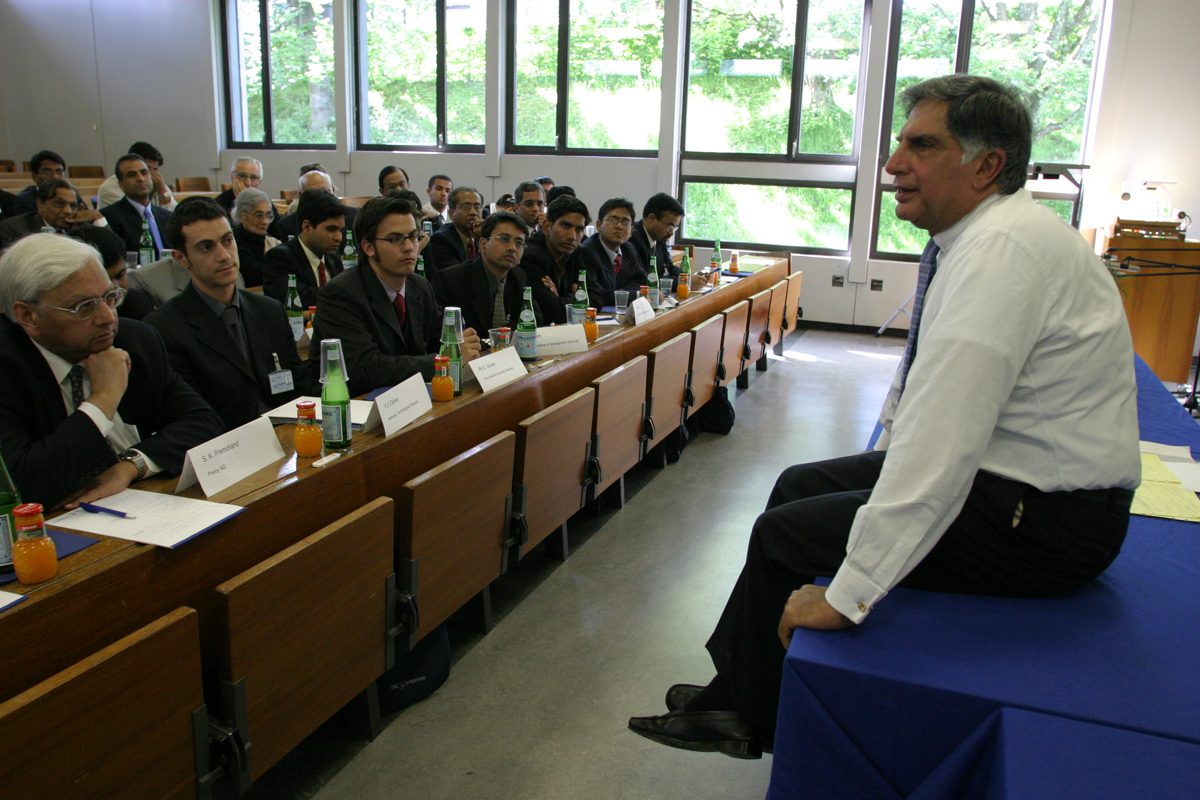
| Key facts | |
|---|---|
| Born | 28 December 1937, Bombay (now Mumbai) [1] |
| Died | 9 October 2024, Breach Candy Hospital, Mumbai, aged 86 [87] |
| Family roots | Parsi Tata family of Bombay. Father Naval Tata had been adopted into the family by Lady Navajbai Tata, widow of Sir Ratanji Tata; mother Soonoo. Raised largely by his grandmother after his parents divorced [1] [3] |
| Education | Campion School and Cathedral & John Connon School, Mumbai; Cornell University (B.Arch., 1962); Advanced Management Program, Harvard Business School (1975) [1] [13] |
| Family | Never married. Brother Jimmy Tata; half-brother Noel Tata, now chairman of Tata Trusts [3] [89] |
| Company/Group | Chairman of Tata Sons 1991-2012 and interim chairman 2016-17; chairman of the Tata Trusts until his death; Chairman Emeritus of Tata Sons [2] [44] |
| Wealth | About Rs 3,800 crore, No. 421 on the IIFL Wealth Hurun India Rich List 2022, his last listing; his estate was valued at about the same figure in 2025 probate reporting. Most of the group’s value sits with the Tata Trusts, which own about 66% of Tata Sons [49] [50] [96] |
| Known for | Taking the Tata group from about Rs 10,000 crore of revenue in 1991 to more than US$100 billion in 2011-12; Tetley, Corus and Jaguar Land Rover; the Indica and the Nano; giving through the Tata Trusts [30] [31] |
On 10 January 2008, at the Auto Expo in New Delhi, a 70-year-old man unveiled a small, rounded car. It was the Tata Nano, the “one-lakh car” he had promised India four years earlier. Input costs had climbed sharply since then, but he held the price. “Since we started the project four years back, there has been a steep increase in input cost,” Ratan Tata told the hall, “but a promise is a promise” [39].
That year held his whole career in miniature. In June 2008 he completed the purchase of Jaguar and Land Rover from Ford for US$2.3 billion, the kind of global deal no Indian company had dreamt of a generation earlier [6]. In October, after weeks of protests over farmland, he pulled the Nano factory out of Singur in West Bengal and moved it to Gujarat [40]. In November, terrorists attacked his family’s most famous property, the Taj Mahal Palace in Mumbai, and he spent the following months making sure the families of the dead were looked after for life [5].
Ambition, a promise kept at a price, a public fight, a tragedy met with decency. This is the story of how a shy, architecture-trained heir whom many thought too soft for the job turned a loose federation of Indian companies into a global group, and of what went wrong along the way.
Where it began
Ratan Naval Tata was born in Bombay on 28 December 1937 to Naval Tata and Soonoo Tata [1]. The family name was famous, but his own link to it came through adoption. His father Naval had been adopted as a boy by Lady Navajbai Tata, widow of Sir Ratanji Tata, the younger son of the group’s founder Jamsetji Tata [3]. Thomas Mathew’s authorised biography, published after Ratan Tata’s death, reported that Parsi priestly records in Navsari show Naval and Jamsetji also shared a distant common ancestor [106].
His parents divorced when he was a child. He and his younger brother Jimmy were brought up by their grandmother at the family’s Tata Palace home in Bombay [1]. Tata later described a protected and fairly lonely childhood. “We were very protected and we didn’t have many friends. I had to learn the piano and I played a lot of cricket,” he said [1]. In a 2020 post he said he had “a happy childhood”, but that as the brothers grew older “we faced a fair bit of ragging and personal discomfort because of our parent’s divorce” [21]. The lesson his grandmother drilled into them, he said, was dignity above everything else [21].
He studied at Campion School and then Cathedral & John Connon School in Bombay [1]. He was, by his own account, shy, and he said he never quite lost his fear of public speaking [1].
His relationship with his father was harder. “I wanted to learn to play the violin, my father insisted on the piano. I wanted to go to college in the US, he insisted on the UK. I wanted to be an architect, he insisted on me becoming an engineer,” he recalled [20].
Cornell and Los Angeles
He went to Cornell University in the United States in 1955, at 17 [1]. He first studied engineering, partly to honour his father’s wishes, then switched to architecture. Cornell records him as a member of the class of 1959 who took a five-year Bachelor of Architecture in 1962 [13]. “If it weren’t for my grandmother, I wouldn’t have ended up at Cornell,” he said, adding that the switch caused “a fair bit of rancour, but I was finally my own, independent person in college” [21]. At Cornell he also learnt to fly [13].
After graduating he moved to Los Angeles to work in an architect’s office and had no plans to come home [19] [22]. “I never regretted being an architect. I only regret that I was not able to practise it long,” he said in 2020 [22]. He also told an interviewer that it was in Los Angeles that he fell in love and almost married. He came back to India “at least temporarily” because his grandmother was unwell, and after the 1962 India-China war, he said, the woman’s family were no longer willing for her to follow him [20].
Back in Bombay he had a job offer from IBM. JRD Tata, the group’s chairman, objected: according to tata.com, he did not want a Tata working for IBM in India. Ratan joined the family firm instead [1].
The first break
His start was not glamorous. In 1962 he joined Tata Industries as an assistant and was sent to Jamshedpur. He spent about six months at Telco (now Tata Motors) and then joined a training programme at Tisco (now Tata Steel), where he worked on the shop floor with blue-collar workers [1] [19]. He was blunt about the Telco stint later: “a total waste of time”, moved “from one department to another”. “It was only after I moved to Tata Steel that I got specific work and my job got interesting” [23].
By 1965 he was a technical officer in Tisco’s engineering division. He spent time as the group’s representative in Australia in 1969 and had a short spell at TCS in 1970 [1]. Also in 1965, following his grandmother’s wishes, he became a trustee of the Sir Ratan Tata Trust, which she had chaired since 1919 [3].
Two sick companies
In 1971 he was made director-in-charge of National Radio & Electronics (Nelco), an ailing consumer electronics maker [1] [18]. He also took on Central India Spinning, Weaving and Manufacturing, owner of the old Empress Mills in Nagpur [25]. Business Standard later wrote that he turned Nelco around within about four years, before it collapsed in an economic slowdown and labour trouble, and that the Empress Mills effort in 1977 also failed [24].
For years these were held up as proof that he could not run a business. He disagreed. “Let me correct you, NELCO was not an unsuccessful stint,” he told Pritish Nandy, recalling a time when “we never knew if we would be able to meet our payroll requirements at the end of every month” [26]. The lessons were real ones: how to deal with unions, with a cash crunch, and with head office refusing to put in more money.
He joined the Tata Sons board in 1974 and attended Harvard Business School’s Advanced Management Program in 1975 [1]. In 1981 he became chairman of Tata Industries, the group’s holding company for new ventures, and in 1983 drafted a strategic plan for the group [1]. From 1986 to 1989 he was also chairman of Air India [1]. JRD was by then his mentor. Ratan Tata credited him with the idea behind Titan and with standing by him through the transition that followed [26].
25 March 1991
On 25 March 1991, JRD Tata handed the chairmanship of Tata Sons to Ratan Tata, then 53 [1]. The reaction was not warm. tata.com itself says he “was seen by many as an interloper, with none of the charisma or the capability of the legend” [1]. Business Standard described him as a shy man who “had nothing much to show except a famous surname” [24].
The timing was remarkable. Within weeks India was in a balance-of-payments crisis, and by July the Narasimha Rao government had begun opening the economy. The Tata companies that had grown up behind licences and tariffs were about to face real competition, and the new chairman was about to find out whether he was in charge at all.
Building the empire
Taking back the group (1991-1998)
In 1991 the Tata group was less a company than a federation. Powerful chief executives ran the big firms almost as personal fiefdoms: Russi Mody at Tata Steel, Darbari Seth at Tata Chemicals and Tata Tea, Ajit Kerkar at Indian Hotels [25] [28]. Tata Sons often held only small direct stakes in them; in Indian Hotels, for example, Outlook reported that Tata Sons directly owned just 11.2% [27].
Tata’s tools were rules rather than rows. A retirement age for directors forced out the old guard one by one [28]. Mody was removed as Tata Steel chairman in 1993, Seth retired from Tata Chemicals and Tata Tea in 1995, and Kerkar left Indian Hotels in 1997 [29]. In 1998 the group adopted a single logo, and group companies began paying Tata Sons a royalty for using the Tata name, which also gave Tata Sons a way to set standards for anyone using the brand [29]. A small Group Executive Office of senior lieutenants was set up in 1998 to drive performance and restructuring across the companies [32].
He also sold what did not fit. Tata Oil Mills (Tomco) went to Hindustan Lever in the early 1990s, the cosmetics brand Lakme followed to Hindustan Lever later in the decade, the pharma company Merind went to Wockhardt, and the group’s stake in cement maker ACC was sold to Gujarat Ambuja in 2000 [29]. Each sale was criticised at the time as the Tatas abandoning their heritage. Each freed up money and management time for the businesses he wanted to grow.
His own explanation of those years was simple. Colleagues who had been “their own bosses” felt “some resentment,” he said, and “Jeh stood with me in making this transition” [26].
The Indica: India’s first home-designed car (1998)
His first big bet was a car. Tata Motors (then Telco) made trucks and buses. In the mid-1990s Ratan Tata pushed it into passenger cars with a hatchback designed and engineered in India. The Indica was shown at the Auto Expo in 1998 with a starting price of about Rs 2.6 lakh, and it drew more than one lakh bookings [33]. It is widely described as India’s first indigenously designed passenger car [33].
The early cars had mechanical problems. A popular story says that in 1999 Tata went to Detroit to sell the car business to Ford and was humiliated by Bill Ford, who asked why he had entered a business he knew nothing about. After Tata’s death Bill Ford publicly denied it. He said the two had met once, in “a warm and cordial meeting”, and that press accounts “could not be any further from the truth” [34]. The story is best treated as legend. What is documented is the turnaround: an improved Indica V2 sold strongly, reaching about 1.4 lakh units at its peak [33].
Going global: Tetley, Daewoo, NatSteel (2000-2005)
Tata’s strategy from the late 1990s was to stop treating India as the whole market. In February 2000 Tata Tea bought Britain’s Tetley, a far bigger and better-known brand, for £271 million [35]. It was an early sign that an Indian company could buy a famous Western name rather than just sell to one.
Other purchases came quickly. In 2004 Tata Motors bought the commercial vehicle arm of South Korea’s Daewoo for about US$102 million, then its largest overseas investment [36]. In 2005 Tata Steel completed the purchase of Singapore’s NatSteel for S$486.4 million [37]. Tata companies also bought hotels abroad, including the Ritz-Carlton in Boston, and chemicals businesses such as Brunner Mond in Britain and General Chemical in the US [29].
TCS goes public (2004)
The real money engine was quieter. Tata Consultancy Services, set up in 1968, had become India’s largest software company, ahead of rivals such as Infosys, co-founded by N. R. Narayana Murthy. In July-August 2004 it came to the stock market at Rs 850 a share, raising about Rs 5,420 crore [17]. At about US$1.17 billion it was India’s largest IPO up to that time, and it was heavily oversubscribed [38] [17]. “It is heartening for the Tata group to have this kind of response that far exceeded what we had hoped for,” Tata said [38].
TCS’s profits, and the dividends it paid to Tata Sons, would later fund much of the group’s expansion and, through Tata Sons’ ownership, the Tata Trusts’ charity. (For how India’s software exports have grown since, see CapitalVia’s look at India’s software export numbers.)
Corus: the biggest bet (2007)
In late 2006 Tata Steel bid for Anglo-Dutch steelmaker Corus, a company several times its size. The Brazilian group CSN bid against it. The contest went to an auction run by the UK Takeover Panel, which ended on 31 January 2007 with Tata Steel offering 608 pence a share against CSN’s 603 pence, valuing Corus at about £6.2 billion [7]. Including debt the deal is usually put at about US$12-13 billion, and it was then the largest foreign takeover by an Indian company [77] [43]. More than half of it was paid for with borrowed money [77].
At the time it was celebrated as India’s arrival on the world stage. The bill came later, as the setbacks section below explains.
Jaguar Land Rover (2008)
On 2 June 2008 Tata Motors completed the purchase of Jaguar and Land Rover from Ford for a net US$2.3 billion in cash; Ford also put about US$600 million into the companies’ pension plans [6]. “This is a momentous time for all of us at Tata Motors,” Tata said [6]. Within months the global financial crisis hit car sales. In the following decade JLR became Tata Motors’ biggest source of revenue, though it also produced heavy losses in bad years, including a £3.1 billion write-down in late 2018 [76].
The Nano and Singur (2006-2008)
The Nano was Tata’s most personal project. He said at its launch that the concept “started as a social issue and not as a business or philanthropy”: a safe, affordable car for families who could otherwise only afford a two-wheeler [39]. Tata Motors chose Singur, near Kolkata, for the factory, and the Left Front government of West Bengal acquired about 1,000 acres of farmland for it [70] [69].
Farmers who had not agreed to sell, backed by Mamata Banerjee’s Trinamool Congress, protested. Construction went ahead, but by the second half of 2008 the protests had brought work to a halt. On 3 October 2008 Tata announced he was leaving Singur. “If somebody puts a gun to my head, the person will either have to pull the trigger or take the gun away… I think Ms Banerjee has pulled the trigger,” he said [40]. Within days the company announced that the plant would go to Sanand in Gujarat instead [40] [70].
26/11 and the Taj
On 26 November 2008 terrorists attacked Mumbai, including the Taj Mahal Palace hotel. Thirty-one people died at the Taj, eleven of them employees [5]. The group’s response became one of the best-known parts of Tata’s reputation. Families of staff who died were promised the employee’s full last salary for life, education for their children anywhere in the world, lifelong medical care, and the waiving of all loans. Railway staff, police and vendors affected by the attacks were also helped. In December 2008 Tata and Taj chief R.K. Krishna Kumar set up the Taj Public Service Welfare Trust to help victims of terror attacks and disasters [5]. When the hotel reopened, he said: “We can be hurt, but we cannot be knocked down” [5].
The numbers by 2012
When Tata turned 75 and retired on 28 December 2012, the group was a different animal. Revenue had grown from about Rs 10,000 crore in 1991 [30] to US$100.09 billion (about Rs 4.76 lakh crore) in 2011-12, of which about 58% came from outside India. Profit after tax was about US$5.2 billion and the group employed about 4.56 lakh people [31]. Its 32 listed companies were worth about US$89 billion on the stock market [31]. AFP’s later estimate of the journey was “about $6 billion to $100 billion” [42]. Sources differ on the exact 1991 figure, but every count shows revenue rising more than 40-fold.
After a search by a selection committee, in November 2011 the Tata Sons board named Cyrus Mistry, 43, son of the group’s largest minority shareholder Pallonji Mistry, as deputy chairman to take over on Tata’s retirement. Tata called it “a good and far-sighted choice” [9]. From 29 December 2012 Tata became Chairman Emeritus of Tata Sons and several group companies, while continuing to chair the Tata Trusts [2].
Afterwards: startups, Air India and the last chapter
Retirement turned him into one of India’s best-known startup investors. Using his personal investment company, RNT Associates, he backed Snapdeal (2014), Paytm (2015), Urban Ladder, Zivame, Urban Company, Lenskart and Ola, among others [46]. In April 2015 he bought a stake in China’s Xiaomi, the first Indian to do so [47]. In 2016 RNT Associates set up a fund with the University of California’s investment office to back Indian ventures [48]. He also backed Goodfellows, a companionship service for elderly people started by his young assistant Shantanu Naidu [100].
In October 2016 he came back to Bombay House as interim chairman after Mistry’s removal (see controversies). In January 2017 the board picked TCS chief N. Chandrasekaran as chairman, the first person from outside the Parsi community to hold the post [44].
One more homecoming mattered to him. On 8 October 2021 Tata Sons won the government’s auction for Air India with a Rs 18,000 crore bid, nearly seven decades after JRD’s airline had been nationalised. “Welcome back, Air India,” Ratan Tata wrote, adding that JRD “would have been overjoyed if he was in our midst today” [45].
How his wealth was held
Ratan Tata ran one of the world’s largest conglomerates but was never close to the top of India’s rich lists. The reason is structural. About 66% of Tata Sons is owned by the Tata Trusts, which are charities; the Shapoorji Pallonji family holds about 18.4% [96]. Tata personally held only a small slice of Tata Sons, reported at about 0.83% [49]. The IIFL Wealth Hurun India Rich List 2022 put his personal net worth at about Rs 3,800 crore, ranking him 421st [49]. After his death, reporting based on the probate petition valued his estate at about Rs 3,800 crore [50] [51]. By comparison, Mukesh Ambani and Gautam Adani own most of their groups personally or through family holding companies.
The setbacks and failures
Nelco and Empress Mills
His first two assignments as a manager both ended badly. Nelco recovered for a while and then fell into losses and labour unrest; Empress Mills, which he took over in 1977, also failed, and the Tatas later exited it [24]. He spent much of the 1980s carrying the label of a man whose businesses had flopped.
Corus and Tata Steel Europe
Corus was bought at the top of the steel cycle with heavy borrowing. The final price was well above Tata’s opening offer, and the financial crisis struck within two years [77]. By 2016 the UK business was losing heavily, and under Cyrus Mistry, Tata Steel sold its UK long-products unit for £1 [77]. By early 2019, Business Standard calculated, Tata Steel’s overseas operations had piled up losses and write-downs running well into five figures in crore [76]. In 2024 Tata Steel closed the blast furnaces at Port Talbot in Wales, replacing them with a £1.25 billion electric arc furnace backed by a £500 million UK government grant, with about 2,500 job losses [78]. Bloomberg quoted ISB professor Kavil Ramachandran saying some of the overseas moves “turned out to be hasty initiatives” [43].
Telecom
Tata Teleservices never became a winner in India’s brutal mobile market [29]. In 2008-09 Japan’s NTT DoCoMo bought 26% of it for about Rs 13,070 crore [8]. The venture struggled, DoCoMo sought to exit, and an arbitration award in London in 2016 ordered Tata Sons to pay US$1.17 billion (see controversies) [74]. In 2017 the group handed its consumer mobile business to Bharti Airtel, founded by Sunil Bharti Mittal, without any payment [75]. Business Standard estimated that telecom had cost Tata Sons about Rs 60,000 crore in write-offs and payouts, against about Rs 93,000 crore in dividends it had received since 2004 [75].
The Nano
The car that was meant to be his legacy did not sell. The Singur move delayed its launch, and sales never came close to early hopes. In June 2018 Tata Motors made just one Nano [41]. In his 2016 letter Cyrus Mistry said the Nano had never been profitable and had lost up to Rs 1,000 crore at its peak [54]. The promise of a one-lakh car was kept; the business case was not.
Controversies and allegations
The boardroom war with Cyrus Mistry (2016-2022)
Allegation: On 24 October 2016 the Tata Sons board removed Cyrus Mistry as chairman without warning, and Ratan Tata returned as interim chairman [56]. Two days later Mistry wrote to the board in a letter that became public. He said he had been made a “lame duck” chairman, that Trust nominees on the board acted as “mere postmen” who left meetings to take instructions from Mr Tata, and that five legacy businesses could need write-downs of about Rs 1.18 lakh crore. He singled out the Nano, saying it had never been profitable [54]. Mistry family companies then petitioned the National Company Law Tribunal (NCLT), alleging oppression of minority shareholders and mismanagement by Tata Sons and Ratan Tata, among others [56].
Response: Tata Sons called the letter “unsubstantiated claims and malicious allegations”, said Mistry had been fully empowered but had lost the board’s confidence, and said it was “unforgivable” that he had tried to “besmirch the image of the group” [55]. Ratan Tata consistently said the removal was a board decision taken in the group’s interest.
What happened next:
- 9 July 2018: NCLT Mumbai dismissed the petition and held that the board was competent to remove its chairman [56].
- 18 December 2019: the National Company Law Appellate Tribunal (NCLAT) reversed this, called the removal illegal and ordered Mistry restored, also restraining Ratan Tata and the Trust nominees from taking decisions in advance on board matters [57].
- 10 January 2020: the Supreme Court stayed the NCLAT order [58].
- September 2020: the Shapoorji Pallonji group told the court it was “time to separate” from the Tatas [61].
- 26 March 2021: a bench led by Chief Justice S.A. Bobde set aside the NCLAT order and ruled in favour of Tata Sons on all questions of law [58]. Tata called the verdict “a validation of the values and ethics that have always been the guiding principles of the group” [59].
- May 2022: the Supreme Court dismissed the Mistry family’s review petition [60].
A linked fight ended earlier. Industrialist Nusli Wadia, removed from some Tata company boards in 2016, filed criminal defamation cases against Ratan Tata and others. The Bombay High Court quashed the criminal case in 2019, and in January 2020, after the Supreme Court urged the two to settle and recorded Tata’s statement that he had not intended to defame him, Wadia withdrew all his cases [62].
Cyrus Mistry died in a road accident in Maharashtra in September 2022 [63].
Status: Concluded in Tata Sons’ favour. The question of the Shapoorji Pallonji family’s roughly 18.4% stake in Tata Sons was not settled by the court and remains open as of October 2026 [96] [92].
The Niira Radia tapes (2010)
Allegation: Between 2007 and 2009 the Income Tax department tapped the phones of corporate lobbyist Niira Radia, whose firm handled public relations for Tata companies. In November 2010 Open and Outlook magazines published transcripts and recordings of some calls, including conversations with Ratan Tata, at the height of the 2G spectrum scandal [64]. During the 2G trial, a defence lawyer for another accused argued that the CBI was shielding the Tatas; those were arguments in court, not findings [68].
Response: On 29 November 2010 Ratan Tata petitioned the Supreme Court, arguing that the leak of private conversations violated his right to privacy and asking for responsibility for the leak to be fixed. He said he had no quarrel with the government [65]. His lawyers later stressed that he was not seeking to stop the media from reporting [66].
What happened next:
- The CBI treated Tata Teleservices as having been disadvantaged in the 2G licence process, not as a beneficiary [68]. Ratan Tata was never charged in the 2G cases.
- In September 2022 the Centre told the Supreme Court that preliminary inquiries arising from the tapes had found no criminality, and argued that Tata’s petition could be closed because the court had since recognised privacy as a fundamental right in the 2017 Puttaswamy judgment [67].
Status: The petition stayed pending for more than a decade; no final ruling on it has been reported as of October 2026. No wrongdoing by Ratan Tata was established.
Singur: the land fight over the Nano plant
Allegation: Farmers and the Trinamool Congress argued that the West Bengal government had forcibly taken fertile farmland at Singur for a private company. Tata, for his part, blamed the agitation led by Mamata Banerjee for driving the project out of the state [40]. Banerjee later said: “I did not drive out the Tatas. CPI(M) did” [72].
Response: Tata Motors said it had invested more than Rs 1,000 crore at Singur before leaving and sought compensation from the state [70].
What happened next:
- 31 August 2016: the Supreme Court ruled the land acquisition “illegal and void” and ordered the land returned to farmers [69].
- 30 October 2023: an arbitral tribunal awarded Tata Motors Rs 765.78 crore plus 11% annual interest from September 2016, against the West Bengal Industrial Development Corporation [70].
- May 2026: hearing the state corporation’s challenge, the Calcutta High Court refused an unconditional stay and allowed a limited stay only on conditions including security for the amount [71].
Status: The arbitral award is under challenge in the Calcutta High Court as of October 2026.
The DoCoMo arbitration
Allegation: NTT DoCoMo said Tata Sons had breached a 2009 agreement that let DoCoMo exit Tata Teleservices at a guaranteed minimum price. Tata Sons argued that Reserve Bank of India rules barred it from paying that price [74] [73].
Response: Tata Sons contested the claim, then agreed to pay once the award was made, subject to legal approval [73].
What happened next:
- June 2016: a London Court of International Arbitration tribunal ordered Tata Sons to pay US$1.17 billion [74].
- 28 April 2017: the Delhi High Court allowed enforcement of the award and the settlement, rejecting the RBI’s objection [73].
Status: Settled and closed.
The Tata Trusts and the taxman
Allegation: In December 2013 the Comptroller and Auditor General told Parliament that the Income Tax department had wrongly allowed tax exemptions to two Tata trusts that had invested about Rs 3,139 crore in forms not allowed for charities, putting the short levy at about Rs 1,067 crore [79]. In October 2019 the Income Tax department cancelled the registrations of six Tata trusts, with a potential tax liability reported at about Rs 12,000 crore [80].
Response: The trusts said they had voluntarily surrendered those registrations in 2015, so the cancellation could not reach back further [80].
What happened next:
- December 2020: the Income Tax Appellate Tribunal in Mumbai upheld the tax-exempt status of the Sir Ratan Tata, Sir Dorabji Tata and JRD Tata trusts, and criticised Cyrus Mistry for handing documents to the tax department [81].
- March 2021: the tribunal accepted that one of the six trusts’ registrations ended on 20 March 2015, as the trusts had argued [82].
Status: The tribunal rulings went largely in the trusts’ favour. The final tax outcome for all six smaller trusts has not been widely reported.
Fake quotes and deepfakes
Allegation: Ratan Tata was one of India’s most misquoted people. Motivational lines he never said circulate widely under his name, and in December 2023 AI-generated videos using a cloned version of his voice promoted investment schemes on Facebook [83].
Response: Tata repeatedly disowned them. In 2015 he told an audience that the popular line “I don’t believe in taking right decisions, I take decisions and then make them right” had been made up by social media [85]. In May 2020 he wrote: “My picture alongside a quote does not guarantee me having said it” [84]. He also called the 2023 investment videos fake [83].
Status: A continuing problem. Readers should treat any “Ratan Tata quote” or investment video without a dated original source with suspicion.
Giving back
Tata’s philanthropy worked mainly through the institutions his family built. The Tata Trusts, which he chaired from 1991 until his death, own about two-thirds of Tata Sons, so a large share of group dividends flows to charity [96] [3]. Hurun’s 2021 study of a century of giving ranked the founder Jamsetji Tata as the world’s top philanthropist of the past 100 years, with an estimated US$102.4 billion in giving through the trusts [105].
In 2012 Ratan Tata named cancer care and nutrition as priorities for the trusts [4]. Highlights include:
- Rs 220 crore to Tata Medical Center in Kolkata (2010) and support for a national network of cancer hospitals [103] [4].
- US$50 million to Cornell in 2008 for scholarships for Indian students and an agriculture and nutrition institute [14].
- US$50 million from Tata companies and trusts for Tata Hall at Harvard Business School, announced in 2010, then HBS’s largest gift from an international donor [16].
- US$70 million in 2016 for a genetics and society institute shared between UC San Diego and Bengaluru [15].
- Rs 500 crore from Tata Trusts for the Covid-19 response in March 2020, followed the same day by Rs 1,000 crore from Tata Sons. “The COVID 19 crisis is one of the toughest challenges we will face as a race,” Tata said [97].
- A Rs 165 crore, 24-hour small animal hospital in Mumbai, opened in 2024. Tata’s fondness for dogs was well known: strays were allowed into Bombay House [104] [101].
He was given the Padma Bhushan in 2000 and the Padma Vibhushan in 2008 [98]. Britain made him an honorary Knight Grand Cross (GBE) in 2014 [10], Australia made him an honorary Officer of the Order of Australia in 2023 [99], and Maharashtra gave him its first Udyog Ratna award the same year [12]. He became the most-followed entrepreneur on X in India, with more than 12 million followers [102].
His death
On 7 October 2024 Tata posted that he was undergoing check-ups for age-related conditions and that there was “no cause for concern” [86]. He died at Breach Candy Hospital on the night of 9 October 2024, aged 86 [87]. His body lay in state at the NCPA in Mumbai, and he was cremated at Worli the next day with state honours [87]. Prime Minister Narendra Modi called him “a visionary business leader, a compassionate soul and an extraordinary human being” [88]. Maharashtra renamed its state skills university after him [11].
His will, dated February 2022 with later codicils, left most of his estate, including his Tata Sons shares, to two charitable bodies, the Ratan Tata Endowment Foundation and the Ratan Tata Endowment Trust. Smaller bequests went to family, friends, staff and the care of his pets, and a loan to Shantanu Naidu was waived [50] [51]. The Bombay High Court took up the probate in 2025; the last objection fell away when a beneficiary accepted his share [52] [53].
Succession
Ratan Tata’s succession happened twice. The first, to Cyrus Mistry in 2012, ended in the 2016 boardroom fight. The second, to N. Chandrasekaran in 2017, lasted. Under Chandrasekaran the group bought back Air India in 2021 [45].
The bigger question since 2024 has been the Tata Trusts. On 11 October 2024, two days after Ratan Tata’s death, the trustees unanimously chose his half-brother Noel Tata as chairman of the Tata Trusts [89]. The trusts have since split into rival camps:
- October 2025: Noel Tata and two other trustees declined to renew the trusteeship of Mehli Mistry, a close confidant of Ratan Tata. Mistry stepped down, saying he did not want to cause “irreparable harm” to the trusts [90] [91].
- September 2026: after the RBI refused to let Tata Sons give up its registration as a core investment company, a step that pushes it towards a stock market listing, the Tata Sons board backed steps towards listing and approved a third five-year term for Chandrasekaran by a majority. Noel Tata opposed both and, according to reports, called the reappointment illegal [92] [93] [94].
- Late September 2026: trustees Venu Srinivasan and Vijay Singh filed complaints with the Maharashtra Charity Commissioner about the governance of the Sir Dorabji Tata Trust. The Commissioner asked the trust to respond by 12 October 2026 [95].
None of these disputes involves allegations against Ratan Tata. But they turn on the structure he left behind: trusts that control a company without owning it the way a family does.
What their journey teaches
Early failure is not a verdict. Nelco and Empress Mills were held against Ratan Tata for more than a decade. He kept the lessons, especially about cash and labour, and was still standing when JRD chose him.
Set rules before you fight people. He did not take on Russi Mody or Darbari Seth head-on. He brought in a retirement age, a brand royalty and an executive office, and let the rules do the work.
Borrowed money makes a bold deal fragile. Tetley and JLR showed what Indian companies could buy abroad. Corus, bought at the top of the cycle with heavy debt, showed what happens when the cycle turns.
A promise is a cost as well as a value. The one-lakh price for the Nano was kept and admired. The car still failed commercially. Keeping a price is not the same as building a product people want.
Succession is the hardest decision a founder makes. A year-long search still produced a public fight that went to the Supreme Court. The structure you leave behind matters as much as the person you pick.
Decency can be a strategy. The 26/11 package for Taj staff cost money and earned something no advertising buys: the trust of employees and customers.
A profile for general reading, based on public records and reporting as of 12 October 2026. Not investment, tax or legal advice.
Sources (106)
- Ratan Naval Tata (Tata Titans) - tata.com, Oct 2026
- Ratan N. Tata, Chairman Emeritus - tata.com, Oct 2026
- Ratan N. Tata: His legacy and vision - Tata Trusts, Oct 2026
- Our History 2001-2024 - Tata Trusts, Oct 2026
- Rising Phoenix: the Taj after 26/11 - tata.com, Dec 2018
- Tata Motors completes acquisition of Jaguar Land Rover - JLR Media, Jun 2008
- Tata Steel acquires Corus Group plc (press release) - Business Standard, Jan 2007
- NTT DoCoMo to acquire stake in Tata Teleservices (news release) - NTT DoCoMo, Nov 2008
- Tata Sons appoints Cyrus P. Mistry Deputy Chairman (press release) - Tata Steel, Nov 2011
- Sir James Bevan presents GBE (Knight Grand Cross) to Ratan Tata - GOV.UK, May 2014
- Maharashtra Ordinance XVIII of 2024 (Ratan Tata Maharashtra State Skills University) - PRS India, Oct 2024
- CM Eknath Shinde presents first Udyog Ratna award to Ratan Tata - All India Radio, Aug 2023
- Industrialist and philanthropist Ratan N. Tata '59, B.Arch. '62, dies at 86 - Cornell Chronicle, Oct 2024
- $50M Tata gift will fund scholarships, research - Cornell Daily Sun, Oct 2008
- Tata Trusts commit $70 million to UC San Diego - UC San Diego Biological Sciences, Oct 2016
- Tata gives HBS $50 million for its 34th building - Poets&Quants, Oct 2010
- Tata Consultancy Services IPO details - Chittorgarh, Oct 2026
- Ratan Tata - Encyclopaedia Britannica, Sep 2026
- What had moved Ratan to leave America (excerpt from The Story of Tata by Peter Casey) - Penguin India, Oct 2021
- Ratan Tata nearly married in 1962; Indo-China war changed things - Business Today, Feb 2020
- On V-Day eve, Ratan Tata reveals his own love story - Morung Express/IANS, Feb 2020
- Ratan Tata misses being an architect - Business Today, Apr 2020
- 'Total waste of time': Ratan Tata recalls his first stint at Tata Motors - WION, Feb 2020
- 40 years ago and now: Ratan Tata increased the dare quotient of the Tata group - Business Standard, Jan 2015
- Ratan Tata: The Reformer - Open magazine, Oct 2024
- Ratan Tata: We don't have the urge to be No 1 (interview with Pritish Nandy) - Open magazine, Jan 2019
- Purging Tata of the Titans - Outlook, Feb 2022
- Dealing with VP Singh, taking on Cyrus Mistry: how Ratan Tata managed the big fallouts - Outlook Business, Oct 2024
- Tata in two minutes - Business Standard, Dec 2012
- Ratan Tata retires as Tata group chairman - Business Today, Dec 2012
- Tata group revenue tops USD 100 bn - Business Today, Oct 2012
- Cyrus Mistry replaces Group Executive Office with Group Executive Council - Business Today, Apr 2013
- INDIA@75: Indica, the model that ignited India - Autocar Professional, Aug 2022
- Bill Ford pays tribute to Ratan Tata, clarifies Detroit meeting stories - Autocar Professional, Oct 2024
- Tata buys Tetley tea - Farmers Weekly, Feb 2000
- Tata Motors buys Daewoo commercial vehicle unit - The Daily Star, Mar 2004
- TISCO completes NatSteel acquisition - SteelOrbis, Feb 2005
- TCS raises $1.17 billion in India's largest IPO ever - Arab News, Aug 2004
- Tata unveils Nano: a promise is a promise - The Tribune, Jan 2008
- When Ratan Tata's big Nano dream drowned in Bengal - Outlook, Oct 2024
- Tata Nano journey comes to an end - RushLane, Jul 2018
- Ratan Tata: Indian mogul who built a global powerhouse (AFP) - The Daily Star, Oct 2024
- Ratan Tata, chairman and patriarch of India's biggest conglomerate, dies (Bloomberg) - Fortune, Oct 2024
- Tata Sons names N. Chandrasekaran chairman (Reuters) - Fortune, Jan 2017
- JRD Tata would be overjoyed: Ratan Tata on Tata Sons winning bid for Air India - Business Today, Oct 2021
- Ratan Tata turns 84: a list of start-ups funded by the industrialist - Business Today, Dec 2021
- India's Ratan Tata purchases stake in Xiaomi (Reuters) - Malay Mail, Apr 2015
- Ratan Tata partners with University of California - YourStory, Feb 2016
- What was Ratan Tata's net worth? - The Week, Oct 2024
- Ratan Tata's will: wealth distribution and charitable legacy - Business Standard, Apr 2025
- Ratan Tata's will: one-third to former employee, Alibaug property to close friend - Business Today, Apr 2025
- Mohini Dutta accepts probate of Ratan Tata's will - Business Standard, May 2025
- Who gets Ratan Tata's listed and unlisted shares? Bombay HC clarifies - Outlook Money, Jun 2025
- Cyrus Mistry's letter to Tata Sons board: all you need to know - Business Today, Oct 2016
- Tatas respond to Mistry's letter, say allegations unwarranted - Onmanorama, Oct 2016
- NCLT dismisses Cyrus Mistry's plea against Tata Sons - Business Today, Jul 2018
- Tata Sons to take legal recourse after NCLAT restores Cyrus Mistry - The Week, Dec 2019
- Big win for Tata Group as Supreme Court upholds removal of Cyrus Mistry - Onmanorama/PTI, Mar 2021
- Validation of values: Ratan Tata on Supreme Court order - The Quint, Mar 2021
- Relief for Tatas as Supreme Court denies review plea on Cyrus Mistry's removal - Deccan Herald, May 2022
- Time to separate: Shapoorji Pallonji group tells Supreme Court - The Wire, Sep 2020
- Nusli Wadia withdraws defamation cases against Ratan Tata - LiveLaw, Jan 2020
- Cyrus Mistry's car sped out of control, rammed into divider - Khaleej Times, Sep 2022
- What are the Niira Radia tapes? - The Quint, Feb 2018
- Ratan Tata takes Radia tapes issue to Supreme Court - Governance Now, Nov 2010
- Tata in Supreme Court criticises government in tapped conversation case - Business Standard, Aug 2013
- CBI to Supreme Court: no criminality found in intercepted Niira Radia conversations - The Wire, Sep 2022
- CBI portrays Tatas as victim in 2G scam, Balwa tells court - Governance Now, May 2011
- Singur acquisition of land for Tata Motors illegal, says Supreme Court - The Wire, Aug 2016
- Tribunal asks West Bengal to pay Rs 766 crore compensation to Tata Motors over Singur - Onmanorama/PTI, Oct 2023
- Calcutta High Court refuses unconditional stay on Rs 765 crore Singur award - Bar & Bench, May 2026
- Not me but CPI(M) drove Tata Motors out of Singur, says Mamata Banerjee - The Sentinel/IANS, Oct 2022
- Delhi High Court allows settlement between Tata Sons and NTT Docomo - LiveLaw, Apr 2017
- Tata ordered to pay DoCoMo $1.17B for stake in venture - Mobile World Live, Jun 2016
- Tatas arranging Rs 14,000 crore to clear telecom arm's AGR dues - Business Standard, Jan 2020
- Tata Motors record loss brings back focus on group's foreign buys - Business Standard, Feb 2019
- Tata Steel's desire to get rid of its UK business shows how unlucky its Corus takeover was - Quartz, Mar 2016
- GBP 500m for Port Talbot electric arc furnace, with 2,500 jobs still set to go - The Chemical Engineer, Sep 2024
- Tata trusts got tax sops: CAG - Deccan Chronicle/PTI, Dec 2013
- Rs 12,000 crore tax blow: IT department cancels registration of six Tata trusts - The Wire, Nov 2019
- ITAT upholds tax-exempt status of Tata trusts - The Tribune, Dec 2020
- ITAT allows Tata trust surrender of 12A registration from 20.03.2015 - TaxGuru, Mar 2021
- Ratan Tata deepfake videos promoting investment schemes - BOOM, Dec 2023
- This too has not been said by me: Ratan Tata calls out fake quote - BOOM, May 2020
- This viral quote on decision-making was not made by Ratan Tata - The Quint, Oct 2024
- Ratan Tata dismisses rumours of hospitalisation: thank you for thinking of me - Business Today, Oct 2024
- Thousands bid adieu to Ratan Tata as Mumbai witnesses emotional farewell - Deccan Herald, Oct 2024
- An extraordinary human being: PM Modi leads India's mourning for Ratan Tata - Business Today, Oct 2024
- Noel Tata appointed new chairman of Tata Trusts - Business Today, Oct 2024
- Tata Trusts tussle: majority vote for removal of Mehli Mistry - Business Today, Oct 2025
- Mehli Mistry quits Tata Trusts after months of discord - Outlook Business, Nov 2025
- Tata Sons, Trusts face off over listing and Chandrasekaran's third term - Business Standard, Sep 2026
- Tata Sons board votes to reappoint Chandrasekaran for third term - ThePrint/PTI, Sep 2026
- Noel Tata on Tata Sons listing: hope RBI will engage with us - Business Today, Sep 2026
- Charity Commissioner seeks response from Tata Trusts over complaints - Business Today, Oct 2026
- Who controls Tata Sons: why Tata Trusts' 66% stake does not tell the whole story - Business Today, Sep 2026
- Tata Sons announces additional Rs 1,000 crore towards coronavirus fight - Business Today, Mar 2020
- Ratan Tata's awards and achievements over the years - Deccan Herald, Oct 2024
- Ratan Tata receives Australian honour - Business Today, Apr 2023
- Ratan Tata invests in Goodfellows - Onmanorama/PTI, Aug 2022
- With Ratan Tata's passing, stray dogs lose their greatest champion - Deccan Herald, Oct 2024
- Ratan Tata most followed entrepreneur on X - Business Today, Oct 2023
- Ratan Tata: a philanthropist who touched millions of lives - Business Today, Oct 2024
- Ratan Tata's Small Animal Hospital in Mumbai - The Better India, Feb 2024
- Not Bill Gates or Warren Buffett: Jamsetji Tata is top philanthropist of the last century - Business Today, Jun 2021
- New book uncovers a twist in Ratan and Noel Tata's family history - Business Today, Nov 2024