
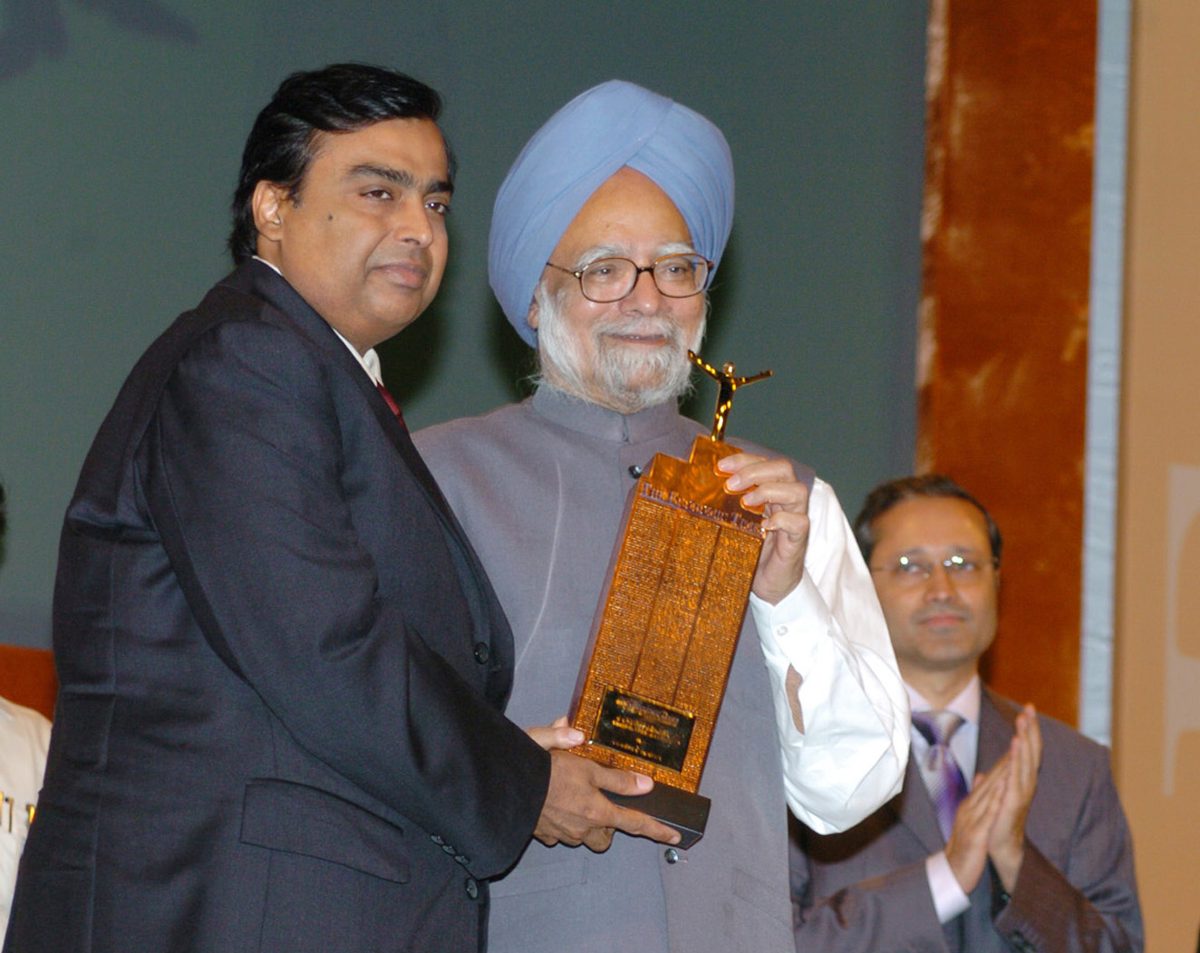
| Key facts | |
|---|---|
| Born | 19 April 1957, Aden (now in Yemen) |
| Hometown / family roots | Chorwad, Junagadh district, Gujarat; raised in Mumbai |
| Education | BE in chemical engineering, UDCT (now ICT), Mumbai; left the Stanford MBA after one year in 1980 |
| Family | Son of Dhirubhai and Kokilaben Ambani; married Nita Ambani in 1985; children Akash, Isha and Anant; younger brother Anil Ambani |
| Company / Group | Chairman and managing director, Reliance Industries Ltd (RIL): oil-to-chemicals, Jio, Reliance Retail, new energy, media |
| Hurun India Rich List 2026 | Rank 2, Rs 8,63,400 crore (about US$90 billion), down 10% on the year |
| Known for | Jamnagar, the world’s largest refining complex; Jio, which made mobile data almost free for India; the country’s largest retailer; India’s richest person for most years since 2008 |
On the afternoon of 5 September 2016, Mukesh Ambani stood in front of Reliance shareholders in Mumbai and did something few telecom operators anywhere had dared: he announced that voice calls on his new network, Jio, would be free forever, and that data would be given away for the rest of the year. The country’s mobile phone bills fell off a cliff. Within 26 days Jio had 16 million subscribers, a pace Reliance said beat Facebook and WhatsApp at their fastest [1]. Within ten years it had 533 million [2].
That launch was the biggest bet of a career built on outsized bets. The same man had, in his twenties, run a polyester plant in rural Maharashtra for a father who had once pumped petrol in Aden. In his forties he had dedicated the largest refinery ever built from scratch. He has been India’s richest person for most of the years since 2008, trading the top spot with Gautam Adani since 2022. On 23 September 2026 the M3M Hurun India Rich List placed him second again, with family wealth of Rs 8,63,400 crore, down 10% in a year, behind Adani’s Rs 9.23 lakh crore [3][4].
This is the story of how that fortune was made, the family split that nearly derailed it, the regulators and courts it has passed through, and how, at 69, Mukesh Ambani is handing it on.
Where it began
Mukesh Dhirubhai Ambani was born on 19 April 1957 in Aden, then a British colony at the mouth of the Red Sea. His father, Dhirajlal Hirachand Ambani, known to everyone as Dhirubhai, was the son of a village schoolteacher from Chorwad in Gujarat’s Junagadh district. He had sailed to Aden as a teenager and joined A. Besse & Co., the trading house that ran Shell’s business there, starting at a petrol filling station and rising to clerk [5]. Decades later Mukesh would tell McKinsey: “My father Dhirubhai Ambani was a son of a schoolteacher. He saved his first $100 working in Yemen as a gas station attendant” [6].
The family came home to Bombay in 1958. Dhirubhai set up Reliance Commercial Corporation in a tiny rented office at Masjid Bunder, trading spices and later yarn [5]. The Ambanis lived in a two-bedroom flat in Jai Hind Estate, a chawl in Bhuleshwar, and travelled by bus. Mukesh’s earliest memories, he has said, are of the family’s move in the early 1960s to Altamount Road, “which was then an emerging area” [7].
Mukesh and his younger brother Anil went to Hill Grange High School on Peddar Road, where their classmate Anand Jain would later become one of Reliance’s closest lieutenants. Dhirubhai never once came to school, Mukesh has recalled, but he cared intensely about a broader education: he placed a newspaper advertisement for a tutor whose brief was not marks but the world. The tutor he hired, Mahendrabhai, took the children around Bombay by bus and train, to hockey and football matches, and out to villages. “I guess when you are left on your own, you find your true potential,” Mukesh said in a 2007 interview. “There were boundaries, of course, but within those, we were not micro-managed” [8][7].
Reliance itself was growing up alongside him. In 1966 Dhirubhai built a textile mill at Naroda near Ahmedabad; the Vimal brand followed. In November 1977 Reliance Textile Industries went public, offering 2.8 million shares of Rs 10 each. The issue was oversubscribed seven times and brought in 58,000 shareholders in its first year; Reliance describes it as the moment that “ushered in the equity cult in India” [9][10]. A boy who watched his father sell shares to ordinary families learned early that in India, scale and public trust could be built together.
Mukesh chose chemical engineering. He has said he cleared the IIT entrance but picked the University Department of Chemical Technology in Matunga, now the Institute of Chemical Technology, because of its faculty; in June 2025 he gave ICT a Rs 151 crore grant in honour of his teacher, Professor M.M. Sharma, whom he called “my most respected Guru” [11][12]. In 1979 he went to Stanford for an MBA. He never finished [13].
The first break
The call from Bombay came after his first year. Dhirubhai had won a licence to make polyester filament yarn and wanted his elder son to build the plant. Mukesh has told the story of asking his father what his job would be. The reply: “If you are in a job, you are a manager. If you are an entrepreneur, you will figure it out. So I won’t tell you anything. Figure out what you want to do” [14].
So, at 24, in 1981, Mukesh Ambani went to Patalganga, a stretch of the Raigad countryside two hours from Bombay, and figured it out. The model was American. “My reference points were US companies. We were hugely influenced by large US chemical companies, especially DuPont,” he said later [7]. Reliance brought in foreign experts and surrounded them with young Indian engineers. The polyester filament yarn plant came up in what the company still calls “record time”, and polyester staple fibre and other petrochemical units followed through the decade [10]. “The first 200-odd people who built Patalganga with me are still around, running different businesses,” he said 25 years later [7].
The apprenticeship became a partnership abruptly. In February 1986 Dhirubhai suffered a stroke that paralysed his right hand, and the two sons, Mukesh at 28 and Anil at 26, took over the day-to-day running of the company [5]. Mukesh’s answer to every question of strategy was the same: go further back up the chain, own the raw material. From fabric to yarn, from yarn to fibre, from fibre to petrochemicals, from petrochemicals to the refinery, and eventually from the refinery to the oil and gas field. The Hazira complex near Surat, commissioned in 1991, made Reliance one of the world’s largest integrated polyester producers [10]. The refinery would make it something else entirely.
In 1996 work began on thousands of acres of scrubland at Motikhavdi, near Jamnagar on the Gujarat coast, with Bechtel as the engineering contractor. There was no infrastructure to speak of, and a severe cyclone hit the site in 1998. The refinery still came up in about three years, with 27 million tonnes a year of capacity, at a capital cost of more than US$3.4 billion. It was, and remains, the largest refinery and petrochemicals complex ever built from the ground up, adding about a quarter to India’s refining capacity in one stroke and taking the country’s petrol and diesel imports from more than 10 million tonnes a year to zero [15][16]. Dhirubhai dedicated it on 28 December 1999, his 67th birthday [15]. “Jamnagar was a totally barren land, it was a desert thirty years ago,” Mukesh told a gathering there in 2024, calling it the family’s “karma bhoomi”, the place “where we found our mission, passion, and purpose” [17].
Dhirubhai died on 6 July 2002, without a will. Mukesh became chairman of Reliance Industries. Within months he had done two things that showed his appetite. In May 2002 Reliance outbid Indian Oil and Nirma to buy the government’s 26% stake in Indian Petrochemicals Corporation for Rs 1,491 crore, at Rs 231 a share against a reserve price of Rs 131 [18]. And in December 2002 Reliance Infocomm, the mobile network Mukesh had personally championed, went live. Dhirubhai’s brief had been that a phone call should cost less than a postcard; the “Monsoon Hungama” offer of July 2003 put a handset in customers’ hands for Rs 501 and signed up half a million people [19].
Building the empire
The split, and what it cost
The empire almost came apart before it was built. On 18 November 2004, asked on television about tensions with Anil, Mukesh admitted there were “ownership issues” [20]. Seven months of public warfare followed, fought through leaks, board meetings and rival camps of advisers.
The peace was made by their mother. On 18 June 2005, after an 18-hour final session with ICICI’s K.V. Kamath, Kalpana Morparia and investment banker Nimesh Kampani, Kokilaben Ambani announced a settlement. Mukesh kept Reliance Industries and IPCL, the oil, petrochemicals and refining businesses, with about US$17 billion in revenue. Anil received Reliance Infocomm, Reliance Energy and Reliance Capital, with about US$2.4 billion. Mukesh paid an estimated US$2.3 billion to US$3.5 billion to even the scales, and a non-compete agreement kept him out of telecom, power and financial services for a decade [21].
For Mukesh, the split meant giving up the phone company he had built. It also left a poison pill: a gas-supply agreement that promised Anil’s power business gas from Reliance’s Krishna-Godavari field at US$2.34 per unit, when the government had approved a price of US$4.20. The brothers fought it all the way to the Supreme Court. On 7 May 2010 a three-judge bench ruled that natural gas belongs to the government until it reaches the consumer, that its price and allocation are subject to government policy, and that the family pact could not override that; the brothers were told to renegotiate within six weeks [22]. Two weeks later the two groups scrapped the non-compete altogether, “to eliminate any room for further disputes” [23]. The decision freed Mukesh to re-enter telecom. It also meant that Anil’s group and Mukesh’s have been legally separate for two decades, a distinction that matters when their fortunes are compared.
Jamnagar doubles, KG-D6 disappoints
Even in the middle of the family war, Mukesh doubled down on Jamnagar. In April 2006 a new Reliance Petroleum was listed to build a second refinery in a special economic zone next to the first; the Rs 8,100 crore issue, priced at Rs 60 a share, was heavily oversubscribed [24]. The SEZ refinery was commissioned in December 2008, in the depths of the global financial crisis, taking the complex to 1.24 million barrels a day, the largest single-site refining hub in the world [15][25]. In March 2009 Reliance Petroleum was folded back into the parent at one RIL share for every 16 [25].
The upstream bet was harder. Reliance’s KG-D6 block off Andhra Pradesh began producing gas in April 2009 and peaked at 69 million standard cubic metres a day in March 2010. Then the wells began drawing water and sand. Output fell below 15 mmscmd by 2013 and to about 10 mmscmd by December that year, against a development plan that had promised 80 [26]. In February 2011 BP had bought 30% of Reliance’s Indian oil and gas blocks for US$7.2 billion, with up to US$1.8 billion more tied to performance [27]; the partners spent most of the decade managing decline and disputes with the government (see below).
Retail: from stone-throwing to 20,000 stores
Reliance Retail opened its first Reliance Fresh grocery stores in Hyderabad in November 2006, with a plan to spend Rs 25,000 crore. The welcome was rough. Small traders saw a threat; stores were stoned in Ranchi, ordered shut in Uttar Pradesh after violence, and Reliance withdrew from West Bengal [28]. The company kept going, learned cash-and-carry, electronics, fashion and jewellery formats, and then bought brands and companies at a pace few Indian firms had attempted, from Hamleys and Netmeds to the Campa cola brand and Metro Cash & Carry’s Indian business, the last for Rs 2,850 crore [29].
In the pandemic year of 2020, when few companies could raise money, Reliance Retail Ventures sold 10.09% to Silver Lake, KKR, GIC, Mubadala, ADIA, Saudi Arabia’s PIF, General Atlantic and TPG for Rs 47,265 crore [30]. By the end of FY26 the business had 20,160 stores, 78 million square feet of space, 387 million registered customers, gross revenue of Rs 3,70,026 crore and a net profit of Rs 13,838 crore [31]. It is by a wide margin India’s largest retailer.
Jio: the second telecom life
The re-entry into telecom began with a deal that would be argued over for years. In June 2010 a small company called Infotel Broadband, with a net worth of about Rs 2.5 crore, won 4G broadband wireless spectrum in all 22 Indian circles for Rs 12,848 crore. Hours after the auction closed, Reliance Industries announced it was buying 95% of Infotel for Rs 4,800 crore [32]. Renamed Reliance Jio Infocomm, the company then spent six years laying fibre and building a pure-4G network before selling a single connection. Sceptics called it a folly. Mukesh has since called Jio “the biggest risk we have taken so far”, adding: “In the worst case, we will not earn much return. That’s okay because it’s our own money” [6].
The launch on 5 September 2016 rewrote the economics of Indian telecom. Free voice and near-free data pushed Indian data prices to among the lowest on earth, in service of a thesis Mukesh would sum up a year later: “Data is the new oil and India does not need to import it” [33]. Jio reached 16 million users in 26 days, 50 million in 83 days and 100 million in under six months [1][34]. Rivals bled, consolidated or collapsed; Anil Ambani’s Reliance Communications filed for insolvency in 2019. In March that year Mukesh and Nita Ambani stepped in to help Anil pay Rs 458 crore owed to Ericsson a day before a Supreme Court deadline that would otherwise have sent him to jail; Anil publicly thanked “my respected elder brother, Mukesh, and Nita, for standing by me during these trying times” [35].
Then came the monetisation. Between April and July 2020, while India was in lockdown, Jio Platforms sold 32.97% to 13 investors for Rs 1,52,056 crore, beginning with Facebook’s Rs 43,574 crore for 9.99% and including Google’s Rs 33,737 crore for 7.73% [36][37]. Add a Rs 53,124 crore rights issue and BP’s Rs 7,000 crore for 49% of Reliance’s fuel retail network, and Mukesh could announce on 19 June 2020 that Reliance had raised Rs 1,68,818 crore in 58 days and was net debt free, nine months ahead of his promise [38]. That September Reliance became the first Indian company worth more than US$200 billion [39]; in February 2024 it became the first to cross Rs 20 lakh crore in market value [40].
Jio has since rolled out 5G across India, bought into media by merging Viacom18 with Disney’s Indian business to create JioStar, a Rs 70,352 crore venture with more than 100 channels and the JioHotstar streaming service [41], and on 19 June 2026 filed a draft prospectus with SEBI for an initial public offering of up to 27 crore new shares, with market estimates of about Rs 37,700 crore to be raised [42]. In FY26, Jio Platforms earned Rs 1,46,885 crore in revenue and Rs 30,049 crore in profit, with 524 million subscribers, 268 million of them on 5G [31].
The new energy bet, and AI
At the June 2021 annual meeting Mukesh announced Rs 75,000 crore over three years for a clean-energy business built around four giga-factories at Jamnagar, for solar modules, batteries, electrolysers and fuel cells [43]. Reliance then bought technology abroad: REC Solar of Norway for US$771 million, Faradion, Lithium Werks, a 40% stake in Sterling & Wilson, and stakes in Ambri, NexWafe and Caelux [44]. By mid-2026 about a gigawatt of heterojunction solar modules had been produced, the first phase of a battery factory was due to start production the same year, and the target for battery capacity had been raised to 120 GWh a year [45]. The business had yet to earn revenue, and Macquarie’s analysts had called a US$20 billion valuation for it “rich for an unproven thesis” [46].
Jamnagar is now also being turned into an artificial-intelligence hub. In August 2025 Reliance set up Reliance Intelligence and announced a joint venture with Meta and a cloud region with Google [47][48]; in June 2026 it agreed to build a 168 MW data centre for Meta at Jamnagar, powered by renewables and cooled by seawater [49].
The numbers, and how the wealth is held
In FY26 Reliance Industries reported gross revenue of Rs 11,75,919 crore (about US$124 billion) and a net profit of Rs 95,754 crore, with consumer businesses now contributing more than half of operating profit [31].
Mukesh Ambani’s wealth is almost entirely his family’s stake in that one company. The promoter group held 50.07% of RIL at the end of FY25 and raised it to 50.48% through market purchases in mid-2026, mostly through holding entities such as Srichakra Commercials, Devarshi Commercials, Karuna Commercial and Tattvam Enterprises; Mukesh, Nita and each of their three children personally own only about 0.12% each [50][51]. The promoter group’s dividend income in FY25 alone was about Rs 3,600 crore. Mukesh capped his own salary at Rs 15 crore from 2008 and has drawn no salary at all since 2020 [50].
Hurun’s 2026 list valued the family at Rs 8,63,400 crore, second in India behind the Adani family’s roughly Rs 9.23 lakh crore; Hurun’s figures are as of 24 August 2026 and, because the wealth is essentially one shareholding, they move with Reliance’s share price [4][3].
The setbacks and failures
For all the scale, the record has plenty of misses.
The 2005 split cost Mukesh the telecom and power businesses he had personally built, and a decade out of the industry he would later transform. The KG-D6 field, sold to investors as India’s answer to its gas shortage, produced a fraction of its promised output for most of a decade and generated more litigation than gas [26].
Abroad, Reliance’s boldest acquisition attempts failed. Its US$14.5 billion bid for the bankrupt chemicals giant LyondellBasell was rejected in March 2010, when the company and its creditors judged that the offer “didn’t offer greater value” than their own reorganisation plan [52]. In August 2019 Mukesh announced that Saudi Aramco would buy 20% of Reliance’s oil-to-chemicals business for about US$15 billion, valuing it at US$75 billion; after two missed deadlines the deal was called off in November 2021, with Reliance citing “the evolving nature” of its portfolio and its new-energy plans [53]. Aramco’s chairman, Yasir Al-Rumayyan, stayed on the Reliance board.
At home, the Rs 24,713 crore deal to buy Future Group’s retail business, announced in August 2020, collapsed in April 2022 after a two-year legal war with Amazon and a vote against the scheme by Future’s secured lenders [54]. Reliance Fresh’s early years were marked by protests and closures [28]. Jio’s IPO, promised “within five years” in 2019, slipped past 2025 as Reliance chose to build revenue first; the Reuters report of the delay knocked about US$6 billion off RIL’s market value in a day [55].
And 2026 itself has been a year of relative weakness. The family’s Hurun valuation dropped 10% and Adani retook the top spot [3]. Mukesh’s own view of risk, offered to McKinsey, is unsentimental: “The principle is whether you can survive in the worst-comes-to-the-worst situation. You start off by thinking in terms of what the worst is that could happen, and then you have to survive that” [6].
Controversies and allegations
Reliance is one of the most scrutinised companies in India, and its chairman has faced regulatory orders, audit reports, court cases and political attack for most of his career. Much of the record concerns the company rather than Mukesh Ambani personally, and a striking number of matters have ended in Reliance’s favour. Each is set out below with the allegation, the response and where it stands today.
The 2007 Reliance Petroleum share sale (SEBI v Reliance Industries)
Allegation: In a March 2017 order, SEBI found that when Reliance sold about 22.5 crore shares of its subsidiary Reliance Petroleum in November 2007, it used 12 front entities to build short positions in RPL futures and then sold 1.95 crore shares in the last minutes of trading on 23 November 2007 to depress the settlement price. SEBI called it a fraudulent and manipulative scheme and ordered Reliance to disgorge Rs 447.27 crore with 12% interest from 2007 [56][57]. In January 2021 a SEBI adjudicating officer separately fined Reliance Rs 25 crore and Mukesh Ambani Rs 15 crore as the person in control [58].
Response: Reliance maintained that the futures positions were a legitimate hedge against a planned share sale and appealed at every stage. The Securities Appellate Tribunal upheld the disgorgement in November 2020 by a 2-1 majority; the Supreme Court admitted Reliance’s appeal on a deposit of Rs 250 crore [57].
What happened next:
- In December 2023 SAT quashed the Rs 15 crore penalty on Mukesh Ambani while upholding the Rs 25 crore penalty on Reliance; on 11 November 2024 the Supreme Court dismissed SEBI’s appeal against that order [59].
- On 29 May 2026, in Reliance Industries Ltd v SEBI (2026 INSC 585), Justices J.B. Pardiwala and R. Mahadevan set aside SEBI’s fraud finding and the Rs 447.27 crore disgorgement, holding that using several entities to exceed position limits was not automatically fraud and that the short position was a proportionate hedge; the court called SAT’s approach an “egregious error”, ordered the Rs 250 crore deposit refunded, but upheld the penalty on Reliance for breaching position-limit and disclosure rules [56][57].
- A Bar & Bench column argued the judgment sits uneasily with earlier rulings that intent is not indispensable to market manipulation and could have “a chilling effect on SEBI enforcement” [60].
Status: Closed as of 29 September 2026. No fraud finding and no penalty stands against Mukesh Ambani personally; a Rs 25 crore regulatory penalty on Reliance for the disclosure breach stands.
The 1994 warrants and the takeover code
Allegation: In April 2021 SEBI imposed a joint penalty of Rs 25 crore on Mukesh Ambani, Anil Ambani, Nita Ambani, Tina Ambani and other promoter entities, holding that when 12 crore Reliance shares were allotted in January 2000 on conversion of warrants issued in 1994, the promoters’ holding rose by 6.83%, beyond the 5% creeping-acquisition limit, without the public announcement the takeover code required [61].
Response: The promoters appealed, arguing the warrants pre-dated the 1997 regulations and no acquisition obligation arose in 2000.
Status: Closed. SAT quashed the penalty on 28 July 2023 as “without any authority of law” [62]; on 11 November 2024 the Supreme Court dismissed SEBI’s appeal, remarking that “you cannot chase a person like this for 20 years” [59].
KG-D6: the CAG, cost recovery and the ONGC “gas migration” case
Allegation: Three strands. First, the Comptroller and Auditor General’s 2011 audit criticised the Petroleum Ministry and Reliance over the KG-D6 budget rising from US$2.4 billion in 2004 to US$8.8 billion in 2006 while projected output merely doubled, over Reliance retaining the whole 7,645 sq km block, and over procurement lapses; the CAG did not quantify a loss [63]. Second, as output collapsed the government disallowed Reliance’s recovery of costs, and Reliance took the dispute to arbitration in 2011; the disallowances eventually totalled about US$3 billion [64]. Third, ONGC alleged in 2013 that Reliance’s wells had drawn gas that migrated from ONGC’s neighbouring blocks. An independent consultant confirmed the reservoirs were connected, a committee under Justice A.P. Shah found unjust enrichment, and in November 2016 the government demanded US$1.55 billion [65].
Response: Reliance has said all KG-D6 spending was approved by the joint management committee, that the production-sharing contract bars retrospective disallowance, and that it produced gas from within its own contract area as the contract allowed. In December 2025 it called reports of a US$30 billion government claim “factually incorrect”, saying the only outstanding disallowance demand was about US$247 million [66][64].
What happened next:
- On gas migration, an arbitral tribunal ruled 2-1 for Reliance in July 2018 and a single judge of the Delhi High Court upheld the award in May 2023.
- On 14 February 2025 a division bench of the Delhi High Court set the award aside as patently illegal and contrary to the public trust doctrine, holding that “without the explicit and express permission of the Union of India, there can be no extraction” of national resources [67][65]. The government raised a provisional demand of US$2.81 billion including interest; Petroleum Minister Hardeep Puri said “we will enforce this right till the end” [68]. Reliance called the judgment and demand “unsustainable” and appealed.
- The Supreme Court heard the appeals from February 2026; the Attorney General told the court Reliance had “virtually committed a theft” of ONGC gas, while Reliance’s counsel called it “an ongoing contract”. On 26 May 2026 the court accepted Reliance’s request for conciliation with the government and kept the appeal pending [69].
- On 27 March 2026 the Bombay High Court dismissed a public-interest petition seeking a CBI case against Reliance and Mukesh Ambani over “gas theft” as an abuse of process that would “cause serious harm to reputation and business prospects” [70].
- On cost recovery, hearings before a tribunal chaired by former Australian judge Michael Kirby concluded in November 2025 [64].
- A related political case went nowhere: in February 2014 Delhi’s Anti-Corruption Branch, under Chief Minister Arvind Kejriwal, registered an FIR naming Union ministers Veerappa Moily and Murli Deora, Mukesh Ambani and others over KG-D6 gas pricing. Reliance called it politically motivated; the Union home ministry restricted the ACB’s jurisdiction that July, the Supreme Court upheld the Centre’s position in 2019, and no charge sheet was ever filed [71].
Status: Pending. As of 29 September 2026 no settlement or Supreme Court judgment in the gas migration appeal had been reported, and the cost-recovery award was awaited. The Delhi High Court’s findings against Reliance stand but are under appeal.
Amazon, Future Retail and the store takeover
Allegation: Amazon, which had invested Rs 1,431 crore in a Future Group promoter entity in 2019, alleged that Future’s Rs 24,713 crore sale of its retail assets to Reliance in August 2020 breached contractual rights barring deals with Reliance. A Singapore emergency arbitrator restrained the deal in October 2020, and on 6 August 2021 the Supreme Court held that the award was enforceable in India [72]. Critics also faulted Reliance for taking over some 950 Future stores in February 2022 after Future defaulted on rents that Reliance entities had come to hold [73].
Response: Reliance was not a party to the arbitration. It said the takeover followed Future’s rent defaults, offered jobs to Future’s staff, and on 23 April 2022 said the scheme “cannot be implemented” after Future’s secured lenders voted against it [54][73].
What happened next:
- Future Retail was admitted to insolvency in July 2022 and ordered into liquidation in July 2024.
- In June 2025 the Singapore tribunal ruled that Future had breached its covenants but awarded Amazon only Rs 23.7 crore against a Rs 1,436 crore claim [74]; Amazon and Future settled in March 2026 and the Delhi High Court closed the challenge to the award in April 2026 [75].
Status: Closed. No court or tribunal found wrongdoing by Reliance; the findings of breach were against Future Group.
Jio’s 4G spectrum and the CAG
Allegation: The CAG’s report tabled in May 2015 said that by allowing Infotel, the company Reliance bought hours after the 2010 auction, to migrate to a unified licence and offer voice services for a fee of Rs 1,658 crore fixed at 2001 prices, the government had conferred an “undue advantage” of Rs 3,367 crore on Reliance Jio. An earlier draft, reported by The Caravan, had put the figure at Rs 22,842 crore [76][77].
Response: Reliance Jio said “no favour had ever been given to it” and that it had “conducted our business as per the prevailing laws” [76].
Status: Closed. On 8 April 2016 the Supreme Court dismissed a public-interest petition, holding that the migration was “a pure policy decision after due deliberations by experts” and that “it cannot be said that any wrongful loss has been caused to the Government” [78]. A complaint by Bharti Airtel that Jio’s free launch offers were predatory was closed by the Competition Commission in June 2017, which found Jio, at 6.4% market share, was not dominant [79]. Jio and Paytm did apologise in March 2017 for using the Prime Minister’s photograph in launch advertisements without permission [80].
Antilia: the land and the bomb scare
Allegation: Two unrelated matters attach to the Ambani home on Altamount Road. Petitioners argued that the 4,532 sq m plot, bought in 2002 from a Khoja orphanage trust, was waqf property that could not be sold; in 2017 the Maharashtra Wakf Board itself filed an affidavit calling the sale “illegal” [81]. Separately, on 25 February 2021 an SUV containing gelatin sticks and a threat note was found near Antilia. The National Investigation Agency later alleged that Mumbai police officer Sachin Waze had staged the incident and that Mansukh Hiran, who had custody of the vehicle, was murdered when he refused to take the blame [82].
Response: The buyer, an Ambani company, has maintained that the sale was sanctioned by the Charity Commissioner in 2002 and ratified by the Wakf Board itself in 2005, and that the plot belonged to a public trust rather than a waqf [81]. On the bomb scare the family made no substantive public comment; they were the intended targets, not the accused.
Status: The land case is closed: the Bombay High Court dismissed one petition in 2016 and the original 2007 petition on 28 July 2025, holding that the property’s character had already been adjudicated [83]. The criminal case is ongoing: a special court framed charges against Waze, former officer Pradeep Sharma and eight others on 1 August 2026 for murder, extortion and conspiracy [82]. On 29 September 2026 the same court granted Waze bail, holding that the NIA had not made out a prima facie terrorism charge and had never recorded the Ambanis’ statements [84]. The trial continues.
Media ownership, politics and Russian oil
Allegation: Since Reliance took control of Network18 and TV18 in May 2014 for about Rs 4,000 crore [85], critics including The Caravan have argued that concentrating news channels in the hands of industrialists close to government weakens press plurality [86]. In the 2024 general election, Rahul Gandhi made “Adani-Ambani” shorthand for crony capitalism, while Prime Minister Narendra Modi asked at a rally why Gandhi had stopped naming them, insinuating that money had changed hands [87]. Abroad, Reliance’s position as India’s largest buyer of discounted Russian crude, under a term contract for about 500,000 barrels a day from Rosneft, was the stated reason when the United States raised tariffs on Indian goods to 50% in August 2025 [88].
Response: A Reliance spokesperson confirmed the media holdings to The Caravan [86]; the company has not responded publicly to the political rhetoric. Ahead of US sanctions on Rosneft and Lukoil and an EU ban on products refined from Russian crude, Reliance stopped taking Russian crude into its export-oriented SEZ refinery from 20 November 2025 and said exports from it would be made from non-Russian oil [88].
Status: These are criticisms and geopolitical pressures, not legal allegations; no regulator has acted against the group on any of them.
Giving back
Reliance Foundation, set up in 2010 and chaired by Nita Ambani, is the family’s main vehicle for philanthropy, and Reliance Industries is India’s largest corporate spender on social responsibility, with Rs 1,186 crore in FY22, Rs 1,271 crore in FY23 and Rs 1,592 crore in FY24 [89][90]. Its programmes include rural livelihoods work that Reliance says has reached tens of millions of people, the Dhirubhai Ambani scholarships (about 10,000 undergraduate awards a year), 13 Reliance Foundation schools, the Sir H.N. Reliance Foundation Hospital in Mumbai, opened in 2014, and Jio Institute [90].
During COVID-19, Reliance says it gave Rs 571 crore to PM CARES and state relief funds, converted Jamnagar to produce more than 1,000 tonnes a day of medical-grade oxygen, about 11% of India’s supply, set up more than 2,000 hospital beds, and served millions of meals under Mission Anna Seva [91].
Measured as personal giving, the family’s numbers are more modest. The EdelGive Hurun India Philanthropy List recorded donations of Rs 407 crore in 2024 and Rs 626 crore in 2025, ranking the family second in India both years behind Shiv Nadar’s Rs 2,153 crore and Rs 2,708 crore [92][93]. Even the higher figure is less than a tenth of one per cent of the family’s wealth, a gap critics pointed to during the months-long celebrations for Anant Ambani’s wedding in 2024, which several publications estimated at about US$600 million; Bloomberg’s Andy Mukherjee called it “business as usual” for a family signalling strength before Jio’s listing, while Al Jazeera framed it against India’s “missing middle class” [94][95].
Anant Ambani’s animal rescue centre at Jamnagar, Vantara, drew allegations of unlawful wildlife acquisition and financial irregularities that led the Supreme Court to appoint a special investigation team under former Justice Jasti Chelameswar. On 15 September 2025 the court accepted the SIT’s finding of “no contravention of law”, closed all complaints and barred identical proceedings [96]. A subsequent CITES fact-finding mission questioned the paperwork on some imports, a point Mongabay India reported in November 2025 [97].
Mukesh Ambani’s own framing of giving is characteristically about scale. “My father used to say that if you want to start a business to be a billionaire, you are an idiot; you will never get there,” he told McKinsey. “If you want to start a business to impact a billion people, then you have a good chance of success” [6]. He has described Jio itself as “the best philanthropy that we will have ever done in India” [6].
Succession
Mukesh Ambani has spent the last five years doing what his father never did: writing down who gets what.
In June 2021 he told shareholders he had “no doubt whatsoever” that Isha, Akash and Anant would carry the legacy forward [98]. In June 2022 he resigned as chairman of Reliance Jio Infocomm and handed the post to Akash, then 30 [99]. In October 2023, after a postal ballot, all three children joined the Reliance Industries board as non-executive directors, Isha and Akash with more than 98% support and Anant with about 93% after the proxy advisers ISS and IiAS opposed him on grounds of limited board experience [100][101]. Nita Ambani stepped off the board. The same year shareholders reappointed Mukesh as chairman and managing director until April 2029, at no salary [102]. In May 2025 Anant became a whole-time director, the first of the three in an executive role at the parent [103].
At the 49th annual meeting on 19 June 2026, the day the Jio prospectus was filed, Mukesh said the transition of day-to-day management was in its “final stretch”. Isha leads the consumer businesses, Akash digital and technology, Anant the legacy energy and new-energy businesses. “The future of your company is not only in safe hands, but in hands that will take Reliance to far greater heights,” he said. “They are three bodies, one soul. Their soul is Reliance. One single indivisible Reliance, now and forever” [104][105]. Bloomberg, reporting the speech, noted the obvious contrast with the split that followed Dhirubhai’s death without a will [105]. In 2021 Bloomberg had reported that he was studying a structure modelled on the Waltons of Walmart, with the family’s stake held through a trust-like entity on whose board Nita and the three children would sit [98].
The people around him have been remarkably constant. Manoj Modi, whom he met at UDCT, has run deals for him for four decades [12]; his cousins Nikhil and Hital Meswani remain executive directors, as does the oil and gas veteran P.M.S. Prasad [50]. The next generation, Mukesh told shareholders in 2026, is backed by about 500 leaders in their thirties and forties [104].
What their journey teaches
Own the layer beneath you. Every big move Reliance made was backward integration: from cloth to yarn, yarn to fibre, fibre to petrochemicals, petrochemicals to the refinery, and finally to the oil field. Each step removed a supplier’s margin and a supplier’s power. A small business can apply the same test: which of your costs could become your product?
Overpay for the best knowledge, then let young people run it. At Patalganga, Reliance modelled itself on DuPont and the big American chemical companies, hired the best outside expertise it could find, and surrounded it with 25-year-olds. Mukesh has said his “biggest obsession” is that senior people give bright 25-year-olds real responsibility [7]. Speed and loyalty followed; so did the leadership bench that runs the group today.
Size the bet so the worst case is survivable, then go all the way. Jamnagar, Jio and new energy were each built over five to six years with tens of thousands of crore spent before a rupee came back. But each was funded so that failure would hurt, not kill. “You start off by thinking in terms of what the worst is that could happen, and then you have to survive that” [6].
Write the will. The Ambani family lost seven months and a telecom company to a succession that was never planned. Mukesh’s answer has been a decade of public, staged transition: roles first, board seats next, executive titles last, with the words “indivisible” said aloud to shareholders [104]. Founders of far smaller firms can learn from both halves of that story.
Expect scrutiny to be part of the price. Reliance has been audited by the CAG, penalised by SEBI, sued by ONGC and attacked on the campaign trail. Most matters were ultimately won in court, but they took 10 to 20 years to resolve, and one of the largest is still pending [69]. Anyone building something big in India should budget for the legal and reputational cost of size as carefully as for capital.
Money is a by-product, or it does not come. Whether or not one takes the “impact a billion people” line at face value, it describes how Reliance actually chose its markets: polyester for a country short of cotton, a refinery for a country importing fuel, cheap data for a country of feature phones. The businesses that made the fortune were all answers to a mass Indian need.
A profile for general reading, based on public records and reporting as of 29 September 2026. Not investment, tax or legal advice.
Sources (105)
- Jio creates world record with 16 million subscribers in first month, media release - Reliance Industries Ltd, Oct 2016
- RIL Q1 FY2026-27 financial and operational performance, media release - Reliance Industries Ltd, Jul 2026
- India's richest in 2026: Adani tops the list, 27 new billionaires emerge - Business Standard, Sep 2026
- Hurun India Rich List 2026: Adani reclaims top spot as wealth jumps 13% - India TV News, Sep 2026
- Dhirubhai Ambani - Encyclopaedia Britannica, Sep 2026
- Mukesh Ambani's bold ambitions: Building businesses of the future - McKinsey & Company, Jun 2025
- Mukesh Ambani, sourced quotations (2007 interview excerpts) - Wikiquote, Sep 2026
- The next Bill Gates? - Gulf News, Jan 2008
- Reliance Industries goes public in 1977 - Jio Institute RIL Timeline exhibit, Sep 2026
- Our History - Reliance Industries Ltd, Sep 2026
- Mukesh Ambani offers Rs 151 crore Guru Dakshina to honour ICT mentor - Business Standard, Jun 2025
- Mukesh Ambani: The Power of Intuition - Open Magazine, Sep 2020
- Mukesh Ambani - Encyclopaedia Britannica, Sep 2026
- When Dhirubhai told Mukesh Ambani: figure out what you want to do - Business Today, Feb 2017
- Reliance's Jamnagar refinery, an industrial marvel, turns 25 - ThePrint (ANI), Dec 2024
- Jamnagar Oil Refinery project page - Bechtel, Sep 2026
- Mukesh Ambani's speech at son Anant Ambani's pre-wedding celebrations in Jamnagar - Storyboard18, Mar 2024
- Why did Reliance bid so high for IPCL? - Paranjoy Guha Thakurta, May 2002
- Reliance rings thrice - Business Standard, Jan 2009
- Ambani feud: chronology of events - Business Today, Jul 2008
- After months of acrimony, an outbreak of brotherly love at Reliance - Knowledge at Wharton, Jun 2005
- Supreme Court says no to cheaper gas for RNRL - Business Standard, May 2010
- Billionaire brothers end feud - Forbes, May 2010
- Reliance Petro sets IPO price at Rs 60 - Business Standard, Apr 2006
- RIL-RPL merger ratio at 1:16 - Business Standard, Mar 2009
- RIL's KG-D6 output slips to 10 mmscmd - Business Standard, Dec 2013
- BP and Reliance Industries partnership announcement, Form 6-K - US Securities and Exchange Commission, Feb 2011
- Trouble in store: a setback for India's organised retail sector - Knowledge at Wharton, Feb 2009
- Reliance Retail to acquire Metro Cash & Carry India for Rs 2,850 crore - Business Standard, Dec 2022
- Reliance Retail completes Rs 47,265 crore fundraise from 10.09% stake sale - Business Standard (PTI), Nov 2020
- Reliance Industries FY2025-26 Analyst Meeting presentation - Reliance Industries Ltd, Apr 2026
- Reliance Industries buys 95% in BWA auction winner Infotel, to invest Rs 4,800 crore - MediaNama, Jun 2010
- Data is the new oil: Mukesh Ambani at India Mobile Congress - Business Today, Sep 2017
- Reliance Jio completes 10 years: from free 4G to 533 million users - TelecomTalk, Sep 2026
- Ericsson case: Mukesh Ambani bails out RCom; Anil thanks Mukesh and Nita - Business Today, Mar 2019
- Facebook invests $5.7 billion in India's Jio Platforms - Meta Newsroom, Apr 2020
- Google to buy 7.73% stake in Jio Platforms - Business Standard, Jul 2020
- Reliance is now net debt-free after Rs 1.69 lakh crore fund raising: Mukesh Ambani - The Tribune, Jun 2020
- Reliance Industries becomes first Indian firm to top $200 billion market cap - Business Standard, Sep 2020
- Reliance becomes first listed Indian firm to cross Rs 20 lakh crore market cap - Business Today, Feb 2024
- Reliance, Disney complete merger to form Rs 70,352 crore joint venture - Business Standard, Nov 2024
- RIL files DRHP for Jio Platforms IPO with SEBI, proposes fresh issue of up to 27 crore shares - ANI, Jun 2026
- RIL to invest Rs 75,000 crore in clean energy, build four giga factories - Business Standard, Jun 2021
- New Energy, Integrated Annual Report 2022-23 - Reliance Industries Ltd, Aug 2023
- Reliance targets 120 GWh of annual BESS and cell manufacturing capacity - pv magazine India, Jun 2026
- Succession at Reliance: a large family fortune starts a risky transition - Business Standard, Aug 2023
- Reliance AGM 2025: Jio IPO in 2026, AI with Meta and Google, retail growth - Business Standard, Aug 2025
- Billionaire Ambani taps Google, Meta to build India's AI backbone - TechCrunch, Aug 2025
- Reliance and Meta to develop AI-enabled data centre in Jamnagar, media release - Reliance Industries Ltd, Jun 2026
- Ambani draws no salary for fifth year; promoter group earns Rs 3,600 crore in dividends - Business Standard, Aug 2025
- Reliance promoters raise stake to 50.48% through market purchases - Free Press Journal, Jul 2026
- LyondellBasell formally rejects Reliance offer - Chemical & Engineering News, Mar 2010
- Reliance to re-evaluate $15 billion stake sale in O2C business to Saudi Aramco - Business Today, Nov 2021
- Reliance calls off Rs 24,713 crore deal with Future Group: timeline of events - Outlook Business, Apr 2022
- Exclusive: Ambani's Reliance Jio delays IPO beyond 2025 (Reuters) - Yahoo Finance, Jul 2025
- Reliance Industries Ltd v SEBI, 2026 INSC 585, judgment summary - Verdictum, May 2026
- SC sets aside SAT order directing RIL to disgorge Rs 447 crore - Business Standard, May 2026
- Reliance Petroleum case: SEBI imposes fines on RIL, Mukesh Ambani - Business Standard, Jan 2021
- SC junks SEBI's pleas against two SAT orders in favour of Mukesh Ambani and others - Business Today, Nov 2024
- RIL vs SEBI: a chilling effect on SEBI enforcement - Bar & Bench, Jun 2026
- SEBI fines Ambani family, firms Rs 25 crore for violating takeover code - Business Standard, Apr 2021
- SAT quashes SEBI's fine of Rs 25 crore on Mukesh Ambani, Anil Ambani and others - Business Standard, Jul 2023
- 10 things you should know about the Reliance KG-D6 gas deal - Business Standard, Feb 2014
- Reliance's $247 million KG-D6 liability likely to be settled in 2026 after 13 years - Business Today, Dec 2025
- Delhi High Court overturns arbitration award in RIL-government gas migration dispute - Business Standard, Feb 2025
- RIL rejects report of government demanding $30 billion over gas underproduction - Business Today, Dec 2025
- Delhi High Court sets aside arbitral award on grounds of patent illegality and public trust doctrine - LiveLaw, Feb 2025
- Will pursue $2.81 billion demand from Reliance and partners till the end: Hardeep Puri - The Tribune, Mar 2025
- SC agrees to Reliance plea for conciliation with Centre in KG basin dispute - Business Standard, May 2026
- Plea alleging gas theft by Reliance is an abuse of process: Bombay High Court - LiveLaw, Mar 2026
- Delhi's anti-graft wing stripped of power to probe gas pricing case - Business Standard, Aug 2014
- Amazon.com NV Investment Holdings LLC v Future Retail Ltd, Supreme Court judgment - Indian Kanoon, Aug 2021
- Reliance takes control of Future Retail stores, offers jobs to employees - Business Standard, Feb 2022
- Amazon wins SIAC case against Future Group, awarded Rs 23.7 crore damages - Business Standard, Jun 2025
- Amazon-Future Group dispute settled; Delhi High Court closes challenge to arbitral award - Bar & Bench, Apr 2026
- Reliance Jio got advantage of Rs 3,367 crore: CAG - Business Standard, May 2015
- The Rs 19,000 crore mystery: how the CAG figure for undue benefit to Reliance Jio shrank - The Caravan, May 2015
- No undue favour by the government towards Reliance Jio, Supreme Court - SCC Online, Apr 2016
- Order in Bharti Airtel v Reliance Industries and Reliance Jio, Case No. 3 of 2017 - Competition Commission of India, Jun 2017
- Reliance Jio, Paytm apologise for using Narendra Modi's picture in ads without permission - Scroll.in, Mar 2017
- Sale of land for Mukesh Ambani's house Antilia illegal, says Maharashtra Wakf Board affidavit - LiveLaw, Dec 2017
- Antilia bomb scare: charges framed; ex-cops Waze, Sharma and eight others to face trial - Business Standard, Aug 2026
- Bombay High Court dismisses PIL against sale of land for Antilia - LawChakra, Jul 2025
- Mumbai court grants Sachin Waze bail in Antilia case - Business Today, Sep 2026
- RIL to acquire controlling stake in Network18 - Business Today, May 2014
- The big five: the media companies the Modi government must scrutinise - The Caravan, Jan 2016
- Rahul Gandhi's stance on Adani and Ambani: silence or vocal opposition? - Business Standard, May 2024
- Reliance stops import of Russian crude oil into Jamnagar's SEZ refinery - Business Standard, Nov 2025
- Reliance maintains No. 1 position among India Inc in social responsibility spends - ThePrint (ANI), Aug 2024
- Corporate Social Responsibility Report 2023-24 - Reliance Industries Ltd, Aug 2024
- COVID-19 response - Reliance Foundation, Sep 2026
- Rs 2,153 crore: Shiv Nadar tops EdelGive Hurun India Philanthropy List 2024; Ambanis rank second - Business Today, Nov 2024
- Hurun India Philanthropy List 2025: Shiv Nadar tops with Rs 2,708 crore donation - Business Today, Nov 2025
- Why Anant Ambani's $600 million wedding is just business as usual (Bloomberg Opinion) - Business Standard, Jul 2024
- Anant Ambani's glitzy wedding highlights India's 'missing middle class' - Al Jazeera, Jul 2024
- Supreme Court affirms SIT clean chit to Vantara - SCC Online, Sep 2025
- Global biodiversity assessment counters Supreme Court's clean chit to Vantara - Mongabay India, Nov 2025
- Mukesh Ambani's ambitious succession plan for Reliance Industries (Bloomberg) - Business Today, Nov 2021
- With son's appointment, Mukesh Ambani sets transition stage at Reliance - Al Jazeera, Jun 2022
- Shareholders approve appointment of Ambani third generation on RIL board - Business Standard, Oct 2023
- Anant Ambani faces resistance from two advisory firms over Reliance board seat - Business Today, Oct 2023
- Reliance seeks shareholder nod to appoint Ambani as head for another five years - Business Standard, Aug 2023
- Anant Ambani appointed whole-time director of Reliance Industries - Goodreturns, Apr 2025
- RIL's future is in safe hands: Mukesh Ambani's big announcement on succession plan - Business Today, Jun 2026
- Ambani vows Reliance will be 'indivisible' as he hands reins to children (Bloomberg) - The Edge Malaysia, Jun 2026