
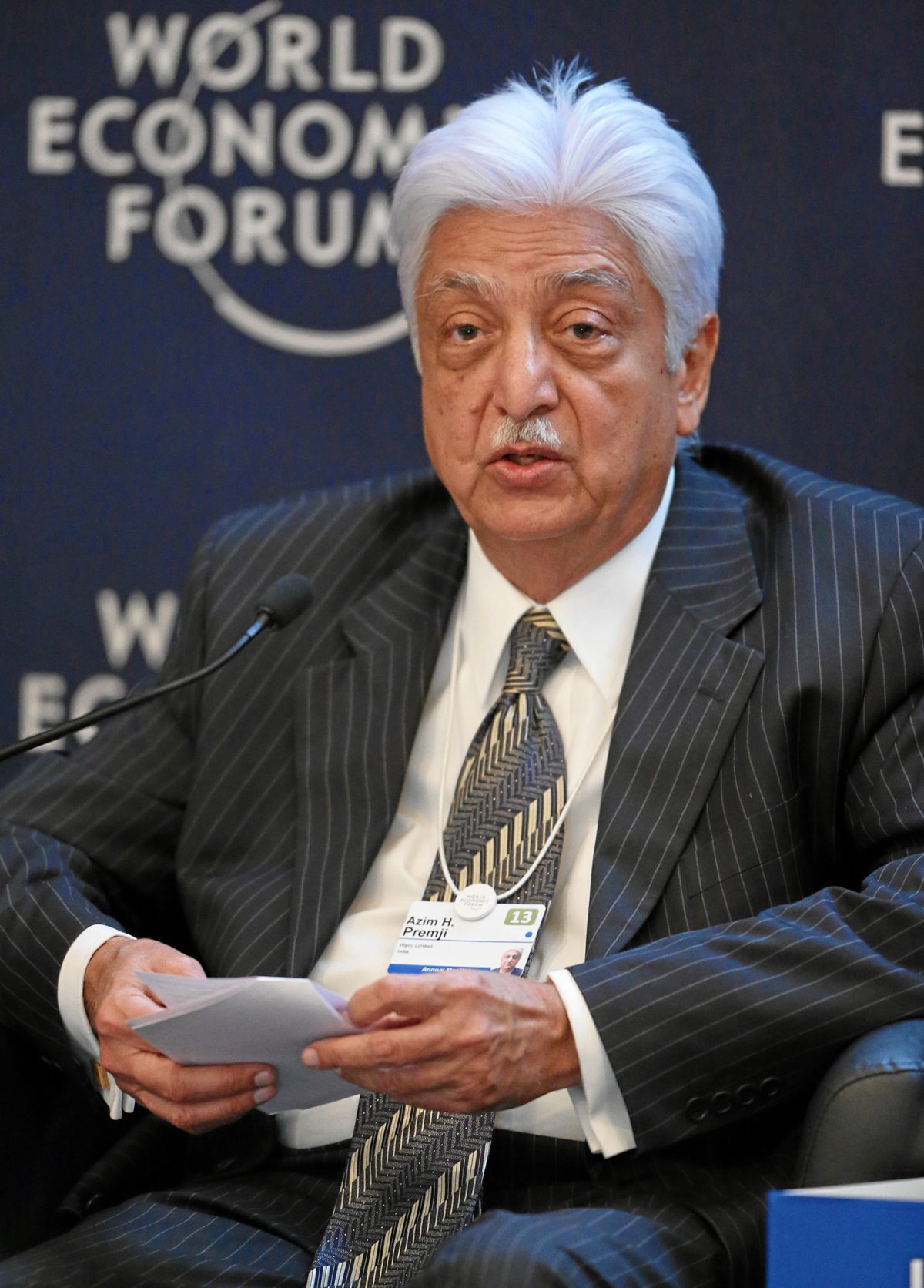
| Key facts | |
|---|---|
| Born | 24 July 1945, Bombay (now Mumbai) |
| Family roots | Bombay trading family; father M.H. Hasham Premji, a rice merchant, incorporated Western India Vegetable Products in 1945, with its factory at Amalner, Maharashtra |
| Education | Schooled in Mumbai; electrical engineering at Stanford University (left in 1966 one term short, completed the degree about three decades later) |
| Family | Wife Yasmeen Premji; sons Rishad (Executive Chairman, Wipro) and Tariq |
| Company/Group | Wipro Ltd (IT services), Wipro Enterprises (consumer care and engineering, unlisted), Premji Invest, Azim Premji Foundation |
| Hurun India Rich List 2026 | Rank 8, “Azim Premji & family”, Rs 2,62,800 crore |
| Known for | Turning a cooking-oil company into a global IT firm, and committing about two-thirds of its economic value to philanthropy |
In August 1966, a 21-year-old engineering student at Stanford University got word from Bombay that his father had died suddenly. He was one term short of his degree. “It came as a complete shock,” Azim Premji said many years later. “I just had to rush back.” [30]
On the morning of 17 August 1966 he walked into Western India Vegetable Products Limited as the man in charge. [32] The company crushed groundnuts and sold cooking fat from a factory in Amalner, a small town in Maharashtra. By his own account it did about US$4 million of business a year. [31] Investors advised the young heir to sell out so that “a more mature management could take over”. [36]
He stayed for 53 years. [7] By the time he stepped down as executive chairman in July 2019, the oil company had become Wipro, a US$8.5 billion technology firm with over 1,70,000 employees. [7] And he had made what Business Standard called the highest charitable commitment by any Indian business leader: he had signed away the economic benefit of about two-thirds of the company to a foundation. [80][79][1]
That decision explains a puzzle in the rich lists. The M3M Hurun India Rich List 2026 places “Azim Premji & family” at No. 8 with Rs 2,62,800 crore, behind Gautam Adani and Mukesh Ambani at the top. [25][26] Forbes, which stopped counting the shares he gave away, puts his fortune at about US$7.8 billion. [28] Both numbers describe the same man. Which is right depends on whether wealth means what you control or what you can spend.
Where it began
Azim Hasham Premji was born on 24 July 1945 in Bombay. [29] Five months later, on 29 December 1945, his father incorporated Western India Vegetable Products Limited. [2] The son and the company grew up together.
His father, Mohamed Hasham Premji, was “a leading rice merchant and commission agent in Bombay”, in the words of Dinesh C. Sharma’s history of Indian IT. [35] The new company set up its factory at Amalner in 1946 and made cooking oil under the Sunflower Vanaspati brand, plus a laundry soap called 787 from the by-products. [23][35] The name Wipro comes from the old company name. [2]
The Jinnah story
One family story appears in almost every profile, so it is worth being precise.
What is documented: in 1944 Muhammad Ali Jinnah invited the elder Premji to join the Muslim League’s planning committee. Premji declined to join the League formally, citing “personal and business reasons”. [35]
What is less certain: that Jinnah later asked him to be Pakistan’s first finance minister. Stanford’s alumni magazine states it as fact. [30] Sharma’s book says only that Jinnah “reportedly” sought him out, and that Premji “rejected the offer and decided to stay on in India and nurture his oil business”. [35] The sources reviewed for this profile cite no document confirming the cabinet offer. It may well be true. It is not proven.
A doctor mother, an upright father
Premji credits his parents for the two things he is best known for: giving and integrity.
His mother, Gulbanoo Premji, was a doctor. “My mother was a qualified doctor and must have been one of the earliest Muslim woman doctors,” he told Outlook Business. “She set up the Children’s Orthopedic Hospital at Haji Ali in Mumbai in the 1950s.” [33] In his Giving Pledge letter he wrote that she spent “close to 50 years” helping to build and run that charitable hospital for children with polio and cerebral palsy. [15] “She was a determining influence on me,” he said. [34]
About his father he tells one story. A businessman came home asking for an out-of-turn electricity connection. His father politely refused. After the man left, the family found a briefcase full of cash. “My father was livid. He walked straight to the nearest police station.” [33]
The boy was schooled in Mumbai and then sent to Stanford to study electrical engineering. [37][1] “Growing up in the ’50s and ’60s,” he said, “it was natural to get infected by the spirit of nation building.” [34]
Then, in 1966, his father died at 51. [34]
Premji did finish the Stanford degree, roughly thirty years late. He got permission to complete the remaining arts requirements by correspondence. “I just wanted that degree,” he said. [30] Some profiles date the completion to 1999. [29]
The first break
A 21-year-old and a room full of doubters
His mother took the chair of the company, and the family asked Azim to lead it. [32] The doubts were immediate. One early investor told him to step down and hand charge to someone more experienced. [37]
He did not pretend he was ready. “Clearly, the challenge of steering the company at a young age of twenty-one was the biggest learning experience for me,” he said. “I wasn’t prepared when I stepped into the role.” It taught him, he added, “the value of a good team” and the humility “to learn from others”. [36]
His first change was unglamorous. The company sold cooking fat in bulk to wholesalers. He wanted a brand that the end customer asked for by name. That meant selling shop by shop: you cannot sell into retail outlets, he said, “unless you are visiting 45 shops a day in the villages of India”. [31] He began hiring professional managers; his first campus recruit came from the Indian Institute of Science. [32]
Old-timers in Amalner still tell stories about him. One monsoon in the late 1960s, rainwater got into the factory. The young boss worked out on the spot how much groundnut had been lost and how much the price per kilo had to rise to cover it. [32]
The price of saying no
The other early habit was refusing to pay bribes. FactorDaily recounts that when a state minister wanted money to approve a power line, Premji ran the factory on generators. The line arrived 18 months later, after the minister’s party lost an election. [32]
A former employee summed up the working rule: “Refuse to pay bribes and then negotiate with your supervisor to reduce your targets.” [38] The company adjusted the targets, not the ethics.
Premji has not romanticised this. Following the path of integrity “was not easy”, he said in 2016, and was “particularly difficult in the early stages of my life”. [39]
Diversifying, then the opening
Through the 1970s he pushed the company beyond oil. In 1976 it set up a hydraulic cylinders business in Bengaluru, its first engineering venture. [24] Soaps and other consumer care products followed. [1] On 7 June 1977 the company was renamed Wipro Products Limited; it became Wipro Limited in 1984. [2]
It was still small. “When I joined Wipro in 1979, the turnover was just Rs 30 crore and profit was not even Rs 1 crore,” a former colleague, A.K. Sabat, recalled. [37]
The real break came from a policy shock. In 1977, IBM left India after a dispute with a government that was promoting indigenous industry. [40][31] Premji saw what that meant. “IBM left the country,” he said, leaving “a huge opportunity of a vacuum”. [31]
A cooking-oil company had no business making computers. So Wipro bought knowledge cheaply. In July 1979 it signed a consultancy agreement with the Indian Institute of Science worth about Rs 14 lakh. [40] It licensed an operating system from Sentinel, a tiny American company that Premji later described as “going bust”. [30][40] In 1981 it launched the Series-86 minicomputer, built around Intel’s 8086 chip. First-year sales were Rs 2 crore. [40]
“The Wipro IT business was born in IISc,” Premji has said. [40]
Building the empire
From boxes to services (1981 to 1999)
Wipro began selling personal computers in India in 1985. [1] Ashok Soota, who took charge of Wipro Infotech in 1984 when it was a Rs 7 crore business, left it in 1999 as a Rs 1,000 crore one. [41]
Premji kept adding legs. In 1990 Wipro formed a medical equipment joint venture with General Electric, with GE holding 51% and Wipro 49%. [2]
The decisive shift came in the 1990s, as India opened up to imports. Wipro used its hardware engineering expertise to start offering software services to clients across the world. [1] Software services went on to become one of India’s biggest export industries, a story CapitalVia has covered in India’s $221bn software exports.
Premji’s contribution here was process. Wipro launched Six Sigma in 1998 and in January 1999 was assessed at SEI-CMM Level 5, which the company says made it the first IT services provider in the world to reach that quality standard. [3] His line to employees was blunt: “Quality is not part of your job, it is your job.” [38]
The dotcom moment (2000)
On 21 February 2000, Wipro’s share price touched Rs 9,624. The company was valued at Rs 2,20,582 crore, and Business Standard put Premji’s holding at Rs 1,65,405 crore. [42] Forbes ran a story headlined “India’s $30 Billion Man” and called him “the world’s richest Indian”. Less than a year earlier, the same stake had been worth US$2.8 billion. [43]
For scale: Wipro’s total revenue that year was Rs 2,299 crore. [2]
It did not last. By 12 May 2000 the holding was worth Rs 44,273 crore, a fall of about 73% in under three months. [42] (Sources differ on his stake at the time: press reports used about 75%, while Wipro’s prospectus that October showed 84.26% after the US offering. [42][2])
Premji used the moment anyway. In October 2000 Wipro listed on the New York Stock Exchange, selling 27.5 lakh American Depositary Shares at US$41.375 each. [2]
Scale (2000 to 2008)
The early 2000s were years of rapid growth. Under Vivek Paul, who ran the technology business for six years until mid-2005, the company became one of the leaders of Indian IT. [44] Revenue went from US$1.35 billion in 2005 to nearly US$4 billion by 2008. [45]
Acquisitions filled the gaps:
- Spectramind (2002): a BPO firm, acquired in July 2002; within a year it was bringing in 4% of group revenue. [3]
- Unza (2007): a South-East Asian personal care company, for US$246 million. It was Wipro’s first big overseas consumer buy. [46]
- Infocrossing (2007): a US infrastructure management services firm. [4]
- Yardley (2009): the old English brand, for India and the Middle East. [23]
The CEO problem (2005 to 2024)
This is where the story turns.
When Paul left in 2005, Premji took on the chief executive’s job himself along with the chairmanship. He later admitted it had not worked. “It pushed too much of the operating load on me and was getting counter-productive,” he said. [45]
His fix, in April 2008, was unusual: two CEOs. Girish Paranjpe and Suresh Vaswani would run Wipro jointly. “We figured that a two-man team at the top would be stronger than one man at the top,” he said. [45] At that point Wipro had revenue of US$3.7 billion, against TCS at US$5.6 billion, Infosys at US$4.17 billion and Cognizant at US$2.81 billion. [47]
It did not hold. Cognizant, once US$380 million behind Wipro in quarterly revenue, had closed the gap to US$63 million by September 2010. [48]
On 21 January 2011 Wipro announced that the joint CEOs had decided to step down and that T.K. Kurien would be sole CEO. [8] Premji’s biographers write that the board, after a seven-hour meeting two days earlier, had decided to ask the two to leave. [47] Premji’s verdict on the experiment: “The whole cycle of decision-making got delayed. We lost time.” [47]
The churn continued. Kurien was followed by Abidali Neemuchwala, and in July 2020 by Thierry Delaporte, hired from Capgemini. [7][49] Delaporte resigned in April 2024 before finishing his term, after about ten senior executives had left in 2023. Srinivas Pallia, a Wipro veteran of over three decades, replaced him. [49]
Meanwhile Wipro lost its No. 3 position. In 2018-19 HCL Technologies, the company now chaired by Roshni Nadar Malhotra, overtook it to become India’s third-largest IT services firm: US$8.63 billion in revenue against Wipro’s US$8.12 billion. It was the first change in the industry’s pecking order in seven years. [50]
The acquisitions got bigger: Capco, a financial services consultancy, for about Rs 10,953 crore in 2021, the largest in Wipro’s history; Rizing for about Rs 4,462 crore in 2022 [6]; Harman’s digital transformation unit for US$375 million in December 2025 [51]; and Mindsprint, Olam Group’s IT arm, for US$375 million in cash in May 2026. [1][19]
The other Wipro
The original business never went away. In 2013 Wipro demerged its non-IT businesses into a separate, unlisted company, Wipro Enterprises. [5][1] Premji is still its chairman. [1]
It is larger than most people realise. Wipro Enterprises reported total operating income of Rs 16,934 crore and a profit after tax of Rs 1,903 crore in FY2024, with the consumer care business bringing in about 61% and infrastructure engineering the rest. [20] The consumer business crossed Rs 10,000 crore in revenue in FY2023, with Santoor soap alone at Rs 2,650 crore, after 14 acquisitions. Nearly half its revenue comes from outside India. [46]
The old hardware business, by contrast, was closed. In December 2013 Wipro stopped making Wipro-branded desktops, laptops and servers. [52]
The town that kept its shares
One by-product of this history sits in Amalner, where many families have held Wipro shares for decades. A local stockbroker told FactorDaily that people there treat the shares like household gold. [32] Equitymaster, retelling the story in 2022, put Amalner residents’ combined holding at more than 3% of Wipro, worth about Rs 3,000 crore in 2016. [53] That is an estimate about the past, not a guide to the future.
Where things stand in 2026
In the year to March 2026, Wipro reported gross revenue of Rs 92,620 crore and net income of Rs 13,200 crore, up 0.5%. IT services revenue was US$10.48 billion, down 0.3% on the year. [18] It employs over 2,40,000 people in 65 countries and ranks fourth among Indian IT services firms. [1][49]
How the wealth is actually held
At 31 March 2026, Azim Premji was the beneficial owner of 72.62% of Wipro, or about 761.7 crore shares. [1] But most of that sits in three partnership firms in which he is a partner: Zash Traders (21.00%), Prazim Traders (20.60%) and Hasham Traders (17.99%). The Azim Premji Trust holds another 6.49%. He and his immediate family directly hold about 46.3 crore shares, a little over 4%. The balance, about 2%, sits in group investment companies and a philanthropic company. [1]
Hurun described the design in 2022, when the three firms held 56%: his “two charities have been made partners in three companies that hold his 56% stake in Wipro Ltd, allowing the trusts to receive monetary gains from the shares even as Premji retains the voting rights”. [22]
So the money (dividends and buyback proceeds) flows largely to philanthropy, while the votes stay with the family. Wipro’s own annual filing says both things plainly: “the economic interest of two-thirds of Wipro shares is earmarked for philanthropy”, and “Mr. Azim H. Premji is the ultimate controlling party”. [1] (The Foundation has put its share at 67% in 2019 and 66% today. [79][17])
Buybacks are one channel. In April 2026 Wipro announced a Rs 15,000 crore buyback of 60 crore shares at Rs 250 each, and the promoter group said it intended to take part. [55] At the end of June 2026 the promoter holding stood at 72.59%. [54]
The second channel is Premji Invest, the investment office set up in 2006. It manages over US$10 billion, is led by former Wipro CEO T.K. Kurien, and returns about 5% of its capital each year to the Foundation. “We are patient capital without an exit time frame,” Kurien has said. [56] Its recent bets include 11 artificial intelligence start-ups. [57]
Now the rich-list puzzle resolves. Hurun’s 2026 figure of Rs 2,62,800 crore, up 19% on the year and the same No. 8 rank as in 2025, is larger than the entire market value of Wipro, which was about Rs 1.58 lakh crore on 1 October 2026. [25][27][54] Hurun’s release gives no breakdown. The likeliest explanation, and it is an inference, is that the figure counts more than the family’s personal shares: the holdings pledged to philanthropy, unlisted Wipro Enterprises and the investment portfolio. Forbes takes the opposite view. When Premji made his largest gift in March 2019, it cut his fortune by 80%, from US$22.6 billion to US$4.4 billion, and said the family retained a 7% stake in Wipro. [58] He fell from 2nd to 17th on its India list that year. [59] Its real-time tracker showed his net worth at US$7.8 billion on 1 October 2026. [28]
The Foundation, for its part, valued its own endowment at about Rs 3,00,000 crore on 30 June 2026. [16] That is more than the fortune Hurun assigns to the family.
The setbacks and failures
“You learn more from failure than you learn from success,” Premji told an American audience in 2011. [31] He has had material to learn from.
The crash of 2000. Nearly three-quarters of his paper wealth vanished between February and May 2000. [42] The “$30 billion man” headline was out of date within weeks of being printed.
Subhiksha. In early 2008 his investment arm, through Zash Investment, paid Rs 230 crore for a 10% stake in Subhiksha, a fast-growing Chennai discount retail chain, buying part of ICICI Venture’s holding. [60] Within months the chain, which had about 1,600 stores, ran out of cash and shut. [61] Business Standard reported that PremjiInvest, in a legal notice to Subhiksha’s directors, was understood to have said it was misled on the company’s true financial position; sources at ICICI Venture said proper due diligence had been done. [60] The fallout produced years of litigation, described below.
Two CEOs. The joint-CEO structure lasted close to three years, in an industry where rivals were growing faster. When it ended, Premji did not hide behind the economy: “I don’t think we should be making excuses. We have underperformed relative to competition, and relative to our potential as a company.” [62] The authors of his biography, Azim Premji: The Man Beyond the Billions, record that executives had warned for years against choosing profitability over growth. [47]
Losing third place. HCL passed Wipro in 2018-19. [50] By April 2024 Business Standard was writing of a “leadership crisis”, and an industry analyst said that “the morale has been sapped out of Wipro for a year now”. [49] In FY2026, IT services revenue shrank slightly in dollar terms. [18]
Starting late on giving. A regret he has voiced is not about business. “I wish I had started earlier, maybe in 1990, not in 2000,” he said of his philanthropy. [34]
Controversies and allegations
Most of the matters below concern Wipro as a company, not Premji personally. The most sustained litigation against him personally ended with his accuser apologising in the Supreme Court. All are set out here because a complete profile needs them.
The India Awake for Transparency cases (2016 to 2022)
Allegation: India Awake for Transparency, a Chennai entity represented by R. Subramanian, the founder of the collapsed Subhiksha chain, filed a series of complaints and petitions against Premji and people associated with him. The central claim was breach of trust and corruption in the transfer of assets worth about Rs 45,000 crore from three group companies (Vidya Investment and Trading, Regal Investment and Trading, and Napean Trading and Investment) into a private trust and a newly formed company. In January 2020 a Bengaluru trial court issued summons on one such complaint. [63] The quarrel went back to Subhiksha: Subramanian had earlier sued Premji for Rs 500 crore in defamation over a remark, attributed to Premji, that investing in the chain had been a mistake. [61]
Response: Premji’s lawyers said the companies had been merged under a scheme of amalgamation approved by the Karnataka High Court on 26 March 2015, that the complaint was “mischievous in nature”, and that the summons had been issued “without judicial application of mind”. [63]
What happened next:
- In May 2020 the Karnataka High Court declined to quash the summons. On 18 December 2020 a three-judge Supreme Court bench stayed the criminal proceedings. [63]
- On 14 January 2022 the Karnataka High Court convicted Subramanian and another representative of the entity of criminal contempt, sentenced them to two months’ simple imprisonment and a Rs 2,000 fine each, and barred them from starting further proceedings against Premji’s group. The court said the petitioner was “indulging in forum shopping on the very same cause of action”. [64][12]
- In March 2022, before Justices Sanjay Kishan Kaul and M.M. Sundresh of the Supreme Court, Subramanian tendered an unconditional apology and undertook to withdraw all the proceedings, reported as over 70. The court recorded: “We are happy to note that Mr. Azim Hasham Premji has taken a constructive view of the matter and agreed to forgive the past conduct of Mr. Subramanian”. It set aside the criminal proceedings against Premji, his wife and the others named, and suspended the contempt sentence for three years. [65][66]
- In May 2022 Subramanian published a newspaper apology admitting that the allegations “were founded on incorrect understanding of facts and legal provisions and the same should never have been made at all”. [67]
Status: Closed. The Supreme Court set aside the criminal proceedings in March 2022, and no court has made a finding against Premji. [65]
The World Bank bar on Wipro (2007 to 2011)
Allegation: In January 2009, days after the Satyam scandal broke, it emerged that the World Bank had barred Wipro from direct contracts for 2007 to 2011. The Bank’s stated reason was “offering improper benefits to bank staff”. [68]
Response: Wipro said the matter arose from its 2000 US share offering, which included a “commonly utilized and Securities and Exchange Commission approved” Directed Share Program allowing employees and clients to buy at the offer price. The World Bank’s chief information officer and a senior staff member were offered participation, and the shares bought through them totalled 1,750, worth about US$72,000. Wipro said participants signed a conflict-of-interest statement and that its World Bank revenue was “insignificant”. [11]
Status: Closed. The ineligibility period ran to 2011. [11] It was a company matter; no finding was made against Premji personally.
The 2009 embezzlement and the US SEC order (2016)
Allegation: The US Securities and Exchange Commission found that weak internal controls at Wipro allowed an accountant in its controllership division to embezzle Rs 22.8 crore (more than US$4 million) between November 2006 and mid-December 2009, and that Wipro’s financial statements were misstated in eleven periodic reports. It found violations of the books-and-records and internal-control provisions of US securities law. [9]
Response: Wipro said it had “self-discovered” the embezzlement in December 2009, had substantially recovered the money, and had fixed the control weaknesses by 31 March 2010. It settled without admitting or denying the findings, and noted that the SEC had “credited the Company’s cooperation and remedial measures”. [10][9]
Status: Settled on 22 December 2016. Wipro paid a civil penalty of US$5 million; two former finance officials were also sanctioned. [9] No finding was made against Premji, who was chairman at the time.
Giving the money but keeping the votes
Allegation: This is a criticism, not a legal charge. Observers, Hurun among them, have noted that Premji’s philanthropic transfers hand over the economic benefit of the shares while leaving voting control with him. [22] In 2013, when promoters had to bring their holding down to 75% under SEBI’s public-float rule, Wipro proposed not to sell the excess (about 3.28%, worth roughly Rs 2,870 crore) in the market but to move it into an “irrevocable independent trust” devoted to philanthropy, which SEBI agreed to treat as public shareholding. Business Standard headlined its report “Premji on ‘philanthropy’ path to meet Sebi norm”. [69]
Response: SEBI approved the 2013 arrangement on condition that the trust was independent and irrevocable, with trustees drawn from public-sector banks or financial institutions, and that it sold the shares within two years. [69] The wider structure is disclosed every year: Wipro’s filings state that Premji disclaims beneficial ownership of the shares held by the Azim Premji Trust and is “the ultimate controlling party”. [1] The Foundation states that 66% of the economic ownership of Wipro is with it. [17]
Status: No regulatory action is reported; the structure is disclosed in Wipro’s filings. [1] It remains a design choice that admirers call stewardship and sceptics call control without ownership. Both descriptions fit the facts.
The Lucknow labour-law summons (2017 to 2026)
Allegation: A criminal complaint in Lucknow alleged labour-law violations concerning security staff supplied to Wipro’s Lucknow office by a contractor, G4S Secure Solutions. The Chief Judicial Magistrate summoned Premji, as chairman, on 8 February 2017. [70]
Response: Premji argued that he had no day-to-day role at the Lucknow facility and no supervisory role over the contractor’s employees. [70]
Status: Quashed. In May 2026 Justice Zafeer Ahmad of the Allahabad High Court set aside the summons, holding that “criminal liability cannot be fastened in a mechanical manner merely on the basis of designation” and calling the summoning order “wholly cryptic”. A coordinate bench had reached the same conclusion on similar facts in May 2024. [71][70] (Reports give the order date as either 20 or 26 May 2026.)
Tax disputes
Allegation: In a case that reached the Supreme Court, the income-tax department contested whether Wipro could opt out of a tax holiday for assessment year 2001-02 through a declaration filed after the due date for the return. [13]
Response: Wipro had won before the tribunal and the Karnataka High Court. [13]
Status: On 11 July 2022 the Supreme Court ruled for the tax department, holding that the conditions in Section 10B(8) are mandatory. [13] More broadly, Wipro disclosed income-tax claims of Rs 10,461 crore “not acknowledged as debt” as of 31 March 2026. These are pending before appellate authorities, and the company says it expects its position to be upheld. [1]
Workplace disputes at Wipro
Allegation: Three company matters are on record. In March 2020 five former employees filed a proposed class action in a US federal court in New Jersey, alleging that Wipro discriminated against staff who were not South Asian or Indian. [14] In September 2022 Rishad Premji, who had earlier called moonlighting “cheating - plain and simple”, announced that Wipro had fired 300 employees found working for competitors at the same time. [72] In February 2023 Wipro asked freshers who had been offered Rs 6.5 lakh a year to accept Rs 3.5 lakh; the employees’ body NITES complained to the labour ministry and said over 4,000 people were affected. [73]
Response: Wipro has contested the US claims in court, and its latest annual filing says it is not party to any pending legal proceeding that could materially affect its finances. [1] On moonlighting, Rishad Premji called working for a competitor a “complete violation of integrity in its deepest form”; Infosys and IBM took a similar line, while Tech Mahindra’s chief said he was open to new work models. [72] On freshers, Wipro said: “Like others in our industry, we continue to assess global economies and customer needs, which factor into our hiring plans.” [73]
Status: In the US case, the court dismissed one count in June 2025 and allowed the disparate-treatment claims to proceed; the allegations remain unproven and the case is pending. [14] The sources reviewed report no regulatory finding on the freshers complaint.
The Sarjapur campus road (2025)
Allegation: In September 2025 Karnataka Chief Minister Siddaramaiah wrote to Premji asking Wipro to allow limited public traffic through its Sarjapur campus, citing an expert estimate that this could cut congestion on the adjoining stretch of Bengaluru’s Outer Ring Road by 30%. [74] Premji declined.
Response: Premji replied that the campus is a Special Economic Zone serving global customers, and that “our contractual obligations mandate stringent, non-negotiable access control norms”. He added that traffic through private property “would not be effective as a sustainable long-term solution”, and offered to bear a significant part of the cost of an expert study on the corridor. [75]
Status: Premji declined the request in September 2025. [75] The sources reviewed report no further action.
A viral claim that was false
Allegation: In March 2020, social media posts and some news sites claimed Premji had donated Rs 50,000 crore to fight COVID-19. [76]
Response: There was no such donation. Fact-checkers found the claim recycled his March 2019 commitment of Wipro shares to his endowment. The actual pandemic commitment, announced on 1 April 2020, was Rs 1,125 crore: Rs 1,000 crore from the Foundation, Rs 100 crore from Wipro and Rs 25 crore from Wipro Enterprises. [76][21]
Status: The Rs 50,000 crore claim is false. The Rs 1,125 crore commitment is documented.
As of 2 October 2026, the sources reviewed for this profile show no court or regulatory finding against Azim Premji personally. The US discrimination case against Wipro and the company’s tax appeals remain pending.
Giving back
Why he gives
Premji gives two reasons: his mother and Gandhi.
“I was deeply influenced by Gandhi’s notion of holding one’s wealth in trusteeship, to be used for the betterment of society and not as if one owned it,” he wrote in his Giving Pledge letter. [15] And more simply: “I have always felt that I am the trustee of my wealth, not its owner.” [33]
He does not think taxes settle the account. “Taxation can’t be a substitute for philanthropy,” he said. “I feel that the wealthy have a responsibility towards society beyond taxes.” [33]
The gifts, in order
- 2000-01: The Azim Premji Foundation is registered in February 2000 and begins work in 2001, focused on government schools. [16][15]
- December 2010: 21.3 crore Wipro shares, 8.68% of the company and worth Rs 8,846 crore, are gifted to the Azim Premji Trust. [77]
- February 2013: Another 29.55 crore shares, 12% of Wipro and worth about Rs 12,300 crore. Earlier that week he had written to the Giving Pledge, the initiative started by Bill Gates and Warren Buffett, reaffirming his commitment; Business Standard described him as the only Indian in it. [78][15]
- By 2016: “I have irrevocably donated about 39 per cent of the wealth of Wipro to the Azim Premji Foundation. I would like to donate much more.” [39]
- March 2019: A further 34% of Wipro’s shares, worth Rs 52,750 crore (US$7.5 billion), taking the total endowment to Rs 1,45,000 crore (US$21 billion), “which includes 67% of economic ownership of Wipro”. [79]
Forbes, reporting that last gift, noted that he had recently told the magazine: “To whom much has been given, much should be expected.” [58]
What the money does
The Foundation’s own June 2026 report gives the scale: an endowment of about Rs 3,00,000 crore, and spending of Rs 1,528 crore in FY2024, Rs 2,374 crore in FY2025 and Rs 3,206 crore in FY2026. [16]
Its main work is improving government schools, not running a parallel system. It has over 2,900 staff, 59 district institutes in six states, 296 Teacher Learning Centres and grants to 1,640 partner organisations. [16] It runs Azim Premji University in Bengaluru (since 2010), Bhopal (2023) and Ranchi (2026). [17]
Recent commitments are large and specific:
- Girls’ scholarships: Rs 30,000 a year for girls from government schools who go on to college. The Foundation committed Rs 2,250 crore (about US$265 million) over three years in May 2025, and had awarded 1.61 lakh scholarships by FY2026. [81][28][16]
- Eggs in school meals: Rs 1,500 crore, pledged in 2024, to add eggs to midday meals in Karnataka’s government schools, reaching over 45 lakh children. [82][16]
- Hospitals: A 1,000-bed charitable super-speciality hospital in Bengaluru, at Rs 4,000 crore over five years, under an agreement signed with the Karnataka government in January 2026. [82] The Foundation plans a network of 30 hospitals. [16]
On the annual EdelGive Hurun philanthropy list he was India’s top giver in FY2020 (Rs 7,904 crore, or Rs 22 crore a day) and FY2021 (Rs 9,713 crore, or Rs 27 crore a day). [21][83] His recorded personal donation then fell to Rs 484 crore in FY2022. [22] Hurun put the drop down to the effect of a share buyback in 2021. [22] The list tracks what a donor gives in a given year, not what the Foundation spends from the endowment it already holds, and that spending has kept rising. [16]
He is candid that giving well is hard. “What I have realised is how more complex doing philanthropic initiatives is than running a business,” he said in 2019. [84]
The scrooge who gave it away
His personal habits are part of the legend, and they are well documented. Forbes reported in 2007 that he drove a Ford Escort for eight years before trading it for a Toyota Corolla, flew economy, often stayed in budget hotels, and that “paper plates were used at a luncheon in honor of his son Rishad’s wedding”. [85] Employees recall him checking that lights were switched off and tracking the consumption of toilet rolls. [32]
His own verdict: “I have been a scrooge for 70 years, can’t change now.” [32]
India gave him the Padma Bhushan in 2005 and the Padma Vibhushan, its second-highest civilian award, in 2011. [29][1] He received the Carnegie Medal of Philanthropy in 2017 and France’s Legion of Honour in 2018. [1]
Succession
In 2011, when observers speculated that a management shake-up was clearing the way for his elder son, the company’s HR chief said Rishad “will be measured like any other senior manager at Wipro”. [86]
In the end, the elder son did take the chair. Rishad Premji studied economics at Wesleyan, took an MBA at Harvard, worked at Bain in London and at GE Capital, and joined Wipro in 2007. [1][80] He rose to chief strategy officer and became Executive Chairman on 31 July 2019. [7]
Azim Premji did not leave. He is a non-executive director with the title “Founder Chairman”, and both his term and Rishad’s run to 30 July 2029. [1] He also chairs Wipro Enterprises. [1]
In his farewell letter he pointed out that Rishad sits on the board of the Foundation, “which now owns 67 per cent of the economic interest of Wipro Limited”. [87] The chairman, in other words, represents the charity as much as the family.
The younger son, Tariq, began his career at Premji Invest and joined the board of Wipro Enterprises in 2018. [88] In January 2024 Premji gifted 51.15 lakh Wipro shares to each son, about Rs 483 crore in all, or 0.20% of the company. [89]
So the succession has three parts. Votes: with the family, through Azim Premji. Management: with hired professionals, under Rishad’s chairmanship. Money: mostly with the Foundation, led by its chief executive Anurag Behar. [82] The sources reviewed for this profile do not set out what happens to the controlling partnerships after him.
“Leading Wipro from 1966 till now has been the greatest privilege of my life,” he wrote on the way out. [87]
What their journey teaches
1. You do not have to be ready. You have to be willing to learn in public. Premji took over at 21, unprepared by his own admission, with investors telling him to sell. He did not fake confidence. He learned the retail trade shop by shop and hired professional managers.
2. Enter when the giant leaves, and buy your education cheaply. Wipro began its computer project two years after IBM’s exit. The entry ticket was a Rs 14 lakh consultancy with IISc and a licence from a failing American firm: a small, fast, cheap bet on a sudden gap.
3. A value is only real once you have paid for it. Running a factory on generators for 18 months rather than pay a bribe is expensive. So is lowering a sales target because winning the deal needed a payment. Wipro’s reputation was built on costs like these, accepted while the company was still small.
4. What wins one decade may not win the next. The discipline that took Wipro to CMM Level 5 in 1999 did not keep it ahead. Executives warned that it was choosing margin over growth, and rivals went past. Strengths harden into habits; someone has to be allowed to challenge them.
5. The founder cannot be the succession plan. Wipro has changed its top executive six times since 2005, once to a pair. Premji’s own words on the joint-CEO years, “We lost time”, are a frank verdict on it.
6. Decide early what the money is for. Premji separated control of the business from the benefit of owning it, and did so while he was still running it. The regret he has voiced is that he did not begin a decade sooner.
A profile for general reading, based on public records and reporting as of 2 October 2026. Not investment, tax or legal advice.
Sources (89)
- Wipro Limited annual report on Form 20-F for the fiscal year ended 31 March 2026 - US Securities and Exchange Commission, Jun 2026
- Wipro Limited prospectus for its American Depositary Shares offering (Form 424B4) - US Securities and Exchange Commission, Oct 2000
- Wipro Limited annual report on Form 20-F for fiscal 2003 - US Securities and Exchange Commission, Jun 2003
- Wipro Limited annual report on Form 20-F for fiscal 2008 - US Securities and Exchange Commission, May 2008
- Wipro Limited annual report on Form 20-F for fiscal 2013 - US Securities and Exchange Commission, Jun 2013
- Wipro Limited annual report on Form 20-F for fiscal 2022 - US Securities and Exchange Commission, Jun 2022
- Wipro Limited appoints Rishad Premji as Executive Chairman (Form 6-K exhibit) - US Securities and Exchange Commission, Jun 2019
- Wipro press release on change of chief executive (Form 6-K exhibit) - US Securities and Exchange Commission, Jan 2011
- Order in the matter of Wipro Limited and others, Release No. 34-79669 - US Securities and Exchange Commission, Dec 2016
- Wipro Limited announces agreement with Securities and Exchange Commission (Form 6-K exhibit) - US Securities and Exchange Commission, Dec 2016
- Wipro discloses vendor status with World Bank (Form 6-K exhibit) - US Securities and Exchange Commission, Jan 2009
- Hasham Investment and Trading Company v India Awake for Transparency, CRL.CCC 9/2021 - Karnataka High Court via Indian Kanoon, Jan 2022
- Principal Commissioner of Income Tax v Wipro Limited - Supreme Court of India via Indian Kanoon, Jul 2022
- MacLean v Wipro Limited, opinion on motion to dismiss - US District Court for the District of New Jersey, Jun 2025
- Azim Premji's pledge letter - The Giving Pledge, Feb 2013
- Towards a Just, Equitable, Humane and Sustainable Society: Report 2026 - Azim Premji Foundation, Jun 2026
- Azim Premji Foundation overview - Azim Premji University, Oct 2026
- Wipro announces results for the quarter and year ended March 31, 2026 - Wipro, Apr 2026
- Wipro completes acquisition of Olam Group's IT and digital services business, Mindsprint - Wipro, May 2026
- Press release on Wipro Enterprises (P) Limited - CARE Ratings, Dec 2024
- EdelGive Hurun India Philanthropy List 2020 - Hurun Report, Nov 2020
- EdelGive Hurun India Philanthropy List 2022 - Hurun Report, Oct 2022
- Company history - Wipro Consumer Care, Oct 2026
- About us - Wipro Hydraulics, Oct 2026
- Hurun India Rich List 2026: Adani reclaims top spot as wealth jumps 13%, check top 10 - India TV, Sep 2026
- India's richest in 2026: Adani tops the list, 27 new billionaires emerge - Business Standard, Sep 2026
- Hurun India Rich List 2025: Names of top 100 richest Indian tycoons - LatestLY, Oct 2025
- Azim Premji profile and real-time net worth - Forbes, Oct 2026
- Who is Azim Premji? The architect of IT major Wipro's global success - Business Standard, May 2024
- The World According to Azim Premji - Stanford Magazine, May 2006
- CEO Speaker Series: A Conversation with Azim H. Premji - Council on Foreign Relations, Feb 2011
- Hello, Azim seth! - FactorDaily, Jul 2016
- I am the trustee of my wealth, not its owner - Outlook Business, Jul 2014
- Azim Premji: Outstanding Philanthropist - Forbes India, Dec 2012
- When Azim Premji's father said no, and no again (excerpt from The Long Revolution by Dinesh C. Sharma) - Churumuri, Jul 2009
- Azim Premji: Inspiring a Generation - Dataquest, Sep 2009
- Azim Premji, an inspiration in business world, a role model in philanthropy - Business Standard, Mar 2020
- Eight reasons Azim Premji is much bigger than just the sum of his money - Scroll, Jul 2019
- Azim Premji to donate more to philanthropic causes - Business Standard, Jun 2016
- The Birth of Wipro's Computer Systems Business - Connect, Indian Institute of Science, Dec 2019
- Ashok Soota - Dataquest, Dec 2006
- 10 richest lose heavily - Business Standard, May 2000
- India's $30 Billion Man - Forbes, Mar 2000
- Vivek Paul logs out of Wipro after six years - Business Standard, Jul 2005
- Team Leadership at Wipro: Are Two CEOs Better Than One? - Knowledge at Wharton, Jun 2008
- The Other Wipro: How Azim Premji's FMCG firm entered the Rs 10,000-crore revenue club - Business Today, Oct 2023
- Book excerpt: Wipro's CEO conundrum and a chronicle of Azim Premji's life - Business Standard, Nov 2020
- Why did Premji's dual CEO model fail? - Business Standard, Feb 2011
- Wipro's leadership crisis gets more severe with Thierry Delaporte's exit - Business Standard, Apr 2024
- HCL Tech overtakes Wipro to become third-largest IT services firm in India - Business Standard, May 2019
- Wipro acquires HARMAN's digital transformation solutions unit for $375 mn - Business Standard, Dec 2025
- Wipro shuts down PC biz - Business Standard, Dec 2013
- The Story of an Indian Village that Landed a Rs 3,000 Crore Fortune - Equitymaster, Feb 2022
- Wipro Ltd consolidated financials and shareholding - Screener, Oct 2026
- Wipro buyback 2026 confirmed: share repurchase price, record date and premium - Business Today, Apr 2026
- Azim Premji's family office to invest more money in AI to prop $10 bn fund - Business Standard, Apr 2024
- Premji Invest's quiet global push with 11 hot AI bets worth $43 billion - Business Standard, Jul 2026
- Indian billionaire Azim Premji's donation to his charitable foundation rises to $21 billion - Forbes, Mar 2019
- Forbes India Rich List: Azim Premji drops from 2nd to 17th position after huge donation to charity - Business Today, Oct 2019
- PremjiInvest says it was misled on Subhiksha - Business Standard, Jun 2009
- Subhiksha promoter files Rs 500-cr defamation case against Azim Premji - Business Standard, Jan 2012
- Behind the Czar's Decree - Forbes India, Feb 2011
- SC stays criminal proceedings against ex-Wipro chairman Azim Premji, others - Business Standard, Dec 2020
- Frivolous cases against Azim Premji: Karnataka High Court convicts representatives of NGO for criminal contempt - LiveLaw, Jan 2022
- Supreme Court lauds Azim Premji for pardoning person who filed over 70 frivolous cases against him - LiveLaw, Mar 2022
- Supreme Court praises Azim Premji for forgiving person who filed 70 frivolous complaints against him - Bar and Bench, Mar 2022
- Why a public apology to Azim Premji has appeared in newspapers - The News Minute, May 2022
- World Bank confirms Wipro is on contractor blacklist - The Register, Jan 2009
- Premji on 'philanthropy' path to meet Sebi norm - Business Standard, May 2013
- Allahabad HC grants relief to Azim Premji in Wipro labour law case - SCC Online, May 2026
- Allahabad HC quashes criminal case against Wipro chairman Azim Premji over alleged labour law violations - LiveLaw, May 2026
- Wipro fired 300 staff found working with rivals at same time: Rishad Premji - Business Standard, Sep 2022
- Wipro tells freshers a job awaits if they accept a lower salary than first offered - The Register, Feb 2023
- Siddaramaiah writes to Azim Premji seeking access to Wipro campus to ease Bengaluru ORR traffic - Deccan Herald, Sep 2025
- Public transport not allowed on Wipro campus: Chairman Azim Premji - Business Standard, Sep 2025
- News from 2019 viral as Azim Premji donates Rs 50,000 crore during coronavirus pandemic - Alt News, Mar 2020
- Premji completes transfer of 213 mn Wipro shares to trust - Business Standard, Dec 2010
- Azim Premji transfers shares worth Rs 12,300 cr to non-profit trust - Business Standard, Feb 2013
- Wipro chairman Azim Premji commits another 34% of his shares for philanthropy - The News Minute, Mar 2019
- Azim Premji outlines four key areas for Wipro's growth at his last AGM - Business Standard, Jul 2019
- Azim Premji Foundation commits Rs 2,250 crore for girls' college education - Mint, May 2025
- Government signs MoU with Azim Premji Foundation to establish a 1,000-bed charitable super-speciality hospital in Bengaluru - Deccan Herald, Jan 2026
- Azim Premji donated Rs 27 cr per day in FY21, retains top giver rank - Business Standard, Oct 2021
- Azim Premji finds philanthropy much more complex than running a business - Business Today, Nov 2019
- In Pictures: The Frugal Billionaires - Forbes, Nov 2007
- Stick over carrot - Business Today, Feb 2011
- Full text of Azim Premji's letter to Wipro employees - India TV, Jun 2019
- Azim Premji's younger son Tariq joins Wipro Enterprises board - Business Today, Jun 2018
- Premji gifts 10 mn equity shares of Wipro worth over Rs 480 cr to his sons - Business Standard, Jan 2024