
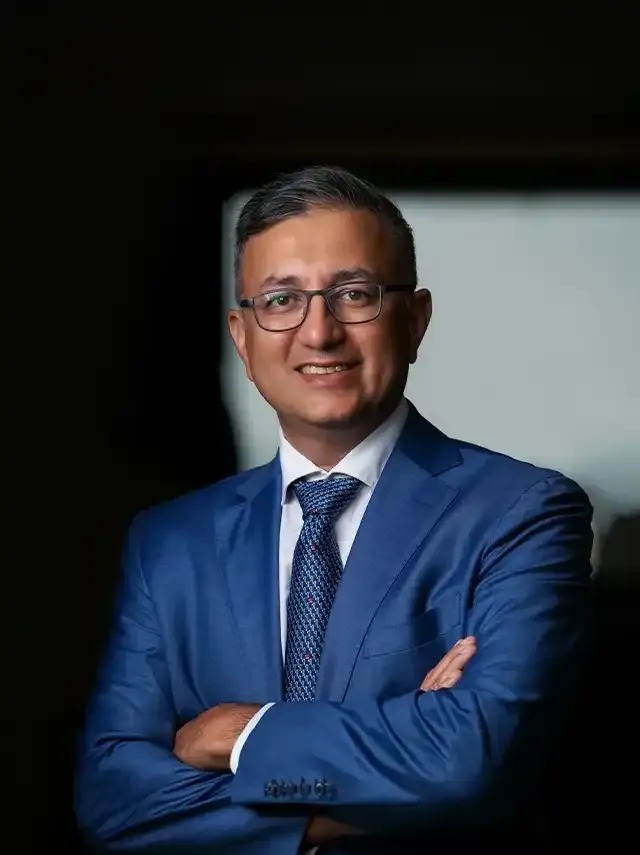
| Key facts | |
|---|---|
| Born | 11 November 1972 [12][70] |
| Hometown / family roots | Manipal, Udupi district, Karnataka [17][19] |
| Education | MBBS, Kasturba Medical College, Manipal; hospital-administration training in Wisconsin, USA [11][20] |
| Family | Father Dr Ramdas M. Pai (chancellor, MAHE); grandfather Dr T.M.A. Pai, founder of Kasturba Medical College; married, two daughters [14][18] |
| Company / Group | Manipal Education and Medical Group (MEMG); promoter of Manipal Health Enterprises; ManipalCigna Health Insurance; stake in Aakash Educational Services |
| Wealth | About US$3.9 billion (Forbes real-time, October 2026); Rs 34,700 crore, rank 85, Hurun India Rich List 2025 [14][67][68] |
| Known for | Turning a loss-making family hospital business into India’s largest multispecialty hospital chain by beds |
In 2001 or 2002, a newcomer to Indian healthcare made the Pai family of Manipal an offer: sell us your hospitals. The family’s hospital arm, run out of Bengaluru and Goa, was losing money. Its revenue was about Rs 56 crore and it had piled up accumulated losses of roughly Rs 100 crore [16]. It was run, as Ranjan Pai later put it, “by retired doctors so they didn’t have the rigour of modern healthcare” [16].
Pai, then not yet 30, went to his father. “I told my father either, we get out and focus on education or let me figure out if I can turn the business around,” he recalled [16]. His father, Dr Ramdas Pai, gave him a free hand. “He said make this into the best hospital network,” Pai told Outlook Business in 2025 [17].
Twenty-four years later, on 5 August 2026, Manipal Health Enterprises listed on the BSE and NSE after a Rs 9,275 crore IPO, valued at about US$9 billion on its first day of trade [38][39]. By March 2026 it ran 49 hospitals with more than 13,000 licensed beds, and called itself India’s largest multispecialty hospital chain by beds [1].
This is the story of how a doctor who never practised medicine for long became one of India’s biggest healthcare builders, what he got wrong, the fights he picked, and what founders can learn from him.
Where it began
To understand Ranjan Pai, you have to start with a town that his family more or less built.
In 1933, Dr Tonse Madhava Ananth Pai, a physician from Udupi, bought a stretch of barren laterite hill nearby called Manipal [23]. He went on to co-found Syndicate Bank with his brother [77], and in 1953 opened Kasturba Medical College (KMC) [7]. It was one of India’s first private medical colleges. The first batch of 100 students each paid Rs 3,000 [73]. Clinical training began at Wenlock Hospital in Mangalore in 1955, and the 150-bed Kasturba Hospital opened in Manipal in 1961 [7]. An engineering college followed in 1957 [23].
That fee-charging model was controversial from the start, and the family’s name later attached itself to one of the most important education cases in Indian law (more on that below). But it worked. A small town on the Karnataka coast became a magnet for students from across India and abroad.
T.M.A. Pai died in 1979. Leadership passed to his son, Dr Ramdas Madhava Pai, born in 1935, who had trained as a doctor and earned a master’s in hospital administration from Temple University in the US [76][74]. In the years after, the extended family’s businesses were divided. According to Outlook Business, Ramesh Pai, a nephew of T.M.A. Pai, took businesses such as Kurl-On mattresses and Canara Steel, while Ramdas Pai kept the education business [23]. Business Today reported that one family dispute in that branch of the family was settled in the mid-1990s with help from Dhirubhai Ambani [75]. Ramdas Pai’s side, in contrast, is described as having stayed on good terms.
Under Ramdas Pai, Manipal grew into a deemed university, the Manipal Academy of Higher Education (MAHE), in 1993 [23]. He also opened the group’s first city hospital, Manipal Hospital on Old Airport Road in Bengaluru, in 1991 [1].
Ranjan Ramdas Pai was born on 11 November 1972 [12][70] and grew up in Manipal [19]. He is his father’s only son [18]. Business Standard described Ramdas Pai as “a stickler for performance” [18].
A failed entrance exam
The boy from the family that ran the medical college did not get into it at first. At 18, Ranjan missed the cutoff for KMC and began his MBBS at a medical college in Davanagere, in central Karnataka [18]. After a strong first year, he transferred to Manipal. Business Standard, in a 2023 profile, described the episode as part of the Pai “legend” [19]. Pai himself has called it a “wake-up call” [17].
He finished his MBBS at Kasturba Medical College [11]. Then, instead of a clinical career, he went to the United States to study how hospitals are run. Most accounts describe this as a fellowship in hospital administration in Wisconsin; Fortune India named the University of Wisconsin-Madison [20], while a company director profile cites an administrative fellowship at the Children’s Hospital of Wisconsin [11]. Pai himself once called it his “Master’s in Hospital Administration” [22]. Business Standard reported that he also worked briefly with the health insurer Cigna in the US [18].
The stint changed him. “Till I went to the U.S. for my Master’s in Hospital Administration, all I had in mind was that I would join my father after my studies and run the businesses in Manipal,” he told SmartCEO in 2013. “The stint abroad opened up my mind” [22].
The first break
Malaysia, in hard hat and boots
Pai came back from the US in 1997 [16]. His father had a job for him: building a medical college overseas.
India had capped foreign students in its medical colleges, and the Malaysian government, through an agreement between the two countries, invited Manipal to set up a college there [23]. The result was the Melaka Manipal Medical College, and Ranjan Pai became its managing director [8]. “A medical school was being set up there, and my father asked me if I would like to go and set it up,” he told Business Today in 2026. “Setting up a college gave me full hands-on experience of doing everything away from India and Manipal” [15].
He watched the campus rise. “With my hard hat and boots, I watched this facility come up brick by brick,” he told Business Standard [18]. Accounts of the timeline differ. Pai told Outlook Business he was in Malaysia “for three years” after returning in 1997 [16]; Business Standard dated his Malaysia years to 2000-2005 [18]. Pai has said that while living there he spent about a week each month in Bengaluru, setting up an office and a team [15]. Outlook Business later reported that a fifth of all Malaysian doctors were Manipal alumni [23].
A holding company in a rented flat
The Malaysia project taught him that the family’s institutions, each run separately, lacked a central brain. “I realised that there was a need to set up a central resources group if we need to scale up globally,” he said. “That’s why I set up Manipal Education and Medical Group” [16].
MEMG was founded in 2000 in a rented apartment near Bengaluru’s M.G. Road with capital of about US$200,000 [20][21]. Pai chose Bengaluru, not Manipal, on purpose. “I thought attracting talent would be easier in Bengaluru,” he said. “We followed a model like the Tatas, bringing talent together and looking at new businesses to build” [15].
The point was to bring in professional managers, which was not easy. “It wasn’t easy to convince professionals to join a family business or, for that matter, match their salary levels,” he said. “But, the move was crucial to build scale” [22]. His father, he said, left him alone: “I had the complete freedom to make my decisions – the good ones and bad” [22].
The hospital turnaround
Then came the buyout offer and Pai’s decision to fight for the hospitals. In April 2002 he hired R. Basil from Wipro GE Medical Systems as the first professional chief executive of the hospital business [16]. The hospitals won ISO 9001 and NABL accreditation in 2003-04 [16]. “Earlier, retired people were running it. Bringing in professional managers was the turning point,” Pai said in 2026 [15].
He also found a new source of money. “Around 2004 or 2005, someone introduced me to private equity. We raised private equity in 2006 as capital was scarce,” he said [15]. In 2006, IDFC Private Equity bought 21% of the healthcare business for Rs 90 crore, valuing it at about Rs 450 crore [16]. The same year, IDFC PE and Capital International put Rs 300 crore into the education side, and the for-profit education businesses were placed in a new company, Manipal Global Education Services [23].
Pai was candid that outside investors made him sharper. “The good thing about having raising private equity is it puts some pressure on the entrepreneur and the management to stay on top of their game,” he said. “If it is your own company, there is a tendency to be complacent at times” [16].
Building the empire
A playbook: start small, professionalise, bring in capital
By 2013 Pai could describe his method in two sentences. “We start really small and put top quality management in place. We then put the Manipal brand in and bring in external capital for growth. Then we plan to sell, keep or IPO the business” [22].
The education side went global. After Malaysia came Dubai, a medical college in Nepal (begun with the Nepal government in 1994, before his time) and, from 2008, the American University of Antigua in the Caribbean [23]. In India, Manipal University Jaipur and Sikkim Manipal University joined MAHE, and the group later added Manipal Tata Medical College in Jamshedpur and an online university, Online Manipal, launched in 2021 [9]. MAHE itself, still a not-for-profit deemed university run by the family’s trust, holds Institution of Eminence status [9].
Pai also experimented with other businesses. A clinical research company, Manipal AcuNova, was started by the group with D.A. Prasanna in 2005, with Ramdas Pai as chairman [71]. It merged with Germany’s Ecron in 2007 and was sold to Take Solutions in 2015 for Rs 115 crore [72]. In 2010 Kotak Private Equity put Rs 110 crore into the hospitals [24].
On hospitals, his early view was modest. “Healthcare is a very regional business, and more suitable for regional players,” he told Business Standard in 2011, adding: “There are not enough hospital beds in the country today” [24]. Manipal opened greenfield hospitals in Jaipur in 2014 and Dwarka, Delhi, in 2018 [21].
The angel investor
In 2011 he co-founded Aarin Capital with T.V. Mohandas Pai, the former Infosys director (no relation) [16][20]. “We wanted to experiment with our own capital before we start investing third-party capital,” Ranjan Pai said. “I am an entrepreneur and I know how tough it is being an entrepreneur in India” [16]. Aarin became the first institutional investor in Byju’s in 2013 and exited with large returns [19]. Pai’s personal investments over the years included Purplle, BlueStone, PharmEasy and FirstCry [19].
TPG, Temasek and the scale-up
The big money for hospitals came in the mid-2010s. Pai says TPG arrived in 2014 “after three fundraising rounds” (other reports date its first investment to 2015) [15]. Singapore’s Temasek followed. By 2022, MEMG had raised more than US$700 million of private equity in total, and TPG and Temasek held about 22% and 18% of the hospital company [21].
In June 2019 Manipal raised its stake in the health insurer Cigna TTK to 51%, TTK exited and the company was renamed ManipalCigna Health Insurance, with Cigna holding 49% [6].
Columbia Asia: the deal that nearly died
The deal that made Manipal a national player was the purchase of Columbia Asia’s 11 Indian hospitals, with about 1,300 beds, for Rs 2,100 crore [28][21]. It nearly fell apart. “We were days away from signing, pens down, all agreements in place, and the pandemic struck!” Pai told Business Standard. “I was beginning to think it was jinxed” [18]. The deal was announced in late 2020 and completed on 30 April 2021, giving Manipal 26 hospitals in 14 cities and more than 7,000 beds [28].
To pay for it, the government-anchored National Investment and Infrastructure Fund (NIIF) invested Rs 2,100 crore in Manipal Hospitals in April 2021, its first healthcare deal [29]. In June 2021 Manipal bought Bengaluru’s 200-bed Vikram Hospital from Multiples Private Equity [30], for about Rs 350 crore according to Forbes India [21].
During the pandemic, Pai pushed for what he called a humane approach inside the group, protecting low-paid staff and limiting pay cuts to high earners. “Offices may be empty but don’t fire your security guards or housekeeping staff,” he told colleagues [18].
Handing control to Temasek
In April 2023 Pai made the most important decision of his career: he gave up majority control. Temasek, through Sheares Healthcare, bought another 41% of Manipal Health Enterprises, taking its stake to about 59% [25][26]. TPG sold from one fund and reinvested for about 11% through another, and NIIF exited [26]. Reuters, citing a source, said Temasek paid about US$2 billion [25]; Business Standard put the enterprise value at about Rs 40,000 crore [26]. The Pai family’s stake fell from about half to about 30% [25][26].
Pai insisted it was not an exit. “Although Temasek has a larger stake, it will be a consensus-run company,” he said, and “A lot of capital is needed in private healthcare in India… private equity money is critical for fuelling faster growth of the industry” [27].
East and west: AMRI, Medica, Sahyadri
With Temasek’s backing, the buying accelerated.
- AMRI Hospitals, Kolkata (September 2023): Manipal bought 84% from the Emami group, with Emami keeping 15% [4]. The price was not disclosed but was reported at about Rs 2,300 crore [31]. Pai said the deal would serve “Eastern India, an underserved area” [32]. (AMRI’s Dhakuria hospital had suffered a deadly fire in December 2011, under its previous owners; Manipal had no role in it [33].)
- Medica Synergie, Kolkata (April 2024): an 87% stake, taking the network to 37 hospitals in 19 cities and more than 10,500 beds [5].
- Sahyadri Hospitals, Pune (July 2025): a majority stake bought from the Ontario Teachers’ Pension Plan, adding 11 hospitals in Maharashtra, for about Rs 6,000 crore (US$701 million) according to a Manipal spokesperson quoted by Bloomberg [34]. Other reports put the price slightly higher [35].
“In many cases, acquisition is the easy part. What makes the difference is how well you execute,” Pai said in 2026 [15]. And the discipline he repeats most often: “In the hospital business, if you overpay for an asset, then you will never make money” [16].
The numbers behind the chain
Manipal Health’s prospectus shows how fast the business grew in its last three years as a private company [1]:
| Year (to March) | Revenue from operations | EBITDA (excl. exceptional items) | Profit after tax | Licensed beds |
|---|---|---|---|---|
| FY24 | Rs 6,172 crore | Rs 1,777 crore | Rs 533 crore | 9,520 |
| FY25 | Rs 8,242 crore | Rs 2,247 crore | Rs 1,082 crore | 10,494 |
| FY26 | Rs 10,336 crore | Rs 2,796 crore | Rs 917 crore | 13,037 |
Two caveats are worth knowing. Operational beds were far fewer than licensed beds: 6,227 in FY26 [1]. And the Sahyadri deal pushed total borrowings from Rs 4,767 crore to Rs 10,553 crore in a year [1].
The IPO
Manipal Health filed its draft prospectus on 24 March 2026, planning a Rs 8,000 crore fresh issue plus a sale of shares by existing holders [36]. The IPO, priced at Rs 560-590 a share, ran from 29 to 31 July 2026 and raised Rs 9,275 crore, the second-largest Indian IPO of 2026 according to Reuters [37][39]. It was subscribed about 4.9 times, largely by institutions; the retail portion was not fully subscribed [38]. The shares listed on 5 August at Rs 652 on the NSE and Rs 655 on the BSE, about 10-11% above the issue price [38].
About Rs 5,500 crore of the proceeds was earmarked to repay the debt taken on for Sahyadri [15]. “We do not have to win at all costs, especially now that we are a public company,” Pai said after the listing [15].
How the wealth is held
Pai’s fortune is spread across several pockets:
- Manipal Health Enterprises: the Pai family held about 30% after the 2023 Temasek deal, mostly through holding companies including Manipal Global Health Services (Mauritius), MEMG India and Cypress Holdings; Pai’s direct personal holding is tiny, about 0.18% before the IPO [1][26].
- Education: MAHE is a not-for-profit trust, so it is not “owned” in the usual sense; Pai is president of the MAHE Trust [8]. The for-profit education businesses sit in group companies.
- ManipalCigna: a 51% stake in the health insurer [6].
- Aakash Educational Services: a large stake, discussed below.
- Claypond Capital: his family office, set up after the Temasek deal, which invests in healthcare, medtech and start-ups [10].
Estimates of his net worth vary a lot. Forbes put it at about US$3.9 billion in October 2026 [14]. The Hurun India Rich List 2025 ranked him No. 85 with Rs 34,700 crore [67][68]. The 360 ONE Wealth Creators List 2026 put it at Rs 17,355 crore [69]. The gap reflects different ways of valuing unlisted and newly listed stakes.
Byju’s and Aakash: the comeback in edtech
In November 2023, with Byju’s in deep trouble, Pai’s family office paid about Rs 1,400 crore to buy out debt that Byju’s owed to the US fund Davidson Kempner [40][41]. The debt was secured on Aakash Educational Services, the test-prep chain Byju’s had bought in 2021 for close to US$1 billion [46]. In January 2024 the debt was converted into about 40% of Aakash [46]. Manipal later bought more shares, including from Aakash’s founding Chaudhry family, with Competition Commission approval in June 2025 [45], and by November 2025 held about 58% [46].
A business analyst quoted by Business Standard called Pai a “savvy, mature, and patient investor… not driven by the fear of missing out” [19]. Aakash was not an easy win, though. In FY26 it reported revenue of Rs 2,041 crore, an EBITDA margin under 1% and a net loss of Rs 186.5 crore, according to Open Magazine’s analysis of company filings [49]. The legal fight it triggered is covered in the controversies section below.
The setbacks and failures
Pai is unusually open that his record includes losses. “We never thought we were going to be the largest healthcare chain. We took one step at a time, with a lot of failures,” he said in 2026 [15].
The early hospital losses. In 2002 the hospital business had accumulated losses of about Rs 100 crore, and the family seriously considered selling [16].
Losing Fortis. In 2018 Manipal, partnered with TPG, bid for the troubled Fortis Healthcare chain and raised its offer several times [21]. In May 2018 the Fortis board voted 5-3 for a rival Munjal-Burman offer. “We are disappointed,” Pai said, adding that “Manipal remains of the view that our offer proposed the most appropriate short and long-term plan” [57]. In July 2018 the board finally chose Malaysia’s IHH Healthcare, which offered to invest Rs 4,000 crore [58]. Pai later reflected: “Our failures were more about capital. We just did not have the conviction to bid higher” [15].
Giving up control. For a family that had owned Manipal for 70 years, ceding majority control of the hospital company to Temasek in 2023 was a big step [25]. Pai’s framing is that the alternative was slower growth.
Being defrauded from inside. In December 2018, a voice-confirmation call about an unauthorised Rs 3.5 crore transfer to a Dubai company alerted Pai to a fraud. Police alleged that Sandeep Gururaj, a deputy general manager in finance, had diverted about Rs 62 crore over three years, including from Pai’s personal account, through shell firms [54]. Four people were arrested [54]. The Supreme Court granted Gururaj bail in January 2021 after two years in custody [13]. We could not find a reported trial verdict.
Aakash’s losses and a costly fight. The Aakash bet tied Pai’s name for nearly three years to the collapse of Byju’s, with courtroom battles from the NCLT to the Supreme Court and an investment that, as of FY26, was still losing money [49].
Controversies and allegations
Ranjan Pai has not been charged with any offence. The matters below are those documented by courts, regulators or official filings, or reported by at least two major publications.
The Aakash Educational Services dispute (2024-2026)
Allegation: After Manipal converted its debt into Aakash equity in early 2024, minority shareholders Blackstone and Prosus objected that the conversion was done at a valuation of roughly Rs 4,500-4,800 crore, about half what Byju’s had paid in 2021, diluting them unfairly; Prosus sent Pai a legal notice [42][46]. From late 2024, Blackstone’s investment vehicle and GLAS Trust, representing Byju’s US lenders, went to the NCLT Bengaluru against Aakash’s plan to change its articles of association. Their counsel argued that stripping minority rights while giving special rights to Manipal was “classic oppression” [44]. In 2025, GLAS Trust and Byju’s resolution professional alleged that a Rs 240 crore Aakash rights issue was designed to shrink the stake of Byju’s insolvent parent, Think & Learn [46][47].
Response: Manipal argued that the minority rights in question were tied to a planned Byju’s-Aakash merger that never happened and had lapsed [44]. Aakash and Manipal said the company needed capital and could not wait on a shareholder in insolvency [47].
What happened next:
- On 20 November 2024 the NCLT barred the articles change for the time being [43].
- In 2025 Manipal bought out the founding Chaudhry family’s stake, with CCI approval in June 2025 [45].
- The rights issue went through appellate courts; in February 2026 the Supreme Court disposed of the appeal after recording Aakash’s undertaking to protect Think & Learn’s right to a 25.75% stake [47].
- In November 2025 MEMG was reported as the only party to file an expression of interest to bid for Think & Learn in its insolvency [46].
- On 23 September 2026 both sides told the NCLT they had settled [47].
Status: Resolved. On 28 September 2026 the NCLT Bengaluru approved a global settlement between Aakash, the Manipal Group and Byju’s creditors, under which Think & Learn’s stake in Aakash rises to 32%, with governance and exit rights [2][48].
The Paradise Papers (2017)
Allegation: In November 2017, The Indian Express and the International Consortium of Investigative Journalists, using leaked files from the law firm Appleby, reported that MEMG International, a Mauritius entity linked to Pai, had taken secured loans from several Indian and foreign banks between 2002 and 2012 against pledged assets [50][51]. Being named in the leak did not by itself suggest wrongdoing, and the ICIJ noted that such structures are not necessarily illegal.
Response: Pai said his investments in MEMG were disclosed to the Income Tax Department and that all MEMG investments into India were declared with Reserve Bank of India approvals; some loans had been repaid and others were being repaid [50][51].
Status: We found no prosecution, penalty or adverse finding against Pai arising from the reports.
Income Tax searches (2022)
Allegation: On 7 September 2022 the Income Tax Department searched about 20 Manipal group locations, including Manipal Hospitals sites in Bengaluru and MAHE’s finance offices, reportedly on suspicion of tax evasion [52][53].
Response: A MAHE spokesperson described the searches as “part of a routine task”, according to reports [52].
Status: No official finding, demand or prosecution arising from the searches has been publicly reported as of November 2026.
A Supreme Court negligence ruling against Manipal Hospital (2024)
Allegation: The widow of a patient who had lung surgery at Manipal Hospital, Bengaluru, in 2003 alleged negligence after a trainee anaesthetist, rather than the head of department, inserted the breathing tube, leaving him with a paralysed vocal cord. Consumer forums at every level found deficiency in service [55][56].
Response: The hospital contested the case through the consumer courts and up to the Supreme Court.
Status: In February 2024 the Supreme Court ordered the hospital to pay Rs 10 lakh with interest, doubling the earlier award [55][56]. The case is closed.
The TMA Pai Foundation case: a landmark, not a scandal
People searching “TMA Pai controversy” often land on T.M.A. Pai Foundation v. State of Karnataka. The foundation, named after Ranjan Pai’s grandfather, was the lead petitioner in a batch of cases on the rights of private educational institutions. On 31 October 2002 an 11-judge Supreme Court bench ruled that private unaided institutions could set “a rational fee structure” but “would not be entitled to charge a capitation fee”, allowing “a reasonable surplus for the furtherance of education” [3]. It is a constitutional ruling that still shapes Indian education, not a finding of wrongdoing against anyone. Separately, in November 2017 the University Grants Commission, following a Supreme Court order, told 29 deemed universities, including Manipal, to stop using “university” in names other than their notified ones; Manipal reverted to “Manipal Academy of Higher Education” [59].
As of 2 November 2026, none of the matters above involves a pending charge against Ranjan Pai personally.
Giving back
Pai’s personal giving has risen sharply in recent years. The EdelGive Hurun India Philanthropy List named him among India’s youngest philanthropists in 2021, with Rs 17 crore given mainly to education [63]. In the 2023 list he gave Rs 92 crore [62]. In the 2025 list he and his family gave Rs 160 crore, joining the Rs 100-crore club and ranking second among Bengaluru donors [60][61].
Much of the family’s giving runs through the Manipal Foundation, set up in 2001, which funds scholarships, maternal and child welfare and heart surgeries for poor children [64]. The Manipal Arogya Card, a discount health card started in 2000 under Ramdas Pai, covered about 1.25 lakh families in a recent year [65]. During COVID-19, MAHE waived full fees for students who lost an earning parent to the virus [66].
Pai’s broader argument is that India simply needs more beds and more doctors, and that private capital has to help build them. “It is unfair to blame private equity for the rising cost of healthcare,” he said in 2026, while adding that “the government health insurance should probably be expanded” [15]. Critics of corporate hospital pricing, a live debate in India, would not fully agree with the first part.
Succession
Ramdas Pai, born in 1935, remains chancellor of MAHE [76][8]. Ranjan Pai is already president of the MAHE Trust and chairman of MEMG [8], making him the family’s clear head at the next generation. At the hospital company, the question of succession is different: Temasek is the majority owner, the board is chaired by Dr H.S. Ballal, and the company is now listed, so its leadership is set by a board, not a family [1]. Pai has not made public statements about who will follow him at MEMG, and his children have no public business roles.
What his journey teaches
Know when to hand over the wheel. Pai’s biggest move was not a purchase but the decision in 2002 to replace retired doctors with professional managers, and in 2023 to give a larger investor control. Ego would have kept both businesses smaller.
Your inheritance is a head start, not a business plan. He inherited a famous name and a loss-making hospital arm. The value came from rebuilding it, with outside managers, outside money and outside scrutiny.
Price discipline beats winning. He lost Fortis rather than overpay, and says, “if you overpay for an asset, then you will never make money.” Patience let him buy Columbia Asia, AMRI, Medica and Sahyadri later.
Use outside capital as a coach, not just a cheque. He welcomed private equity partly because it forced discipline: “If it is your own company, there is a tendency to be complacent at times.”
Failure early is cheap. He failed his first attempt to get into his own family’s medical college and called it a wake-up call. The habit of treating setbacks as information shows up throughout his career.
Distressed deals are messy. The Aakash bet shows that buying into someone else’s crisis can mean years of litigation and public scrutiny, even when you are on the right side of the law.
For more on how Indian business families and founders have built their companies, read our profiles of Devi Shetty, a Kasturba Medical College alumnus who built Narayana Health [20]; Apollo Hospitals founder Prathap C. Reddy; and Byju Raveendran, whose company’s collapse brought Aakash to Pai. Explore more market and business explainers on CapitalVia Insights.
A profile for general reading, based on public records and reporting as of 2 November 2026. Not investment, tax or legal advice.
Sources (77)
- Manipal Health Enterprises Ltd - Abridged Prospectus - SEBI, Jul 2026
- Kirkland advises Think & Learn (Byju's) creditors on global settlement with Aakash and Manipal - Kirkland & Ellis, Oct 2026
- T.M.A. Pai Foundation v. State of Karnataka, Supreme Court judgment - Indian Kanoon, Oct 2002
- AMRI divestment to Manipal Hospitals, press release - Emami Group, Sep 2023
- Manipal Hospitals acquires majority stake in Medica Synergie, press release - Manipal Hospitals, Apr 2024
- Cigna TTK Health Insurance changes company name to ManipalCigna - ManipalCigna, Jun 2019
- History of Kasturba Medical College - Manipal Academy of Higher Education, Nov 2026
- Dr Ranjan Pai, leadership - Manipal Academy of Higher Education, Nov 2026
- Our universities - Manipal Education and Medical Group, Nov 2026
- Claypond Capital - Manipal Education and Medical Group, Nov 2026
- Dr Ranjan Ramdas Pai, director profile - Dr Agarwal's Health Care, Nov 2026
- Ranjan Pai (Q112119155) - Wikidata, Nov 2026
- Manipal fraud case: Supreme Court grants bail to Sandeep Gururaj - LiveLaw, Jan 2021
- Ranjan Pai profile and real-time net worth - Forbes, Oct 2026
- Manipal's Ranjan Pai on what makes a hospital an attractive acquisition - Business Today, Aug 2026
- Healthy, Wealthy and Wise - Outlook Business, Apr 2018
- Ranjan Pai creates a capitalism of care to make Manipal the largest hospital chain in India - Outlook Business, Dec 2025
- Steady focus: Meet Ranjan Pai, chairman, Manipal Education & Medical Group - Business Standard, Jul 2021
- Life with Pai: What does Ranjan Pai's re-entry mean for Byju's and Aakash - Business Standard, Nov 2023
- Just what the doctor ordered - Fortune India, Dec 2018
- How Ranjan Pai is striving to make Manipal Hospitals India's biggest health care player - Forbes India, May 2022
- Where ownership and management are different - SmartCEO, Dec 2013
- Small town, big business - Outlook Business, Oct 2012
- Q&A: Ranjan Pai, MD & CEO, Manipal Education & Medical Group - Business Standard, Mar 2011
- Temasek buys 41% stake in India's Manipal Health for $2 billion - Reuters via ThePrint, Apr 2023
- Singapore's Temasek Holdings buys majority stake in Manipal Health - Business Standard, Apr 2023
- PE money critical: Manipal's Ranjan Pai on Temasek deal - Business Today, Apr 2023
- Manipal Hospitals completes acquisition of Columbia Asia Hospitals in India - Deccan Herald, Apr 2021
- NIIF invests Rs 2,100 cr in Manipal Hospitals, its first in health space - Business Standard, Apr 2021
- Manipal Hospitals acquires 100% stake in Bengaluru-based Vikram Hospital - The News Minute, Jun 2021
- Manipal acquires majority stake in AMRI Hospitals for Rs 2,300 crore - Business Standard, Sep 2023
- Manipal acquires AMRI Hospitals for Rs 2,300 crore, gets 84 per cent stake - Medical Dialogues, Sep 2023
- 7 years since Kolkata's AMRI hospital fire, victims' families still await justice - Outlook India, Dec 2018
- Temasek-backed Manipal Health acquires Sahyadri for $700 million - Bloomberg Law, Jul 2025
- Manipal to acquire Pune-based Sahyadri Hospitals for around Rs 6,400 cr - Outlook Business, Jul 2025
- Manipal Hospitals files DRHP for over $1 billion IPO - Business Standard, Mar 2026
- Manipal Health Enterprises IPO price band, listing on August 5 - Kotak Neo, Jul 2026
- Manipal Health Enterprises makes solid stock market debut, shares list at 11% premium - Business Today, Aug 2026
- India's Manipal Health jumps 10.5% in trading debut after $960 million IPO - Reuters via SRN News, Aug 2026
- Ranjan Pai invests $168 mn in Byju's Aakash to clear Davidson Kempner debt - Business Standard, Nov 2023
- Manipal Group's Ranjan Pai injects Rs 1,400 crore in Byju's, settling Davidson Kempner debt in Aakash - Business Today, Nov 2023
- Blackstone, Prosus object to Aakash debt-to-equity conversion - Inc42, Feb 2024
- NCLT stays Byju Raveendran's bid to sell Aakash stake - Inc42, Nov 2024
- Aakash Institute's minority shareholders deny Manipal's claims before NCLT - Legal Era, Jan 2025
- CCI approves Manipal's acquisition of additional stake in Aakash - PTI via The Week, Jun 2025
- Bankrupt Byju's receives single bid from Ranjan Pai's Manipal Group - Outlook Business, Nov 2025
- Byju's-Aakash settlement: the shareholding tussle behind the Rs 240 cr rights issue - Outlook Business, Sep 2026
- Byju's parent to hold 32% stake in Aakash after settlement - Inc42, Oct 2026
- 50 toppers, 0.75% margin: Aakash still can't exorcise the ghost of Byju's - Open Magazine, Sep 2026
- Ranjan Pai of Manipal University listed in Paradise Papers - Deccan Herald, Nov 2017
- Ranjan Pai of Sikkim Manipal University used offshore vehicles to fuel credit - Herald Goa, Nov 2017
- IT department conducts raids on Manipal group of hospitals in 20 locations - The Federal, Sep 2022
- Income Tax raids on Manipal group of hospitals over suspected tax evasion - Medical Dialogues, Sep 2022
- Explained: How a former employee siphoned Rs 62 crore from Manipal group - The News Minute, Jan 2019
- Faulty intubation during anaesthesia: SC slaps Rs 10 lakh compensation on Manipal Hospital - Medical Dialogues, Feb 2024
- Loss of voice post surgery: SC directs Manipal Hospital to pay Rs 10 lakh to patient - LawStreet Journal, Feb 2024
- Fortis chose Munjal-Burman for funds certainty, Manipal feels let down - DT Next (IANS), May 2018
- Fortis picks IHH to take over hospital chain - Orissa Post (PTI), Jul 2018
- UGC asks deemed universities to drop the word university - Scroll, Nov 2017
- Hurun India Philanthropy List 2025: Shiv Nadar tops list - Business Today, Nov 2025
- Generous Bengaluru: philanthropists contributed Rs 1,588 crore - Deccan Herald, Nov 2025
- Shiv Nadar is India's most generous billionaire, but young guns have their hearts in the right place - Business Insider India, Nov 2023
- Dr Ranjan R Pai named in the EdelGive Hurun India youngest philanthropists list - The Hans India, Dec 2021
- Manipal Foundation - Wikipedia, Nov 2026
- Silver jubilee year enrolment for Manipal Arogya Card 2025 begins - Mangalorean.com, Jun 2025
- Manipal's MAHE offers full fee waiver to students who lost earning parent to Covid - Udayavani, Jun 2021
- Hurun India Rich List 2025: names of top 100 richest Indian tycoons - LatestLY, Oct 2025
- Hurun India Rich List 2025: top 100 rich Indians - Trak.in, Oct 2025
- Ranjan Ramdas Pai net worth 2026 - 360 ONE Wealth Creators List, Nov 2026
- Ranjan Pai net worth and biography - Goodreturns, Nov 2026
- D A Prasanna becomes CMD of Manipal AcuNova - BioSpectrum, Sep 2010
- Leading CRO Ecron Acunova re-branded as Navitas Life Sciences - BioVoice, Jun 2017
- How sale of MBBS seats started and it is going - The Weekend Leader, Jul 2013
- Manipal and Beyond: Ramdas Pai and the Landscape of Indian Education - Penguin India, Mar 2016
- Manipal Group: Satish and Gautham Pai - Business Today, Oct 2013
- Ramdas Pai - Wikipedia, Nov 2026
- T. M. A. Pai - Wikipedia, Nov 2026