
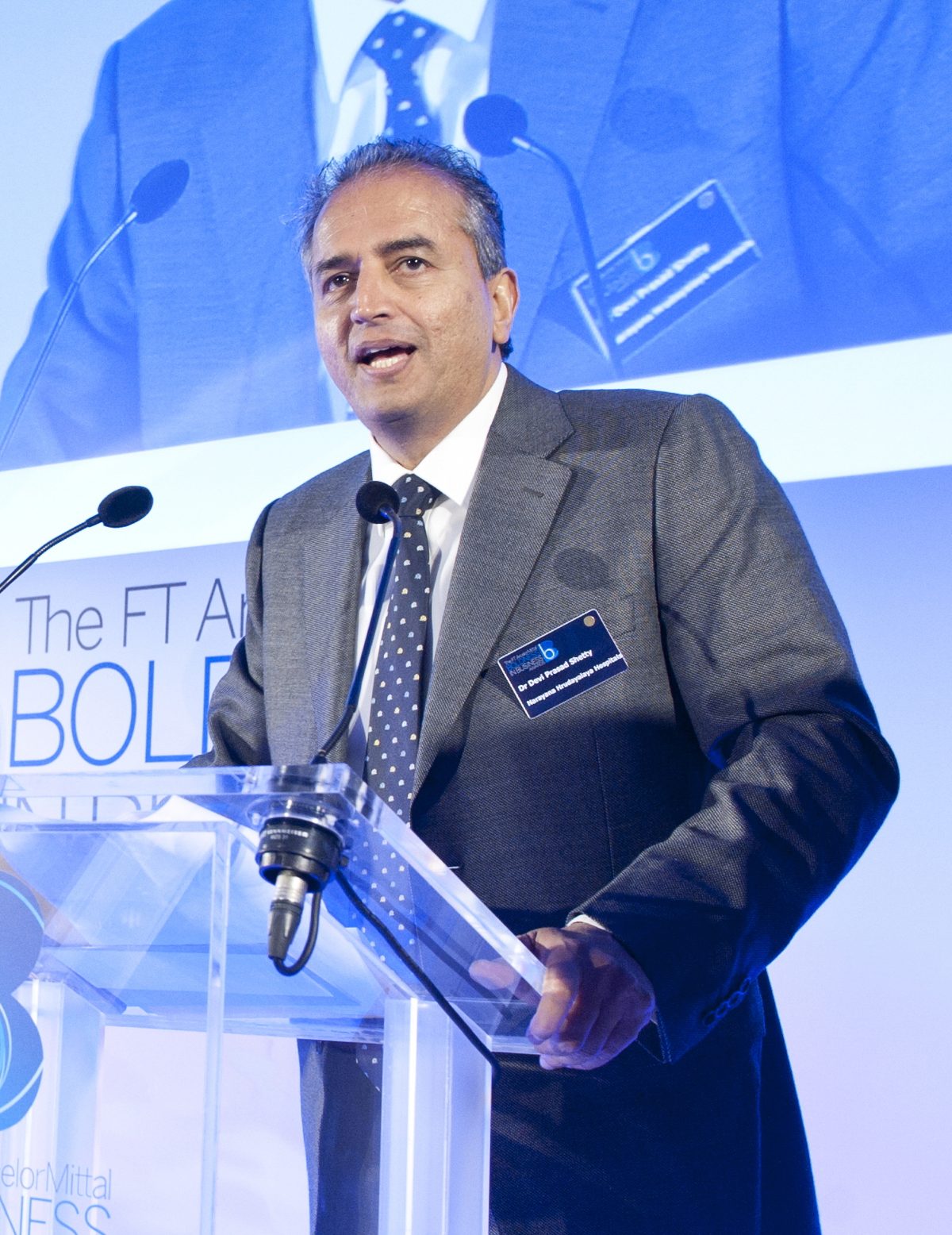
| Key facts | |
|---|---|
| Born | 8 May 1953, Kinnigoli, Dakshina Kannada, Karnataka [11][15] |
| Family roots | Eighth of nine children; his father ran hotels in Bombay [12][13] |
| Education | St Aloysius School, Mangaluru; MBBS and MS (General Surgery), Kasturba Medical College, Mangalore; cardiac surgery training at Guy’s Hospital, London; FRCS (England) [15][16][17] |
| Family | Wife Shakuntala Shetty, the largest shareholder in Narayana Health; sons Viren (Executive Vice Chairman), Dr Varun (cardiac surgeon) and Anesh (board director) [1][3][58] |
| Company | Narayana Hrudayalaya Ltd (Narayana Health), Bengaluru, founded 2000; Founder and Chairman [1][3] |
| Wealth | About US$2.4 billion (Forbes real-time, 16 October 2026); Rs 20,756 crore for “Devi Prasad Shetty and family” (360 ONE Wealth Creators List 2026, rank 87) [54][55] |
| Known for | Bringing heart surgery within reach of ordinary Indians; Narayana Health’s 55 facilities and about 5,955 beds in India, the Cayman Islands and the UK; the Yeshasvini farmers’ health scheme [2][28] |
In Kolkata in the early 1990s, a young heart surgeon got a phone call he did not want. Someone wanted him to come to a patient’s home. He said no. “I politely told him that I am a heart surgeon, what do I do at home,” he recalled years later [20].
The caller kept pressing, so he went. The patient was Mother Teresa.
Dr Devi Prasad Shetty looked after her heart for the rest of her life, about five years by his own account [12][16]. When she was critically ill, he says, he took a call from the White House offering the US President’s aircraft to fly her to America for treatment [19]. What stayed with him, though, was her outlook rather than her fame. “She introduced me to the power of simplicity, power of compassion, power of love,” he said [20]. “I can’t imagine how my life would have turned out if I hadn’t made that house call” [12].
He also took away a hard truth. In Kolkata he was seeing over 100 patients a day who needed heart operations [82], and most of them could not pay. Mother Teresa’s compassion worked one patient at a time. Shetty came to believe that kindness without a business model would never reach the millions. Later he put it bluntly: “What Mother Teresa did was not scalable” [25].
The rest of his life has been an attempt to make it scale. In 2000 he set up Narayana Hrudayalaya in a Bengaluru suburb. The Wall Street Journal later called him the “Henry Ford of heart surgery” [26], and Bloomberg Businessweek called it “India’s Walmart of heart surgery” [27]. By 2008 his flagship’s 42 cardiac surgeons were doing more bypass operations than the Cleveland Clinic, at about US$2,000 each, against US$20,000 to US$100,000 at American hospitals [26].
A quarter of a century later, Narayana Health is a listed company. In the July–September 2026 quarter it reported Rs 2,844 crore of revenue [56]. It runs hospitals in India, the Cayman Islands and Britain [2], and Forbes counts its founder among the world’s billionaires [54]. Shetty still lists himself as a practising cardiac surgeon, and his hospital’s website takes appointments in his name [87]. By 2016 he had personally performed more than 15,000 heart operations [83].
This is the story of how a boy from a coastal Karnataka village built that company: the in-laws who funded it, the American gamble in the Caribbean that did not go to plan, the court cases, and the family that now stands beside him.
Where it began
Devi Prasad Shetty was born on 8 May 1953 in Kinnigoli, a village in Dakshina Kannada district on the Karnataka coast [11][15][16]. He was the eighth of nine children [11][15]. “When you have eight siblings, you automatically learn how to get someone’s attention,” he once wrote [12].
Reliable sources do not name his parents. In his own telling, his father ran hotels in Bombay and “was always away on business” [12][13]. His mother was “a more defining influence” [13]. She would tell him, “Pechu, share your sweets with your friends before you eat!” He says, “I guess my sense of empathy comes from her” [12][13]. She admired a doctor who had treated a relative’s child for free, and that admiration helped turn her son toward medicine [13].
By his own account he was no prodigy. “I was an average student, who pulled out the books just before the exams,” he wrote. “Maths was a recurring nightmare” [13]. A drawing teacher, Achutha Acharya, tutored him in maths and pushed him into a district-level exam, which he passed [13].
The day he decided
He went to school at St Aloysius in Mangaluru [11][16]. There, in December 1967, a teacher told the class about a South African surgeon called Christiaan Barnard, who had just performed the world’s first human heart transplant. “That’s the day I decided I would become a heart surgeon,” Shetty said [86]. “I didn’t even know you had to become a doctor first, I was so naïve, but my heart was set” [16].
Shetty himself always says he was in the fifth standard at the time [12][16]. Born in May 1953, though, he would have been 14 in December 1967, the age India Today gives [14]. We report the moment and flag the mismatch. What matters is that the ambition took hold early and never left.
Medical school and London
He studied medicine at Kasturba Medical College (KMC) in Mangalore. Sources differ on whether he finished his MBBS in 1978 [17] or 1979 [11][15]. One likely reason is that the final exams and the end of internship fell a year apart. He then did an MS in general surgery at the same college, completing it in 1982 [16][17].
At KMC he showed a streak of the organiser he would become. As secretary of the student union he led a strike over interns’ stipends. “The interns got their increase but the management increased our fees to pay the higher stipends!” he recalled [12]. It was an early lesson in where money really comes from.
In 1983 he went to Britain and trained in cardiac surgery, mainly in the cardiothoracic unit at Guy’s Hospital in London, until 1989 [16]. He also worked on a West Midlands rotation [86]. He became a Fellow of the Royal College of Surgeons of England [11][15]. At Guy’s his mentor, Dr Alan Yates, also introduced him to the business side of medicine [12].
London made him a fine surgeon, but it kept him at a distance from his patients’ lives. “In London, I became an excellent surgeon, but I didn’t have to meet the families of patients,” he wrote [12]. His wife Shakuntala spent long stretches in India and, he says, was “counting the days” until they could return [12][14]. “I always wanted to come back to India,” he said [13].
The first break
He came home in 1989. “Heathrow to Howrah was such a change, both in terms of protocol and aftercare,” he said [12][13]. “When I returned from England with all the enthusiasm and excitement to change the world, reality struck” [86].
He found work in Kolkata, where the B.M. Birla Foundation had opened a heart hospital, the B.M. Birla Heart Research Centre [14]. He led its cardiac surgery programme [11][12]. He spent his first two months training nurses and doctors [12].
India’s first newborn heart operation
In 1992 he performed what is widely recorded as India’s first heart surgery on a newborn [11][12][15]. Sources disagree on the baby’s age: Wikipedia and a 2024 review in the journal Cureus say 21 days [11][15], while Shetty himself says nine. “I still remember the first time I performed open heart surgery on a nine-day-old baby,” he wrote [12]. Either way, the operation gave Indian paediatric cardiac surgery something it had not had before.
Around the same time came the house call to Mother Teresa. Shetty has dated their first meeting to 1992 [19]. In November 1996, after a heart attack, she underwent angiography and angioplasty for two blocked arteries at the B.M. Birla Heart Research Centre [18]. Contemporary reports did not name her doctors [18]; later accounts credit Shetty with treating her [15][16]. He quotes her telling him that God had sent him “to this world to fix it”, meaning the hearts of children born with holes in them [21].
The Manipal years
Shetty’s family lived in Bangalore, and for a while he shuttled between the two cities [12]. Then Dr Ramdas Pai of the Manipal group offered him what every surgeon wants. “When Dr. Ramdas Pai approached me and gave me the complete freedom to set up the Manipal Heart Foundation, I moved to Bangalore,” Shetty wrote [12]. Company records show Manipal Heart Foundation Pvt Ltd was incorporated on 12 August 1996 at the Manipal Hospital address on Bangalore’s Airport Road [22]. Reports differ on whether he left Kolkata in 1996 or 1997 [14][21].
At Manipal he built a large cardiac programme, but he wanted something bigger. Rich patients were too few to pay for the poor ones he wanted to treat [12]. Public sources do not record exactly why he left Manipal. The direction of his thinking, though, is on record. “I never wanted to build a company,” he wrote. “I wanted to build a charitable trust” [12][13].
The father-in-law’s bet
The money for his own hospital came from family. Shetty’s father-in-law, C. Narayana Shetty, was a construction businessman who founded Shankaranarayana Constructions [24]. Shetty says his brother-in-law persuaded the older man to back a hospital “to leave a legacy behind”. He added, “I have much to thank my brother-in-law” [13]. The hospital was named after the father-in-law: Narayana Hrudayalaya [13]. Wharton’s business school journal records that he built the first hospital at minimum cost [23].
The company’s 2015 prospectus fills in the paperwork. Narayana Hridayalaya Private Limited was incorporated in Bengaluru on 19 July 2000, and its first two shareholders were C. Narayana Shetty and Dr Devi Prasad Shetty, with 10 shares each [1]. In September 2001 it issued 2,49,980 shares at Rs 10 each, mostly to Shetty and his wife’s family: her brothers Dr N. Sitaram Shetty and Manohar Shetty, and her sisters [1]. Shetty paid for his shares with Rs 12.75 lakh borrowed from his wife, Shakuntala [1].
Bloomberg later reported that his father-in-law put up “$20 million” in 2000 [25]. The prospectus shows only about Rs 25 lakh of share capital before 2008 [1], so any larger family support must have come in another form, such as loans or the building itself. We give Bloomberg’s figure as Bloomberg’s.
When did the hospital open? The prospectus says the Narayana Institute of Cardiac Sciences at Bommasandra was “commissioned in July 2000” [1]; many profiles say 2001 [11][23]. The most likely explanation is that the company and the first operations date from 2000, with fuller operations in 2001. It started with about 225 beds [1].
The site was at Bommasandra, on the city’s southern edge [1][15]. Shetty soon found that a charitable trust could raise only so much money. “We transitioned from a charitable trust to a for-profit organisation,” he said [13].
Building the empire
Making surgery a factory, in a good way
Shetty’s big idea was simple to say and hard to do: treat heart surgery the way Japanese carmakers treated cars. “Japanese companies reinvented the process of making cars. That’s what we’re doing in health care,” he told the Wall Street Journal in 2009. “What health care needs is process innovation, not product innovation” [26].
In practice that meant volume. One campus did so many operations that surgeons became highly practised, expensive machines were used all day, and fixed costs were spread over thousands of patients. In 2008 the flagship’s 42 cardiac surgeons performed 3,174 bypass operations, against 1,367 at the Cleveland Clinic. They also did 2,777 paediatric heart operations, against 1,026 at Boston Children’s Hospital [26]. Average open-heart surgery cost about US$2,000 [26]. Shetty told the American College of Cardiology that by noon each day his managers received a text message with the previous day’s revenue, expenses and margin [82]. “For us looking at the profit and loss account at the end of the month is like reading a postmortem report,” he said [74].
He went after every input. “The most expensive medical equipment is not a CT/MRI/PET scanner, but a doctor’s pen,” he said, meaning the decisions doctors make about tests and drugs [82]. Bloomberg Businessweek reported in 2013 that a bypass at Narayana cost Rs 95,000 (about US$1,555), half its price of 20 years earlier, while the Cleveland Clinic charged US$106,385 [27]. His public target was an US$800 heart operation [27][76].
Bloomberg reported in 2019 that 30-day bypass mortality at Narayana was about 1.4%, against about 1.9% in the US [25]. “If a solution is not affordable, it is not a solution,” became his signature line [82][78].
Telemedicine and the farmers’ scheme
Early on he looked beyond the hospital walls. In 2001, with the Indian Space Research Organisation (ISRO) supplying satellite links free of charge, Narayana started telemedicine links to district hospitals in remote areas [33]. By 2004, Ashoka recorded, more than 11,000 patients had been seen this way [34].
Telemedicine could diagnose a poor farmer’s heart disease, but it could not pay for the operation. So Shetty took an idea for a micro-insurance scheme to the Principal Secretary of Karnataka’s Cooperation Department [28]. The result was Yeshasvini, formally agreed in April 2003 [29] and launched that year [28]. Members of rural cooperatives paid Rs 5 a month, Rs 60 a year, for cover for surgery [28][29]. About 1.6 million people joined in the first year [28]. It is covered in more detail under “Giving back”.
Private equity and a nationwide push
Narayana grew beyond Bengaluru on the strength of its Kolkata links and its model. In Kolkata, Shetty founded the Rabindranath Tagore International Institute of Cardiac Sciences, which opened in 2000 under the Asia Heart Foundation. Narayana formally took over its management in January 2008 [1]. The same month it signed its first big outside investment. JPMorgan and two vehicles linked to AIG (later PineBridge) put in about Rs 400 crore for roughly 23% of the company, which valued it at about Rs 1,700 crore [1][35]. One magazine account puts the stake at 25% [13]. The prospectus arithmetic gives 23.2%.
The money funded an ambitious plan. In 2008 Narayana spoke of 5,000-bed “health cities” in Kolkata, Jaipur, Ahmedabad, Raipur, Jamshedpur, Bhopal and Delhi [35]. Not all were built, but the network spread fast. According to the prospectus, Narayana opened or took over Jamshedpur (2008), the Mazumdar Shaw Medical Centre for cancer at Bommasandra (2009), Hyderabad (2010), Jaipur (2011), Ahmedabad (2012), Mysuru (2012), Shimoga (2013), Guwahati (2013) and Howrah (2014) [1]. The Bommasandra cancer centre carries the name of Biocon founder Kiran Mazumdar-Shaw, who held about 2.3% of Narayana before its listing [1]. In 2013 the group renamed itself Narayana Health [89].
In December 2014 the UK government’s development investor, CDC Group, put in Rs 300 crore: Rs 200 crore for 5.88% of the equity plus Rs 100 crore of convertible debentures [1]. That valued the company at about Rs 3,400 crore, double the 2008 valuation [1]. By the time of its prospectus in December 2015, Narayana had 23 hospitals, 8 heart centres and 24 primary-care units in 31 cities, with 5,442 operational beds and over 11,000 employees [1]. Revenue had grown from Rs 478 crore in FY11 to Rs 1,364 crore in FY15 [1].
The Caribbean gamble
The boldest bet was half a world away. In July 2012 Narayana signed a joint venture with Ascension, a large US Catholic hospital system, to build a hospital in the Cayman Islands [1]. The idea was to bring Indian prices, Indian-trained surgeons and American-standard care to a short flight from Miami, so that uninsured or under-insured Americans could fly in for surgery. Health City Cayman Islands opened in February 2014 [37]. The launch was billed as the first phase of a US$2 billion, 2,000-bed project over 15 years [37]. In fact it opened with just over 100 beds [1][38].
The American patients came more slowly than hoped (see “The setbacks and failures”). In November 2017 Ascension announced it would step back, and in January 2018 Narayana bought out its 74.1% stake for US$32.26 million, making Health City wholly owned [38][39]. Narayana stayed on, and the islands came to depend on the hospital: in the July–September 2026 quarter the Cayman business earned US$63.4 million in revenue and US$22.1 million in EBITDA [56].
Listing on the stock market
Narayana went public in December 2015. The issue was entirely an offer for sale: the company raised no new money, while JPMorgan, the AIG-linked funds and Shetty and his wife sold shares [1]. The price was Rs 250 a share, and the issue raised about Rs 613 crore [42]. Reported subscription figures differ: Business Standard gave 8.45 times and later 8.67 times, while Chittorgarh gave about 6.4 times [42][43][44]. The shares listed on 6 January 2016 and closed the first day about 35% above the issue price, giving the company a market value of about Rs 6,881 crore [43]. It was the first Indian IPO of 2016 [89].
Professional managers, family heirs
In February 2019 the long-serving group chief executive, Dr Ashutosh Raghuvanshi, resigned after 18 years. Dr Emmanuel Rupert, with Narayana since 2000, became Managing Director and Group CEO, and Shetty’s eldest son Viren became Group Chief Operating Officer [47]. Viren, a civil engineer with a Stanford MBA [55], had overseen the construction of the group’s hospitals [49]. He became Executive Vice Chairman on 1 April 2022 [48].
From Covid to a decade of profit
The Covid-19 pandemic hit hard. In April–June 2020 revenue fell by about half and Narayana lost Rs 119.8 crore [46]. It recovered quickly. Consolidated revenue (Screener’s figures, which may differ slightly from the company’s annual reports) went from Rs 2,583 crore in FY21 to Rs 3,701 crore in FY22, Rs 4,525 crore in FY23 and Rs 5,483 crore in FY25. Net profit rose from a small loss in FY21 to about Rs 790 crore in FY24 and FY25 [57].
Insurance: “we have no incentive to prevent heart attacks”
Shetty had long argued that hospitals earn money when people fall ill, so they have no reason to keep them well. “We have no incentive to prevent people from heart attacks, but that will change the moment we become an insurance company,” he said in March 2024 [80]. Narayana Health Insurance received its licence from the insurance regulator on 8 January 2024 [84]. Its first plan, Aditi, launched on 1 July 2024: for Rs 10,000 a year, a family gets up to Rs 1 crore of surgical cover and Rs 5 lakh for medical treatment, used at Narayana hospitals [50]. It is early days. In April–June 2026 the insurer wrote Rs 26.2 crore of premiums and lost Rs 20.1 crore [2].
Britain
The latest leap came in October 2025. Narayana agreed to buy Practice Plus Group Hospitals in the UK for £188.78 million (about Rs 2,200 crore) in cash [51][52]. The business is one of Britain’s larger independent providers of surgery to NHS patients. Business Standard reported 12 hospitals and surgical centres, while Forbes counted 10; the company’s own July 2026 presentation shows 13 UK facilities [51][53][2]. It has about 330 beds and about 2,500 staff, and performs some 80,000 surgeries a year [51][52]. The deal took effect on 6 November 2025 [2]. “Together, we are a perfect fit,” Shetty said [51].
The acquisition transformed the numbers. FY26 revenue rose to roughly Rs 7,800 to 7,900 crore, depending on the source, with net profit of about Rs 806 to 810 crore [57][88]. In July–September 2026 revenue was Rs 2,844 crore, up 73%, and profit was Rs 301 crore. The UK unit, still absorbing separation costs, lost £2.7 million in the quarter [56].
The group today
As of 1 July 2026 Narayana Health ran 55 healthcare facilities: 20 hospitals and heart centres in India with 5,461 operational beds plus clinics, two facilities with 164 beds in the Cayman Islands, and 13 facilities with 330 beds in the UK. In total it had 5,955 operational beds and about 20,950 staff [2]. Its flagship Bengaluru heart institute alone did 2,137 cardiac surgeries in that quarter [2]. It has projects planned in Bengaluru, Kolkata and Raipur to add thousands more beds by 2030 [2][56].
How the wealth is held
Almost all of the Shetty family fortune is in Narayana Hrudayalaya shares. At the end of September 2026 the promoter group held 63.27% of the company, with no shares pledged [58]. The largest single shareholder is Shetty’s wife, Shakuntala Shetty, with 34.80%. Devi Shetty holds 11.66%, and his sons Viren, Varun and Anesh hold 5.00% each [58]. At the time of the IPO Shetty and his wife each held a little under a third [1]; since then part of his holding has passed to the next generation.
Forbes put his real-time net worth at US$2.4 billion on 16 October 2026 [54]. It had reported US$2.6 billion in November 2025 [53]. The 360 ONE Wealth Creators List 2026, compiled with Crisil, values “Devi Prasad Shetty and family” at Rs 20,756 crore, 87th among India’s wealthiest families [55].
The setbacks and failures
Cayman: the patients who did not fly in
Health City Cayman Islands was supposed to draw thousands of Americans a year: one plan spoke of about 17,000 US medical tourists [40]. American insurers and patients proved far more cautious than the planners had hoped. In 2018 the trade publication LaingBuisson reported occupancy of just 27% [40]. Ascension, which had once owned most of the venture, withdrew in 2017, saying it was refocusing on its US priorities [38]. Narayana took the whole hospital for US$32.26 million [39]. In March 2020 the hospital briefly suspended operations after a cruise-ship cardiac patient developed Covid-19 symptoms and half its clinical staff had to go into quarantine [41].
The project survived by changing shape. Instead of relying on medical tourists, it now serves mainly the islands’ own residents, and Narayana also runs a health insurer there [2]. In July–September 2026 the Cayman business made US$22.1 million of EBITDA on US$63.4 million of revenue [56]. The original dream of a 2,000-bed resort for Americans has not come true.
Profits squeezed after the listing
The early years as a listed company were not easy. In 2017 the government capped the price of coronary stents, which hit cardiac hospitals directly. In April–June 2017 Narayana’s net profit fell 36% to Rs 10.9 crore. Management blamed the stent cap, losses at a new Mumbai hospital and an “unpredictable and challenging regulatory environment” [45]. Shetty also argued publicly that the government’s Ayushman Bharat (PM-JAY) insurance scheme paid hospitals less than treatment cost. “They are paying less than what it costs,” he told Bloomberg in 2019 [25].
Projects that did not happen
Not every plan worked out. A 1,000-bed hospital in Bhubaneswar, on land the Odisha government had allotted in 2008–09, was never built. In April 2017 Narayana dropped it as “no longer financially viable” (see below) [60]. In 2020 a trust in Bengaluru did not renew Narayana’s contract to run the Chinmaya Mission hospital, which provided about 0.4% of group revenue [85]. And the network of 5,000-bed “health cities” announced in 2008 [35] turned into a smaller set of large campuses.
Controversies and allegations
For an Indian hospital group of its size, Narayana Health’s record of serious controversy is thin. We found no criminal case against Devi Shetty personally, and no order against him or the company from SEBI or the Competition Commission. The matters below are those documented by courts, regulators or government, or reported by at least two major publications.
Land at Anekal, Bengaluru (2011–2012)
Allegation: In June 2011 former prime minister H.D. Deve Gowda alleged that the Karnataka Industrial Areas Development Board (KIADB) had improperly acquired and allotted 6.07 acres belonging to an education institute at Kittaganahalli, Anekal taluk, to Narayana Hrudayalaya. He blamed “influential people”, alleged collusion by KIADB officials and demanded that the land be denotified [61].
Response: KIADB called the allegations baseless and said the allotment followed an application made in 2001 and later notifications [61].
What happened next:
- Landowners challenged the acquisition. In Muninanjappa L v State of Karnataka, decided on 20 November 2012, a Division Bench of the Karnataka High Court dismissed their appeals [5].
- The court held that land acquired for a single company can be valid when used for industrial development, and that a heart or cancer hospital and a nursing college count as “industrial infrastructural facilities” [5].
Status: The acquisition was upheld in 2012. We found no later reversal.
The Odisha hospital land (2012–2017)
Allegation: The Odisha government had allotted Narayana a plot in Bhubaneswar on a 90-year lease for a 1,000-bed hospital, with construction due within three years. The state issued a show-cause notice in April 2012 because work had not begun, and in October 2015 it asked the company why the lease should not be cancelled and the land taken back [59].
Response: Narayana sought more time. On 5 April 2017 it told the BSE the project was “no longer financially viable” because a rival had opened a multispecialty hospital nearby, and said it would surrender the land, subject to a refund of the lease premium [60].
Status: The project was abandoned in 2017 and the land given up. We could not confirm whether the premium was refunded.
The Shivajinagar hospital lease (2018)
Allegation: In February 2018 Karnataka’s urban development department proposed leasing a newly built 100-bed municipal (BBMP) hospital in Shivajinagar, Bengaluru, to Narayana for 30 years. Narayana would invest Rs 20 crore and reserve 10% of beds for free treatment of the poor and civic workers [62]. Health activists objected to handing a public hospital to a private chain [63]. No wrongdoing by Narayana was alleged.
Response: The state government said the aim was better services for patients [62]. We found no public statement from Narayana.
Status: The plan was dropped. In 2020 the building was used for Covid-19 care by the government-run Bowring hospital.
The Jaipur angioplasty negligence case (2017–2023)
Allegation: Raghuveer Singh had an angioplasty at Narayana Multispeciality Hospital, Jaipur, on 3 April 2017. He alleged inadequate checks before the procedure, that he had not given informed consent to the route used, and that he was not referred elsewhere when things went wrong. After complications he needed 14 surgeries and his leg was amputated, eventually at the hip [6][64].
Response: The hospital and doctors denied negligence. They said he had undisclosed disease in his leg arteries and that the complications came from his condition [6].
What happened next:
- In July 2019 the Rajasthan State Consumer Commission awarded Rs 50 lakh in all, Rs 30 lakh against the hospital and Rs 10 lakh against each of two doctors, with 9% interest [6].
- On 17 November 2023 the National Consumer Disputes Redressal Commission (NCDRC) dismissed the appeals. It called the case a “therapeutic misadventure”, found that consent was not informed, and held the hospital vicariously liable [6][64].
Status: The award stands. We found no appeal to the Supreme Court. Shetty was not personally a party.
The Barasat billing complaint (2021–2026)
Allegation: A man whose mother was treated for a fractured thigh bone at Narayana Multispeciality Hospital, Barasat (West Bengal), alleged that the hospital billed Rs 2,500 for a chest CT scan it never did, delayed giving him medical records, and that staff threatened him. In March 2021 a magistrate issued process for cheating, criminal breach of trust and conspiracy. The accused included the company, the hospital and “the Chairman” of the company [7][8]. In May 2023 the Calcutta High Court said an offence was made out prima facie and sent the matter back [7].
Response: Narayana said the scan was proposed but later found unnecessary, that the bill was corrected and a refund offered [8].
What happened next:
- On 12 May 2026 the Supreme Court (a bench of Justices P.S. Narasimha and Alok Aradhe) set aside the High Court order and quashed the criminal complaint [7][8][65].
- The court found it was an honest billing error with no dishonest intention from the start, and said the records complaint was a civil or regulatory matter. The complainant’s civil remedies remain open [7].
Status: The criminal case is closed.
Health City’s Cayman concessions (2022)
Allegation: A competing hospital in the Cayman Islands challenged the government’s long-term fee and import-duty waivers for Health City under a 2010 agreement [66].
Response: Health City said it had received about US$15 million in concessions over 12 years against investment of about CI$250 million [66].
Status: In August 2022 the Cayman Grand Court refused to declare the concessions unlawful. It did find that the government had acted inappropriately by granting waivers for such long periods without putting them before Parliament or reviewing them, and said the government should review the deal [66].
Tax disputes (2025)
Allegation: Tax authorities in Bengaluru issued two GST penalty orders. One, dated March 2025, levied a Rs 2.22 crore penalty, plus tax and interest, over GST on Covid-19 vaccination services [4]. Another, disclosed in December 2025, levied a Rs 24.6 lakh penalty over an alleged shortfall for FY22 on revenue the company says is exempt [67].
Response: Narayana said neither order has a material impact [4][67]. It admitted it had missed the deadline for disclosing the first [4].
Status: The company obtained an interim stay on the first order from the Karnataka High Court and is appealing the second. Both were pending as of the latest disclosures.
Shetty as a victim: deepfake “cures”
Shetty has also been the target. Fraudsters made doctored videos of him promoting diabetes and blood-pressure “cures”. He and Narayana sued in the Delhi High Court, which granted an injunction in November 2024 [9] and made it permanent in 2026, with the right to have new copies taken down [10]. Many viral messages credited to Shetty are fakes, and readers should treat health advice “from Dr Devi Shetty” on WhatsApp with suspicion.
Criticism of the model
Most coverage of Narayana is admiring, and we found no sustained critique of the model in peer-reviewed medical journals. Friendly observers have noted its costs. Richard Smith, a former editor of The BMJ, wrote in 2017 (on a visit partly paid for by Narayana, which he disclosed) that surgeons worked six days a week for more than 10 hours a day, that records were still largely on paper, and that it was unclear whether the model would work elsewhere [68]. Shetty does not hide the hours. “We work six days a week,” he said [74]. When he chaired Karnataka’s expert committee on a third Covid-19 wave in 2021, critics noted it had no women and only one epidemiologist [72].
Status of all matters as of 31 October 2026.
Giving back
Yeshasvini: Rs 5 a month for a heart operation
Yeshasvini is Shetty’s most important public contribution outside his own hospitals. The scheme let members of Karnataka’s rural cooperatives pay a tiny premium, collected through their cooperatives, for cover for surgery in private and public hospitals [28][30]. “Yeshasvini is the first insurance programme in the world to coin the term micro health insurance,” he said, adding that it worked “because poor people trust only the government” [30].
By 2012 it had about 3 million members, with the premium raised to Rs 210 a year. Between launch and 2012 it paid Rs 412 crore for about 4.69 lakh surgeries [30]. It ended in 2017–18, when it was folded into a wider state scheme, and was revived in 2022 [31]. In 2024–25, 68,159 members used it for Rs 117.79 crore of treatment [31]. In 2026 it was still enrolling: Rs 1,000 a year for up to four family members, for cover of up to Rs 5 lakh [32].
Free surgery for children
Narayana says it has never turned a patient away for lack of money. “We have never refused a single patient because they have no money,” Shetty told NPR [75]. Wealthier patients and donors pay for poorer ones [34]. In June 2022, for example, a corporate donation paid for free heart operations for 125 poor children at Narayana Health City [79]. Shetty says about 2.4 lakh children are born in India every year with a hole in the heart [79]. “If I tell her that the heart surgery on her kid cost $800, which she doesn’t have, that is a price tag on that kid’s life,” he said of a mother who cannot pay [74].
He does not pretend that charity is the answer. “We believe that charity is not scalable,” he said [76]. His answer is cheaper care, more insurance and more trained people.
Training doctors and nurses
Shetty has campaigned for years for India to train far more medical staff. “We are already short of two million nurses,” he said in 2019, and “a nurse with 20 years experience cannot legally prescribe a paracetamol tablet” [90]. In 2024 he said India could train doctors for the whole world if it added 100 seats to each medical college [80]. Narayana says it aims to train more than 25,000 clinicians by 2030 [2].
Public roles and honours
He served on the Board of Governors that ran the Medical Council of India in 2010–11, set up after the government dissolved the elected council in 2010 [69]. In October 2018 he became chairman of the Board of Governors of IIM Bangalore [71], and he was reappointed for a second four-year term in December 2022 [70]. In May 2021 Karnataka named him head of a 13-member expert committee to prepare for a third wave of Covid-19 [72][73].
India awarded him the Padma Shri in 2004 and the Padma Bhushan in 2012 [11][73]. The Economist gave him an innovation award in 2011 [81].
Succession
No formal succession plan has been announced. At 73, Shetty remains Chairman and an Executive Director; shareholders reappointed him in August 2023 [3]. Day-to-day management is in the hands of a professional, Dr Emmanuel Rupert, Managing Director and Group CEO since 2019, who was reappointed in February 2025 [3][47].
The family’s next generation is already in place. Viren Shetty, Executive Vice Chairman since 2022, has led the group’s strategy and fronted its insurance launch [48][50]. In 2019 ThePrint called him the “heir apparent” and quoted him: “I can keep my father’s model afloat” [49]. Anesh Shetty, who runs Health City Cayman Islands, joined the board as a non-executive director in June 2024 [3]. Dr Varun Shetty is a cardiac surgeon at the group’s Bengaluru heart institute [1]. Each son holds 5% of the company, and their mother holds the largest block [58].
Shetty shows no sign of stopping. In 2025 and 2026 he spoke mostly about artificial intelligence and digital hospitals. “AI will not make doctors redundant. AI will make doctors safer for the patient,” he said in February 2026 [77]. And on the future: “India will become the first country in the world to dissociate healthcare from wealth” [77].
What their journey teaches
Cost is a design problem, not a fixed fact. Shetty did not accept that a heart operation had to cost what it cost in America. By asking why at every step, from the surgeon’s pen to how long an operating theatre stands empty, he brought the price down to a fraction [26][27][82]. Any business that says “this is just what it costs” should ask how Narayana did it.
Volume builds quality. Shetty’s point is that doing more operations makes the outcomes better, not worse, because teams get practice and systems get tested daily. “Healthcare is a volume game — the more procedures you do, the better your results and the lower your costs,” he said [36].
Purpose needs a balance sheet. He started out wanting a charitable trust and ended up running a listed company, because trusts could not raise enough money to grow [13]. “Where there is no money, there is no mission. Money is like oxygen,” he said [74]. For founders in education, health or social causes, the lesson is to build an engine that pays for the mission.
Family capital can be patient capital. His first funding came from his wife’s family, not from venture investors [1][13]. That gave him eight years to prove the model before outside investors came in, in 2008 [1]. Many great Indian companies began this way. The lesson is to treat that money with the same discipline as an investor’s.
Survive the bold bet that goes wrong. Cayman did not become the medical-tourism hub he imagined, but Narayana adjusted, bought out its partner and made the hospital work for the islands themselves [39][56]. Expect a bold bet to change shape, and leave room to change it.
The everyday version for salaried readers. The family who could not pay for surgery is still common in India. Health cover, even a basic scheme, is what Yeshasvini proved could change outcomes [28][30]. CapitalVia’s look at how thin most Indian households’ emergency savings are is a reminder of why. Read alongside the story of Apollo’s founder Prathap C. Reddy, Shetty’s life shows two very different ways Indian doctors turned private hospitals into national institutions.
A profile for general reading, based on public records and reporting as of 31 October 2026. Not investment, tax or legal advice.
Sources (90)
- Narayana Hrudayalaya Ltd Red Herring Prospectus - SEBI, Dec 2015
- Narayana Hrudayalaya Investor Presentation Q1 FY27 - NSE filing, Jul 2026
- Integrated Filing (Governance) FY2025-26, Narayana Hrudayalaya - NSE, Apr 2026
- Imposition of penalty, intimation to stock exchanges - Narayana Hrudayalaya NSE filing, Apr 2025
- Muninanjappa L vs State of Karnataka, Karnataka High Court - Indian Kanoon, Nov 2012
- Raghuveer Singh vs Narayana Hridayalaya Ltd, NCDRC - Indian Kanoon, Nov 2023
- 2026 LiveLaw (SC) 512: Narayana Health & Ors v State of West Bengal & Ors - LiveLaw, May 2026
- Supreme Court quashes criminal case against Narayana Health over Rs 2,500 billing error - Bar & Bench, May 2026
- Delhi High Court protects personality rights of Dr Devi Shetty, Narayana Health trademark - Bar & Bench, Dec 2024
- Delhi High Court bars fake medical videos using Dr Devi Shetty's persona - LiveLaw, Oct 2026
- Devi Shetty - Wikipedia, Oct 2026
- Never Say Never: Secret Diary of an Entrepreneur - Outlook Business, Aug 2016
- One Needs To Be Curious To Grow: Secret Diary of an Entrepreneur - Outlook Business, Aug 2016
- Dr Devi Prasad Shetty, Newsmakers - India Today, Jan 2021
- Dr Devi Prasad Shetty: The Visionary Cardiothoracic Surgeon Who Championed Affordable Healthcare - Cureus, Oct 2024
- Devi Shetty profile - GlobalIndian, Oct 2026
- Profile of Dr Devi Prasad Shetty - IIT Kanpur Convocation, Oct 2026
- Mother Teresa still at risk after heart surgery success - The Irish Times, Nov 1996
- US President offered aircraft for Mother Teresa - Deccan Herald, Oct 2026
- Dr Devi Shetty speaks of how medical doctors treat a patient - Star of Mysore, Sep 2021
- God sent you to this world to fix it. Fix what? - Radio Veritas Asia, Jul 2020
- Manipal Heart Foundation Private Limited, company record - WiseBooks, Oct 2026
- Narayana Hrudayalaya: A Model for Accessible, Affordable Health Care? - Knowledge at Wharton, Jul 2010
- New charitable hospital opens in Shankaranarayana - Mangalore Today, Dec 2024
- The World's Cheapest Hospital Has to Get Even Cheaper - Bloomberg, Oct 2026
- The Henry Ford of Heart Surgery (Wall Street Journal excerpt) - NextBillion, Nov 2009
- India's Walmart of Heart Surgery Cuts the Cost by 98% - Bloomberg Businessweek, Aug 2013
- The Karnataka Yeshasvini Health Insurance Scheme for Rural Farmers and Peasants - Cornell University and DHAN Foundation, Mar 2005
- Co-op farmers in Karnataka get health insurance - Business Standard, Apr 2003
- Micro health insurance: Healing Touch - Business Today, Dec 2012
- Yeshasvini scheme to cover 2,191 procedures - Deccan Herald, Apr 2025
- Yeshasvini Health Scheme: enrolment begins - Star of Mysore, Jan 2026
- Spin-offs from the Devi Shetty Model - Forbes India, Jul 2009
- Devi Shetty, Ashoka Fellow profile - Ashoka, Oct 2026
- Narayana Hrudayalaya to raise Rs 500 cr - Business Standard, Sep 2008
- A mighty heart - Outlook Business, Jul 2013
- Health City: A milestone achievement - Cayman Compass, Feb 2014
- Health City Cayman Islands to transition to new ownership model - Ascension, Nov 2017
- Narayana Health completes stock buyback of Health City - Cayman Compass, Jan 2018
- 27% occupancy level in Health City Cayman Islands - LaingBuisson IMTJ, May 2019
- Narayana Hrudayalaya temporarily suspends operations at its Cayman Islands hospital - ANI, Mar 2020
- Narayana Hrudayalaya IPO details - Chittorgarh, Oct 2026
- Dream debut for Narayana Hrudayalaya; stock jumps over 34 pc - Business Standard, Jan 2016
- Narayana Hrudayalaya's IPO sails through on bourses - Business Standard, Dec 2015
- Narayana Hrudayalaya Q1 net profit slips 36% to Rs 11 crore - Business Standard, Aug 2017
- Narayana Hrudayalaya reports Q1 net loss of Rs 120 cr - Business Standard, Aug 2020
- Narayana Hrudayalaya rejigs top posts - Business Standard, Feb 2019
- Narayana Hrudayalaya appoints Viren Prasad Shetty as Executive Vice Chairman - MarketScreener, Mar 2022
- Devi Shetty's son has a plan for his 'Walmart model' Narayana hospital chain - ThePrint, Jul 2019
- Narayana Health Insurance launches its first insurance product Aditi - Business Standard, Jul 2024
- Narayana acquires UK-based Practice Plus Group Hospitals for Rs 2,200 crore - Business Standard, Oct 2025
- Narayana Health enters UK market with Rs 2,200 crore acquisition - Business Today, Oct 2025
- Indian billionaire Devi Shetty's Narayana Health to enter UK market in $248 million deal - Forbes, Nov 2025
- Devi Shetty, real-time net worth - Forbes, Oct 2026
- Devi Prasad Shetty and Family - 360 ONE Wealth Creators List, Oct 2026
- Narayana Hrudayalaya announces Q2 FY27 results - Equitybulls, Oct 2026
- Narayana Hrudayalaya consolidated financials - Screener, Oct 2026
- Narayana Hrudayalaya shareholding pattern, Sep 2026 - Trendlyne, Oct 2026
- State govt reclaims land from Narayana Hrudayalaya - Medical Dialogues, Oct 2015
- Narayana Hrudayalaya drops Bhubaneswar hospital plan - Business Standard, Apr 2017
- KIADB notified land illegally: Deve Gowda - Deccan Herald, Jun 2011
- Govt property to be leased to Narayana Hrudayalaya - Deccan Herald, Feb 2018
- Activists fume as Karnataka govt decides to run new BBMP hospital in PPP model - The News Minute, Feb 2018
- Jaipur-based Narayana Multispecialty Hospital, 2 doctors asked to pay Rs 50 lakh compensation - Moneylife, Nov 2023
- SC quashes criminal case against Kolkata hospital over billing dispute - ThePrint, May 2026
- CIG should review duty deal with HCCI, court says - Cayman News Service, Aug 2022
- Narayana Hrudayalaya faces GST penalty - FilingReader, Dec 2025
- Richard Smith: Impressions of Devi Shetty's hospital city - The BMJ Opinion, Jul 2017
- Shetty's offer to quit MCI board - Deccan Herald, Oct 2026
- Dr Devi Prasad Shetty is Chairperson of IIMB Board of Governors for a second term - IIMB Digest, Dec 2022
- Dr Shetty named as chairman of management college - Cayman Compass, Oct 2018
- Karnataka announces expert panel headed by Devi Shetty to prepare for third wave - The News Minute, May 2021
- Who is Devi Shetty, head of Karnataka's Covid task force - Deccan Herald, May 2021
- Episode 7: India's top doctor has a message for American healthcare - Fixing Healthcare podcast, Feb 2019
- India's philanthropist surgeon delivers cardiac care Henry Ford style - NPR, Jan 2015
- 'No frills' India hospitals offer $800 heart surgery - Gulf News (AFP), Sep 2018
- India will become first country in world to dissociate healthcare from wealth, says Dr Devi Prasad Shetty - ANI, Feb 2026
- Devi Shetty on AI, a mobile-first hospital and the NHS - Eastern Eye, Jan 2026
- Narayana Health performs free surgeries on 125 paediatric heart patients - The Hans India, Jun 2022
- "This is India's moment," says Dr Devi Shetty - ThePrint, Mar 2024
- Dr Devi Shetty is named as Economist innovator - Cayman Compass, Oct 2011
- Clinical Innovators: Making Cardiac Surgery Affordable, interview with Devi Shetty - American College of Cardiology, May 2014
- How an Indian doctor built a billion dollar company by making heart surgeries affordable - Quartz, Jan 2016
- Dr Devi Shetty is setting his sights now on expanding abroad - Business Today, Mar 2025
- Narayana Hrudayalaya to stop operating Bangalore's Chinmaya Narayana Superspeciality Centre - Business Standard, Mar 2020
- Devi Shetty, executive interview - The CEO Magazine, Oct 2026
- Dr Devi Prasad Shetty, doctor profile - Narayana Health, Oct 2026
- Narayana Hrudayalaya share price jumps 6% after Q4 FY26 results - Angel One, May 2026
- Narayana Health - Wikipedia, Oct 2026
- We are short two lakh nurses: Dr Devi Shetty - Explocity Bangalore, Oct 2019