
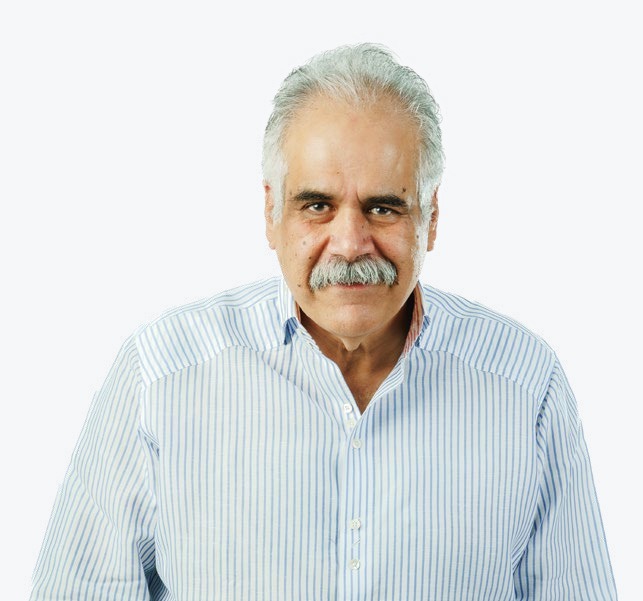
| Key facts | |
|---|---|
| Born | 1960, Nainital (then Uttar Pradesh, now Uttarakhand) [11][68] |
| Family roots | Delhi; father Kapil Bhatia ran a small airline-sales agency, Delhi Express Travels [12][13] |
| Education | Modern School, New Delhi; BASc, Electrical Engineering, University of Waterloo, Canada (1984) [8][12] |
| Family | Father Kapil Bhatia (Executive Chairman, InterGlobe Enterprises); wife Rohini Bhatia (Chairperson, InterGlobe Foundation); son Madhav [1][59][6] |
| Company/Group | InterGlobe Enterprises (founded 1989); InterGlobe Aviation, operator of IndiGo (first flight 2006) [1][3] |
| Wealth | Kapil & Rahul Bhatia: US$9.3 billion, No. 23 on the Forbes India Rich List 2026 (as of 30 Sep 2026) [9]; Hurun India Rich List 2025: No. 30, Rs 71,270 crore with family [64] |
| Known for | Building IndiGo into India’s largest airline, with roughly two of every three domestic passengers [41][61] |
In 1985, a 25-year-old Indian engineer doing computer work at United Airlines’ headquarters in Chicago was introduced to one of the airline’s rising planners, a Kolkata-born executive called Rakesh Gangwal [13][15]. Rahul Bhatia would later say that the meeting fixed something in his mind: “I was certain, after meeting him, that if I ever entered the aviation business, I wanted him as my partner” [12].
It took him almost twenty years to act on that thought. In between, he tried to make telephone exchanges, failed, thought seriously about becoming a teacher, and spent a decade and a half selling other people’s airline seats from a small office on Janpath in New Delhi [12]. When he finally did start an airline, India’s skies were a graveyard of failed carriers, and almost everyone told him the business would “take the Mickey out of” him [12].
Two decades on, IndiGo flies more than 430 aircraft and about 2,200 flights a day, and says it has carried around 900 million customers since 2006 [3]. Roughly two out of every three domestic air travellers in India now fly with it [41][61]. That scale has made Bhatia, a famously quiet man, one of India’s richest people. It has also made him the target of a bitter, public feud with his co-founder, and, in December 2025, the owner of the airline at the centre of the worst operational meltdown in Indian aviation in years.
This is the story of how he built it, and what it has cost along the way.
Where it began
Rahul Bhatia was born in 1960 in Nainital, the hill town where his family spent its summers [11][12]. “I am basically a Delhi boy,” he told Open magazine; the family home, schooling and business were all in the capital [12].
His father, Kapil Bhatia, had started out as a sales manager at an airline ticketing agency and went on to build Delhi Express Travels, a small firm that acted as a general sales agent (GSA) for foreign airlines in India [13][14]. A GSA sells tickets and handles marketing for an airline that does not have its own office in a country. It was a modest, relationship-driven business, and young Rahul grew up around it without much interest in joining it.
He went to Modern School on Barakhamba Road in New Delhi, finishing in 1977, and then left for Canada [12]. He studied electrical engineering at the University of Waterloo in Ontario, a university known for its co-operative programme that alternates study with paid work terms. Waterloo’s alumni office lists him as a 1984 graduate (BASc) [8]. Open magazine reported that he made the Dean’s Honour List [12].
His ambition at the time was not business at all. “I wanted to get a post-grad degree and start teaching,” he said. “The attraction of teaching was that you were the master of your own time” [12].
During and around his studies he spent about two years at IBM; Bloomberg describes the work as an automated screen-manufacturing pilot done while he was still a student [11][14]. He also did information-technology work for United Airlines at its Chicago headquarters, which is where he met Gangwal in 1985 [11][13][15]. Accounts differ slightly on the timeline: Open magazine says he returned to Delhi in 1984, while other reports place the United assignment in 1985, so he may have moved back and forth for a while [12][13].
The first break
A failed telecom venture
Bhatia’s first attempt at his own business had nothing to do with aviation. Back in India, he signed up with Northern Telecom (later Nortel) to manufacture digital telephone exchanges [12]. The timing could not have been worse. The government was backing the home-grown Centre for Development of Telematics (C-DoT) programme, and the venture “eventually withered away,” Open magazine reported [12]. Forbes describes the same episode as a telecom business that failed because of regulatory hurdles [9].
It was a formative lesson in how much Indian business depended on policy, and it pushed him, reluctantly, toward his father’s world. “I had a very reluctant initiation into that business,” he recalled. One day his father told him plainly that his own heart was no longer in the work. “I couldn’t say ‘no’ to him,” Bhatia said [12].
Losing Delhi Express, starting InterGlobe
Delhi Express had an unusual ownership structure. According to Bhatia’s account to Open magazine, it was owned by about ten partners, each with roughly 10%, and had been started with around Rs 1 lakh pooled by his father’s friends [12]. In late 1988, half the ownership changed hands and, in Bhatia’s words, “my dad was ushered out of the company” [12]. Business Today later dated the partners’ takeover to 1991 and suggested the experience shaped the tight control Bhatia would insist on at IndiGo [16]. The earlier date fits better with what happened next.
Father and son started again. InterGlobe Enterprises Private Limited was incorporated on 13 September 1989, according to IndiGo’s 2015 IPO prospectus [1]. Bhatia remembers it slightly differently: “On paper, it was formed on 6th of October, 1989” [12]. The start was thin. Open magazine reported capital of about US$140,000, a first office at 66 Janpath, and support from the Bank of Tokyo. Some airlines that had used Delhi Express followed the Bhatias to the new firm. “It was only a dream because I had no resources,” he said [12].
The business was air transport management: selling and marketing foreign airlines in India as their GSA [1][5]. It is still a core InterGlobe business; the group’s 2022 corporate presentation described InterGlobe Air Transport as India’s largest GSA, with clients including Delta, Virgin Atlantic, ANA and LATAM [5].
Galileo, technology and hotels
The real step-up came in 1994, when InterGlobe won the Indian distribution franchise for Galileo, the global computer reservation system part-owned by United [12]. Travel agents across India needed terminals to book flights, and Galileo gave InterGlobe a toll on a growing share of those bookings. Bhatia, by his own admission, was cautious: the contract allowed InterGlobe to walk away if losses hit US$400,000. “I was so paranoid that we put in a clause…” he recalled [12]. Galileo India Private Limited was incorporated in 1997 [1].
From there he kept adding businesses, nearly always with a global partner who brought expertise while InterGlobe brought the Indian market. In 1999 he set up an IT services company, IGT Solutions, with Galileo’s backing [1][12]. Cendant, the US travel and hospitality group, became a technology partner [13]. In 2004 he closed a deal with France’s Accor to build value hotels under the ibis brand, after approaching the company two years earlier [12]. “There is an enormous void in value-for-money lodging in the country, and we think the gap will only grow,” he later said [13]. Bloomberg reports he owns 60% of InterGlobe Hotels [11].
There were hard years too. After the September 2001 attacks in the United States, United stopped flying to India, a blow to a business so tied to the American carrier. Forbes India reported that Bhatia chose to keep all his staff anyway [14].
By the early 2000s, InterGlobe was a solid, profitable, low-profile travel services group. It knew how airlines sold seats, how travel agents booked them and how distribution technology worked. What it did not have was an airline.
Building the empire
Talking Gangwal into it
India opened its domestic skies to private airlines in the 1990s, and by 2003-04 a new wave of low-cost carriers was taking shape. Bhatia had kept in touch with Gangwal, who by then had run US Airways as president and CEO until 2001 [1]. Gangwal was reluctant, but Bhatia persuaded him to join by the end of 2004 [12][16].
InterGlobe Aviation Private Limited was incorporated on 13 January 2004 in Lucknow and moved its registered office to Delhi later that year [1]. The name it would fly under had history: “IndiGo” had earlier been associated with another aviation venture, and Bhatia bought the name back for just Rs 25,000, according to Open magazine [12].
The two men split the work. Gangwal brought airline expertise, aircraft negotiations and network design; Bhatia brought capital, the Indian business network and government relations [16]. At the founding, InterGlobe’s side and Gangwal’s side held close to equal stakes [15][16].
Who carried more risk later became a matter of dispute. In a 2019 statement issued during the founders’ feud, InterGlobe said that the Bhatias had given personal guarantees and taken loan exposure of more than Rs 1,100 crore at the peak, while Gangwal wanted to limit his financial risk to no more than Rs 15 crore [17]. That is InterGlobe’s account, made in the middle of a fight, and Gangwal’s side disputed the characterisation of his role [16][17].
The order that announced IndiGo
On 16 June 2005, at the Paris Air Show, an airline that did not yet own a single aircraft placed a firm order for 100 Airbus A320 jets, worth about US$6 billion at list prices [18]. Gangwal is generally credited with negotiating the deal; Forbes India reported that Bhatia did not even attend the show [14][16]. The aviation world was stunned, and many in India’s industry assumed the order was a bluff.
It was not. The scale of the order bought IndiGo deep discounts, and the airline then used a sale-and-leaseback model: it sold new jets to leasing companies, often at a gain, and leased them back [15][20]. That kept its ownership costs low and its fleet young. Its first aircraft was delivered in July 2006 [1], and on 4 August 2006 IndiGo’s first flight took off from Delhi for Imphal via Guwahati [3][67].
A religion of low cost
From the start, IndiGo was built around a short list of rules: one aircraft type, one class, no frills, quick turnarounds and obsessive punctuality. Forbes India described the early focus as “low-cost operations rather than low fares” [75]. Bhatia put it more bluntly: “It is our religion to be the cheapest” [15].
His own management instructions were just as plain. “Think twice before you spend a single rupee. Ask if it is absolutely necessary or can I do without it?” he told Open magazine [12]. He spoke of wanting to be “the Southwest of India,” after the American low-cost pioneer, and dismissed expensive advertising: “Branding can give a feel-good thing, but it can’t bring more people into a plane if other things are not in order” [12]. Business Standard reported that in the early years he personally interviewed IndiGo’s executives, check-in staff, cabin crew and sales staff [13].
Timing helped. The 2008 global financial crisis and an oil price spike hammered Indian airlines. Kingfisher, Jet Airways and others piled up losses. IndiGo, with its new fuel-efficient fleet and lean costs, kept growing. Forbes India featured him in its Person of the Year 2009 issue under the headline “Last Man Standing” [14]. Asked what explained his success, he credited “honesty of purpose which comes from my parents, luck and destiny” [14].
Number one
IndiGo got its international licence and launched its first overseas route, Delhi to Dubai, in September 2011 [77]. In January 2011 it had already placed a second huge order, for 180 A320-family jets worth US$15.6 billion at catalogue prices, including 150 of the new fuel-saving A320neo [19].
In August 2012, six years after its first flight, IndiGo overtook Jet Airways to become India’s largest airline by market share [77]. By October 2014, when it signed for 250 more A320neo jets with a list value of about US$25.7 billion, it held roughly a third of the domestic market [20]. All 100 aircraft from the original 2005 order had been delivered by November 2014, about two years ahead of schedule [1].
The IPO
InterGlobe Aviation went public in late 2015. The issue was priced at the top of its Rs 700-765 band, raising about Rs 3,000 crore and valuing the airline at roughly US$4 billion [24][25]. Business Standard reported that the issue was a little over six times subscribed, and that the shares listed on 10 November 2015 at Rs 856, a 12% premium [25]. Bloomberg says the IPO made Bhatia one of India’s wealthiest people [11].
The listing also exposed the governance structure that would later blow up. Under the shareholders’ agreement and articles of association, Bhatia’s InterGlobe Enterprises (IGE) held special rights, including the right to nominate the chairman and appoint the CEO and President [33].
Hands-off owner, until he isn’t
For most of IndiGo’s first decade, Bhatia and Gangwal stayed in the background and the airline’s public face was its president, Aditya Ghosh. Newspapers routinely described the founders as “media-shy billionaire owners” [66]. Bhatia rarely gives interviews; one of his most widely shared public images is a photo of him on an IndiGo flight in a casual shirt, with tea and Parle-G biscuits [69]. Critics see the other side of that silence: during the December 2025 crisis, commentator Govindraj Ethiraj wrote that “IndiGo is no Infosys,” calling it an owner-controlled company where the promoter has not ceded influence [65]. When Ghosh left abruptly in April 2018, Bhatia stepped in to run the airline himself on an interim basis [66]. Industry veteran Ronojoy Dutta later became CEO, and led the airline through its next big order: 300 A320neo-family jets in October 2019, valued at more than US$33 billion at list prices, which took its total A320neo-family orders to 730 and made it the type’s largest customer in the world [21].
Covid and recovery
The pandemic grounded aviation in 2020. IndiGo lost Rs 5,806 crore in FY21 and Rs 6,162 crore in FY22 [26]. Pilots and staff took pay cuts, which later became a source of friction (see below).
In February 2022, after the founders’ dispute was resolved, IndiGo appointed Bhatia as its first Managing Director, for five years and without a salary [29]. Later that year Pieter Elbers, the former chief executive of KLM, took over as CEO [44].
The recovery that followed was spectacular. In June 2023, at the Paris Air Show again, IndiGo placed an order for 500 A320-family aircraft, the largest single aircraft order by number in commercial aviation history [22]. It became the first Indian airline to carry 100 million passengers in a calendar year in 2023 [77]. In 2024 it ordered 30 Airbus A350-900 widebodies, and in June 2025 it firmed up 30 more, with deliveries from 2027 [23][77]. It added a business-class product, IndiGoStretch, on busy routes from November 2024 [77]. In June 2025 it signed a cooperation agreement with Delta, Air France-KLM and Virgin Atlantic, with the stated goal of becoming “a global airline by 2030” [4]. FY25 closed with a net profit of Rs 7,258 crore [2]. Asked about IndiGo’s dominance, Bhatia argued in 2024 that “India deserves more than just two major airlines” and that IndiGo “will never be found guilty of ‘gouging’ its customers” [60]. In 2026 he added that a large share of IndiGo’s capacity flies routes no rival serves, and that competitors are free to enter them [61].
In December 2025, Hurun ranked Bhatia and Gangwal third on its list of India’s top self-made entrepreneurs of the millennium [70].
How the wealth is held
Bhatia’s fortune is overwhelmingly one asset. InterGlobe Enterprises owned about 35.7% of InterGlobe Aviation at the end of 2025, while Rahul and Kapil Bhatia’s direct personal holdings are tiny [68]. Bloomberg attributes roughly 36% of IndiGo to Bhatia, counting the stakes credited to his family [11]. The family’s first-ever sale came in June 2024, when IGE sold about 2% of the airline in a block deal worth about US$394 million [63].
Around the airline, InterGlobe Enterprises has grown into a wider group. It runs about 30 hotels in India with Accor and 13 abroad, including the Sheraton Amsterdam Airport Hotel; formed Movin, a logistics venture with UPS, in 2022; and backs AIonOS, an artificial-intelligence venture [9]. It also runs travel technology distribution, pilot training and aircraft maintenance training businesses [5].
Forbes valued the combined fortune of Kapil and Rahul Bhatia at US$9.3 billion as of 30 September 2026, ranking them 23rd in India [9]; its separate real-time estimate for Rahul Bhatia alone was US$6.7 billion in mid-October 2026 [10]. The M3M Hurun India Rich List 2025 had placed “Rahul Bhatia & family” at No. 30 with Rs 71,270 crore [64]. These figures move sharply with IndiGo’s share price, which fell steeply in December 2025 and early 2026 before partially recovering [57][27].
For a broader look at how rich lists value promoter holdings and listed businesses, see CapitalVia’s Insights section.
The setbacks and failures
Bhatia’s career is often told as an unbroken climb. It was not.
The telecom venture failed in the 1980s when government policy turned toward the home-grown C-DoT programme [12].
His father lost Delhi Express to his partners, forcing the family to rebuild from scratch with InterGlobe in 1989 [12].
9/11 hit the core business when United, InterGlobe’s anchor relationship, pulled out of India [14].
The partnership that built IndiGo broke down in public in 2019, turning into arbitration in London and court filings in the United States before a settlement in 2022 [37][38][39].
Covid wiped out two years of profits, with combined losses of nearly Rs 12,000 crore over FY21 and FY22 [26].
December 2025 was the hardest blow, operationally and reputationally (detailed below). It was followed by a difficult FY26: total income rose 6.4% to Rs 89,513 crore, but IndiGo reported a net loss of Rs 2,393.6 crore, mainly because of a sharp fall in the rupee, against a profit of Rs 7,258 crore the year before [2]. Bhatia called FY26 “an exceptionally challenging operating environment” [2].
The long-haul push stalled. War in West Asia from late February 2026 disrupted IndiGo’s Middle East network and lengthened routes to Europe [27]. In July 2026, IndiGo and Norse Atlantic agreed to end the entire wet lease of Boeing 787s that IndiGo had been using to fly to Europe since 2025, with widebody flying pausing until its own A350s arrive [28]. In the June 2026 quarter IndiGo posted a net loss of Rs 238 crore despite a 20% rise in revenue [27].
Controversies and allegations
Bhatia has not been charged with any criminal offence, and no court or regulator has made an adverse finding against him personally that we could find in court records or major publications. Most of the legal and regulatory actions below were against the company, InterGlobe Aviation, or its executives. They are included because they bear directly on the business he controls and leads.
The Gangwal feud and related-party transactions (2019-2022)
Allegation: In July 2019, co-founder Rakesh Gangwal wrote to SEBI chairman Ajay Tyagi, copying the Prime Minister and several ministers. He said IndiGo was “veering off from the core principles and values of governance,” objected to related-party transactions (RPTs) between the airline and Bhatia-linked companies, and remarked that “even a paan ki dukaan” would have addressed the issues better [32]. He also challenged IGE’s special rights to appoint three of six directors, nominate the chairman and appoint the CEO and President, and complained that the board had refused his request for an extraordinary general meeting [33]. IndiGo’s shares fell as much as 8.9% in a day on the news [33].
Response: Bhatia, in a letter to the board, said Gangwal’s grievances stemmed from IGE’s refusal “to succumb to his unreasonable demands” [16]. IGE issued statements rejecting the RPT allegations, arguing that the Bhatias had carried far more financial risk in IndiGo’s early years [17]. An Ernst & Young review commissioned by the audit committee found the RPTs over five years were at arm’s length and none conflicted with the company’s interest, while noting minor procedural irregularities such as some approvals obtained after the fact [34]. At the August 2019 AGM, Bhatia said, “I hope his actions will start speaking louder than his website over time” [71]. IndiGo also adopted a new RPT policy and expanded its board [37].
What happened next:
- February 2020: Mint reported that SEBI’s investigation found some RPTs had not complied with the rules, including missing approvals [35].
- November 2020: SEBI issued a show-cause notice to InterGlobe Aviation [36].
- February 2021: InterGlobe Aviation paid about Rs 2.10 crore to settle the proceedings “without admitting or denying” the findings [36].
- October 2019: Bhatia and IGE began arbitration at the London Court of International Arbitration, alleging Gangwal had breached the shareholders’ agreement [37].
- September 2021: The tribunal largely favoured Gangwal, ordering removal of share-transfer restrictions, but also found merit in Bhatia’s confidentiality claim and awarded him some damages [38].
- December 2021: Shareholders voted by more than 99.9% to remove the restrictions. IGE retorted that the “paan ki dukaan has apparently done well” [39].
- February 2022: Gangwal resigned from the board and said he would sell down his stake over five or more years [30].
- 2022-2025: The Gangwal family sold large blocks, including a 5.72% stake for Rs 11,564 crore in May 2025 and about 3.1% for around Rs 7,000 crore in August 2025 [31][78].
Status: Closed. The SEBI matter was settled by the company in 2021 with no admission of wrongdoing; no SEBI order was made against Bhatia personally. The founders’ arbitration was resolved in 2022. Gangwal’s group still appeared as part of IndiGo’s promoter group in an exchange disclosure in April 2026 [79].
The December 2025 flight meltdown (2025-2026)
Allegation: Between early and mid-December 2025, IndiGo cancelled thousands of flights after failing to plan crew rosters for Phase II of the DGCA’s revised pilot flight-duty and rest rules, which took effect on 1 November 2025 [40][72]. At the peak, on 3-5 December, it cancelled over 2,500 flights and delayed more than 1,800, leaving over 3 lakh passengers stranded [40]. The DGCA issued show-cause notices to CEO Pieter Elbers and the accountable manager, citing “significant lapses in planning, oversight and resource management” [42]. Civil Aviation Minister K. Ram Mohan Naidu blamed “internal mismanagement of crew rosters, flight schedules and inadequate communication” [43]. The DGCA said IndiGo’s “overriding focus” on maximising use of crew, aircraft and network had caused the crisis [41].
Response: IndiGo’s chairman Vikram Singh Mehta apologised and said the board would examine “every aspect of what went wrong,” with an external review [76]. The airline said it took “full responsibility for the operational lapses,” processed refunds and offered affected passengers Rs 10,000 “Gesture of Care” vouchers [40]. In March 2026, taking interim charge of the airline, Bhatia wrote to staff: “What happened last December should never have taken place. Our customers didn’t deserve it, nor did all of you” [45].
What happened next:
- 9 December 2025: The government cut IndiGo’s winter schedule by 10%, with slots reallocated to other airlines [43].
- 17 January 2026: The DGCA imposed a record penalty of Rs 22.20 crore and required a Rs 50 crore bank guarantee linked to a reform programme; the CEO was cautioned, the COO warned and a senior vice president relieved of operational duties [40][41].
- 4 February 2026: The Competition Commission of India ordered an investigation into whether IndiGo, with about 60-63% of the market and sole operator status on over 330 routes, had abused its dominant position by withholding capacity and allowing excessive fares; the CCI rejected IndiGo’s argument that only the aviation regulator had jurisdiction [46].
- 10 March 2026: Pieter Elbers resigned, citing personal reasons, and Bhatia became interim CEO [44].
- 23 July 2026: The CCI invited public comments on commitments offered by IndiGo, including automatic refunds and fare caps during large disruptions; IndiGo did not admit any anti-competitive conduct [47].
Status: The DGCA penalty has been imposed; we found no report of an appeal. The CCI case is pending a decision on IndiGo’s proposed commitments as of 15 October 2026.
Safety and security penalties (2023-2026)
Allegation: In July 2023, after four tail-strike incidents in six months, the DGCA said a special audit had found “systemic deficiencies” in IndiGo’s operations, training and engineering documents, and fined it Rs 30 lakh [48]. In January 2024, after passengers of a diverted flight sat and ate on the tarmac at Mumbai airport, the airline was fined Rs 1.2 crore [49]. In 2025 the DGCA penalised senior flight-operations officials over pilot training lapses [80].
Response: On the tail strikes, IndiGo said it had “zero tolerance to any safety compromise” and had not violated manufacturer procedures [48]. It appealed the Mumbai penalty and contested the training penalty [50][80].
Status: The Mumbai penalty was reduced on appeal to Rs 70 lakh, which IndiGo paid in September 2024 [50]. Deccan Herald reported in January 2026 that IndiGo lost its appeal against the training-lapse penalty [80].
Pay cuts and staff protests (2022)
Allegation: In April 2022, pilots unhappy with the slow restoration of Covid-era pay cuts planned a sick-out; IndiGo suspended five pilots, saying they had breached their employment terms [52].
Response: IndiGo said it was restoring pay in stages and that its code of conduct barred such collective action [52].
Status: Resolved through pay revisions; no regulatory action against the company over the protests was reported.
Tax and customs disputes (2025-2026)
Allegation: The Income Tax Department imposed a penalty of Rs 944.20 crore on InterGlobe Aviation for assessment year 2021-22 [53]. In December 2025, GST authorities raised a demand of Rs 458.26 crore covering FY2018-19 to FY2022-23 [54].
Response: IndiGo called the income-tax penalty “erroneous and frivolous,” saying its appeal was still pending, and said the GST order was “erroneous and not in accordance with law.” It is contesting both [53][54].
Status: Pending. Separately, in a long-running customs dispute over IGST on aircraft parts re-imported after repair abroad, the Supreme Court dismissed the Customs department’s review petitions in early 2026, upholding rulings in favour of IndiGo and SpiceJet [55].
Passenger assault at Delhi airport (2017)
Allegation: In November 2017, a video surfaced showing IndiGo ground staff pinning a passenger to the ground at Delhi airport after an argument on the tarmac. The Minister of State for Civil Aviation called it deplorable and sought a report [51].
Response: IndiGo’s then president Aditya Ghosh said the staff “were completely out of line” and apologised; the airline said it had sacked the main person responsible and suspended others [51].
Status: Closed. The passenger and a staff member reached a compromise recorded by police [51].
Kunal Kamra flying ban (2020)
Allegation: In January 2020, IndiGo banned comedian Kunal Kamra for six months after he heckled a television anchor on board; critics said the ban was imposed without the airline’s pilot classifying the conduct as unruly and after the civil aviation minister publicly urged action [73].
Response: IndiGo’s internal committee reviewed the case and cut the ban to three months [73].
Status: Closed; the ban has long expired [73].
Cargo cartel case (2015-2018)
Allegation: In 2015, the CCI found Jet Airways, IndiGo and SpiceJet had acted in concert in setting fuel surcharges on cargo and fined them [74].
Response: The airlines appealed, and the appellate tribunal sent the case back on procedural grounds in 2016 [74].
Status: In a fresh order in March 2018, the CCI fined IndiGo Rs 9.45 crore [74].
As of 15 October 2026, none of these matters has led to any criminal charge against Rahul Bhatia.
Giving back
The Bhatias’ philanthropy runs mainly through two channels.
The InterGlobe Foundation, chaired by his wife Rohini Bhatia, focuses on heritage, environment and livelihoods [6]. Its best-known project is the restoration, with the Aga Khan Trust for Culture, of the tomb of Abdur Rahim Khan-i-Khanan in Delhi, the poet-general of Akbar’s court, which reopened to the public in December 2020 after six years of work [6]. “India is known for its cultural heritage, hence the preservation of our art and culture is essential for our identity,” Rohini Bhatia said [6]. The foundation has also restored a stepwell in Rajasthan and funds heritage fellowships [6].
IndiGo’s own CSR arm, IndiGoReach, funds girls’ education, school programmes, water projects and tree planting. It spent Rs 1.98 crore in FY24 even though, with Covid-era losses, it had no statutory obligation to spend that year [56]. In December 2022 it won a FICCI CSR award for its work with tribal women spice farmers in Assam and Meghalaya [7].
Compared with some of India’s billionaires, Bhatia has made few large personal pledges in public. We found no credible report of a major personal donation by him to a university or similar institution.
Succession
For years, Bhatia’s succession plan was professional management. That plan was tested in 2026.
After Elbers resigned in March 2026, Bhatia signed his first message to staff “Rahul (alias ‘Main Hoon Naa’)”, borrowing the Shah Rukh Khan film title, meaning roughly “I’m here” [45]. On 31 March 2026 the board named Willie Walsh, the former head of British Airways’ parent IAG and then director general of IATA, as CEO [57]. Walsh took charge on 3 August 2026, with Bhatia remaining Managing Director [58]. At the airline’s 20th anniversary in August 2026, Bhatia described himself as “kuchh hee dinon kaa mehmaan” (a guest for only a few days) in his interim role and told staff, “The best is yet to come” [67].
The family’s next generation is starting to appear. In July 2026, The Economic Times reported, citing unnamed sources, that Bhatia’s son Madhav, in his mid-twenties, was being groomed for a future role, attending IndiGo executive committee meetings and being mentored by InterGlobe Enterprises Group CEO Aditya Pande [59]. The company made no statement, and Madhav holds no formal title at the airline [59]. Bhatia’s own term as Managing Director was set at five years from February 2022 [29].
What their journey teaches
Failing early is not the same as failing. Bhatia’s first venture died because of government policy, and his family lost its first business to partners. InterGlobe, and later IndiGo, were built on the lessons of both.
Build on what you already know. IndiGo did not come out of nowhere. Fifteen years of selling airline seats, running reservation systems and dealing with travel agents taught InterGlobe how the money in aviation actually moves, long before it owned a plane.
Partner with people better than you at the thing you lack. From Galileo and Cendant to Accor and Gangwal, Bhatia’s pattern was to find experts and give them room. “If you find those people, hang on to them with your dear life,” he said [12].
Costs are a strategy, not a department. One aircraft type, bulk orders, sale-and-leaseback and a refusal to spend on frills gave IndiGo a cost base rivals could not match through two industry crises [15][20].
Write the governance down carefully, at the start. The special rights that protected Bhatia’s control became the centre of a three-year public fight with his closest partner. Clear agreements made in good times still get tested in bad ones.
Scale magnifies every mistake. An airline that carries two-thirds of a country’s flyers cannot run its crew rosters on the edge. The December 2025 meltdown showed that the same efficiency that built IndiGo can, without enough slack, hurt millions of people at once.
Readers interested in another chapter of India’s aviation story can read CapitalVia’s profile of Ratan Tata, whose group took back Air India in 2022. On Tata’s death, Bhatia wrote that he “was only too pleased to see Air India return to where it truly belonged” [62].
A profile for general reading, based on public records and reporting as of 15 October 2026. Not investment, tax or legal advice.
Sources (80)
- InterGlobe Aviation Ltd Red Herring Prospectus - InterGlobe Aviation / JP Morgan India, Oct 2015
- IndiGo FY2026: capacity and income growth - IndiGo press release, May 2026
- IndiGo celebrates 20 years of giving wings to the nation - ANI press release via ThePrint, Aug 2026
- IndiGo, Delta Air Lines, Air France-KLM and Virgin Atlantic announce partnership - Delta News Hub, Jun 2025
- InterGlobe Corporate Deck - InterGlobe Enterprises, Feb 2022
- A tomb restored to its original glory: Mausoleum of Abdur Rahim opened to public - InterGlobe Foundation, Dec 2020
- IndiGo Reach wins Best CSR Award for Women Empowerment at 20th FICCI CSR Awards - IndiGo press release, Dec 2022
- Rahul Bhatia discusses IndiGo's expansion - University of Waterloo Alumni, Apr 2011
- Kapil & Rahul Bhatia profile - Forbes, Sep 2026
- Rahul Bhatia profile - Forbes, Oct 2026
- Rahul Bhatia - Bloomberg Billionaires Index, Oct 2026
- Rahul Bhatia: High Flier - Open Magazine, Apr 2015
- Growth on two planes - Business Standard, Feb 2011
- Last Man Standing (Person of the Year 2009) - Forbes India, Dec 2009
- How Rahul Bhatia found IndiGo gold - Forbes India / Forbes, Nov 2010
- Friends turned foes: how IndiGo founders Rahul Bhatia and Rakesh Gangwal's relationship soured - Business Today, Jul 2019
- IndiGo row: Rahul Bhatia claims he bore most of the financial risks - Business Today, Jul 2019
- New Indian airline orders 100 Airbus jets for $6B - Associated Press via Fox News, Jun 2005
- Airbus celebrates $15.6 billion Indian deal - IndustryWeek, Jan 2011
- IndiGo agrees record 250 Airbus jet order - Reuters via Business Standard, Oct 2014
- India's IndiGo places landmark order for 300 Airbus planes - Reuters via Al Jazeera, Oct 2019
- Paris Air Show kicks off with record order from India's IndiGo - Al Jazeera, Jun 2023
- IndiGo confirms additional 30 firm orders for A350 from Airbus - Business Today, Jun 2025
- India's IndiGo airline IPO price band set at 700-765 rupees - Reuters via Business Standard, Oct 2015
- IndiGo lists 12% up at Rs 856 per share - Business Standard, Nov 2015
- IndiGo FY2022 loss zooms to over Rs 6,000 crore on high fuel outgo - STAT Times, May 2022
- IndiGo Q1 FY27 net loss at Rs 238 crore despite 20% rise in revenue - Business Today, Jul 2026
- Norse Atlantic and IndiGo terminate entire 787 wet lease - FlightGlobal, Jul 2026
- IndiGo appoints Rahul Bhatia as managing director - Business Today, Feb 2022
- Co-founder of India's IndiGo quits board to cut stake - ch-aviation, Feb 2022
- IndiGo co-founder Rakesh Gangwal sells 5.72% stake for Rs 11,564 crore - Business Standard, May 2025
- IndiGo runs into inner turbulence - Free Press Journal, Jul 2019
- What is the bone of contention between Gangwal and Bhatia - Business Today, Jul 2019
- EY found no major procedural lapses in IndiGo transactions - Business Today, Jul 2019
- SEBI finds IndiGo violated rules in some related-party transactions - The News Minute (citing Mint), Feb 2020
- IndiGo parent InterGlobe Aviation pays Rs 2.1 crore to settle case with SEBI - Business Today, Feb 2021
- IndiGo's owners' feud over heads to court - ThePrint / Bloomberg, Oct 2019
- IndiGo founders' arbitration award and Delhi HC enforcement bid - ch-aviation, Oct 2021
- IndiGo promoters resolve 3-year dispute to prepare for fight ahead - Business Today, Dec 2021
- IndiGo fined Rs 22 crore by DGCA for flight disruptions in December 2025 - India TV, Jan 2026
- India fines IndiGo record $2.45 million over mass flight cancellations - Reuters via Arab News, Jan 2026
- DGCA issues show cause notice to IndiGo CEO, accountable manager on flight disruptions - Outlook Business, Dec 2025
- After DGCA, govt cuts IndiGo's flight schedule by 10% - Deccan Herald / PTI, Dec 2025
- IndiGo CEO Pieter Elbers resigns, Rahul Bhatia to act as interim CEO - Business Standard, Mar 2026
- 'Main Hoon Na': IndiGo's interim boss to employees after CEO Elbers's resignation - The CSR Journal, Mar 2026
- CCI orders probe into IndiGo over flight cancellations, fare surge - Bar & Bench, Feb 2026
- IndiGo offers commitments in abuse of dominance case; CCI seeks comments - Business Standard, Jul 2026
- DGCA imposes Rs 30 lakh fine on IndiGo for tail strikes during landing - Business Today, Jul 2023
- Rs 1.2 crore fine on IndiGo, Rs 60 lakh on Mumbai airport in passengers-eating-on-tarmac case - Business Today, Jan 2024
- IndiGo pays reduced Rs 70 lakh fine to BCAS over Mumbai airport incident - Outlook Business, Sep 2024
- IndiGo airline staff assault passenger on video - Fortune, Nov 2017
- IndiGo suspends 5 pilots for protesting pay cuts, may act against 15 more - Business Standard, Apr 2022
- IndiGo gets Rs 944 crore tax penalty from I-T department, airline to contest - Business Today, Mar 2025
- IndiGo faces Rs 458 crore GST demand, says order is erroneous - Storyboard18, Dec 2025
- Supreme Court dismisses Customs plea against IndiGo, SpiceJet in IGST exemption case - LiveLaw, Feb 2026
- IndiGo boosts CSR efforts with Rs 1.98 crore, targets 10 lakh saplings by 2030 - India CSR, Mar 2025
- IndiGo appoints William Walsh as CEO after Pieter Elbers's exit - Forbes India, Mar 2026
- Willie Walsh takes charge as IndiGo CEO - exchange4media, Aug 2026
- Is IndiGo's next generation ready? Rahul Bhatia begins grooming son Madhav - Outlook Business, Jul 2026
- India deserves more than 2 major airlines, welcomes competition with right cost structure, says Rahul Bhatia - TravTalk India, Aug 2024
- IndiGo monopoly debate explained: why Rahul Bhatia says numbers don't tell full story - Outlook Business, Jul 2026
- Rahul Bhatia pays tribute to Ratan Tata - BW Hotelier, Oct 2024
- Bhatia family set to offload 2% stake in IndiGo via block deal valued at $394 million - Outlook Business, Jun 2024
- Hurun India Rich List 2025: top 100 richest Indians - Trak.in, Oct 2025
- IndiGo is no Infosys - The Core, Dec 2025
- IndiGo's billionaire boss Rahul Bhatia steps in after Aditya Ghosh's exit - Business Standard, Apr 2018
- On 20th anniversary, IndiGo MD Rahul Bhatia says best is yet to come - The Economic Times via inkl, Aug 2026
- Main Hoon Naa: who is Rahul Bhatia, IndiGo founder who took interim charge after CEO exit - Storyboard18, Mar 2026
- HELLO! 100 Most Influential: Rahul Bhatia - HELLO! India, Sep 2023
- IndiGo promoters fly into top 10 list of self-made businessmen - Outlook Business, Dec 2025
- Hope Gangwal's action will speak louder than words: IndiGo co-promoter - PTI via Business Standard, Aug 2019
- 2025 IndiGo scheduling crisis - Wikipedia, Oct 2026
- IndiGo reduces Kunal Kamra's flying ban from 6 to 3 months - Business Today, Feb 2020
- CCI penalises Jet, IndiGo, SpiceJet for cartelisation - The Quint, Mar 2018
- IndiGo's Rahul Bhatia back in the cockpit - Forbes India, Mar 2026
- We will examine every aspect of what went wrong: IndiGo board chairman - Business Today, Dec 2025
- IndiGo - Wikipedia, Oct 2026
- IndiGo block deal: Rakesh Gangwal family to sell 3.1% stake for Rs 7,000 crore - Business Today, Aug 2025
- Rakesh Gangwal confirms no encumbrance on InterGlobe Aviation shares - ScanX, Jun 2026
- IndiGo loses appeal against DGCA order imposing penalty for alleged pilot training lapses - Deccan Herald, Jan 2026