
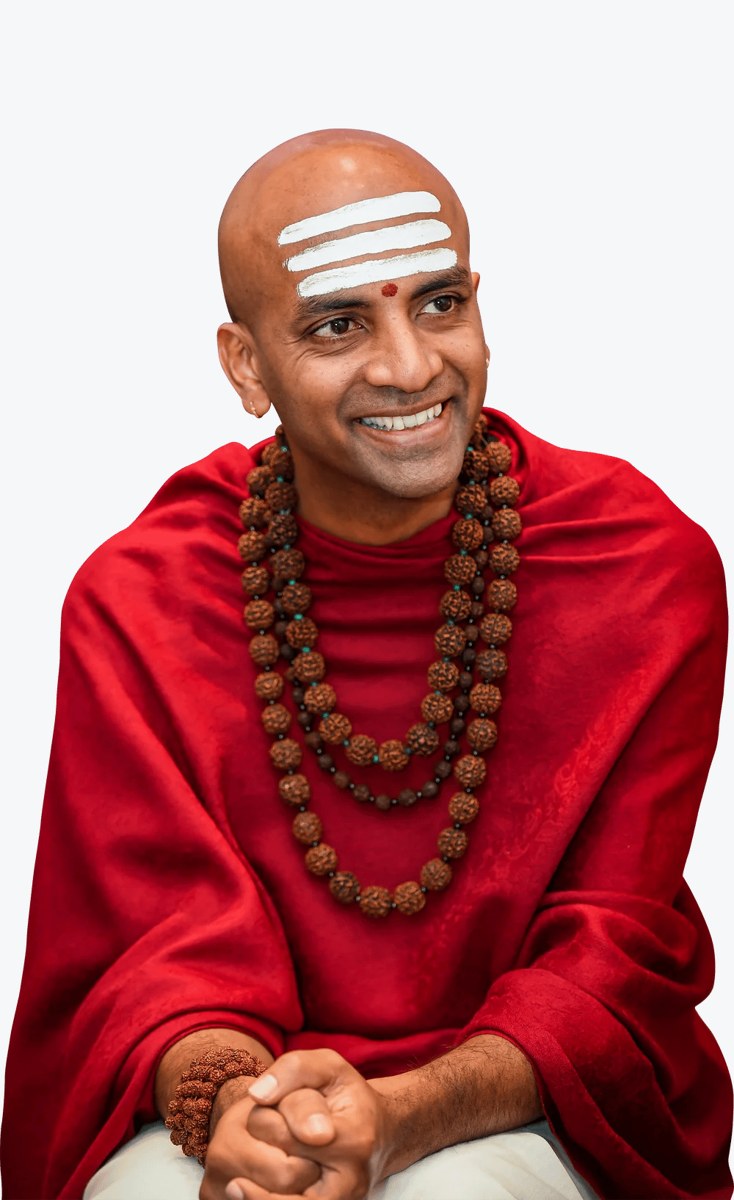
| Key facts | |
|---|---|
| Born | Malaysia; he has not published a birth date, but his own timeline points to the mid-1970s [14] [12] [10] |
| Family roots | Sri Lankan ancestry; father a biochemist with a PhD, mother a homemaker; grew up in Malaysia and then Perth, Western Australia [14] [13] [17] |
| Education | Degree in electrical engineering, Australia [12] [1] |
| Family | Married to Tatiana, co-founder of Siva Ashram; one daughter [2] |
| Company | Dandapani LLC / Dandapani Group LLC (speaking, courses, app); Siva Ashram sanctuary, Costa Rica [36] [2] |
| Training | About ten years as a cloistered monk at Kauai’s Hindu Monastery, Hawaii, under Satguru Sivaya Subramuniyaswami [1] [4] |
| Known for | The Power of Unwavering Focus (2022), published in 23 languages; the TEDxReno talk “Unwavering Focus”, with more than 7.7 million views [3] [1] [27] |
In the second half of 2008, as Lehman Brothers collapsed and the world’s banks froze, a young Hindu monk walked out of a monastery on the Hawaiian island of Kauai. He had spent about ten years there. He took two sets of robes, a MacBook Pro and a thousand dollars in cash [4].
The monastery offered him the usual parting gift for monks who leave: a one-way ticket home, which for him meant Australia. He asked to be flown to the US mainland instead [32]. “I landed at LAX at midnight,” he recalled years later, and checked into a backpackers’ motel in Santa Monica, sharing a room with six German travellers. He set himself one rule: he would not borrow a single cent from anybody [12]. “I felt if I borrowed money now I’d always know how to borrow money,” he said [32].
That monk was Dandapani. Today he is a Hindu priest, an entrepreneur, a keynote speaker to companies such as Nike, Bloomberg and American Express, and the author of The Power of Unwavering Focus, which his website says has been published in 23 languages [1] [3]. His TEDx talk on concentration has passed 7.7 million views [1] [27].
He is not a billionaire and does not run a listed company. He is in this series because readers asked about him, and because his story is an unusual business story. A man with no money and no CV built a global business from one asset: a set of mental tools he learned in a monastery.
Where it began
A boy in Malaysia who wanted to be a monk
Dandapani says he was born in Malaysia and is of Sri Lankan ancestry. “So I am Sri Lankan of ancestry… I was born in Malaysia,” he told the podcaster Darin Olien in 2021 [14]. He has given the same account elsewhere [12] [19], and so does the page of the sanctuary he co-founded [2]. Some online profiles call him Indian, but he does not describe himself that way. His link to India is religious and cultural: he was raised Hindu, in the Saivite tradition that is strong in Tamil Nadu and northern Sri Lanka [1] [10].
He has not published his date of birth. His own milestones point to the mid-1970s: he says he joined the monastery at “23, 24” [10], and that this was about three years before his guru’s death in November 2001 [4] [5].
Library authority records list him as Dandapani Satgunasingam [9]. He uses only “Dandapani”, the name under which he appears in the monastery’s own daily records from 2001 [6].
He has described the family as comfortable but not rich: “we didn’t grow up wealthy” [10]. “My dad was a biochemist, a PhD, and my mom was a mom and a housewife,” he said in 2022. His father wanted him to pursue science; his mother, he says, “greatly influenced me in the spirituality and she still continues to do so” [13]. He has two brothers [4].
The moment he dates his calling to came early. “Around 4 or 5, I was living in Malaysia. A monk had come to my house. He was wearing an orange robe… I saw him and I said, ‘That’s me,’” he recalled in 2026 [10]. By about eight or nine, he says, he had realised that the robe was not the point. What he really wanted was Self-Realisation, the Hindu idea of knowing the deepest self [10].
Perth, a Catholic school and an engineering degree
When he was a teenager the family moved to Australia [14] [2]. He finished his last couple of years of high school at “a very small private Catholic school” in Perth. He says the priests there encouraged his monastic plans rather than discouraging them [13] [17].
At university he studied electrical engineering [12] [1]. It was a practical, employable degree, and it fits his father’s wish for a science career. But he never used it in a job. “I graduated from engineering school and I moved straight to Hawaii to be a monk,” he said [14].
Finding a guru
He had read and listened to many teachers by then, and found most of them too abstract. “I met many wonderful inspiring monks and gurus… but… a lot of what they said was not practical,” he said in a 2016 interview. “I finally met a Hindu monk who was actually born in America” [12].
That monk was Satguru Sivaya Subramuniyaswami, known to his followers as Gurudeva. Born Robert Hansen in Oakland, California, in 1927, he had been a dancer with the San Francisco Ballet. He sailed to India and Sri Lanka as a young man and was initiated into sannyas (renunciation) in Jaffna in 1949 by the Tamil sage Siva Yogaswami [8]. He went on to found the Saiva Siddhanta Church, the monastery on Kauai in 1970, and the magazine Hinduism Today in 1979 [8] [43].
Dandapani writes that he first met Gurudeva at about nine, and again at twenty-one [4]. At that second meeting he told the guru that his goal in life was Self-Realisation. Gurudeva “looked me in the eyes and asked, ‘What are you willing to do for it?’” Dandapani replied: “I’m willing to give my life for it” [4]. He says he began studying with Gurudeva in 1995 [22]. The guru then tested his resolve for about three years before letting him join [4].
The first break
Ten years in the monastery
Kauai Aadheenam, also called Kauai’s Hindu Monastery, sits on a large estate on the garden island of Hawaii. Himalayan Academy, the guru’s teaching and publishing arm, puts it at 382 acres [8] [43]. When Dandapani arrived in the late 1990s (he gives dates that point to 1998, while a 2008 newspaper profile says 1999 [17]) he gave up almost everything.
“This act of renunciation involved no longer communicating with my family, relatives, friends… Music, shows, foods, drinks, clothing, preferences… my life as I knew it was no longer to be,” he writes [4]. He spoke to his parents perhaps twice a year, by phone [12].
The first year was a novitiate. “You’re not a monk. The first year you’re there, you’re trained as a novice,” he explained [13]. Vows came in two-year cycles, renewable for 10 to 14 years before a monk could take lifetime vows [11].
The days were tightly organised. “The day would start at 5:30 in the morning with the traditional Hindu ritual ceremony in the temple that went on for half an hour. The monks would meditate for an hour after that, would exercise a little bit,” he said. The monks then split into work groups covering publishing, finance, and land and buildings, and did all their own cleaning. “There were no moms, no dads at home. We were the moms and dads” [11].
What surprised many listeners later was how modern the work was. “Every monk that came to the monastery got a set of robes, a set of beads, and a MacBook Pro,” he said. “Monks learn HTML, CSS, JavaScript… Photoshop and InDesign… Final Cut Pro… We also learn finance… endowments” [12]. “A lot of my technology skills came from the monastery,” he says [33].
The monastery’s own daily web log, “Today at Kauai Aadheenam”, gives a few glimpses of him there. On 31 July 2001 it records “Sadhaka Dandapani” leaving with Gurudeva and other monks on a trip to Europe [6]. In June 2005 it notes him helping upgrade the monastery’s news announcements to HTML. His last mention that we found is a kulam (work-group) report on 28 June 2008 [7].
The lesson of the tissue
Of all the stories he tells from those years, the one he returns to most is about a tissue. A few months after he joined, he was sad because he had not spoken to his family in a long time [4]. Gurudeva took a tissue from a box on his desk, spread it flat, and named each corner: his father, his mother and his two brothers. Then he put his finger in the middle and lifted it. All four corners rose off the desk [4].
The lesson, in Gurudeva’s words as Dandapani quotes them: “As you uplift yourself, you uplift all of them as well, so investing your time in developing yourself is not selfish” [4]. He would later make this idea one of the first lessons of his book.
Losing the guru
Gurudeva died at the monastery on 12 November 2001, aged 74 [5]. Dandapani was devastated. He has said the death taught him that “life is not short, but rather finite” [13]. “Unfortunately, my guru died three years after I joined and things changed a little bit,” he said in 2021 [14]. In a 2016 interview he was more direct: “It was kind of a big changing point in the monastery and quite a few [monks] left. I stayed 7 more years” [12].
Walking out
In 2008 his vows came up for renewal. “At that point, I felt the monastery and I will go on a slightly different direction. When my vows came up for renewal, I decided not to renew them,” he said [12]. In the book he gives the date as the second half of 2008 [4]. In other interviews and a 2020 blog post his count of the years varies by about a year either way [34] [13]. He has called it “the most difficult decision I’ve ever made” [15].
He left to share what he had learned [12]. The first months were a scramble. After the night in the Santa Monica motel, he bought clothes, opened a bank account and set up an email address [12]. That August and September a newspaper in Colorado, the Vail Daily, reported a “guest monk” named Dandapani teaching meditation and yoga in the small town of Eagle [17]. “I made Eagle my first home in the world after leaving Hawaii,” he told the same paper in 2012 [18]. “After about a year or so of traveling, I made my way to New York City,” he told the podcaster Robert Glazer [11].
He has said that it hurt to know he would never again live as a monk, something he had wanted since he was four [13]. He did not go back to engineering. He became a Hindu priest instead. In his tradition a priest belongs to the householder path, which allows marriage and working in the world. “I’m no longer a monk, I’m a priest now,” he says [42] [1]. “I am a Hindu priest now,” he told an Indian magazine in 2023 [24].
Building the empire
The word “empire” needs a caveat here. Dandapani’s business is a small, founder-led media and education company, not a conglomerate. How he built it from nothing is still worth studying.
New York: a monk in Queens
New York became his base for about a decade [2]. By 2012 the Vail Daily described him as based in New York, running workshops and leading spiritual trips to Asia. He also came back to Colorado to teach meditation and Indian cooking [18].
In New York he met Tatiana, who had moved to the city in 1998 after studying at Reed College in Portland on a scholarship. She converted to Hinduism in 2006 and ran a holistic health practice in the city for 11 years [2]. The page of their Costa Rica sanctuary describes their finances when they met in plain terms: “Neither Tatiana nor Dandapani come from wealth and when they met, neither had much money in their bank accounts” [2].
What they did next is the most entrepreneurial part of the story. “They lived in a humble apartment in Queens, New York and after paying living expenses, they put 100% of their earnings toward the creation of Siva Ashram,” the sanctuary’s site says [2].
The Costa Rica bet (2013)
In 2013, still living in Queens, the couple bought 16.5 acres in Nosara, on Costa Rica’s Pacific coast. They registered it as the “Subramuniya Sanctuary”, a spiritual retreat and botanical garden [30]. For years they flew down twice a year and worked 12-hour days with a small local team, designing gardens and planting trees [2]. The sanctuary now describes itself as 33 acres, with more than 9,000 trees and plants [1]. The public sources do not explain how the extra land was added.
When the pandemic hit in 2020, they “fast-forwarded their life plan by a few years” and moved from New York to Costa Rica [2]. Nosara has been his home since then, though some speaker agencies still list him in New York [1] [41].
The talk that changed everything (2015)
In October 2015 he spoke at TEDxReno, at the Lear Theater in Reno, Nevada [26]. The talk, “Unwavering Focus”, is about 15 minutes long and simple in structure. He argues that most people struggle to focus for two reasons. “We’re never taught how to concentrate; and second is, we don’t practice concentration,” he says [28]. People practise distraction instead, all day, on their phones and in conversations. After six months of that, he asks, “What would you be good at? Distraction” [38].
The video spread slowly and then fast. A Deccan Chronicle report on his 2019 India visit cited 2.9 million views [20]. By late 2026 it had passed 7.7 million [1] [27]. The same report said two of his clips on GoalCast, a viral-video platform, had drawn about 75 million views in five months [20]. The talk turned a little-known priest into a speaker that companies wanted to book.
Selling focus to business (2016-2019)
From then on his audience was mainly business people: entrepreneurs, executives and athletes. “I work as an advisor to entrepreneurs and athletes,” he has said [24]. The Entrepreneurs’ Organization (EO), a global network of founders, became an important channel. In November 2019 he ran an EO workshop in Chennai, telling Indian entrepreneurs that “multi-tasking doesn’t exist” [20]. “I tell them to treat energy the same way they treat money,” he told DT Next. He also said: “My guru was the first to tell me that desire is ok” [19].
He made no apology for the commercial side. “One of my goals is to make as much money as possible,” he has said, adding that “profit is for the purpose of impact” [22] [19]. In an EO interview the same year he summed himself up: “My primary purpose in life is enlightenment” and “I am too driven” [21].
In 2017 he gave a keynote, “Master your Mind, Master your Life”, at the World Knowledge Forum in Seoul, where Ban Ki-moon and Hillary Clinton also spoke [31]. His website lists corporate clients including Nike, McKinsey, American Express, Bloomberg, Red Bull, ICONIQ, Fortress Investment Group, Commonwealth Bank of Australia and Xero [1]. A 2019 Deccan Chronicle report also named Trivago [20]. The website also says he has shared stages with Prime Minister Narendra Modi, Mark Zuckerberg and the filmmaker J.J. Abrams [1]. These are his own claims; we could not find independent records of the specific events.
Turning teaching into a product (2019)
The step that turned him from a speaker into a business owner came in September 2019. He launched the Dandapani app on iOS and Android, along with an online course, “Unwavering Focus”, of more than 50 videos. It went on sale at a launch price of US$19.99, down from US$199 [29]. In the launch post he wrote a line that shows how he thinks about money and value: “I don’t believe in giving things away” [29]. An EO profile says he and his wife created the app together [21].
The app has since been rebuilt. By late 2026 his site was selling the Unwavering Focus course for US$99 and a course called “The Energy Alchemist” for US$199. It claims more than 10,000 students in over 120 countries, a figure we could not verify independently [35] [1]. On the speaking side, the eSpeakers booking marketplace lists his fee as US$15,000 and up for in-person events and US$10,000 and up for virtual ones, under the company name Dandapani Group LLC, based in Guanacaste, Costa Rica [36].
The book (2022)
In July 2021 The Bookseller, the British trade magazine, reported that Transworld had pre-empted UK rights to a book on focus by the former Hindu monk [25]. In the US, Portfolio, a Penguin Random House imprint, published The Power of Unwavering Focus on 6 September 2022: 352 pages, with endorsements from Cal Newport, Adam Grant, Arthur C. Brooks and former PepsiCo chief Indra Nooyi [3] [39]. Before launch he called his years of study with Gurudeva the thing that “changed my life forever” [39].
The book is built on one sentence from his guru: “Where awareness goes, energy flows” [16] [1]. Its chapters treat awareness and the mind as two different things. The mind, he says, is like a vast mansion with many rooms, and awareness is like a ball of light that moves from room to room. Where it goes, energy flows and that part of the mind grows stronger [3] [22]. “We’re pure awareness travelling within the mind at any given point in time,” he told Thought Economics. “We’ve got the most powerful tool in the world sitting in our head, yet no manual of instructions on how to use it” [22].
He also argues that popular mindfulness has things the wrong way round. “You don’t practice mindfulness, you practice concentration,” he told the Art of Manliness podcast [16]. He defines concentration simply: “my ability to keep my awareness on you, until I choose to shift it on someone else” [23]. Willpower, in his telling, is built through small acts: finish what you begin, do it well, and do a little more than you planned [10].
He refuses to blame technology. Phones “are not ruining your life”, he said on London Real. “It’s your inability to exercise discipline around the use of them” [15]. Use technology “as a butler”, he advises: “You tell the butler what you want” [22].
Google invited him to give a Talks at Google session on the book in November 2022 [37]. The publisher’s page carries a “Best Seller” badge [3]. We checked the Publishers Weekly/NielsenBookScan hardcover non-fiction chart for the launch weeks and did not find the book there [40]. We found no named bestseller list that included it, so we do not call it a bestseller here.
How the wealth is held
There is no public net worth figure for Dandapani from Forbes, Hurun, Bloomberg or any other credible source. Numbers on celebrity net-worth websites are guesses and should be treated as such.
What can be said from public records is what the business consists of:
- keynote speaking, at fees eSpeakers lists from US$10,000 [36]
- book royalties from an edition published in 23 languages [1]
- courses and subscriptions sold through the app [35]
- paid retreats, including a nine-day retreat in South India in March 2026 aimed at “entrepreneurs and C-suite executives” [1]
His main visible asset is the 33-acre Costa Rica sanctuary, which he co-founded with his wife and which is held through a Costa Rican company, Subramuniya Sanctuary SRL [2] [1].
The setbacks and failures
Dandapani’s setbacks are quieter than a corporate collapse, but they were real.
Losing his guru three years in. He joined the monastery to learn from one man, and that man died three years later [4] [5]. He has described the years after as a time when “things changed”, when many monks left, and when his own sense of direction slowly drifted away from the institution’s [12] [14].
Giving up a lifelong dream. He had wanted to be a monk since he was four or five. Leaving meant accepting that he would never be one again. He has said the first year and a half outside was hard for exactly that reason [13]. In a 2020 post he called the choice the most difficult decision of his life [34].
Starting at zero in his thirties. He came out with a thousand dollars, no work history and an engineering degree he had never used [4]. He chose not to go back to his family in Australia and not to borrow [32] [12]. For years after that, he and his wife lived in a small apartment in Queens and put everything they earned into land in Costa Rica, a commitment that paid nothing back for a long time [2].
The loneliness of discipline. Even inside the monastery, he says, the hardest moments were alone in his hut at night: “I’m stuck with me, and that is horribly painful” [15].
Controversies and allegations
We searched court records, regulatory reports and major publications (Indian, US, UK, Australian and Malaysian) up to 29 November 2026. We found no lawsuits, regulatory actions or investigative reports involving Dandapani or his companies. We also found no credible press reports of controversy involving him at the Kauai monastery [43] [8].
There is also very little independent journalism about him at all. Most of what is known comes from his own website, his publisher, speaker agencies and friendly interviews. Readers should keep three points in mind.
- Bestseller label. His publisher’s page carries a “Best Seller” badge, but we could not find the book on a named list such as the Publishers Weekly/NielsenBookScan hardcover chart for its launch weeks [3] [40].
- Client and stage claims. The lists of corporate clients and the people he says he has shared stages with come from his own site and agency pages. We could not independently confirm specific events [1] [41].
- Course numbers. The figure of “10,000+ students in 120+ countries” is self-reported [35].
None of this is an allegation of wrongdoing. Self-reported marketing claims like these are normal for speakers and authors. They are simply claims we could not verify independently.
Giving back
His main project outside the business is Siva Ashram, the Hindu spiritual sanctuary and botanical garden he and his wife are building in Nosara [2]. It is described as a place for reflection, learning and spiritual practice. It accepts donations and tree sponsorships, and its site says it is meant to show “what can be accomplished by those who apply the tools consistently, stay focused and work hard” [2].
He also gives away a lot of his teaching for free: a weekly email, a large archive of short audio talks on his website, and hundreds of videos on YouTube [1] [42]. We found no record of large financial donations, foundations or endowments in his name, and he does not claim any.
Within Hinduism, he has helped many Western and diaspora listeners understand the tradition. His guru helped him “define the Hindu philosophy” he had grown up with [10]. He in turn presents its tools in plain language for people of any faith or none, while still introducing himself first as a Hindu priest [1].
What his journey teaches
Your core skill can be the product, even if it has no market yet. Dandapani left the monastery with no CV. He realised that the ability to concentrate, which he had trained for a decade, was something stressed professionals would pay to learn. Many founders overlook the unusual skill they already have.
Refusing debt can be a strategy. His rule on day one, not to borrow “a single cent”, shaped everything after [12] [32]. He and his wife later bought land in Costa Rica out of savings, living frugally in Queens to do it [2] [30]. For salaried readers, the lesson is simple: decide what your money is for, then fund it first. CapitalVia’s Insights section covers the investing side of that discipline.
One great piece of content can carry a business for a decade. A 15-minute TEDx talk in a small theatre in Reno led to an app, a book in 23 languages and speaking fees in five figures [26] [1] [36]. He kept reusing one core idea, “where awareness goes, energy flows”, until it became a brand.
Price your work like it is worth something. “I don’t believe in giving things away,” he wrote when he launched his first paid course [29]. Building and maintaining a paid product is what lets him also give away a large free library.
Discipline beats inspiration. The monastery taught him to do small things, like milking a cow or brushing his teeth, with full attention [10] [15]. Indian founders who build slowly and deliberately, such as Zoho’s Sridhar Vembu, show a similar habit of guarding attention from noise.
Change direction without disowning your past. He left the monastery but kept his guru’s teachings and his tradition. He built a new career out of what he had already learned instead of starting from scratch [1] [12].
A profile for general reading, based on public records and reporting as of 29 November 2026. Not investment, tax or legal advice.
Sources (43)
- About Dandapani - dandapani.org, Nov 2026
- The Founders - Siva Ashram, Nov 2026
- The Power of Unwavering Focus by Dandapani - Penguin Random House, Sep 2022
- The Power of Unwavering Focus, sample chapters (PDF) - Penguin UK, Dec 2022
- Maha Samadhi at 74 - Hinduism Today, Jan 2002
- Today at Kauai Aadheenam, 31 July 2001 - Himalayan Academy, Jul 2001
- Today at Kauai Aadheenam archive, June 2008 - Himalayan Academy, Jun 2008
- Satguru Sivaya Subramuniyaswami - Himalayan Academy, Nov 2026
- Dandapani Satgunasingam (Q124637503) - Wikidata, Nov 2026
- Know Thyself Podcast with Dandapani on Distraction (transcript) - The Singju Post, Jul 2026
- Elevate with Robert Glazer, Ep. 51: Dandapani (transcript) - Robert Glazer, Sep 2019
- AES Nation Ep. 130: Dandapani (transcript) - AES Nation, Feb 2016
- Dandapani: The Power of Unwavering Focus - The Unmistakable Creative, Aug 2022
- How to Structure Your Spirituality: Dandapani - The Darin Olien Show, Sep 2021
- Dandapani: The Power of Unwavering Focus - London Real, Sep 2022
- Podcast #832: The Power of Unwavering Focus - The Art of Manliness, Sep 2022
- Guest monk Dandapani teaching in Eagle through Sept. 21 - Vail Daily, Sep 2008
- Former monk brings meditation, Indian cooking to Eagle - Vail Daily, Apr 2012
- Energy management, a key concern for modern-day workers - DT Next, Jan 2020
- Monk who motivates biz aspirants - Deccan Chronicle, Nov 2019
- Dandapani discusses focus, harnessing entrepreneurial drive, parenting and purpose - EO Blog, Oct 2019
- Dandapani on the Power of Unwavering Focus - Thought Economics, Sep 2022
- First Learn To Concentrate, Then Meditate - BW Wellbeing World, Jan 2023
- The High Priest of Purposeful Living - Life Positive (via Magzter), Jan 2023
- Transworld pre-empts book on focus by former Hindu monk Dandapani - The Bookseller, Jul 2021
- TEDx speakers announced for October - This Is Reno, Aug 2015
- Unwavering Focus, Dandapani, TEDxReno - TEDx Talks on YouTube, Oct 2015
- Dandapani: Unwavering Focus at TEDxReno (full transcript) - The Singju Post, Nov 2026
- Announcing my app and new online course - dandapani.org, Sep 2019
- Birth of a Spiritual Sanctuary in Nosara, Costa Rica - dandapani.org, May 2014
- 2017 World Knowledge Forum - dandapani.org, Nov 2017
- The Best Investment I Ever Made - dandapani.org, Nov 2026
- The Monastery That Used Apple Macs - dandapani.org, Nov 2026
- America ... I love - dandapani.org, Nov 2020
- Unwavering Focus course - dandapani.org, Nov 2026
- Dandapani Group LLC speaker profile - eSpeakers, Nov 2026
- Ep. 296: Dandapani, The Power of Unwavering Focus - Talks at Google, Nov 2022
- Are You a Master of Distractions? - Good News Network, Jul 2018
- What changed my life forever! - dandapani.org, Jul 2022
- Hardcover Nonfiction, week ending 19 September 2022 - Publishers Weekly, Sep 2022
- Dandapani speaker profile - APB Speakers, Nov 2026
- Technology Isn't Ruining Your Life - dandapani.org, Nov 2026
- Kauai Aadheenam - Wikipedia, Nov 2026