
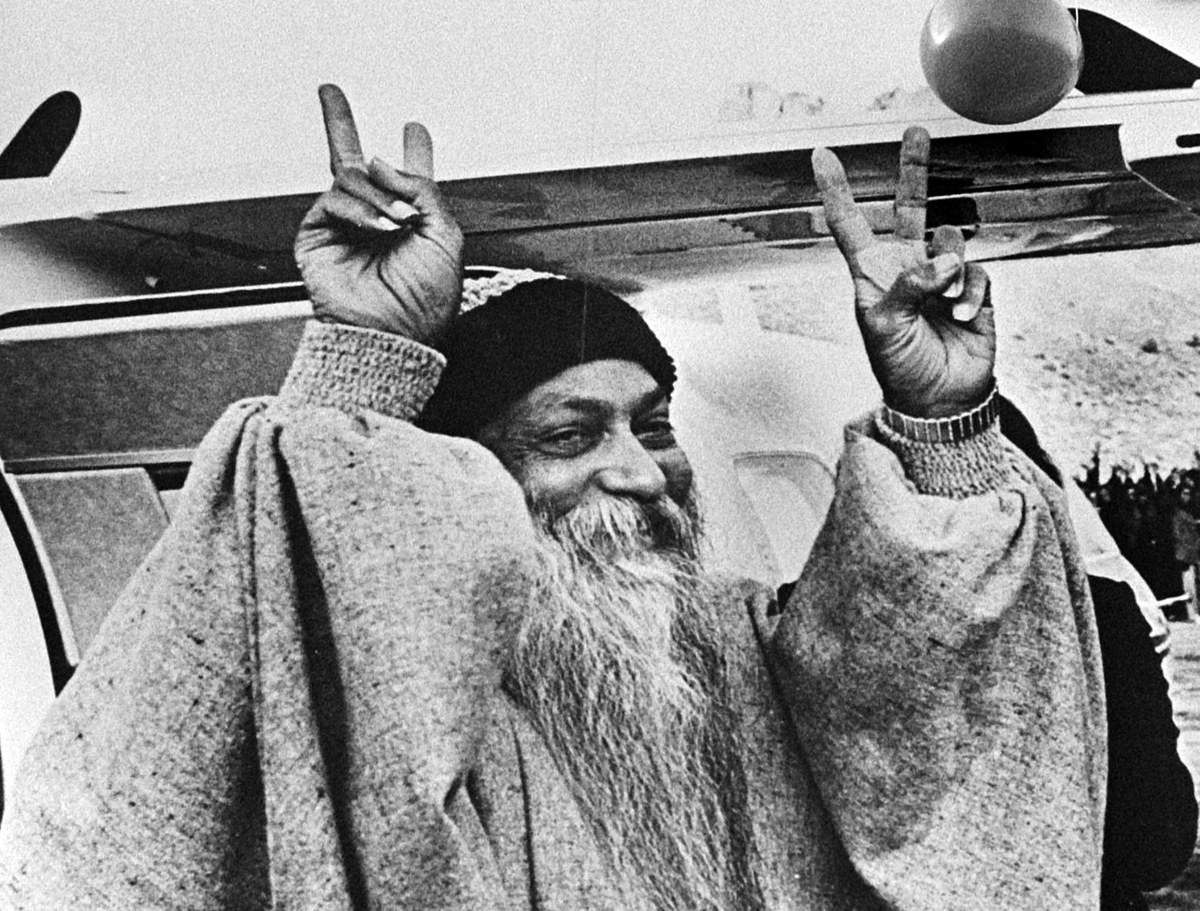
| Key facts | |
|---|---|
| Born | 11 December 1931, Kuchwada, Raisen district, Madhya Pradesh [10][36] |
| Died | 19 January 1990, Pune, aged 58 [21] |
| Birth name | Chandra Mohan Jain; later Acharya Rajneesh, Bhagwan Shree Rajneesh, and from 1989 Osho [10][63] |
| Family roots | Eldest of 11 children of Babulal Jain, a cloth merchant of Gadarwara, and Saraswati; a Taranpanthi Jain family [63][40] |
| Education | BA in philosophy, Jabalpur (1955); MA in philosophy, University of Sagar (1957) [10][35] |
| Career before | Lecturer and then professor of philosophy, Raipur and Jabalpur, 1957-1966 [10][40] |
| Organisations | Jeevan Jagruti Kendra, Rajneesh Foundation (Pune), Rajneesh Foundation International (US), today the Osho International Foundation, Zurich [5][25][31] |
| Wealth | No credible personal net worth figure exists; assets were held by trusts and companies (see “Building the empire”) |
| Known for | More than 600 book titles of transcribed talks, Dynamic Meditation, the Pune ashram, Rajneeshpuram and its 93 Rolls-Royces [49][19] |
On a summer afternoon in 1982, on a dusty road through the high desert of central Oregon, a long line of people dressed in shades of red and orange stood along the roadside. They had come from across the world, and they were waiting for a slow-moving white Rolls-Royce. At the wheel sat a bearded Indian man, born in a Madhya Pradesh village with no railway line and no post office. He drove past slowly, waving as he went.
This was the “drive-by”, the daily ritual of Rajneeshpuram, a city that had not existed a year earlier. It had its own airline, its own police, its own dam and, eventually, 93 Rolls-Royces [19][30]. Three years later the city was gone, its leaders were in prison or abroad, and the man in the car had pleaded to federal immigration charges and been flown out of the United States [15].
Osho is one of the most searched Indian names of the 20th century and one of the hardest to profile. To his followers he was a mystic. To Oregon’s prosecutors his commune was the scene of the largest bioterror attack in US history. To a publisher, he is a back catalogue that still sells in dozens of languages. This story is about something narrower and, for readers of a business site, more useful: how a small-town philosophy lecturer built one of the most remarkable organisations of his age, how it made and spent money, how it collapsed, and what the fight over its assets looks like today. It takes no side on his teachings.
Where it began
Chandra Mohan Jain was born on 11 December 1931 in his maternal grandparents’ house in Kuchwada, a village in what is now the Raisen district of Madhya Pradesh [10][36][37]. “My birthplace, Kuchwada, was a village with no railway line and no post office,” he later said [40]. Even in 2020, a reporter found it reached by a 4 km dirt track, 45 km from the nearest railway station [36].
His father, Babulal Jain, was a cloth merchant, and his mother was Saraswati. The family belonged to the Taranpanthi sect of Digambar Jains, followers of the 16th-century reformer Taran Svami [63][40]. He was the eldest of 11 children; one detailed chronology counts 12 [35][40]. The family called him “Raja”, and “Rajneesh” began as a childhood nickname [63].
For his first seven or eight years he was raised not by his parents but by his maternal grandparents, whom he called Nana and Nani. He later described this as his great fortune: the grandparents, the most prosperous family in the village, gave him almost total freedom [40][63]. When his grandfather died, around 1938, he moved to his parents’ home in Gadarwara, a market town where the family ran a cloth shop [40].
In Gadarwara he went through Ganj primary school, a middle school and the government higher secondary school, leaving in 1951 [40][35]. By his own and his family’s accounts he was a sharp debater, a heavy reader and a rebel, interested in socialism and atheism, and a constant trial to teachers [63]. Much of the colour of his childhood comes only from his own later talks, so it should be read as memoir rather than record.
Jabalpur, and a claim made at 21
In 1951 he enrolled at Hitkarini College in Jabalpur but left within about a year after clashes with a philosophy professor, moving to D.N. Jain College [40][63]. To pay his way he worked for a time as a sub-editor on a Hindi daily, Nav-Bharat, reportedly for Rs 75 a month [40].
On 21 March 1953, aged 21, he said he had become enlightened while sitting under a tree in a Jabalpur garden [63][39]. No one else witnessed it, and it is best understood as his own account. It became the founding story of everything that followed, and the date was later chosen for key milestones, including the move to Pune.
He finished a BA in philosophy in 1955, and in 1957 an MA in philosophy from the University of Sagar [10][35]. He was, by every account, a gifted speaker before he was anything else.
The first break
The professor who would not stay in the classroom
In 1957 he joined the Sanskrit college in Raipur as a philosophy lecturer. The vice-chancellor soon asked for him to be moved, reportedly calling him a danger to his students’ morality and religion [63]. In 1958 he moved to the University of Jabalpur, where he became a professor of philosophy, and he taught there until 1966 [10][39][40].
The real career was outside the campus. Through the 1960s, as “Acharya Rajneesh”, he toured India giving lectures to growing crowds. His themes were designed to provoke: he attacked socialism, criticised Gandhi as a worshipper of poverty, and mocked organised religion [63]. In 1966 he left the university, under pressure from the administration according to most accounts, and became a full-time speaker [10][63].
The first capital: Mumbai’s Jain businessmen
What turned a lecturer into an organisation was money from wealthy patrons, especially Jain businessmen in Bombay. Around 1965, a group of them set up the Jeevan Jagruti Kendra (“Life Awakening Centre”) as a trust to fund his tours, publish his talks and organise his meditation camps; its formal trust deed is dated 11 June 1969 [40][5]. Early backers paid for cars and travel; donors bought him time to speak rather than teach [40].
The model had three revenue lines from the start, and they never really changed: donations, residential meditation camps (from about 1964, at places such as Ranakpur, Nargol and Mount Abu), and books. The first book, Sadhana Path, was published from the Ranakpur camp talks in December 1964 [40]. Each talk could become a book, and each book a reason to come to the next camp.
Notoriety as marketing
In August 1968, invited by a Jain youth group to speak at Bharatiya Vidya Bhavan in Bombay, he argued that sex, understood rather than repressed, could be a path to “superconsciousness”. The hosts cancelled the rest of the series. He resumed it a month later at Gowalia Tank Maidan, reportedly before about 15,000 people [40]. The talks, later published as Sambhog Se Samadhi Ki Ore (in English, From Sex to Superconsciousness), scandalised religious leaders and stuck him with the label “sex guru” in the Indian press for decades [35][63].
The label hurt his reputation and helped his attendance. It was the first sign of a pattern that ran through his career: controversy as a distribution channel.
Mumbai, the orange robe and a new title
In July 1970 he left Jabalpur for Bombay. In September 1970, at a meditation camp near Manali, he began initiating “neo-sannyasins”, followers who took a new name, wore ochre or orange, and carried a mala with his photograph [63][41]. Unlike traditional sannyas, it did not require renouncing the world, jobs or money. That made it attractive to the middle class, and later to the Western young.
By late 1970 he was living in a flat in Woodlands apartments on Peddar Road, bought, by one account, in the name of the trust [41]. In 1971 he took the title “Bhagwan Shree Rajneesh” [10][63]. His organiser was Ma Yoga Laxmi, daughter of a wealthy Gujarati Jain family with Congress connections, who raised money and ran his affairs for the next decade [41][63]. By 1972 a movement publication counted about 3,800 sannyasins in India and 134 abroad [39].
Building the empire
Pune, 1974: the ashram as a business
On 21 March 1974, the 21st anniversary of his claimed enlightenment, he moved to two adjoining houses in Koregaon Park, Pune, set in about six acres [42][63]. The purchase was reportedly financed largely by Ma Yoga Mukta, a Greek shipping heiress, and other wealthy disciples [42][63]. The houses became Lao Tzu House, his residence, and the core of the Shree Rajneesh Ashram.
The Pune ashram (1974-81) was where the model matured. Westerners arrived in growing numbers, drawn by a mix of Indian meditation and the new Western therapies of the human-potential movement: encounter groups, primal therapy and gestalt. Time magazine called it “Esalen East” [27]. His daily morning discourse, alternating between Hindi and English, was recorded, transcribed and published. The ashram ran paid therapy groups and meditation courses, and visitors bought books, tapes and photographs.
Indian tax records give a rare look at the money. In calendar year 1974 the Rajneesh Foundation reported book sales of about Rs 15 lakh, commissions of about Rs 2.72 lakh and donations of under Rs 1 lakh [4]. In January 1983, the Income Tax Appellate Tribunal in Bombay held that the trust was neither educational nor charitable, describing its objects as involving “an activity for profit” [4]. A later tribunal ruling went further: “the only object of the trust is to project, establish and perpetuate the image of Sri Rajneesh” [5].
Whatever the tax view, the scale was real. By 1981 about 6,000 sannyasins lived in or around the ashram [39][38]. Some of them were very rich: heiresses, film people, executives. In a later interview collection he described himself, without apology, as “the rich man’s guru” [63].
Pressure at home
The success drew enemies. In July 1979 the government told the Lok Sabha that an audit of the Rajneesh Foundation for 1977 had shown irregularities, including spending without vouchers and poor records of donations, and that the Assistant Charity Commissioner in Pune had ordered an inquiry [6]. The Morarji Desai government withdrew the trust’s tax exemption retroactively, creating a bill that reports put at several million dollars [25][63]. Plans for a much bigger commune, including at a site in Kutch, ran into refusals of land-use approval [63].
On 22 May 1980, during a morning discourse, a man named Vilas Tupe threw a knife at him. It missed; he kept speaking [63]. India Today reported in June 1981 that the foundation was “up to its neck in income-tax arrears” [25]. On 10 April 1981 he went into public silence. In 1981 Ma Anand Sheela, a Baroda-born disciple in her early thirties, replaced Laxmi as his secretary [13][39].
On 1 June 1981 he flew from Bombay to New York on a visa granted, according to the later indictment, to seek medical treatment [20][38]. He would not live in India again for more than five years.
Oregon: buying a desert
Sheela moved fast. On 10 July 1981 a movement entity closed the purchase of the Big Muddy Ranch in Wasco and Jefferson counties, Oregon: 64,229 acres, about 100 square miles of overgrazed hills, for about US$5.75 million [1][11][13]. Reports put the price between US$5.75 million and US$6 million [59][14].
The plan was a self-contained city. The problem was Oregon’s strict land-use law, which allowed only a handful of residents on farmland. The answer was to become a city. On 26 May 1982, after a vote of 154 electors, Wasco County proclaimed the incorporation of Rajneeshpuram [1]. As a city, it could issue its own building permits.
The corporate structure
Behind the orange robes was a carefully layered legal structure, described in detail in a 1984 US federal court opinion and in Win McCormack’s investigations for Oregon Magazine [1][25]:
- Rajneesh Foundation International (RFI), a non-profit “church” with Sheela as president, which earned money from books, tapes, films, therapy and meditation courses, festivals and donations.
- Rajneesh Investment Corporation (RIC), a for-profit Oregon company wholly owned by RFI, which held the ranch land.
- Rajneesh Neo-Sannyas International Commune, a cooperative that leased the land and supplied the workforce. No one could become a member without Sheela’s approval [1].
- A London-registered company that moved money through the network, and a separate trust that held title to the Rolls-Royces [25][19].
Sheela held a general power of attorney from Rajneesh [1]. The minutes of one 1982 coordinators’ meeting put the fundraising logic bluntly: “Money [is] easier to get from those who have it” [28]. Residents worked long unpaid days, often 12 hours or more, seven days a week, and paid to belong: McCormack reported entrance contributions of US$5,000 to US$150,000 and monthly charges of US$500 to US$1,500 in 1984 [25]. Elsewhere, the movement ran discos in West Germany, a hotel in Portland and restaurants under the name “Zorba the Buddha” [25].
Building a city in three years
What residents built was remarkable by any measure. Rajneeshpuram had an airstrip and its own small airline, a reservoir behind a new dam, about 300 buildings, a shopping mall, a hotel, schools, a crematorium, and its own fire and police departments [30][14][39]. Its meditation hall, Rajneesh Mandir, covered about 88,000 square feet [30]. Permanent residents numbered roughly 2,000 to 3,000, rising to around 7,000 at peak including temporary residents, according to the Oregon Encyclopedia and other accounts [11][24].
The annual summer festivals were the cash engine. The 1984 festival drew about 15,000 people and was estimated to have brought in upward of US$10 million for the city and its businesses [25][63].
Across its short life, estimates of what the commune raised and spent vary widely: OPB put the investment at “more than $50 million”, UPI reported in November 1985 that more than US$100 million had been spent developing it, and the scholar Hugh Urban has estimated at least US$120 million generated in the Oregon period [14][19][57]. None of these is an audited figure.
The Rolls-Royces
The cars became the symbol of the whole enterprise. By 1985 the fleet numbered 93 Rolls-Royces, most counts agree [19][30]. They were held by the Rajneesh Modern Car Collection Trust, not in his name [19][23]. He enjoyed the provocation: “My disciples give me Rolls-Royces because they love me,” he said, and he later claimed the cars “fulfilled their purpose” by creating jealousy among the super-rich [19][63].
As a business decision, the fleet worked the way a luxury brand works. It turned an Indian guru in a remote desert into a fixture of American television. It also turned local suspicion into hostility.
Antelope and the homeless voters
The tiny neighbouring town of Antelope, with about 40 residents, became the first battleground. Rajneeshees moved in, won control of its council in November 1982 and renamed it Rajneesh [11][12]. Oregon’s attorney general, David Frohnmayer, sued, arguing that a city controlled by a religious organisation violated the US Constitution’s separation of church and state. In October 1984 a federal judge refused to dismiss the case [1]. Separately, the land-use group 1000 Friends of Oregon challenged the incorporation through the state courts [3].
In late 1984, ahead of county elections that could decide the city’s future, the commune bused in homeless people from across the US under a “Share-a-Home” programme, between 2,000 and 4,000 by various estimates [14][63]. On 10 October 1984, Oregon suspended new voter registration in Wasco County. No Rajneeshee candidate won [63]. Many of the homeless were later left in nearby towns.
That autumn, as later court cases showed, a small group around Sheela had already crossed into crime.
The setbacks and failures
The collapse of 1985
On 13-14 September 1985, Sheela and about 15 to 20 senior aides abruptly left for Europe [13][33]. Two days later, Rajneesh, who had resumed speaking that year, called press conferences. He accused Sheela and “her gang” of turning the commune into “a fascist concentration camp”, of poisoning people in The Dalles and of plotting to kill his doctor, and he invited the FBI and state police onto the ranch [26]. Copies of the Book of Rajneeshism were burned; the red clothing rule was dropped [26].
The investigations that followed brought down the city. On 28 October 1985, two chartered Learjets carrying Rajneesh and a few aides landed at Charlotte, North Carolina, and federal officers arrested him [20][26]. On 14 November 1985 he entered pleas to two immigration counts and left the US the same day (details below) [15].
Within weeks the commune was in liquidation. A Texas dealer bought 84 of the Rolls-Royces and trucked them to Dallas; reports put the price at about US$5 million to US$6 million [23][19]. First Interstate Bank closed the corporations’ accounts [33]. By 1986 Rajneeshpuram was a ghost town [11].
The ranch itself went through creditors and owners. In 1991 the Montana businessman Dennis Washington bought it for about US$3.65 million, and in the late 1990s it was given to Young Life, a Christian youth organisation, which opened a summer camp there in 1999. The old meditation hall became a sports complex; the Rolls-Royce garages became storage [12][30].
“Unwelcome” in 21 countries
After his departure from the US, he spent months looking for a new home. Greek police arrested him in Crete on 5 March 1986 and expelled him [18]. According to Encyclopaedia Britannica, 21 countries refused him entry or deported him in this period [10][62]. He returned to Bombay on 30 July 1986 and to the Pune ashram in January 1987 [63].
Rebuilding in Pune and the last years
The comeback was smaller and quieter. Book sales were reported to be struggling after Oregon [63]. He resumed discourses in Pune, and in 1989 dropped “Bhagwan” and took the name Osho [10][63]. From late 1987 he claimed that his failing health was the result of poisoning in US custody; no evidence was produced, and the then US attorney called the claim “complete fiction” [63]. That claim remains his, and unproven.
In April 1989 he set up a 21-member “Inner Circle” to handle the organisation’s affairs after him [31]. He gave his last public discourse that month [63].
He died in Pune on 19 January 1990, aged 58. A spokesman told reporters: “The doctors say it’s heart failure” [21][22]. He was cremated the same evening [52]. His epitaph, on the marble over his ashes in Lao Tzu House, reads: “Never Born, Never Died. Only Visited this Planet Earth between Dec 11 1931 - Jan 19 1990” [56][58].
Controversies and allegations
The legal record around Osho is unusually well documented, because much of it passed through US federal and state courts. A distinction matters throughout: Osho himself was charged only with immigration offences. He was never charged in the poisonings, the assassination plot, the wiretapping or the attack on his own physician. The matters below are listed as of 29 November 2026.
The 1984 salmonella attack in The Dalles
Allegation: Between September and October 1984, 751 people in The Dalles, Oregon, fell ill with salmonella after restaurant salad bars were deliberately contaminated. At least 45 were hospitalised; no one died [8]. A criminal investigation traced the bacteria to a vial seized from the commune’s clinic laboratory, and testimony cited in a 1997 paper in the Journal of the American Medical Association said the aim was to make residents too ill to vote in the November 1984 county elections [8]. It is widely described as the largest bioterror attack in US history.
Response: Rajneesh publicly blamed Sheela and her group in September 1985 and said he had known nothing about it [26]. Sheela has since given different accounts in interviews, but no court has found that he knew of or directed the attack.
What happened next:
- In 1986 Ma Anand Sheela and Ma Anand Puja (Diane Onang), who ran the commune’s medical corporation, were indicted under federal product-tampering law, and in July 1986 both entered pleas covering this and other charges [8][17].
- Sheela received concurrent sentences of up to 20 years on several state and federal counts, including the attempted murder of Osho’s physician, Swami Devaraj, along with fines [17][64].
Status: Concluded. Sheela was released in December 1988 after about 29 months and deported; she later settled in Switzerland [17][13]. Puja was also released in December 1988 [17]. Osho was never charged.
The plot to kill US Attorney Charles Turner
Allegation: In 1985 Charles Turner, the US attorney in Oregon, was leading a grand jury inquiry into the commune. According to the trial evidence summarised by a US appeals court, Sheela told a meeting that Turner and other enemies would need to be killed; a team bought handguns and kept Turner under surveillance, though no attempt was ever made [2].
Response: The defendants contested the charges; two of them fought extradition from Britain for years [29].
What happened next:
- A federal grand jury indicted seven people in 1990 [9].
- Two British women, Sally-Anne Croft and Susan Hagan, were extradited, convicted by a Portland jury in 1995 and sentenced to five years each; the Ninth Circuit upheld the convictions in 1997 [29][2].
- Switzerland refused to extradite Sheela; a Swiss court convicted her in 1999 of acts preparatory to murder [9][64].
- Catherine Jane Stork returned voluntarily and pleaded guilty in 2005 [9].
Status: Concluded. The appeals court opinion does not say Osho knew of the plot, and he was never charged.
Wiretapping and other crimes inside the commune
Allegation: Investigators found an extensive bugging and wiretapping system inside Rajneeshpuram, including in Rajneesh’s own residence [14][63]. Other charges against members included arson and immigration fraud.
Response: Rajneesh said the bugging was done by Sheela’s group without his knowledge [26].
Status: Concluded. Several members pleaded guilty to wiretapping offences in 1985-86 [16]. According to OPB, 25 followers were eventually convicted of crimes ranging from arson to attempted murder, and 10 served prison time [14].
Immigration fraud and the 1985 plea
Allegation: A 35-count federal indictment in Portland in October 1985 charged Rajneesh and seven aides with arranging sham marriages so that foreign disciples could stay in the US, and charged that he had lied about his intention to stay permanently when he entered the country in 1981 [15][20].
Response: He maintained he was innocent. His lawyer said he entered the plea “because of the possible danger to himself or to his followers” [15]. It was an Alford plea, in which a defendant accepts conviction without admitting guilt.
What happened next:
- Arrested in Charlotte, North Carolina, on 28 October 1985; released on US$500,000 bail [20][26].
- On 14 November 1985, before US District Judge Edward Leavy, he entered the plea to two felony counts [15].
Status: Concluded. He received a 10-year suspended sentence, five years’ probation and US$400,000 in fines and costs, and agreed to leave the US and not return for at least five years without permission [15]. Five co-defendants pleaded guilty in December 1985 [16].
The church-state case against the city
Allegation: The State of Oregon argued that Rajneeshpuram was in effect a city run by a church, in breach of the US Constitution’s Establishment Clause [1].
Response: The city argued that its residents had the same right as any others to incorporate, and that the suit attacked their religious freedom [1].
Status: Concluded. The federal court refused to dismiss the case in October 1984 [1] and in December 1985, after the commune had collapsed, ruled the city’s incorporation invalid [16]. A separate land-use case in the state courts became moot [3][11].
Tax and charity disputes in India
Allegation: Indian tax authorities held that the Rajneesh Foundation was not a charitable trust and withdrew its tax exemption from assessment year 1975-76; in 1979 the government told Parliament an audit had shown irregularities and that the charity commissioner had ordered an inquiry [4][6].
Response: The foundation contested the assessments for years before tax tribunals [4][5].
Status: Concluded. According to a 2001 tax tribunal order, the foundation proposed a settlement in November 1988, paying Rs 30 lakh upfront and Rs 7.5 lakh a month, in exchange for waiver of interest, penalties and prosecution, which the tax commissioner broadly accepted in February 1989 [5].
The disputed will
Allegation: In 2013, a will said to have been signed by Osho in 1989, leaving his property and intellectual-property rights to the Osho International Foundation (OIF), surfaced in European trademark proceedings. In December 2013 Yogesh Thakkar (Swami Prem Geet), a disciple who runs the Osho Friends Foundation, filed a police complaint in Pune alleging the signature was forged, naming OIF trustees [43][45].
Response: An ashram spokesperson called the allegation “completely wrong” and declined further comment as the matter was before the courts [52].
What happened next:
- The Bombay High Court pushed the police to investigate in 2016 and 2017 [43][44].
- In 2018 the Pune police’s Economic Offences Wing filed an inconclusive closure report, and the High Court declined to order a CBI probe; the Supreme Court also declined to transfer the case in January 2019 [45].
- Thakkar pursued a protest petition before a magistrate in Pune [45].
Status: Unresolved. No court has found the will forged or genuine, and no later decision has been reported.
The “OSHO” trademark
Allegation: Breakaway groups argued that the name Osho belongs to everyone who follows him and should not be a private brand.
Response: OIF has said it must protect the integrity of his work and licenses the name commercially in Europe [49].
Status: Split outcome. In the US, the Trademark Trial and Appeal Board cancelled OIF’s OSHO marks in 2009, finding the term generic and merely descriptive; OIF later withdrew its appeal [50][63]. In the European Union, the General Court on 11 October 2017 dismissed a challenge by a German commune and upheld OIF’s EU trademark [49][61].
The Rs 107 crore land sale
Allegation: In 2020-21, OIF sought permission to sell two plots of the Pune ashram, about 9,836 square metres, for Rs 107 crore to Rajivnayan Rahulkumar Bajaj (identified in press reports as Bajaj Auto managing director Rajiv Bajaj) and a family trust, citing losses during Covid; it reported income of about Rs 28 lakh against spending of Rs 3.65 crore for April-September 2020 [46][7][47]. Disciples led by Thakkar objected that the trust was selling a legacy property without need [46].
Response: OIF said the sale was needed “to ensure the survival” of the resort [46].
What happened next:
- On 7 December 2023 the Joint Charity Commissioner in Mumbai rejected the sale, finding no “genuine and compelling necessity”, ordered the Rs 50 crore advance refunded and directed a special audit of the trust for 2005-2023 [7][47].
- On 8 April 2024 the Bombay High Court dismissed OIF’s petition against that order as “devoid of merits” [7][48].
- OIF appealed to the Supreme Court, which listed the matter in July 2024 [47].
Status: Pending. No final Supreme Court ruling has been reported as of 29 November 2026.
Questions about his death
Allegation: In a 2017 book, Who Killed Osho?, journalist Abhay Vaidya called for a court-monitored inquiry into the circumstances of the death, citing the speed of the cremation and statements by Dr Gokul Gokani, who signed the death certificate, that he was asked to record a heart-related cause and did not see the moment of death [51][52]. These are questions raised in a book and in press reports, not established facts.
Response: An ashram spokesperson dismissed the claims (“Anyone can say anything”), and the movement’s own news site called the book’s title “misleading” and “sensational” [52]. Accounts from his close aides say he refused emergency treatment and chose to die naturally [52].
Status: No investigation has been opened and no court has made any finding.
Giving back
Osho did not build hospitals or schools, and he openly mocked what he saw as the glorification of poverty in Indian public life [63]. The Pune ashram’s tax history shows that, whatever its legal form, its income came overwhelmingly from fees and sales rather than donations: in 1990-91, according to a tax tribunal, the foundation earned Rs 2.66 crore from meditation and healing courses against voluntary contributions of Rs 2.75 lakh [5].
His legacy is instead the material itself. His talks were transcribed into more than 600 book titles, with about 6,500 audio discourses and 1,870 video recordings, according to a 2017 Hindustan Times report [49]. In 1996, 16 of his titles sold 600,000 copies in China; Osho Zen Tarot sold 150,000 copies in the US [32]. His books are fixtures in Indian railway and airport bookstalls. The author Khushwant Singh, no believer, called him “much the most erudite of world’s religious philosophers” and “an iconoclast who held nothing sacred” [34]. Dynamic Meditation, which he introduced around 1970, is still practised far beyond his own movement.
Public perception in India has also shifted. The 2018 Netflix series Wild Wild Country, which won an Emmy for outstanding documentary series, introduced Rajneeshpuram to a new generation [55]; the religion scholar Hugh Urban argued that it left out his teachings and the wider historical context [57]. In 2021 Netflix released Searching for Sheela, following her return to India after 34 years [54]. Sheela, now in Switzerland, has run care homes for people with disabilities [53].
Succession
Osho named no single successor. He left an Inner Circle, and control of the Pune resort and the intellectual property passed in practice to the Osho International Foundation in Zurich and a small group of trustees; Swami Jayesh (Michael O’Byrne), the Inner Circle’s chairman, led it until his death in November 2023 [31][65].
The resort, now the Osho International Meditation Resort in Koregaon Park, charges a daily fee for meditation passes and runs therapy courses [47]. Its numbers have fallen well below the 1990s peak; in 2012 Outlook reported peak-season visitors had dropped to about 150 a day from 1,200-1,500 [60]. A breakaway network around disciples such as Swami Chaitanya Keerti and Yogesh Thakkar runs its own centres and has fought the Zurich foundation in court over the will, the trademark and the land for more than a decade [47]. The legacy of a man who said he wanted no biography is now a property dispute measured in crores.
What his journey teaches
A clear, provocative message travels farther than a careful one. From his attacks on Gandhi in the 1960s to the Rolls-Royces in Oregon, he chose provocation deliberately. It built a global audience fast, and it also built the enemies who brought the commune down.
Content compounds. A daily talk, transcribed, became a book; the book brought visitors to the next camp; the camp produced more talks. Thirty-six years after his death, that library is still the main asset his heirs are fighting over. For founders, an archive of original work can outlast every building.
Structure is not the same as control. Rajneeshpuram had a careful set of companies, trusts and cooperatives, but almost every lever ended in one person’s power of attorney. When Sheela left, the organisation lost its finances, its management and its credibility in a single week.
Growth that ignores the neighbours rarely lasts. The Oregon project failed not for lack of money but because it treated local laws and local people as obstacles. Founders building anything large, from a factory to a township, can learn from how quickly a US$100 million city unravelled once the community turned against it.
Assets held in trust need governance that outlives the founder. The disputes over his will, his name and his land show what happens when succession is left to an informal circle. Family businesses and promoter groups face the same risk; CapitalVia’s Insights section covers governance and succession in Indian companies.
A profile for general reading, based on public records and reporting as of 29 November 2026. Not investment, tax or legal advice.
Sources (65)
- State of Oregon v. City of Rajneeshpuram, 598 F. Supp. 1208 - US District Court, District of Oregon, Oct 1984
- United States v. Croft, 124 F.3d 1109 - US Court of Appeals for the Ninth Circuit, Sep 1997
- 1000 Friends of Oregon v. Wasco County Court, 299 Or 344 - Oregon Supreme Court, 1985
- Rajneesh Foundation v. Income-Tax Officer - Income Tax Appellate Tribunal, Bombay, Jan 1983
- Dy. CIT v. Rajneesh Foundation - Income Tax Appellate Tribunal, Pune, Oct 2001
- Lok Sabha Debates, Unstarred Question on Rajneesh Foundation - Parliament of India, Jul 1979
- Osho International Foundation v. Yogesh Thakkar & Ors., Writ Petition 63 of 2024, judgment - Bombay High Court, Apr 2024
- A large community outbreak of salmonellosis caused by intentional contamination of restaurant salad bars - JAMA (Torok et al.), Aug 1997
- Former Rajneeshee pleads guilty in 1985 conspiracy to murder US Attorney - US Department of Justice, Sep 2005
- Bhagwan Shree Rajneesh - Encyclopaedia Britannica, Nov 2026
- Rajneeshees - The Oregon Encyclopedia (Oregon Historical Society), Nov 2026
- City of Antelope and Muddy Ranch - The Oregon Encyclopedia, Nov 2026
- Ma Anand Sheela (b. 1950) - Oregon History Project, Oregon Historical Society, 2002
- Rajneeshpuram - OPB Oregon Experience, Nov 2012
- Guru pleads guilty and goes - UPI, Nov 1985
- Five Rajneeshees plead guilty to immigration fraud - UPI, Dec 1985
- Guru's ex-aide back in Oregon after prison - UPI, Dec 1988
- Scores of armed police arrested Indian guru Bhagwan Shree Rajneesh - UPI, Mar 1986
- 'Staggering' interest in guru Rolls-Royces - UPI, Nov 1985
- Unholy Mess: The Bhagwan faces a federal rap - Time, Nov 1985
- Bhagwan Rajneesh dies at 58 - The Seattle Times (AP), Jan 1990
- Guru who attracted thousands to Oregon dies at 58 in India - Deseret News, Jan 1990
- 84 Rolls-Royces bought as liquidation of guru's Oregon commune continues - Christian Science Monitor, Dec 1985
- Guru's commune faces hostile community, internal problems - Christian Science Monitor, Nov 1985
- Bhagwan's Bottom Line I (Win McCormack) - The New Republic, Apr 2018
- Bhagwan's Final Year (Win McCormack) - The New Republic, Apr 2018
- A Beautiful Place for an Ashram (Win McCormack) - The New Republic, Apr 2018
- Bhagwan's Rich Folk (Win McCormack) - The New Republic, Apr 2018
- Former Rajneeshees sentenced in plot - The Spokesman-Review, Dec 1995
- Christian camp transforms Rajneesh compound - The Seattle Times, Sep 1998
- Departed Rajneesh still enraptures devotees - The Seattle Times (Los Angeles Times), Feb 1994
- Osho, guru extraordinaire, is long gone - but his books live on - Publishing Trends, May 2001
- Sheela defects to Europe; Rajneeshism is dead - Hinduism Today, Nov 1985
- A spiritually incorrect mystic (Khushwant Singh) - The Tribune, Jul 2000
- Acharya Rajneesh: Controversial spiritual leader, philosopher - The Tribune, Jan 2025
- Faded memories - The Week, Dec 2020
- Osho's followers celebrate his birth anniversary - Business Standard (PTI), Dec 2016
- The rise and spectacular fall of an Indian guru - UCA News, May 2013
- Osho/Rajneesh Timeline - World Religions and Spirituality Project, Jan 2015
- OSHO Source Book, Part Two: Jabalpur 1951-1970 (Pierre Evald) - oshosourcebook.com, 2019
- OSHO Source Book, Part Three: Bombay 1970-1974 (Pierre Evald) - oshosourcebook.com, 2019
- OSHO Source Book, Part Four: Poona 1974 (Pierre Evald) - oshosourcebook.com, 2019
- Bombay HC asks State to consult experts in Osho's "fake will" case - LiveLaw, Oct 2016
- Forgery of Osho's will: HC asks police to expedite probe - Business Standard (PTI), Nov 2017
- Shoddy probe into Osho's 'forged' will, says petitioner (Hindustan Times report) - Osho News, Apr 2019
- Citing cash crunch by pandemic, Osho trust starts process to sell two plots in Pune - The Tribune (PTI), Mar 2021
- Osho land feud is a battle for legacy - ThePrint, Jul 2024
- HC dismisses Osho Foundation's plea in Koregaon Park land deal case - Free Press Journal, Apr 2024
- How 'Osho' became a European brand - Hindustan Times, Dec 2017
- 'Osho' freed from trademarks - DNA, Jan 2009
- New book seeks court-monitored probe into Osho's death - Business Standard (IANS), Mar 2017
- 29 years on, Osho's death remains a mystery - The Quint, Jan 2019
- The rebirth of Ma Anand Sheela - Swissinfo, Apr 2018
- The homecoming of Ma Anand Sheela - Netflix, Apr 2021
- 2018 Outstanding Documentary or Nonfiction Series - Television Academy, Sep 2018
- Who is Osho? - osho.com, Nov 2026
- Rajneeshpuram was more than a utopia in the desert (Hugh Urban) - Humanities, National Endowment for the Humanities, Mar 2018
- 33 KP, Pune: A vision for Osho's Samadhi - Free Press Journal, Nov 2022
- The guru down the road - Christianity Today, Apr 1982
- The Salvation Slide - Outlook, Oct 2012
- Osho brand belongs to Zurich entity, rules European Court (Hindustan Times report) - Osho News, Oct 2017
- Rajneesh, Bhagwan Shree (1931-1990) - Encyclopedia.com (Gale), Nov 2026
- Rajneesh - Wikipedia, Nov 2026
- Ma Anand Sheela - Wikipedia, Nov 2026
- Jayesh (Osho International Foundation announcement) - Osho News, Nov 2023