
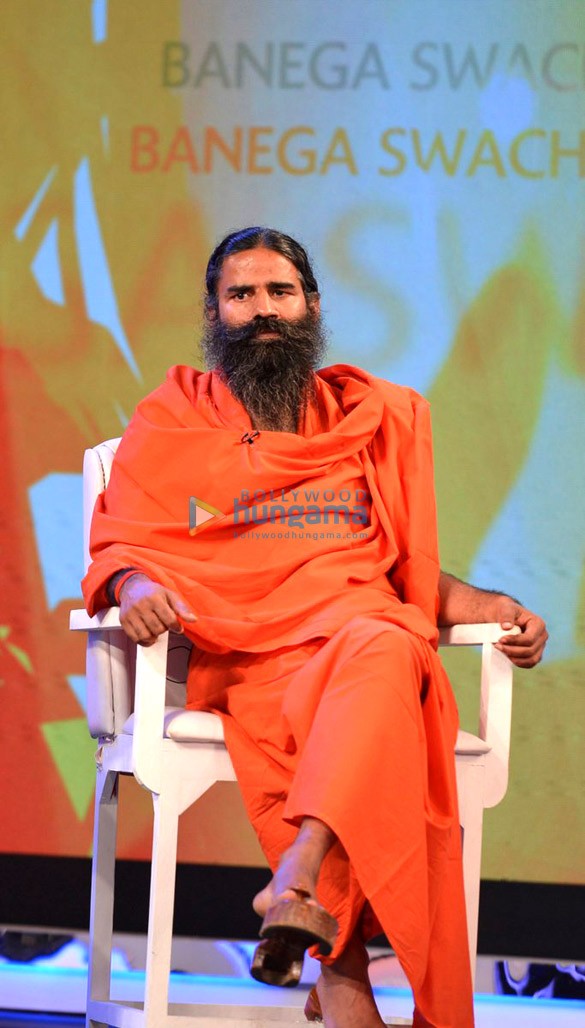
| Key facts | |
|---|---|
| Born | Ramkishan Yadav (also spelt Ram Kisan or Ramkrishna); year most often given as 1965, though his family has said 1975 [11][12][13] |
| Hometown | Said Alipur village, Mahendragarh district, Haryana [11][13] |
| Family | Son of farmers Ram Niwas Yadav and Gulabo Devi; younger brother Ram Bharat is managing director of Patanjali Foods [14] |
| Education | Village government school to about Class 8; Sanskrit and yoga at Arya Samaj gurukuls in Khanpur and Kalwa, Haryana [15][11][8] |
| Company/Group | Co-founder of Patanjali Ayurved (2006) with Acharya Balkrishna; Patanjali Yogpeeth and related trusts; Patanjali Foods (formerly Ruchi Soya) [10][16] |
| Wealth | No reliable personal net-worth figure. Ramdev holds no shares in Patanjali Ayurved; about 98.5% is held by Acharya Balkrishna, whom Forbes put at about US$2.3 billion in November 2026 [6][17][18] |
| Known for | Taking yoga to tens of millions on television, and building a swadeshi FMCG group that took on Colgate and Hindustan Unilever |
At a little past one in the morning on 5 June 2011, Delhi Police moved into Ramlila Maidan, where thousands of people were sleeping after the first day of a hunger strike against black money. Tear gas and lathis cleared the ground [19]. The man they had come for jumped off the stage, changed into a white salwar-kameez and dupatta, and tried to slip away in the crowd. He was caught at about 4 a.m. and flown out of the capital [20][21].
The man in the dupatta was Baba Ramdev, a yoga teacher from a poor Haryana farming family who, in under a decade, had become one of the most watched gurus on Indian television and a political force that four Union ministers had gone to the airport to receive [21]. The Supreme Court later called the midnight raid an assault on basic democratic values [22].
What almost nobody saw coming was what he would build next. Within six years, Patanjali Ayurved, the company he co-founded with his friend Acharya Balkrishna, claimed sales of Rs 10,561 crore and was telling Colgate, Nestle and Hindustan Unilever that their days were numbered [23][24]. By 2026 the Patanjali group controlled a listed food company with sales above Rs 40,000 crore [25], had bought a general insurer [26], and opened a hospital [27].
It has also spent years in court. The Supreme Court made Ramdev and Balkrishna appear in person and apologise in 2024 over misleading advertisements [1], and High Courts have rebuked him over remarks about doctors, rival brands and a rival company’s owners. This is the full story: the gurukul boy, the TV yogi, the swadeshi tycoon who owns no shares, and the record on both sides.
Where it began
Ramdev was born Ramkishan Yadav in Said Alipur, a village of a few thousand people in Mahendragarh district, south-west of Delhi [11][12]. Even the basic facts are contested. Most profiles and reference sources give his birth year as 1965; his elder brother told the Hindustan Times in 2011 that he was born in 1975 [12]. When the journalist Priyanka Pathak-Narain pressed him on it, he would only place it “sometime between 1965 and 1975” [13]. Spellings of his birth name also vary between Ramkishan, Ram Kisan and Ramkrishna.
His parents, Ram Niwas Yadav and Gulabo Devi, were farmers [14]. “My parents were poor and uneducated,” he told Open magazine in 2016 [15]. He has described sleeping on the floor with his siblings, playing with balls made of rolled-up rags and walking several kilometres to school in slippers cut from old tyres [13]. “I never used any soap in my childhood,” he told Entrepreneur India, which is an odd sentence for the man who would later sell crores of rupees’ worth of soap [28]. Grazing cattle and farm work were part of daily life [12].
He went to a government school where, he says, the fee was one rupee and the books were second-hand. “We could buy new books only once or twice but I always stood first in class” [29]. He also remembers taunts from the village: “What can this son of a poor farmer do? His parents are illiterate” [15].
The turning point was a book. As a teenager he read Satyarth Prakash, the 1875 work by Swami Dayanand Saraswati, founder of the Arya Samaj. “This book was a revelation to me. It awakened my inner-self, gave me a sense of purpose in life,” he later said. He vowed never to marry and left the government school, whose curriculum he dismissed as a leftover of Macaulay’s education policy [30].
The gurukul years
An uncle who preached for the Arya Samaj took him to the Arsh Gurukul at Khanpur, about 30 km away [12]. The dates, again, differ: the gurukul’s head told India Today he joined in 1984 and stayed five years; the Hindustan Times put his arrival in 1988 [11][12]. His official biography skips Khanpur and says he entered the gurukul at Kalwa, in Jind district, at 14, studying Sanskrit and yoga under Acharya Baldev [8].
The Arya Samaj gurukul gave him something the village had not. “There, everyone was treated as equal,” he said [15]. It also gave him his name. Acharya Baldev, he says, told him that “Ramkrishna” carried two gods and he needed one; he chose Ram, and became Ramdev [30].
It was at the gurukul, around 1987-88, that he met a quiet boy a few years younger: Balkrishna, the son of Nepali parents who had come to India for work. Accounts differ on whether they met at Khanpur or Kalwa [31][29]. The two would be inseparable for the next four decades.
After the gurukul he taught Sanskrit and spent time in the caves near Gangotri. “I never thought about becoming a yoga teacher,” he told Entrepreneur India [28].
The first break
Haridwar, a guru and a trust
In the early 1990s (1992 or 1993, depending on the source) Ramdev reached Kankhal, on the edge of Haridwar, and attached himself to Kripalu Bagh Ashram, run by an elderly ascetic, Swami Shankar Dev [12][15]. Shankar Dev, born in 1930 in Almora district, had lived at the ashram since 1968 [9]. Ramdev took sanyas, the vow of renunciation, from him; the ashram’s own account dates the diksha to 1995 [9].
The beginnings were tiny. In 1993, when he first taught yoga on the banks of the Ganga, he had two students, both junior engineers [15]. A Gujarati businessman, Jeevraj Bhai Patel, asked him to run a yoga camp. “I never knew how to do it,” Ramdev recalled [28]. He learnt. Through the 1990s he rode a scooter to around 50 camps a year, mostly in Haryana and Rajasthan; a camp in 1995 drew about 250 people [12].
In January 1995 Ramdev, Balkrishna and another teacher, Acharya Karamveer, set up the Divya Yog Mandir Trust at the ashram, with Shankar Dev as patron [8][9]. The same year they started Divya Pharmacy to make Ayurvedic medicines. “When Divya Pharmacy was set up, we hardly had the money to pay for the registration,” Ramdev told Business Today. “For the first three years, till 1998, we distributed the medicines free. From buying the raw materials to grinding and mixing, we did everything ourselves” [32]. Pathak-Narain’s reporting describes the three making chyawanprash in rented utensils and selling it from bicycles around Haridwar [31].
By 2000, the Hindustan Times reported, the division of labour was set: Ramdev was the face, Balkrishna the financial manager, Karamveer the administrator [12].
Television
The breakthrough came from a medium no yoga teacher had used at scale. In 2002 a camp in Rewari was broadcast on a religious channel [11]. Ramdev at first paid for slots on Sanskar TV [33]. Aastha, the bigger devotional channel, passed him over in 2003, then watched his ratings and sent an executive to lure him back; within months, Open magazine reported, he was the channel’s blockbuster [34][35].
The formula was new: a saffron-clad man in a dhoti, at dawn, demonstrating breathing exercises such as kapalbhati and anulom-vilom to camps of thousands, with plain-spoken Hindi and a promise that anyone could do it at home for free. By 2011 his camps drew 50,000 people or more [12]. “The SUVs, security and the aura came after 2002,” the Hindustan Times noted [12]. Ramdev himself gives the media most of the credit. “My own role is just one to 10 per cent, the rest of the credit goes to the media,” he told Business Today [32]. In December 2007 a company linked to Balkrishna bought Aastha’s domestic business [34][35].
Fame brought money and trouble together. In 2005 a wage dispute at the trust’s pharmacy, which employed about 400 workers, ended with more than a hundred dismissals; CPI(M) leader Brinda Karat then alleged that some Divya Pharmacy medicines contained animal and human remains. That episode is covered in the controversies section below [36].
Patanjali Yogpeeth and Patanjali Ayurved
In April 2006 the Patanjali Yogpeeth campus opened in Haridwar, a Rs 100-crore complex with a hospital, inaugurated by Vice-President Bhairon Singh Shekhawat. Rahul Bajaj, Brijmohan Lall Munjal and A.P. Hinduja attended [37]. The guest list showed how far a yoga teacher on a scooter had travelled in a decade.
A few months earlier, on 13 January 2006, Patanjali Ayurved Ltd had been incorporated in Delhi [10]. The money came from devotees and banks rather than investors. “We took some money from people who were not looking at returns,” Balkrishna said. “Then I took a personal loan. I got a loan without any paper work. It was of almost 50-60 crore on the basis of trust from a bank” [29]. Early backers included Sam and Sunita Poddar, a Scotland-based couple who ran care homes. In 2009 the Poddars bought the Scottish island of Little Cumbrae for about £2 million and Ramdev led a bagpipe procession there [38].
Ramdev, as a sanyasi, took no shares. Balkrishna took nearly all of them [39]. Ramdev has explained it this way: “Just for legal requirement he has the shares; else he doesn’t consider himself the owner” [29].
Building the empire
The swadeshi pitch
Patanjali’s early products were what a yoga audience already wanted: Ayurvedic medicines, chyawanprash, honey, aloe vera and amla juice, sold through the trust’s own clinics and shops. Then the range widened to everyday groceries and toiletries, among them Dant Kanti toothpaste, Kesh Kanti shampoo, soap, atta and, most successfully, cow ghee. The pitch was simple and well timed. Products were natural, Indian and cheaper than multinational brands, and every rupee, Patanjali said, went to a good cause.
“Why do Indians work for foreign brands? Why don’t they create their own brands?” Ramdev asked in 2016. “Indian money should stay in India” [29]. “I believe that MNCs are looting this country,” he told Open [15]. Advertising was mostly Ramdev himself, on his own television slots. “We do not have paid brand ambassadors,” he said [40].
The growth was startling. Patanjali Ayurved’s revenue was about Rs 453 crore in FY12 [23]. It reached about Rs 5,000 crore in FY16 [40]. Forbes calculated that revenue grew about tenfold in four years and net profit rose from about US$11 million to US$105 million [39].
Getting onto every shelf
For years Patanjali was sold mainly through its own network of Chikitsalayas (clinics), Arogya Kendras and Swadeshi Kendras. In October 2015 it signed with Kishore Biyani’s Future Group to sell through Big Bazaar and the group’s other stores, targeting Rs 1,000 crore of sales over 20 months. “Our effort is to promote swadeshi and give a tough fight to the MNCs,” Ramdev said at the launch [41]. (Read our profile of Kishore Biyani.) Modern retail chains including Radhakishan Damani’s DMart followed [42].
By April 2016 Patanjali had 4,000 distributors and 10,000 stores [40]. By January 2018 it had about 10,000 distributors, a sales force of more than 5,000, factories in several states and reach into about a million general stores [42]. That month it signed up Amazon, Flipkart, BigBasket, Grofers and others for online sales [43]. It launched instant noodles in 2015 and in 2018 an apparel line, Paridhan, promising to compete with “Adidas, Puma” [44].
The big claims
Ramdev’s rhetoric grew with the numbers. In April 2016 he said Patanjali “would shut the ‘gate’ in Colgate” and that “the birds in Nestle’s nest will also fly away” [24]. In May 2017, announcing results in Haridwar, Patanjali claimed group sales of Rs 10,561 crore for FY17, with Patanjali Ayurved at Rs 9,346 crore, Divya Pharmacy at Rs 870 crore and Patanjali Gramodyog at Rs 345 crore. Cow ghee alone was Rs 1,467 crore and Dant Kanti Rs 940 crore [23]. The next target was Rs 20,000 crore by March 2018, and Ramdev said multinationals would be forced to do kapalbhati. Analysts were sceptical: Edelweiss’s Abneesh Roy called doubling “a farfetched idea” [45].
The same month Prime Minister Narendra Modi inaugurated the Rs 200-crore Patanjali Research Institute in Haridwar, where Ramdev promised, “In the next five years, we will drive out these MNCs from the Indian market” [46].
Patanjali’s success also made Balkrishna one of India’s richest people. Hurun put him at Rs 25,600 crore in 2016 and Rs 70,000 crore in 2017, eighth in India [47][48]. Forbes headlined its 2016 profile “India’s Baba Ramdev billionaire is not Baba Ramdev” [39]. Bloomberg later called the company “controlled by a penniless yoga superstar” [49].
The stumble
The Rs 20,000 crore never came. In FY18 Patanjali Ayurved’s revenue fell about 10%, to roughly Rs 8,100 crore, and profit more than halved, to about Rs 529 crore [50][51]. The company blamed the July 2017 rollout of GST, which it said cost about two months of business, and the slow switch of its distributors to GST-compliant billing. Rating agencies and retailers pointed also to a supply chain stretched by rapid expansion [50]. A Reuters report in 2019 described how Patanjali’s “dash for growth” had led to stumbles [51].
Revenue crept back to about Rs 8,330 crore in FY19 and Rs 9,023 crore in FY20, but the net margin of 4.67% in FY20 was a fraction of the 13-16% of the boom years [52].
Ruchi Soya: buying a bankrupt giant
Patanjali’s boldest move came through India’s new bankruptcy law. Ruchi Soya, the Indore-based edible oil company behind Nutrela soya chunks and brands such as Mahakosh and Ruchi Gold, had collapsed under debt. It was admitted to insolvency in December 2017, owing about Rs 12,000 crore [53][16]. Adani Wilmar, part of Gautam Adani’s group, was the top bidder in 2018 but withdrew, citing delays [54].
Patanjali raised its offer to Rs 4,350 crore in March 2019 [54]. Lenders approved it, and the NCLT in Mumbai cleared the plan in July 2019, with a written order in September [53][16]. Secured creditors received about Rs 4,053 crore against claims of about Rs 8,377 crore [53]. The deal closed in December 2019.
What followed was one of the strangest stock-market episodes of recent years. After a 99% capital reduction, Ruchi Soya relisted in January 2020 at Rs 17 a share with only about 1% of shares in public hands. By late June 2020 the thin float had taken the price to Rs 1,535, about 90 times higher in five months [55].
To meet SEBI’s rule that at least 25% of a listed company be publicly held, Ruchi Soya raised Rs 4,300 crore in a follow-on public offer in March 2022 at Rs 650 a share [56]. During the issue SEBI found unsolicited SMS messages promoting it “misleading/fraudulent” and ordered that investors be allowed to withdraw their bids [57][58]. The company was renamed Patanjali Foods in June 2022.
Moving the business into the listed company
Over the next two years Patanjali Ayurved moved most of its consumer business into Patanjali Foods. In May 2022 Patanjali Foods agreed to buy the food retail business, covering 21 products including ghee, honey and atta, for Rs 690 crore [59]. In July 2024 it agreed to buy the home and personal care business, including Dant Kanti, for Rs 1,100 crore plus a royalty [60]. In March 2023 the stock exchanges froze the promoters’ shares because public holding was still below 25% [61]; an offer for sale in July 2023 cut promoter holding to about 74%, with the US investor GQG Partners buying 5.96% [62]. A 2:1 bonus issue followed in 2025 [63].
The listed company is now by far the biggest part of the group. Patanjali Foods reported FY26 revenue of Rs 40,170 crore, up 19%, and profit of Rs 1,815 crore, up 40% [25]. Edible oils brought in about Rs 29,300 crore of that, at thin margins; the FMCG products earned most of the operating profit [5]. Its market value was about Rs 43,000-45,000 crore in November 2026 [64].
Patanjali Ayurved, now smaller and more of a holding company, reported FY25 operating revenue of about Rs 3,781 crore and profit of about Rs 2,133 crore; the figures fell after the consumer businesses moved to Patanjali Foods [6]. Its FY24 profit had jumped to about Rs 2,820 crore largely because of gains from selling Patanjali Foods shares [65]. A rating agency report in 2025 listed Balkrishna’s holding in Patanjali Ayurved at 98.54% [6].
The 2020s: insurance, oranges and a hospital
Ramdev has not lowered his sights. In September 2022 he put group turnover at about Rs 40,000 crore and promised Rs 1 lakh crore within five to seven years, along with IPOs of Patanjali Ayurved, Patanjali Medicine, Patanjali Wellness and Patanjali Lifestyle within five years [66]. Four years later, no group company has filed for an IPO; in 2018 he had declared, “We will not list Patanjali on the stock exchanges. We will list Patanjali in people’s hearts” [17].
In March 2025 Patanjali Ayurved and the DS Group agreed to buy Magma General Insurance from Adar Poonawalla’s Sanoti Properties at a valuation of about Rs 4,500 crore [67]. (See our profile of Cyrus Poonawalla.) The insurance regulator approved the deal in July 2026, with Patanjali taking about 74% [26]. The same month the deal was announced, Patanjali opened an 800-tonne-a-day orange and fruit processing plant at Mihan, Nagpur, on land allotted in 2016; Ramdev put its eventual cost at Rs 1,500 crore [68]. In December 2025 the group signed a wellness memorandum with the Moscow city government [69].
In his July 2024 interview with Business Today he was as combative as ever: “Our competition is not just with domestic companies, but directly with Unilever, Colgate, Nestle, and others” [70]. He put group turnover at about Rs 45,000 crore and said critics belonged to “a corporate mafia, a political mafia, an intellectual mafia, a drug mafia” [70][71].
The setbacks and failures
Ramdev rarely speaks of failure, but the record has several.
- The missed targets. Rs 20,000 crore by March 2018 became a revenue fall to about Rs 8,100 crore [50]. The 2016 promise to overtake Hindustan Unilever within three years never came close [24].
- Growing faster than the systems. Patanjali itself blamed distributors for the FY18 slump, and in 2017 the defence canteen network withdrew Patanjali’s amla juice [50][42].
- The ventures that faded. Paridhan apparel targeted Rs 1,000 crore of revenue and 100 stores in its first full year [44]; it has not become a major business. The promised IPOs have not happened [66].
- Losing his guru. Swami Shankar Dev, who gave Ramdev the ashram where it all started, disappeared in July 2007 while Ramdev was on a tour of Britain and the US. His disappearance remains unexplained (see below) [72].
- Losing a co-founder. Acharya Karamveer, a founding trustee and his early teacher, left in 2004-05. “Idealism is easy when you have nothing,” Karamveer later told Pathak-Narain [31].
- The brand cost of court battles. From 2024, Supreme Court hearings, the suspension of 14 product licences and repeated court orders against Patanjali advertising became national news, damaging the trust that the brand had been built on [1][73].
Controversies and allegations
Ramdev’s public life has produced an unusually long legal record. What follows covers the matters documented by courts, regulators or several major publications, with the response and the latest status we could find as of 29 November 2026.
Supreme Court contempt case over misleading advertisements (2022-2025)
Allegation: In August 2022 the Indian Medical Association (IMA) petitioned the Supreme Court, alleging that Patanjali ran a campaign of misinformation against modern medicine and advertised cures for diseases in breach of the Drugs and Magic Remedies (Objectionable Advertisements) Act, 1954. In November 2023 Patanjali’s counsel undertook that no statements claiming medicinal efficacy or attacking any system of medicine would be released; the Court found that a press conference the next day and advertisements in December 2023 broke that undertaking [1]. On 27 February 2024 the Court issued contempt notices, barred Patanjali from advertising products for listed diseases, and remarked that “the entire country has been taken for a ride” [2][74].
Response: Patanjali first filed affidavits that both apologised for and defended the advertisements. The Court rejected them as not unconditional and warned of perjury proceedings [75]. Ramdev and Balkrishna then appeared in person, apologised orally in April 2024 and published apologies in newspapers; the Court rejected the first set as too small to read and accepted a larger second set [1]. Patanjali’s managing director said the offending lines had been included inadvertently and that its media staff were unaware of the November 2023 order [1].
What happened next:
- April 2024: Uttarakhand’s licensing authority suspended manufacturing licences for 14 Patanjali and Divya Pharmacy products; Patanjali told the Court it had stopped their sale. The state later revoked the suspension, and in July 2024 the Supreme Court asked it to decide afresh [73][76].
- 13 August 2024: the Court accepted the apologies and closed the contempt case, warning that contempt would be revived “as swiftly” if the undertakings were broken [1][77].
- 11 August 2025: the Court disposed of the IMA’s petition, saying its main requests had been met [78].
- June 2025: the Uttarakhand High Court quashed a separate criminal summons issued by a Haridwar court over the same kind of advertisements, on grounds including delay [79].
Status: Closed. No finding of contempt stands against Ramdev or Balkrishna after the apology was accepted. In September 2026 Ramdev said no Patanjali medicine had been banned by the Supreme Court and called the 1954 law “outdated” [80].
Coronil and remarks on allopathy (2020-2025)
Allegation: On 23 June 2020 Ramdev and Balkrishna launched Coronil and said clinical trials showed it cured Covid-19 patients within seven days. The same day the AYUSH Ministry said it was unaware of the claims and asked Patanjali to stop advertising them [81]. Uttarakhand’s licensing office said the licence had been sought for an immunity booster [82]. In February 2021, at a relaunch attended by Health Minister Harsh Vardhan, Patanjali said Coronil had been certified under a WHO scheme; the WHO said it had not certified any traditional medicine for Covid, and the IMA called the claim a “blatant lie” [83]. In May 2021 a video of Ramdev saying lakhs had died from allopathic medicines drew a letter from Harsh Vardhan calling the remarks unfortunate [84]. Resident doctors’ associations sued in the Delhi High Court, and police complaints were filed in Bihar and Chhattisgarh.
Response: Patanjali said it had shared trial results and not claimed a cure [85]. On 1 July 2020 the AYUSH Ministry allowed Coronil to be sold as an immunity booster, “with no claim of cure” [82]. On the allopathy video, Patanjali said he had been reading out a forwarded message, and Ramdev withdrew the remarks on 23 May 2021, saying he was not against modern medicine [84]. Balkrishna said the WHO-linked certificate was a Certificate of Pharmaceutical Product issued by India’s drug regulator under a WHO scheme [83].
What happened next:
- July 2024: the Delhi High Court ordered Ramdev and Balkrishna to remove social media posts calling Coronil a “cure” for Covid and blaming allopathy for deaths, observing that Coronil was licensed only as an immunity booster [3][86].
- Separately, in August 2020 the Madras High Court fined Patanjali Rs 10 lakh for using “Coronil”, a trademark held since 1993 by a Chennai industrial chemicals firm; a Division Bench later stayed that order [87].
- December 2025: Chhattisgarh police had filed a closure report, and Ramdev withdrew his Supreme Court plea to combine the FIRs, leaving only the Bihar case [88].
Status: The takedown order stands. The doctors’ suit and the Bihar case had no reported final outcome as of November 2026.
“Sharbat jihad” and the Hamdard case (2025)
Allegation: In April 2025, promoting Patanjali’s rose sharbat, Ramdev said money from a rival drink was used to build madrasas and mosques, a remark widely understood to target Hamdard’s Rooh Afza. Hamdard sued, calling it hate speech [89]. Justice Amit Bansal of the Delhi High Court said the remark “shocks the conscience of the court” and was “indefensible” [89]. When a new video followed, the judge said Ramdev “lives in his own world” and that the video was prima facie in contempt [90].
Response: Ramdev said he had not named any brand or community, and undertook to remove the videos and posts [89].
Status: Closed. On 9 May 2025 the court recorded that the content had been removed, bound Ramdev and Patanjali Foods to their undertakings and decreed Hamdard’s suit [91].
Advertising and trademark fights with rivals
Allegation: Dabur sued Patanjali for advertisements that called other chyawanprash “ordinary” and implied rivals lacked the knowledge to make it; in July 2025 the Delhi High Court ordered specific lines removed [92]. In November 2025 it restrained a second Patanjali advertisement that called other brands’ chyawanprash “dhoka” (deception) [93]. (Dabur’s story is told in our profile of Anand Burman.) In a separate case, the Bombay High Court found in July 2024 that Patanjali had kept selling camphor products after being restrained in a trademark dispute with Mangalam Organics, and imposed costs totalling Rs 4.5 crore [94][95].
Response: Patanjali told the court that its chyawanprash follows the prescribed formula [92]. In September 2025, with Dabur’s consent, a Division Bench allowed Patanjali to use the phrase “ordinary chyawanprash” as long as it did not link it to Dabur’s product [4].
Status: The Dabur trials continue; the “dhoka” injunction was in force at last report. No appeal outcome on the camphor costs was found.
Kerala and other advertising prosecutions
Allegation: Kerala’s drugs controller told the Supreme Court in February 2025 that it had launched 31 prosecutions against Patanjali and Divya Pharmacy advertisements, with cases registered in 26 [96]. A Palakkad magistrate issued non-bailable warrants against Ramdev and Balkrishna in February 2025 when they did not appear [97].
Response: Both sought recall of the warrants and challenged the prosecutions, arguing that the procedure set by the Supreme Court had not been followed [98].
Status: The Kerala High Court stayed the Palakkad case in April 2025 and seven more in July 2025 [97][98]. No final outcome was found.
Food safety cases
Allegation: In May 2024 a Pithoragarh court convicted three people, including a Patanjali assistant general manager, after a 2019 sample of Patanjali’s Navratna Elaichi Soan Papdi failed quality tests; each was sentenced to six months and fined [99]. In November 2025 a Pithoragarh official fined Patanjali Rs 1 lakh, and a distributor and a retailer smaller sums, after a 2020 sample of cow ghee failed state and national lab tests [100]. In January 2025 the food regulator FSSAI ordered Patanjali Foods to recall a batch of red chilli powder that did not meet pesticide-residue rules; about 4 tonnes were recalled [101].
Response: Patanjali Foods said it would appeal the Soan Papdi verdict and that the product belonged to Patanjali Ayurved’s business at the time [99]. Patanjali is reported to have appealed the ghee fine, and in September 2026 Ramdev rejected claims of ghee adulteration [80]. Patanjali Foods carried out the chilli recall and offered refunds [101].
Status: Appeals pending or outcome not reported.
Tax disputes
Allegation: India’s anti-profiteering authority ordered Patanjali Ayurved in 2020 to pay Rs 75 crore for not passing on a GST rate cut to buyers [102]. GST officers in Ghaziabad alleged circular invoicing without real supply and proposed a penalty of about Rs 273.5 crore on Patanjali Ayurved; the Allahabad High Court dismissed its challenge in May 2025 [103]. In May 2026 Patanjali Foods received a GST notice for about Rs 1,353 crore for FY23 over return mismatches [104]. The Supreme Court in April 2024 upheld a service tax demand of about Rs 4.5 crore on the trust’s fee-charging residential yoga camps: “Yoga in camps for a fee is a service” [105].
Response: Patanjali said it had passed on benefits in other ways and challenged the anti-profiteering law in the Delhi High Court [102]. Patanjali Foods said it would contest the 2026 notice and did not expect a liability [104].
Status: The Supreme Court stayed recovery of the Rs 273.5 crore penalty in August 2025 and is hearing the appeal [106]. The other disputes were pending at last report, except the service tax case, which was decided against the trust.
The Brinda Karat allegations (2005-06)
Allegation: In January 2006 CPI(M) leader Brinda Karat, who had taken up the cause of dismissed pharmacy workers, released a Health Ministry letter saying tests on two Divya Pharmacy samples showed prima facie violations of licensing and labelling rules, and alleged that some medicines contained human and animal parts [36].
Response: Ramdev called the accusations “absolutely baseless, false and unfounded” and blamed vested interests [36].
Status: In March 2006 the Uttaranchal government said tests by the Shriram Institute found the samples “purely herbal” [107]. No prosecution followed.
The disappearance of Swami Shankar Dev (2007)
Allegation: Ramdev’s guru, then 77, vanished on a morning walk on 14 July 2007, leaving a note saying he could not repay a loan taken for the trust [72]. Questions were raised about why Ramdev, then abroad, did not return sooner. In March 2013, at the Uttarakhand government’s request, the CBI registered a kidnapping case against unknown persons [108].
Response: Ramdev welcomed the CBI inquiry. Asked why he did not come back, he said: “If I knew he was alive, I would have” [72][108].
Status: No one has been charged. Reports in 2014 said the CBI had found no evidence against Ramdev and moved to close the case; we could not confirm a final court order [109][72]. In 2018 the Delhi High Court ordered references linking Ramdev to the disappearance removed from Pathak-Narain’s book Godman to Tycoon, finding no evidence for them [110].
The book case, ED inquiry and Balkrishna’s passport case
Allegation: In 2011 the Enforcement Directorate registered a foreign exchange case against Ramdev’s trusts over foreign remittances [111]. In 2012 the CBI charge-sheeted Balkrishna, alleging forged educational certificates had been used to obtain a passport [112]. Ramdev himself went to court against Godman to Tycoon, a 2017 biography by Priyanka Pathak-Narain, arguing it was defamatory [113].
Response: Ramdev called the 2011 inquiries politically motivated. Balkrishna denied wrongdoing throughout.
Status: In May 2015 the ED was reported to be preparing to close the FEMA case for lack of evidence [114]. On 7 September 2026 a special CBI court in Dehradun acquitted Balkrishna in the passport case; he said the truth had prevailed [115][116]. The book was cleared by a trial court in April 2018, but the Delhi High Court in September 2018 restrained publication of the portions it found defamatory until the suit is decided [113][110].
Ramlila Maidan and politics
Allegation: After the June 2011 crackdown, the Supreme Court took up the matter itself. In February 2012 it held that the police action against sleeping protesters was unjustified and ordered compensation, while also finding that Ramdev’s side had contributed to what happened [7][22].
Response: Ramdev rejected the finding: “It is not correct that I was equally responsible” [117].
Status: Decided in 2012.
Beyond the courts, Ramdev’s politics and remarks have drawn wide criticism. He backed Narendra Modi for prime minister in January 2014 [118], later saying he was “with all parties and… with no parties” [119]. In December 2013 he called homosexuality “unnatural” and claimed it could be cured [120]. Critics have also questioned public help to his institutions, such as the 2019 government decision to let Patanjali Yogpeeth Trust sponsor a new national school board, reportedly over objections from the government’s Vedic education body [121].
Giving back
Ramdev’s case for Patanjali has always been that it is not a normal company. “Every paisa goes to charities,” he told Open in 2016 [15]. In 2018 Patanjali said it would become a non-profit, that ownership could pass only to a sanyasi, and that it had done charitable work worth more than Rs 11,000 crore [17][122]. Balkrishna takes no salary or dividends [47].
The institutions are real and large. Patanjali Yogpeeth in Haridwar runs yoga and Ayurveda programmes and a hospital [37]. The University of Patanjali dates from 2006, the Acharyakulam residential school from 2013, and the Patanjali Research Institute from 2017 [46]. The trust now sponsors the Bhartiya Shiksha Board, a school board with a Vedic curriculum, which the Centre handed over in 2022 [123][121]. In 2017 a tax tribunal accepted that yoga taught by the Yogpeeth was a charitable activity [124]. In October 2025 Patanjali opened an emergency and critical care hospital in Haridwar, formally inaugurated by Home Minister Amit Shah in January 2026, which Ramdev described as combining modern emergency care with Ayurveda [27]. (India’s high out-of-pocket health spending is the backdrop to every such promise.)
His biggest public contribution may be yoga itself. Millions of Indians learnt pranayama from his dawn broadcasts. He stood beside the prime minister at the first International Day of Yoga at Rajpath in June 2015, when about 35,000 people took part [125], and Patanjali Yogpeeth co-organised a Guinness-recognised yoga lesson of about 1.05 lakh people in Kota in 2018 [126]. In 2015 he asked the government not to consider him for the Padma Vibhushan, saying an ascetic should avoid honours [127], and declined cabinet-minister rank from the Haryana government: “I want to serve you by remaining a ‘baba’ and a ‘fakir’” [128].
The charity claims have also been examined. In May 2024 The Reporters’ Collective reported that Yogakshem Sansthan, a tax-exempt not-for-profit linked to the group, did no charitable work for six years while being used to hold large blocks of Patanjali shares, and later held 16.52% of Patanjali Foods. Patanjali did not respond to its questions [129]. No independently audited account of the Rs 11,000 crore claim has been published.
Succession
Ramdev has said who will not succeed him. “Those having a family life or materialistic person will not be helming the affair of Patanjali,” he said in 2022. “Saint or seer will be entrusted with the responsibility of Patanjali Yoga Peeth” [130]. Since 2018 he has initiated batches of young sanyasis at Ram Navami ceremonies, about 90 in the first, with a stated aim of training 1,000 successors [131].
The day-to-day picture is more familiar. Acharya Balkrishna, the majority owner, is managing director of Patanjali Ayurved and has chaired Patanjali Foods [6][132]. Ramdev’s younger brother Ram Bharat, who has handled purchasing, manufacturing and cash flows since the early days, joined the Patanjali Ayurved board in 2017 and has been managing director of Ruchi Soya, now Patanjali Foods, since 2020 [14]. Day-to-day running of the listed company sits with professional managers under a chief executive [5].
Ramdev holds no shares, so in the legal sense there is no fortune to pass on [17]. The real question is whether the Patanjali brand, built almost entirely on one man’s face and voice, can outlive him.
What his journey teaches
Distribution can be built on trust before it is built on money. Patanjali’s first network was yoga camps, clinics and devotees, not distributors on margin. By the time Big Bazaar called in 2015, the demand already existed [41][12].
A new medium can beat a big budget. Ramdev paid for early television slots when no FMCG company saw value in a dawn yoga show. That audience became Patanjali’s free advertising for a decade [33][32].
Targets need systems behind them. Promising Rs 20,000 crore while billing systems were not GST-ready turned a boom into the company’s first revenue fall [50][51].
Distress can be a shortcut, if you can finance it. Buying a bankrupt Ruchi Soya for Rs 4,350 crore gave Patanjali a national edible oil business, factories and a stock market listing in one step [53][25].
In health, claims run into the law. The Supreme Court case showed that a regulated product is judged on evidence and licences, not on fame or popularity [1][3].
Ownership structures shape trust. A company owned on paper by one man and presented as belonging to “125 crore Indians” invites questions about who really benefits, and Patanjali has faced them repeatedly [23][129].
A profile for general reading, based on public records and reporting as of 29 November 2026. Not investment, tax or legal advice.
Sources (132)
- Suo Motu Contempt Petition (C) No. 4 of 2024 (Patanjali Ayurved), judgment - Supreme Court of India, Aug 2024
- Indian Medical Association v Union of India, order of 27 February 2024 - Supreme Court of India, Feb 2024
- Resident Doctors Association, AIIMS Rishikesh v Ram Kishan Yadav alias Swami Ramdev, order - Delhi High Court, Jul 2024
- Patanjali Ayurved v Dabur India, Division Bench judgment - Delhi High Court, Sep 2025
- Patanjali Foods Q4 FY26 earnings call transcript - NSE filing, Jun 2026
- Patanjali Ayurved Limited: rating rationale - Brickwork Ratings, Aug 2025
- In re: Ramlila Maidan Incident, judgment - Supreme Court of India via Indian Kanoon, Feb 2012
- Swami Ramdev Ji (official biography) - Divya Yoga, Nov 2026
- Swami Shankerdev Ji (official biography) - Divya Yoga, Nov 2026
- Patanjali Ayurved Limited: company filings summary (MCA data) - Tofler, Nov 2026
- Haryana school that made Baba Ramdev a yoga guru - India Today, Jun 2015
- Making of brand Baba - Hindustan Times, Jun 2011
- The yogi and his epic story - The Hindu, Jul 2017
- Ramdev's low-key brother emerges from the shadows with Ruchi Soya - Business Standard, Sep 2020
- Baba Ramdev: The Karma Yogi - Open, Sep 2016
- NCLT approves Patanjali's bid for Ruchi Soya - Business Standard (PTI), Sep 2019
- Patanjali to be turned into non-profit, will not list - Hindustan Times, Jan 2018
- Acharya Balkrishna profile and real-time net worth - Forbes, Nov 2026
- Police swoop on Baba Ramdev, detention ends protest - Business Standard, Jun 2011
- Ramdev posed as woman to dodge cops - Business Standard, Jun 2011
- Timeline: Ramdev's nine-day fast - Deccan Herald, Jun 2011
- Midnight crackdown: SC raps Delhi Police, Ramdev - Business Standard, Feb 2012
- Ramdev's Patanjali doubles sales to Rs 10,561 crore in FY17 - Business Standard, May 2017
- Ramdev mocks rivals - Business Insider India, Apr 2016
- Patanjali Foods Q4 profit rises 46% to Rs 524 crore - Outlook Business, May 2026
- IRDAI clears Patanjali's move into general insurance - Insurance Business Asia, Aug 2026
- Union Home Minister inaugurates Patanjali Emergency and Critical Care Hospital in Haridwar - Medical Dialogues, Jan 2026
- The ultimate yogipreneur: a dialogue with Baba Ramdev - Entrepreneur India, Jun 2016
- The Baba who's making billions - Entrepreneur India, May 2016
- When Baba Ramdev quit school, fled home and joined gurukul - The Economic Times, Apr 2017
- 'Tragedy follows him everywhere': what I discovered while writing my book about Ramdev - Scroll, Jul 2017
- Baba Ramdev, Balkrishna and the reasons for Patanjali's success - Business Today, Sep 2016
- Interview: Priyanka Pathak-Narain on Baba Ramdev and Patanjali - The Wire, Jul 2017
- The origins of Ramdev - Open, Jun 2011
- Behind the curtain - The Caravan, Sep 2012
- Ramdev's medicine contains human parts, says Brinda - DNA, Jan 2006
- Baba Ramdev yoga centre in Haridwar inaugurated - Business Standard, Apr 2006
- Swami and his followers take a healthy interest in Scotland - The National, Oct 2009
- India's Baba Ramdev billionaire is not Baba Ramdev - Forbes, Oct 2016
- Patanjali targets over Rs 10,000 crore turnover in 2016-17 - Business Standard (IANS), Apr 2016
- Future Group seals pact with Baba Ramdev's Patanjali - Business Today, Oct 2015
- Decoding the Patanjali phenomenon - Business Today, Jan 2018
- Patanjali ties up with Amazon, Flipkart and others for online sales - Inc42, Jan 2018
- Patanjali launches apparel brand Paridhan, eyes Rs 1,000 crore revenue - FashionNetwork, Nov 2018
- Is Patanjali's Rs 20,000 crore revenue target realistic? Experts weigh in - Business Standard, May 2017
- PM Modi inaugurates Ramdev's research institute - Business Standard, May 2017
- How Patanjali's Balkrishna became wealthier than many conventional Indian tycoons - Business Standard, Sep 2017
- Balkrishna makes it to Hurun India richest list - Business Standard, Sep 2017
- This multibillion-dollar corporation is controlled by a penniless yoga superstar - Bloomberg, Mar 2018
- Patanjali revenue plunges for first time in five years - Business Today, Nov 2018
- Dash for growth at Baba Ramdev's company Patanjali leads to stumbles - Reuters via Khaleej Times, Jun 2019
- Patanjali Ayurved's revenue and profit rise, but still far from glory days - Business Standard, Nov 2020
- Patanjali's Rs 4,350 crore bid for Ruchi Soya gets NCLT nod - Business Today, Jul 2019
- Ramdev's Patanjali Ayurved ups offer for bankrupt Ruchi Soya to Rs 4,350 crore - Business Standard, Mar 2019
- Why Ramdev's Ruchi Soya shares jumped to Rs 1,535 from Rs 17 in five months - ThePrint, Jul 2020
- Ruchi Soya tumbles after board sets FPO issue price - Business Standard, Apr 2022
- Sebi directs Ruchi Soya to allow FPO investors to withdraw bids - Business Standard, Mar 2022
- Sebi allows Ruchi Soya FPO investors to withdraw bids over misleading SMSs - BloombergQuint, Mar 2022
- Ruchi Soya to acquire Patanjali's food retail business for Rs 690 crore - Business Standard, May 2022
- Patanjali Foods to acquire Patanjali Ayurved's home and personal care business for Rs 1,100 crore - Business Today, Jul 2024
- Stock exchanges freeze promoter shareholding of Patanjali Foods - Business Standard, Mar 2023
- US firm GQG Partners buys 5.96% stake in Patanjali Foods via OFS - Business Standard, Jul 2023
- Patanjali Foods announces 2:1 bonus share issue - Business Today, Jul 2025
- Patanjali Foods Ltd: stock data - Value Research, Nov 2026
- Patanjali Ayurved's FY24 revenue rises 23% to Rs 9,335.3 crore - Business Standard, Nov 2024
- Patanjali eyes Rs 1 lakh crore turnover, plans four IPOs - The Tribune, Sep 2022
- Patanjali Ayurved, DS Group to acquire Magma General Insurance from Poonawalla's Sanoti Properties - ThePrint, Mar 2025
- Patanjali inaugurates Asia's largest orange processing unit in Nagpur - ThePrint, Mar 2025
- Patanjali Group signs MoU to enter Russia with its Ayurveda products - Deccan Herald, Dec 2025
- 'Corporate mafia, political mafia targeting Patanjali': Swami Ramdev interview - Business Today, Jul 2024
- Swami Ramdev has a plan to help Patanjali overcome its recent troubles - Business Today, Jul 2024
- Excerpt from Godman to Tycoon on Swami Shankar Dev - Newslaundry, Aug 2017
- After Supreme Court rap, Uttarakhand suspends licences of 14 Patanjali and Divya Pharmacy products - LiveLaw, Apr 2024
- 'Country taken for a ride': SC bans Patanjali medicine ads, issues contempt notice - ThePrint, Feb 2024
- Supreme Court refuses to accept Patanjali's apology, warns of perjury proceedings - LiveLaw, Apr 2024
- SC asks Uttarakhand govt to decide on suspension of 14 Patanjali products - Business Standard, Jul 2024
- SC closes contempt case as Ramdev, Balkrishna agree to end misleading ads - Business Standard, Aug 2024
- Misleading medical ads case: Supreme Court closes case - Bar & Bench, Aug 2025
- Uttarakhand High Court quashes summons against Patanjali, Ramdev and Balkrishna over medical ads - LiveLaw, Jun 2025
- Swami Ramdev rejects Patanjali ghee adulteration claims - India TV, Sep 2026
- AYUSH Ministry stops Patanjali from advertising purported Covid medicine - BloombergQuint, Jun 2020
- Govt allows Ramdev to market Coronil as immunity booster, not for Covid-19 therapy - The Tribune, Jul 2020
- IMA shocked over Patanjali's claim on Coronil, demands explanation from Harsh Vardhan - Deccan Herald, Feb 2021
- Ramdev withdraws statement on allopathy after Harsh Vardhan's letter - Deccan Herald, May 2021
- Didn't promote Covid-19 cure, just shared trial results, claims Patanjali - Deccan Herald, Jun 2020
- Delhi HC orders Ramdev to remove remark claiming Coronil as Covid-19 cure - Business Standard, Jul 2024
- Patanjali injuncted from using trademark Coronil; Madras High Court imposes Rs 10 lakh fine - Business Today, Aug 2020
- 'Only Bihar case remaining': Baba Ramdev withdraws plea in Supreme Court to club FIRs - LiveLaw, Dec 2025
- Ramdev's 'sharbat jihad' remark shocks court's conscience: Delhi HC - ThePrint, Apr 2025
- 'Lives in his own world': Delhi HC rebukes Ramdev in sharbat jihad row - Business Today, May 2025
- Delhi High Court decrees Hamdard's suit against Ramdev over 'sharbat jihad' remarks - LiveLaw, May 2025
- Patanjali's disparaging ads against Dabur Chyawanprash restrained - LiveLaw, Jul 2025
- Delhi HC restrains Patanjali from running disparaging ads about chyawanprash by other brands - Scroll, Nov 2025
- Bombay High Court imposes costs on Patanjali in camphor trademark case - LiveLaw, Jul 2024
- Bombay High Court imposes Rs 4.5 crore costs on Patanjali - Bar & Bench, Jul 2024
- 26 cases against Baba Ramdev in various Kerala courts over misleading Patanjali ads - The News Minute, Feb 2025
- Kerala High Court stays criminal proceedings against Divya Pharmacy, Ramdev and Balkrishna over medical ads - LiveLaw, Apr 2025
- Kerala High Court stays more cases against Patanjali over ads - LiveLaw, Jul 2025
- Soan papdi case: Patanjali Foods to appeal against Uttarakhand court order - Business Standard, May 2024
- Patanjali, two others fined Rs 1.4 lakh for selling substandard ghee - The Tribune, Nov 2025
- FSSAI asks Patanjali Foods to recall specified batch of red chilli powder - ThePrint, Jan 2025
- Patanjali fined by National Anti-Profiteering Authority for not passing on GST benefits - The News Minute, Mar 2020
- Patanjali Ayurved's plea against Rs 273.5 crore GST penalty rejected by Allahabad HC - The Tribune, Jun 2025
- Patanjali Foods faces Rs 1,352 crore GST notice, says it will contest demand - Business Today, May 2026
- Yoga camps for a fee: SC upholds CESTAT order for service tax on Patanjali trust - ThePrint, Apr 2024
- Supreme Court stays Rs 273 crore GST penalty on Patanjali - Bar & Bench, Aug 2025
- Report on state tests of Divya Pharmacy samples - BBC News, Mar 2006
- CBI registers case in disappearance of Ramdev's guru - Deccan Herald (PTI), Mar 2013
- CBI may clear Swami Ramdev in missing guru case - India TV, Apr 2014
- Delhi High Court restrains publication of defamatory portions of book on Ramdev - Scroll, Sep 2018
- ED books Ramdev for forex violation - Business Standard, Sep 2011
- CBI files charge sheet against Ramdev's aide - Business Standard (PTI), Jul 2012
- Delhi court lifts injunction on book on Ramdev, Godman to Tycoon - LiveLaw, Apr 2018
- ED may close FEMA case against Ramdev - Millennium Post, May 2015
- Ramdev's associate Balkrishna acquitted in forged documents case - ThePrint, Sep 2026
- Acharya Balkrishna acquitted by CBI court in 15-year-old passport fraud case - The Hans India, Sep 2026
- Crackdown on Baba Ramdev followers tyrannical: Supreme Court - Deccan Herald, Feb 2012
- Ramdev announces support for Modi - Business Standard, Jan 2014
- Five years on, Baba Ramdev isn't smitten by Modi - ThePrint, May 2019
- Baba Ramdev welcomes SC's verdict on Section 377 - Business Standard (ANI), Dec 2013
- How the Centre's backflip led to Ramdev-led Vedic school board - Deccan Herald, Jun 2021
- Patanjali to be non-profit firm, aims to beat HUL next year in sales - Business Standard, Jan 2018
- Centre hands over Bharatiya Shiksha Board to Patanjali Yogpeeth Trust - ETV Bharat, Aug 2022
- Tax tribunal grants Patanjali Yogpeeth exemption, says yoga is charitable - Scroll, Feb 2017
- PM leads International Yoga Day celebrations - Business Standard (PTI), Jun 2015
- Yoga world record created in coaching hub of Kota - Business Standard (PTI), Jun 2018
- Ramdev declines Padma award - Business Standard (PTI), Jan 2015
- Ramdev declines cabinet minister status, wants to remain baba - Business Standard (PTI), Apr 2015
- How Baba Ramdev and associates used a tax-free charity to park Patanjali investments and funds - The Reporters' Collective, May 2024
- Successor of Patanjali Yog Peeth will not be a family person, says Baba Ramdev - ETV Bharat, May 2022
- Ramdev confers deeksha on 90 sanyasis - Business Standard (PTI), Mar 2018
- Corporate governance at Patanjali Foods Limited - IndiaCSR, Nov 2022