
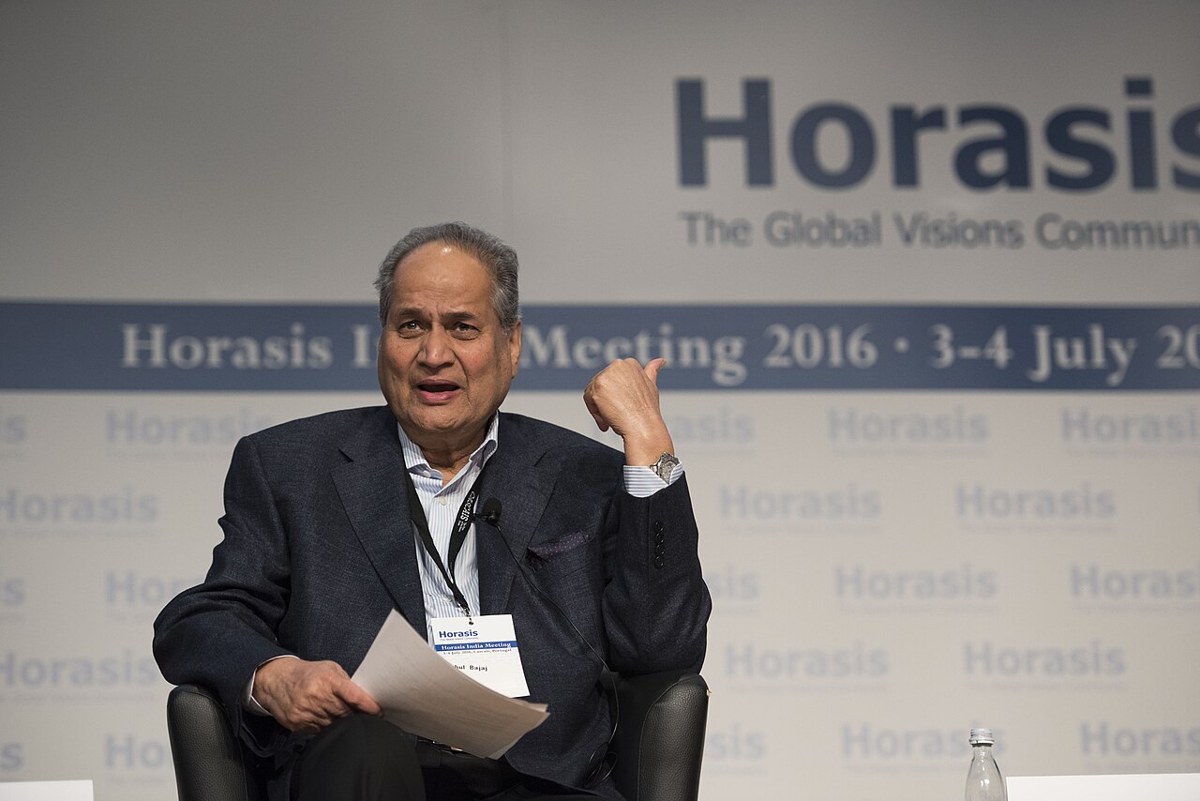
| Key facts | |
|---|---|
| Born | 10 June 1938, Calcutta (now Kolkata) [1][20] |
| Died | 12 February 2022, Pune, aged 83 [39][40] |
| Family roots | Wardha, Maharashtra; a Marwari business family close to Mahatma Gandhi [1][45] |
| Education | Cathedral and John Connon School, Bombay; BA Economics, St. Stephen’s College, Delhi (1958); LLB, Government Law College, Bombay; MBA, Harvard Business School (1964) [1][15] |
| Family | Grandfather Jamnalal Bajaj; father Kamalnayan Bajaj; wife Rupa (married 1961, died 2013); sons Rajiv and Sanjiv, daughter Sunaina [1][15][11] |
| Company/Group | Bajaj Auto, Bajaj Finserv, Bajaj Holdings & Investment (Bajaj Group) [3][11] |
| Wealth | US$6.3 billion (Forbes, April 2021). The Bajaj family: US$19.8 billion, No. 12 on Forbes India’s Richest 2026 (as of 30 September 2026) [11][12] |
| Known for | The Chetak scooter, “Hamara Bajaj”, running Bajaj Auto for four decades, and saying what he thought to every government [18][19][35] |
In the late 1960s, a scooter in India was not something you bought. It was something you booked, and then waited for. Families put their names down when a daughter was born, because a scooter would be part of her wedding years later [1]. Some waited a decade for a Bajaj [1][18]. Booking slips changed hands at a premium, like shares.
The man making those scooters was not short of buyers. He was short of permission. Rahul Bajaj, chief executive of Bajaj Auto at 30, could not legally build more than his government licence allowed. “My blood used to boil,” he told the business historian Gita Piramal. “The country needed two-wheelers. There was a ten-year delivery period for Bajaj scooters. And I was not allowed to expand. What kind of socialism is that?” [15][17]
That anger, and what he did with it, is the story of Rahul Bajaj. He was born into India’s freedom movement, sat in Mahatma Gandhi’s lap as a child, studied at Harvard, and spent forty years turning a licensed Vespa assembler in Pune into one of the world’s biggest makers of two- and three-wheelers. He was also, by his own description, “born anti-establishment” [19]. He argued with Indira Gandhi’s government over licences, with Narasimha Rao’s over foreign competition, and with Narendra Modi’s over free speech. Here is how he did it, where he got it wrong, and what the record shows.
Where it began
A family of freedom fighters
Rahul Bajaj was born in Calcutta on 10 June 1938, the first child of Kamalnayan and Savitri Bajaj [1][15]. (One Business Standard profile gives 30 June; almost every other source, including his own Harvard oral history, says 10 June.) [1][20]
His grandfather, Jamnalal Bajaj, had been adopted as a small boy into a Marwari trading family in Wardha, in central India [51]. He went on to become one of the most remarkable businessmen of the freedom movement. He gave up his British title of Rai Bahadur, served as treasurer of the Indian National Congress, and persuaded Mahatma Gandhi to settle near Wardha [51][1]. Gandhi called him his “fifth son”. “Gandhiji had his own four sons,” Rahul Bajaj explained decades later [1]. The group itself dates its founding to 1926 [20][21].
The family took the cause seriously. In Rahul’s words, “grandfather, grandmother, mother, father, uncles, aunts, all were in British jails during the ’30s and till 1946” [1]. Piramal records that between 1939 and 1947 most of the adults in the family spent time in prison [15]. Jamnalal died in 1942, when Rahul was not yet four [51].
Even his name came from that world. According to family accounts recorded by Piramal, Jawaharlal Nehru picked the name “Rahul” for Kamalnayan’s first-born. His wife Rupa later joked that this made Indira Gandhi “hopping mad as she had wanted it for her own son” [15][17]. Treat that last part as family lore, but the Nehru connection is widely reported [15][18][20].
Wardha, then Bombay
He spent his first eight years in Wardha, with no formal schooling, around Gandhi’s Sevagram and Vinoba Bhave’s Pawnar ashrams [1][45]. “I remember being in the lap of Mahatma Gandhi,” he said in a 2014 interview with Harvard Business School professor Srikant Datar. At six or seven he helped dig a well at Vinoba’s ashram [1].
His father, Kamalnayan, had grown up in those same ashrams. He went on to Cambridge, took over the group in 1942 at 27, and later served three terms as a Lok Sabha MP for Wardha [1].
Around 1946 the family moved to Bombay. Rahul went to St. Xavier’s and then, from 1948, Cathedral Boys’ School (Cathedral and John Connon), passing his Senior Cambridge in 1954 [1]. The family home was on Carmichael Road, but holidays, Piramal writes, were often spent playing with workers’ children in the family’s factories [15]. Politics and business filled the dinner table. By 13 or 14 he had decided: “Business, business, business. I never thought of being a lawyer.” [1]
At 16, his father gave him a speech he never forgot: “Rahul, in Hindu scriptures, when a son becomes 16, he becomes a friend… There is no need at all for you to go into business. You have to do what you want to do.” [1]
Delhi, law school and Harvard
He chose St. Stephen’s College in Delhi because it was “the best” and because he wanted hostel life. He was one of only two students in the college with a scooter, a Vespa, which Piramal says “boosted his popularity” [1][15]. He graduated in economics in 1958 [1].
Back in Bombay he studied law at Government Law College in the mornings, 7:30 to 10, and then walked next door to work at Bajaj Electricals, which opened at 9:30 [1][15]. He never practised law [1].
He trained for about four years inside the family companies: two at Bajaj Electricals, then as a junior purchase officer at Mukand Steel in Kurla [1][15]. His father refused him a car for the commute. His mother refused him a scooter. “I said no to bus and turned to the scooter. My mother had to give in,” he recalled [1].
In December 1961 he married Rupa Gholap, a Maharashtrian whose father was a senior civil servant [1][15]. It was, he said, probably the first love marriage in his circle, and a shock to the wider Marwari family [1]. In 1962 the couple left for Harvard Business School, where he graduated with an MBA in 1964 [1][14]. HBS later called him one of its earliest Indian students [1].
The first break
A scooter company that was not yet his
The company he would run had started small. Bajaj Auto was incorporated on 29 November 1945 as Bachraj Trading Corporation. From 1948 it sold imported two- and three-wheelers [15][17]. In the late 1950s it won a government licence to make scooters and signed a technical collaboration with Italy’s Piaggio, maker of the Vespa. Company records date the licence to 1959; Rahul Bajaj remembered it as 1960, two years after a rival, and said the first licence allowed only 6,000 scooters a year [1][15]. It became a public company in 1960 [17].
The early operation was modest. Piramal writes that the first Indian Vespa came out of a garage shed in Goregaon, and manufacturing later moved to Akurdi, outside Pune [15]. A plant in Bombay was unlikely to get permission, Rahul Bajaj said, and Akurdi was a “backward area” that came with incentives [1].
The man running it then was not a Bajaj. N.K. Firodia, a Gandhian lawyer from Ahmednagar, ran Bajaj Auto and its sister company Bajaj Tempo, which made three-wheelers [15].
Pune, snakes and a Godrej chair
Rahul Bajaj joined in late 1964 at 26. “In November 1964, I joined Bajaj Auto. The official date we gave is January 1965,” he said [1]. Piramal records that he started as deputy general manager, handling “purchasing, marketing, sales, accounts, finance, audit, everything but the production” [15].
He and Rupa moved to the factory at Akurdi. They lived first in a 10 ft by 12 ft guest-house room [15]. “We had snakes coming in our house… For years we lived like a middle-class family,” he said [1]. His first office had a Godrej table and a Godrej chair. “Though I was an MBA from Harvard, I didn’t have any fancy ideas that I must have staff, or a secretary,” he told Piramal [15]. He lived on the factory campus for decades, which he called his answer to “absentee landlordism” [15].
The fight for control
His first big test was a fight for the company itself. From mid-1967, Piramal writes, the Firodia family began buying Bajaj Auto shares in the market. Rahul, who ran the commercial side, refused to register the transfers. When financial institutions auctioned a 4% block, the Firodias bid Rs 262.50 a share. Rahul bid Rs 411 [15].
By September 1968 the two families had split. The Firodias kept Bajaj Tempo (later Force Motors) and the Bajajs kept Bajaj Auto, each with about Rs 7 crore of sales [15][20]. “I felt they had taken away our company. Of course, they have their side of the story,” he said [15].
That same year, at 30, he became chief executive of Bajaj Auto [1][21]. He became managing director in 1970, according to Piramal, and chairman in 1972, the year his father died [15]. The company’s turnover then was about Rs 7.2 crore [20][21].
Building the empire
Volume, cost, quality
His strategy fit in one sentence. “I must have volume and the lowest cost and the best quality… There is nothing intelligent in that. You don’t need to go to Harvard to learn that.” [1]
The hard part was volume. Under the licence raj, a company needed a government licence for every increase in capacity. In 1970–71 Rahul Bajaj argued an expansion case himself, without lawyers, before the Monopolies and Restrictive Trade Practices (MRTP) Commission. The commission remarked that “this young man had full command of the facts and figures” [1]. On 31 March 1970, Bajaj had 176,933 pending Vespa bookings [16]. The company rolled out its 100,000th vehicle in 1970 [17].
From Vespa to Chetak
The government refused to extend the Piaggio collaboration, and it ended in 1971 [1][15]. By then Bajaj had made the scooter almost entirely in India. In 1972 it launched it under its own name: the Chetak, named after Maharana Pratap’s horse.
The Chetak became the vehicle of the Indian middle class: the scooter that took a family of four to the market, survived potholes and could be fixed by any roadside mechanic. Bajaj sold everything it could make. When the post-Emergency Janata government loosened capacity rules, Bajaj expanded [18].
He was proud that he did it without bribes. Open magazine records his claim that he never paid one for a licence [18]. He also said that during the Emergency, officials told him expansion would be approved if he publicly supported it, and that he refused [34].
The 1980s: Waluj, Kawasaki and “Hamara Bajaj”
In the 1980s the company grew beyond Akurdi. A second large plant at Waluj, near Aurangabad, began production on 5 November 1985 [17]. In 1986 Bajaj began making motorcycles with Japan’s Kawasaki, starting with the KB100 [23].
In 1989 came the advertising campaign that made Bajaj part of popular culture. “Hamara Bajaj” (Our Bajaj), made by Alyque Padamsee’s team at Lintas, showed ordinary Indians on Bajaj scooters across the country [35]. It turned a company surname into a national tagline [35].
Outside the factory, he took on public roles. He was president of the Confederation of Indian Industry (CII) in 1979–80 and again in 1999–2000, the only person to hold the post twice, according to PTI [21]. Prime Minister Rajiv Gandhi appointed him chairman of Indian Airlines, where he served from 1986 to 1989 [18][21].
Not every bet came off. In 1987 he bid for the truck maker Ashok Leyland and lost to the Hinduja family. “I can’t blame the seller. I can only question our government,” he said, blaming foreign-exchange rules [18][17].
Liberalisation and the Japanese challenge
The 1991 reforms opened Indian markets, and Bajaj’s advantage shrank fast. Hero Honda, a joint venture between the Munjal family and Honda, had been selling fuel-efficient motorcycles since 1984 under the line “Fill it, shut it, forget it” [18][23]. As incomes rose, Indians moved from scooters to motorcycles.
By 2000–01 the damage showed. Bajaj Auto’s net profit fell to Rs 263 crore from Rs 635 crore a year earlier, on net sales of Rs 3,138 crore. In April–July 2001, Hero Honda outsold Bajaj in total vehicles for the first time. Scooter demand was falling about 15% a year while motorcycles grew about 25% [22]. “There is a distinct possibility that Hero Honda will be No. 1 by the year-end,” Rahul Bajaj admitted to Business Today [22].
The response came from the next generation. His elder son, Rajiv, an engineer, pushed the company into motorcycles. The Caliber, launched in 1998, sold 100,000 units in its first year [23]. In November 2001 Bajaj launched the Pulsar, a 150cc and 180cc motorcycle with sporty styling [17][23]. It became the company’s most important product and rebuilt Bajaj Auto as a motorcycle company. A new plant at Chakan, near Pune, had started production in 1998 [17].
Handing over the keys
Rahul Bajaj began handing over day-to-day control in 2005, when Rajiv became managing director [20][21]. The same year, Harvard Business School gave him its Alumni Achievement Award, its highest alumni honour, describing Bajaj Auto as the world’s fourth-largest maker of scooters, three-wheelers and motorcycles [14]. He had received the Padma Bhushan in 2001 [9].
The 2008 split into three
In May 2007 the board approved a plan to split the old Bajaj Auto into three listed companies [3]. The Bombay High Court approved it in December 2007, and the new companies listed on 26 May 2008 [3]:
- Bajaj Auto Ltd took the vehicle business and about Rs 1,500 crore in cash [3].
- Bajaj Finserv Ltd took the insurance joint ventures with Germany’s Allianz, the lending arm Bajaj Auto Finance, a wind-power project and about Rs 800 crore in cash [3].
- The old company became Bajaj Holdings & Investment Ltd (BHIL), which kept about 30% of each new company [3].
Shareholders got one new share in each company for every old share [3]. Rahul Bajaj stayed on as executive chairman of Bajaj Auto and non-executive chairman of the other two [3]. Rajiv ran autos; his younger son Sanjiv ran financial services [3][11].
In its last full year before the split, 2007–08, Bajaj Auto sold 2.45 million vehicles. Net sales were Rs 9,169 crore and net profit Rs 756 crore. It held 32.7% of India’s motorcycle market and exported 618,341 vehicles [2].
Obituaries often say he took the company from Rs 7.2 crore to Rs 12,000 crore in turnover, though none dates the second figure [20][21]. The company’s own FY2007–08 results, above, are the firmer benchmark.
The finance business becomes the crown jewel
The 2008 split put the lending business under Sanjiv Bajaj. Bajaj Auto Finance had been incorporated in 1987, and Rahul Bajaj chaired it from then until 2020 [37]. Under Sanjiv and chief executive Rajeev Jain, it became one of India’s largest consumer lenders. Outlook Business calculated that Bajaj Finance’s profit rose from Rs 20 crore in 2007–08 to Rs 1,836 crore in 2016–17, about 92 times [46]. Forbes now calls Bajaj Finserv “the family’s biggest asset” [11].
KTM: a stake that became a takeover
In November 2007 Bajaj bought 14.5% of Austria’s KTM, the off-road and racing motorcycle maker [17]. The stake rose to about 48% by 2015 [23]. Bajaj built small KTM motorcycles in Pune and sold them worldwide. In November 2025, more than three years after Rahul Bajaj’s death, Bajaj Auto completed taking control of KTM’s parent company, Pierer Mobility, which is to be renamed Bajaj Mobility AG [13].
Parliament
In June 2006 he won a by-election to the Rajya Sabha from Maharashtra as an independent, backed by the NCP, Shiv Sena and BJP against a Congress candidate [48]. He served until 2010, with 88% attendance and 57 questions asked [6]. “I would not have missed the four years I spent in the parliament for anything,” he said in 2013 [47].
Stepping back
He gave up his chairmanships one by one. In May 2019 he stepped down as chairman of Bajaj Finserv and became chairman emeritus of Bajaj Holdings, where his cousin Niraj Bajaj took over [38]. On 31 July 2020 he left the chair of Bajaj Finance after 33 years, handing it to Sanjiv [37]. On 30 April 2021, citing his age of 83, he resigned as chairman of Bajaj Auto. Niraj Bajaj became chairman from 1 May 2021, and Rahul Bajaj was named chairman emeritus [36].
How the wealth is held
The family’s wealth sits mainly in its stakes in the listed companies. Bajaj Holdings owns about 30% or more of both Bajaj Auto and Bajaj Finserv, and Bajaj Finserv in turn controls Bajaj Finance and the insurers [3][11]. Forbes put Rahul Bajaj’s own net worth at US$6.3 billion on its 2021 billionaires list (as of 5 April 2021) [11]. Forbes now tracks the family together: US$19.8 billion, No. 12 on its 2026 India’s Richest list, as of 30 September 2026 [12].
The setbacks and failures
The licence raj years
The worst decade for Indian industry, he said, was the 1970s [1]. Bajaj had customers waiting years but could not legally serve them. Gita Piramal’s Business Maharajas records a three-day income-tax raid in 1976, during the Emergency, on more than a hundred Bajaj establishments, as cited by BloombergQuint [17].
Losing No. 1
Bajaj was slow to see the shift from scooters to motorcycles. Honda had chosen the Munjals and the Firodias as partners rather than Bajaj [17]. By 2001 Hero Honda had passed Bajaj in sales [22], and Honda’s Activa scooter, launched in 2001, took over the market the Chetak had owned [23].
Giving up the scooter
The Chetak was retired in the mid-2000s; sources differ between 2005 and 2006 [23]. A newer scooter, the Kristal, did not sell [23]. In late 2009 Rajiv Bajaj decided Bajaj Auto would stop making scooters altogether, and the last one, the Kristal, was dropped in early 2010 [24].
It was a painful moment for the father. “I feel bad, I feel hurt,” Rahul Bajaj said publicly. Rajiv replied that business decisions should come more from logic than emotion [21]. Rahul Bajaj said he did not fully agree with the policy [17], but he did not overrule it. Bajaj returned to scooters a decade later with an electric Chetak [17].
Labour trouble
Labour relations were sometimes violent in the early years. BloombergQuint recalls a 1979 dispute at Akurdi that led to deaths [17]. He described facing striking workers at his front door: “Guys, you are talking to a Bajaj… Talk to us, negotiate, I will be fair, but I will be firm.” [1] In 2013, under Rajiv’s leadership, a union strike at the Chakan plant lasted about 50 days before it was called off without conditions; the company estimated it lost about 20,000 Pulsars of production [50].
The quadricycle that waited six years
Bajaj unveiled the RE60, a small four-wheeler for cities, in 2012. Public interest litigation in several high courts questioned its safety, and in 2015 the Supreme Court took the cases to itself and stayed the introduction of quadricycles [49]. The government created rules for commercial quadricycles in June 2018 and for personal use in November 2018 [52]. The vehicle, renamed the Qute, came to market years later than planned.
Controversies and allegations
Rahul Bajaj faced no criminal case, no SEBI action and no personal tax case that this profile could find in court records or major publications. His controversies were mostly about what he said, and about family and business disputes. They are set out below.
The “Bombay Club” and the charge of protectionism (1993)
Allegation: In 1993 Rahul Bajaj was the spokesman for a group of 15 industrialists, later called the “Bombay Club”, who met at the Oberoi in Mumbai and gave the government a memorandum. It welcomed the end of licensing but asked for a “level playing field” before foreign companies and cheap imports were let in. Economists and commentators, including former minister Jairam Ramesh, wrote that this came to be seen as a euphemism for protection from foreign competition [19][18]. Gita Piramal wrote that the episode “splattered Bajaj’s whiter-than-white image with the hues of a protectionist” [18].
Response: He said he supported liberalisation and objected only to its sequencing, and that his demand was “misconstrued as protectionism” [34]. “When in 1993 I asked for a level playing field, what I only said was, we have a labour policy problem,” he said [34]. Speaking at the Indian School of Business in 2017, he said: “It had 15 members, but it was like a one-member club. The government said ‘shut up’ and they obediently shut up, but not me. It seems that I was 20 years ahead of my time.” [19]
Status: A policy debate, not a legal matter. Historians still disagree about whether the Bombay Club slowed reforms [18][19].
The split with the Firodias (1968) and the “Bajaj Tempo” name (2005)
Allegation: In 1967–68 the Firodia family, which ran Bajaj Auto and Bajaj Tempo, bought Bajaj Auto shares in the market. Rahul Bajaj refused to register the transfers and outbid them for an institutional block of shares, according to Piramal [15]. The families separated in September 1968. In 2005 the Firodias, who still ran Bajaj Tempo, moved to rename it Force Motors. Rahul Bajaj, whose family held about 24%, said: “Any proposition or resolution that drops the word Bajaj from the name will be opposed by us.” [28]
Response: Abhay Firodia, Bajaj Tempo’s chairman, said the company was “merely following the name change directive” issued by the government, linked to DaimlerChrysler’s objection to continued use of the “Tempo” name [28].
Status: The company became Force Motors in 2005 [28]. The 1968 split was settled long ago.
The family split with brother Shishir Bajaj (2001–2010)
Allegation: In 2001 Rahul’s younger brother Shishir Bajaj said he wanted his share of the family business separated [17]. By 2007 the brothers were before the Company Law Board over control of two family holding companies, Bachhraj & Co and Jamnalal Sons. Shishir sought what he saw as his 25% share of the family interest [27]. “Things won’t happen the way he (Shishir) wants it,” Rahul Bajaj said then [27].
Response: The Company Law Board urged the brothers to settle, and they did [27].
What happened next:
- In December 2008, Rahul Bajaj bought about 29% of Bajaj Hindusthan for about Rs 266 crore and transferred it, with other family holdings, to Shishir’s side, ending what Business Standard called a “six-year-long family dispute” [25].
- In February 2010, Shishir sold his 25% stake in Bajaj Sevashram to Rahul, and the remaining cross-holdings between the branches were unwound. Rahul Bajaj called them “internal transactions” [26].
Status: Settled in 2008–10. Shishir Bajaj and his son run Bajaj Hindusthan separately from the Rahul Bajaj branch [26].
The DTS-i patent battle with TVS (2007–2019)
Allegation: In September 2007 Bajaj Auto accused TVS Motor of infringing its patented DTS-i (digital twin spark ignition) technology in its new 125cc Flame motorcycle [29]. Bajaj said TVS had sought to revoke the patent just before launch, which it called proof that TVS knew it was on protected ground [29]. Rajiv Bajaj led the public fight; the group was then chaired by Rahul Bajaj.
Response: TVS, led by Venu Srinivasan, called the claim “a malicious attempt to tarnish the fair name of the TVS Group”, threatened a defamation suit, and said its engine, developed with Austria’s AVL, used a different design [29].
What happened next:
- On 16 February 2008, a single judge of the Madras High Court found a prima facie case for Bajaj and stopped TVS from selling the Flame [5][4].
- On 18 May 2009, a Division Bench overturned that order [4].
- On 16 September 2009, the Supreme Court allowed TVS to keep selling but ordered it to file sales accounts with a court-appointed receiver, and directed the High Court to decide the case quickly. It made no finding on the merits [4].
- On 31 October 2019, the two companies told the stock exchanges they had settled and would withdraw all pending cases in India and abroad, with no compensation paid by either side [30].
Status: Settled in October 2019.
The “climate of fear” remark to Amit Shah (2019)
Allegation: This was a controversy about what Rahul Bajaj alleged. At the Economic Times Awards in Mumbai on 30 November 2019, with Home Minister Amit Shah, Finance Minister Nirmala Sitharaman and Commerce Minister Piyush Goyal on stage, he said industrialists were afraid to criticise the government. “In UPA-II we could abuse anyone… you are doing good work, but if we want to openly criticise you, [there is no] confidence you will appreciate it,” he said [31]. He also raised mob lynchings and BJP MP Pragya Thakur’s praise of Nathuram Godse [31][32].
Response: Amit Shah replied that no one needed to be afraid, and that if such an atmosphere had been created, the government would work to improve it [32][53]. The next day Sitharaman tweeted that it was “always a better way to seek an answer than spreading one’s own impressions”, which “can hurt national interest” [33]. Ministers Hardeep Puri and Anurag Thakur spoke of “fake” and “false narratives” [31][33]. Kiran Mazumdar-Shaw and opposition leaders backed him [33].
Status: No legal or regulatory consequence. The exchange remains the most quoted moment of his public life [19][21].
The quadricycle litigation (2012–2018)
Allegation: Petitioners in public interest litigation argued that quadricycles such as Bajaj’s RE60 were unsafe and should not be allowed on Indian roads [49].
Response: Bajaj said the RE60 was a safer, cleaner replacement for auto-rickshaws and pushed for a legal category for it [49].
Status: The government notified quadricycle rules in 2018, clearing the way for it to be sold [52]. No finding was made against the company.
This section reflects the public record as of 24 October 2026.
Giving back
The Gandhian trusts
The Bajaj family’s charities predate him. The Jamnalal Bajaj Institute of Management Studies in Mumbai was set up in 1965 with money from a family trust, and the Jamnalal Bajaj Foundation was inaugurated by Prime Minister Morarji Desai on 4 November 1977 [8]. Rahul Bajaj chaired the Foundation from 1994 until his death [8].
The Foundation’s annual Jamnalal Bajaj Awards, started in 1978, honour constructive work, rural technology and work for women and children, plus an international award for spreading Gandhian values. Past international winners include Desmond Tutu [8]. “The light lit by Jamnalalji and nursed with care by Ramkrishnaji will not be allowed to be dimmed,” he said in his first speech as chairman in 1994 [10].
After his uncle Ramkrishna Bajaj died in 1994, he guided the group’s charitable work and “greatly expanded” it, according to the Foundation [9]. That includes:
- Jankidevi Bajaj Gram Vikas Sanstha, a rural development trust started in 1987, which works in villages around Pune, Aurangabad, Wardha and Sikar [9].
- Kamalnayan Bajaj Hospital in Aurangabad, run by a group trust [9].
- Wardha, his childhood home, where the family supports the Shiksha Mandal colleges. He founded the Bajaj Science Centre there in 2007, and the family started the Bajaj Institute of Technology in 2017 [45].
IIT Bombay and later pledges
He chaired the Board of Governors of IIT Bombay [9]. His donation funded the Rahul Bajaj Technology Innovation Centre on campus, which houses the institute’s incubator and design school; it opened on 10 June 2022, what would have been his 84th birthday [44].
In March 2020 the Bajaj Group pledged Rs 100 crore for Covid-19 relief, including ventilators, ICU upgrades and support for daily-wage workers around Pune [42]. In March 2024, after his death, the group committed Rs 5,000 crore over five years to skills training, saying it had spent nearly Rs 4,000 crore on social causes in the previous decade [43].
He did not like the 2013 law that made corporate social responsibility (CSR) spending compulsory, arguing that giving should be voluntary [1].
Succession
Rahul Bajaj planned his succession over 15 years, and in public. Rajiv became managing director of Bajaj Auto in 2005 [21]. The 2008 demerger gave each son his own listed company: Rajiv took autos, Sanjiv financial services [3].
He then gave up chairmanships one at a time, between 2019 and 2021 [36][37][38]. The top jobs did not all go to his sons. His cousin Niraj Bajaj became chairman of Bajaj Auto and of Bajaj Holdings, and long-time director Nanoo Pamnani chaired Bajaj Finserv for a time [36][38]. “Rahulbhai believed that your surname doesn’t give you special privileges,” Niraj Bajaj told Forbes in 2022 [54].
As of Bajaj Auto’s 2025–26 annual report, Niraj Bajaj is chairman and Rajiv Bajaj is managing director and CEO, reappointed from 1 April 2025 for five years [7]. Sanjiv Bajaj is chairman and managing director of Bajaj Finserv and chairman of Bajaj Finance [7][12].
His death
Rahul Bajaj died in Pune on the afternoon of 12 February 2022, aged 83, after treatment at Ruby Hall Clinic [39][40]. He was cremated with state honours the next day [39]. President Ram Nath Kovind called him “a doyen of Indian industry”. Prime Minister Narendra Modi said he would be remembered for “his noteworthy contributions to the world of commerce and industry” [41].
What their journey teaches
1. Win the argument with facts, not lawyers. When he needed more capacity in 1970, he argued the case himself before the MRTP Commission and won its respect for knowing “the facts and figures” [1]. Knowing your numbers better than anyone else in the room is still the cheapest advantage a founder has.
2. Live where the work is. A Harvard MBA who could have run Bajaj Auto from Bombay chose a 10 by 12 foot room next to the factory, and stayed on the campus for decades [15]. Being close to the shop floor shaped how he priced, built and negotiated.
3. Let the next generation be right. He was openly hurt when Rajiv ended the scooter business, but he did not overrule him [21]. The Pulsar and motorcycles saved Bajaj Auto. Disagreeing in public and still letting the successor decide is rarer than it sounds.
4. Split the business before it splits the family. The 2008 demerger gave each son a listed company with its own board, and a long, open handover followed [3][36]. Contrast that with the years he spent before the Company Law Board with his own brother [27].
5. Your reputation is a long game. He said he never paid a bribe for a licence [18], and he criticised governments of every party, from Indira Gandhi’s to Narendra Modi’s [19][34]. It cost him some favours. It also meant that when he spoke, people listened.
A profile for general reading, based on public records and reporting as of 24 October 2026. Not investment, tax or legal advice.
Sources (54)
- Interview with Rahul Bajaj, Creating Emerging Markets oral history (interviewer Srikant M. Datar) - Harvard Business School Baker Library, Jul 2014
- Bajaj Auto Q4 and FY2007-08 results - Bajaj Auto Ltd, May 2008
- Demerger of Bajaj Auto: scheme and news compilation - Bajaj Auto Ltd, May 2008
- Bajaj Auto Ltd v. TVS Motor Company Ltd, Civil Appeal 6309 of 2009, order - Supreme Court of India, Sep 2009
- Bajaj Auto Ltd v. TVS Motor Company Ltd, C.S. 1111 of 2007 - Madras High Court via Indian Kanoon, Feb 2008
- MP Track: Rahul Bajaj, Rajya Sabha - PRS Legislative Research, Jul 2010
- Annual Report 2025-26, Corporate Governance Report - Bajaj Auto Ltd, Jun 2026
- The Foundation - Jamnalal Bajaj Foundation, Oct 2026
- Rahul Bajaj: Guiding Hands - Jamnalal Bajaj Foundation, Oct 2026
- Rahul Bajaj's speech at the Jamnalal Bajaj Awards, 1994 - Jamnalal Bajaj Awards, Nov 1994
- Rahul Bajaj profile - Forbes, Apr 2021
- Bajaj family profile - Forbes, Sep 2026
- New strong owner for KTM - Pierer Mobility AG (EQS release), Nov 2025
- HBS honors achievements of alumni - Harvard Gazette, Oct 2005
- Rahul Bajaj, from Business Maharajas by Gita Piramal (reading sample) - Penguin, 1996
- From the biography: When the Vespa scooter became the household name that was Chetak Bajaj - Scroll, Mar 2022
- Rahul Bajaj: The Scooter King - BloombergQuint, Feb 2022
- Rahul Bajaj (1938-2022): Scooter Man - Open, Feb 2022
- Rahul Bajaj (1938-2022): The man who wouldn't shut up - Scroll, Feb 2022
- 'Hamara Bajaj': With Rahul Bajaj's death, an era ends in Indian business - Outlook Business, Feb 2022
- Rahul Bajaj: Man who called spade a spade even if it meant ruffling feathers in government - Outlook Business (PTI), Feb 2022
- Bike Wars - Business Today, Sep 2001
- Bajaj Auto: A historical analysis - Business Today, Oct 2015
- Scoot and shoot - Business Standard, Feb 2011
- Rahul Bajaj buys 29% in Bajaj Hindusthan - Business Standard, Dec 2008
- Bajaj brothers hand over stakes in each other's firms - Business Standard, Feb 2010
- Round two - Business Today, Nov 2007
- Firodias to go ahead with Bajaj Tempo name change - Business Standard, Mar 2005
- TVS vs Bajaj: the fight gets dirty - Business Today, Sep 2007
- Bajaj Auto and TVS Motor Co settle 12-year-long patent infringement dispute - Autocar Professional, Oct 2019
- Day after industrialist Rahul Bajaj's comments, BJP minister claims fake narratives being created - Scroll, Dec 2019
- Atmosphere of fear: Rahul Bajaj criticises Centre in presence of Amit Shah - The Week, Dec 2019
- False narratives, spreading own impressions: BJP ministers on Rahul Bajaj - Business Today, Dec 2019
- This isn't the first time Rahul Bajaj has called out a govt - The Quint, Dec 2019
- Hamara Bajaj: From an industrialist's surname to an iconic tagline - afaqs!, Feb 2022
- Rahul Bajaj steps down as Bajaj Auto chairman, Niraj Bajaj takes charge - Outlook (PTI), Apr 2021
- Rahul Bajaj steps down as Bajaj Finance's chairman - Business Standard, Jul 2020
- Family takes charge after Rahul Bajaj cedes top job in key group companies - Business Today, Sep 2019
- Rahul Bajaj cremated with full state honours in Pune - Gulf News, Feb 2022
- Industrialist Rahul Bajaj passes away at the age of 83 - Business Today, Feb 2022
- President Kovind, PM Modi pay tributes to Rahul Bajaj - Outlook Business (PTI), Feb 2022
- Bajaj pledges Rs 100 crore for the fight against COVID-19 - exchange4media, Mar 2020
- Bajaj Group commits Rs 5,000 crore towards CSR initiatives in 5 years - Deccan Herald, Mar 2024
- IIT Bombay launches Rahul Bajaj Technology Innovation Centre - Careers360, Jun 2022
- Rahul Bajaj maintained a deep-rooted connection with Wardha - Free Press Journal (IANS), Feb 2022
- Creating a legacy of his own - Outlook Business, Aug 2017
- India's poor have benefitted from globalisation: Rahul Bajaj - Business Standard (ANI), Oct 2013
- It's two-wheeler giant Rahul Bajaj vs Avinash Pande - OneIndia, Jun 2006
- Bajaj RE60 delayed further - Autocar India, Apr 2015
- Bajaj Auto Chakan plant strike ends after 50 days - Business Today (IANS), Aug 2013
- Jamnalal Bajaj, the Gandhian capitalist who was the Mahatma's merchant prince - ThePrint, Feb 2019
- Govt allows quadricycles for personal use - Deccan Herald, Nov 2018
- Indians afraid to criticize govt, says industrialist - Asia Times, Dec 2019
- Indian business titan Rahul Bajaj's family is building on his legacy (Forbes article, reprinted) - Bajaj Group, Oct 2022