
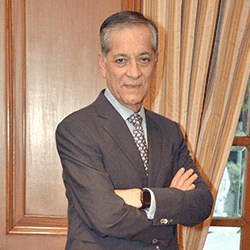
| Key facts | |
|---|---|
| Born | 5 May 1952, Kolkata (then Calcutta), West Bengal [1] [15] |
| Family roots | Fifth generation of the Burman family, which started Dabur in Calcutta in 1884 and moved the business to Delhi in 1972 [1] [2] |
| Education | St. Paul’s School, Darjeeling; BSc in chemistry, University of Wisconsin; MSc and PhD (pharmaceutical chemistry, 1980), University of Kansas [1] |
| Family | Son of the late Ashok Chand Burman; father of Aditya Burman, a Dabur director [27] [38] |
| Company | Dabur India (chairman 2007-2019); now non-executive chairman of Eveready Industries and a director of Religare Enterprises [3] [15] [53] |
| Wealth | Not ranked individually. Forbes ranks the “Burman family” at No. 43 in India with US$6.05 billion (India’s 100 Richest 2026) [70] [71] |
| Known for | The scientist in a 142-year-old business family that chose to stop managing its own company, and saw it grow many times over |
In January 2009, the chairman of Dabur sat in a product review and was handed a new flavour of Hajmola, the digestive tablet that generations of Indians have stolen from their grandparents’ jars. This one tasted of mint. Dr Anand Burman hated it.
“This is terrible, why would you launch this?” he remembers asking. The answer from his own managers, he told a Harvard Business School interviewer years later, “made me feel really proud. They said, ‘Sir, you are not the target audience. We don’t care what you think’” [1]. The mint Hajmola went to market anyway and, Business Today reported, sold about Rs 8 crore in its first year [25].
Not many promoter-chairmen in India would tell that story against themselves, and fewer would call it a proud moment. But it is the cleanest summary of what the Burmans did with Dabur. In 1998 the family that had run the company for more than a century walked out of its executive offices and handed the keys to salaried professionals. Anand Burman, a pharmaceutical chemist with a PhD and a shelf of patents, was one of the last Burmans to hold a management job there, and later the chairman who had to prove the experiment worked.
This is the story of a man who was born above the shop, trained as a scientist, built a cancer-drug business inside an Ayurveda company, sold it, and then spent his sixties as a quiet investor whose family name landed in some very loud fights.
Where it began
A doctor in Calcutta, 1884
Dabur began in 1884, when Dr S.K. Burman started making healthcare products in Calcutta [2]. Anand Burman describes his ancestor as “a qualified medical doctor”; Forbes calls him an Ayurvedic practitioner. Both agree on what he did: he made remedies for diseases such as cholera and malaria and sent them to villages by mail order [1] [21]. The name joined “Daktar”, as doctor is said in Bengal, to Burman [21] [78].
The first production unit came up at Garhia in 1896, and the founder’s son, C.L. Burman, set up a research laboratory in 1919 [2] [21]. The firm was incorporated in 1936 as Dabur India (Dr S.K. Burman) Pvt Ltd [2]. C.L. Burman’s sons, Puran Chand and Ratan Chand, split the work between them: one took formulations and manufacturing, the other sales, distribution and finance [21]. Under that generation came the products that still carry the company, including Dabur Amla hair oil and, in 1949, Dabur Chyawanprash [1] [25].
Born above the shop
Anand Chand Burman was born in Calcutta on 5 May 1952, the eldest of the fifth generation [1] [15]. His father, Ashok Chand Burman, would go on to lead the fourth generation of the family in the business [21] [27].
He grew up in Dabur House, where seven families across three generations lived next door to the business [21]. The quality-control laboratory was in the house itself, with a bridge across to the office [1]. “The lunch table discussion, the dinner table discussion - everything was something to do with the business,” he recalled [1].
The Bengal of his childhood was also teaching the family a harder lesson. Labour militancy was rising, and he remembers the family home being surrounded during gheraos in the late 1950s. “The only person who was allowed to leave the house was me because I had to go to school,” he said [1]. The unrest eventually pushed Dabur out of its birthplace. In 1972 the company shifted operations to Delhi, starting with a rented factory in Faridabad, and in 1979 its new plant at Sahibabad began production alongside a research and development centre [1] [2].
Ten years in America
He was sent to St. Paul’s School in Darjeeling, and in 1970 left for the United States. He stayed a decade: a bachelor’s degree in chemistry from the University of Wisconsin, then a master’s and a doctorate in pharmaceutical chemistry from the University of Kansas, which he finished in 1980 [1].
He did not linger. “I think three days after the defense of my thesis, I pulled up stakes and moved back to Delhi,” he said [1].
The first break
Anand Burman’s first break was not a deal or a windfall. It was a boss.
He joined Dabur in 1980 as manager of research and development. The company’s revenue then, by his account, was about Rs 20 crore [20] [23]. His father placed him under his uncle Gyan Chand (G.C.) Burman, a pharmacist trained in Philadelphia. “My father said, ‘You are going to work under him,’” he recalled. “What I learned under my uncle was manifold more than what I had in the formal education” [1] [20].
For a young PhD back from America, Dabur was an unusual laboratory. Its products came from Ayurvedic texts, not from synthetic chemistry. His contribution was to treat the old recipes as a scientist would. “We have taken an age old remedy, and we have standardized it. We have put it into a very modern format,” he said [1]. He has also argued that nobody should be allowed to patent an Ayurvedic formulation, and that a company’s real intellectual property lies in how it standardises its products [1].
He joined the board in 1986 [22], the year Dabur became a public limited company [2]. Three years later he started the venture that would define his own career inside the family firm: a pharmaceutical division, with the Dabur Research Foundation at Sahibabad as its engine [22] [23].
Building the empire
A cancer drug from the Himalayan yew
In the early 1990s, paclitaxel, sold abroad as Taxol, was among the most important new cancer drugs in the world, and among the most expensive. It was extracted from the bark of the Pacific yew. Burman’s researchers went after it through a cousin of that tree, the Himalayan yew.
Dabur set up an oncology formulation plant at Baddi in Himachal Pradesh in 1993 [2]. In March 1994, Down To Earth reported that Burman, then director of research, had announced a process to extract the drug from the tree’s leaves. Dabur had put Rs 11.5 crore into the project, and planned to sell the medicine at about half the overseas price. The same report recorded protests by a Himachal environmental group over the harvesting of yew leaves, and Burman’s frank assessment of the opportunity: Dabur could not compete with big players in synthetic pharmaceuticals, so it would compete in natural products [30].
By 1998 the anti-cancer business was a small but real earner, and Dabur was building a sterile cancer-drug plant in Britain through a subsidiary Burman oversaw [23] [36]. He also collected patents, more than 40 by the count of Business Standard [24].
“Just because your last name is Burman”
By the mid-1990s Dabur was a listed company. Its first public issue, in 1994, was oversubscribed 21 times [2]. It was also a company with a crowd of Burmans in its management, a sprawl of unrelated ventures and new multinational rivals arriving after liberalisation.
In 1997 the family hired McKinsey to study the business [26]. Burman remembers how the assignment ended: “They asked a fairly simple question: ‘Just because your last name is Burman, does that mean you are the best managers in the world?’ Which sort of resonated with pretty much everybody” [1].
The restructuring that followed took effect in 1998. Fewer Burmans would sit on the board, an outsider would run the company, and the fifth generation would stay out of management [23]. Anand Burman, then 45, was the exception, becoming deputy managing director as what Business Standard called the bridge between generations [23]. In November 1998 Ninu Khanna, from Colgate-Palmolive, joined as Dabur’s first non-family chief executive [35] [36].
It was a hard decision for the elders. “It was hard to decide that none of my children or brothers would be allowed into the company,” his father told Business Today [25]. Burman credits that generation. “This kind of a change doesn’t happen overnight but over 10 years. Luckily, there was a lot of maturity in the family, led by my father AC Burman and uncles, and we were ready for it,” he wrote in Forbes India [20]. His bluntest explanation of why they did it: “The easiest way to bring in conflict is to bring in a bunch of family members to work together, especially when there are uncles and cousins” [20].
The rules were written down. A family constitution adopted in 2002 defines a family council, which meets every quarter and is the family’s single channel to the board [26]. Only the chairman and vice-chairman are Burmans, neither draws a salary, and the family has capped its nominees at four [19] [26]. Younger Burmans are encouraged to build their own ventures outside Dabur [26].
The chairman who stayed out of the way
The handover was not smooth at first, as the next section shows. It settled in 2002, when Sunil Duggal, a Dabur insider, became chief executive. He would hold the job for 17 years [37].
Burman’s own rise was shaped by a family tragedy. G.C. Burman, his mentor, died in September 2001, days before he was due to become chairman. Vivek Chand (V.C.) Burman stayed on as chairman and Anand moved up to vice-chairman [28] [29]. When the pharmaceutical business was demerged into a separately listed Dabur Pharma in 2003, he chaired that too [2] [29].
On 23 July 2007 he was appointed chairman of Dabur India, succeeding V.C. Burman, with his cousin Amit Burman as vice-chairman [3] [29].
What followed was the most acquisitive period in Dabur’s history. The company had already bought Balsara’s oral-care and home brands (Babool, Meswak, Odonil, Odomos) in 2005, for Rs 143 crore by Dabur’s account and Rs 147 crore by Business Standard’s [2] [33]. In 2007 Dabur Foods, the maker of Real juices, was merged into the parent [80]. In November 2008, weeks after Lehman Brothers collapsed, Dabur paid Rs 203.7 crore for 72.15% of Fem Care Pharma [4]. In 2010 came two overseas deals in four months: Turkey’s Hobi Kozmetik for US$69 million, the first overseas acquisition, and Namaste Laboratories, a US maker of hair products for women of African descent, for US$100 million [5] [6]. The second took overseas revenue to nearly a quarter of the total [6]. The deals continued after he left the chair: 51% of Badshah Masala for Rs 587.52 crore in 2022, and the hair-oil maker Sesa Care in 2024 [34] [81]. Dabur has also gone to court for its oldest brands; in 2025 the Delhi High Court restrained Patanjali from running advertisements that disparaged Dabur Chyawanprash [82].
Through all this, the chairman kept to his side of the line. “I’m very passionate about R&D but you will never find me calling up a junior chemist. If I need to know something, I ask Sunil,” he wrote [20]. Duggal’s view from the other side was that the owners were willing to bankroll big and even risky bets [25].
The numbers over his twelve years as chairman are the argument for the model. Dabur’s consolidated revenue was about Rs 2,234 crore in 2006-07, the year before he took the chair, with net profit of Rs 283 crore [7]. In 2018-19, his last full year, revenue was Rs 8,533 crore and net profit Rs 1,446 crore [8]. Revenue had grown almost four times and profit about five times, under a management in which no Burman held a desk. The company has kept growing since: revenue from operations was Rs 13,193 crore in 2025-26, with net profit of Rs 1,869 crore [9].
Selling what he built
The one business Anand Burman had built with his own hands did not stay in the family.
In April 2008 the Burmans and other key shareholders agreed to sell 73.27% of Dabur Pharma to Germany’s Fresenius Kabi at Rs 76.50 a share, about Rs 880 crore; the deal closed that August [10] [31]. FinanceAsia valued it at about 3.7 times sales [32]. More than a hundred of the research foundation’s scientists moved to the buyer [79].
Asked years later whether he regretted it, he was unsentimental. “The question of regret does not arise. We create businesses to make money and we did that with Dabur Pharma,” he told Forbes India [22]. The family kept one piece Fresenius did not want, the cancer-diagnostics company Oncquest Laboratories, which his son Aditya went on to run [22] [24].
The investor
The pharma sale freed both money and time. In 2010 he launched the Asian Healthcare Fund with a target corpus of US$200 million, and said he and another family member had put in about US$20 million as anchor investors. Its first deal was a controlling stake in a Delhi radiology chain. The fund, he stressed, had “nothing to do with Dabur” [40]. “I understand health care a little bit,” was how he put it to Forbes India [22]. He also co-founded Health Care at Home India with his cousin Gaurav Burman and the founders of a British home-care company [41].
The wider family built a portfolio around the Dabur holding, which stood at a little over 67% of the company in September 2022 and is held through private investment firms [76]. The Burmans were the Indian partner in Aviva’s life insurance venture; in July 2026 Aviva agreed to buy their remaining 26% [16]. In December 2022 the promoters sold 1% of Dabur, saying the money would finance the family’s private ventures [76].
Two of those bets put Anand Burman back in boardrooms. The family became the largest shareholder of the battery maker Eveready Industries and in February 2022 launched an open offer at Rs 320 a share to take control [42]. He became Eveready’s non-executive chairman on 1 August 2022, when the group held 38.3%, and still held the post as of March 2026 [15] [43].
The other bet was Religare Enterprises, the financial services group that owns Care Health Insurance. On 25 September 2023 the Burmans announced an open offer for 26% of the company at Rs 235 a share, about Rs 2,116 crore. “The proposed transaction is in line with our vision to create a leading financial services platform,” Anand Burman said in the announcement [44]. It turned into one of the most bitter takeover fights in recent Indian corporate history, told in the controversies section below.
The setbacks and failures
The first outsider did not last. Ninu Khanna left in January 2002. Business Standard reported at the time that his three-year contract had ended; Business Today later wrote that he quit after differences with the top management [36] [37]. Burman drew a lesson from it: “It’s always better to have somebody from within the company rise… rather than to take a raw outsider… and parachute that person into a very senior role” [1]. The change, he said, worked “like being treated with Ayurvedic medicine. It’s a long term thing” [1].
The 1990s diversifications were unwound. Dabur Finance, a non-bank lender started earlier in the decade, was wound up from October 1998, with the company citing bad market conditions [35]. The restructuring also saw Dabur leave a clutch of non-core ventures [23].
His flagship project was sold. Whatever the logic of the Fresenius deal, the oncology business Burman spent two decades on is no longer the family’s.
Growth has stalled at times. In 2024-25 Dabur’s revenue grew little more than 1%. In May 2025 the company said it would drop underperforming lines such as tea and diapers and chase acquisitions more aggressively [77].
The reputational cost of fights outside Dabur. A family known for staying out of headlines found itself in a police complaint, regulatory letters and court cases once it went after Religare.
Controversies and allegations
Anand Burman has not been convicted of, or charged with, any offence in the record we reviewed. The matters below involve him, his family or the companies he led. They are set out with the allegation, the response and the latest status we could establish.
Foreign bank accounts and the “black money” lists (2012-2024)
Allegation: On 9 November 2012, activists Arvind Kejriwal and Prashant Bhushan alleged at a press conference that “Anand, Pradeep and Ratan Burman” together held Rs 25 crore in HSBC’s Geneva branch, citing a list of about 700 Indian account holders as of 2006 [56]. On 27 October 2014 the Government of India named Pradip Burman, a former Dabur director and Anand Burman’s relative, in an affidavit to the Supreme Court as one of the people against whom income-tax prosecution had begun. Anand Burman was not named in that affidavit [58]. In February 2015, press reports of the HSBC “Swiss Leaks” list published by The Indian Express and the ICIJ included the name Anand Chand Burman among many Indian business figures. The ICIJ itself noted that there are legitimate uses for Swiss accounts [60].
Response: The family’s statement in 2012 said the accounts were opened when the family members concerned were non-resident Indians and legally allowed to hold them, and that the money came from declared, tax-assessed income sent through banking channels [57]. In 2014 Dabur said the same of Pradip Burman’s account, adding: “We have followed all the laws,” and that it was unfortunate that everyone with a foreign account was “being painted with the same brush” [59].
What happened next:
- In December 2015 the Delhi High Court declined to halt the tax prosecution of Pradip Burman [61].
- In May 2018 the Enforcement Directorate seized assets of his worth about Rs 20.87 crore under the foreign exchange law [62].
- A Delhi magistrate’s court discharged him in the income-tax complaint on 18 November 2020, finding no prima facie case, according to a later tribunal order [12].
- In July 2024 the appellate tribunal for foreign exchange cases upheld the 2018 seizure while adjudication continued [12].
Status: As of 21 November 2026, the criminal tax case against Pradip Burman has ended in discharge, and the foreign exchange proceeding was pending at the last order we could find. We found no report of any prosecution, tax order or regulatory finding against Anand Burman in connection with a foreign account.
The Religare takeover battle (2023-2026)
Allegation: After the open offer, Religare’s independent directors wrote to SEBI, the RBI and the insurance regulator in October 2023, arguing that the Burmans were not “fit and proper” to control the company and raising allegations of fraud and market manipulation [45]. The Burmans, in turn, alleged that Religare’s chairperson, Rashmi Saluja, had sold company shares after being told privately of the coming offer [54].
Response: The Burman family called the directors’ allegations false and said it met all fit-and-proper norms [46]. Saluja denied insider trading, saying she learnt of the offer only when it was announced, that her trades were pre-cleared and that the complaint was a product of the control battle [54].
What happened next:
- In September 2024, ThePrint and Business Today reported that the Enforcement Directorate had alleged that a separate 2023 police complaint against the Burmans, filed by a Religare shareholder, was motivated; a fresh FIR was registered against Saluja and other executives. These were the agency’s allegations, not court findings [49].
- The RBI cleared the Burmans’ stake increase in December 2024, with conditions [83].
- In February 2025 shareholders voted against Saluja’s reappointment and she ceased to be a director. Very few shares were tendered in the open offer, but with market purchases the family reached 25.16% and was classified as promoter [50].
- In July 2025 Religare approved a Rs 1,500 crore fund-raise, half of it from the Burmans [51]. By March 2026 the family held about 30% [55].
- On 13 May 2026 SEBI held Saluja guilty of insider trading, ordering her to give up Rs 1.99 crore plus interest and pay a Rs 40 lakh penalty. Anand Burman was a witness: his affidavit said he met her at a Delhi hotel on 20 September 2023 to tell her the offer was coming. Saluja argued that his disclosure was itself improper; SEBI made no finding on that, saying its order was confined to the notice against her [11] [54].
- Anand, Mohit and Aditya Burman joined the Religare board with effect from 3 November 2026, after RBI approval [52] [53].
Status: As of 21 November 2026 the Burmans control Religare. The criminal allegations against Saluja remain unproven and in court, and we found no regulatory finding against any Burman in the matter.
The Mahadev betting app FIR (November 2023)
Allegation: In November 2023 Mumbai police registered an FIR, on a private complaint and a court’s direction, alleging a Rs 15,000 crore fraud linked to the Mahadev betting app. Mohit Burman, the Dabur chairman, and Gaurav Burman were among more than 30 people named. Anand Burman was not named [47].
Response: The family called the FIR “patently false and baseless”, said the two “do not even know or have ever met” the other accused, and said it had been “provoked by vested interests in an attempt to block the acquisition of Religare” [46].
Status: The case was transferred to the Mumbai Crime Branch in late November 2023 [48]. As of 21 November 2026 we found no report of a chargesheet against either Burman, nor of their names being formally dropped.
Dabur Honey and the CSE adulteration report (2020)
Allegation: On 2 December 2020, after Anand Burman had left the chair, the Centre for Science and Environment said samples of ten honey brands, including three batches of Dabur Honey, had failed a nuclear magnetic resonance test at a German laboratory, indicating adulteration with sugar syrup [63].
Response: Dabur rejected the report as an attempt to malign the brand and said its honey passed all tests prescribed by India’s food regulator, as well as NMR testing. CSE replied that it stood by its findings [64] [65].
Status: The regulator said it would review the findings [65]. We found no penalty or adverse regulatory finding against Dabur on the 2020 report. The episode also set off a public quarrel over test claims between Dabur and Marico, the company built by Harsh Mariwala.
US hair-relaxer lawsuits against Namaste (2023 onwards)
Allegation: Thousands of plaintiffs in the United States allege that chemical hair relaxers caused cancers. Namaste Laboratories, bought by Dabur in 2010 when Anand Burman was chairman, is one of several defendants alongside much larger companies. In October 2023 Dabur disclosed about 5,400 cases naming Namaste and two other subsidiaries [66].
Response: Dabur says the suits have no merit and rest on an unsubstantiated and incomplete study, that Namaste is confident its products are safe, and that relaxers are under 1% of group turnover [67].
Status: Two Dabur subsidiaries were dismissed from the federal litigation in November 2023; Namaste remains a defendant [67]. Federal test cases were still in pre-trial stages in mid-2026 [13]. In November 2026 Reuters reported that more than 12,700 cases were pending and that L’Oreal and other unnamed companies had settled four cases during the first state trial [68]. As of 21 November 2026 there has been no verdict against Namaste.
The “100%” label order (2026)
Allegation: In August 2026 India’s food regulator barred the sale of Dabur food products labelled with claims such as “100% pure”, calling them misleading [69].
Response: Dabur said the order came without notice or a hearing and affected 11 products and about Rs 150 crore of stock [69].
Status: The Delhi High Court stayed the order within days; the case is listed for 16 December 2026 and the stay continues [14]. The dispute is about wording on labels, not about product safety.
Giving back
Giving in the Burman family runs through institutions more than individuals. Dabur’s social work is carried out mainly by Sundesh, a society the company calls “our foundation”, and the Jivanti Welfare and Charitable Trust [84]. The company committed Rs 36.86 crore to such work in 2025-26, across nutrition, healthcare, water, schools and the promotion of Ayurveda [17].
The most distinctive programme grows out of the business itself. Dabur depends on medicinal herbs, some of them endangered, and it supplies saplings and buys back the harvest from a network of about 15,000 farmers on more than 15,000 acres [74].
When Covid-19 hit in 2020, the Dabur group pledged Rs 21 crore, of which Rs 11 crore went to the PM CARES fund [18]. The Hurun philanthropy list for 2021 ranked the Burman family tenth in India, with donations of Rs 114 crore, mostly for healthcare [75].
We could not find, in major publications, any large personal gift in Anand Burman’s own name. His public legacy is more a way of running a family firm than a foundation.
Succession
On 19 July 2019, at 67, Anand Burman stepped down as chairman and director of Dabur. Amit Burman, 50, became chairman and Mohit Burman vice-chairman. Business Standard reported an understanding in the family that a chairman serves two terms and then makes way [38]. His son Aditya joined the board the same day [38].
The rotation has continued. Amit Burman resigned the chair in August 2022; Mohit Burman has been non-executive chairman since, with Saket Burman as vice-chairman [39]. According to Mohit Burman, each branch has one representative on the board, and a father and son, or two siblings, do not sit there together [72]. Professional management has turned over too: Mohit Malhotra, chief executive since 2019, left in November 2026, and Herjit S. Bhalla, hired earlier in the year to run the India business, joined the board [73].
“We have got the succession plan in place for the company, we have got the succession plan in place for the family. It’s all in order,” Burman said in 2017 [1].
One gap has been acknowledged by the family itself. In 2015 Forbes reported that the family council was a ten-seat, all-male body. “Women’s representation is something that’s being debated,” Burman said then [21]. We could not confirm what has changed since.
For readers who follow family-business handovers, the contrast with the Godrej family’s 2024 division, covered in our profile of Adi Godrej, is instructive. More stories of this kind are on the CapitalVia Insights page.
What their journey teaches
Ask the uncomfortable question about yourself before the market asks it. The Burmans paid consultants to tell them their surname was not a qualification, and then acted on it. Most owners never commission that question, let alone accept the answer.
Write the family rules down while everyone is still friends. The council, the cap on board seats, the no-salary rule and the two-term convention were agreed in good times. That is why a chairman could leave at 67 without a fight.
Let managers overrule you on small things, or they will never own the big ones. A chairman who could not stop a mint-flavoured tablet is a chairman whose chief executive could spend US$169 million on two overseas acquisitions in four months and be held to account for them.
Promote from inside when you professionalise. The first outside chief executive lasted about three years. The insider who followed stayed 17. Burman drew the conclusion himself.
Passion and ownership are different things. He built the oncology business and then sold it when the price and the logic were right, without public regret. Being fond of a business is not a reason to keep it.
Stepping outside your core raises the stakes for your name. Dabur gave the family a century of quiet reputation. The Religare bid showed how quickly a fight over control can drag that name into police stations and regulators’ files, even when the family ends up on the winning side.
A profile for general reading, based on public records and reporting as of 21 November 2026. Not investment, tax or legal advice.
Sources (84)
- Interview with Dr. Anand Burman, Creating Emerging Markets - Harvard Business School, Dec 2017
- Our Story: company milestones (as accessed) - Dabur, Nov 2026
- Dabur India first quarter net profit surges 31% (chairman appointment) - Dabur press release, Jul 2007
- Dabur India acquires 72.15% of Fem Care Pharma - Dabur press release, Nov 2008
- Dabur acquires Turkey's Hobi Kozmetik Group for $69 million - Dabur press release, Jul 2010
- Dabur acquires Namaste Group for $100 million - Dabur press release, Nov 2010
- Dabur India Q4 profit surges 31% (2006-07 results) - Dabur press release, May 2007
- Dabur India Ltd 2018-19 financial results - Dabur press release, May 2019
- Dabur Q4 2025-26 results - Dabur press release, May 2026
- Fresenius Kabi completes acquisition of Dabur Pharma - Fresenius press release, Aug 2008
- Final order in the matter of insider trading in Religare Enterprises - SEBI, May 2026
- Order in Appeal FPA-FE-112/DLI/2018, Pradip Burman - Appellate Tribunal under SAFEMA, Jul 2024
- Joint status report, In re Hair Relaxer Marketing, Sales Practices and Products Liability Litigation (MDL 3060) - US District Court, N.D. Illinois, Jun 2026
- Regulation 30 disclosure on FSSAI order and Delhi High Court stay - Dabur India filing, NSE, Aug 2026
- Integrated governance filing for the year ended 31 March 2026 - Eveready Industries, NSE, Apr 2026
- Aviva agrees to purchase remaining 26% stake in India joint venture - Aviva plc, Jul 2026
- Integrated Annual Report 2025-26: Social and Relationship Capital - Dabur, Jul 2026
- Dabur Group pledges support to fight Covid-19 pandemic - Dabur press release, Apr 2020
- Corporate Governance Report 2024-25 - Dabur, Jul 2025
- How Dabur's Burmans Segregated Family and Business - Forbes India, Nov 2012
- The Burmans: Keeping their council - Forbes India, Nov 2015
- Anand Burman scripting a 'future-ready' makeover - Forbes India, Oct 2015
- Generation Next At Dabur - Business Standard, Feb 1998
- Lunch with BS: Anand Burman - Business Standard, Sep 2009
- Dabur: Growth tonic - Business Today, Jun 2011
- Professionals run the show at Dabur - Business Today, Jul 2011
- Visionary adapter for our times (Ashok C. Burman obituary) - Business Standard, Jul 2011
- V C Burman to continue as Dabur chief - Business Standard, Sep 2001
- Anand Burman to quit as Dabur Pharma chief - Business Standard, Jul 2007
- Himalayan yew to fight cancer - Down To Earth, Mar 1994
- European firm buys Dabur for Rs 880 cr - Business Standard, Apr 2008
- Fresenius buys Dabur's Indian oncology business - FinanceAsia, Apr 2008
- Dabur buys Balsara firms for Rs 147 cr - Business Standard, Jan 2005
- Dabur India to acquire 51% stake in Badshah Masala for Rs 587.52 crore - Business Today, Oct 2022
- Burmans to wind up Dabur Finance - Business Standard, Oct 1998
- Ninu Khanna quits as Dabur chief executive - Business Standard, Jan 2002
- Sunil Duggal has transformed the family-run company into a professional corporate entity - Business Today, Dec 2016
- Dabur India appoints Amit Burman as chairman in top management rejig - Business Standard, Jul 2019
- Amit Burman resigns as Dabur chairman, Mohit Burman takes charge - Business Standard, Aug 2022
- We plan long-term investments in healthcare: Anand Burman interview - Business Standard, Mar 2010
- Health Care at Home brings hospital care to your doorstep - Business Today, Aug 2016
- Burmans step in to take control of Eveready, announce open offer - Business Standard, Feb 2022
- Anand Burman takes charge as non-executive chairman of Eveready Industries - Business Standard, Aug 2022
- Burman family makes open offer to acquire 26% stake in Religare Enterprises - Business Standard, Sep 2023
- Religare independent directors move against Burmans' takeover plan, write to SEBI, RBI, IRDAI - Business Today, Nov 2023
- Dabur group's Burmans deny any involvement in cricket betting app - Business Standard, Nov 2023
- Mahadev betting app case: Mohit Burman, Gaurav Burman named among accused in FIR - Business Today, Nov 2023
- Mumbai police forms special team to investigate Mahadev app case - Business Standard, Nov 2023
- Religare executives booked for 'motivated' FIR against Burmans after acquisition row - ThePrint, Sep 2024
- Burman Group gets control of Religare Enterprises Limited - Business Today, Feb 2025
- Burman family leads Rs 1,500 cr fund infusion in Religare - Business Standard, Jul 2025
- Religare board appoints Burman family members - Business Standard, Nov 2025
- Anand Burman, Mohit Burman, Aditya Burman, Jimeet Modi join Religare board - exchange4media, Nov 2026
- SEBI orders Rashmi Saluja to disgorge Rs 2 crore in insider trading case - Business Standard, May 2026
- Burman family raises stake in Religare Enterprises to over 30 per cent - Business Standard, Mar 2026
- Kejriwal targets HSBC, Ambani brothers - PTI via Business Standard, Nov 2012
- Accounts in foreign banks as per law: Burmans - PTI via Business Standard, Nov 2012
- India prosecutes black money suspects, more to come - Reuters via Business Standard, Oct 2014
- Dabur says foreign bank account legal, Lodhiya denies having any - IANS via Business Standard, Oct 2014
- Swiss leaks: top Indian business names on list - Deccan Herald, Feb 2015
- Delhi HC dismisses Dabur promoter Pradip Burman's plea in tax evasion case - LiveLaw, Dec 2015
- HSBC black money list: ED seizes assets of Dabur's Pradip Burman - PTI via Business Standard, May 2018
- Major honey brands fail global quality test, alleges CSE; Dabur rejects report - Business Today, Dec 2020
- CSE responds to statements from Dabur and Patanjali on its investigation - Centre for Science and Environment, Dec 2020
- FSSAI to review CSE findings on adulterated honey sold by Dabur, Patanjali, other brands - ThePrint, Dec 2020
- Dabur's three foreign subsidiaries face cases in US, Canada - PTI via ThePrint, Oct 2023
- 2 Dabur firms get relief in lawsuits in US, 3rd entity to face charges - PTI via Business Standard, Nov 2023
- L'Oreal US settles hair relaxer cancer cases during first trial - Reuters via WHTC, Nov 2026
- Dabur says FSSAI favoured certain manufacturers by banning sale of items with 100 percent label - Business Today, Aug 2026
- India's 100 Richest 2026 - Forbes India, Sep 2026
- Burman family profile - Forbes, Sep 2026
- House Rules: Mohit Burman on family wealth and the art of investing - Outlook Business, Jul 2026
- Dabur names Herjit Singh Bhalla as whole-time director, Mohit Malhotra to step down - exchange4media, Nov 2026
- Dabur expands farmer network to secure medicinal herb supplies - Business Today, Jun 2026
- The Joy of Giving - Outlook Business, Dec 2021
- Dabur India promoters sell 1% stake through block deal to finance ventures - Business Standard, Dec 2022
- Dabur to drop underperforming tea, diapers, focus on q-commerce for growth - PTI via Business Standard, May 2025
- How Dabur went from a small manufacturing outlet in Kolkata to a brand in over 100 countries - Scroll, May 2023
- Dabur to hive off R&D subsidiary - Business Standard, Aug 2008
- Dabur Foods to merge with Dabur India Ltd - Dabur press release, Jul 2007
- Dabur to acquire Ayurvedic product maker Sesa Care for Rs 315-325 crore - Outlook Business, Oct 2024
- Delhi High Court on Patanjali's Chyawanprash advertisement and Dabur - LiveLaw, Sep 2025
- RBI clears Burmans' open offer for Religare, AGM scheduled for Dec 31 - Business Standard, Dec 2024
- Corporate Social Responsibility Policy - Dabur, Nov 2026