
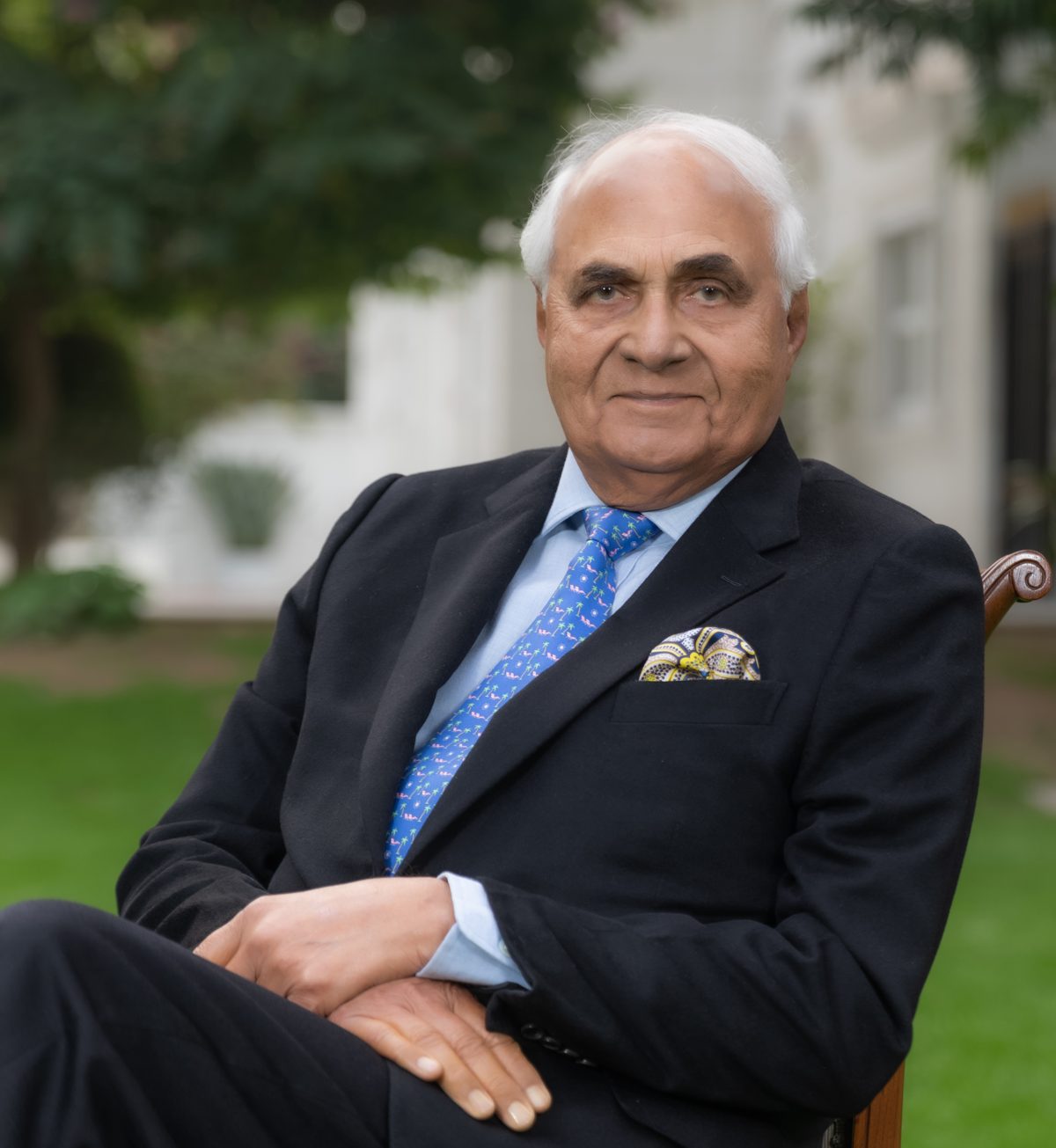
| Key facts | |
|---|---|
| Born | 15 August 1931 (official record); his memoir says a family horoscope gives 19 November 1929 [11][14] |
| Hometown / family roots | Khandera village, near Bulandshahr, Uttar Pradesh; father Chaudhry Mukhtar Singh was a lawyer and later public prosecutor at Bulandshahr [11] |
| Education | Science degree, Meerut College; aeronautical engineering in the UK; Indian Military Academy, Dehradun [14][15][19] |
| Family | Wife Indira (daughter of DLF founder Chaudhary Raghvendra Singh; died 2018); son Rajiv Singh (DLF chairman); daughters Pia Singh and Renuka Talwar [14][2] |
| Company / Group | DLF Ltd (chairman 1995-2020; chairman emeritus since June 2020) [2][14] |
| Wealth | US$12.7 billion, Forbes Billionaires 2026 (March 2026); about US$13.4 billion on Forbes real-time, October 2026 [13] |
| Known for | Assembling about 3,500 acres in Gurgaon and building DLF City and Cyber City; India’s biggest IPO of 2007; Padma Bhushan, 2010 [5][15][16] |
One afternoon in the early 1980s, a car with an overheating engine pulled up in a dusty village on the edge of Gurgaon, south of Delhi. The driver needed water for the radiator. Sitting nearby, under a kikar tree, was a tall former cavalry officer who had spent the day trying to persuade farmers to sell him their fields. The man who got out of the car was Rajiv Gandhi. He asked the officer what on earth he was doing out there. “I am dreaming,” Kushal Pal Singh replied, “dreaming of a new city.” [20][16]
They talked for about two hours. Singh later called that roadside conversation “the birth of the entire urban-development policy of India today.” [16] That may be an exaggeration. But what followed is not in dispute. The land where Rajiv Gandhi stopped for water is now Gurugram, a city of glass towers, malls and gated estates, home to the offices of a large share of the Fortune 500 [28]. Much of its core was planned, bought and built by one company, DLF, and that company was steered for four decades by one man.
KP Singh’s story has everything: a village boyhood, a near-sale of the family firm for Rs 26 lakh, a decade of being frozen out by a powerful politician, a moment in 2008 when Forbes ranked him the eighth richest person in the world, and a crash that wiped out more than US$22 billion of that fortune in eight months [32]. It also includes regulatory bans, court battles and criticism of the city he built. This is the full picture.
Where it began
Kushal Pal Singh has two birthdays. In his 2011 memoir, Whatever the Odds, he explains that the municipal record says 15 August 1931, but a horoscope cast by a village pandit gives 19 November 1929. Village births were rarely recorded, and families often understated a child’s age to win extra years in government service. Singh suspects the earlier date is the true one [11]. Most reference works use 1931 [14][15].
He grew up in Khandera, a village near Bulandshahr in western Uttar Pradesh, among wheat fields and mango groves [11]. His father, Chaudhry Mukhtar Singh, was a strict, self-made lawyer who practised in Bulandshahr and played tennis and hockey for the state. He was briefly selected as a revenue officer in 1945, resigned to return to law, and was later appointed public prosecutor at Bulandshahr [11]. His mother, Rampyari Devi, ran the household. An elder brother died young of pneumonia, leaving KP as the only surviving son [11].
His schooling started humbly. “The local madrasa where I used to walk barefoot to attend classes” was his first school, before he moved to an English-medium school in Bulandshahr, where he cared more for sport than books [11][18]. He went on to study science at Meerut College [14][15].
His father then did something unusual for a small-town family: he sent his son to England to study aeronautical engineering, taking on debt to pay for it without telling him [11][15]. In England, the young man’s skill as a horse rider opened doors to country-house society. He admits he neglected his studies [72].
Then came a twist. He was allowed, as a rare concession, to sit the entrance examination for India’s Indian Military Academy while still in England, and passed [11]. He went to Dehradun reluctantly. He has said he planned to run away until an officer warned that he would be branded a deserter. He stayed, and grew to love the life [19]. He was commissioned into the Deccan Horse, one of the Indian Army’s oldest cavalry regiments, in 1951 according to most accounts, and rose to captain [14][21]. Years later, Gurgaon’s farmers would still call him “Kaptaan Sahab” [23].
It was in the army that his life turned. His commanding officer played matchmaker and arranged for him to meet the daughter of an honorary colonel [11]. She was Indira, daughter of Chaudhary Raghvendra Singh, a St Stephen’s graduate and army major who in 1946 had founded a company called Delhi Land & Finance: DLF [3][14].
The first break
A son-in-law in an unfashionable business
DLF had a glorious start. Founded on 4 July 1946, it built 22 residential colonies in Delhi between 1950 and 1964, including Model Town, Rajouri Garden, Greater Kailash, South Extension and Hauz Khas [3]. Then the state stepped in. The Delhi Development Act of 1957 handed urban development in the capital to a government authority, and private developers like DLF were squeezed out [14][27].
KP Singh left the army around 1960-61 (accounts differ on the year) and joined his father-in-law’s world [15][16][27]. His first assignment was not real estate at all. He worked on a stud farm, and then ran American Universal Electric (India), a venture with a US partner that made electric motors, fans and batteries, with a factory in Faridabad [12][8][16]. The battery business did poorly, but Singh said he learned American management methods from his American mentor, George Hoddy [11][16]. He also became president of the Faridabad Industries’ Association [22].
January 1975: the share transfer he never signed
By the early 1970s DLF was close to dead. Banks were not allowed to lend to real estate, and the company had done no worthwhile project in nearly a decade [11][72]. His father-in-law retired in 1972 and decided the family should sell.
Singh’s memoir opens at this moment: “It was January 1975. I picked up my pen to sign a share transfer form.” [72] He was about to sell his DLF shares for about Rs 26 lakh, roughly book value (some accounts say Rs 25 lakh or Rs 27 lakh) [20][17][18]. “The decision to sell my shares had been taken for me by my father-in-law,” he wrote, and “that was the culture in our families.” [17][20] His financial adviser warned him of what he would be giving up, and his wife Indira and her sister Prem urged him not to sell [72][19][12]. He did not sign.
The first win: freeing frozen land
DLF’s first revival was won in government offices, not on building sites. After the Urban Land (Ceiling and Regulation) Act of 1976, thousands of people who had bought DLF plots in Delhi decades earlier faced the risk of losing them. Singh lobbied ministries for exemptions and guidelines that protected those buyers; Business Standard wrote that it “enabled thousands of property owners of DLF colonies in Delhi to become millionaires overnight” [17][23]. In 1979 American Universal Electric was merged into DLF Universal, and Singh became managing director [14][28].
A dinner that cost him a decade
Not every relationship went well. At a dinner the Singhs hosted in the mid-1970s, an incident involving another guest offended Bansi Lal, then a powerful Congress leader from Haryana. Bansi Lal stormed out and blamed Singh [22]. Singh later described him as a “biased central minister” who “managed to keep us in check for almost 20 years” [17]. Reuters reported that a quarrel with Haryana’s chief minister in the 1980s cost DLF nearly a decade of opportunities [26]. Years later, according to Singh’s memoir, Bansi Lal admitted he had harassed him needlessly [18].
Building the empire
Buying Gurgaon, one farmer at a time
With Delhi closed to private developers, Singh looked across the border to Haryana. Gurgaon was then a dusty district of farms and scrub. Haryana’s 1975 urban areas law allowed private colonies on licensed land, backed by bank guarantees [7], and DLF bought freehold land and secured licences there, starting with DLF Qutab Enclave [7][14]. TIME reported that by 1981 DLF held only about 40 acres, and its push to let companies buy farmland had stalled [16]. DLF’s own timeline dates the start of DLF City Gurugram to 1985 [3].
How he got the land is the heart of the legend. There were no bank loans for private developers, so Singh had to win the trust of landowning families one by one; EY’s lifetime achievement citation says this took about a decade and calls it the first private land development of its kind in India [28]. He visited farmers at dusk in a kurta, shawl and his old black army beret, spoke their dialect and sat on their charpoys [23][18]. He played “good cop” to a colleague’s “bad cop” [23]. He helped sellers buy larger farms further away, around Sohna, Palwal and Alwar [23][19]. Some farmers lent their sale money back to DLF, and a company jeep went out every month to pay their interest [19].
“At DLF, we will always use persuasion, not coercion,” he said; his father-in-law’s advice was “In the quest for your own prosperity, ensure the farmers prosper too.” [23] His co-author Ramesh Menon writes that DLF acquired over 3,500 acres without a single legal case against it from sellers [19]. TIME reported land bought for as little as US$65 an acre later sold for about US$4 million an acre [16]. Singh has said he never paid a bribe and worked through industry bodies and the media instead [25].
Political goodwill mattered too. After the roadside meeting, Rajiv Gandhi invited Singh to present his plan, and helped persuade the central and Haryana governments to loosen the rules on private land development [14][16][19]. Singh was candid about his state of mind: “I was hungry. And the best things in life are done when you are hungry for more business.” [16]
Jack Welch and the back-office boom
Singh’s most valuable insight was that Gurgaon’s future lay in offices, not just houses. In 1988-89, at the request of Rajiv Gandhi’s office, he persuaded General Electric chairman Jack Welch to visit India; he suggested the newly married Welch see the Taj Mahal [24][28]. During that trip Welch met Sam Pitroda and others who pitched India as a base for back-office work [24]. In his own memoir Welch described Singh as “tall, natty and aristocratic”; Singh said, “I learned a lot from Jack Welch about how to run a business.” [16]
The payoff came in 1997, when GE Capital International Services, later Genpact, set up in Gurgaon, taking floors in DLF Corporate Park [24][29]. Where GE went, others followed. Gurgaon became the outsourcing and corporate capital of north India.
From colonies to a corporate city
KP Singh became chairman of DLF in 1995 [14]. DLF’s own milestones trace the build-out: group housing from 1996, Grade A offices in Gurugram from 1999, organised retail from 2002, DLF Cyber City from 2003, IT parks and malls from 2005, hotels and townships from 2006 [3]. DLF Cybercity received the world’s first LEED Platinum “City and Community” certification in 2007 [28]. DLF Emporio, billed as India’s first luxury mall, opened in 2008; CyberHub in 2013; DLF Mall of India in Noida in 2016 [3]. DLF and the state development authority built a 16-lane road link from the NH-8 toll plaza into the heart of the new city [77].
The 2007 IPO and a fortune of US$30 billion
On 5 July 2007 DLF listed on the stock exchanges after an IPO priced at Rs 525 a share that raised Rs 9,187.5 crore, subscribed 3.28 times [30]. It was then India’s largest IPO. On listing day DLF was valued at Rs 96,285 crore, making it the first real estate company in India’s top ten by market value. With promoters holding about 87% of the company, Business Standard estimated Singh’s wealth at about Rs 84,968 crore, making him the fourth richest Indian [31].
In March 2008 Forbes estimated his net worth at US$30 billion, ranking him the eighth richest person in the world and the richest real estate developer anywhere [14][32]. That same boom saw DLF buy the Aman luxury resorts group for about US$400 million in November 2007 [37], and sponsor the first editions of the Indian Premier League [77].
Selling the rental crown jewels to GIC
The crash of 2008 (see the next section) left DLF heavily indebted. Its rescue was a complex deal completed in December 2017. The promoter family sold its entire 40% stake (held as compulsorily convertible preference shares) in DLF Cyber City Developers Ltd (DCCDL), the company that owns most of DLF’s rent-earning offices and malls, for about Rs 11,900 crore. Singapore’s sovereign fund GIC paid about Rs 8,900 crore for 33.34%, and DCCDL bought back the rest [38]. The family then put about Rs 11,250 crore back into DLF through convertible instruments priced at Rs 217.25 per share, and DLF raised more through a share sale to restore its public float [39]. The result: DLF owned two-thirds of DCCDL, GIC one-third, and DLF’s debt fell sharply.
Rental income became DLF’s steady engine. In FY26 DCCDL reported rental income of Rs 5,525 crore, up 16%, with occupancy above 92% [44].
The ultra-luxury comeback
The second act came at the very top of the housing market. DLF’s The Camellias, launched in Gurugram in 2014, became a byword for super-luxury. In May 2024 DLF sold all 795 flats in Privana West for about Rs 5,590 crore within three days of launch [41]. Its next project, The Dahlias, launched in October 2024 with 420 apartments of at least 10,300 sq ft each; by January 2025 DLF had sold 173 of them for Rs 11,816 crore, an average of about Rs 70 crore a home [42].
Those launches drove record numbers. DLF reported FY25 sales bookings of Rs 21,223 crore and net profit of Rs 4,367 crore [43]. In FY26 bookings were Rs 20,143 crore, profit before exceptional items rose to about Rs 4,256 crore, and the company reported net cash of about Rs 14,155 crore, with zero gross debt in its development business [44][1].
How the wealth is held
KP Singh no longer holds DLF shares in his own name. On 1 August 2023 he sold his entire direct stake of 0.59%, about 1.45 crore shares, for roughly Rs 731 crore [40]. The family’s control runs through promoter group companies, principally Rajdhani Investments & Agencies; promoters together hold about 74% of DLF [40][76]. Forbes still values the family fortune under KP Singh’s name: US$12.7 billion on its 2026 list, and about US$13.4 billion in October 2026 [13]. Hurun, since the 2020 handover, lists it under “Rajiv Singh & family”; its 2026 real estate list put that fortune at Rs 90,200 crore, down 29% in a year, with Gautam Adani’s family overtaking it at the top [45]. A separate 2026 Hurun ranking estimated the DLF family business had lost about a quarter of its value over three years [46]. Wealth tied to one listed stock moves with that stock; readers interested in how promoter holdings drive such rankings can find more on CapitalVia Insights.
The setbacks and failures
The crash of 2008
The fall was as dramatic as the rise. By November 2008 Forbes estimated Singh’s wealth at US$7.8 billion, a drop of US$22.2 billion in eight months [32]. DLF’s shares, and the whole property sector, went into a long slump [35].
The problem was debt. DLF had bought land aggressively at boom prices. In October 2008 it had about Rs 6,000 crore of short-term debt due within a year [33]. Net debt climbed to about Rs 23,000 crore by 2012 by the company’s measure; some reports put it at Rs 26,000 crore [35][36].
The DLF Assets problem
A promoter-owned company, DLF Assets Ltd (DAL), had been set up to buy commercial buildings from DLF and list as a kind of property trust. It missed its listing window by weeks when markets collapsed in early 2008, leaving it owing DLF about Rs 5,000 crore [33]. In 2009 the Singh family sold 9.9% of DLF for about Rs 3,800 crore to buy out investor DE Shaw from DAL, which had received about US$500 million for its 36% stake [34].
Selling the trophies
To cut debt, DLF sold almost everything that was not core. A 17-acre Mumbai land parcel went to Lodha for Rs 2,727 crore in 2012 [36]. A plan to sell Aman back to its founder for US$300 million in 2012 fell through; the sale finally closed in 2014 for about US$358 million [37]. Wind power assets, IT park stakes, hotel land and an insurance joint venture stake were sold or put up for sale [35][77].
Gurgaon’s unfinished promise
The city itself became a setback of a kind. Critics have long pointed to Gurgaon’s unreliable water and power, flooding and poor public infrastructure [26]. Singh has partly accepted this. “Gurgaon was envisaged to be as good as any city in the world,” he told BW Businessworld in 2023, blaming “archaic” town planning rules that left colony roads 12 metres wide when he wanted 24-36 metres: “a mistake cannot be set right.” [69] In 2020 he said his dream of a Singapore-like satellite city had not come true: “Unfortunately, we could not do that.” [68]
Controversies and allegations
As of 14 October 2026, no court has convicted KP Singh personally of any offence. Several matters involving him or DLF remain open.
SEBI’s ban over the 2007 IPO prospectus
Allegation: On 10 October 2014 SEBI barred DLF, KP Singh, his son Rajiv Singh, daughter Pia Singh and other directors and officers from the securities market for three years. SEBI found that the 2007 IPO documents had not disclosed that three companies, Sudipti Estates, Shalika Estate Developers and Felicite Builders, were in effect still DLF subsidiaries or related parties after shares in them were transferred in 2006, and had not disclosed related transactions and a criminal complaint. It called the suppression deliberate and fraudulent [47][14]. The case began with complaints by Kimsuk Krishna Sinha, who had a land dispute with DLF [47]. DLF shares fell 28% the next trading day [48]. In February 2015 SEBI’s adjudicating officer separately imposed penalties totalling about Rs 86 crore on DLF, its officials and related entities [49].
Response: DLF said it had violated no law, that the transactions were immaterial, and that its board had relied on legal advisers, merchant bankers and auditors [47][50].
What happened next:
- On 13 March 2015 the Securities Appellate Tribunal (SAT), by a 2-1 majority, set aside the ban; the presiding officer, in dissent, would have reduced it to six months [50].
- SEBI appealed to the Supreme Court, which issued notice in April 2015 but declined to stay the SAT ruling [51].
- In April 2018 SAT disposed of the penalty appeals in light of its 2015 ruling, saying they would revive automatically once the Supreme Court decides SEBI’s appeal [6].
Status: Pending. DLF’s audited results of May 2026 describe these matters as awaiting final outcome and say management expects to succeed [1].
CCI’s Rs 630 crore penalty
Allegation: Acting on a complaint from the Belaire Owners’ Association, the Competition Commission of India found in 2011 that DLF had abused its dominant position in Gurgaon through one-sided apartment buyer agreements in projects including Belaire and Park Place, and imposed a penalty of Rs 630 crore [52][77].
Response: DLF argued that it was not dominant and that the agreements predated the competition law, and said it had delivered the projects [52][53].
What happened next:
- The Competition Appellate Tribunal upheld the penalty in May 2014 [52].
- In August 2014 the Supreme Court admitted DLF’s appeal but refused a stay and ordered DLF to deposit the Rs 630 crore [53].
Status: Pending in the Supreme Court. DLF says it has deposited Rs 630 crore under protest [1].
The Robert Vadra land deal
Allegation: In October 2012 activists Arvind Kejriwal and Prashant Bhushan alleged that DLF gave Robert Vadra, son-in-law of Congress leader Sonia Gandhi, interest-free money and cheap flats in return for favours from Congress governments. The central transaction: in 2008 Vadra’s Skylight Hospitality bought 3.53 acres at Shikohpur, Gurugram, for Rs 7.5 crore, obtained a commercial licence, and in 2012 sold the land to DLF for Rs 58 crore [54][4].
Response: DLF said it dealt with Vadra at arm’s length as an individual entrepreneur, gave no unsecured or interest-free loans, and received no favours from any government; it called the allegations baseless [54]. Vadra has called the cases political vendetta [58].
What happened next:
- In October 2012 IAS officer Ashok Khemka cancelled the land’s mutation; a Haryana government committee later held his order illegal [55].
- A commission headed by Justice S.N. Dhingra, set up in 2015, reportedly found collusion in its unpublished report; the Punjab and Haryana High Court’s rulings in 2019 and 2024 left its future uncertain [73][74].
- In September 2018 Haryana Police registered an FIR naming Vadra, former chief minister Bhupinder Singh Hooda, DLF and another company, alleging that the Wazirabad land allotment (see below) was the quid pro quo [56].
- In April 2023 Haryana Police told the High Court that revenue officials found no violation of rules in the transfer to DLF; the state said this was not a clean chit [57].
- In July 2025 the Enforcement Directorate filed a money-laundering complaint against Vadra and others; DLF was not named as an accused [58]. On 15 April 2026 a Delhi court took cognisance, and said DLF’s role should be investigated further [4][75].
- In July and August 2026 the ED told the court that further investigation into DLF’s role was under way [59].
Status: The PMLA case against Vadra and others is pending trial. DLF is under further ED investigation but is not an accused in that case, and the 2018 FIR remains under investigation. KP Singh is not named as an accused in the FIR, the ED complaint or the court’s cognisance order [4][56][58].
The Wazirabad 350-acre allotment
Allegation: In 2009-10 Haryana’s industrial corporation allotted 350 acres at Wazirabad, Gurugram, to DLF for about Rs 1,750 crore for a golf and leisure project; DLF was the only qualified bidder. Villagers challenged it [60].
Response: DLF said the land was awarded through two rounds of international competitive bidding [60].
What happened next:
- In September 2014 the Punjab and Haryana High Court upheld the land acquisition but set aside the allotment to DLF and ordered a fresh process [60].
- In November 2014 the Supreme Court ordered status quo on DLF’s appeal [61].
Status: The Supreme Court appeal appears to be pending; no final ruling was found as of October 2026.
The Primus homebuyers case
Allegation: Buyers in DLF’s The Primus project in Gurugram said the project did not match its brochure, including a promised 24-metre sector road and water supply. On 25 February 2026 the Supreme Court ordered a CBI preliminary inquiry, noting a “huge mismatch” between promises and reality and saying it was expressing no final opinion [62][63].
Response: DLF said it had complied with all laws and that 696 allottees had taken possession [63].
What happened next:
- In September 2026 the court noted a CBI status report finding the road “did not exist” as represented, and strengthened the inquiry team [64].
Status: Live. The CBI inquiry continues under the Supreme Court’s supervision. KP Singh is not personally named as a party in the reported orders.
Delayed flats at Capital Greens
Allegation: Buyers in DLF’s Capital Greens project in Delhi complained of delays in possession [65].
Response: DLF argued force majeure, citing approval delays and other factors [65].
Status: Decided. In December 2020 the Supreme Court upheld delay compensation for buyers at 6% a year, rejecting the force majeure defence [65].
Panama Papers
Allegation: The Indian Express’s 2016 Panama Papers investigation reported that KP Singh and his wife were linked to a British Virgin Islands company acquired in 2010, and other family members to two entities set up in 2012 [66].
Response: Singh said the investments were made with money sent abroad under the RBI’s Liberalised Remittance Scheme, which allows such remittances, and that the arrangement was permissible [66].
Status: No adverse finding against him was found in public records as of October 2026.
Giving back
DLF’s corporate social responsibility work runs through the DLF Foundation, set up in 2008. Its programmes include education support, public green belts and foot-over-bridges built with the Gurugram development authority, health centres and ambulances, and an eco-friendly crematorium in Gurugram [10]. In its FY26 action plan DLF set a statutory CSR contribution of about Rs 26.8 crore, most of it routed through the foundation, plus a coaching hostel for rural civil-services aspirants through its educational trust [9].
Singh’s personal giving is less documented. Forbes named him in its Asia Heroes of Philanthropy list in 2023, reporting that he had set up charitable trusts in his name and that his 2023 stake sale was to fund philanthropic causes [67]. His publisher says he founded the KP Singh Charitable Foundation to support vulnerable sections of society [12]. No detailed total of his personal donations has been published.
His honours include the Padma Bhushan in 2010 for trade and industry [5] and EY’s Entrepreneur of the Year lifetime achievement award for 2022 [28]. He has also written two books: the 2011 memoir Whatever the Odds, launched with a video message from Jack Welch [20], and Why the Heck Not? (2024), a book of lessons for entrepreneurs, written with Aparna Jain [12].
Succession
Singh handed over gradually. His son Rajiv Singh became vice chairman in 1999 [2]. In June 2020, at about 89, KP Singh resigned as chairman and was named chairman emeritus; Rajiv Singh became chairman [2][68]. His daughter Pia Singh stepped down as a whole-time director in 2015 but remains on the board as a non-executive director [70], and Rajiv Singh’s daughters Savitri and Anushka have joined the board as non-executive directors [71]. Day-to-day management is in professional hands: Ashok Kumar Tyagi and Devinder Singh became whole-time directors in 2017 and managing directors in 2023 [39].
In his later years he has used his voice for one cause above all: better urban planning. “India will need to develop one Chicago type of city every year,” he said in 2023, urging leaders to “invent new cities” and calling for “a national debate” [69]. At the launch of his 2024 book, aged about 95 by his own reckoning, he urged the government to set up a panel on urban infrastructure [25]. He has also been candid about the personal cost of his career: “I had very little time for my children. This is one of my biggest regrets.” [12]
What their journey teaches
Not selling can be the biggest decision of your life. In 1975 Singh was a pen-stroke away from selling his DLF shares for about Rs 26 lakh because his elders expected it. Pausing, and listening to people who believed in the company, changed everything.
Trust is a form of capital. With no bank loans available, Singh built India’s largest private land bank by sitting with farmers, helping them buy bigger farms elsewhere and paying their interest on time. Where money was scarce, credibility did the work.
Sell the future, not just the product. DLF’s big leap came when Singh stopped thinking only about houses and convinced GE to bring its back offices to Gurgaon. Bring the jobs, and the homes, shops and offices follow.
Debt turns a boom into a trap. The same leverage that made Singh one of the world’s richest people in 2008 nearly sank DLF afterwards. It took a decade of asset sales and a family cash infusion to repair the balance sheet.
Process matters as much as vision. The SEBI disclosure case, the CCI ruling and homebuyer disputes show that how a company documents and delivers its promises can follow it for decades, long after the buildings are finished.
Admit what did not work. Singh openly says Gurgaon fell short of the city he imagined and blames planning rules he could not change. Owning the gap is the first step to doing better next time, and for a city that houses millions, the lessons are worth learning.
A profile for general reading, based on public records and reporting as of 14 October 2026. Not investment, tax or legal advice.
Sources (76)
- DLF Ltd audited financial results Q4 FY26 with notes on litigation - DLF Ltd, May 2026
- DLF board outcome: resignation of KP Singh as chairman, appointment of chairman emeritus - DLF Ltd, Jun 2020
- About Us: history, founder and milestones - DLF Ltd, Oct 2026
- ED v. Robert Vadra & Ors, order on cognisance - Rouse Avenue Court via Bar & Bench, Apr 2026
- Padma Awards 2010 notification, Gazette of India - Government of India, Mar 2010
- DLF Home Developers Ltd vs SEBI, SAT order on penalty appeals - Indian Kanoon, Apr 2018
- Haryana Development and Regulation of Urban Areas Act, 1975 - PRS India, Jan 1975
- American Universal Electric (India) vs Union of India - Indian Kanoon, Nov 1976
- CSR Annual Action Plan FY 2025-26 - DLF Ltd, Apr 2025
- DLF Foundation - DLF Ltd, Oct 2026
- Whatever The Odds: The Incredible Story Behind DLF (book preview) - HarperCollins via Everand, Nov 2011
- Why the Heck Not? Blueprints for Success from the Man Who Built DLF - Penguin Random House India, Nov 2024
- Kushal Pal Singh profile - Forbes, Oct 2026
- Kushal Pal Singh - Wikipedia, Oct 2026
- Kushal Pal Singh - Encyclopaedia Britannica, Oct 2026
- The Real Estate Mogul Leading India's Charge - TIME, Aug 2007
- K P Singh's journey: From UP village to realty empire - Business Standard, Nov 2011
- Memoirs of a real estate tycoon - Business Standard, Feb 2012
- K P Singh: The man who turned DLF into India's biggest real estate giant - Business Standard, Jun 2020
- K.P. Singh almost sold DLF stake for Rs 26 lakh - Business Today, Nov 2011
- Whatever the Odds: review - IIM Indore Management Journal, Mar 2012
- From the biography: When DLF's KP Singh fell out of favour with an important minister - Scroll, Nov 2024
- 'We Will Always Use Persuasion, Not Coercion': KP Singh's DLF success story - The Quint, Nov 2024
- When DLF's KP Singh fulfilled Rajiv Gandhi's wish to bring GE to India - Aaj Tak, Nov 2024
- PM Modi should set up panel on urban infra development: KP Singh - The Week (PTI), Nov 2024
- Banned: Property tycoon KP Singh, who built India's first 'smart' city - The Daily Star (Reuters), Mar 2015
- Time to rebuild - Bangkok Post (Reuters), Jan 2015
- K. P. Singh, Lifetime Achievement, EY Entrepreneur of the Year 2022 - EY India, Feb 2023
- Genpact - Wikipedia, Oct 2026
- DLF IPO subscription status - Chittorgarh, Jun 2007
- KP Singh 4th richest Indian post DLF issue - Business Standard, Jul 2007
- Four Indian realtors lose $33 bn in 8 months: Forbes - Business Standard, Nov 2008
- Arun Kumar: Fixing DLF - Business Standard, Apr 2009
- DE Shaw reaps $500 mn in DAL deal - Business Standard, Dec 2009
- The worst seems to be over for DLF - Business Standard, Mar 2013
- DLF debt cut Rs 2,000 cr on Mumbai land sale to Lodha - Business Today, Nov 2012
- DLF plays its last card with Aman Resorts sale - Business Standard, Feb 2014
- DLF promoters conclude Rs 9,000 cr deal with GIC - Business Standard (PTI), Dec 2017
- DLF promoters to infuse Rs 11,250 crore; board okays QIP - BloombergQuint, Dec 2017
- DLF's KP Singh sells entire 0.59% stake for Rs 731 cr - Business Standard, Aug 2023
- DLF sells all 795 luxury flats for Rs 5,590 crore within 3 days of launch - Outlook Business, May 2024
- DLF sells 173 ultra-luxury homes for Rs 11,816 cr in Gurugram - Outlook Business (PTI), Jan 2025
- DLF profit rises 39% in Q4; sales bookings record Rs 21,223 cr in FY25 - The Week (PTI), May 2025
- DLF reports strong FY26 earnings and robust sales bookings - Construction World, May 2026
- GROHE-Hurun India Real Estate Rich List 2026: Gautam Adani overtakes DLF's Rajiv Singh - Free Press Journal, Jul 2026
- Family fortunes shrink: HCL, DLF, Asian Paints among biggest losers - Business Standard, Aug 2026
- SEBI's Order in the DLF Case: A Summary - IndiaCorpLaw, Oct 2014
- DLF stock dives over 28% after SEBI ban - Business Standard (IANS), Oct 2014
- DLF IPO disclosure case: Sebi imposes Rs 85 cr penalties - Business Today, Feb 2015
- DLF v SEBI saga continues: divided tribunal - Bar & Bench, Mar 2015
- Supreme Court notice to DLF on Sebi appeal - Business Standard, Apr 2015
- Compat upholds Rs 630 crore penalty on DLF - Business Standard (PTI), May 2014
- SC refuses interim relief to DLF, orders deposit of Rs 630 crore - LiveLaw, Aug 2014
- Deals with Vadra transparent: DLF - Business Standard, Oct 2012
- Committee report on Khemka order - The Tribune, Apr 2013
- DLF land deal: FIR filed against Robert Vadra, Bhupinder Singh Hooda - Business Today, Sep 2018
- 5 yrs after FIR, Haryana Police say 'no violations' in Vadra-DLF land deal, but no clean chit yet - ThePrint, Apr 2023
- ED charge sheet against Robert Vadra, others in Shikohpur land deal case - The Week (PTI), Jul 2025
- ED files status report in sealed cover on investigation into the role of DLF - ANI, Aug 2026
- Court cancels allotment of 350 acres of land to DLF by Govt of Haryana - SCC Online, Sep 2014
- SC orders status quo with respect to land allotted to DLF in 2010 - Business Standard (PTI), Nov 2014
- Supreme Court orders CBI probe into homebuyers' grievances against DLF over Primus project - LiveLaw, Feb 2026
- A consumer dispute that spiralled into a CBI probe: what's the DLF Primus case - ThePrint, Mar 2026
- Housing project must be built as per brochure: Supreme Court directs CBI enquiry into DLF construction - LiveLaw, Sep 2026
- Supreme Court holds flat buyers entitled to refund and compensation for delay - The Indian Lawyer, Dec 2020
- Panama leaks: Aishwarya denies, KP Singh says it's permissible - The Quint, Apr 2016
- Nandan Nilekani, Nikhil Kamath on Forbes Asia Heroes of Philanthropy list - Outlook Business, Nov 2023
- DLF's Chairman K.P. Singh retires, his son Rajiv Singh to take over - People Matters, Jun 2020
- It's time we had a national debate on urbanisation: KP Singh - BW Businessworld, Feb 2023
- DLF's Pia Singh resigns from post of whole-time director - Business Today, May 2015
- DLF Ltd board of directors - Choice India, Oct 2026
- Whatever the odds: K.P. Singh tells his story - Track2Realty, Nov 2011
- Relief for Hooda: HC quashes Dhingra report - The Tribune, Jan 2019
- Government at liberty to decide on continuation of commission probing Gurugram land deal - LiveLaw, May 2024
- Delhi court takes cognisance of ED chargesheet against Robert Vadra - The Tribune, Apr 2026
- Rajiv Singh, wife sell DLF shares worth Rs 351 cr to another promoter - Business Standard (PTI), Aug 2018