
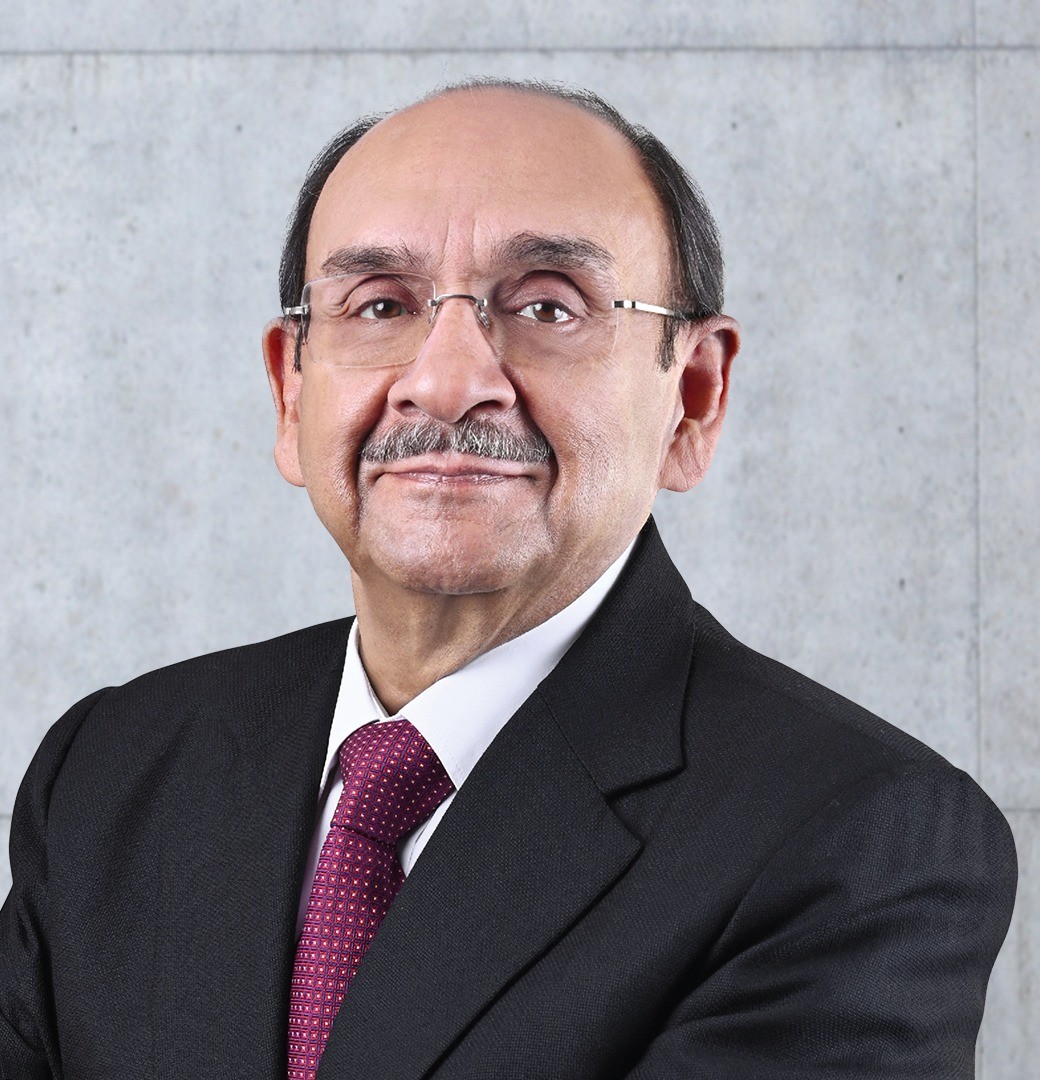
| Key facts | |
|---|---|
| Born | 4 March 1954, Calcutta (now Kolkata) [3] |
| Family roots | Delhi; great-grandson of Sir Shri Ram, who built the Delhi Cloth & General Mills (DCM) group [7][23] |
| Education | The Doon School, Dehradun; B.Com, Sydenham College, Bombay; Programme for Management Development, Harvard Business School [3] |
| Family | Parents Shridhar and Prabha Shriram; brothers Vikram (Vice Chairman & MD) and Ajit (Joint MD); sons Aditya and Anand, both in the business [1][2] |
| Company | DCM Shriram Ltd (formerly DCM Shriram Consolidated Ltd, DSCL): chlor-alkali, PVC, urea, sugar, seeds, Fenesta windows |
| Role | Chairman & Senior Managing Director; director since 24 July 1989 [1] |
| Known for | Turning a debt-laden share of a family split into a Rs 14,000-crore-revenue group; CII President 2014-15 [20][38] |
In the late 1960s, a schoolboy from The Doon School would spend his holidays not at a hill station but on the shop floor of his family’s factories in Calcutta. These were the years of the Naxalite movement, when a rich industrialist’s son wandering around a mill was not considered safe. His father sent him anyway. When the boy, later at college, asked for a car, his father said no. He took the local bus [25].
That boy was Ajay Shriram. He was born into one of the oldest names in Indian business, the family of Sir Shri Ram and the Delhi Cloth Mills. And yet the most important part of his career began with a feeling he has described with unusual honesty: fear. When the old DCM empire was divided among the family around 1990, Ajay’s branch was seen as the underdog. Their share was a fertiliser plant they did not understand, a chemicals complex buried in debt, and a textile mill bleeding money. “We had zero idea about fertilisers, nearly no idea about power plants,” he later said [28].
Three and a half decades later, the company he leads, DCM Shriram Ltd, reported revenue of about Rs 14,264 crore for 2025-26 and runs one of India’s largest chlor-alkali businesses, four sugar mills in Uttar Pradesh, a seeds business in four countries and Fenesta, one of the best-known window brands in the country [20][46]. This is the story of how a family’s “leftover” share became a durable industrial company, and of what went wrong along the way.
Where it began
The house that Shri Ram built
To understand Ajay Shriram, you have to start with his great-grandfather. Sir Shri Ram was born in Delhi on 27 April 1884 [57]. Delhi Cloth & General Mills had been founded in 1889 by a group of Delhi businessmen, and Shri Ram joined it in 1909, aged about 25 [53][7]. A First World War army contract for tents revived the struggling mill around 1917, and over the next three decades he turned it into a conglomerate: sugar mills from 1925, DCM Chemical Works in 1941, the Daurala distillery in 1942 and vanaspati in 1946 [57].
He was also a builder of institutions. He was a founding member of the first board of the Reserve Bank of India and the first chairman of IFCI [7]. The Commercial Education Trust he set up in 1920 grew into Shri Ram College of Commerce (SRCC), which he chaired from 1942 to 1962 [22]. He founded the Shriram Institute for Industrial Research in 1947 and Lady Shri Ram College in 1956, named after his wife [7][54]. He was knighted in 1941 and died on 11 January 1963 [57]. His line on management is still quoted by the company: “Management in business is essentially a matter of human relations” [7].
Like other pre-independence builders such as Ghanshyam Das Birla and Jamnalal Bajaj, Shri Ram left behind both an industrial empire and a large family that would one day have to decide how to share it.
The Murli Dhar branch
Shri Ram had three sons: Murli Dhar, Bharat Ram and Charat Ram [57]. Bharat Ram and Charat Ram, the two younger sons, ran DCM for decades. Charat Ram built the chemicals and sugar businesses and, in the mid-1960s, set up the chemicals and fertiliser complex at Kota in Rajasthan, which would later become the heart of Ajay’s company [26].
Ajay comes from the eldest son’s line. Murli Dhar died with his wife in a 1949 air crash while returning from Lyallpur (now Faisalabad in Pakistan), where his family had owned the Lyallpur Cloth Mills. He left two sons, Bansi Dhar and Shri Dhar [24]. Shri Dhar was Ajay’s father, which makes Ajay a great-grandson of Sir Shri Ram and a grand-nephew of Bharat Ram and Charat Ram [26]. Business Standard notes that this branch was known as the “kotwal family”, after an ancestor who served as kotwal, or police chief, of Delhi [24].
Ajay Shridhar Shriram was born on 4 March 1954 in Calcutta, the second of four children of Shridhar and Prabha Shriram [3]. His younger brothers Vikram and Ajit would later become his partners in running the company. Ajit was born in October 1967, more than 13 years after Ajay [2].
Doon, Sydenham and a pilot’s uniform
As a boy, Ajay wanted to be a pilot and even owned a pilot’s uniform [3]. Family tradition decided otherwise. He was sent to The Doon School in Dehradun, and then to Sydenham College in Bombay for a B.Com [3]. In later years he would take the Programme for Management Development at Harvard Business School and, with his brothers, attend a family-business programme at IMD in Lausanne in 2006 [3][24].
The Calcutta factory holidays shaped him. He attended weddings and feasts in workers’ families and learnt the shop floor before he learnt the boardroom [25]. He has named Dharma Vira, a former Cabinet Secretary, as his best teacher in business [32].
The first break
Six years at Daurala
After college, Ajay spent four months in the United States with Ina, a joint-venture partner of the Shriram group [25]. Then he was sent to Daurala Sugar Works near Meerut in western Uttar Pradesh, one of the family’s oldest units.
He did not start at the top. For about two years he worked with “every equipment in the Sugar Factory and at the attached Distillery,” according to a company profile. He then bought molasses for the distillery and later ran the distillery and the potable alcohol plant. He lived at Daurala for six years [3]. Business Standard’s account says he was asked to run the factory about four years after joining [25]. Neither source gives exact years, but the dates suggest he joined in the mid-1970s.
Those years in a sugar town taught him two things that would matter later: how the cane economy works, and how a factory runs when the owner lives next to it.
The Swraj Paul storm
In 1983 the family faced the most famous corporate raid in Indian history. London-based industrialist Swraj Paul, through 13 non-resident investment entities linked to his Caparo group, began buying shares of DCM and Escorts. DCM’s share price rose from about Rs 35 to Rs 80, and the promoter family held only around 10-14% of the company [33][35]. The boards of DCM and Escorts refused to register Paul’s shares, and the fight went to the courts and to the government [33]. (The full matter is set out under Controversies below.)
The raid failed. But it left a mark on Ajay’s branch: Paul’s broker, Harish Bhasin, ended up holding a significant block of DCM shares, which after the split became a 6-7% stake in Ajay’s company [36]. Ajay and his brothers would later buy it out [23].
The split: getting the “difficult” share
By the late 1980s the DCM family had grown too large, and relations between the branches had frayed. Business Standard’s obituary of Charat Ram described “persistent tensions and bickering (including on succession issues)” between Bharat Ram and Charat Ram [26]. Ajay himself spoke of the “family difficulties of 1987-89” [29].
Accounts differ on the exact shape and date. Vinay Bharat-Ram’s own book describes a first three-way division in 1988-89, worked out with the help of the financial institution IFCI and arbitrators. The Murli Dhar branch’s block, which included Kota, Daurala sugar and Swatantra Bharat Mills, was later divided between Bansi Dhar’s family and Shri Dhar’s family [27]. The company itself describes a 1990 “trifurcation” [6], while most press accounts count four successor companies in 1990 [28]:
- DCM Ltd - Bharat Ram’s branch
- DCM Shriram Industries - Bansi Dhar’s branch
- DCM Shriram Consolidated Ltd (DSCL) - Shri Dhar and his sons Ajay, Vikram and Ajit
- Shriram Industrial Enterprises (SIEL) - Charat Ram’s branch
Ajay has called the restructuring “done in the most dignified, harmonious and cooperative manner” [29]. But the assets his branch received were hard ones. DSCL got the Kota complex (chlor-alkali, PVC, urea, cement and power) and Swatantra Bharat Mills in Delhi, a 112-acre textile mill with more than 7,000 workers that had been losing about Rs 20 crore a year since the mid-1970s [28]. Debt was about eight times equity [28]. The fertiliser plant at Kota had stopped because the company could not afford naphtha, its feedstock [29]. Observers called Ajay’s branch “the underdogs” of the split [24].
“We were dead scared when this business was handed to us,” Vikram Shriram later admitted [28]. Ajay, the eldest of the three brothers, had been a director of the new company since 24 July 1989 [1].
Building the empire
Fixing Kota first (1990-1996)
The brothers’ first job was survival. In the mid-1990s they did something unusual for an Indian family business of that era: they sat down with 13 trade unions at Kota and shared five years of the company’s accounts with them [29]. A team-building exercise for managers in Agra in 1994-95 became part of company folklore [29]. The loss-making textile business was “rationalised” in 1994-95 [6], and when the Supreme Court ordered hazardous and polluting industries out of Delhi in 1996, DCM Shriram’s Delhi operations were among those affected [37].
At the same time, they bet on growth. In 1992-93 DSCL formed a hybrid-seed joint venture with Bioseed Genetics International [6]. And in 1995-96 it commissioned Shriram Alkali & Chemicals at Bharuch in Gujarat, a new chlor-alkali plant built from scratch rather than bought [6]. Bharuch would grow into the group’s most important asset; by 2017 it was described as India’s largest single-location chlor-alkali plant [29].
The brothers also worked quietly on ownership. At the split, the family held only about 18% of DSCL. By buying shares, including Harish Bhasin’s block, they lifted it to about 55% by 2006 [23]. Today the promoter group holds 66.52% [21].
A family that divides the work
Ajay did not build DSCL alone, and he says so. The three brothers divided responsibilities, lunched together almost every day and met at annual off-site family retreats run with a psychologist. Ajay and Vikram jointly signed off on large capital spending [24]. “We are not the only brains and not necessarily the best,” Ajay told Business Standard. “Our job is to ensure we get the best people for each job” [24].
In 2006, at a lunch interview, he summed up the record since the split: “Our turnover has grown 13.8 per cent annually and our profit 22 per cent annually since the family split in 1990” [23]. Revenue had been Rs 934.6 crore in 2000 with a profit of Rs 29.5 crore [28].
Into sugar (1997-2007)
With roots in Daurala, sugar was a natural bet. DSCL built its first sugar mill at Ajbapur in Lakhimpur Kheri district, UP, in 1997-98, acquired the Rupapur unit in 2002-03 and commissioned the Loni and Hariawan mills in 2006-07 [6]. By October 2006 Ajay said DSCL was among India’s top six sugar producers [23]. The company’s own overview puts the four mills’ combined cane-crushing capacity at 33,000 tonnes a day, since expanded further at Hariawan and Loni [6], and they buy cane from about 1.5 lakh farmers [9][28].
Sugar would prove a mixed blessing. It gave scale and rural reach, but prices are set by government policy. “The sugar industry is governed completely by the political decision-makers,” Ajay told Fortune India in 2018. That year sugar was 28% of revenue but only 8.6% of operating profit [28].
Hariyali, Fenesta and the hunt for consumer businesses (2002-2013)
The early 2000s were the brothers’ most experimental years. In 2002 they launched two very different ventures.
The first was Hariyali Kisaan Bazaar, an ambitious chain of rural “one-stop shops” selling farm inputs, fuel, groceries and consumer goods to farmers [30]. In October 2006 it had about 35 outlets and plans for more than 700; Ajay even turned down a request from the Australian Wheat Board to take a stake [23]. By FY10 Hariyali’s revenue was Rs 630 crore [11]. Its story did not end well, as the next section explains.
The second was Fenesta, a brand of uPVC windows and doors. Fortune India dates the launch to 2002; the company’s milestone list puts its entry into uPVC windows in 2003-04 [28][6]. It took time: by FY18 Fenesta’s revenue was Rs 332.4 crore, growing 25-30% a year [28]. By FY26 it had crossed Rs 1,112 crore, up 28% in a year [46], with more than five million installations in over 900 cities [55].
Meanwhile the core businesses kept expanding. In 2005-06 the company expanded carbide, PVC, chlor-alkali, cement and power at Kota, helped by a US$74.2 million investment from the World Bank’s International Finance Corporation [6][18]. In 2007-08 it raised its stake in the seeds business from 51% to 100% [6]. In 2008-09 it more than doubled Bharuch’s capacity and added a coal-based power plant [6]. In FY10 the Kota fertiliser plant switched from naphtha to gas [11].
CII and a new name (2014)
In March 2014 Ajay Shriram became President of the Confederation of Indian Industry for 2014-15, succeeding Kris Gopalakrishnan of Infosys [38]. Before that he had led a long list of industry bodies: the Northern India Textile Mills Association (1992-93), the Alkali Manufacturers’ Association (1995-97), the Fertiliser Association of India (2000-02) and, from 2009 to 2011, the International Fertilizer Industry Association in Paris [58][1].
As CII President he argued that the new Companies Act 2013 needed “a comprehensive review” and that the government should “trust industry” [39]. He also called for tax breaks on transparent political donations and for state funding of elections [40].
The same year the company dropped “Consolidated” from its name. A postal ballot in early 2014 renamed DCM Shriram Consolidated Ltd as DCM Shriram Ltd, to make the name “simple, sharp and focused” [14]. In April 2014 US chemicals maker Axiall paid Rs 34.65 crore for half of the group’s PVC compounding business, forming a 50:50 joint venture [15]; DCM Shriram bought Axiall’s half back in 2021 for Rs 23.80 crore [44].
The profit years (2014-2023)
The clean-up of the early 2010s set up the best decade in the company’s history. Consolidated figures from the company’s own financial highlights tell the story [10][21]:
| Year | Net revenue (Rs crore) | Net profit (Rs crore) |
|---|---|---|
| FY15 | 5,639 | 211 |
| FY17 | 5,789 | 552 |
| FY19 | 7,771 | 906 |
| FY22 | 9,627 | 1,067 |
| FY23 | 11,547 | 911 |
| FY24 | 10,923 | 447 |
| FY25 | 12,077 | 604 |
Fortune India calculated that operating profit had grown from about Rs 12 crore to about Rs 1,200 crore in the 27 years after the split, while debt-to-equity fell from 8.1 to 0.3 [28]. The company spent about Rs 2,000 crore on capacity in the two to three years before 2018 [28].
The investments came in steady layers. Distilleries started in 2018, turning sugar’s by-product molasses into ethanol [30]. Bharuch added aluminium chloride in 2018-19 and more chlor-alkali in 2019-20; Kota got a 66 MW power plant; PVC capacity at Kota was raised to 220 tonnes a day in 2020-21 [6]. In 2022-23 the company launched Shriram AgSmart for water-soluble and bio-fertilisers and expanded its grain distillery at Ajbapur to 320 kilolitres a day [6].
Moving up the chemical chain (2024-2026)
The latest phase is about turning commodity chemicals into specialty ones. In 2024-25 the company commissioned at Bharuch an 850-tonne-a-day caustic soda plant, 120 MW of captive power, a hydrogen peroxide plant and a refined glycerine plant [6]. In April 2026 it started a 52,000-tonne-a-year epichlorohydrin (ECH) plant there [46].
To use that ECH, the board approved buying Hindusthan Speciality Chemicals, an epoxy resin maker, for Rs 375 crore in June 2025 [45]. It also bought 53% of DNV Global, a maker of window hardware, for Fenesta [6]. After FY26 it sold half of its PVC compounding arm, Shriram Polytech, to Teknor Apex to form a joint venture [20].
For FY26 the company reported consolidated revenue from operations of Rs 14,263.91 crore and profit of Rs 855.98 crore, which included a one-off deferred tax credit of about Rs 239 crore [20][46]. It paid a total dividend of Rs 11.20 a share [20].
How the wealth is held
The Shriram brothers’ wealth sits mostly inside DCM Shriram. At 31 March 2025 the promoter group held 66.52% of the company, almost all of it (63.03%) through a family holding company, Sumant Investments. Ajay personally held 0.32% and his HUF another 0.36%; Vikram, Ajit and their mother Prabha Shridhar held similar small direct stakes [1].
No publication has put out a reliable net worth figure for Ajay Shriram individually. For context only: at the market price on 12 November 2026, DCM Shriram was valued at about Rs 14,074 crore [21], so the whole promoter group’s 66.52% stake was worth roughly Rs 9,400 crore. That is shared across the extended family and is not Ajay’s personal wealth.
His own pay for FY25 was about Rs 16.38 crore, including Rs 8.5 crore in commission, which the company disclosed as 214 times the median employee’s pay [1].
The setbacks and failures
Ventures that never took off
Ajay is open about the mistakes. In 2006 he listed the ones that did not work: proposed insurance joint ventures with Royal Sun Alliance and Zurich that were aborted, a shrimp farm in Pondicherry that failed, and a deal with a US partner for Shriram Polymers that fell through [23]. A small hydro power project, Chhatru in Himachal Pradesh, had its allotment cancelled by the state in 2019-20; arbitration over it is still being challenged in the Himachal Pradesh High Court [1].
The Hariyali experiment
Hariyali Kisaan Bazaar was the biggest bet that failed. By December 2010 it had 275 stores in eight states, but it had shut 30 that year. “In the past one year, we have not added a single store,” Ajay admitted [41]. In 2012 Business Standard reported that the chain had closed at least 70 outlets [42].
The numbers were stark. Revenue fell from Rs 853 crore in FY12 to Rs 516 crore in FY13, and the business lost Rs 106 crore in FY12 and Rs 35 crore in FY13. The company took a Rs 53.6 crore exceptional charge to wind it down [43][13]. By June 2013 only 37 outlets were left, all of them fuel stations [43]. “We have completed the restructuring process… We do not expect any losses this fiscal,” Ajay said [43]. Fortune India later blamed rural logistics and the cost of diesel back-up power [28].
Sugar’s bad years
Sugar’s politics hurt the company repeatedly. In FY11 DSCL reported a consolidated net loss of Rs 14.3 crore, and in FY12 profit was just Rs 11.9 crore after a Rs 38 crore exceptional charge on cane-price arrears [12]. “We are in commodities, there will be ups and downs, and we have to manage it,” Ajay said [28].
Commodity downturns
The chemicals cycle bites too. Profit halved from Rs 911 crore in FY23 to Rs 447 crore in FY24 [10]. In the July-September 2026 quarter, revenue rose 22% to Rs 3,977 crore but profit fell to Rs 106 crore from Rs 159 crore because of cost pressures [47]. The seeds business has struggled too: blocked GM field trials in India hampered Bioseed’s research [28], and its revenue in that quarter fell to Rs 73 crore from Rs 86 crore [47].
Controversies and allegations
Ajay Shriram has no personal regulatory or criminal case against him in the public record we reviewed: we found no SEBI enforcement order, CCI order, NCLT proceeding or court judgment against him or against DCM Shriram Ltd beyond routine tax and duty disputes. The matters below involve the wider family company before the split, or are disputes disclosed by DCM Shriram itself.
The 1985 oleum gas leak and absolute liability
Allegation: On 4 December 1985, oleum gas leaked from a tank at Shriram Foods and Fertiliser Industries, a unit of Delhi Cloth Mills Ltd in Delhi, after the structure the tank stood on collapsed. It affected many workers and members of the public, and an advocate practising at the Tis Hazari court died after inhaling the gas. A smaller leak followed two days later [4]. Environmental lawyer M.C. Mehta took the matter to the Supreme Court.
Response: The plant was shut by government orders in December 1985. The company asked to restart its caustic-chlorine plant, and the Supreme Court allowed this in February 1986 under strict conditions, including a Rs 20 lakh deposit for oleum victims’ compensation and a Rs 15 lakh bank guarantee [4].
What happened next:
- On 20 December 1986 a Constitution Bench of the Supreme Court laid down the doctrine of “absolute liability”: a business in a hazardous industry owes an absolute and non-delegable duty to the community, and compensation must match the size and capacity of the enterprise [5].
- The court directed the Delhi Legal Aid and Advice Board to file compensation claims for victims [5].
- In 1996 the Supreme Court ordered hazardous industries out of Delhi; Shriram Foods and Fertilisers, by then part of Siddharth Shriram’s SIEL, planned to close and move to Punjab [37].
Status: Closed. The case is a landmark of Indian environmental law. It predates the 1990 split, and neither judgment names Ajay Shriram or any member of his branch. After the split, the Delhi food and fertiliser complex appears to have gone with the Charat Ram branch’s SIEL rather than with DSCL [37].
The Swraj Paul takeover battle (1983)
Allegation: In 1983, entities linked to Swraj Paul’s Caparo group bought large blocks of DCM and Escorts shares through non-resident accounts [33]. DCM’s management refused to register the shares, alleging irregularities in how they were bought, including possible breaches of foreign exchange rules [35].
Response: Paul challenged the refusals. The DCM family lobbied the government; according to Business Standard, Vivek Bharat Ram sought the help of Rajiv Gandhi and Paul was asked to settle [34]. On 16 May 1983 the RBI capped non-resident portfolio holdings at 5% of a company [33].
What happened next:
- The Bombay High Court ruled for the Indian companies. The Supreme Court later ruled in Paul’s favour in the LIC v Escorts case, but the victory was hollow and the takeovers did not happen [33].
- Paul’s broker Harish Bhasin was left holding 6-7% of DCM, which became a similar stake in DSCL after the split. Ajay’s branch later bought him out [36][23].
Status: Closed decades ago. Ajay was a young executive at the time and had no documented role in the fight.
Tax and duty disputes
Allegation: On 31 October 2025, the Income Tax Department issued an assessment order for assessment year 2022-23 that made transfer-pricing and other additions, raising assessed income to Rs 1,596.53 crore against Rs 1,086.46 crore declared and creating a demand of Rs 249.27 crore [16]. In December 2025, GST authorities at Kota raised two smaller demands, of Rs 85.80 lakh and Rs 19.84 lakh plus equal penalties, over input tax credits [17].
Response: DCM Shriram said the order ignored MAT credit and directions of the Dispute Resolution Panel, and that similar issues had already been decided in its favour by the Delhi High Court for an earlier year. It said it would appeal, and described the GST demands as not material [16][17].
What happened next:
- The company’s annual report also lists older matters decided in its favour that the tax department has appealed to the Supreme Court, including service tax of Rs 31.66 crore and sales tax of Rs 16.75 crore [1].
- Disputed claims for interest on delayed cane payments fell to Rs 5.49 crore at 31 March 2025 from Rs 47.05 crore a year earlier. Delayed cane payments are an industry-wide issue in Uttar Pradesh, where a long-running Allahabad High Court case is examining interest owed to farmers [1][48].
Status: The AY2022-23 demand is under appeal; the other matters are pending as of 12 November 2026.
Political donations
Allegation: No wrongdoing has been alleged. Election Commission data compiled by the Association for Democratic Reforms show that DCM Shriram bought electoral bonds worth Rs 10 crore (listed under two spellings of its name), all redeemed by the BJP [19]. The scheme drew wide public scrutiny before the Supreme Court struck it down in February 2024.
Response: The company discloses political contributions in its annual reports. In FY25 it gave Rs 15.50 crore to Prudent Electoral Trust and Rs 2 crore to the BJP [1]. As CII President in 2014, Ajay had argued for tax breaks on transparent political donations and for state funding of elections [40].
Status: Donations were made through legal channels and disclosed. No investigation or case relating to them has been reported.
A case of mistaken identity at Kota
Allegation: In October 2025 the National Green Tribunal took up pollution of the Chambal river at Kota, fining Kota’s municipal corporation and the Kota thermal power station Rs 3.6 crore each [49]. Directions were also issued to Shriram Rayons, which shares the DCM Shriram name.
Response: Shriram Rayons belongs to DCM Shriram Industries, the Bansi Dhar branch’s company, not to Ajay Shriram’s DCM Shriram Ltd. That company said no penalty had been imposed on it [50].
Status: Not a matter involving DCM Shriram Ltd. Readers should note that several separate companies descend from the old DCM, and news about one is often wrongly attached to another.
As of 12 November 2026, no other court, regulator or major publication has documented an allegation of wrongdoing against Ajay Shriram personally.
Giving back
DCM Shriram’s charity runs mainly through two foundations, the DCM Shriram Foundation and the Shridhar Shriram Foundation, named after Ajay’s father. Ajay chairs the board’s CSR committee [1].
In FY25 the company spent Rs 24.33 crore on CSR, exactly 2% of its average net profit [1]. In FY26 it spent Rs 21.25 crore against an obligation of Rs 19.82 crore, reaching about 86,000 people through programmes in health (Khushali Sehat), anganwadi education with Pratham in Hardoi and Lakhimpur Kheri, skills, water and mangroves, sanitation, and farming (Jeetega Kisaan) [51].
Water is the cause he writes about most. In a 2021 column he argued that Indian farm policy encourages wasteful water use, and described the company’s “Meetha Sona” sugarcane project with the IFC and Solidaridad, which he said saved about 300 billion litres of water over two years. He also called coal dependence a cause of air pollution and urged companies to see climate action as an opportunity [52].
He carries on the family’s link with education. He chairs the Governing Body of SRCC, the college his great-grandfather founded, and the Board of Governors of IIM Sirmaur, and sits on the boards of the Centre for Social and Economic Progress and the Indian School of Development Management’s advisory board [1]. He has been a trustee of SOS Children’s Villages of India [8]. BML Munjal University awarded him an honorary D.Litt, and the Indian Chemical Council gave him a Lifetime Achievement Award [1][56].
Succession
The Shriram brothers have been planning succession for years, and on paper it is well under way.
Ajay was re-appointed Chairman and Senior Managing Director for five years from 1 November 2023 [1]. His elder son, Aditya A. Shriram (born 1982), studied engineering at Cornell, worked as an options trader at Optiver in Amsterdam and returned to Kota in 2006, where he bought limestone and later ran the cement business [25][2]. He took an MBA from London Business School in 2014, led the chemicals business by 2017, and became Deputy Managing Director on 2 July 2023 [2][29][1]. Ajay’s younger son, Anand A. Shriram, joined at Kota in 2010, moved through plastics and seeds, and now heads Shriram AgSmart [2][8]. Vikram’s son Pranav runs Fenesta [8].
Ajay has said that “competence will be the main driver for family-run businesses”, and that the younger generation “is much more ambitious, much more result-driven” [29]. He has also argued that involving “external well-wishers” in family matters brings “objectivity and neutrality,” and that “family composition is not a constant” [31]. Ajit Shriram said in 2017 that a family constitution was being drafted [29].
His great-grandfather’s empire split after two generations. Whether this branch avoids that fate is the real test of his succession work. Readers can compare the paths taken by other old families on this site, such as Harsh Goenka and Sanjiv Goenka, whose family also divided its businesses.
What their journey teaches
The “worst” share can be the best foundation. Ajay’s branch got a debt-heavy chemicals complex and a dying textile mill. By fixing the unglamorous core first (Kota’s costs, then a new plant at Bharuch), the brothers built a company whose operating profit grew roughly a hundredfold in 27 years [28].
Trust your people with the numbers. Sharing five years of accounts with 13 unions in the 1990s was a risky move. It helped turn a stalled complex into a working one [29].
Close what isn’t working, even if it is your favourite idea. Hariyali was a bold idea about rural India, and Ajay backed it publicly. When losses hit Rs 106 crore in a year, he shut most of it within about a year [43]. Exiting fast saved the rest of the company.
Know which businesses you can control. Ajay has been frank that sugar is “governed completely by the political decision-makers” [28]. The company kept sugar for its rural roots but put its biggest money into chemicals and Fenesta, where it sets its own course. For a view of how farm and rural economies move differently from cities, see CapitalVia’s note on the rural-urban inflation gap.
Make room for people better than you. “We are not the only brains and not necessarily the best,” Ajay says [24]. Structured family meetings, divided responsibilities and professional managers have kept three brothers working together for more than three decades.
Patience compounds. Fenesta took about 16 years to reach Rs 330 crore of revenue and only eight more to cross Rs 1,100 crore [28][46]. “We are here for 50 years, not five,” Ajay has said [30].
A profile for general reading, based on public records and reporting as of 12 November 2026. Not investment, tax or legal advice.
Sources (58)
- DCM Shriram Annual Report 2024-25 - DCM Shriram Ltd, Jul 2025
- Notice of 35th Annual General Meeting - DCM Shriram Ltd, Jul 2024
- Know your Leader: Mr Ajay S Shriram (company profile) - DCM Shriram via MarketScreener, Mar 2016
- M.C. Mehta & Anr v Union of India (order of 17 Feb 1986) - Supreme Court of India via Indian Kanoon, Feb 1986
- M.C. Mehta & Anr v Union of India (Constitution Bench, absolute liability) - Supreme Court of India via Indian Kanoon, Dec 1986
- Milestones - DCM Shriram Ltd, Nov 2026
- Our Founder: Sir Shri Ram - DCM Shriram Ltd, Nov 2026
- Our Leadership - DCM Shriram Ltd, Nov 2026
- About Us - DCM Shriram Ltd, Nov 2026
- Financial Data 2025 - DCM Shriram Ltd, Jul 2025
- DSCL Financial Results Q4 and FY2010 - DCM Shriram Consolidated Ltd, May 2010
- DSCL Q4 & FY12 Results Presentation - DCM Shriram Consolidated Ltd, May 2012
- DCM Shriram Q4 & FY14 Results Presentation - DCM Shriram Ltd, May 2014
- Postal Ballot Notice for change of name - DCM Shriram Consolidated Ltd, Jan 2014
- DCM Shriram and Axiall LLC form joint venture - DCM Shriram Ltd, Apr 2014
- Disclosure of material tax litigation, AY 2022-23 - DCM Shriram Ltd, Nov 2025
- Disclosure of GST demand order, Kota - DCM Shriram Ltd, Dec 2025
- DCM Consolidated: Environmental and Social Review Summary - International Finance Corporation, Nov 2026
- Electoral bonds: donor list - ADR / MyNeta, Mar 2024
- DCM Shriram Ltd Directors' Report FY2025-26 - IIFL (India Infoline), May 2026
- DCM Shriram Ltd consolidated financials and shareholding - Screener, Nov 2026
- History of SRCC - Shri Ram College of Commerce, Nov 2026
- Lunch with BS: Ajay Shriram - Business Standard, Oct 2006
- The family way - Business Standard, Apr 2009
- The inheritors - Business Standard, May 2010
- DCM loses stalwart - Business Standard, May 2007
- Breaking point (excerpt from From the Brink of Bankruptcy: The DCM Story) - Business Standard, Feb 2011
- DCM Shriram: Low on sugar - Fortune India, Jul 2018
- Competence alone will be the driver for family-owned businesses - BW Businessworld, Apr 2017
- Growing a legacy - Outlook Business, Jul 2019
- Involving external well-wishers will bring both objectivity and neutrality - Outlook Business, Jan 2020
- Profile of Ajay Shriram - Business Today via PressReader, Jan 2018
- How an NRI's attempt to take over 2 Indian firms led to LIC turning invincible - ThePrint, Dec 2022
- Sitting ducks - Business Standard, Apr 2011
- DCM redux - Business Standard, Nov 2007
- Swraj Paul's broker returns to haunt Shrirams - Business Standard, Nov 2007
- Closure of polluting Delhi units to release 80 acres - Business Standard, Apr 1997
- Ajay Shriram takes over as new CII President - Business Standard, Mar 2014
- Companies Act needs comprehensive review: CII President - Business Standard, Jun 2014
- Political donations should get tax breaks, says new CII chief - Business Insider India (Times of India), Apr 2014
- DCM Shriram re-seeds rural retail hopes - Business Standard, Dec 2010
- Rural retail sees fall in demand - Business Standard, Jan 2012
- Expect Hariyali business to make profit this FY: DSCL - Business Standard, Jun 2013
- DCM Shriram rises after board OKs buyout of Axiall's stake in Shriram Axiall - Business Standard, Sep 2021
- DCM Shriram to acquire Hindusthan Speciality Chemicals for Rs 375 cr - Business Standard, Jun 2025
- DCM Shriram reports 42 pc jump in FY26 profit, announces 200 pc final dividend - Rural Voice, May 2026
- DCM Shriram Q2 revenue jumps 22% to Rs 3,977 crore but profit falls on cost pressures - Indian Chemical News, Oct 2026
- Uttar Pradesh sugar mills owe over Rs 2,889 crore as interest for delayed payments to farmers - Rural Voice, Oct 2024
- NGT imposes Rs 3.6 cr fine each on Kota's municipal corporation, power plant for polluting Chambal - ThePrint, Oct 2025
- DCM Shriram unit receives NGT directives, no penalties imposed - FilingReader, Oct 2025
- DCM Shriram spends CSR in FY 2025-26 - India CSR, Jul 2026
- Government, business and society (column by Ajay S Shriram) - Business India, Nov 2021
- DCM among 100-year-old Indian companies - Business Today, Jun 2011
- How Lala Shri Ram set up Lady Shri Ram College for Women - Scroll, Mar 2023
- About DCM Shriram - Fenesta, Nov 2026
- Ajay Shridhar Shriram - Indian School of Development Management, Nov 2026
- Lala Shri Ram - Wikipedia, Nov 2026
- Ajay S. Shriram - Wikipedia, Nov 2026