
| Key facts | |
|---|---|
| Born | 5 April 1955, Thiruvananthapuram (then Trivandrum), Kerala [1] [18] |
| Hometown/Family roots | Grew up in Trivandrum; his father began as a clerk and ran a small plumbing business; grandparents on both sides were teachers [20] |
| Education | B.Sc. physics, University of Kerala; M.Sc. physics (1977) and M.Tech. computer science (1979), IIT Madras [17] [23] |
| Family | Wife Sudha Gopalakrishnan (co-founder, Pratiksha Trust); one daughter [40] [28] |
| Company/Group | Infosys (co-founder 1981; CEO and MD 2007-2011; vice chairman to 2014); chairman, Axilor Ventures; family office Pratithi Investments [1] [2] [3] |
| Wealth | About US$3.1 billion, Forbes real-time estimate, 28 October 2026 [62] |
| Known for | One of the seven Infosys founders; doubling Infosys’s revenue as CEO through the 2008-09 crisis; funding India’s biggest private push into brain research |
In the early 1970s, a teenager in Trivandrum waited for the result that his family had planned his life around. He wanted to be a doctor, and so did they. When the medical entrance results came, he had missed a seat by two marks. There was no Plan B [20].
“It devastated my family. It devastated me,” he said decades later [20]. He has called it the greatest failure of his life, and said it took him three years to get his confidence back [21]. He then cleared the entrance test for an Indian Institute of Management and reached the interview, but could not express himself in English. He failed that too [20].
The boy was Senapathy Gopalakrishnan, now known to Indian business simply as Kris. Within a decade of those two failures he was one of the seven people who started Infosys from a home in Pune with Rs 10,000 [24] [25]. Within four decades he had run the company as chief executive, steered it through the worst global recession in its history, and doubled its revenue [6]. Today he gives away crores of rupees a year to an unlikely cause for a software man: trying to understand how the human brain works [45].
His story is less loud than those of some Infosys founders. He wrote no manifestos and fought no public battles. But it may be the most useful one for a young Indian who has just failed an exam.
Where it began
Kris Gopalakrishnan was born on 5 April 1955 in Thiruvananthapuram, then called Trivandrum, the capital of Kerala [18] [17]. “My entire childhood and schooling was in Trivandrum,” he told Forbes India. “I studied in a government school” [20].
His father had started work as a clerk straight out of school and later ran a small plumbing business for the rest of his life. On both sides of the family, his grandparents were teachers [20]. It was a home that valued books more than money. “I was brought up in a world with no internet or even computers, so my knowledge was limited to studies,” he said, “and I devoured books both while studying and in different libraries” [22].
The medical-entrance result broke that steady path. Kris has said that after it, “my parents never, ever influenced me in anything I ever did” [20]. The person who pulled him out of the slump was not a parent but a tuition teacher, a chain-smoking, tough-talking man he remembers as C. C. Phillips. “He did not show me the path forward but helped me regain confidence,” Kris said [20]. In another telling: “He saw me and believed in me when I did not” [21].
He took a physics degree at the University of Kerala [23]. The failed IIM interview taught him a second lesson. “The IIM experience taught me how important communication is,” he said [20]. Years later he would sit on the board of governors of IIM Bangalore [81].
The machine at IIT Madras
In 1975 he joined IIT Madras for a master’s degree in physics, which he completed in 1977 [17]. There he met the thing that changed his life. Professor H. N. Mahabala had started a new FORTRAN programming course and, Kris recalls, “knew I’d be interested in” it. “That course ignited my love for experimentation and I never looked back at anything else” [22].
He worked day and night on the institute’s IBM 370 mainframe, then the most advanced computer most Indian students would ever see, and realised he could write his own programs [20]. He stayed on for an M.Tech. in computer science, finishing in 1979 [17]. “I completed my Masters in physics and then did another Masters in computing,” he told Physics World [23].
He never forgot who opened that door. In 2014 he endowed a Rs 10 crore chair at IIT Madras in Mahabala’s name, the first chair at the institute funded by an individual. “This is my way of thanking the institution where I graduated from,” he said [29].
The first break
In 1979 Kris joined Patni Computer Systems in Mumbai as a software engineer, recruited by its founder Narendra Patni [20] [17]. He rose to assistant project manager and worked on a distributed process-control system for the steel converter at the Rourkela Steel Plant [17].
At Patni he met the people who would shape the rest of his life. “None of us are related or studied together. We met accidentally at Patni and bonded thereon,” he said of the Infosys founders [27]. The senior among them was N. R. Narayana Murthy, then head of Patni’s software group. Kris remembers him as “a tough task master” who was “extremely fair” and “put people first” (read Narayana Murthy’s life story) [20].
When Murthy decided to start his own company, he asked Kris to join. “He wanted to start his own venture and asked me to come on board,” Kris recalled. “I couldn’t refuse because I looked up to him as a senior” [22]. Murthy has said he picked his co-founders for shared values: middle-class people willing to defer rewards and take low salaries. Kris was the one who “liked technology” [71].
Seven people and Rs 10,000
Infosys was started in 1981 by seven people: Murthy, Nandan Nilekani, Kris Gopalakrishnan, S. D. Shibulal, K. Dinesh, N. S. Raghavan and Ashok Arora [27] [28]. The starting capital was Rs 10,000 from the savings of Murthy’s wife, Sudha Murty [25] [24]. The first office was the Murthy family’s home in Pune [25]. Kris married the same year, and has said he was nervous about telling his family he had joined an untested venture [22] [28].
“There was no expectation; we had nothing to lose,” he said later. “We said we wanted to build a globally respected corporation” [24]. His own ambitions were narrower and more technical. “When we did start Infosys, I wanted to work on embedded software. That is what I loved most” [20].
For six years Infosys had one client: Data Basics Corporation of New York, for which it built software for clothing manufacturers [25]. Murthy had persuaded the company’s chief executive to shut its own Indian unit and work with Infosys instead [71]. There was no internet. “We would develop the software here and then send its [installation disk] to the United States,” Kris told The Week. “It would usually take two weeks to reach the US” [25]. In another interview he laughed about it: “Initially we would actually ship tapes using courier! That was remote software development!” [26] The company installed its first data communication link only in 1989 [26].
“We had to prove that we can develop world-class software sitting here in India,” he said [25]. That proof, built one courier packet at a time, became the global delivery model that later made India the world’s back office.
Building the empire
The technician in Atlanta (1981-1994)
Infosys’s own profile describes Kris as a director of the company from 1981 and its technical director until 1987 [1]. In 1987, as Infosys opened its first office in the United States, he moved to Atlanta as vice president (technical) of KSA/Infosys, a joint venture with the consulting firm Kurt Salmon Associates, and ran all its projects for seven years [1] [17].
These were lean, uncertain years. The founders experimented with hardware between 1985 and 1987 and sold that business. “We succeeded, but not as [much as] we had hoped for,” he said. They also entered banking software in 1985, the seed of what later became Finacle [25].
By 1989 the doubts were serious. “In 1989, we got a $1 million offer for the company,” Kris told The Week. “Fortunately, we decided to continue” [25]. Murthy’s own account dates the founders’ debate to the winter of 1990 and has him telling colleagues who wanted to sell, “No, I will buy you people out” [71]. Kris, who was in Atlanta for much of this period, summed up the mood in a 2008 interview: “We almost gave up” [24].
They did not. Infosys went public in India in February 1993 at Rs 95 a share and listed that June, opening at Rs 145 [8]. “We grew without external funding until we went public,” Kris said [26]. His father died in 1992, just before the IPO [28].
Back home and up the ladder (1994-2007)
Kris returned to India in 1994 to head technical support services, and later ran client delivery and technology [1]. He became deputy managing director in 1999 [1]. That March, Infosys sold 1.8 million American Depositary Shares at US$34 each and listed on Nasdaq, one of the first Indian companies to do so [7]. For Kris, the listing proved “it is possible to run a business legally and ethically in India” [24].
In 2002, when Murthy handed the chief executive’s job to Nandan Nilekani (read Nandan Nilekani’s story), Kris became chief operating officer [23] [27]. By 2006 he was also president and joint managing director [2].
The CEO years (2007-2011)
On 22 June 2007, Kris Gopalakrishnan became chief executive officer and managing director of Infosys, taking over from Nilekani, who became co-chairman [2]. His mother died a month later [28]. He inherited a company that had just reported revenue of US$3.09 billion and net income of US$850 million for the year to March 2007, with 72,241 employees [2].
The first year went well: revenue rose 35% to US$4.18 billion in 2007-08, and headcount crossed 91,000 [4]. Then the global financial crisis hit Infosys’s biggest customers, American and European banks.
“This is perhaps one of the worst times we have seen in our lifetime,” Kris said in April 2009 [30]. For the year to March 2010, Infosys did something it had never done: it guided investors to expect revenue to fall, by 3.1% to 6.7% [5]. Deal cycles stretched from about six months to nine or ten [30].
How he handled the downturn mattered. Infosys honoured all 20,000 job offers it had made on campuses for 2009-10, at a time when many companies were withdrawing offers [31]. Kris kept variable pay allocations at 80-85% and denied that the company was cutting it, while capping the share of employees rated as low performers at 5% [30].
The crisis passed faster than feared. Revenue for 2009-10 came in at US$4.80 billion, slightly up, not down [6]. In November 2009 Infosys BPO agreed to buy McCamish Systems, an Atlanta-based insurance back-office company, for US$38 million upfront plus up to US$20 million in earn-outs [19]. In May 2011 Kris and his team laid out “Infosys 3.0”, a plan to reorganise the company around operations, transformation and innovation, including software products and platforms [10].
By the time he stepped down as CEO, the numbers had changed shape [6]:
| Year to March | Revenue (US$) | Net income (US$) | Employees |
|---|---|---|---|
| 2007 (before he took over) | 3.09 billion | 850 million | 72,241 |
| 2008 | 4.18 billion | 1.16 billion | 91,187 |
| 2009 | 4.66 billion | 1.28 billion | 1,04,850 |
| 2011 | 6.04 billion | 1.50 billion | 1,30,820 |
Sources: Infosys annual results releases [2] [4] [5] [6].
Revenue roughly doubled, profit rose by about three-quarters and nearly 59,000 people were added to the payroll in four years, through a recession [2] [6]. In 2011 the Government of India awarded him the Padma Bhushan for trade and industry [1].
Co-chairman, vice chairman and exit (2011-2014)
The handover was planned. On 30 April 2011 the board announced that, from 21 August 2011, Murthy would retire, banker K. V. Kamath would become chairman, Kris would be executive co-chairman and S. D. Shibulal would be CEO [3]. “I am happy and honoured that the Board has requested me to take on the responsibility of Executive Co-Chairman,” Kris said [3].
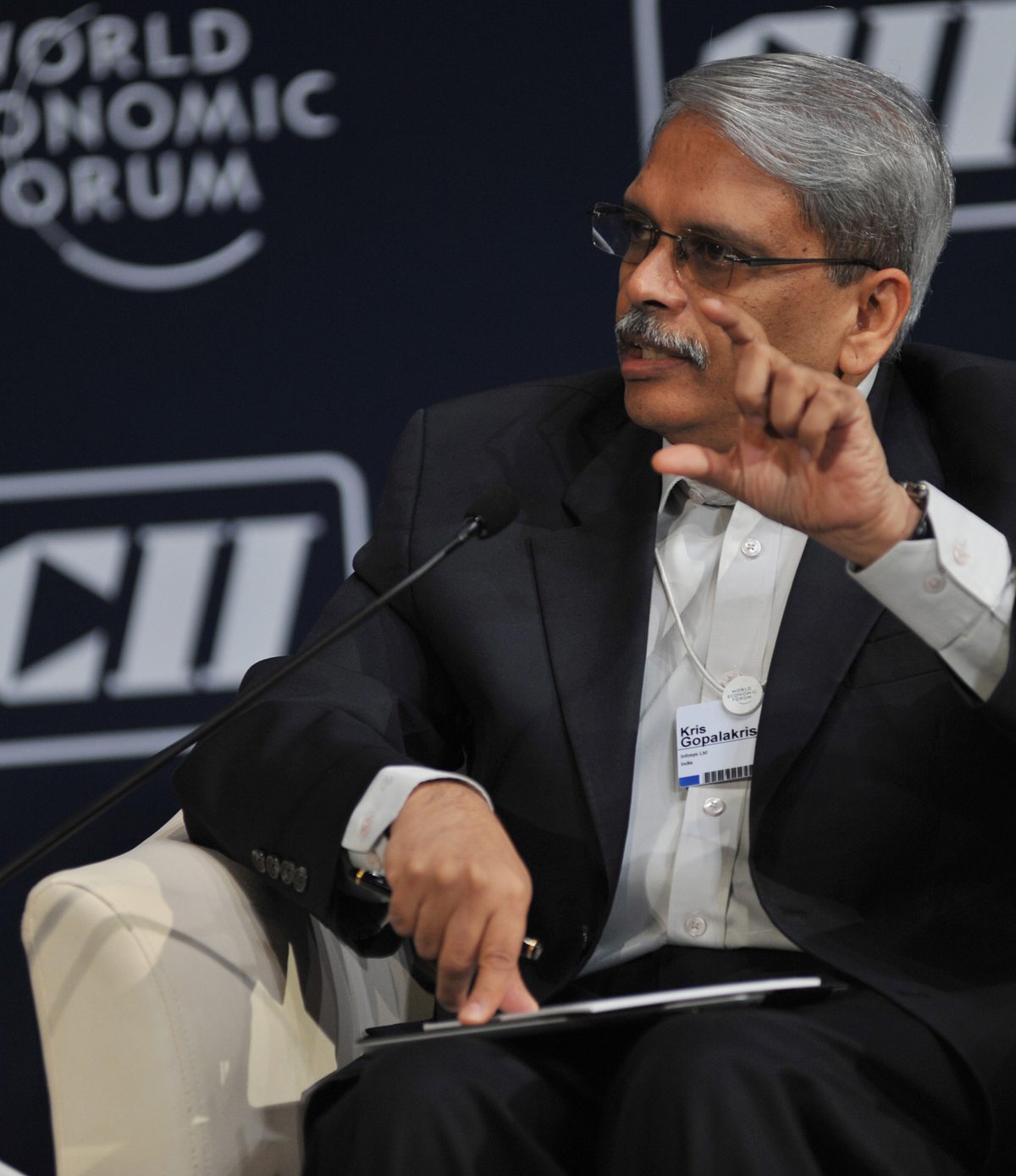
In April 2013 he was elected president of the Confederation of Indian Industry (CII) for 2013-14, succeeding Adi Godrej (read Adi Godrej’s story) [37]. He co-chaired the World Economic Forum’s annual meeting at Davos in January 2014 [1].
At Infosys, though, these were hard years (see below). On 1 June 2013 the board brought Murthy back as executive chairman and re-designated Kris as executive vice chairman, focusing on clients and industry issues [32]. He stepped down from that executive role on 14 June 2014, alongside Murthy, as Vishal Sikka became the company’s first chief executive from outside the founding group [28]. He stayed on the board as non-executive vice chairman until 10 October 2014, the last of the founders in a leadership role [36].
In a farewell letter to employees he tied his own life to the company’s: he married in 1981, the year Infosys began; his father died just before the IPO; his mother died a month after he became CEO. “Many major events in my life are linked to major milestones of Infosys,” he wrote. “In some sense, both these stories are inseparable for me” [28]. He said he had “no political ambitions at all” and would focus on research and entrepreneurship [36].
The second act: startups, policy and institutions
Within weeks he started something new. In November 2014 he and Shibulal launched Axilor Ventures in Bengaluru, an accelerator and early-stage investor offering startups Rs 30 lakh to Rs 6 crore [38]. “Axilor was set up with a vision to help early-stage startups improve the odds of success,” he said in 2018, when it launched a technology fund [73]. He still chairs it [1]. He is also chief mentor of Startup Village in Kochi, an early startup incubator in his home state [13] [80].
Government and regulators kept calling him. In 2019 the Ministry of Electronics and IT asked him to chair a committee of experts on how India should govern non-personal data, which reported in July 2020 and proposed a new Non-Personal Data Authority [39]. In November 2020 the Reserve Bank of India named him the first chairperson of the Reserve Bank Innovation Hub, which it set up to promote innovation in financial services [13]. He chairs the board of governors of IIIT-Bangalore and, since 2022, the council of the Indian Institute of Science [1] [72].
He also turned historian. He funded Itihaasa, a free archive of about 600 video interviews on the history of Indian IT. “I made sure that we covered the Satyam scam, too,” he said [70]. In 2022 he co-wrote Against All Odds: The IT Story of India with N. Dayasindhu and Krishnan Narayanan [69].
How the wealth is held
Almost all of Kris Gopalakrishnan’s fortune sits in one place: Infosys shares. At the end of September 2026, his family held about 14.2 crore shares, roughly 3.83% of the company. His wife Sudha held the largest part (2.57%), Kris held 0.86% and their daughter 0.40% [65].
The family has hardly sold. Kris last sold Infosys shares in March 2016, when he and Shibulal, with family members, sold 75 lakh shares worth about Rs 862 crore, citing personal reasons including philanthropy [60]. The family’s share count in September 2026 was identical to that in Infosys’s own September 2024 filing [9] [65]. Its percentage rose a little only because the promoters stayed out of Infosys’s Rs 18,000 crore share buyback in 2025, which cancelled other investors’ shares [66].
Because the holding is concentrated, his net worth moves with Infosys’s share price. The Hurun India Rich List 2024 put it at Rs 38,500 crore, slightly ahead of Narayana Murthy [63] [64]. Since then Indian IT services stocks have been under pressure as companies worry about what artificial intelligence will do to their business (CapitalVia’s insights team tracked IT hiring falling as AI jobs rose). Forbes’s list of India’s 100 Richest, published on 30 September 2026 with a US$3 billion cut-off, named him among 11 people who fell off the list, citing pressure on IT services from AI-led automation [61]. Forbes’s real-time tracker put his net worth at about US$3.1 billion on 28 October 2026 [62].
The setbacks and failures
Two marks, one interview
The early failures are already told: the medical seat missed by two marks and the IIM interview lost to poor English [20]. What matters is what he took from them. “Looking back, chance, coincidence and luck played an important role,” he said in 2016 [21]. In Forbes India he put it more practically: “You become far more successful if you adapt when circumstances change” [20].
Eight years in the wilderness
For most of the 1980s Infosys was a small company with one client, a failed hardware line and a sale offer on the table [25]. The founders “worked virtually for free,” and the company leased out its only computer during working hours to earn money, according to the World Economic Forum’s account of Kris’s story. “We cared more about doing things right than about doing things fast,” he said [21].
The lost years at Infosys (2011-2014)
The most public setback came after he handed over as CEO. In January 2012 and again in July 2012, Infosys cut its revenue growth forecast; the July cut, to 5% growth in dollar terms, knocked as much as 10% off its share price in a day [35]. Rivals TCS and HCL were winning market share. Reuters reported criticism of Infosys’s practice of choosing every chief executive from the founding group and of what analysts called an insular, risk-averse culture [33]. Murthy later told investors that growth had collapsed between March 2011 and March 2013, with Infosys growing about 5.8% against about 11% for the industry [79].
Kris did not hide behind the numbers. In his note in the 2013-14 annual report, he wrote: “We underestimated the effects of the adoption of these new technologies and the change in the business model.” Traditional services had slowed, he said, “perhaps due to a lack of focus” [34]. It is a rare admission from a founder in an Indian annual report.
Watching from the outside
In 2017 a bitter row broke out between Narayana Murthy and the Infosys board over the pay of chief executive Vishal Sikka, severance for former executives and other governance issues. Kris was among the founders, with Murthy and Nilekani, who were reported to have raised concerns with the board in January 2017, and he was among the founders who stayed away from the June 2017 annual general meeting [59] [76]. Murthy was the public face of the campaign; no individual public statement by Kris on it was found in major publications. Sikka resigned in August 2017 and Nilekani returned as chairman [75].
Controversies and allegations
Kris Gopalakrishnan has largely avoided controversy in a long public life. No SEBI order or insider-trading case naming him or his family was found; SEBI’s insider-trading orders involving Infosys shares concern unrelated individuals [78]. Two matters are on the public record.
The SC/ST Act case linked to IISc (2025)
Allegation: On 27-28 January 2025, Bengaluru’s Sadashivanagar police registered an FIR under the Scheduled Castes and Scheduled Tribes (Prevention of Atrocities) Act against 18 people, including Kris Gopalakrishnan and a former IISc director, P. Balaram [51] [52]. The FIR was registered on the direction of a special court, on a private complaint by D. Sanna Durgappa, a former assistant professor at IISc’s Centre for Sustainable Technology and a member of the Bovi community [51]. He alleged that he had been falsely implicated in a 2014 complaint, removed from his job in 2015 without a fair inquiry, and subjected to caste abuse and threats [51] [55]. Kris was named as a member of IISc’s governing body; the High Court’s later judgment does not attribute any specific act to him [12].
Response: Kris said on 30 January 2025: “I am deeply saddened that a law meant to protect marginalized communities has been misused to make false allegations against me.” He added that he would not comment further as the matter was before the courts, and that he had “full faith in the judiciary” [53].
What happened next:
- On 29 January 2025, Justice S. R. Krishna Kumar of the Karnataka High Court stayed the investigation against the petitioners [52] [72].
- The court record shows that Durgappa’s 2015 termination was converted into a resignation by a settlement, and that the High Court had quashed two earlier FIRs on similar complaints, in 2022 and 2023 [12].
- For balance, Scroll reported that in 2017 a Karnataka Legislative Assembly committee on SC/ST welfare had found in Durgappa’s favour [55].
- On 16 April 2025 Justice Hemant Chandangoudar quashed the case, calling the third complaint “an abuse of the process of law” and a “vexatious attempt to harass the petitioners”, and holding that the dispute was essentially civil [12] [54].
- On 17 July 2025 the High Court recalled that quashing order, because the complainant had not been heard when it was passed. It expressed no view on the merits, restored the petition and extended the stay [56].
Status: As of 29 October 2026, no later ruling has been reported. On the last public record the petition is pending before the Karnataka High Court, the stay on investigation remains in force, and no court has found wrongdoing by Kris Gopalakrishnan.
The US visa settlement during his leadership (2011-2013)
Allegation: In 2011 Jay Palmer, an Infosys employee in Alabama, sued the company. He claimed it had misused short-term B-1 business visas for work that needed H-1B work visas, and that he was harassed after complaining [58]. US federal authorities investigated. The US Attorney’s Office for the Eastern District of Texas alleged that Infosys had used B-1 visa holders for skilled work, sent misleading invitation letters to consular officials, coached visa holders on what not to say, and had substantive errors in most of its employee eligibility (I-9) forms for 2010-11 [11]. The period covered Kris’s term as CEO and executive co-chairman; he was not personally named.
Response: Infosys said it “denies and disputes any claims of systemic visa fraud”, that its use of B-1 visas was for legitimate business purposes, and that the claims were “unproven” [57]. Reuters reported that it accepted civil violations of paperwork rules for I-9 forms without admitting wider wrongdoing [57].
What happened next:
- In August 2012 a US federal judge dismissed Palmer’s lawsuit, ruling that Alabama law gave him no basis to recover; the judge noted that the ruling did not decide whether Infosys had broken immigration law [58].
- On 30 October 2013 Infosys agreed to pay US$34 million to settle the government’s civil claims, which US authorities called the largest payment ever in an immigration case. It also agreed to extra audits and reporting [11] [57].
Status: Closed in 2013 through a civil settlement. No criminal charge was filed.
Giving back
If Infosys was Kris Gopalakrishnan’s first life’s work, the human brain is his second. “I decided to look at the brain because I felt that it’s close to computer science, which is my area of work and knowledge,” he told ThePrint in 2025. “My purpose when I stepped down from Infosys was to help the research and innovation ecosystem in India” [47].
The Pratiksha Trust and IISc
He and his wife Sudha set up the Pratiksha Trust as their charitable arm [40]. In January 2014 it committed Rs 225 crore over ten years to set up the Centre for Brain Research at the Indian Institute of Science in Bengaluru, to study age-related brain disorders such as Alzheimer’s and Parkinson’s and to use what is learnt to build better computing models [40]. In February 2023 the Trust signed a fresh agreement with IISc for Rs 450.27 crore over another ten years, and committed to support the centre “in perpetuity” [14] [41]. “The human brain is one of the world’s biggest mysteries, which is yet to be fully understood,” he said then, adding that he hoped it would become the world’s leading centre for ageing-brain research by 2030 [14].
The centre runs a long-term study of about 11,500 Indians aged 45 and over, 10,000 of them in rural areas funded by the Trust, to understand how the brain ages in India [82]. In March 2026 IISc launched a “Moonshot” project on brain co-processors, devices that read brain signals, process them with AI and stimulate the brain, starting with stroke rehabilitation; IISc said the Trust funds it, and Forbes India reported the commitment at Rs 80 crore [15] [45].
Chairs, centres and other gifts
- IISc chairs: In 2015 he gave Rs 30 crore for three distinguished chairs at IISc in computational neuroscience, data science and neuromorphic engineering. The first was named after Sudha Gopalakrishnan’s father, K. Vaidyanathan [42] [74].
- IIT Madras: Three more Rs 10 crore chairs at his alma mater, including the H. N. Mahabala chair and one named after N. R. Narayana Murthy for computational brain research [29] [43]. “I was introduced to computers while at IIT, and my life was changed by the stint here,” he said [43]. He also funds IIT Madras’s Centre for Computational Brain Research, and in March 2022 the institute opened the Sudha Gopalakrishnan Brain Centre, which is mapping the human brain at the level of single cells [16].
- Carnegie Mellon: In 2014 he gave US$1.8 million to Carnegie Mellon University for a research partnership with the IISc centre [44].
- Science prizes: He is a trustee of the Infosys Science Foundation, which awards the Infosys Prize to researchers [77].
How much he gives
The EdelGive Hurun India Philanthropy List ranked “S Gopalakrishnan & family” 16th in 2022, with Rs 90 crore given in the year, and 9th in 2023, with Rs 93 crore [48] [49]. In 2025 Hurun named the families of Infosys’s co-founders, including his, as together giving more than Rs 850 crore in a year [50]. Forbes India reported in 2026 that he puts Rs 100-150 crore a year into brain research [45].
He has a simple rule for this. His family office splits its income every year: half goes to growing the family’s wealth, half to the Pratiksha Trust. “I see having wealth as a responsibility,” he told Outlook Business in July 2026 [46]. On his style as a funder: “Basic research is long term, and I don’t want to put any unnecessary pressure on the scientists” [45]. On why others should follow: “Philanthropic capital is a way to solve many problems in society. Leverage it” [45].
He has also used his voice. He has argued that India must raise its research and development spending to 3% of GDP, about triple today’s level, and in 2025 described AI as the next leap beyond IT, warning that millions of IT professionals will need retraining [68] [67]. (India’s standing on research is tracked in CapitalVia’s note on the Global Innovation Index 2026.)
Succession
Kris Gopalakrishnan has no business empire to hand down in the usual sense. No member of his family works in Infosys’s management, which has been run by professional managers since 2014 [36]. Nilekani chairs the company today, as he has since 2017 [75].
What he is passing on is a structure. The family’s wealth sits mainly in Infosys shares held by him, his wife and his daughter [65]. Its investments are run by the family office, Pratithi Investments, and its giving by the Pratiksha Trust [1] [46]. He has said he deliberately stays less involved in the investment side “so it can run independently of me in the future” [46]. The Trust’s open-ended commitment to IISc’s brain centre is meant to outlast him [14].
What his journey teaches
A failed exam is a detour, not a verdict. Kris missed medicine by two marks and lost an IIM interview because of his English. Both failures pushed him towards physics, then IIT Madras, then a FORTRAN class that set his course. He says it took three years to rebuild his confidence, and a teacher who believed in him [20] [21].
Prove the hard thing with small, boring wins. For six years Infosys had one client and shipped code by courier, two weeks each way. “We had to prove that we can develop world-class software sitting here in India,” Kris said [25]. The giant came from years of reliable delivery, not from one big idea.
In a downturn, keep your promises to people. In 2009, with revenue guidance pointing down for the first time, Infosys under Kris honoured all 20,000 campus offers [5] [31]. Within two years revenue had hit US$6 billion [6]. Trust kept in bad years is paid back in good ones.
Say plainly what you got wrong. When Infosys lost ground in 2011-13, Kris wrote in the annual report that the company had “underestimated” new technologies and lost focus [34]. Owning a mistake in public is rare among founders, and it is the first step to fixing it.
Give your money a long horizon. He chose basic brain research, a field where results may take decades, set up funding “in perpetuity”, and split his family’s income evenly between wealth and giving [14] [46]. Patient capital can do things that quarterly capital cannot.
A profile for general reading, based on public records and reporting as of 29 October 2026. Not investment, tax or legal advice.
Sources (82)
- S. Gopalakrishnan: management profile - Infosys, Oct 2026
- Results for the quarter and year ended March 31, 2007 (CEO appointment from June 22, 2007) - Infosys, Apr 2007
- Infosys Announces Leadership Succession - Infosys, Apr 2011
- US GAAP press release, Q4 FY2008 - Infosys, Apr 2008
- Financial release, March 31, 2009 (IFRS) - Infosys, Apr 2009
- IFRS USD press release, Q4 FY2011 - Infosys, Apr 2011
- Infosys prices American Depositary Share offering - Infosys, Mar 1999
- Share details: IPO and listing history - Infosys, Oct 2026
- Shareholding pattern, quarter ending September 2024 - Infosys, Oct 2024
- Investor call: Building Tomorrow's Enterprise (Infosys 3.0) - Infosys, May 2011
- Indian corporation pays record amount to settle allegations of systemic visa fraud - US Attorney's Office, Eastern District of Texas, Oct 2013
- Prof. Govindan Rangarajan & Ors v. Dr D. Sanna Durgappa, WP 2550/2025 - Karnataka High Court (Indian Kanoon), Apr 2025
- Reserve Bank Innovation Hub: appointment of chairperson (press release 2020-2021/639) - Reserve Bank of India, Nov 2020
- Pratiksha Trust signs MoU with IISc for research on neurodegenerative diseases - Indian Institute of Science, Feb 2023
- IISc launches Moonshot project on brain co-processors supported by Pratiksha Trust - Indian Institute of Science, Mar 2026
- IIT Madras launches Sudha Gopalakrishnan Brain Centre - IIT Madras, Mar 2022
- Distinguished Alumnus Award citation: S. Gopalakrishnan - IIT Madras, Oct 2026
- Profile of Shri Senapathy Gopalakrishnan (honorary degree) - IIT Kanpur, Oct 2026
- Infosys BPO signs agreement to acquire McCamish Systems - Infosys BPO, Nov 2009
- Kris Gopalakrishnan: Destiny's Child - Forbes India, Feb 2011
- The secret to a successful career? One tech mogul shares his story - World Economic Forum, Sep 2016
- Kris Gopalakrishnan reflects back on his startup days - Business Insider India, Apr 2017
- Once a physicist: Kris Gopalakrishnan - Physics World, Apr 2008
- Infosys CEO S. Gopalakrishnan: Lessons on building a globally respected corporation - Knowledge at Wharton, Nov 2008
- Infosys @ 40: Journey of the IT giant - The Week, Jul 2021
- Kris Gopalakrishnan: Infosys co-founder on scaling business - Thought Economics, Apr 2019
- Lunch with BS: S Gopalakrishnan - Business Standard, Jun 2010
- Major events in my life linked to milestones at Infosys: Kris - Business Standard (PTI), Jun 2014
- Kris Gopalakrishnan sets up Prof Mahabala Distinguished Chair - Business Standard (PTI), Nov 2014
- This is perhaps one of the worst times (interview) - Business Standard, Apr 2009
- Infy hiring on track, to honour all campus offers - Business Standard, Jan 2009
- Narayana Murthy back as Infosys executive chairman - Business Standard (IANS), Jun 2013
- Under pressure, Infosys recalls Murthy as chairman - Business Standard (Reuters), Jun 2013
- Infosys admits to making strategy errors - Business Standard, May 2014
- Infosys cuts FY13 outlook, shares fall - Business Standard (Reuters), Jul 2012
- Gopalakrishnan bids farewell to Infosys - Business Standard (PTI), Oct 2014
- Kris Gopalakrishnan is new CII president - Business Standard, Apr 2013
- Infosys co-founders launch incubator Axilor Ventures - Business Standard, Nov 2014
- Non-Personal Data Governance Framework: report summary - PRS Legislative Research, Jul 2020
- Pratiksha Trust to invest Rs 225 cr to set up brain research center - Business Standard, Jan 2014
- Pratiksha Trust provides funds worth Rs 450 Cr to IISc for brain research - BioSpectrum India, Feb 2023
- Kris Gopalakrishnan grants Rs 30 crore to boost research at IISc - Business Insider India, Jun 2015
- Chair on Narayana Murthy set up at IIT Madras - Business Standard (IANS), Apr 2015
- Gift from Infosys co-founder to create research partnership - Carnegie Mellon University, Jul 2014
- From Infosys to neuroscience: Kris Gopalakrishnan's next big mission - Forbes India, Apr 2026
- How Kris Gopalakrishnan divides every Rs 100 between wealth and philanthropy - Outlook Business, Jul 2026
- Bengaluru billionaires are changing Indian philanthropy - ThePrint, Jul 2025
- EdelGive Hurun India Philanthropy List 2022 - Hurun Report, Oct 2022
- Leading philanthropists of 2023: personal contributions to charitable causes - India CSR, Nov 2023
- Nadar family tops EdelGive Hurun India Philanthropy List 2025 - Business Standard, Nov 2025
- Infosys co-founder Kris Gopalakrishnan among 18 booked under SC/ST Act - The Tribune (PTI), Jan 2025
- Karnataka High Court stays SC/ST Act case against Infosys co-founder Kris Gopalakrishnan - LiveLaw, Jan 2025
- 'Law misused': Kris Gopalakrishnan responds to SC/ST Act case against him - Business Standard, Jan 2025
- Karnataka HC quashes SC/ST Act case against Infosys co-founder - LiveLaw, Apr 2025
- HC quashes FIR against Infosys' Kris Gopalakrishnan, IISc officials in caste discrimination case - Scroll, Apr 2025
- Karnataka High Court recalls order quashing SC/ST case against Infosys co-founder - LiveLaw, Jul 2025
- Infosys to pay $34 million in U.S. visa case - Business Standard (Reuters), Oct 2013
- Judge throws out Palmer suit against Infosys - Computerworld, Aug 2012
- Infosys founders raise a stink on governance, question Vishal Sikka's pay - Business Standard, Feb 2017
- Two Infosys founders sell shares worth Rs 862 crore - Business Standard (IANS), Mar 2016
- India's 100 Richest 2026 - Forbes, Sep 2026
- Senapathy Gopalakrishnan: real-time net worth - Forbes, Oct 2026
- Kris Gopalakrishnan richer than Narayana Murthy: Hurun India Rich List - DNA India, Sep 2024
- Kris Gopalakrishnan surpasses Narayana Murthy in Hurun India Rich List 2024 - Storyboard18, Sep 2024
- Infosys shareholding pattern, September 2026 - Trendlyne, Oct 2026
- Infosys Rs 18,000-crore buyback: promoters opt out - Angel One, Oct 2025
- From IT to AI: Kris Gopalakrishnan charts India's next big transformation - Business Today, Oct 2025
- India must triple its R&D spending to 3% of GDP: Kris - Deccan Herald, Jul 2026
- Against All Odds: the IT story of India - YourStory, Nov 2022
- Kris Gopalakrishnan's itihaasa app - The Week, May 2016
- Narayana Murthy interview: why I became an entrepreneur - Dataquest, Dec 2010
- Karnataka HC stays proceedings against Infosys co-founder in SC/ST case - The News Minute, Jan 2025
- Axilor Ventures launches a $30 Mn seed fund - Inc42, Jun 2018
- IISc gets first three distinguished chairs - Deccan Herald, Jun 2015
- Nilekani returns to Infosys as chairman as board tries to end feud with founders - Business Standard (Reuters), Aug 2017
- With Nandan Nilekani's return, spotlight on Infosys promoters at AGM - The News Minute, Jun 2018
- Infosys Science Foundation trustees - Infosys Prize, Oct 2026
- Order in the matter of insider trading in the scrip of Infosys Limited - SEBI, Jan 2025
- Infosys revenue growth rate crashed 77% during March 2011-2013 - Millennium Post (PTI), Mar 2014
- Kochi Startup Village: country's best - The News Minute, Jul 2016
- Mr S. Gopalakrishnan, Chairman: governing body - IIIT Bangalore, Oct 2026
- After Infosys: Kris Gopalakrishnan's brain research mission - Biotecnika, Apr 2026