
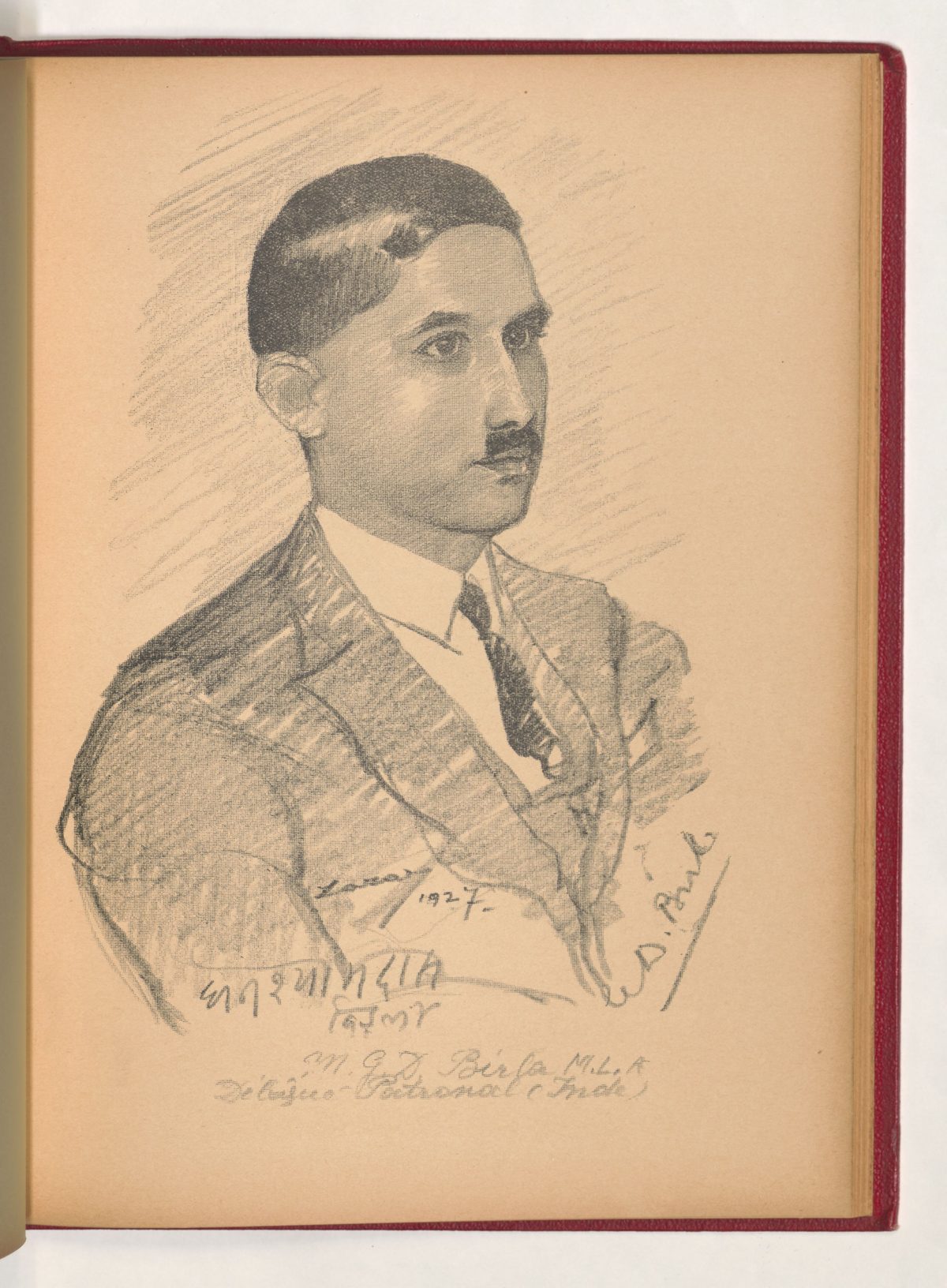
| Key facts | |
|---|---|
| Born | April 1894 (on Ram Navami; often given as 10 April), Pilani, Rajasthan [1] [54] |
| Died | 11 June 1983, London, aged 89 [39] [54] |
| Family roots | Marwari trading family of Pilani; father Baldeo Das Birla; grandfather Shiv Narayan Birla began trading around 1860 [1] [30] |
| Education | Formal schooling ended at 11; self-taught in English, Sanskrit, history and economics [1] [2] |
| Family | Sons Lakshmi Niwas, Krishna Kumar and Basant Kumar Birla; grandson Aditya Vikram Birla; great-grandson Kumar Mangalam Birla [34] [53] |
| Company/Group | Birla group: Birla Jute (now Birla Corporation), Hindustan Motors, UCO Bank, Grasim, Hindalco, Hindustan Times and more [8] [5] [7] [6] |
| Honours | Padma Vibhushan, 1957 [3] |
| Known for | Taking on British jute mills, financing Gandhi, co-founding FICCI, the Bombay Plan, founding BITS Pilani |
Around 1911, a teenage jute broker from a desert village used to call on British trading houses in Calcutta. He was there to do business, and they were happy to take it. But he was not allowed to use their lift to reach their offices, and he was not allowed to sit on their benches while he waited.
“I smarted under these insults,” Ghanshyam Das Birla wrote four decades later, “and this created within me a political interest which, from 1912 until to-day, I have fully maintained” [1].
That young broker went on to break into the Scottish-run jute industry, build a group that by the late 1970s rivalled and by some counts overtook the Tatas [44], bankroll much of Mahatma Gandhi’s work, help write a plan for independent India’s economy, and found one of the country’s best-known engineering universities. He also became the face of what critics called monopoly capital, and his group was the subject of more parliamentary questions, inquiry committees and a full commission of inquiry than almost any other business house of its time.
This is the story of how a boy whose schooling ended at 11 built the Birla empire, and what both his admirers and his critics got right.
Where it began
Birla was born in April 1894 in Pilani, in the Shekhawati region of today’s Rajasthan. The family celebrated the date as Ram Navami; most modern accounts give 10 April, while a 1979 India Today profile gave 5 April [1] [2] [40] [54].
Pilani then was not the university town it is today. “I was born in 1894 in a village with a population of barely three thousand,” he wrote in his memoir, In the Shadow of the Mahatma. There was no railway, no proper road and no post office. People travelled by camel, horse or bullock cart, and he remembered that “my family had two very good camels” [1].
The Birlas were Marwari traders. His great-grandfather, by his own account, worked as a clerk “on a paltry pittance of Rs. 10/- per month”. His grandfather, Shiv Narayan Birla, set out at 18 for Bombay “to seek his fortune” [1]. The Aditya Birla Group dates the family business to 1857; Birla’s own arithmetic puts it at around 1860 [30] [1]. His father, Baldeo Das Birla, expanded the business, and the family traded in cotton, silver, cloth and, according to Medha Kudaisya’s biography as summarised by Khushwant Singh, opium [35] [36]. G.D. was the third son [30].
School ends at 11
His education was brief. A tutor taught him arithmetic from the age of four. “My school education, however, ended with the First Book of Reading by Pyarecharan Sarkar, when I was only eleven,” he wrote [1]. At 12 he was in the family business. “My training began at the age of 12 but I started doing business independently when 16,” he told India Today in 1979 [2].
What school did not give him, he took for himself. “My books, the newspapers, a dictionary and a copy-book became my main tutors,” he wrote, and he taught himself English, Sanskrit, history and economics [1]. In old age he told interviewers, “I have been a student all my life” [2].
Calcutta, and a dangerous detour
The family’s trade took him to Bombay and then Calcutta, the commercial capital of British India [35] [40]. At 16 he set up as an independent broker. “I started in 1911,” he said. “Independently as a jute broker. All the business in those days belonged to the British or you can call them Scot if you like” [2].
His anger at racial snubs had a dangerous side. In his memoir he admitted that he got “involved… with the terrorists of those days”, got “into serious trouble” and went underground for nearly three months before “kindly friends” kept him out of prison [1]. Khushwant Singh, summarising Kudaisya’s biography, linked this to the Rodda arms heist of 1914, when revolutionaries in Calcutta made off with a consignment of pistols and ammunition [35]. Live History India reports that police raided his house on Zakaria Street in July 1916 [42]. He was never charged, and he did not repeat the episode; within a few years he had found a very different kind of politics.
The first break
The First World War was the making of the family fortune. The army needed sandbags, sacking and uniforms, and jute prices swung wildly. Gurcharan Das, drawing on Kudaisya, writes that Birla’s success in jute speculation during the war “laid the foundation” for the family’s move from trading into industry, and credits his “phenomenal appetite for risk” [38]. Khushwant Singh writes that the family “made a killing supplying jute bags and uniforms to the army” [35].
The obvious next step was to make jute, not just trade it. That meant entering a business run by British and Scottish managing agencies from Calcutta, which had no wish to share it.
Birla Jute, 1919
In 1919 he set up Birla Jute Manufacturing Company Limited, one of the first Indian-owned jute mills in Bengal. The company still exists: it was renamed Birla Corporation in 1998 [8] [30]. Birla himself, in 1979, dated his first step into manufacturing to 1918, when the mill was conceived [2].
The European mill owners resisted. They kept him out of their industry association, leaned on banks not to finance him, and the wartime exchange rate made British machinery expensive [39] [40]. The Aditya Birla Group’s own history describes the British as seeing him as “a native industrialist trying to break their stranglehold over the jute industry” [31]. Even his own family was cautious; he broke away from the trading business to set up the mill [31].
The mill worked. The same year, Kesoram Cotton Mills was incorporated in Calcutta; it later became part of the Birla group and is today Kesoram Industries [9] [12]. A cotton mill in Gwalior, Jiyajeerao Cotton Mills, joined the group, and in the 1930s came sugar and paper [12] [40].
Finding Gandhi
In the same years, Birla found the man who would shape the rest of his life. “My first meeting with Gandhiji was in 1916 when he came to Calcutta shortly after he landed from South Africa,” he wrote. “I started as his critic and ultimately became his fast devotee” [1]. (Some sources give 1915 or 1919; we use the year Birla himself gave.)
The friendship deepened from 1924, when their long correspondence begins [39]. It began during a hard time: the orthodox Marwari community had socially boycotted the Birlas “for our modernism”, and Birla titled that chapter of his memoir “I was an outcast” [1]. He later said simply: “Gandhiji came into my life because I went to him” [2].
A voice for Indian business
Birla also saw that Indian businessmen needed their own voice. In December 1925 he led a group of industrialists in founding the Indian Chamber of Commerce in Calcutta [11]. In 1926 he was elected to the Central Legislative Assembly, where he sat until 1930 [24]. Gandhi approved of his turning down a knighthood but disapproved of his going into the legislature [1].
At a session in Calcutta from 31 December 1926 to 2 January 1927, Indian business leaders approved the constitution of a new national body, the Federation of Indian Chambers of Commerce and Industry. FICCI’s office opened on 1 February 1927, with Birla on its founding committee alongside Purshotamdas Thakurdas [10]. In 1929 he became its third president [24]. That year he also went to Geneva as India’s employers’ delegate to the International Labour Conference [24].
He was 33, and his schooling had ended at 11.
Building the empire
Over the next half-century, Birla built a group that came to span jute, textiles, rayon, paper, sugar, cars, aluminium, chemicals, machinery, banking, insurance, tea, shipping and newspapers. He did it through the slump of the 1930s, the Second World War, Partition and three decades of the licence raj.
The 1920s and 1930s: newspapers and nationalism
Birla used his money to back the national movement. In 1924 Gandhi inaugurated the press of a new Delhi paper, the Hindustan Times, started by the Akalis with Rs 25,000 and taken over within months by Madan Mohan Malaviya. When it became a joint-stock company in 1927, Birla was among its largest shareholders, and by the 1930s he controlled it [46] [47]. In 1937 he made Gandhi’s son Devdas the editor [47].
In 1928 he built Birla House in New Delhi, a large mansion that became a meeting place for Congress leaders [4] [40]. In 1931 he went to London as a delegate to the Second Round Table Conference, the one Gandhi attended [24] [54]. His memoir records long conversations with the British, including Lord Irwin (later Lord Halifax) and Sir Samuel Hoare. He worked through what the book calls the “personal touch” [1].
On 30 September 1932, after Gandhi’s fast against separate electorates for the “depressed classes”, the All-India Anti-Untouchability League was set up. It was later renamed the Harijan Sevak Sangh, and Birla was its first president [29] [1].
The war years: Hindustan Motors, UCO Bank and the Bombay Plan
The Second World War opened up new industries. In 1942 Birla’s group incorporated Hindustan Motors at Port Okha in Gujarat. In 1948 it moved to Uttarpara near Calcutta, assembling Morris cars and then, from around 1958, the Ambassador, based on the Morris Oxford [43]. By 1964 Hindustan Motors made 66.1% of the cars built in India, according to the Monopolies Inquiry Commission [12].
Indian business also lacked its own banks. “The idea of a truly Indian bank was first conceived of by Mr. G.D Birla,” says UCO Bank’s official history. The United Commercial Bank was founded in Calcutta on 6 January 1943 [5].
In January 1944, Birla and seven others, including J.R.D. Tata, Purshotamdas Thakurdas, Kasturbhai Lalbhai and John Mathai, signed A Brief Memorandum Outlining a Plan of Economic Development for India, better known as the Bombay Plan. It proposed investing Rs 10,000 crore over 15 years [25]. It was striking because private industrialists were calling for heavy state investment and planning. The historian Medha Kudaisya, his biographer, argues it was more than a capitalist manoeuvre: it was a bid for partnership between business and the coming national state [49]. (For the Tata side of that partnership, see our profiles of Jamsetji Tata and Ratan Tata.)
Independence: rayon, Gwalior and Nagda
Ten days after independence, on 25 August 1947, the group incorporated Gwalior Rayon Silk Manufacturing (Weaving) Company. Birla had foreseen a severe cotton shortage [7]. Its weaving unit began production in 1950, and in 1954 a viscose staple fibre plant opened at Nagda in Madhya Pradesh [7] [57]. The company is today Grasim Industries, one of the flagships of the Aditya Birla Group. By 1964 it made 89% of India’s viscose staple fibre [12].
The group also bought into older companies. Business Today reports that R.D. Birla began buying shares in Century Spinning, founded in 1897 by the Wadias, in 1945 and had control by 1951. Century added rayon in 1956 and cement in the 1970s [58].
Aluminium: Hindalco and Renukoot
The biggest single bet of his later career was aluminium. Hindustan Aluminium Corporation, now Hindalco, was incorporated on 15 December 1958. In 1962 its plant at Renukoot in Uttar Pradesh started production with capacity of 20,000 tonnes of aluminium and 40,000 tonnes of alumina a year, with the US company Kaiser Aluminum as technology partner [6]. A captive power plant at Renusagar followed in the late 1960s [6].
After visiting Renukoot and the nearby Rihand dam, Jawaharlal Nehru wrote to Edgar Kaiser in January 1963 that the plant was “the happy result of the cooperation of Mr Birla and his associates with you” [26]. The government inquiry that later examined licensing found that the first paper on the official Hindalco file was a letter from Birla “expressing his gratitude that he had been asked to take up the project” [14].
How big did it get?
The best numbers come from government inquiries, which counted the big business houses obsessively in the 1960s.
| Year | Tata group | Birla group | Source |
|---|---|---|---|
| 1939 | Assets Rs 62 crore (rank 1) | Assets Rs 4.85 crore (rank 13) | Business Standard [44] |
| 1963-64 | 53 companies; assets Rs 417.72 crore | 151 companies; assets Rs 292.72 crore; turnover Rs 290.24 crore | Monopolies Inquiry Commission [12] |
| 1978 | Assets Rs 1,102 crore | Assets Rs 1,171 crore | Business Standard [44] |
Gurcharan Das, reviewing Kudaisya’s biography, notes that Birla companies grew from about 20 in 1945 to almost 150 by 1962 [36]. In 1963-64 the group’s biggest companies by assets were Orient Paper Mills (Rs 22.46 crore), Hindustan Motors (Rs 20.81 crore), Gwalior Rayon (Rs 18.96 crore), Century (Rs 17.22 crore) and Hindustan Aluminium (Rs 16.45 crore) [12]. The 1978 comparison, which put the Birlas ahead of the Tatas for the first time, comes with a caveat from Business Standard that the Tatas may have under-reported [44]. In 1982 the Christian Science Monitor described the two groups’ assets as “nearly equal” [45].
How the empire was held
Birla’s group was not one company but a web of companies. In 1965 the Monopolies Inquiry Commission found five Birla managing agency firms, including Birla Brothers and Birla Gwalior, managing 47 companies. For 82% of Birla companies, the managing agency was the link to the rest of the group. Another 77 companies were “otherwise under the control of the group” [12]. Investment companies such as Pilani Investment Corporation and a network of trading and finance companies, some holding licences with very small assets of their own, completed the web [12] [13].
He ran it with the Marwari parta system, a daily check that cash was flowing into each business rather than out. Business Today wrote that Birla “embraced it wholeheartedly”; his great-grandson Kumar Mangalam Birla still uses a version of it [51]. Gurcharan Das notes his “legendary ability to hire, train, and retain” the managers who ran his many companies [36].
Going abroad
Before 1965 the group already had ventures in Ethiopia (Indo-Ethiopian Textiles) and Nepal, a Pakistan subsidiary of Hindustan Motors, and a Swiss company, Birla A.G. [12]. The bigger push came from his grandson. Aditya Vikram Birla, back from studying in the US, set up Indo-Thai Synthetics in Thailand in 1969, the family’s first major venture abroad. He went on to build 19 companies in Thailand, Malaysia, Indonesia, the Philippines and Egypt [34].
The setbacks and failures
Birla’s story is often told as a straight climb. It was not.
The outcast years. In the 1920s his family was boycotted by the orthodox Marwari community for its reformist ways [1].
The British obstacle. His early mills faced resistance from European competitors, banks and, according to the group’s own history, the colonial government [32] [39].
Losing his place at the top table. After Gandhi’s death in 1948, Birla’s role as an informal go-between faded. Khushwant Singh, summarising Kudaisya, writes that Nehru took his advice at first but later kept big business at a distance. Birla disapproved of the Second Five-Year Plan’s tilt towards the state. Indira Gandhi was colder still, quipping that “our private enterprise is more private than enterprising” [35].
Nationalisation. One by one, businesses he had built passed to the state. Gurcharan Das lists the nationalisation of his airline Bharat Airways and of his insurance company, and the rejection of his proposal for a private steel plant at Durgapur, as blows [37]. On 19 July 1969 United Commercial Bank, which he had founded, was among the 14 banks nationalised by Indira Gandhi’s government [5].
The 1969-70 squeeze. The same year, Parliament passed the Companies (Amendment) Act. It abolished the managing agency system with effect from 3 April 1970 and banned company donations to political parties [60] [44]. The Monopolies and Restrictive Trade Practices Act, prompted in part by the inquiries described below, restricted the expansion of large houses [59]. Gurcharan Das argues that this system “by eliminating competition, distorted their behaviour and suppressed their business skills” [36].
Controversies and allegations
No court ever found G.D. Birla guilty of any offence. But for two decades his group was the main target of India’s debate about monopoly and the licence raj. Below are the principal matters, how Birla and his companies responded where that is on record, and how each ended. This section is current as of 27 October 2026; all the matters concern events of the 1960s and 1970s and are closed.
Pre-empting industrial licences: the Hazari report (1966-67)
Allegation: R.K. Hazari, a consultant to the Planning Commission, studied industrial licensing from 1959 to 1966. In his final report of September 1967 he found that “the largest number of applications were made by Birla, Tata, J.K., and Amichand Pyarelall, in that order”. Multiple applications for the same product, he wrote, “are meant to foreclose licensable capacity. This appears to be particularly true of Birla applications.” The Birla group won approvals for capital-goods investment of Rs 114 crore for new units, Rs 126 crore for expansions and Rs 32 crore for new products. Hazari named several Birla-linked applicants that held licences with very small assets of their own [13].
Hazari also qualified his finding. He called the Birla performance “unrivalled, and… not to be belittled or under-estimated”, and said whether it “actually blocks the entry of other… entrepreneurs is an open question” [13].
Response: Asked in the Lok Sabha on 26 May 1967 whether the government would act, Industry Minister F.A. Ahmed said that “no specific instances of irregularities or malpractices committed by the Birla Group in securing industrial licences have come to the notice of the Government” [15]. We found no published rejoinder by Birla himself. Defenders, such as Gurcharan Das, argue the fault lay with “the incentive system of the Licence Raj”, which rewarded those who applied first and most often [37].
What happened next:
- The government set up the Industrial Licensing Policy Inquiry Committee, later chaired by Subimal Dutt [14].
- The 1965 Monopolies Inquiry Commission had already ranked the Birlas second only to the Tatas in concentration of economic power, a structural finding, not one of illegality [12].
Status: No prosecution followed. The report shaped licensing reform and the MRTP framework [59].
The Dutt Committee, Chandra Shekhar and the Sarkar Commission (1967-79)
Allegation: In 1967 Chandra Shekhar, then a Congress MP, sent the Prime Minister three memoranda containing 88 allegations against Birla group companies, ranging from licensing to accounts. By February 1969 the government told the Lok Sabha that most had been disposed of. In four cases a preliminary inquiry found a “prima facie case of violation of an existing law” and action had been started [16].
The Dutt Committee’s main report of July 1969 found that the Birlas had received about Rs 46 crore, roughly a quarter, of the public financial assistance given to the 20 largest houses between 1956 and 1966. It found the Birla group showed “the highest degree of disproportionately higher investments” relative to its size [14]. The committee stressed that it was examining “the working of the system”, not individual conduct [14]. A supplementary report on the Birla allegations said a full inquiry had not been possible in many cases [18].
Response: In April 1969 a Lok Sabha resolution demanding a high-powered commission was debated and lost. Members opposing it said official inquiries had found mill fires accidental and no case against two insurance companies [17]. But after the Congress split, on 29 August 1969, the government announced it would appoint a commission of inquiry [18]. The Sarkar Commission, under a former Chief Justice of India, A.K. Sarkar, was notified on 18 February 1970 [19].
Birla companies challenged it in court. They argued that its terms were vague and that it had been set up for political reasons [19].
What happened next:
- On 26 September 1978 the Calcutta High Court, in Orient Paper Mills v. Union of India, struck down six items of the commission’s terms as “neither ‘definite’ nor of any ‘public importance’”. It left the political-motive argument undecided [19].
- On 18 April 1979 Industry Minister George Fernandes told the Lok Sabha that the commission had never submitted a report, about 30 companies had obtained stay orders and about Rs 1.64 crore had been spent. Justice Sarkar had resigned, and the commission was wound up. Its records were sent to ministries “for action under law” [20].
Status: Closed. The commission made no finding against G.D. Birla or his companies, and we found no later prosecution arising from it.
Income-tax investigations (1976-78)
Allegation: On 5 May 1978 Finance Minister H.M. Patel told the Lok Sabha that tax authorities had investigated eight Birla group companies, including Hindalco, Gwalior Rayon, Kesoram and Orient Paper. They were examining alleged bogus commissions, inflated purchases and undervalued stock [21].
Response: The minister said action had taken the form of reassessments and penalty proceedings “where warranted”, some of which the courts had stayed. One company had surrendered Rs 47 lakh for tax. He also noted that the group paid at least Rs 50-60 crore a year in taxes [21].
Status: The minister said the cases “continue to be under investigation”. We found no public record of a final outcome or of any finding of evasion against Birla.
Money and politics
Allegation: Birla’s funding of Gandhi and the Congress drew criticism from the left for decades, and the 1944 Bombay Plan was attacked as a capitalist blueprint [49]. In the 1969 Lok Sabha debate, a member cited Birla payments of about Rs 38.25 lakh to the Congress between 1963 and 1966 [17]. In 1967 a petition alleged that Birla company vehicles and staff had been used to elect R.K. Birla, a senior Birla executive who was not a member of G.D. Birla’s family, to the Lok Sabha from Jhunjhunu [22].
Response: Birla was open about his support for Gandhi. “Whatever sum he asked from me… he knew that he would get, because there was nothing I could refuse him,” he wrote. He also wrote that he often disagreed with Gandhi [1]. In the 1969 debate a Congress member denied any Birla money had been received, and others argued that lawful company donations were not an offence [17].
What happened next:
- Company donations to political parties were banned by the 1969 Companies (Amendment) Act [60].
- The Supreme Court dismissed the Jhunjhunu election appeal in 1970, holding that corrupt practice had not been proved [22].
Status: Closed. Kudaisya argues that reading the Bombay Plan purely as a capitalist manoeuvre is too simple [49].
Pollution at the Mavoor rayon plant
Allegation: Gwalior Rayons’ pulp and fibre plant at Mavoor in Kerala, opened in the 1960s, was accused of discharging toxic effluent into the Chaliyar river. In the Lok Sabha on 26 March 1979 an MP said the factory had been “mired in controversy since its inception” and alleged expansion beyond sanctioned capacity [23]. Local campaigners documented complaints from the 1970s onward [56].
Response: The company contested state pollution-control orders before appellate bodies and the courts [56].
Status: Production was suspended in May 1999, years after G.D. Birla’s death, and the company sought to close the plant in 2000 [56].
Giving back
Birla described the purpose of his group in terms rarely heard from businessmen of his era: “It has been the policy of the House of Birla not to build up business with a view to the accumulation of capital but to develop unexplored lines, harness the undeveloped resources of the country… spread education” [30]. Whatever one makes of that claim, his giving was on a large scale.
Pilani: from village school to BITS
His biggest gift went back to his birthplace. He founded the Birla Education Trust in 1929, and it opened an intermediate college in Pilani that year [39]. Engineering and science colleges followed in the 1940s. In 1964, with help from the Massachusetts Institute of Technology and a Ford Foundation grant, these became the Birla Institute of Technology and Science, recognised as a deemed university by notification of 18 June 1964 [28] [39]. The village with no school became one of India’s best-known technical campuses.
Gandhi’s causes
Birla funded Gandhi’s constructive work for more than two decades, from his ashrams to the campaign against untouchability. Reports put his early support at Rs 300 a month for ashram expenses, rising to many lakhs a year; exact totals are not known [41] [40]. At Sardar Patel’s request he gave Rs 25 lakh for an engineering college at Vallabh Vidyanagar in Gujarat [30].
Temples, schools and universities
He gave to Banaras Hindu University, Aligarh Muslim University and the Delhi School of Economics [39] [30]. The Laxminarayan Temple in Delhi, built by his father Baldeo Das and elder brother Jugal Kishore Birla, was opened by Gandhi in 1939 on condition that people of all castes could enter [55].
Birla House becomes Gandhi Smriti
Gandhi spent the last 144 days of his life at Birla House in Delhi, from 9 September 1947. He was shot dead there on his way to evening prayers on 30 January 1948 [4]. Birla was in Pilani. “I left him only ten hours before he died,” he wrote. He also recalled that he had attended the prayers “with a pistol concealed in my belt”, fearing an attack [1]. The government acquired the house in 1971, and it opened as the Gandhi Smriti memorial on 15 August 1973 [4].
In 1957 he received the Padma Vibhushan, India’s second-highest civilian honour [3]. Nehru noted in a letter the next year that the only two businessmen given such high awards were “J.R.D. Tata and G.D. Birla” [27].
His own words
Birla wrote several books, including The Path to Prosperity (1950), his memoir In the Shadow of the Mahatma (1953), with a foreword by President Rajendra Prasad, and his correspondence with Gandhi, published as Bapu: A Unique Association [1] [24]. He explained the memoir’s title: “In all my actions I felt he was close beside me, and I was his shadow” [1]. The standard scholarly biography is Medha M. Kudaisya’s The Life and Times of G.D. Birla (Oxford University Press, 2003), based on unrestricted access to his papers [50] [36].
Succession
Birla remained active into his late eighties. On 11 June 1983 he died of a heart attack in London, aged 89 [30] [39]. “He had been hale and hearty,” his great-grandson Kumar Mangalam Birla recalled [30]. He was cremated in London, as he had wished, and his sons brought his ashes back to India [35]. India Post issued a stamp in his memory on 11 June 1984, his first death anniversary [54].
Three sons, many branches
Birla had three sons: Lakshmi Niwas, Krishna Kumar (1918-2008) and Basant Kumar (1921-2019), the youngest [52] [53]. The wider family, including his nephews’ branches, also ran companies within the group, so the “Birla group” was in practice a family federation rather than one company [48].
After his death, his grandson Aditya Vikram Birla, B.K. Birla’s son, became chairman of the Birla group [34]. The federation did not hold. India Today reported in 1987 that a composite plan to divide the businesses, drawn up in August 1986, gave way to company-by-company separation amid share-buying contests between family camps. The combined assets were then put at about Rs 4,000 crore [48]. Mint reported that in 1986 “the group’s firms were divided among family members; Aditya Vikram and B.K. Birla received most of the larger companies” [34].
The branches today
The result was several groups that carry the Birla name:
- The Aditya Birla Group, built from Grasim, Hindalco and other companies. After Aditya Vikram died in 1995, his son Kumar Mangalam Birla became chairman at 28. The group now reports revenue of about US$67 billion and operations in 41 countries [33] [34]. (See our profile of Kumar Mangalam Birla, who called his great-grandfather “one of my best friends”.)
- The B.K. Birla group, including Century Textiles and Kesoram [53].
- The K.K. Birla group, including the Hindustan Times and sugar businesses. K.K. Birla was also a three-term Rajya Sabha member [52].
- The M.P. Birla group, from a nephew’s line, which kept Birla Corporation, the descendant of the 1919 jute mill [8].
What his journey teaches
Turn an insult into a project. Birla’s anger at being barred from a British lift became a 70-year campaign to prove Indians could run industry. He did not stay angry; he built a jute mill in the industry that had snubbed him.
Schooling can end early; learning must not. His formal education stopped at 11, yet he taught himself enough English, economics and history to argue with Viceroys and help draft a national economic plan. “I have been a student all my life” was a description, not a slogan [2].
Build institutions, not just companies. The Indian Chamber of Commerce, FICCI, UCO Bank and BITS Pilani have outlived the managing agencies and the licence raj. Business owners who give time to industry bodies and education leave a longer trail than their balance sheets.
Watch cash every day. The parta habit of checking each day whether cash is coming in or going out is unglamorous. It helped one family keep track of more than 150 companies, and it still survives in the Aditya Birla Group [51].
Closeness to power cuts both ways. Access to Gandhi, Patel and Nehru helped Birla. It also made him the symbol of everything critics disliked about big business, and the target of inquiries for two decades. As India’s economy shifts, from the jute and textiles he started in to newer industries such as electronics, whose exports have now overtaken textiles, the lesson is the same: firms that win by competing outlast those that win by permits.
Plan for the family split before it happens. G.D. Birla held a family federation together by force of personality. Within three years of his death it had split into branches, with share-buying battles along the way [48]. Founders who want their life’s work to stay whole need clear structures, not just strong relationships.
A profile for general reading, based on public records and reporting as of 27 October 2026. Not investment, tax or legal advice.
Sources (60)
- In the Shadow of the Mahatma: A Personal Memoir (G.D. Birla) - Orient Longmans via Internet Archive, Jan 1953
- I have been a student all my life: G.D. Birla interview - India Today, Apr 1979
- Padma Awards 1957 notification - Government of India, Jan 1957
- Gandhi Smriti - Gandhi Smriti and Darshan Samiti, Government of India, Oct 2026
- History of UCO Bank - UCO Bank, Oct 2026
- Our legacy - Hindalco Industries, Oct 2026
- About us - Grasim Industries, Oct 2026
- Company profile - Birla Corporation, Oct 2026
- Company history - Kesoram Industries, Jan 2009
- History of FICCI - FICCI, Oct 2026
- Our legacy - Indian Chamber of Commerce, Oct 2026
- Report of the Monopolies Inquiry Commission - Government of India via The 1991 Project, Oct 1965
- Industrial Planning and Licensing Policy: Final Report (R.K. Hazari) - Planning Commission via The 1991 Project, Sep 1967
- Report of the Industrial Licensing Policy Inquiry Committee (Dutt Committee) - Government of India via The 1991 Project, Jul 1969
- Lok Sabha Starred Question 573 on Birla group licences - Lok Sabha Debates, May 1967
- Lok Sabha Question 148 on allegations against Birla concerns - Lok Sabha Debates, Feb 1969
- Resolution re commission of inquiry into Birla group - Lok Sabha Debates, Apr 1969
- Statement re Commission of Inquiry into Birla concerns - Lok Sabha Debates, Aug 1969
- Orient Paper Mills Ltd v. Union of India - Calcutta High Court via Indian Kanoon, Sep 1978
- Statement re winding up of the Sarkar Commission - Lok Sabha Debates, Apr 1979
- Lok Sabha Starred Question 994 on income-tax investigations of Birla companies - Lok Sabha Debates, May 1978
- Magraj Patodia v. R.K. Birla and Others - Supreme Court of India via Indian Kanoon, Sep 1970
- Matter under Rule 377 on Gwalior Rayons, Mavoor - Lok Sabha Debates, Mar 1979
- Ghanshyamdas Birla - Nehru Archive, Oct 2026
- Bombay Plan - Nehru Archive, Jan 1944
- Nehru to Edgar F. Kaiser: Hindustan Aluminium plant at Renukoot - Nehru Archive, Jan 1963
- Nehru to Sri Prakasa - Nehru Archive, Aug 1958
- About BITS Pilani - BITS Pilani, Oct 2026
- Harijan Sevak Sangh, Delhi - Gandhi Heritage Portal, Oct 2026
- Shri G.D. Birla: A visionary who transformed India - Aditya Birla Group, Apr 2021
- G.D. Birla: Reliving a remarkable life - Aditya Birla Group, Apr 2023
- The patriotic entrepreneur - Aditya Birla Group, Apr 2024
- Our heritage - Aditya Birla Group, Oct 2026
- Growing with India's global ambitions - Mint via Aditya Birla Group, Aug 2014
- Socialism's Other: review of The Life and Times of G.D. Birla (Khushwant Singh) - Outlook, Jun 2003
- Review of Medha Kudaisya's The Life and Times of G.D. Birla (Gurcharan Das) - Outlook via gd.ccs.in, Jun 2003
- Biblio essay: Medha M. Kudaisya, The Life and Times of G.D. Birla (Gurcharan Das) - Biblio, Jul 2004
- The Marwaris: From Jagat Seth to the Birlas (Gurcharan Das) - gurcharandas.org, Mar 2018
- Education and enterprise - The Week, Dec 2021
- GD Birla: The nationalist businessman who helped fund the freedom struggle - The Better India via mkgandhi.org, Jun 2022
- Ghanshyam Das Birla and Mahatma Gandhi - The Quint, Jun 2018
- A great robbery that shook the Raj - Live History India, Sep 2019
- The Ambassador: Why India fell in love with the car - Live History India, Aug 2021
- Known and unknown - Business Standard, Jun 2007
- The Rockefellers and Du Ponts in giant industries - Christian Science Monitor, Jul 1982
- Who owns your media? Hindustan Times's journey from broadsheet to media conglomerate - Newslaundry, Jul 2022
- Hindustan Times and the Mahatma - Hindustan Times via PressReader, Oct 2019
- After months of tension, Birlas part ways amicably - India Today, Sep 1987
- The promise of partnership: Indian business, the state, and the Bombay Plan of 1944 (Medha M. Kudaisya) - Business History Review, Mar 2014
- The Life and Times of G.D. Birla (Medha M. Kudaisya) - Oxford University Press India, May 2006
- Chip off the Birla block: the parta system - Business Today, Sep 2011
- K.K. Birla passes away - The Tribune, Aug 2008
- Veteran industrialist BK Birla passes away in Mumbai at 98 - The News Minute, Jul 2019
- 1st death anniversary of Ghanshyam Das Birla: stamp information - India Post via Indian Philatelics, Jun 1984
- Birla Mandir (Laxminarayan Temple) - Delhi Tourism, Government of NCT of Delhi, Oct 2026
- Justice denied: the Mavoor rayon factory (Surendranath C.) - Seminar, Aug 2000
- Aditya Birla Group company history - International Directory of Company Histories via Encyclopedia.com, Oct 2026
- Century Textiles and Industries: among 100-year-old Indian companies - Business Today, Jun 2011
- Report of the Industrial Licensing Policy Inquiry Committee, 1969: summary - The 1991 Project, Jul 2023
- Companies (Amendment) Bill debate - Lok Sabha Debates, May 1969