
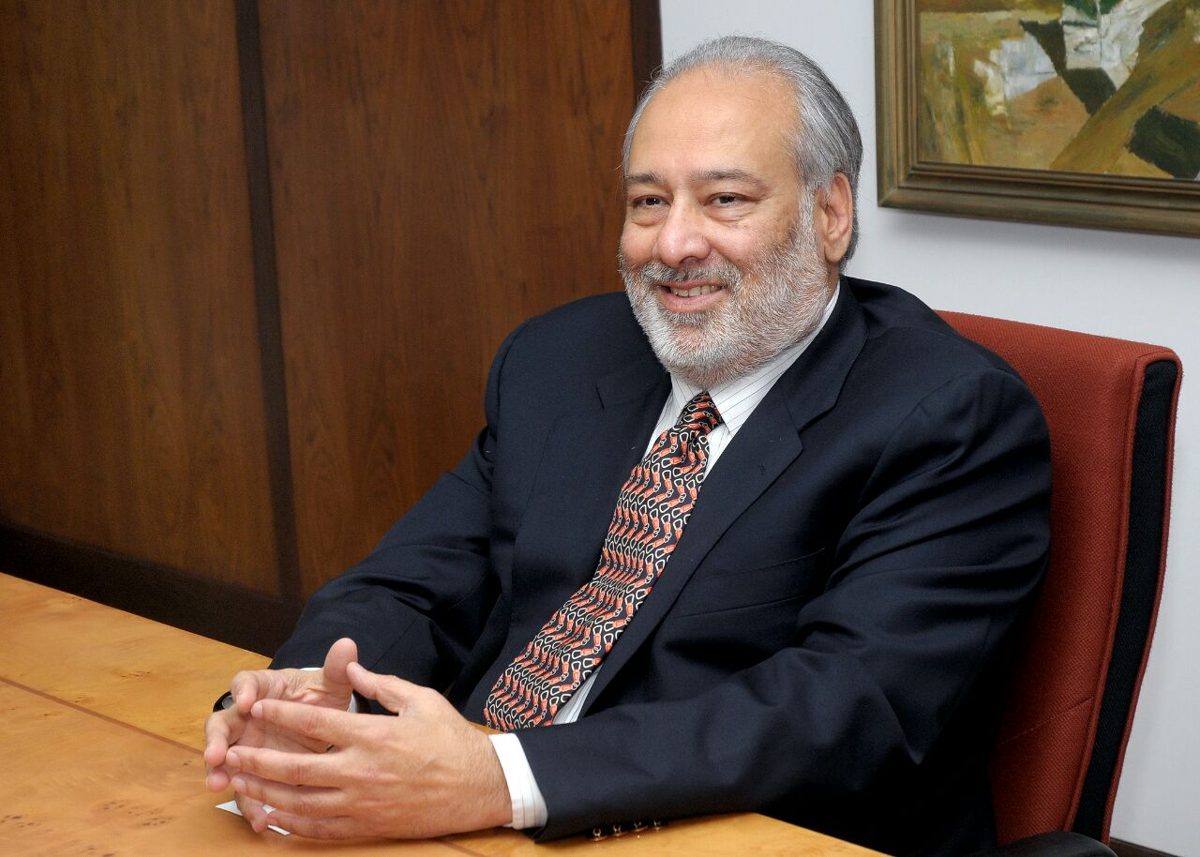
| Key facts | |
|---|---|
| Born | 10 April 1954 [1] |
| Hometown/Family roots | Ahmedabad, Gujarat; a Jain mill-owning family whose textile business goes back to the 1890s [9][16] |
| Education | B.Sc, Gujarat University; Master of Management Studies (finance), Jamnalal Bajaj Institute, Mumbai [23][1] |
| Family | Father Shrenik Kasturbhai Lalbhai; grandfather Kasturbhai Lalbhai; wife Jayshree; sons Punit and Kulin, both Vice Chairmen of Arvind [74][71][11] |
| Company/Group | Arvind Ltd (Chairman); Arvind Fashions (Chairman); Lalbhai Group |
| Known for | Turning a dying Ahmedabad cotton mill into one of the world’s biggest denim makers, surviving a Rs 2,700 crore debt crisis, Arrow and US Polo in India, the 2018 Arvind demerger |
In 1998, Arvind Mills did something it had never done in its history: it skipped its dividend. The company had just built a Rs 1,000 crore denim complex at Santej, outside Ahmedabad, with borrowed money. The plant was a year late, after heavy rain and flooding. Denim prices were falling. Around 80 lenders, in India and abroad, were starting to sue [18][19].
The man in charge was Sanjay Lalbhai, then in his mid-forties, grandson of Kasturbhai Lalbhai, one of the most respected names in Indian business. “The period from 1997 to 2002 were the worst years of my life,” he said later. “Even friends talked to me like I was a criminal” [18]. He sold personal property, including a flat in Mumbai, and put about Rs 70 crore of his own money into the company “to show our commitment” [18].
Arvind survived. A quarter of a century later it is a company with consolidated revenue of Rs 9,303 crore (FY26), a garment-making business that turns out more than 40 million pieces a year, a technical-textiles arm buying companies in the United States, and sister companies in fashion, real estate and engineering [3][2]. It is also one of the very few big Ahmedabad cotton mills of the 20th century still standing.
This is the story of how a reluctant student who failed to settle into two American universities became the man who bet an old mill on blue jeans, nearly lost it, and spent the next 25 years rebuilding it more carefully.
Where it began
A family that built Ahmedabad
To understand Sanjay Lalbhai you have to start with his surname. The Lalbhais are an Oswal Jain family whose roots in Ahmedabad go back to the 17th century; the Atul group traces 18 generations of the family’s history [16]. In 1896-97 Lalbhai Dalpatbhai set up the Saraspur mill, the family’s first textile company (sources differ on the exact year) [16][9].
His son Kasturbhai Lalbhai (1894-1980) took over the business as a teenager and turned it into a group of mills. In 1931, answering Mahatma Gandhi’s call for swadeshi, Kasturbhai and his brothers founded Arvind Mills in Ahmedabad [9][43]. In 1952 the family set up Atul Products at Valsad, a chemicals venture inaugurated by Jawaharlal Nehru [17][16].
Kasturbhai was more than a mill owner. He was FICCI president in 1934, a director of the Reserve Bank of India, a signatory of the 1944 Bombay Plan and co-founder of the Ahmedabad Education Society (AES) and of ATIRA, the textile research body set up with Vikram Sarabhai. In 1961 he rallied Ahmedabad’s industrialists to raise money that helped bring the Indian Institute of Management to the city [15]. Those institutions would later become a large part of his grandson’s life.
The son of an engineer, the grandson of a legend
Sanjay was born on 10 April 1954 [1]. His father, Shrenik Kasturbhai Lalbhai (1925-2014), was Kasturbhai’s younger son; he had studied engineering at MIT and business at Harvard, and later chaired Deepak Nitrite [17][74][16]. Kasturbhai’s elder son, Siddharth, built Atul Ltd, which is today run by Sanjay’s cousin Sunil Lalbhai [16].
The house he grew up in, Lalbaug in Shahibaug, had a lawn and a Chevrolet. But he cycled to school, his friends were mostly from ordinary homes, and dinner was served at 7 pm sharp because his grandfather lived a spare, Gandhian life [17]. He has told one story about his father many times. As a boy he picked up a pencil at home that belonged to the company; his father took it back. “It was an early lesson in trusteeship,” he said [17]. His mother pushed him towards music, painting and drama, and as a teenager he played drums in a school band [17].
A student who kept starting over
His education did not go to plan, and he says so freely. His father first sent him to the L.D. College of Engineering, a college the family had helped found; he left after six months. He could not get into St Xavier’s College, Ahmedabad, at first, spent two years at the M.G. Science Institute, and then moved to St Xavier’s, where he studied statistics and mathematics [17]. He graduated with a B.Sc from Gujarat University [23][1].
He did badly on the GMAT. At 23 he went to the United States for an executive programme at St John’s in New York and got into the University of Rochester, but came home. His father wrote to him: “I feel guilty that I pushed you into this, so please come back without any hesitation if your heart is not there” [17]. He then did a Master of Management Studies in finance at the Jamnalal Bajaj Institute in Mumbai, where his batch shrank from 48 to 17 and he once sat a final exam on a stretcher after surgery [17][23].
“There are no exemptions in life,” he concluded. “I believe there’s a thin line separating the successful and not so successful people - it’s their sheer perseverance” [17].
The first break
Joining a mill in trouble
Sanjay joined Arvind as a trainee in 1977, starting in materials management [17][21]. His uncle, Arvind Narottam Lalbhai (a cousin of his father), was chairman, and a professional, Manubhai Shah, ran the company day to day [17]. He joined the board on 17 March 1979 [10].
“When I joined, the company had existential problems,” he told Forbes India [21]. Ahmedabad was once called the Manchester of India, with dozens of composite mills that spun, wove and finished cloth under one roof. By the late 1970s they were being undercut by small powerlooms that paid little tax and faced little regulation [18][26]. “Ahmedabad had almost 65 composite mills, and everything has since vanished… except Arvind, because of denim,” he told GQ India in 2019 [27].
Thirty side ventures and a hard lesson
Before the big idea came, he went through a phase he now regrets. Between 1979 and 1985 he started some 30 to 40 ventures of his own - among them Amtrex, which made Hitachi air conditioners, the advertising agency Trikaya and a finance company called Anagram - funded with debt at about 18% interest that he guaranteed personally. “I had zero capital, also zero approval from the family,” he said. “It was a disastrous thought process. My simple advice is: never do something like this!” [17]
The bet on blue
By his own account he took over as managing director in 1985 [18]. Arvind then was “a 100% domestic business with womenswear as our domain”, making everything from saris to handkerchiefs [18][23]. That year the company adopted a strategy it called “Renovision”: move from the crowded domestic market to the world [9].
“In those dark days, I saw a ray of light when we stumbled on to denim,” he said. “That single ray of light meant we could experiment going global” [18]. He worked on the strategy with Vasant Mote of IIM Ahmedabad; the technology came from Arvind’s research head, P.R. Roy [18]. India had cheap, plentiful cotton, and denim was a fabric the whole world wore [26].
Arvind commissioned what it describes as India’s first denim manufacturing plant in Ahmedabad in 1987 (Forbes India dates the first plant on Naroda Road to 1986) [9][21]. Over the following years the company dropped about 250 products to concentrate on denim [23]. The first exports went to Russia through a trading house. “It was an instant hit,” he recalled [18].
Winning Western buyers was harder. “We had to fly in buyers to see our operations to convince them we could do it,” he told the Christian Science Monitor in 1997; “I was thrown out of some companies” [26]. It worked. By 1997 Arvind was described as the world’s third-largest denim maker, selling to about 70 countries and supplying Levi’s, Lee, Gap and JC Penney [26]. Arvind also owned Flying Machine, which it describes as India’s first denim apparel brand, launched in the early 1980s [10][9].
Building the empire
The 1990s: going for a billion dollars
In 1993, working with McKinsey, Lalbhai set Arvind two goals: US$1 billion in sales and the title of the world’s largest denim maker, within three years [22]. Arvind joined the Sensex, India’s benchmark index, in 1996 [22].
In September 1996 the company announced a Rs 850 crore expansion to add 40 million metres a year of denim, taking capacity from 80 to 120 million metres [24]. At around the same time Arvind licensed international brands for India - Arrow shirts and the jeans labels Lee and Wrangler (accounts date these deals to 1992-93) - and in 1995 launched Megamart, a chain of value stores [22][36].
The timing could hardly have been worse. Rivals including Raymond, Mafatlal-Burlington and Century rushed into denim. By February 1998 Arvind had 120 million metres of capacity but expected to sell only about 80 million metres; it had cut prices from Rs 105 to Rs 95 a metre the previous October [25]. The Santej project ran late, and the rupee fell [19].
Collapse and the great restructuring
Arvind went from a net profit of Rs 14.47 crore on sales of Rs 906 crore in 1998-99 to a net loss of Rs 271 crore in 1999-2000 [28]. Its debt reached about Rs 2,700 crore, owed to around 80 lenders in India and abroad [19][18][29].
Lalbhai’s answer was a restructuring of the entire debt with dozens of lenders at once. Under a scheme of arrangement sanctioned by the Gujarat High Court in April 2002, lenders who wanted their money back immediately took a cut of roughly half the principal; others accepted longer repayment at lower interest. Promoters and shareholders put in fresh money through a Rs 75 crore rights issue [12][33]. The court recorded that secured creditors holding about 88.6% by value of the valid votes approved the scheme [12].
The price of rescue was control. Lenders could name up to four directors on a board of twelve, help choose the chairman and finance director, appoint a monitoring accounting firm, and replace management if certain defaults occurred [30]. Lalbhai stayed on as managing director.
“To turn Arvind profitable again, the debt of Rs 2,700 crore was restructured,” he wrote in 2012. “The key learning from this experience was to not leverage the balance sheet” [19]. In the years that followed, Arvind also sold surplus land, raising Rs 255 crore [19]. By Fortune India’s account, its leverage fell from about six times in 2001 to around 1.1 times over the following decade [22].
The 2000s: from fabric to brands
Once the balance sheet was stable, Lalbhai began to change what Arvind was. “There are life cycles in a company’s history and you need to ride them,” he said in 2008. “You constantly need to reinvent, keeping values and core competence intact” [20].
The garment and brand business was moved into a separate unit, Arvind Brands, in 2006, and a joint venture with VF Corp was formed for Lee and Wrangler that year [36]. In 2011 Arvind sold its 40% stake in that venture to VF for Rs 257 crore [39]. In 2014 it bought the Murjani group’s 49% stake in the Calvin Klein venture in India for Rs 88 crore, partnering PVH, the American owner of Calvin Klein and Tommy Hilfiger [40].
The fashion side grew quickly. In FY05 the brands business made about Rs 200 crore of revenue at a loss; by FY14 its “power brands” alone - led by US Polo Assn, Arrow, Flying Machine and Tommy Hilfiger - brought in Rs 1,185 crore. Arvind then had about 30 brands and 1,130 stores [36]. “I may be the largest producer of denim globally, but I still account for only 2%,” he said that year, explaining why he wanted to be closer to the customer [36].
He became chairman of Arvind on 28 September 2007, after the death of Arvind Narottam Lalbhai in August that year [6]. Arvind’s revenue grew at about 17% a year from 2008 to reach Rs 4,925 crore in FY12, with capacity of 240 million metres of fabric [19].
New businesses: technical textiles, water, real estate
Lalbhai also used Arvind’s land, engineering skills and textile know-how to start businesses unrelated to fashion:
- Advanced materials. From around 2010, led by his elder son Punit, Arvind began making technical textiles - fabrics for protective clothing, industrial filters, composites and automotive uses [42][11]. By FY26 this division had revenue of Rs 1,839 crore [3].
- Real estate. Arvind Infrastructure was incorporated in December 2008 to develop the group’s land. It was demerged from Arvind in 2015 and renamed Arvind SmartSpaces in 2016 [41].
- Water. Arvind Envisol builds effluent-treatment and zero-liquid-discharge plants for industry. “Water will become a very important business for us,” Lalbhai said in 2017 [38].
- Engineering. The Anup Engineering, a group company that makes process equipment for refineries and chemical plants, became the fourth pillar [44].
“We ensure that every business grows at its logical pace, but we don’t over-leverage,” he said [38].
2017-2019: breaking up to grow
In November 2017 Lalbhai announced that Arvind would split into three listed companies. Shareholders would get one share of Arvind Fashions for every five Arvind shares, and one share of The Anup Engineering for every 27 [44]. “Financial independence will help unlock the full potential of these businesses,” he said, while committing Rs 1,500 crore over three to four years to transform the textile business [44]. The National Company Law Tribunal approved the plan in 2018 and Arvind Fashions listed on 8 March 2019 [45].
At the same time Arvind pushed deeper into garment-making, so it could sell finished clothes to global brands instead of only cloth. In January 2019 it opened a Rs 350 crore garment hub at Bavla in Gujarat, built to make 3 million garments a month and employ about 12,000 people, and a Rs 300 crore plant in Ranchi. “At present only 10% of the fabrics we produce are converted into garments,” Lalbhai said [46].
The present: tariffs, trade deals and a US acquisition
In May 2024 the board changed Lalbhai’s title from Chairman and Managing Director to Chairman; longtime executive Susheel Kaul became MD, and both sons became Vice Chairmen [47]. From 1 April 2026 Punit took an executive role leading textiles and apparel [5].
The last two years have tested the business. In 2025 the United States raised tariffs on Indian goods, at one point to an effective 50%; Arvind paused discretionary capital spending and estimated an EBITDA hit of Rs 25-30 crore a quarter [48][2]. “We are in the eye of the storm,” Kulin Lalbhai said in September 2025, describing how Arvind’s teams visited Europe, Japan and Australia more in one month than in the previous five years [49]. In February 2026 an India-US interim trade deal cut the tariff to 18% [50]. (For the wider picture, see CapitalVia’s note on how electronics exports overtook textiles.)
Even so, FY26 was a record year. Consolidated revenue rose 12% to Rs 9,303 crore, EBITDA to Rs 1,061 crore and profit (before exceptional items) to Rs 444 crore; garment output reached a record 41.6 million pieces [3]. In May 2026 Arvind Advanced Materials agreed to buy about 61% of the US nonwovens maker Dalco-GFT for about US$136 million - “a transformational milestone”, Punit Lalbhai called it [51]. In August 2026 Arvind raised about Rs 500 crore from institutional investors, and in the July-September 2026 quarter it posted record revenue of Rs 2,919 crore [52][4].
“In a volatile world, a strong balance sheet is a strategic asset,” Lalbhai wrote in his FY26 letter to shareholders - a sentence that reads very differently coming from someone who learned it the hard way [2].
How the wealth is held
The Lalbhai family’s stake in Arvind sits mainly in a holding company. As of June 2026, promoter entities held 39.5% of Arvind, most of it (34.2%) through Aura Securities Pvt Ltd; Atul Ltd, run by the other branch of the family, held another 1.6%. Sanjay Lalbhai himself held only 170 shares directly [53]. After the August 2026 share sale, the promoter stake was diluted to about 38% [53]. The family also controls Arvind Fashions, Arvind SmartSpaces and The Anup Engineering through promoter entities.
No reliable published estimate of his personal net worth exists: he does not appear by name in the recent Forbes or Hurun India rich lists, and CapitalVia does not estimate one.
The setbacks and failures
The debt crisis of 1997-2002 was the defining failure, and Lalbhai has never played it down. “There was no one I could blame,” he said [18]. “It was the greatest business lesson of my life: if you overleverage and don’t give yourself time, things will go wrong. You cannot assume they will go right” [18].
It was not the last bad patch.
- 2008-09. The global financial crisis brought a consolidated net loss of about Rs 99 crore, with foreign-exchange losses and gas shortages. Crisil cut Arvind’s rating to the default category in February 2009, which Arvind disputed, saying its lenders had already approved rescheduling of loan payments [7][35].
- Megamart. The value-retail chain peaked at over 200 stores. About 30 loss-making stores were shut in late 2015 and the rest were turned into a new chain, Unlimited [54][37].
- Arvind Fashions after the demerger. Losses mounted. In May 2019 the company said it would exit loss-making licences such as Gant, Izod and Nautica [55]. CARE downgraded its rating in February 2020 [56]. The Gap franchise was ended in 2020 [57]. In 2021 Unlimited’s 74 stores were sold to V-Mart for about Rs 150 crore [58], and in 2023 the Sephora India business went to Reliance Retail for Rs 99 crore [59]. The slimmed-down company returned to profit, reporting about Rs 184 crore in FY26 [60].
- Covid-19. In the April-June 2020 quarter Arvind’s income fell about 69% and it posted a pre-tax loss of Rs 156 crore [61].
- The 2024 strike. A 21-day strike at the Santej plant in May-June 2024, later declared illegal by a labour court, cost an estimated Rs 180-200 crore of revenue [63][64][65].
Controversies and allegations
Sanjay Lalbhai has not personally been named in any regulatory or criminal order that CapitalVia could find. No SEBI enforcement order, CCI, ED, CBI or SFIO case against him or the Arvind companies surfaced in our search of records and major publications. The matters below concern the companies he leads.
Foreign lenders’ criminal complaints (2001-2002)
Allegation: During the debt restructuring, some dissenting foreign lenders, led by Germany’s Commerzbank, alleged that mortgaged assets had been sold to repay ICICI, the lead lender, and that assets were moved to subsidiaries. In 2001 Commerzbank filed criminal complaints in Mumbai and Ahmedabad against unnamed executives of ICICI and Arvind Mills, alleging criminal breach of trust and conspiracy [34][31]. Sanjay Lalbhai was not named.
Response: Arvind called the case an abuse of the legal process meant to pressure it into paying some lenders ahead of others [32].
What happened next:
- In June 2001 the Gujarat High Court stayed the Ahmedabad complaint [32].
- In April 2002 the High Court sanctioned the restructuring scheme, rejecting the dissenting lenders’ objections, while leaving any civil or criminal claims open [12].
- Commerzbank withdrew its appeal, and the Supreme Court quashed its criminal complaint [33].
Status: Closed. No finding of wrongdoing was made against Arvind or its executives.
The Sabarmati pollution case and the Ankur unit (2021-2022)
Allegation: In a public-interest case it started on its own about pollution of the Sabarmati river, the Gujarat High Court ordered industrial units discharging effluent into Ahmedabad’s sewers to be disconnected. Around 141 units were cut off in November 2021, including Arvind’s Ankur unit, and the Gujarat Pollution Control Board issued a closure order for it [8][66]. In January 2022 the court rejected the textile units’ applications to reconnect, holding that industries have no legal right to discharge effluent into city sewers and citing a joint task force’s finding of “serious technical inadequacies” in the units’ treatment plants as a group [66].
Response: Arvind said the Ankur unit held the approvals needed to discharge treated effluent, and challenged the action in court [8].
What happened next:
- Arvind moved the unit to zero liquid discharge, recycling its water rather than sending it to the sewer; a 2023 National Green Tribunal order notes that the High Court recorded this [13].
- The unit fully resumed operations on 9 March 2022. Arvind estimated the shutdown cost about Rs 40 crore of revenue [67].
Status: Resolved. No penalty specific to Arvind was found.
Real estate buyers’ complaints (2024-2026)
Allegation: Buyers of villas in Arvind’s “Forreste” weekend-home project in Kalol taluka, Gujarat, complained to the state’s real estate regulator, GujRERA, about late possession and, in one case, about construction quality, charges and promised amenities [68].
Response: No public statement from the company was found.
What happened next:
- In May 2026 GujRERA ordered Arvind SmartSpaces to pay five buyers 10% interest from the promised possession dates and to install roof railings. It rejected the buyers’ other complaints, including the claims of fraud and poor construction [68].
Status: Order passed in May 2026; whether it was appealed was not reported as of 10 November 2026.
Electoral bond purchases (disclosed 2024)
Allegation: No wrongdoing has been alleged. But when the Election Commission published electoral bond data in March 2024, after the Supreme Court struck down the scheme in February 2024, Arvind Limited appeared as a buyer of Rs 9 crore of bonds, all redeemed by the BJP, according to data compiled by the Association for Democratic Reforms [14].
Response: CapitalVia found no public comment from Arvind on its purchases.
Status: The purchases were legal when made. No investigation or allegation of any favour in return has been reported.
Labour disputes
Allegation: Workers at the Santej complex struck in October 2015 over wages and bonus, and again in May-June 2024, alleging exploitation, irregular working hours and no increments [62][63].
Response: In 2015 Arvind called the strike illegal, saying wages had been settled until 2018; in 2024 a labour court declared the strike illegal [62][64].
Status: Both strikes were called off and work resumed.
Status as of 10 November 2026.
Giving back
The Lalbhai family’s public life has always run alongside its business, and Sanjay has made education his main cause.
He is president of the Ahmedabad Education Society, the body his grandfather co-founded in 1935-36, and the force behind Ahmedabad University, which AES set up under a Gujarat law in 2009 [69][1]. As the university’s chancellor, he has described its aim as “a comprehensive university system in Ahmedabad”, and at its 2024 convocation spoke of making it “a holistic center of education” in the spirit of Nalanda and Takshashila [70]. He also chairs the governing body of CEPT University, the architecture and planning school, and has served on the governing board of IIM Ahmedabad [1][71]. He chairs ATIRA’s council and sits on the council of the Physical Research Laboratory [1].
With his wife Jayshree, he turned the family home, Lalbaug, into the Kasturbhai Lalbhai Museum, and he founded the Arvind Indigo Museum [71][2]. He chairs the Gujarat Museum Society and the Lalbhai Dalpatbhai Institute of Indology [1].
Arvind’s own giving runs through the SHARDA Trust and the Arvind Foundation, which work on education, urban development and relief. In FY26 Arvind spent Rs 10.63 crore on CSR, more than its legal requirement of Rs 7.69 crore [2].
He has practised Heartfulness (Sahaj Marg) meditation since 1994 and has trained others in it since 2015 [1][17].
Succession
Lalbhai learned early that family and management can clash. “I knew if you mix management and ownership, there would be problems,” he said. “The best thing is to hand over the management to a neutral guy” [18]. His succession plan has mixed the two: professional chief executives run the businesses, while his two sons hold the chairs.
- Punit Lalbhai (born 1982), who studied conservation biology at UC Davis and environmental studies at Yale and has an INSEAD MBA, joined Arvind in 2007 and built the advanced materials business [21][42]. He chairs Anup Engineering and, from April 2026, leads the textiles and apparel business as Vice Chairman of Arvind [2][5][11].
- Kulin Lalbhai (born 1985), a Stanford engineering graduate who worked at McKinsey and has a Harvard MBA, launched Arvind’s online fashion business. He is Vice Chairman of Arvind Ltd and Arvind Fashions and, since November 2025, Chairman of Arvind SmartSpaces [2][72][73].
When he handed the SmartSpaces chair to Kulin, Sanjay called it “part of the company’s succession planning process” [73]. He remains Chairman of Arvind Ltd and Arvind Fashions [2]. On the family’s money, he said in 2018: “Our approach is that the investment is not for the next gen but the one beyond that” [75].
What their journey teaches
Debt kills time, and time is what a big project needs. Arvind’s denim bet was right; its timing and funding were wrong. A plant that runs a year late is survivable with equity and fatal with too much debt. Lalbhai’s own summary - don’t leverage the balance sheet - is the lesson he took from it [19].
Own the mistake in public. He did not blame the floods, the rupee or his rivals. “There was no one I could blame,” he said, and he put his own money in [18]. That helped keep about 80 lenders at the table long enough to agree a deal.
Reinvention is a habit, not an event. Arvind moved from saris to denim, from denim to shirting, from fabric to brands, then to garments, technical textiles, water and housing. “You constantly need to reinvent, keeping values and core competence intact,” he said [20].
Cut what doesn’t work, even if you built it. Megamart, Unlimited, Gap, Sephora and several licensed brands were closed or sold. The fashion business returned to profit only after it got smaller [58][59][60].
Split businesses so each can be judged on its own. The 2018 demerger gave fashion, engineering and real estate their own balance sheets, managers and shareholders, and stopped one business’s losses from hiding inside another’s profits [44].
Institutions outlast fortunes. The schools his grandfather helped found are still standing long after most of Ahmedabad’s mills closed. Sanjay has spent much of his later life building Ahmedabad University for the same reason.
A profile for general reading, based on public records and reporting as of 10 November 2026. Not investment, tax or legal advice.
Sources (75)
- Arvind SmartSpaces Integrated Annual Report 2023-24 (AGM notice, director profile, p.297) - Arvind SmartSpaces, Jul 2024
- Arvind Limited Integrated Annual Report 2025-26 - Arvind Ltd, Aug 2026
- Arvind Ltd Q4 and FY26 earnings release - Arvind Ltd, May 2026
- Arvind Ltd Q2 FY27 results filing - NSE, Oct 2026
- Arvind Ltd intimation on leadership changes - NSE, Dec 2025
- Arvind Mills Annual Report 2007-08 - Arvind Ltd, May 2008
- Arvind Annual Review Note 2008-09 - Arvind Ltd, May 2009
- Arvind Limited update on Ankur unit - Arvind Ltd (stock exchange filing), Nov 2021
- About us: heritage timeline - Arvind Ltd, Nov 2026
- Sanjay S. Lalbhai, director profile - Arvind Ltd, Nov 2026
- Leadership - Arvind Ltd, Nov 2026
- Arvind Mills Ltd scheme of arrangement judgment, Gujarat High Court - Indian Kanoon, Apr 2002
- National Green Tribunal order in OA 91/2023 - Indian Kanoon, Jul 2023
- Electoral bonds: donor-wise bond details - ADR / MyNeta (ECI data), Mar 2024
- Shri Kasturbhai Lalbhai - IIM Ahmedabad, Nov 2026
- Our heritage - Atul Ltd, Nov 2026
- There are no exemptions in life - Outlook Business, Mar 2018
- You have to give your best even when you know the shutters can come down any time - Outlook Business, Mar 2018
- Sanjay Lalbhai on turning Arvind Mills profitable again - Business Today, Jul 2012
- How Sanjay Lalbhai is reinventing Arvind - Business Today, May 2008
- A New Fabric (cover story) - Forbes India, Sep 2023
- Phoenix Rising - Fortune India, Dec 2013
- Denim sultan - Business Standard, Aug 2010
- Arvind Mills lines up Rs 850 crore expansion - Business Standard, Sep 1996
- The denim giant stumbles - Business Standard, Feb 1998
- Dungarees fit Delhi just fine - Christian Science Monitor, Nov 1997
- Into the Blue - GQ India, Mar 2019
- Arvind Mills board okays new revamp package - Business Standard, Feb 2002
- We expect to perform even better (interview with CFO Jayesh Shah) - Business Standard, Aug 2001
- Arvind lenders pin management clause to revamp - Business Standard, Aug 2001
- ICICI, Arvind Mills face Commerzbank criminal suit - Business Standard, Jun 2001
- HC stays criminal case vs Arvind - Business Standard, Jun 2001
- Commerzbank pulls back Arvind plea - Business Standard, Aug 2002
- Foreign creditors feel the pinch - Euromoney, Oct 2001
- Arvind reschedules loan payments - Business Standard, Feb 2009
- A brand new spin - Outlook Business, Sep 2014
- Creative Destruction - Outlook Business, Jul 2017
- We ensure that every business grows at its logical pace: Sanjay Lalbhai - Business Standard, Jan 2017
- Trilegal acts on VF Corp purchase of Arvind stake in Indian JV - Bar & Bench, Nov 2011
- Arvind buys Murjani stake in Calvin Klein JV - Business Standard, Mar 2014
- Arvind SmartSpaces company history - Goodreturns, Nov 2026
- Next-generation entrepreneurs: Punit Lalbhai and Kulin Lalbhai - The Textile Magazine, Dec 2016
- Lalbhai group history - Indian Textile Magazine, Sep 2011
- Arvind to demerge branded apparel and engineering businesses - domain-b, Nov 2017
- Arvind Fashions share listing on BSE and NSE - Business Today, Mar 2019
- Arvind launches huge garmenting hubs in Gujarat and Jharkhand - The Textile Magazine, Jan 2019
- Board of Arvind approves change in directorate and senior management - Business Standard, May 2024
- Arvind flags margin pressure from US tariffs, pauses capex - Business Standard, May 2025
- Arvind looking to diversify markets as tariffs hit exports - Informist, Sep 2025
- Textile stocks after the US-India trade deal - Finology Ticker, Feb 2026
- Arvind Advanced Materials enters USA through acquisition of Dalco-GFT - Textile World, May 2026
- Arvind Limited approves qualified institutions placement - Investywise, Aug 2026
- Arvind Ltd shareholding pattern, June 2026 - Trendlyne, Jul 2026
- Arvind shuts 30 Megamart stores while restructuring - FashionUnited, Feb 2016
- Arvind Fashion exiting loss-making MNC brands - FashionUnited, May 2019
- Arvind Fashions slumps after CARE downgrade - Business Standard, Feb 2020
- Arvind Lifestyle Brands and Gap terminate franchise agreement - Apparel Resources, Sep 2020
- Arvind Fashions to sell Unlimited retail business to V-Mart - Business Standard, Jul 2021
- Arvind Fashions sells Sephora India business to Reliance Retail for Rs 99 cr - Business Today, Nov 2023
- Arvind Fashions Q4 FY26 results - Outlook Business, May 2026
- Lockdown-hit Arvind posts Q1 consolidated loss before tax of Rs 156 cr - Business Standard, Aug 2020
- Arvind's 7,000 workers go on strike - Apparel Resources, Oct 2015
- Labourers go on strike at Arvind Mills Santej unit - DeshGujarat, May 2024
- Arvind: strike at Santej plant called off - Angel One, Jun 2024
- Arvind Q1 FY25 result: net profit drops 40% due to elections, workers strike - Storyboard18, Jul 2024
- Gujarat High Court on Sabarmati pollution: Arvind Limited v. Suo Motu - LiveLaw, Feb 2022
- Arvind stock rises on resumption of operations at Ahmedabad unit - Business Today, Mar 2022
- GujRERA directs Arvind SmartSpaces to compensate buyers over delay in villa project - DeshGujarat, May 2026
- AES members aspire to transform Ahmedabad into India's first education district - DNA, Mar 2009
- Will make Ahmedabad University a holistic centre of education: Lalbhai - ThePrint (PTI), Dec 2024
- Shri Sanjay Lalbhai - CEPT University, Nov 2026
- I am more than my surname: Punit and Kulin Lalbhai - Entrepreneur India, Sep 2016
- Kulin Lalbhai elevated as chairman of Arvind SmartSpaces - Media Infoline, Nov 2025
- Industrialist Shrenik Lalbhai passes away - Business Standard (PTI), Jun 2014
- Sanjay Lalbhai: Where the rich are investing - Outlook Business, Nov 2018