
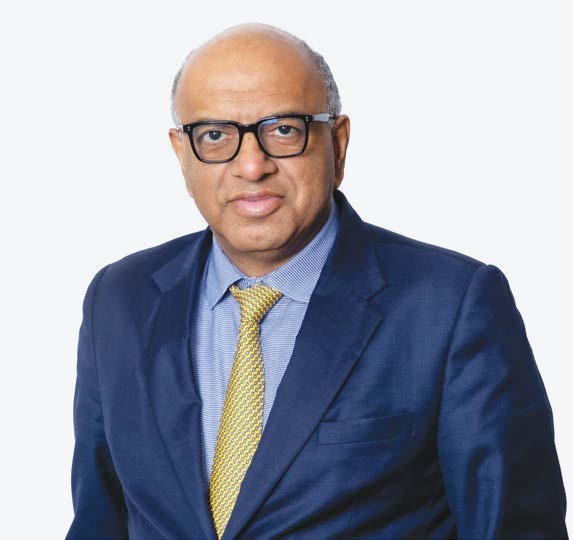
| Key facts | |
|---|---|
| Born | 1963, Delhi [92][1] |
| Family roots | Sindhi family; father Dr Ram Lokram Bikhchandani, a government doctor; mother Dayawanti, a homemaker [1][13][20] |
| Education | St Columba’s School, Delhi; BA Economics, St Stephen’s College (1984); PGDM, IIM Ahmedabad (1989) [1][20] |
| Family | Wife Surabhi Bikhchandani, his IIM Ahmedabad batchmate; two children; elder brother Sushil Bikhchandani, a UCLA economist [1][28] |
| Company | Info Edge (India) Ltd: Naukri.com, 99acres, Jeevansathi, Shiksha; early investor in Zomato (now Eternal) and Policybazaar (PB Fintech) [2] |
| Wealth | About US$2.8 billion (Forbes real-time, 17 October 2026); Rs 23,530 crore with family (360 ONE Wealth Creators List 2026) [43][48] |
| Known for | Founding Naukri.com in 1997 after seven years of bootstrapping, and backing Zomato and Policybazaar when they were tiny [4][2] |
In 1990 a young brand manager at Hindustan Milkfood Manufacturers, the company that made Horlicks, was standing in the heat of Madurai with two labels in his hands. One was the old red-and-blue Horlicks pack, the other a new design with a golden line. His job that day was to find out which one sold better. By lunchtime, after 25 or 30 shops, he had his answer: the cheaper one sells more. He walked to the Meenakshi temple, did the parikrama, took prasad for his mother, and wrote up his report: “test marketing successful and should be extended nationally” [14].
“I didn’t study so much to do this,” Sanjeev Bikhchandani remembers thinking. “I didn’t want to be a prisoner of EMIs and visiting cards” [14]. Within months he had quit, moved his work into the servant’s quarters above his father’s garage in east Delhi, and started a business with no computer, no investor and no salary [13][14].
It would take him seven years to find the idea that worked, Naukri.com, and three more before anyone gave him outside money [13][26]. Today Info Edge, the company he built around that website, is worth tens of thousands of crores, and its early cheques into Zomato and Policybazaar are among the most successful venture bets in Indian history [2]. Forbes put his own fortune at about US$2.8 billion on 17 October 2026 [43].
This is the story of how a government doctor’s son who turned down IIT became the patient father figure of Indian internet start-ups: what he got right, what went badly wrong, and why his outspoken views keep landing him in the news.
Where it began
Sanjeev Bikhchandani was born in Delhi in 1963 into a Sindhi family [92][22]. His father, Dr Ram Lokram Bikhchandani, was a doctor in government service; his mother, Dayawanti, ran the home [1][20]. “My father is a doctor and he was in the government from 1950 to 1983. So we were brought up in government colonies,” he told an interviewer in 2007 [13].
That upbringing shaped one of his earliest decisions. “I knew that I didn’t want to join government service, after my father’s experience, because in government, you are financially very badly off if you are honest,” he said. “There was no way I was going to be dishonest, because those were not the values we were brought up with” [13].
The ambition came early, if vaguely. “At 10, I wanted to be Sunil Gavaskar, at 11, Rajesh Khanna. A year later, an entrepreneur – it was a fuzzy kind of a goal, but I kept returning to it. Maybe, because I thought it was easier to become an entrepreneur than India’s best batsman or actor… it wasn’t!” [14]. By 12 or 13, he says, the plan was fixed: an MBA, a few years in a job, then his own company [13].
He studied at St Columba’s School in Delhi, as his elder brother Sushil had before him [13][17]. Sushil, seven years older, set a high bar: IIT Kanpur, IIM Ahmedabad and a PhD from Stanford, followed by a long career as an economics professor at UCLA’s Anderson School [28][16]. Sanjeev qualified for IIT too, but did not go. “My rank wasn’t great. I wouldn’t have got the top three or four departments. Secondly, I went for a medical test and found out I was colour-blind – partially. Thirdly, it was a five-year course” [13]. He chose a three-year economics degree at St Stephen’s College instead, graduating in 1984 [1][20].
His brother advised him not to do an MBA straight away, because it was “useless unless you work for a while” [13]. So he joined the advertising agency Lintas as one of its first graduate trainees, working in Delhi and then Mumbai for about three years [13][1]. Client servicing was humbling. “When you are a trainee, at the bottom of the chain, you get kicked around because you have zero authority… I had to plead to get work done” [14]. Years later he credited the job with teaching him people skills and how to communicate [14].
He then went to IIM Ahmedabad, graduating in 1989 [1][16]. There he took the entrepreneurship electives and found “a group of us who would talk about entrepreneurship, think entrepreneurship” [16]. He also met Surabhi Motihar, a batchmate who would become his wife and, in his telling, his first investor [20][21]. Because he already had work experience, he skipped campus placement, but he watched it closely. Recruiters fought over students so fiercely that one firm pushed candidates to sign offer letters on the spot. “That’s when I realised companies would go to any length to get the right talent,” he said [14]. The observation would later become a business.
The first break
The Horlicks job and the back pages of Business India
After IIM he joined HMM (Hindustan Milkfood Manufacturers, later part of GlaxoSmithKline Consumer Healthcare) in brand management on Horlicks, and stayed about a year and a half [13][27]. It was there that he noticed something small. “When an office copy of Business India came in, everybody used to read it from back to front. It had 35 to 40 pages of appointment ads in every issue… even if you are not looking for a job, you look at a job” [13]. Headhunters called his colleagues every week with jobs that were never advertised. He filed the thought away as “one of a thousand ideas – file and forget kind of thing” [13].
He was earning a salary he describes as decent for 1990 (accounts vary between Rs 80,000 a year and Rs 8,000 a month) [13][18]. What gave him the nerve to give it up was his marriage. “That strength came only after marriage. Surabhi was doing well at Nestle,” he wrote later [14]. “I had told her that we will be living off your salary for quite a while. She was cool with it” [16].
Seven years of drifting
In 1990 he quit [20][25]. With a partner named Kapil, he put in Rs 1,000 for letterheads and visiting cards [14]. They paid his father Rs 800 a month in rent for the servant’s quarters above the garage at the family home in east Delhi [13][19][14]. “Those were hard days – Rs 800 evaporated every month as rent. I was plodding around in a scooter when my classmates were eyeing their next car” [14].
A computer cost more than three times an IIM graduate’s average salary, so a friend, Jeyadev, gave them a duplicate key to his office. “We would sneak in at 10 PM and sneak out at 4 AM” [14].
The two ran two small businesses. Info Edge sold salary surveys, the idea he had picked up watching placement day. The first survey brought in Rs 80,500 from companies that wanted copies, and they kept publishing it until 1998 [14]. Kapil’s business, Indmark, sold trademark search reports to pharmaceutical companies at Rs 350 each [13][14]. Both men agreed not to take a salary home until they broke even [14]. A bank took six months to give them a Rs 30,000 overdraft [14].
There were dead ends. The Department of Telecommunications invited private firms to provide content for a “Videotex” service, with terminals in telephone exchanges. Bikhchandani pitched a searchable jobs database at Rs 50 a search, was shortlisted, and submitted a detailed plan, before the government cancelled the project [13][14][16]. Sources date this to anywhere between 1990 and 1993.
Around 1993 the partners split amicably: Kapil kept the trademark business, and Bikhchandani kept Info Edge, its surveys and the idea of a jobs database [13][16]. The company was formally incorporated as Info Edge (India) Private Limited on 1 May 1995, with share capital of exactly Rs 200 [1][12].
To keep the household going he taught weekend classes at coaching institutes for about Rs 2,000 a month, “enough for booze and cigarettes since I didn’t want to be a fully-kept man” [18]. Later he took a part-time job as consulting editor of the Pioneer newspaper’s careers supplement, offered by its editor Chandan Mitra [14][19]. Across his first ten years in business he went about six years without drawing a salary [21][16]. “I drifted for seven years,” he would say later [26].
October 1996: “www”
The turn came at the IT Asia exhibition at Pragati Maidan in October 1996. Bikhchandani made a habit of visiting the small stalls. One had “www” written on it.
“I asked this guy what it meant, he said it was the World Wide Web… He was a retailer, reselling VSNL e-mail accounts. I said I don’t want e-mail, show me the Internet. So he took me to a site called Yahoo!… I asked him how many users are there in India. He said 14,000” [13]. When he said he wanted to build a website, the man told him he couldn’t help: the servers were all in the US [13].
He called his brother in California. “Have you heard of the internet?” Sushil laughed: they used it every day. “But I don’t have any money,” Sanjeev said. “Don’t worry, I will pay for your server until you are able to do it,” his brother replied [16]. The shared server cost US$25 a month. Sanjeev gave his brother 5% of the company in return, although Sushil had not asked for it [16][13][18].
He gave away more. A freelance programmer, Anil Lall, got about 7% for building the site, and V.N. Saroja, a junior from IIM Ahmedabad, got 9% for running operations while Bikhchandani worked at the Pioneer [13][14][1]. “By now I’d given away around a fourth of the company, but a fourth of zero is still zero!” he joked in 2005 [18].
Every domain name with “job” in it was taken, so he settled for the Hindi word “naukri” [19]. The domain was registered on 27 March 1997 [1], and Bikhchandani dates the launch to 2 April 1997 [13][14]. Two data-entry operators who had little else to do re-keyed job advertisements from about 29 newspapers. “In three days, they had 1,000 jobs,” he recalled [13]. For the first six months the office had no internet connection; they would carry floppy disks to Anil Lall’s house to upload the site [16].
The first paying customer was an auto-parts company in Pune, which asked if Naukri would post five openings it had never advertised. “Rs 350 per listing. That was the first number that popped up in my head! That’s what we had charged for the trademark report” [14]. Revenue was Rs 2.35 lakh in the first year, around Rs 18 lakh in the second and Rs 36 lakh in the third [14][13][17]. After the second year he shut his other lines of business and put everyone on Naukri [13][16].
His days in that period ran from 5 am to midnight. “I would wake up at 5 AM… work for two hours and reach the office at 10:30 AM. I would leave for The Pioneer at 2 PM, come back at 7 PM and work on till midnight” [14].
Building the empire
The ICICI cheque and the crash
By 1999, investors were calling. He turned them away, including an American venture capitalist offering US$2 million for 25% and a Nasdaq listing. “I told him I couldn’t list in Paharganj if I wanted to,” he said [14]. What changed his mind was a rival. JobsAhead.com, backed by ChrysCapital, launched with advertising during a cricket tournament in Sharjah on a budget about twice Naukri’s annual turnover [14][18].
On 8 April 2000, Info Edge signed an investment agreement with the ICICI Information Technology Fund, managed by ICICI Ventures. The fund paid Rs 7.29 crore in tranches for about 15% of the company [1][17][18]. “We were the last or second last dot-com in India to get funded,” he said [13]. He put the money in fixed deposits. “ICICI thought I was crazy,” he recalled [14].
The caution paid off. Within months the dot-com bubble burst. After the 11 September 2001 attacks the company was losing about Rs 25 lakh a month with around 16 months of cash left. It cut costs, built a sales force, and broke even by 2002 [15]. ICICI, he noted, never asked to revise the valuation or held back a tranche [13]. Its eventual return was 28.5 times its money [22][23].
The same year brought the most important hire of his career. Hitesh Oberoi, an IIT Delhi and IIM Bangalore graduate working at Hindustan Lever, joined on 1 March 2000 [1]. He had come to ask Bikhchandani for advice about another start-up’s offer. After two or three hours, Bikhchandani said: “Yeh sab theek hai. But why don’t you join us instead? You will be happier here because we will give you less money and salary but we will give you more stock” [16]. The other start-up folded a few months later [16]. Oberoi would go on to run the company.
The business plan Bikhchandani had shown ICICI projected Rs 12 crore of revenue in five years. The actual figure was Rs 84 crore [14][24].
India’s first internet IPO at home
In November 2006, Info Edge became one of the first internet companies to list on Indian stock exchanges. It sold 53.24 lakh new shares at Rs 320 each, raising Rs 170.36 crore [3][31]. The issue was subscribed about 55 times [29][31]. On listing day, 21 November 2006, the stock closed at Rs 593, up 85%, valuing the company at Rs 1,619 crore [30][3]. Bikhchandani and his wife held 44.6% between them, worth about Rs 722 crore that evening [29].
He was still living in his father’s house and driving a ten-year-old Opel Astra, Business Today reported [17]. In FY2007, the first year as a listed company, Info Edge earned revenue of Rs 139.6 crore and a profit of Rs 27.1 crore [3]. He later admitted, “Maybe we underpriced the IPO” [24].
More portals: matrimony, property, education
Bikhchandani’s plan was to repeat the Naukri formula of classifieds on the internet in other parts of Indian life.
- Jeevansathi.com, a matrimonial site Anil Lall built in about a week, launched in October 1998 [24][1]. ICICI wanted the company to focus on jobs, so it was sold off, and Business Today reports it was bought back in 2004 [24]. By 2007 it was a wholly owned subsidiary [3].
- 99acres.com, a property portal, followed in 2005 [32].
- Naukrigulf.com for Gulf jobs launched in 2006-07 [3], and Shiksha.com, an education portal, in May 2008 [4].
- Later came FirstNaukri for campus hiring, the AmbitionBox company-review platform (2017), iimjobs and hirist (bought for Rs 80.82 crore in 2019), the blue-collar jobs app Jobhai (built in-house), DoSelect (Rs 21 crore, 2021) and a controlling stake in Coding Ninjas (2022) [4][40][6][90][91].
Naukri remained the engine. In FY2026, Info Edge’s standalone revenue was Rs 3,052 crore, of which recruitment contributed Rs 2,256 crore, with an operating margin of about 57% in that segment [2][8]. The company’s profit before exceptional items was Rs 1,103.6 crore [2].
The investor years: Zomato and Policybazaar
In July 2010 Bikhchandani handed day-to-day control to Oberoi, who became managing director and CEO. Bikhchandani became founder and executive vice-chairman, with a brief to focus on “strategic matters, investments and acquisitions” [39][4]. The annual report that year said he had “taken focused charge of identifying and nurturing such investments” [4].
He was already busy. In FY2009 Info Edge had put Rs 20 crore into Etechaces, the company behind Policybazaar, for a 49% stake [4][32]. In FY2011 it committed Rs 4.7 crore to a small Delhi restaurant-listing start-up then called Foodiebay, which became Zomato [4][34]. Over the next three years Info Edge was the only institutional investor across four Zomato rounds, putting in about Rs 86 crore in total [92][32].
These were not sure things. In FY2016 Zomato’s losses, consolidated into Info Edge’s accounts, pushed the group into a large consolidated loss even though the core business remained profitable [5]. Bikhchandani held on.
When Zomato listed in July 2021, Info Edge halved the shares it planned to sell, from Rs 750 crore to Rs 375 crore [35]. Its remaining stake was worth about Rs 9,455 crore at the IPO price [34]. Policybazaar’s parent, PB Fintech, listed in November 2021 at Rs 980 a share [36]. By 31 March 2026, Info Edge held 12.43% of Eternal (Zomato’s new name), bought at a cost of about Rs 146 crore and then worth Rs 27,468 crore, and 12.12% of PB Fintech, bought for about Rs 568 crore and worth Rs 8,209 crore [2]. By 30 July 2026 the two listed stakes together were worth about Rs 46,400 crore, according to the company [2].
To keep investing, Info Edge raised Rs 750 crore through a share sale to institutions in 2014 and Rs 1,875 crore in August 2020 [6][37]. It also built a venture-fund arm. Its first fund, Info Edge Venture Fund I, launched in 2020 with a planned Rs 750 crore, half of it committed by Singapore’s Temasek [6][38]. Further funds followed, including a Rs 1,272 crore second fund and the Rs 638 crore Capital 2B deep-tech fund [2]. By FY2026 Info Edge said it had backed 135 start-ups [2].
His investing philosophy is blunt. “We don’t want founders who want to sell secondary early,” he wrote in 2022. “We seek entrepreneurs who want to run the company for the rest of their lives if needed” [84].
How his wealth is held
Bikhchandani’s fortune is almost entirely his stake in Info Edge, a listed company. Forbes describes him as drawing his wealth from “listed Info Edge (India)” [43]. On 30 June 2026 he held 24.03% of the company directly; his wife Surabhi and other family members in the promoter group held about 2.3% more, and a trust of which he and Oberoi are trustees held 6.22% [7]. None of the promoters’ shares were pledged [7]. His exposure to Zomato and Policybazaar comes indirectly, through Info Edge.
In FY2026 he drew Rs 3.87 crore in pay as executive vice-chairman and received about Rs 131.6 crore in dividends [2].
His net worth has risen and fallen with the market. He made his debut on the Forbes India Rich List in 2020 at US$2.1 billion [45]. Hurun’s India list ranked him 48th in 2021 with Rs 29,700 crore and 83rd in 2022 with Rs 19,600 crore [46]. Forbes valued him and his family at US$3.43 billion in October 2025 [44]. Hurun’s Global Rich List in March 2026 put him at US$3.0 billion, down 14% [47], and the 360 ONE Wealth Creators List 2026 put the family at Rs 23,530 crore [48]. On 17 October 2026, Forbes’s real-time estimate was about US$2.8 billion [43].
The setbacks and failures
His career is full of near-misses, and he talks about them openly.
The bootstrap years. Ten years without outside capital meant years without a salary, a wife who supported the household, and a second job to make ends meet [13][14]. “I could have quit anytime in the first 10 years, and I would have been a failed entrepreneur,” he said. “Why did I keep going? Because I wasn’t chasing money” [16].
Strategic mistakes. In a 2014 interview he listed his own errors. He said he had underestimated how big Naukri could become, that the company was “substantially under-invested in engineering”, and that Naukri ran for years without a résumé database or a sales team [24].
Businesses that lagged. Jeevansathi was a distant third behind BharatMatrimony and Shaadi.com for years and was losing money in 2010 [41]. As recently as FY2023 the matchmaking segment lost about Rs 105 crore before narrowing its losses to about Rs 4 crore in FY2026 [2]. 99acres has lost money for most of its life: Rs 118.5 crore at the operating level in FY2023 and Rs 59 crore in FY2026 [2]. When IT hiring slumped in 2023, Naukri’s billings went flat and Info Edge’s quarterly profit halved [42].
Investments that failed. For every Zomato there were write-offs. Info Edge wrote off its entire Rs 29.3 crore investment in the fashion e-commerce site 99labels in 2013 [58]. It wrote down Canvera, a photo-book company, in 2016 [5]. Outlook Business counted Rs 333 crore of write-offs and provisions across 15 start-ups by 2020 [33]. In 2023 it wrote off Rs 76.6 crore in Bijnis, a B2B marketplace [50]. The biggest loss, 4B Networks, is covered below. That loss and others meant FY2023 was Info Edge’s first full-year net loss in about six years [50][51].
The 99acres fraud finding. In FY2026 the company disclosed that a whistle-blower complaint had led to an outside investigation of some 99acres employees, which put the likely amount involved at about Rs 16 crore. The company said this was not material and took disciplinary action [2].
He admits that he also missed some big winners. “My anti-portfolio is crazy,” he has said of start-ups he passed on, which by press accounts included Flipkart and Ola [93].
Controversies and allegations
No court, regulator or police complaint has accused Sanjeev Bikhchandani personally of wrongdoing, as far as our review of court records, regulatory orders, company filings and major news reporting could find, and we found no SEBI order against him or Info Edge. The matters below are a failed investment that turned into a criminal complaint brought by Info Edge, his role as a founder of Ashoka University, his outspoken public statements, and routine company disputes.
The 4B Networks loss and the case against Rahul Yadav
Allegation: Info Edge invested about Rs 288 crore, through its subsidiary Allcheckdeals, in 4B Networks (Broker Network), a property start-up run by Housing.com co-founder Rahul Yadav [53][55]. In February 2023 it wrote off its Rs 276 crore investment, citing “excessive cash burn, prevailing liquidity issues and significant uncertainty towards funding options”; Info Edge’s shares fell about 10% [49]. Info Edge later alleged that 4B’s management had misrepresented facts to obtain the investment and diverted funds. It ordered a forensic audit and went to the Delhi High Court, which barred 4B, Yadav and another director from disposing of assets. It complained to the Mumbai Police Economic Offences Wing in 2023, and on 29 November 2024 its subsidiary filed an FIR at Bandra police station against Yadav and others [55][56][57].
Response: Yadav denied wrongdoing. He said he had been largely unaware of the company’s financial transactions and blamed Info Edge’s approval rights for blocking new fundraising [52][55]. On an analyst call in August 2023, Bikhchandani accepted his own share of the blame: “It was a mistake and we have to admit it… Sometimes you make a mistake” [53]. Press analysis also faulted Info Edge’s due diligence, given Yadav’s turbulent exit from Housing.com [52].
What happened next:
- January 2024: the NCLT in Mumbai admitted insolvency proceedings against 4B Networks on a creditor’s petition [54].
- November 2024: Info Edge told the stock exchanges about the FIR, saying it had no material financial impact [55][56].
Status: As of 17 October 2026, we found no court finding, charge sheet or conviction. The allegations against Yadav and others remain unproven, and the arbitration and criminal complaint are pending.
Ashoka University and the resignations of Pratap Bhanu Mehta and Arvind Subramanian (2021)
Allegation: Bikhchandani is one of the founding trustees of Ashoka University, a private non-profit university in Sonepat, Haryana [64][11]. In March 2021 the political scientist and government critic Pratap Bhanu Mehta resigned as a professor. His resignation letter said that “after a meeting with Founders it has become abundantly clear to me that my association with the University may be considered a political liability” [59]. The economist Arvind Subramanian resigned two days later. Faculty, students and alumni accused the founders of bowing to political pressure [60].
Response: On 21 March 2021 a joint statement by the university’s leadership and the two professors acknowledged “some lapses in institutional processes” [63]. The next day the Board of Trustees promised an ombudsperson for academic freedom and said the founders “have never interfered, nor do they intend to, with the academic functioning of the university”. The Tribune reported that the statement was signed by Ashish Dhawan, Pramath Raj Sinha, Sanjeev Bikhchandani and Vineet Gupta [61][62]. No report we found says Bikhchandani personally asked Mehta to leave.
Status: Closed as an episode; no legal proceedings followed.
The “activism” letter after Ali Khan Mahmudabad’s arrest (2025)
Allegation: In May 2025, Haryana Police arrested Ashoka associate professor Ali Khan Mahmudabad over a social-media post about Operation Sindoor; the Supreme Court granted him interim bail [65]. When an alumnus criticised the university’s silence, Bikhchandani replied in an email that was later published with the alumnus’s consent. “Activism and a Liberal Arts University are not joined at the hip,” he wrote, adding that office-bearers who wished to take an activist position “may resign” and that “hijacking an institutional platform is an act of entitlement” [67][66]. Critics, including the political activist Yogendra Yadav in a newspaper column, argued that the university should have stood by a faculty member facing a criminal case over a post, and called the stance illiberal [66].
Response: Bikhchandani defended his position publicly, writing on X that Ashoka “was never meant to be an instrument of ideological activism—neither from the left nor the right” [66].
Status: A public debate, not a legal matter. No proceedings involve him.
Clashes on X: start-up critics and the gig-worker row (2025-26)
Allegation: Bikhchandani is one of the most combative business voices on X. In April 2025, after Commerce Minister Piyush Goyal asked whether India was “happy about being delivery girls and boys”, he answered critics of start-ups, calling founders “heroes” who “should be respected and lionised not abused” [72][73]. In January 2026, during a strike by delivery workers, he posted remarks widely read as aimed at AAP MP Raghav Chadha, who had campaigned for the workers. He called him a “Champagne Socialist”, added “Aam Aadmi my foot”, and said he had “come late to the party” to “seek attention for himself” [70][71][69]. Critics saw the language as personal. Readers should note that Info Edge is a major shareholder in Eternal, Zomato’s parent, which runs one of the platforms involved [2].
Response: He argued that work on social security for gig workers had been “an ongoing effort for five years”, and backed Zomato founder Deepinder Goyal, saying “half knowledge is dangerous” [68][69]. No reply from Chadha or AAP to his posts was reported [69][70].
Status: Social-media exchanges only; no legal action was reported.
His views on working hours drew attention too. In January 2024 he said start-up founders should not expect work-life balance and that “70 hours a week is not religion” [86], but we found no wider row about him over it.
Data-security lapses at Naukri and IIMjobs
Allegation: In November 2020, data on about 1.4 million users of IIMjobs, which Info Edge had bought in 2019, was reportedly offered for sale online [76]. In May 2025 a security researcher reported that Naukri’s mobile app had exposed the email addresses of recruiters who viewed candidates’ profiles [74][75].
Response: IIMjobs said the leaked data was two years old, and reset passwords and tightened security [76]. Naukri fixed the app flaw within days. Its head of IT infrastructure said “all identified enhancements are implemented” and that no unusual activity affecting user data had been detected [74].
Status: Resolved; no regulatory action was reported.
Tax disputes
Allegation: The income-tax department has repeatedly disallowed Info Edge’s deductions for employee stock-option costs. It raised demands of Rs 17.05 crore for assessment year 2023-24 and Rs 3.65 crore for 2024-25 [9][10].
Response: Info Edge appealed both. It says the Income Tax Appellate Tribunal has ruled in its favour on the same issue since assessment year 2007-08, and that the department’s appeal is pending before the Delhi High Court [10].
Status: Pending in appeal as of 17 October 2026. The amounts are small next to the company’s profits.
Giving back
Bikhchandani’s best-known philanthropy is Ashoka University, which opened in 2014 [77]. It was built through “collective philanthropy”, in which more than 90 founders, mostly professionals and entrepreneurs, had pooled over Rs 750 crore by 2018 [77]. Each founder gets one voice regardless of the size of the gift, according to fellow founder-trustee Siddharth Yog [78]. Bikhchandani is a founding trustee [11][64]; the size of his own gift has not been disclosed. Info Edge has also given CSR money to Ashoka’s sponsoring body, Rs 1.9 crore in FY2025 and Rs 1 crore in FY2026, and its annual report discloses that body as a related party in which senior management has significant influence [2][87].
He was a founding donor of the 1947 Partition Archive, which records survivors’ memories of Partition [81][80]. He sits on the board of IIM Ahmedabad’s start-up incubator, CIIE [80], and has served as president of TiE Delhi, chair of NASSCOM’s internet council and a member of the government’s National Startup Advisory Council [11][89]. Info Edge spent Rs 15.33 crore on CSR in FY2025, mostly on education and livelihoods [87].
He received the Padma Shri for trade and industry in 2020 [79][80], and shared EY’s Entrepreneur of the Year award with Hitesh Oberoi in 2008 [80][11].
In recent years he has become a sought-after speaker on start-ups and AI. “If you don’t do AI, AI will be done to you. So you better do AI,” he told young professionals at the India AI Impact Summit in February 2026, adding that “nobody’s lost a job in our company because of AI” [85]. He has also argued that liberal arts graduates may be better suited to an AI world than many expect [88].
Succession
Info Edge settled its leadership succession in 2010, when Hitesh Oberoi became MD and CEO [39]. The board is chaired by a non-executive director, Kapil Kapoor [2][11]. In August 2025 shareholders reappointed Bikhchandani as executive vice-chairman and Oberoi as MD and CEO, each for five years from 27 April 2026 to 26 April 2031 [2]. No retirement has been announced.
The finance team has changed. Chintan Thakkar, CFO for about 12 years, left in November 2025. “One of the jobs of a good CFO is to save the founder from himself,” Bikhchandani said when the exit was announced [82]. Former CFO Ambarish Raghuvanshi, who first joined in 2000 [1], returned in the interim, and Himanshu Agarwal took over as CFO from 17 September 2026 [2][83].
The open question for Info Edge is less who runs it day to day than what eventually happens to the founder’s 24% stake, which makes him the largest shareholder. He has said nothing public about plans for it, and none of his shares are pledged [7].
What their journey teaches
Your first idea is rarely the one that works. Bikhchandani spent seven years on salary surveys, trademark reports and a cancelled government contract before he saw a “www” stall at a trade fair [13][26]. The insight behind Naukri, that people read job ads even when they aren’t looking, was six years old by then. “You only fail when you give up,” he says [14].
Being broke can teach you discipline. Because he had no money for ten years, he put the ICICI cheque in a fixed deposit, and that is why Naukri survived the crash that killed many better-funded rivals [14][15]. “Bootstrap as long as possible; it teaches fiscal discipline,” he still advises [25].
Give away equity to people you need. A quarter of a company worth nothing bought him a server, a programmer and an operations head. One stock-heavy offer brought in Hitesh Oberoi, who would run the company for over 15 years [18][16].
Hand over the business you built. By making Oberoi CEO in 2010, Bikhchandani freed himself to find Zomato and Policybazaar, bets that now dwarf the original business in market value [39][2].
Admit mistakes out loud. He told analysts that 4B Networks “was a mistake and we have to admit it”, and has spoken openly about write-offs and missed opportunities [53][24]. That candour has helped shareholders trust the investments that worked.
Patience is a strategy. “Taking a company to scale, profit and an IPO in India takes a decade and a half or more,” he wrote in 2022 [84]. Naukri reached the stock market nine and a half years after its launch, and 16 years after he quit his job. Info Edge held Zomato for 11 years before it listed.
For readers interested in other self-funded Indian founders, see our profile of Nithin Kamath. For a very different view on work hours, see N. R. Narayana Murthy.
A profile for general reading, based on public records and reporting as of 17 October 2026. Not investment, tax or legal advice.
Sources (93)
- Info Edge (India) Ltd Red Herring Prospectus - SEBI, Oct 2006
- Info Edge Annual Report 2025-26 - Info Edge (India) Ltd, Aug 2026
- Info Edge Annual Report 2006-07 - Info Edge (India) Ltd, Jul 2007
- Info Edge Annual Report 2010-11 - Info Edge (India) Ltd, Jul 2011
- Info Edge Annual Report 2015-16 - Info Edge (India) Ltd, Jul 2016
- Info Edge Annual Report 2019-20 - Info Edge (India) Ltd, Jul 2020
- Shareholding Pattern, quarter ended 30 June 2026 - Info Edge (India) Ltd, Jul 2026
- Q4 FY26 Investor Call Transcript - Info Edge (India) Ltd, May 2026
- Disclosure on income-tax appeal, AY 2023-24 - Info Edge (India) Ltd filing, Apr 2025
- Intimation of income-tax demand notice, AY 2024-25 - NSE filing, Mar 2026
- Board of Directors - Info Edge (India) Ltd, accessed Oct 2026
- About Us: Overview - Info Edge (India) Ltd, accessed Oct 2026
- The amazing story of the making of Naukri.com - Rediff/MoneyLIFE, Jan 2007
- You Only Fail When You Give Up - Outlook Business, Jul 2016
- If The Customer Comes, Investor Money Will Follow - Outlook Business, Jul 2016
- The case of Sanjeev Bikhchandani, PGP '89 IIMA (case study) - COL OpenBooks, accessed Oct 2026
- Hire and higher - Business Today, Nov 2006
- How Naukri.com became a hit - Rediff/Business Standard, Dec 2005
- How I made my 1st million: naukri.com CEO - Rediff, Jul 2005
- Sanjeev Bikhchandani traces his journey from dreamer to achiever - India Today, Sep 2012
- Business of Jobs: Sanjeev Bikhchandani - People Matters, Feb 2012
- Sanjeev Bikhchandani: of grit and determination, of not giving up - YourStory, Jun 2011
- Dot-com's poster boy: Sanjeev Bikhchandani - Business Today, Jan 2008
- Info Edge's Sanjeev Bikhchandani shares his slip-ups on the path to success - Business Today, Apr 2014
- Bootstrap as long as possible; it teaches fiscal discipline - The Week, Nov 2025
- The Reluctant Revolutionary - India Legal, Jan 2026
- Sanjeev Bikhchandani on Naukri's inception - Storyboard18, Nov 2023
- Sushil Bikhchandani, faculty profile - UCLA Anderson School of Management, accessed Oct 2026
- Naukri.com promoter Info Edge's issue oversubscribed 55 times - exchange4media, Nov 2006
- Info Edge stock price rises 85% on debut - Business Standard, Nov 2006
- Info Edge IPO subscription status - Chittorgarh, Nov 2006
- Cash Machine - Outlook Business, Aug 2018
- After two blockbuster bets, Info Edge wants to be more - Outlook Business, Nov 2020
- Zomato's Rs 9,375-crore IPO to bring bonanza for Info Edge, Sequoia, Goyal - Business Standard, Jul 2021
- Info Edge revises its offer for sale in Zomato IPO by half to Rs 375 crore - YourStory, Jul 2021
- Policybazaar scrip gains 22.74 pc on day one of listing - YourStory, Nov 2021
- Info Edge (India) announces closure of QIP issue - Business Standard, Aug 2020
- Info Edge Ventures raises Rs 375 crore from Temasek as part of Rs 750 crore fund - YourStory, Dec 2020
- Changes at the top at Info Edge - MediaNama, Jul 2010
- Info Edge acquires iimjobs - MediaNama, May 2019
- Info Edge call: Jeevansathi worries, 99acres performs - MediaNama, Nov 2010
- Info Edge reports 50% drop in net profit in Q1 as Naukri sees weak billings - YourStory, Aug 2023
- Sanjeev Bikhchandani (real-time profile) - Forbes, Oct 2026
- Sanjeev Bikhchandani & family (India's 100 Richest) - Forbes, Oct 2025
- In Good Company: Sanjeev Bikhchandani debuts on India's 100 Richest list - Forbes, Oct 2020
- Hurun India Rich List database (2019-2022) - Hurun Report, Sep 2022
- Hurun Global Rich List 2026 - Hurun Report, Mar 2026
- Sanjeev Bikhchandani and family - 360 ONE Wealth Creators List, accessed Oct 2026
- Info Edge slumps 10% on Rs 116 crore Q3 loss; writes off investment in 4B Networks - Business Standard, Feb 2023
- Info Edge, reeling from Rahul Yadav's startup loss, now writes off Bijnis - TechCrunch, May 2023
- Info Edge slips into the red in Q4 FY23, posts net loss of Rs 503.2 crore - Inc42, May 2023
- The Rahul Yadav deja vu: inside Info Edge-backed Broker Network's implosion - Inc42, Jun 2023
- Sanjeev Bikhchandani admits mistake investing in 4B Networks - YourStory, Aug 2023
- NCLT initiates insolvency process against Rahul Yadav's Broker Network - Inc42, Jan 2024
- Why did Info Edge file an FIR against Rahul Yadav? A timeline of events - MediaNama, Dec 2024
- Info Edge files FIR against 4B Networks' Rahul Yadav and others - Entrackr, Dec 2024
- Info Edge files FIR against Rahul Yadav, alleges fund misuse in 4B Networks - Outlook Business, Dec 2024
- Info Edge writes off Rs 29.3 crore investment in 99labels - MediaNama, Mar 2013
- 'Considered a political liability for university': Mehta in letter - Careers360, Mar 2021
- Pratap Bhanu Mehta, Arvind Subramanian resign: the Ashoka University row explained - The News Minute, Mar 2021
- After backlash, Ashoka varsity founders promise ombudsperson for academic freedom - The Tribune, Mar 2021
- Ashoka University trustees promise ombudsperson - Scroll, Mar 2021
- Ashoka University acknowledges 'lapses in institutional processes' over Mehta, Subramanian exits - Business Today, Mar 2021
- Ashoka University profs exit: who are the founding members of the varsity? - The Quint, Mar 2021
- Supreme Court grants interim bail to Ashoka University professor Ali Khan Mahmudabad - Business Standard, May 2025
- Ashoka University founder Bikhchandani takes on India's intellectual Left - Open, Jun 2025
- 'Hijacking institutional platform is an act of entitlement': Ashoka University founder - Organiser, Jun 2025
- 'Half knowledge is dangerous': Info Edge founder backs Deepinder Goyal amid gig worker pay row - Business Today, Jan 2026
- 'Ongoing effort for five years': Sanjeev Bikhchandani hits back at Raghav Chadha on gig worker rules - Business Today, Jan 2026
- 'Aam Aadmi my foot': Sanjeev Bikhchandani appears to lambast Raghav Chadha - OfficeChai, Jan 2026
- Zomato CEO, Info Edge founder slam 'elite hypocrisy' over gig economy criticism - Storyboard18, Jan 2026
- 'Founders are heroes, not dukaandars': Sanjeev Bikhchandani joins Piyush Goyal vs start-ups debate - Outlook Business, Apr 2025
- Sanjeev Bikhchandani hits back at startup critics - Storyboard18, Apr 2025
- Naukri exposed recruiter email addresses, researcher says - TechCrunch, May 2025
- Another top employment website found exposing recruiter email addresses - TechRadar, May 2025
- Data of 1.4 million users on IIMjobs leaked: report - MediaNama, Nov 2020
- Collective philanthropy model takes root in education - Business Today, Mar 2018
- 'When we participate, we not only bring in money, but our time' - Careers360, Aug 2019
- Naukri.com founder gets Padma Shri (PTI) - Udayavani, Jan 2020
- Sanjeev Bikhchandani, Padma Shri 2020 - IIMA Wimwian, Mar 2020
- Sanjeev Bikhchandani: the entrepreneur-investor with an eye for great startups - The Global Indian, Aug 2021
- Info Edge's CFO Chintan Thakkar steps down - Storyboard18, Aug 2025
- Info Edge appoints former Bennett Coleman CFO Himanshu Agarwal as finance chief - Inc42, accessed Oct 2026
- What Sanjeev Bikhchandani said about Ashneer Grover's Doglapan epilogue - Business Today, Nov 2022
- India AI Impact Summit 2026: 'If you don't do AI, AI will be done to you' - Business Today, Feb 2026
- Naukri.com boss Sanjeev Bikhchandani supports Narayana Murthy's 70-hour work week concept - WION, Jan 2024
- Info Edge spends Rs 15.33 crore on CSR in FY2025 - India CSR, Oct 2025
- Not just MBAs, engineers, CAs: Bikhchandani says arts graduates are better in AI world - Business Today, Jul 2026
- National Startup Advisory Council nominates 28 members - YourStory, Jan 2021
- Info Edge acquires DoSelect for Rs 21 crore - YourStory, Jul 2021
- Info Edge invests Rs 135.4 crore in Coding Ninjas - YourStory, Oct 2022
- Sanjeev Bikhchandani - Wikipedia, accessed Oct 2026
- Sanjeev Bikhchandani said no to invest in Flipkart, Snapdeal, Ola - BW Disrupt, accessed Oct 2026