
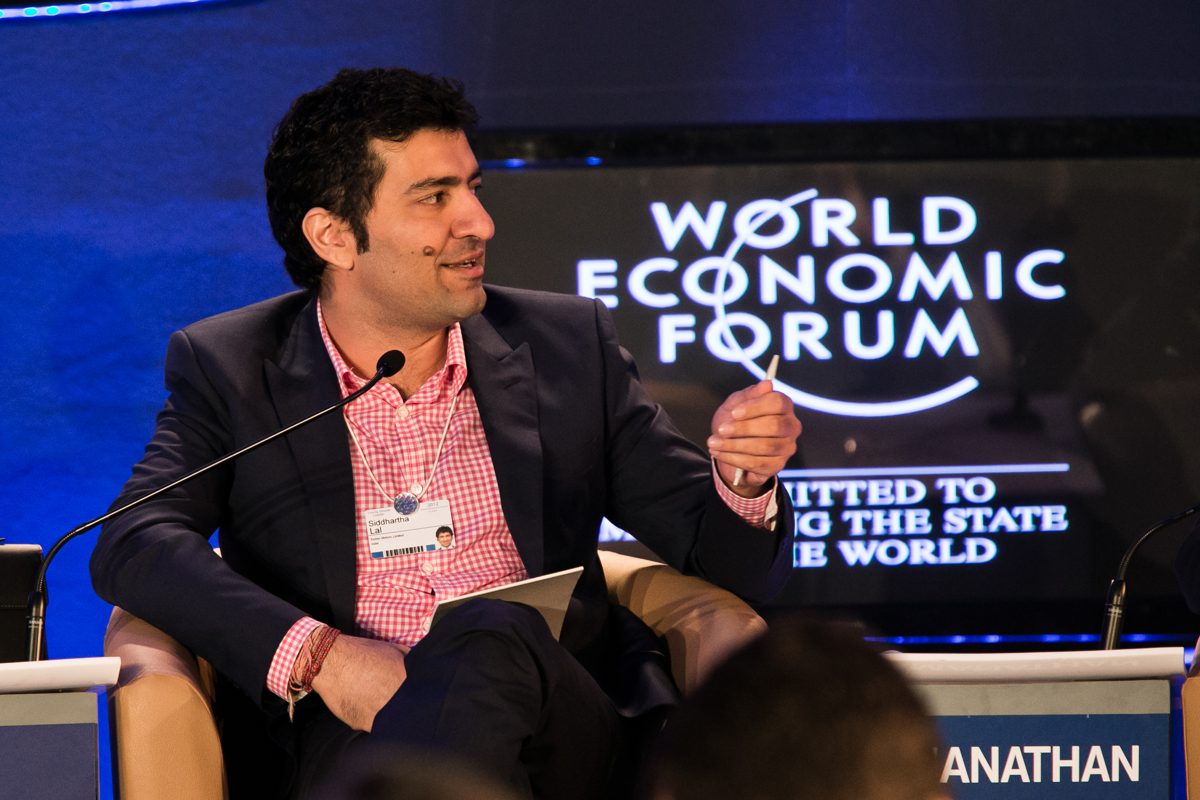
| Key facts | |
|---|---|
| Born | 1973 (Eicher’s 2012 annual report gives his age as 39) [1] |
| Family roots | The Delhi-based Lal family, founders of the Eicher group [27][38] |
| Education | The Doon School; BA Economics, St. Stephen’s College, Delhi; mechanical engineering, Cranfield University; MSc Automotive Engineering, University of Leeds [2][3] |
| Family | Father Vikram Lal, who led Eicher from 1972 to 1997; mother Anita Lal, founder of Good Earth; sister Simran Lal, who runs Good Earth [27][88] |
| Company | Executive Chairman, Eicher Motors Ltd (Royal Enfield; VE Commercial Vehicles with Volvo) [9] |
| Wealth | “Vikram Lal & family”: US$11.4 billion, No. 18 on Forbes India’s 100 Richest 2026 [86][87]; Rs 1,03,820 crore, No. 18 on the M3M Hurun India Rich List 2025 [90][91] |
| Known for | Reviving Royal Enfield from about 2,000 bikes a month in 2000 to over 12 lakh bikes a year in FY26 [31][52] |
In 2000, a 26-year-old engineer stood in front of a business that his own company’s managers wanted to sell or shut. Royal Enfield, the maker of the thumping Bullet, was losing money. Its Chennai factory could build about 6,000 motorcycles a month but was selling fewer than 2,000 [33]. Oil leaks, seized engines and clutch failures had badly hurt the old British design’s reputation [29][36].
The young man was Siddhartha Lal, son of the family that controlled Eicher. As a schoolboy he had sneaked rides on the family’s Enfield. “I used to nick it, to ride to school,” he later told the Los Angeles Times [94]. Now he asked for time to save it. Forbes India reported that he asked his father for one year; Business Today put it at two [33][35].
He thought the problem was simple. “I was in my mid-twenties. I was naive,” he recalled in 2015. “It was about, ‘how difficult could it possibly be to sell a few more motorcycles?’… if we could sell 500 more every month, we probably wouldn’t be losing money… And then I discovered there were a lot more issues” [31].
It took far longer than a year. But a quarter of a century later, Royal Enfield sold 12,27,977 motorcycles in FY26 [52]. Eicher Motors earned a consolidated profit of about Rs 5,515 crore that year [55][52]. And the family behind it ranked among the 20 richest in India [86].
This is the story of how Lal did it: by saying no to almost everything his family had built, and yes to one unfashionable old motorcycle.
Where it began
A family business, started in 1948
The Eicher story starts with Siddhartha’s grandfather, Man Mohan Lal. In 1948 he set up Goodearth, a company that imported and serviced tractors [38][5]. Over the next decade it sold about 1,500 imported tractors. In 1958 it formed Eicher Tractor Corporation of India with the German tractor maker Eicher, and in 1959 it built its first locally made tractor at Faridabad, near Delhi [5].
Vikram Lal, Siddhartha’s father, was born in Delhi in 1942. He finished school at the Doon School, studied mechanical engineering in West Germany and joined the family firm in 1966 [101][38]. He took over from his father in 1972 [27].
Vikram Lal built Eicher into a diversified group. In 1982 it signed a light commercial vehicle tie-up with Mitsubishi and set up Eicher Motors Ltd [5]. By 1996-97 the group had sales of Rs 919 crore, about 6,000 employees and six companies making light trucks, tractors, motorcycles and components [27].
Enfield India enters the family
Royal Enfield itself is far older than Eicher. The brand traces its roots to Redditch in England, where it built its first motorcycle in 1901 [6]. In 1955 the British company and Madras Motors set up Enfield India to make motorcycles in Chennai [6]. When the British factory closed around 1970, the Indian unit carried on alone [6].
By the late 1980s, Enfield India was struggling. Eicher bought in step by step: 26% in 1990, a 60% majority in 1993, and in 1994 the company was renamed Royal Enfield Motors Ltd [5]. In 1996, Eicher Tractors and Royal Enfield Motors merged to form Eicher Ltd [5].
A father who walked away
In December 1997, Vikram Lal did something unusual for an Indian business family. At 55, after exactly 25 years at the helm, he retired and handed the chairmanship not to a child, but to a professional manager, Subodh Bhargava [27]. The family then owned about 80% of the group’s holding company [27].
“Families must supervise – not manage – business,” Vikram Lal told Business Today at the time [27]. His son later said the business was rarely discussed at home. “My father (Vikram Lal) gave up his role in the company as soon as he could,” he told Forbes India [33].
His mother, Anita Lal, built a business of her own: the Delhi design and lifestyle label Good Earth, which his sister Simran Lal now runs [27][88].
School, engineering and a borrowed motorcycle
Siddhartha Lal was born in 1973. Eicher’s annual report for 2012 lists his age as 39, though press reports over the years have given ages that vary by a year or so [1][27]. Sources do not agree on his exact birthplace, so we have left it out.
Like his father, he went to the Doon School. He then took an economics degree at St. Stephen’s College, Delhi [2][34]. Engineering came later. He qualified in mechanical engineering at Cranfield University in England, and then earned a master’s in automotive engineering from the University of Leeds [2][33]. Eicher’s 2012 annual report lists his qualifications as “PGDME, MSc. (Automotive Engg.)”, which suggests the Cranfield award was a postgraduate diploma [1].
“I was 25 when I got bitten by this bug of ‘how do things work,’” he told Outlook Business [28].
The motorcycle bug came earlier. He told Outlook Business that at 21 his father sent him to Europe to meet Royal Enfield’s importers. He ended up working as a mechanic in a Swiss importer’s garage and then toured several countries on a borrowed Enfield. “His passion was so addictive that I ended up working with him as a mechanic in his garage!” he said [29][28].
The first jobs
Lal joined the Eicher group in 1999 [3]. Outlook Business reported that he spent a year in marketing at Eicher Tractors and then set up the group’s digital maps and GIS business [28]. He set one condition. “I told my father that if I was entering business, I would do it my way,” he told Business Standard [32].
The first break
Taking charge of a business marked for closure
In 2000, Lal became CEO of Royal Enfield [2][30]. He was 26. Eicher’s long-serving chairman, S. Sandilya, later said the division “was making large losses and was slated for closure” at the time [29]. Business Today reported annual losses of about Rs 20 crore [35].
The numbers were grim. Lal himself said the company was selling “1,600 or 1,800 motorcycles a month” [31]. The factory had capacity for about 6,000 [33].
“Honestly, at age 26, it seemed a fun thing to do. I could eat, sleep, ride and talk motorcycles,” he said in a 2015 interview [30]. “My condition for taking on the mantle was a free hand to do what I thought was important,” he wrote years later [28].
Fixing the basics
Lal moved to Chennai and stayed there until 2004 [33]. He brought in a young team, many of them fellow riders. He sold surplus factory assets, cut the product range and hired the motoring journalist Sachin Chavan [34].
He also killed a project that the company’s engineers had been working on: a fast, sporty commuter bike meant to compete with Bajaj’s Pulsar. Royal Enfield, he decided, should not try to be like everyone else [33].
In 2002, Royal Enfield launched the Thunderbird, a cruiser aimed at highway riders [6]. Quality work went on in the background: fixing the oil leaks and reliability problems that had driven buyers away [29].
Progress was slow. By around 2004-05, Royal Enfield was selling about 25,000 motorcycles a year, still only about a third of its installed capacity [30][100].
The hardest “no”: selling 13 of 15 businesses
In 2004, Lal became chief operating officer of Eicher Motors, aged 30 [30][3]. He returned to Delhi and looked at the whole group. What he saw worried him.
Eicher had about 15 businesses, including tractors, trucks, motorcycles, components, footwear, garments and maps. None was a market leader [30][33]. “We were doing too many things and we were not the best in any of them,” he said [33].
With help from the Boston Consulting Group, the management team decided to exit 13 of the 15 businesses and keep only trucks and motorcycles [34][28]. Sources differ on whether the decision was taken in 2004 or 2005; the sales took place over 2005 [30][28].
The biggest and most painful sale was the tractor business, the original family enterprise. In 2005, it went to TAFE (Tractors and Farm Equipment) [5][33].
“The biggest decision was to sell our tractor business – started by my grandfather and built by my father,” Lal later wrote. “But the reality was the business had run its course… It was heart-wrenching, but we had to let go” [28].
“Do we want to be a mediocre player in 15 small businesses or just be good in one or two businesses,” he told The Economic Times. “That’s why we sold 13 out of the 15 businesses, the big one being tractors to TAFE… Motorcycles was the joker in the pack. Many did think Eicher was going out of business” [30].
He summed up the logic in a line: “By becoming smaller… we have become bigger” [30].
In May 2006, Lal became managing director and CEO of Eicher Motors [1][34]. He was 32.
Building the empire
The Volvo deal, 2008
The first big move as MD was in trucks. In May 2008, Eicher signed a joint venture with Sweden’s Volvo Group. The new company, VE Commercial Vehicles (VECV), took over Eicher’s truck, bus and components businesses. Volvo paid SEK 1,840 million in all: SEK 1,510 million into the JV, SEK 220 million for an 8.1% stake in Eicher Motors, and SEK 110 million for a non-compete agreement [7]. Volvo held 45.6% of VECV directly, while Eicher kept control [7]. Motorcycles stayed outside the deal.
Lal also ran VECV himself as CEO from July 2008 to July 2010, according to his Eicher board profile [4]. “Sometimes, you have to shed a few things to get more,” he had told Rediff when the Volvo deal was announced [37].
VECV grew into a major business in its own right. In FY26 it sold 1,03,404 vehicles, its first year above one lakh, on revenue of about Rs 27,077 crore [52][54].
The new engine and the Classic, 2008-2010
The motorcycle turnaround needed a new heart. The old Bullet engine was a separate engine-and-gearbox design dating back decades. In June 2008, Royal Enfield launched its new Unit Construction Engine (UCE) in the Thunderbird Twinspark 350 [41]. “We have developed a new technology here which is the unit construction engine,” Lal said at the launch [41].
The bike that changed everything followed: the Classic 350, a post-war-styled machine with the new engine. Royal Enfield and most sources date it to 2009; some trade reports say its main launch was at the 2010 Auto Expo [29][40]. Lal called the UCE-powered Classic “a critical and visible point in this transformation” [40].
Buyers who wanted something different from a commuter bike responded, and the Classic went on to become the company’s best-known model.
From 50,000 to three lakh
The numbers began to move fast. “We were barely selling 50,000 bikes a year in 2010; this year, we are set to touch 300,000,” Lal told Outlook Business in December 2014 [39]. “For nearly 20 years, we grew at just 3%, much slower than the industry” [39].
| Year | Royal Enfield motorcycles sold |
|---|---|
| 2010 | about 50,000 [39] |
| 2012 (calendar year) | 1,13,432 [8] |
| 2013 (calendar year) | 1,78,121 [8] |
| FY17 | 6,66,490 [47] |
| FY18 | 8,20,492 [47] |
| FY20 | about 6.96 lakh [48] |
| FY22 | 6,02,268 [49] |
| FY24 | 9,12,732 [50] |
| FY25 | 10,02,893 [51] |
| FY26 | 12,27,977 [52] |
To meet demand, Royal Enfield built new plants near Chennai. Commercial production started at Oragadam in April 2013 [8]. A third plant at Vallam Vadagal began production in August 2017, with a first-phase capacity of 3 lakh bikes, taking total capacity to 8.25 lakh [42].
Lal’s explanation for the boom was simple: “We have created a desirable brand that is not really bought on the basis of its features” [39].
“Pure motorcycling”
As the brand grew, Lal sharpened its philosophy. He did not want to fight the Japanese and European giants on speed or technology. He wanted bikes that were simple, accessible and fun.
“Motorcycles have become extraordinarily fast, extraordinarily heavy and extraordinarily expensive,” he told the Los Angeles Times in 2014. “But motorcycling must be accessible. The bikes must be easy to ride, easy to modify and to maintain… If you drop the bike, you should be able to pick it up — and keep riding” [94].
In 2017 he described it to Autocar India as “this simple, pared-back, heritage-driven, accessible motorcycling that’s missing in the world” [95]. The company’s slogan became “pure motorcycling” [94].
Going global: the UK, the Himalayan and the 650 twins
Lal wanted Royal Enfield to be a global brand, not just an Indian one. In May 2015, Royal Enfield bought Harris Performance, a small British firm known for motorcycle chassis [43]. In November 2017 it opened a UK Technology Centre at Bruntingthorpe in Leicestershire, with more than 120 staff [44].
The Himalayan, launched in 2016, was the company’s first purpose-built adventure bike. “The Himalayas have always been our spiritual home,” Lal told the veteran journalist Alan Cathcart. “We figured we should make a motorcycle that does justice to that environment” [96].
The bigger bet came in November 2018: the Interceptor 650 and Continental GT 650, Royal Enfield’s first modern twin-cylinder bikes, priced at Rs 2.5 lakh to Rs 2.85 lakh in India [45]. Lal pointed out that the multi-cylinder segment above 500cc in India was tiny, “not more than 15000 units a year.” “We want to change that,” he said [45].
In 2017 he had set a public goal: “In the next five-year horizon, we intend Royal Enfield should be No.1 in global sales in the middleweight segment” [96].
The 650 twins were followed by the Meteor 350 (2020), the Hunter 350 (2022) and, in November 2023, a new Himalayan with the 452cc “Sherpa” engine, the company’s first liquid-cooled engine, priced from Rs 2.69 lakh [20].
Royal Enfield also built assembly plants abroad. In December 2022 it opened a unit in Manaus, Brazil, its fourth assembly unit outside India after Argentina, Colombia and Thailand [16]. Brazil volumes grew about 71% in FY26, Lal told analysts [19].
The electric bet
Lal was cautious about electric motorcycles at first. In December 2022, Eicher bought a 10.35% stake in the Spanish electric bike maker Stark Future for EUR 50 million [15][102]. “We love the vision, passion and focus of the amazing team at Stark Future,” Lal said [15].
In November 2024, at the EICMA show in Milan, Royal Enfield unveiled its own electric brand, Flying Flea, named after a lightweight bike it built during the Second World War [97]. “This is the next chapter in the history of Royal Enfield,” Lal said [98]. He was candid about the risk: “We’re not betting the entire farm on it… We are putting money behind it, but if it doesn’t work, we’ll be okay” [97].
The first model, the Flying Flea C6, launched in Bengaluru on 9 April 2026 at Rs 2.79 lakh, or Rs 1.99 lakh with a battery-as-a-service plan [17].
Record years: FY25 and FY26
The last two years have been the best in Royal Enfield’s history. In FY25, it crossed one million motorcycles in a year for the first time, selling 10,02,893 [51]. In FY26, sales jumped to 12,27,977, including 1,20,634 exports [52].
Eicher Motors’ consolidated revenue rose from about Rs 7,033 crore in FY17 to Rs 23,408 crore in FY26, and profit from about Rs 1,667 crore to Rs 5,515 crore [55][52]. In the first quarter of FY27, Royal Enfield sold a record 3,32,940 motorcycles, and in September 2026 it had its best month ever, with 1,33,958 bikes [53][18].
The company is still adding capacity. In July 2026, Eicher’s board approved a Rs 1,225 crore first phase of a new greenfield plant in Andhra Pradesh, adding 4.5 lakh units a year [53]. “It feels like we’re just getting started,” Lal told analysts in May 2026 [19].
How the stock market saw it
Eicher became one of the best-known wealth creators on Dalal Street. Business Today calculated that the share rose from Rs 594.7 in December 2009 to Rs 21,727 in December 2019, a gain of about 3,553% in ten years [56]. The stock hit a then-record Rs 33,483.95 in September 2017 [77]. In August 2020 the company split each share into ten [57].
(This is history, not a recommendation; CapitalVia does not offer any view on the stock here. For more on reading company results and long-term wealth creation, see CapitalVia Insights.)
How the wealth is held
The Lal family’s wealth sits almost entirely in Eicher Motors shares. At 30 June 2026, the promoter group held 49.02% of the company. The largest holder is The Simran Siddhartha Tara Benefit Trust, with 43.83%. Siddhartha Lal personally held 1.05% [13].
The family has occasionally sold shares. In May 2016, promoters sold 4.2% of Eicher in a block deal worth about Rs 2,100 crore [58].
Forbes tracks the family’s fortune under his father’s name, “Vikram Lal & family.” Forbes India’s 100 Richest 2026, published on 30 September 2026, ranked the family 18th with US$11.4 billion [86][87]. The year before, Forbes India had ranked it 19th, also at US$11.4 billion [89]. On the M3M Hurun India Rich List 2025, the family was 18th with Rs 1,03,820 crore [90][91]. Real-time figures move with the share price every day [88].
The setbacks and failures
The Polaris venture that never took off
Not every bet worked. In 2012, Eicher formed a 50:50 joint venture with the American firm Polaris Industries to build a low-cost utility vehicle for small businesses and farmers. The result, the Multix, launched in June 2015 [46].
It flopped. Only about 3,000 were sold. By December 2017, Eicher had invested Rs 289.5 crore, and the JV lost Rs 91.83 crore in FY17 alone. In March 2018, the board shut it down, saying sales were “well below expectations” [46].
Lal has been open about lessons like this. “The most difficult thing in business and in life is the ability to say, ‘no, this doesn’t work,’” he wrote in 2021 [28].
The 2018-2020 slump
After years of rapid growth, the engine sputtered. Sales growth slowed in 2018, and in December 2018 sales fell 13% year on year [78]. In FY20, Royal Enfield volumes fell 16% to about 6.96 lakh [48]. The share price fell well below its 2017 peak [78].
Then came Covid. In the April-June 2020 quarter, Eicher posted a net loss of Rs 55 crore, compared with a profit of Rs 452 crore a year earlier [79]. Volumes fell to about 6 lakh in FY21 and FY22 [49].
New rivals
In July 2023, Harley-Davidson (with Hero MotoCorp) and Triumph (with Bajaj Auto) launched rival bikes in the 400cc class. Kotak analysts forecast that Royal Enfield’s share of the over-250cc market could fall from more than 90% to about 75%, and Eicher’s shares fell as much as 12.5% in a day, Reuters reported [80].
Lal’s response was blunt. “We are not going to cede any market share willingly,” he told analysts, adding that Royal Enfield aimed to hold about 80% of the segment in the medium to long term [81]. Its sales have since kept rising [52].
A lost argument on GST
In August 2025, Lal publicly urged the government to keep a single 18% GST rate on all two-wheelers. He warned that “a differential rate would dramatically shrink the domestic >350cc segment” and said “these motorcycles are not luxury goods” [84]. The government went ahead with a 40% rate for motorcycles above 350cc from 22 September 2025, while bikes up to 350cc moved to 18% [84][85]. Royal Enfield passed on the full cut on its 350cc range and raised prices on its 650cc models [21][85].
Controversies and allegations
Siddhartha Lal has no criminal case, SEBI order or major regulatory finding against him personally that we could find in court and regulator records or major publications. The matters below are the documented controversies involving him or the company he leads.
The 2021 shareholder vote on his pay
Allegation: At Eicher’s annual general meeting on 17 August 2021, institutional investors objected to Lal’s reappointment as managing director because it came with a pay rise of about 10% in a Covid-hit year, when the median employee’s pay rose about 1% [61]. The proxy adviser IiAS estimated his FY22 pay at Rs 23.23 crore, up from Rs 21.2 crore in FY21 [61]. The special resolution won 73.05% of votes, short of the 75% required. Public institutions voted 72.01% against [11]. A Business Standard editorial criticised the board for ignoring the optics [63].
Response: The board said Lal’s raise was in line with the average employee increase of 9.7%. Chairman S. Sandilya said investors were also concerned about an enabling clause that allowed pay of up to 3% of profits, when actual pay was about 1.04% [62]. The board capped his pay at 1.5% of net profit and went back to shareholders [62].
What happened next:
- On 25 October 2021, shareholders approved his reappointment for five years from 1 May 2021 by postal ballot, with 93.75% in favour, and his remuneration with 98.56% [12][64].
- In February 2025 he moved to the role of Executive Chairman [9].
Status: Resolved. The reappointment and revised pay structure were approved in October 2021.
The 2018 Oragadam strike
Allegation: Workers at Royal Enfield’s Oragadam plant near Chennai went on strike from 24 September 2018. The newly formed Royal Enfield Employees Union demanded recognition, better wages and bonus, and the reinstatement of trainees, and objected to the use of trainee labour, Reuters reported [67]. The union claimed about 3,000 workers joined, while People Matters reported about 600 stayed away [67][70].
Response: The company said most of its associates were working, that it had forums for workers’ welfare, and that it hoped for a “mutually beneficial solution” [67]. People Matters reported that the company did not recognise the union’s outside political leadership [70].
What happened next:
- The strike ended effective 13 November 2018, after about 50 days [68][69].
- Royal Enfield estimated a production loss of about 28,000 motorcycles [68].
- IndustriALL, a global union federation, said in February 2019 that union office-bearers had been transferred to other states and that workers had protested; this is a union account and was not confirmed by mainstream outlets [71].
Status: The strike ended in November 2018. We found no later reported court ruling on the dispute.
Recalls and quality complaints
Allegation: Royal Enfield has faced several recalls and owner complaints. In May 2019 it recalled about 7,000 Bullet and Bullet Electra bikes over brake-caliper bolts [74]. In May 2021 it recalled 2,36,966 Meteor, Classic and Bullet bikes in India and six other countries over a faulty ignition coil from an outside supplier that could cause misfiring and, rarely, a short circuit [72][73]. In September 2024 it issued a global recall over reflectors that might not meet standards [75]. In 2018, owners of the limited-edition Pegasus 500 protested when a cheaper Classic variant came with ABS while their bikes did not [76].
Response: In 2021 the company said routine internal testing had caught the ignition coil problem and that fewer than 10% of recalled bikes would need the part replaced [72][73]. Faulty reflectors were replaced free of charge [75]. Business Today reported that Royal Enfield planned to buy back Pegasus bikes from unhappy owners [76].
Status: The recalls were carried out by the company. We found no recall reported in 2025 or 2026.
A SEBI penalty on Eicher over duplicate share certificates
Allegation: In a June 2022 order, SEBI fined Eicher Motors (the company, not Lal) Rs 10 lakh for lack of due diligence in issuing duplicate share certificates. An impersonator had forged an investor’s signature, and her 903 shares were fraudulently transferred between 2007 and 2012 [82][83].
Response: Eicher compensated the investor in 2021 and challenged the penalty before the Securities Appellate Tribunal [82][24].
Status: Eicher’s 2025 secretarial compliance report refers to the appeal and reports no SEBI or stock exchange action against the company in FY25 [24].
Tax demands
Allegation: Like most large manufacturers, Eicher and VECV have received tax demands. In December 2023, GST authorities in Chennai raised a demand of Rs 129.79 crore on Eicher for FY2017-18 over input tax credit; after appeal it was cut to Rs 26.97 crore in August 2024 [22]. In December 2025, VECV received a GST order of Rs 96.18 crore in tax, plus an equal penalty and interest, for FY2017-18 [23].
Response: In its filings the company said the demands were not maintainable and that it planned to appeal or was evaluating further remedies [22][23].
Status: Pending in appeal as of October 2026, based on the company’s latest disclosures.
As of 19 October 2026, none of these matters involves a finding of wrongdoing against Siddhartha Lal personally.
Giving back
The Lal family’s giving runs mainly through Eicher’s corporate social responsibility (CSR) programmes and the Eicher Group Foundation. The Hurun India Philanthropy List for FY21 ranked “Vikram Lal & family” 29th, with donations of Rs 28 crore, mostly to education [26].
Royal Enfield’s Social Mission focuses on the Himalayas, the region the brand calls its spiritual home. In the Royal Enfield Sustainability Journal 2023-24, Lal set out a commitment “to partner with 100 Himalayan communities and to spark the largest rider-led movement of one million riders dedicated to sustainable explorations and to ‘leave every place better’” [25]. “We keep our learnings open source,” he wrote [25].
Eicher’s CSR obligation for FY25 was Rs 66.68 crore. It spent Rs 50.25 crore in the year and moved Rs 16.43 crore to an unspent CSR account for ongoing projects, as the rules allow [92].
His father’s interests ran in a similar direction: Vikram Lal backed education through the Goodearth Education Foundation and sat on the board of WWF-India [101].
Succession
Lal began stepping back from day-to-day control years ago. In April 2019 he handed the Royal Enfield CEO role to Vinod Dasari, while staying MD of Eicher Motors. “There is no better person than Vinod Dasari to lead Royal Enfield,” he said [59]. Dasari resigned in August 2021, and B. Govindarajan, a long-time Royal Enfield executive, took over the business [60].
In February 2025, Eicher announced a reshuffle. Lal became Executive Chairman from 13 February 2025, replacing S. Sandilya, who had chaired the company for about 25 years. Govindarajan became MD of Eicher Motors while remaining CEO of Royal Enfield [9][65][66]. His appointment, for a five-year term running to February 2030, was put to shareholders by postal ballot [10].
“I am now looking forward to the opportunity to reinvent my role,” Lal said [9]. Autocar India reported that he would focus on strategy, brand and “mentoring the next generation of leaders” [66]. In May 2026, VECV’s long-time chief Vinod Aggarwal was appointed Executive Vice-Chairman of Eicher Motors [14].
Govindarajan describes the division of work simply. “For us, he’s the visionary. I’m an option generator,” he told Business Standard in June 2026 [99].
The model echoes his father’s. Vikram Lal handed the group to professionals in 1997 [27]. His son, who took charge of a family business young, much like Kumar Mangalam Birla, has now put a professional team in charge of daily operations, while the family remains the controlling shareholder [13].
His recognition along the way includes the EY Entrepreneur of the Year award for India for 2018 [93].
What their journey teaches
Shrinking can be the fastest way to grow. Eicher sold 13 of its 15 businesses, including the tractor company his grandfather started, to focus on two. “By becoming smaller… we have become bigger,” Lal said [30]. For a founder or a manager, the lesson is that a portfolio of average businesses can hide the one that could be great.
Fix the product before you sell harder. In 2000, Lal thought he only needed to sell 500 more bikes a month. The real problems were oil leaks, engine failures and poor quality [31][29]. Royal Enfield’s growth came only after a new engine and better bikes.
Don’t copy the market leader. Lal killed a project to build a Pulsar-style bike and bet instead on simple, classic, “pure” motorcycling [33][94]. Being different gave Royal Enfield pricing power that features alone could not.
Admit failure quickly. The Polaris JV cost Eicher Rs 289.5 crore before it was shut [46]. Lal’s own rule is that the hardest skill is saying “no, this doesn’t work” [28].
Respect the owners, even when you are the owner. The 2021 pay vote showed that even a celebrated promoter-CEO must answer to minority shareholders. The board listened, capped the pay and won approval [62][12].
Think in decades, not quarters. “I don’t care about the next quarter or two years,” Lal wrote [28]. Royal Enfield took about ten years to move from 25,000 bikes to three lakh, and twenty-five to pass twelve lakh [30][39][52].
A profile for general reading, based on public records and reporting as of 19 October 2026. Not investment, tax or legal advice.
Sources (100)
- Eicher Motors Annual Report 2012 - Eicher Motors, Mar 2013
- Re-appointment of Managing Director, Annexure-1 (stock exchange disclosure) - Eicher Motors, Aug 2021
- Siddhartha Lal, Executive Chairman - Eicher Motors, Oct 2026
- Siddhartha Lal, Executive Chairman, Eicher Motors Limited (board profile) - Eicher Motors, Feb 2025
- Milestones - Eicher Motors, Oct 2026
- Since 1901: Royal Enfield history - Royal Enfield, Oct 2026
- Volvo signs final agreement with Eicher - Volvo Group, May 2008
- Audited consolidated financial results for the year ended 31 December 2013 (press release) - Eicher Motors, Feb 2014
- Eicher Motors announces board changes (press release) - Eicher Motors, Feb 2025
- Appointment of Directors (postal ballot notice) - Eicher Motors, Feb 2025
- Results of the postal ballot - Eicher Motors, Oct 2021
- Shareholding pattern as on 30 June 2026 - Eicher Motors, Jul 2026
- Appointment of Executive Vice-Chairman (SEBI disclosure) - Eicher Motors via NSE, May 2026
- Investment in Stark Future SL (BSE disclosure) - Eicher Motors, Dec 2022
- Royal Enfield inaugurates CKD assembly unit in Brazil (BSE disclosure) - Eicher Motors, Dec 2022
- Royal Enfield launches Flying Flea C6 (press release) - Eicher Motors via NSE, Apr 2026
- Monthly business update, September 2026 - Eicher Motors via NSE, Oct 2026
- Transcript of Q4 FY26 earnings conference call - Eicher Motors, May 2026
- Royal Enfield launches the all-new Himalayan at Motoverse 2023 (press release) - Eicher Motors, Nov 2023
- Royal Enfield announces full GST benefit to customers (press note) - Eicher Motors, Sep 2025
- GST demand order (Regulation 30 disclosure) - Eicher Motors, Aug 2024
- Annual Secretarial Compliance Report 2025 - Eicher Motors, May 2025
- Royal Enfield Sustainability Journal 2023-24 - Eicher Motors, Aug 2024
- Hurun India Philanthropy List (FY21) - Hurun India, Oct 2021
- The CEO who walked away - Business Today, May 1998
- The most difficult thing in business and in life is the ability to say 'no, this doesn't work' - Outlook Business, Aug 2021
- Siddhartha Lal: An Indian powerhouse on two wheels - Outlook Business, Dec 2022
- Meet Siddhartha Lal, the man who turned around Royal Enfield into Eicher Motors' profit engine - The Economic Times, Mar 2015
- Royal Enfield customers have a different take on life, says CEO Siddhartha Lal - The Economic Times, May 2015
- Firing on all cylinders - Business Standard, Feb 2016
- Siddhartha Lal: The braveheart - Forbes India, Oct 2015
- The talented Mr. Lal - Fortune India, Oct 2011
- Turnaround drive - Business Today, Dec 2011
- To Italy on a Bullet - Outlook India, May 2017
- Eicher Motors' CEO on the Volvo deal - Rediff, Dec 2007
- India at 75: Munjals to Mahindras, 20 visionary industrialists of India - Business Standard, Aug 2022
- Bullet Raja - Outlook Business, Dec 2014
- 2012 News Maker: Siddhartha Lal - Autocar Professional, Dec 2012
- Royal Enfield launches motorcycle with new unit construction engine - Oneindia, Jun 2008
- Royal Enfield expands capacity, begins production at new plant - Autocar Professional, Aug 2017
- Royal Enfield acquires UK-based Harris Performance - Business Today, May 2015
- Royal Enfield opens its UK Technology Centre - Autocar Professional, Nov 2017
- Royal Enfield launches its 650cc twins in India - Business Today, Nov 2018
- Eicher Polaris shuts down six-year-old JV - Autocar Professional, Mar 2018
- Royal Enfield sales FY 2017-18 - Rushlane, Apr 2018
- Royal Enfield sees 16% dip in sales in FY20 - Business Today, Apr 2020
- Royal Enfield sales March 2022 - Rushlane, Apr 2022
- Royal Enfield posts 5% growth in March sales, FY24 volume up 9% - Autocar Professional, Apr 2024
- Eicher Motors closes FY25 with record motorcycle sales - Mobility Outlook, May 2025
- Eicher Motors reports record FY26 profit - Autocar Professional, May 2026
- Eicher Motors reports 32% revenue growth in Q1 FY27, approves Rs 1,225 crore greenfield facility - Autocar Professional, Jul 2026
- VECV nears Rs 26,000 crore turnover as Vinod Aggarwal moves to chairman role - Autocar Professional, Apr 2026
- Eicher Motors consolidated financials - Screener.in, Oct 2026
- Eicher Motors share price rises 3,553% in 10 years - Business Today, Dec 2019
- Eicher Motors' 10-for-1 stock split takes effect - Business Standard, Aug 2020
- Royal gains: Lals sell 4.2% in Eicher for Rs 2,100 crore - Business Standard, May 2016
- Royal Enfield names new CEO; Lal keeping Eicher Motors position - Powersports Business, Apr 2019
- Royal Enfield CEO Vinod K Dasari resigns - Business Today, Aug 2021
- Eicher Motor shareholders reject Siddhartha Lal's reappointment as MD over salary hike - Business Today, Aug 2021
- Eicher Motors re-appoints Siddhartha Lal as MD, revises pay structure - Business Standard, Aug 2021
- The rumble over CEO pay (editorial) - Business Standard, Aug 2021
- Siddharth Lal appointed Eicher Motors MD for 5 years starting May 1 - Business Today, Oct 2021
- Eicher Motors appoints Siddhartha Lal as Executive Chairman, Govindarajan as MD - Autocar Professional, Feb 2025
- Siddhartha Lal appointed as Executive Chairman of Eicher Motors - Autocar India, Feb 2025
- Motorcycle companies in India's Detroit hit by strike over wages (Reuters) - Business Standard, Sep 2018
- Labour strike at Royal Enfield impacts production of 28,000 motorcycles - Autocar Professional, Nov 2018
- Eicher Motors gains 16% in one week as strike called off at Oragadam facility - Business Standard, Nov 2018
- Workers end strike at Royal Enfield - People Matters, Nov 2018
- Workers protest as Royal Enfield transfers union members across India - IndustriALL Global Union, Feb 2019
- Royal Enfield to recall 236,966 Classic, Bullet and Meteor bikes - Autocar Professional, May 2021
- India's Royal Enfield recalls about 2.37 lakh motorcycles on ignition coil defect (Reuters) - Deccan Herald, May 2021
- Royal Enfield recalls around 7,000 units of Bullet, Bullet Electra - Business Today, May 2019
- Royal Enfield issues global recall over sub-standard reflectors - MotorBeam, Sep 2024
- Royal Enfield to buy back Pegasus 500 from unsatisfied owners, says report - Business Today, Sep 2018
- Eicher hits record high - Business Standard, Sep 2017
- Eicher Motors shares tumble over 9% on weak December sales (PTI) - Business Standard, Jan 2019
- Eicher Motors dips after posting a loss of Rs 55 crore in June quarter - Business Standard, Aug 2020
- Harley-Davidson, Triumph gearing up to challenge Royal Enfield's India reign (Reuters) - TimesLIVE, Jul 2023
- Confident of holding on to 80% market share despite new competition: Siddhartha Lal - Autocar Professional, Aug 2023
- SEBI imposes penalty of Rs 10 lakh on Eicher Motors over duplicate share certificates - Moneylife, Jun 2022
- SEBI penalises Eicher Motors - Trade Brains, Jun 2022
- Royal Enfield's Siddhartha Lal calls for uniform GST rate across two-wheeler market - Autocar India, Sep 2025
- Royal Enfield 650cc prices hiked after GST increase - BikeDekho, Sep 2025
- India's 100 Richest 2026 - Forbes India, Sep 2026
- India's 100 Richest 2026: tycoons' wealth holds firm at $1 trillion - Forbes, Sep 2026
- Vikram Lal & family (real-time profile) - Forbes, Oct 2026
- India's 100 Richest 2025 - Forbes India, Oct 2025
- Hurun Rich List India 2025: list of 50 richest Indians and their net worth - The Daily Jagran, Oct 2025
- Hurun India Rich List 2025: top 100 richest Indians - Trak.in, Oct 2025
- Eicher Motors CSR spending report: Rs 50 crore in FY25 - IndiaCSR, Feb 2026
- Eicher Motors CEO Siddhartha Lal named EY Entrepreneur of the Year 2018 - Business Today, Feb 2019
- India's Royal Enfield going global with retro-cool bikes - Los Angeles Times, Aug 2014
- Siddhartha Lal interview on Royal Enfield's future - Autocar India, Nov 2017
- Royal Enfield boss speaks - Motorrad International, May 2017
- Royal Enfield takes a bold leap with the launch of electric Flying Flea brand - CleanTechnica, Nov 2024
- Entry into EV next big chapter for Royal Enfield, says Siddhartha Lal - Autocar Professional, Nov 2024
- Balakrishnan Govindarajan on the bike's journey and its road ahead - Business Standard, Jun 2026
- Bullet Raja: Siddhartha Lal, MD, Eicher Motors - Business Today, Dec 2019
- Vikram Lal - Common Cause, Oct 2026
- Royal Enfield parent Eicher Motors picks up 10.35% stake in Stark Future for EUR 50 million - Autocar Professional, Dec 2022