
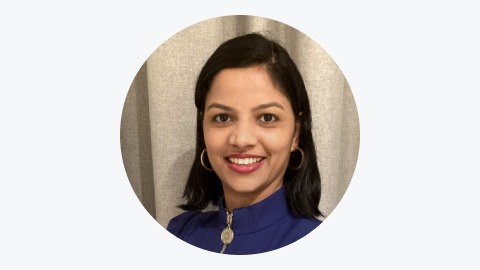
| Key facts | |
|---|---|
| Born | Matunga, Mumbai; date of birth not publicly confirmed |
| Hometown/Family roots | Matunga, Mumbai; youngest of four sisters; her mother was a gold medallist who was not allowed to keep studying [8] |
| Education | BTech and MTech, IIT Bombay; MBA, The Wharton School, University of Pennsylvania [9][48] |
| Family | Keeps her personal life private |
| Company/Group | Upstox (RKSV Securities India Pvt Ltd): co-founder and board member, in charge of growth, strategy, finance and customer experience [2][8] |
| Wealth | Rs 2,685 crore, about US$287 million (360 ONE Wealth Creators List 2026, Aug 2026) [6]; Rs 3,840 crore, 10th among self-made women (M3M Hurun India Rich List 2025) [42][43] |
| Known for | Making Upstox one of India’s best-known investing apps; the IPL and ICC sponsorships and the “Start Karke Dekho” campaign; bringing first-time investors from small towns into the market |
Where it began
In 2007 a McKinsey analyst went to work for SKS Microfinance and found herself on the edges of Indian villages. Small loans of Rs 3,000 to Rs 4,000 were being used to buy a cow, a goat or a buffalo. Within months that animal could be an asset worth about Rs 15,000. She saw families who had been struggling suddenly own something. Children wore slippers for the first time. Pregnant women ate three meals a day instead of two. Children could go to school [8].
That analyst was Kavitha Subramanian. Almost twenty years later, as co-founder of the online broker Upstox, she still tells this story when she explains her work. “Finance is not about chasing growth; it is about enabling transformation,” she told Forbes India in 2026. “When women gain access to finance, they don’t just build businesses, they build future generations.” [8]
Her story is not the usual founder story. She did not trade shares as a teenager and did not start a company in a hostel room. She became a co-founder of a business that already existed, at the point when it was about to change completely. She then spent ten years helping turn a small Mumbai brokerage for traders into an app used by crores of first-time investors, many of them outside the big cities. This is how that happened, including the parts that did not go to plan.
Matunga, four sisters and one rule
Kavitha Subramanian was born and raised in Matunga, the old South Indian neighbourhood of central Mumbai. She was the youngest of four sisters, in a family where, as Forbes India put it, “education was non-negotiable” [8].
The driving force was her mother. She had been a gold medallist herself but was not allowed to study further or have a career. She made sure her daughters would not lose the same chance. Her line at home, Kavitha recalls, was: “Don’t come to the kitchen, go and study.” [8]
Kavitha credits her mother with teaching her that daughters could and should claim their place in the world. “Nobody had told me girls are not supposed to do certain things,” she says [8]. Her date of birth, her father’s work and her schooling have not been reliably published, and this profile does not guess at them.
IIT Bombay and Wharton
She went to the Indian Institute of Technology Bombay and earned both a BTech and an MTech [9][48]. Sources disagree on her branch. A Zee Business interview in 2023 said electrical engineering [9]. Profiles by India.com and DNA the same year said electronics and telecommunications [48][49]. She later took an MBA from the Wharton School of the University of Pennsylvania [9]. India.com describes it as an MBA in finance [48].
An IIT degree and a Wharton MBA are a common route into consulting and investment firms. That is where she went next.
The first break
McKinsey, and then the villages
Her first job was at McKinsey & Company’s Mumbai office. The firm’s alumni network lists her years there as 2004 to 2007 [5]. India.com and DNA describe her role as business analyst [48][49]. That is the usual entry-level job for fresh graduates, who spend long hours on spreadsheets and client slides.
In 2007 she moved to SKS Microfinance, a lender that made small loans to poor rural women. She worked there in 2007-08 [8], and this is the period she points to as the turning point of her career. Watching small loans turn into livestock, income and school fees convinced her that money, used well, can change lives. “My work is focussed on one of India’s largest challenges, with the potential to deliver visible, transformative impact,” she said later [8].
The private equity years
After Wharton she spent most of the next decade in private equity. Zee Business describes her as “a private equity investor at Leapfrog Investments and Actis Investments” [9]. Actis is a large emerging-markets investor. LeapFrog Investments specialises in companies serving low-income customers in Asia and Africa, mainly in insurance, financial services and healthcare.
The PE job taught her the other side of the table. She learnt how investors judge a business, how a balance sheet holds up under stress, and how a founder’s story becomes a valuation. All of that would matter at Upstox, where she now looks after finance and strategy as well as customer-facing work [2].
A brokerage that already existed
The company she joined has its own origin story, and it is worth telling correctly because many profiles get it wrong.
Upstox began life as RKSV. Forbes India says it was launched in April 2009 [8]. Its founders were the brothers Ravi Kumar and Raghu Kumar and their partner Shrinivas (Shrini) Viswanath [11][13]. The brothers had worked in finance in the United States. YourStory reported in 2015 that they had tried to start a hedge fund but closed it during the 2008 financial crisis, then started RKSV as a proprietary trading firm in India [10]. Forbes India says the firm ran high-frequency proprietary trading operations until 2015 [8].
RKSV got its broking licence in 2010, through a subsidiary now called Upstox Securities Pvt Ltd [2]. In 2012 it moved into retail broking. It was the first to offer unlimited trading plans, where a trader paid a monthly fee and could place as many trades as they liked [2][9]. By 2014, the company says, its trading turnover had passed Rs 4,000 crore [2]. Until then the business was bootstrapped [10].
In February 2016 RKSV raised its first institutional money: US$4 million led by Kalaari Capital, with GVK Davix Technologies and others joining [11][12]. Ratan Tata also invested that year [8][31]. By then the firm already had an app called Upstox and a trading platform called Upstox Pro [12], and the whole company was soon known by that name [9].
Kavitha Subramanian joined that same year, 2016, as a co-founder [8][13]. Several articles, including McKinsey’s own alumni list, say she co-founded the company in 2009 [5]. Her documented career makes that unlikely, since she was at SKS Microfinance and in private equity during those years. The most careful accounts, including Forbes India and YourStory, say she joined in 2016 [8][13]. Upstox today lists three co-founders: Ravi Kumar, Kavitha Subramanian and Shrini Viswanath [2]. YourStory reported that Raghu Kumar later stepped away from day-to-day work [13]. He remains a large shareholder [27].
Building the empire
From a trader’s tool to a nation’s app
When she joined, Upstox was built for traders. The pitch in 2016 was simple. Delivery investing was free, and traders paid a flat Rs 20 an order [11]. The firm had about 100 employees, and a year earlier it had claimed about 25,000 active traders [11].
The bigger problem was opening an account. YourStory recalled that in the early days a customer had to fill in a paper form of about 30 pages, and it took around two weeks to get started [13]. In 2016 Upstox became one of the first brokers to offer fully paperless account opening using e-KYC with Aadhaar and PAN [9][13].
Forbes India credits Subramanian with leading this mobile-only onboarding and with pushing for multi-language support and a simpler interface for non-urban users [8]. That is the thread through her decade at the company: take something built by traders for traders, and make it usable for a first-time investor in a small town.
Tiger Global arrives
In September 2019 the New York investment firm Tiger Global put US$25 million into the company [16]. Business Standard reported that Tiger Global’s fund took a 31.1% stake for Rs 178.47 crore [15]. At the time Upstox said it had about 3 lakh clients, daily turnover above Rs 15,000 crore, and that it had been profitable for two years [16]. Ratan Tata’s stake was then about 1.33% [15].
2020-21: the boom, and the IPL
Then came the pandemic. Lockdowns, cheap smartphones, cheap data and a rising market brought crores of young Indians into stocks for the first time. Upstox was ready to take advantage, and Subramanian was the face of its marketing.
In 2020 the company launched its “Start Karke Dekho” (just start) campaign [9]. In February 2021 it beat its rival Groww to become an official partner of the Indian Premier League [19]. Entrackr reported a fee of about Rs 45 crore a year [24]. Upstox was the first broking firm to partner with the IPL since the league started in 2008 [20].
“With the IPL association, our aim is to become a generic for investing, and the platform of choice for young Indians,” Subramanian told Adgully in April 2021 [20]. The campaign ran on TV for Tier 2, 3 and 4 towns, and on OTT and digital for the metros [20]. It went out in nine languages, and she tied the choice of sponsor to trust: “Cricket is a game of ethics,” she told exchange4media [21]. In June 2021 the International Cricket Council named Upstox an official partner [4]. It also sponsored the Tamil Nadu Premier League [9]. The 2022 IPL campaign, “Own Your Future”, made the link explicit. “Just like IPL has redefined cricket, Upstox aims to redefine investments for its customers,” she said at its launch [23].
The money was spent on growth, and growth came. Upstox had close to 3 million customers in April 2021 [20]. Subramanian said then that the customer base had been growing three to four times a year [51]. By November 2021 it had more than 7 million [18]. In May 2022 it crossed 1 crore (10 million), ten times its size two years earlier [50]. The company said about 85% of new customers came from Tier 2 and Tier 3 cities [50].
Becoming a unicorn
In November 2021 Upstox raised fresh money from Tiger Global and became a unicorn. The details depend on the source:
- RoC filings, read by Entrackr, showed US$25 million (Rs 185 crore) from Tiger Global. The new shares were priced at Rs 98,608 each, about 28 times the price in the previous round. Entrackr estimated the post-money valuation at about US$3.4 billion [17].
- Business Today reported a round of about US$200 million, mostly from Tiger Global, at a valuation of US$3.5 billion [18].
- The company later described itself as “the highest-valued broker in India at $3.5 billion (nearly Rs 30,000 crore)” [9].
For a few months Upstox was worth more on paper than its much larger rivals Zerodha and Groww. For the profile of Zerodha’s founder, see Nithin Kamath; for Groww’s co-founder, see Lalit Keshre.
The cost of growth
The sponsorships and advertising were expensive, and the numbers show it:
| Year (FY) | Revenue | Advertising spend | Profit / loss |
|---|---|---|---|
| FY20 | about Rs 155 crore total income | Rs 47 crore | loss of about Rs 38 crore [24] |
| FY21 | Rs 431 crore operating revenue | Rs 151 crore | loss of about Rs 72 crore [25] |
| FY22 | Rs 766 crore operating revenue | Rs 401 crore | loss of Rs 445 crore [25] |
In FY22, Entrackr calculated, Upstox spent Rs 1.59 to earn every rupee of revenue [25]. Advertising had grown from about Rs 7 crore in FY19 [24] to about Rs 400 crore three years later [25].
The turnaround
The next phase was about fixing the business, and this is where Subramanian’s finance background mattered. Forbes India credits her with shaping the company’s “growth and profitability roadmap” [8].
In May 2023 Upstox said it had broken even in FY23, with broking revenue above Rs 1,000 crore [26]. It later claimed a profit after tax of about Rs 25 crore for the year [27]. In January 2025 it announced FY24 revenue of Rs 1,311 crore and a profit of Rs 190 crore, its second profitable year [28].
The audited consolidated accounts filed with the Registrar of Companies, read by Entrackr in January 2026, use a narrower definition of revenue. They show revenue from operations of Rs 951 crore and profit of Rs 177 crore for FY24. For FY25 they show revenue from operations of Rs 945 crore, other income of Rs 263 crore, total income of about Rs 1,205-1,208 crore, and a profit of Rs 215 crore [29]. Brokerage made up Rs 767 crore. Advertising was still the largest cost at Rs 467 crore, but costs grew only 6% [29].
The gap between Rs 1,311 crore and Rs 951 crore for FY24 seems to come from what is counted (operating revenue alone versus total income including other income). Neither the company nor the reports fully explain it, so read the two sets of figures separately.
More than broking
As trading slowed, Upstox added products for investors rather than traders. These included mutual funds, IPOs, digital gold and ETFs [20], then fixed deposits, government securities and bonds [28]. Insurance distribution began in May 2024 with term plans [53]. The app now has two modes, “Invest” and “Pro”, for the two kinds of users [9].
In 2023 the company’s message changed from “start investing” to “invest right”. The campaign pushed SIPs in index funds and passive investing [9][52]. “Financial education has been at the core of our customer-first orientation,” Subramanian said [9]. “If people invest as little as Rs 5,000 in a SIP, they will end up with a substantial amount of money at the end of 15 years,” she told afaqs [22]. For how many Indians actually keep their SIPs going, see CapitalVia’s look at the SIP stoppage ratio.
Today Upstox charges up to Rs 20 an order for equity, F&O, commodity and currency trades, and nothing for mutual funds and IPOs [2][3]. It says it has more than 2 crore users [2].
Paying back Ratan Tata
In October 2024 Upstox bought back 5% of Ratan Tata’s holding. That small slice returned about ten times its cost. YourStory reported that Tata had invested about US$200,000 in 2016 [31]. Business Standard reported that the overall stake had risen about 23,000% [30]. “Our mission is to deliver strong returns for all our investors,” Subramanian said [30]. The buyback valued the company at about US$3.5 billion [31]. Tata died a few days later, on 9 October 2024. See CapitalVia’s profile of Ratan Tata.
How her wealth is held
Subramanian’s wealth is almost entirely her shares in Upstox, a private company with no market price. Data from TheKredible, cited by Entrackr, put the combined stake of the founding team (Ravi Kumar, Shrini Viswanath and Kavitha Subramanian) at about 36%. Raghu Nathan Kumar held about 15% and Tiger Global about 38.5% [27][28]. Her individual stake has not been published.
Rich lists therefore have to estimate. She was among the Upstox founders named in the 2022 Hurun India Rich List, part of a wave of fintech entrants [46]. The 2024 Hurun list put her wealth at Rs 2,700 crore, 10th among India’s self-made women [44]. In the M3M Hurun India Rich List 2025 it was Rs 3,840 crore, again 10th among self-made women [42][43]. A separate Hurun women leaders list in June 2025 used a higher figure of Rs 6,500 crore [47], which shows how much these estimates vary. The most recent figure, from the 360 ONE Wealth Creators List 2026 compiled with Crisil and released in August 2026, is Rs 2,685 crore, about US$287 million [6][45]. The same list put Ravi Kumar at Rs 3,543 crore [45].
Towards an IPO
In August 2026 Bloomberg reported that Upstox had begun early talks with investment banks about an IPO that could raise about US$400 million (about Rs 3,800 crore). It would combine new shares with a sale by existing investors [32][33]. Upstox declined to comment [32]. A few weeks earlier Subramanian had told Forbes India: “Upstox has reached a stage where the scale of the business, its profitability and the long-term growth opportunity make it attractive for public market investors… We remain open to the idea of an IPO as a natural next step in Upstox’s journey.” [8]
The setbacks and failures
Targets that were never met
In the boom years Upstox set very large goals. In May 2022 the company spoke of reaching 200-300 million users in four to five years [50]. That did not happen. A year later YourStory reported that Upstox was “still at about 11 million” users. Active clients had fallen to about 3.4 million in January 2023 from about 4.9 million a year earlier, and new accounts per month had roughly halved [14].
Leadership exits and a US U-turn
The same period brought a run of senior departures. In 2022-23 the chief technology officer, the head of HR, the chief growth officer and a senior engineering director all left. The technology team shrank from about 400 people, many of them contractors, to about 270 full-time staff and about 30 contractors [14]. Plans to expand into the United States were dropped [14]. CEO Ravi Kumar said most exits were for personal reasons, denied that the founders micromanaged, and pointed to the company’s breakeven [14]. There was no announced round of layoffs.
Hit by SEBI’s F&O rules
Many retail traders were losing money in futures and options. From November 2024 SEBI tightened the rules for index derivatives with higher margins and fewer weekly expiries. Active trading fell across the industry. In the first half of 2025 Upstox lost just over 3 lakh active users [34]. In FY26 its share of NSE active clients fell from 5.58% to 4.35%, the sharpest fall among the large discount brokers [35]. By July 2026 it was India’s fifth-largest broker with about 1.9 million active clients [32].
Revenue has also stalled. Operating revenue in FY25 was flat at Rs 945 crore [29]. The story of Upstox since 2023 is of a company that became profitable but has struggled to grow.
Controversies and allegations
No allegation, regulatory order or court case naming Kavitha Subramanian personally has been found. The matters below concern the company, Upstox (RKSV Securities), of which she is a co-founder and director.
The 2021 customer-data breach
Allegation: On 11 April 2021 the independent security researcher Rajshekhar Rajaharia said that data of about 25 lakh Upstox users, including about 5.6 crore KYC records, was being offered for sale. He said the fields included names, dates of birth, PAN, passport details and images of signatures [36][38]. He attributed the hack to a group called ShinyHunters, which he said had used leaked Amazon Web Services keys [38][39]. MediaNama reported that the hackers had sought a ransom of about US$1.2 million and had already published data of about 1 lakh users as a warning [38]. These figures come from the researcher and the hackers and were not confirmed by Upstox.
Response: Upstox confirmed “unauthorized access” to a third-party data warehouse holding contact and KYC details, without confirming the number of people affected [36][37]. It said customers’ funds and securities were safe. CEO Ravi Kumar said: “Funds can only be moved to your linked bank accounts and your securities are held with the relevant depositories.” [37] The company said it had hired an international cyber-security firm, forced OTP-based password resets, restricted database access, set up round-the-clock monitoring, expanded its bug-bounty programme and informed the relevant authorities [36][38].
Status: No penalty has been reported that is explicitly tied to the breach. The SEBI settlement below concerns cyber-security compliance, but the published order does not say whether it arose from this incident [1].
SEBI settlement on cyber-security norms (2023)
Allegation: SEBI started adjudication proceedings against RKSV Securities India Pvt Ltd for alleged violations of its December 2018 cyber-security and cyber-resilience framework for stockbrokers and depository participants. A show-cause notice was issued in January 2022 [1].
Response: RKSV applied to settle in April 2022 and presented its case to SEBI’s high-powered steering committee on cyber security, which in May 2023 recommended concluding the incident [1].
What happened next:
- SEBI’s committees accepted the settlement terms in 2023, and RKSV paid Rs 1,13,75,000 (about Rs 1.14 crore) on 31 October 2023 [1][40].
- SEBI’s settlement order is dated 3 November 2023 [1][41].
Status: Settled. The order disposed of the proceedings without RKSV admitting or denying the findings. Under SEBI’s rules the case can be reopened if the settlement terms turn out to be untrue or are breached [1]. No other SEBI order against RKSV was found in a search of SEBI’s records for 2018-2026.
Fake “Upstox” groups targeting investors
Allegation: Here Upstox was the complainant. Fraudsters set up fake Upstox websites and WhatsApp and Telegram groups to trick investors into paying money [7].
Response: RKSV Securities sued unknown defendants (“John Does”) in the Delhi High Court. In December 2024 the court granted an interim injunction, ordered the fake domains suspended and directed banks to freeze the accounts involved [7].
Status: The court’s interim protection stands. The case is part of a wider industry problem of brokers’ names being used in investment scams.
Status of all matters as of 10 November 2026.
Giving back
Subramanian does not run a publicly known personal foundation, and no large personal donations have been reported. Her public work on access to money has been through Upstox itself: the free UpLearn courses and the “Invest Right” campaigns that pushed new investors towards SIPs and index funds rather than trading tips [9][52].
Inside the company, she has worked on the problem she says shaped her own life: women being held back. Forbes India reports that she insists on strict gender pay parity at Upstox and has introduced maternity and menstrual leave policies so women feel “supported, not sidelined” [8]. “One of the biggest things is us holding ourselves back,” she says. “We are as much victims of bias as men. It’s something we must eliminate structurally by having women believe they can do anything.” [8]
She has also spoken about the rise of women investors. “Women’s participation surged during the pandemic, and at Upstox too, we observed a major rise in women opening accounts, largely first-time investors,” she told Zee Business [9]. For the wider picture, see CapitalVia’s insight on India’s female workforce.
Recognition has followed. Forbes India profiled her in its W-Power 2026 list of top self-made women [8]. In October 2026 she was named a nominee for “Iconic Woman Achiever” in CNN-News18’s Indian of the Year awards; the results had not been announced at the time of writing [54]. Her story sits alongside other self-made women on these lists, such as Falguni Nayar, Vineeta Singh and Ghazal Alagh.
Succession
Upstox is a founder-led private company, not a family business, so succession is about governance rather than heirs. Ravi Kumar is chief executive, and Subramanian and Shrini Viswanath are co-founders on the board [2][8]. Tiger Global is the largest single shareholder [32]. If the IPO goes ahead, the founders will for the first time have a public market price for their stakes, and new duties to public shareholders.
What their journey teaches
You do not have to be there on day one to be a founder. Subramanian joined a company that was seven years old. She became a co-founder because she brought what it lacked: finance, strategy and an understanding of customers outside the trading world.
A career detour can become your purpose. A year in microfinance, between consulting and an MBA, gave her the idea she has worked on ever since: that access to money changes lives, especially for women [8].
Growth bought with advertising has to be paid for later. Upstox went from about 3 lakh clients to more than 1 crore in under three years, but lost Rs 445 crore in FY22 doing it [25]. The next three years were spent becoming profitable.
Know your actual customer. About 85% of new users came from Tier 2 and 3 cities [50]. Regional-language campaigns, TV for small towns and simpler onboarding were built around that fact [8][20].
Big targets need honest follow-up. The 200-300 million user goal of 2022 [50] was never close. Investors and staff remember the gap between promises and results, and so does the press [14].
Security is part of the product. The 2021 breach and the SEBI settlement that followed showed that in finance a lapse in data protection costs money and trust, even when no customer funds are lost [1][36].
A profile for general reading, based on public records and reporting as of 10 November 2026. Not investment, tax or legal advice.
Sources (54)
- Settlement Order in respect of RKSV Securities India Private Limited - SEBI, Nov 2023
- About Us: Our Journey and Founders - Upstox, Nov 2026
- Brokerage Charges - Upstox, Nov 2026
- International Cricket Council unveils Upstox as an Official Partner - ICC, Jun 2021
- 2023 Alumni-founded Unicorns: Asia - McKinsey & Company, Sep 2023
- Kavitha Subramanian, Upstox: Net Worth 2026 - 360 ONE Wealth Creators List, Aug 2026
- Delhi High Court restrains fraudsters impersonating Upstox - LiveLaw, Dec 2024
- Kavitha Subramanian: Taking finance to India's heartland - Forbes India, Jun 2026
- Data security is paramount to us, says Kavitha Subramanian, Co-Founder, Upstox - Zee Business, Dec 2023
- Only 2% of Indians trade in stocks, these ex-hedge fund managers want to change the scene - YourStory, Feb 2015
- Online discount stock brokerage firm RKSV Securities raises $4M from Kalaari Capital, GVK Davix and others - YourStory, Feb 2016
- RKSV Securities raises $4 million - MediaNama, Feb 2016
- The rising stock of Upstox and how it got to 10M+ users - YourStory, Jun 2022
- An upheaval at Upstox: Leadership exits, strategy U-turns, user churn - YourStory, May 2023
- Tiger Global picks up 31.1% stake in Tata-backed RKSV Securities - Business Standard, Sep 2019
- Tiger Global Invests $25 Mn In Investment App Upstox - Inc42, Sep 2019
- Exclusive: Upstox turns unicorn with fresh round from Tiger Global - Entrackr, Nov 2021
- Upstox to take on Groww, Zerodha with Tiger Global's $200 mn push - Business Today, Nov 2021
- Upstox pips Groww to become IPL official partner - Business Today, Feb 2021
- With IPL association, our aim is to become a generic for investing: Kavitha Subramanian - Adgully, Apr 2021
- What makes Upstox a great partner for IPL is the brand's commitment to ethics - exchange4media, Apr 2021
- IPL has helped Upstox in creating awareness, says co-founder Kavitha Subramanian - afaqs!, Apr 2023
- Upstox trading platform launches 'Own Your Future' campaign - MxMIndia, Apr 2022
- Upstox revenue touches Rs 155 Cr in FY20, expense balloons over 3X - Entrackr, Mar 2021
- Upstox revenue grows 77% in FY22 while losses balloon 6X - Entrackr, Apr 2023
- Ratan Tata, Tiger Global-backed Upstox breaks even in FY23, revenue touches Rs 1,000 crore - Business Today, May 2023
- Upstox claims Rs 1,000 Cr revenue and Rs 25 Cr PAT in FY23 - Entrackr, Jan 2024
- Upstox profit jumps 8X to Rs 190 Cr in FY24 - Entrackr, Jan 2025
- Upstox posts Rs 1,208 Cr income and Rs 215 Cr profit in FY25 - Entrackr, Jan 2026
- Upstox delivers 10x returns to Ratan Tata following partial stake sale - Business Standard, Oct 2024
- Ratan Tata's $200,000 Upstox bet now worth $46.5M, brokerage buys back 5% holding - YourStory, Oct 2024
- Tiger Global-Backed Upstox Begins IPO Talks, Eyes $400 Mn Public Issue: Report - Inc42, Aug 2026
- Upstox IPO: Tiger Global-backed brokerage begins talks with bankers for $400 million issue - Business Today, Aug 2026
- Groww, Zerodha see big drop as 2 million active investors exit top brokers - Business Standard, Jul 2025
- NSE's active investor base tanks 7% in FY26 - Free Press Journal, Apr 2026
- Upstox Tiptoes Around Data Breach Impacting 2.5 Mn Users But Upgrades Security System - Inc42, Apr 2021
- Upstox alerts users of data breach; says funds, securities remain safe - Business Standard, Apr 2021
- Upstox suffers hack, data of 25 lakh users up for sale on dark web - MediaNama, Apr 2021
- Indian brokerage firm Upstox suffers data breach - The Hacker News, Apr 2021
- RKSV Securities settles case with Sebi, pays Rs 1.13 cr as settlement fee - Business Standard, Nov 2023
- Upstox owner RKSV Securities pays Rs1.13 crore to settle case with SEBI - Moneylife, Nov 2023
- Jayshree Ullal tops India's wealthiest women entrepreneurs - Business Standard, Oct 2025
- India's richest self-made women - Channel IAM, Oct 2025
- Zoho's Radha Vembu tops India's self-made women billionaires list 2024 - Women Entrepreneurs Review, Aug 2024
- India's top 3,040 wealth creators own INR 104 lakh crore: 360 ONE Wealth Creators List 2026 - Entrepreneur India, Aug 2026
- Startup founders sparkle in Hurun rich list - Mint (via inkl), Sep 2022
- Candere Hurun India Women Leaders List: 97 leaders - YourStory, Jun 2025
- Who is Kavitha Subramanian, IIT alumnus and co-founder of brokerage firm Upstox - India.com, May 2023
- Meet Kavitha Subramanian, IIT alumnus and co-founder of Upstox - DNA India, May 2023
- Upstox crosses 10 mn userbase milestone, sees 10x growth in investors on platform - Business Today, May 2022
- Upstox eyes 3-4 times growth in its customer base this year to 6-8 mn - Business Standard, Apr 2021
- Upstox shifts its focus towards 'Investing Right' - MediaNews4U, Apr 2023
- Upstox forays into insurance distribution - Entrackr, May 2024
- CNN-News18 announces nominees for Indian of the Year 2026 across four categories - Storyboard18, Oct 2026