
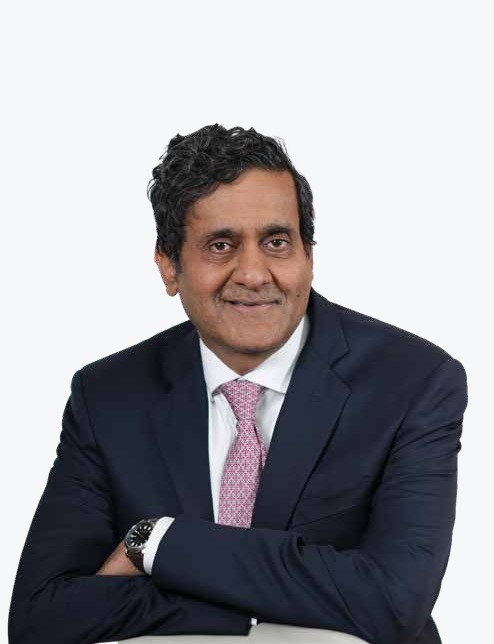
| Key facts | |
|---|---|
| Born | 11 December 1966 [1] |
| Family roots | Ancestral home at Haldighati, near Udaipur, Rajasthan; his father, a trader, moved to Bombay as a boy [20] |
| Education | B.Com, University of Mumbai; rank-holding chartered accountant and cost accountant; PGDM, IIM Ahmedabad (1989) [1] [20] [21] |
| Family | Wife Madhu Jain, a co-promoter and director of the IIFL Foundation; three children [20] [27] |
| Company/Group | IIFL Group: IIFL Finance (Managing Director), IIFL Capital Services, 5paisa Capital; early backer of 360 ONE WAM (formerly IIFL Wealth) [2] [17] |
| Wealth | About US$1.2 billion with his wife Madhu, per the Bloomberg Billionaires Index, March 2026 [69] |
| Known for | Turning a small equity research shop into one of India’s largest non-bank financial groups |
Around the turn of the millennium, a Mumbai research firm with 50-odd analysts did something that looked brave and turned out to be foolish. It put its company reports on the internet for free, hoping that advertisers would pay for the eyeballs. The eyeballs came. The advertisers did not. Within a year, the dot-com bubble had burst and the cash in the bank had fallen to Rs 4-5 crore. “We only had fuel to last a few months,” his co-founder later recalled [23].
The founder, a 34-year-old chartered accountant named Nirmal Jain, drew a lesson from that near-death experience that would shape the next quarter-century. “People were not willing to pay for information,” he said, “but they would pay for transactions” [23]. India Infoline stopped trying to be a media company and became a broker, then an insurance distributor, then a lender, and eventually a group of listed financial companies that, at one point or another, served millions of Indian savers and borrowers.
Jain’s story is not a straight line upward. It includes the dot-com crash, two rejected bank licence applications, a long-running commodity-exchange scandal that touched his group, a SEBI ban that an appeals tribunal later threw out, and a six-month Reserve Bank of India embargo on his most profitable business in 2024. Through all of it, he has remained, as one magazine put it, “the modest billionaire” [20]. This is how he built it, what went wrong, and what the record shows.
Where it began
Nirmal Bhanwarlal Jain was born on 11 December 1966, according to the director profile in IIFL Finance’s annual meeting notice [1]. (Wikipedia and several profiles give 1967; the company filing is the more reliable source.) His roots lie in Rajasthan. His family’s ancestral home was at Haldighati, the historic pass near Udaipur, and his father, a trader, moved to Bombay when he was just eight years old [20].
Jain grew up in that Bombay of traders and small businesses, and he credits his father for the values he took into finance. “Honesty, integrity and hard work are some of my greatest takings from my father,” he told MARWAR magazine in 2018. “One of the greatest lessons I have learnt from him is that one needs to be conservative” [20]. That word, conservative, is an odd one to hear from a man who would bet his savings on a research start-up and later on the internet. But it explains a lot about how he ran his balance sheets.
He studied commerce at the University of Mumbai and then took the gruelling double route that many ambitious Marwari and Gujarati boys of that era chose: he qualified as a chartered accountant, securing an all-India rank, and also as a cost accountant [1] [20]. Then he went to the Indian Institute of Management, Ahmedabad, finishing his PGDM in 1989 [1] [21]. His batchmates at IIM-A included Rashesh Shah, who would go on to found Edelweiss, another Mumbai financial group. The two would spend decades as friendly rivals [21].
In 1989, at 23, Jain joined Hindustan Lever (now Hindustan Unilever) [2]. He did not go into marketing, the glamour job for IIM graduates, but into commodities. For about five years he worked on the company’s commodity trading and export business [21] [37]. It was an unusual apprenticeship for a future broker: physical goods, prices that moved every day, and counterparties who had to be trusted.
He took two things from those years. One was a feel for markets. The other was a piece of advice from Keki Dadiseth, who later became chairman of Hindustan Lever: “reputation matters more than anything” [22].
Around 1994 Jain moved to Motilal Oswal, the Mumbai broking house, where he headed research and helped Raamdeo Agrawal set up its institutional equities and research unit [23] [20]. (CapitalVia has profiled Raamdeo Agrawal separately.) He stayed only a little over a year. He had seen something in Indian capital markets of the mid-1990s that he wanted to chase on his own.
“The hold of the old brokers had been broken,” he later said of that period. “The business was becoming more professional and there were opportunities for those with a background in finance” [21].
The first break
On 18 October 1995 Jain incorporated Probity Research and Services Private Limited in Mumbai [19] [1]. Its first registered office was a modest one, at 208-C Agarwal Market in Vile Parle (East) [19].
He did not have a family fortune behind him. “A first-generation entrepreneur such as I with no capital, just 5-10 lakh rupees of savings,” is how he described his starting point in a 2020 interview. He also refused to pretend there was a grand plan: “I think it would be wrong to say I had a vision to create this… we took one day at a time and kept moving” [25].
Probity sold independent research on Indian companies and the economy to institutions. Its clients, according to the group’s own history, included Hindustan Lever, Tata companies, CRISIL, McKinsey, SBI and Citibank, and its products had names like Probity 200 Company Reports and Economy Probe [17].
Finding Venkat
The most important early hire was not an analyst but a partner. R. Venkataraman, an IIT Kharagpur engineer with an MBA from IIM Bangalore, was working at ICICI. His boss there had been Jain’s dorm-mate at IIM-A, and the two were introduced through him [24] [2]. They bonded, Outlook Business reported, “over numerous cups of chai and vada pav” near a Mumbai stall that served as an informal meeting room [24].
Venkataraman joined the board on 5 July 1999 and has been Jain’s co-promoter ever since [2]. The division of labour was clear from the start. Venkataraman called Jain “a born entrepreneur” and “a friend, philosopher and guide.” Jain said his partner “can execute a plan perfectly,” and added: “I have not found a person who is as trustworthy as Venkat” [24]. Asked what had kept them together for so long, Venkataraman answered in four words: “Shared values and mutual respect” [24].
The internet bet
In May 1999 the firm launched the portal indiainfoline.com [19]. The timing fitted the moment. Venture money was pouring into anything with “.com” in its name, and a research house with a library of company reports looked like a ready-made content business.
Probity raised its first private equity from CDC, the British development finance institution, which put in US$1 million; Intel followed [17]. By May 2000 the company had raised a second round of Rs 26 crore from investors including Intel and ICICI, at a valuation of about Rs 250 crore. Jain said the first round, a year earlier, had valued the firm at Rs 45-50 crore [26]. The company changed its name to India Infoline.com Ltd in May 2000 and to India Infoline Ltd in March 2001 [19].
It also went shopping. In March 2000 it bought Agri Marketing Services, a distribution business with 32 branches and more than 30,000 customers, paying in shares, and acquired Indiafn.com for cash [26].
Then the bubble burst. The idea had been simple: make research free and earn from advertising. “We had 100 subscribers, but our reports were being read by several thousand people,” Jain recalled [23]. Readers were happy to read for free. Advertisers were not willing to pay enough. By 2000-01 the cash balance had shrunk to Rs 4-5 crore, according to Venkataraman [23]. The company reported losses of Rs 58.87 crore in 2001-02 and Rs 47.07 crore in 2002-03 [28].
The pivot that saved the company
What saved India Infoline was a willingness to change the business model fast. If people would not pay for information, they would pay to trade. The firm built an online trading platform; its prospectus text dates the launch of 5paisa.com to July 2000, while later accounts describe a pilot in 2001 and a full-fledged online broker by 2002 [19] [23] [20]. Its selling point was in the name: brokerage of 0.05%, at a time when the industry charged 1-1.5% [17].
In 2001 India Infoline also became the first corporate agent for insurance in India, selling ICICI Prudential policies [17]. “We were the largest non-bank distributors for ICICI Prudential for a long time,” Jain later said [23].
By 2003-04 the company was back in profit, reporting net profit of Rs 74.8 crore, helped by a deferred tax release [28]. The near-death experience had produced a company that earned fees and commissions rather than hoping for advertising.
Building the empire
The 2005 IPO
India Infoline went public in April 2005. It sold about 1.19 crore fresh shares in a price band of Rs 70-80, raising about Rs 90 crore; the issue was priced at Rs 76 and subscribed 6.63 times [29] [27]. Enam Financial Consultants ran the book [27]. The shares listed on 17 May 2005, opening at Rs 87.15 on the BSE [29]. The promoters named in the offer were Nirmal Jain, R. Venkataraman and Madhu Jain [27]. At the time, India Infoline had 73 branches in 36 locations [27].
The IPO had its critics. About two months before the issue, the promoters had allotted themselves 4.3 lakh shares at par. Jain explained that this was in exchange for giving up a 10% profit-share arrangement, and it took the promoter stake to 51%. Business Standard called the gap between that allotment and the issue price “jarring” [28]. It was a reminder that even in a successful listing, investors look closely at how promoters treat themselves.
The bull market years
The listing came just as Indian markets entered one of their great bull runs. Equity brokerage income, which had been Rs 8.55 crore in 2002-03, rose to Rs 590 crore by 2007-08 [23]. The firm added a commodities licence and portfolio management in 2004, an NBFC licence in 2006 (initially only for loans against shares), and housing finance registration with the National Housing Bank in 2009 [19] [23]. In 2007 it hired a team of institutional brokers from the foreign broker CLSA, offering them about 10% dilution as a sign-on bonus, and launched a consumer finance brand [23].
In 2008 Karan Bhagat joined to build a wealth management business for rich families; IIFL took 76% and employees held the rest [23]. Nobody knew it yet, but this would become the group’s most valuable single creation.
The 2008 global financial crisis hit hard. In 2008-09 consolidated income fell 5.9% to Rs 963 crore and net profit fell 9.4% to Rs 144.8 crore. “During 2008-09, our business faced strong headwinds,” Jain said [30]. Broking had another bad patch in 2011, when he called the June quarter “perhaps one of the worst in the past six-seven years” [31].
Those swings taught him a lesson that many brokers learn the hard way: trading income comes and goes with the market mood. Lending, if done carefully, compounds.
Shifting the weight to lending
Through the 2010s, IIFL steadily turned itself from a broker that lent on the side into a lender that also broked. It grew in gold loans, home loans, loans to small businesses and, after buying Samasta Microfinance in 2017, microfinance [17].
Jain also tried twice to become a banker. IIFL applied for a universal bank licence in 2013, when the RBI gave licences to IDFC and Bandhan instead, and the group later explored a small finance bank. Outlook Business reported that its bank licence applications were “rejected twice” [23]. Like many non-bank lenders, IIFL had to keep funding itself through bonds, bank loans and outside equity.
He was also careful about what not to do. When rivals rushed into insurance underwriting, IIFL stayed out. “We still decided not to get into insurance underwriting because it is a capital-guzzling business,” Jain said. “If your balance sheet is not high quality, you can get into big trouble” [23].
Prem Watsa arrives
Outside capital came from some of the biggest names in global finance. The most important was Fairfax Financial Holdings, the Toronto insurer run by Indian-born billionaire Prem Watsa. Fairfax began as a broking client around 2007 and bought about 9% of IIFL in 2011 [23]. In July 2015 it launched an open offer to buy up to 26% more at Rs 195 a share, worth about Rs 1,621 crore. Fairfax then held 8.97% and the promoters 29.77%, and the promoters said they would not sell into the offer [32]. The deal made Fairfax the largest shareholder [23].
Other big cheques followed. General Atlantic bought 21.6% of IIFL Wealth in 2015, and CDC returned with Rs 1,005 crore (about US$150 million) for India Infoline Finance in 2016 [17]. Jain has said Fairfax brought not just money but credibility [69].
Breaking up the group
By the late 2010s IIFL was a sprawling holding company, and Jain decided it was worth more in pieces. First came 5paisa. In late 2016 IIFL announced that it would demerge its discount broking arm into a separate listed company, with one 5paisa share for every 25 IIFL shares [33]. “Such organisations require a different structure and culture,” Jain said of the do-it-yourself, low-cost broking business [33]. It was a clear-eyed bet on the market that young discount brokers such as Zerodha would later dominate. (See CapitalVia’s profile of Nithin Kamath.)
Then, in early 2018, came the big restructuring. IIFL Holdings announced it would split into three listed companies: IIFL Finance for lending, IIFL Securities for broking and capital markets, and IIFL Wealth for wealth management. Shareholders would get 7 IIFL Finance shares, 7 IIFL Securities shares and 1 IIFL Wealth share for every 7 IIFL Holdings shares [34]. “By separating them, we will allow them to grow to their full potential,” Jain said [34]. He also argued that “a clean corporate structure with no cross holdings will ensure transparency, highest governance standards and compliance” [36].
The National Company Law Tribunal approved the scheme in March 2019, and IIFL Wealth and IIFL Securities listed in September 2019 [35].
Becoming a billionaire
The market began to notice the man behind the group. In March 2018, Bloomberg reported that Jain had joined its billionaires index, with about 23% of IIFL and a fortune built on managing money for India’s new rich [37] [38]. “Most of it is first-generation wealth, so your clients are pretty hands-on,” he said of his wealth clients [37]. Asked about his own wealth, his reply was typical: “I just do my work” [38]. He disputed reports that he was worth a billion dollars [20].
Wealth: from IIFL Wealth to 360 ONE
IIFL Wealth became one of India’s largest wealth and asset managers under Karan Bhagat. In March 2022 Bain Capital agreed to buy about a quarter of it from General Atlantic and Fairfax; the deal was completed in November 2022, when Bain’s vehicle bought 2.2 crore shares at Rs 1,661 each [39]. The company renamed itself 360 ONE WAM in late 2022. Jain and Venkataraman stepped off its board in 2024 and did not seek reappointment [78]. In July 2025 Bain sold 3.7% of the company for Rs 1,741 crore, keeping about 18% [82].
Jain is now a shareholder in 360 ONE, not a promoter, but his early bet keeps paying off. In the quarter to September 2026, 360 ONE reported total assets under management of about Rs 8.99 lakh crore and quarterly profit of Rs 302 crore [15].
Home loans and ADIA
In June 2022 a subsidiary of the Abu Dhabi Investment Authority agreed to invest Rs 2,200 crore for a 20% stake in IIFL Home Finance, which then had loans of Rs 23,617 crore [40]. That valued the housing lender at about Rs 11,000 crore. “We are delighted to partner with ADIA who bring to the table long term commitment,” Jain said [40].
Hands on at IIFL Finance
When IIFL Finance’s chief executive Sumit Bali resigned in 2020, Jain took on the CEO role himself [83]. He has been Managing Director of IIFL Finance since 1 April 2022, having earlier been whole-time director and chairman [2]. Former SBI chairman A. K. Purwar became chairman, and in December 2025 former RBI deputy governor B. P. Kanungo took over as non-executive chairman, with Jain staying on as MD [76].
The pay disclosures tell their own story. For 2024-25, a loss year, Jain drew Rs 12.26 crore against an entitlement of over Rs 17 crore, and the company told shareholders he “has not drawn any commission” since his appointment [2].
The comeback in numbers
After the setbacks of 2024 (covered below), IIFL Finance recovered sharply. For 2025-26 it reported profit before minority interest of about Rs 1,817 crore and loan assets of about Rs 1.08 lakh crore, with gold loans again the biggest single book [79]. In the quarter to December 2025 it earned Rs 501 crore [60]. India’s gold loan boom has helped the whole sector; CapitalVia has written about how gold loans have grown far faster than credit cards.
2026: Fairfax takes the wheel at IIFL Capital
The group’s ownership is still moving. In May 2026 Fairfax India agreed to invest Rs 2,000 crore in IIFL Capital Services (the renamed IIFL Securities) through a preferential issue at Rs 350 a share, with an open offer, aiming to hold at least 51% and join the promoter group alongside Jain and Venkataraman [66]. In March 2026 Jain told Bloomberg that he wanted IIFL Capital’s wealth book of about Rs 60,000 crore to grow 80-100% in two years [69] [68].
At IIFL Finance, Bloomberg reported in September 2026 that Blackstone was in early talks to invest, while Fairfax was considering selling its stake to meet regulatory requirements linked to its proposed purchase of IDBI Bank [67]. On 10 November 2026 Business Standard, citing The Economic Times, reported that Blackstone was set to take about 15%, with the promoters adding capital to keep their combined stake near 25% [87]. As of today no final deal had been announced by the company, and terms may change.
How the wealth is held
Jain’s fortune is mostly in listed shares. A disclosure filed in April 2026 showed him holding 5.34 crore shares of IIFL Finance directly, with the wider promoter group (including his wife Madhu, Venkataraman and family trusts) holding about 10.57 crore shares, none of them pledged [14]. That was roughly a quarter of the company. He also holds stakes in IIFL Capital Services and 5paisa Capital, where he is a promoter, and a minority stake in 360 ONE WAM [2] [69].
The Bloomberg Billionaires Index put the combined net worth of Jain and his wife at US$1.2 billion in March 2026 [69]. He did not appear in the Forbes India Rich List for 2024 or 2025, whose cut-offs were well above that level. Any such figure moves daily with share prices.
The setbacks and failures
Jain’s career is full of reversals, and he talks about them more openly than most.
The dot-com crash. The free-research-for-ads model nearly killed the company in 2000-01, with cash down to a few months’ runway and two years of heavy losses [23] [28].
Market cycles. Broking income fell in 2008-09 and again in 2011, both times because of market downturns [30] [31].
No bank licence. Two attempts to become a bank failed, leaving IIFL dependent on wholesale funding [23].
The 2024 gold loan embargo. The single biggest blow of his career came from the RBI in March 2024, when IIFL Finance’s most profitable business was frozen for six months (details below). In the September 2024 quarter, IIFL Finance posted a consolidated net loss of Rs 93 crore, against a profit of Rs 526 crore a year earlier, as its gold loan book shrank by more than half and it also made a large one-time provision on an investment in an alternative investment fund [57]. “This past quarter has been one of our most challenging,” Jain said [57]. The company ended 2024-25 with a loss [2].
Microfinance stress. Like much of the industry, IIFL’s microfinance and unsecured lending went through a credit squeeze in 2024-26. Looking back in February 2026, Jain admitted: “In hindsight, unsecured lending had expanded very rapidly across the industry” [80].
He has written that he would not tell his younger self how to avoid mistakes, because they were part of the education: “I would not give any advice or tips to my younger self on how to avoid mistakes, failures or pain” [85].
Controversies and allegations
IIFL is a regulated financial group, and over three decades it has faced a long list of regulatory actions. Most were penalties of a few lakh rupees for process lapses. A handful were serious. They are set out below as documented by regulators, courts and company filings, with the company’s response and the latest status.
The RBI gold loan embargo (2024)
Allegation: On 4 March 2024 the Reserve Bank of India ordered IIFL Finance “to cease and desist, with immediate effect, from sanctioning or disbursing gold loans or assigning/securitising/selling any of its gold loans” [3]. Based on an inspection of the company’s position as of 31 March 2023, the RBI cited “serious deviations in assaying and certifying purity and net weight of the gold” at sanction and auction, “breaches in Loan-to-Value ratio,” “significant disbursal and collection of loan amount in cash far in excess of the statutory limit,” “non-adherence to the standard auction process” and “lack of transparency in charges being levied to customer accounts.” It said “no meaningful corrective action has been evidenced so far” [3]. Existing loans could still be serviced. At the time, gold loans were about a third of IIFL Finance’s loan book [52].
Response: The company said it would “rectify observations of the RBI in gold loan portfolio” [4]. Jain said: “While the directive from RBI appears a little harsh, would like to express utmost gratitude to the regulator.” He described the problems as operational rather than a governance or ethics failure, and said that “gold testing is manual and subjective process” [50]. The then chairman, A. K. Purwar, said all of the RBI’s concerns “pertain to operational and process-related matters” [86].
What happened next:
- The shares fell 20% on two successive days [51].
- Fairfax offered up to US$200 million in liquidity support; Prem Watsa said he was “confident that Nirmal and Venkat will take corrective actions” [52].
- IIFL Finance raised Rs 1,271 crore through a rights issue at Rs 300 a share in May 2024, which the promoters fully subscribed to [53].
- An RBI-appointed special audit began in April 2024 and was completed by mid-June [54].
- On 19 September 2024 the RBI lifted the restrictions with immediate effect [55]; the shares rose up to 13% that day [56].
- In May 2026 the RBI separately fined IIFL Finance Rs 3.10 lakh for failing to pay some borrowers the surplus from auctions of their pledged gold [11].
Status: The embargo was lifted in September 2024. In a 2025 interview Jain said: “We treated the embargo as a wake-up call,” and “Nothing can be compromised for the sake of growth.” He added: “adherence to regulatory guidelines must be independent of perceived industry norms” [58]. By early 2026 he was saying the company was “not chasing growth by stretching ticket sizes or LTVs” [80].
SEBI’s ban on IIFL Securities taking new clients (2023)
Allegation: In an order dated 19 June 2023, a SEBI whole-time member barred IIFL Securities from taking on new clients for two years [5] [45]. Based on inspections covering April 2011 to January 2017, SEBI said the broker had mixed client money with its own: 26 of 45 client bank accounts were not titled as client accounts, and money of clients with credit balances was used to meet obligations of clients with debit balances on 687 of 695 sample days, and for the broker’s own trades on 29 days [5]. “Money is fungible,” the order said [5]. Two earlier SEBI adjudication orders in 2022 had already fined the firm Rs 1 crore each over the same issues [46]. The shares fell about 18% [45].
Response: In its exchange filing, IIFL Securities said SEBI had applied a 2017 circular retroactively, pointed out that the order itself recorded “no instance of misuse of clients funds” after that circular, said existing clients were unaffected, and announced an appeal [6].
What happened next:
- The Securities Appellate Tribunal stayed the order within days.
- On 7 December 2023 SAT set the order aside. “There has been no misuse of client funds,” the tribunal held, calling SEBI’s approach “erroneous” [47] [48].
- SAT upheld only a “technical breach” of the 1993 rule on naming client accounts and reduced the penalty to Rs 20 lakh [47] [49].
Status: Overturned by SAT in December 2023. We found no reported appeal by SEBI to the Supreme Court.
The NSEL case and IIFL’s commodity broker (2013 onwards)
Allegation: The National Spot Exchange (NSEL) collapsed in July 2013 with a payment default of about Rs 5,600 crore. IIFL’s subsidiary India Infoline Commodities Ltd (IICL) was one of many brokers on the exchange. In March 2015 the Mumbai police’s Economic Offences Wing arrested an IIFL official, along with executives from other brokers, on charges including cheating and conspiracy linked to the sale of NSEL contracts; they were later released on bail [41]. In February 2019 SEBI declared IICL “not a fit and proper person” to be a commodity broker [42]. On 18 May 2023 a special court under the Maharashtra MPID Act, acting on an application by NSEL, issued process against “Nirmal Jain, director of IICL,” and against IIFL Finance as its promoter, finding prima facie that promoters had been left out of the 2018 chargesheet “without providing cogent reasons” [44].
Response: IIFL has maintained that IICL “acted only as a broker” and “did not have any proprietary position or funding positions towards NSEL contracts” [41]. After SEBI’s later order, IIFL said it had “no impact on the businesses of other companies of IIFL Group” [8]. Jain and IIFL Finance appealed the 2023 summons order to the Bombay High Court [7].
What happened next:
- In June 2022 SAT quashed SEBI’s “not fit and proper” order against IICL and four other brokers, calling the findings “farfetched and arbitrary,” and sent it back to SEBI [43].
- In November 2022 SEBI passed a fresh order barring IICL from seeking registration for six months, or until acquitted, whichever came earlier [8].
- In February 2025 a Bombay High Court bench, while ruling on related appeals, directed that the appeals by Jain and IIFL Finance against the 2023 summons order be listed for hearing later [7].
Status: Pending. The MPID court’s 2023 order is a summons stage, not a finding of guilt, and Jain’s appeals against it were pending before the Bombay High Court at the latest available record. It is worth noting that the application to add the brokers’ promoters was filed by NSEL, itself a party to the dispute [44].
Income-tax search and demands (2025-26)
Allegation: From 28 January 2025 the Income Tax Department searched IIFL Finance, IIFL Securities, 360 ONE WAM and related premises over alleged tax evasion [59]. In January 2026 the department ordered a special audit of IIFL Finance’s accounts for the period, and the shares fell about 13% despite strong quarterly profits [60]. After block assessments, the department raised a demand of Rs 475.56 crore on IIFL Finance in May 2026 [62], and in August 2026 a demand of Rs 963.39 crore on IIFL Home Finance, plus Rs 23.78 crore on IIFL Finance, mainly over the tax treatment of commissions, deductions, interest-strip assets and stock-option costs [61].
Response: The companies said they were cooperating fully [59]. On the January 2026 earnings call, Jain said: “This is not a finding, this is not an allegation, and this is not an adjudication… There is no tax demand, no penalty” [12]. After the demands came, IIFL said it had challenged the assessment before the appellate authority and did not expect a material impact [61] [62].
What happened next:
- The special audit was completed and its report submitted by March 2026 [13].
- Recovery of the Rs 475.56 crore demand was stayed until 31 December 2026, or the disposal of the appeal if sooner, subject to a 5% deposit [61].
Status: Under appeal before the Commissioner of Income Tax (Appeals). Tax disputes of this kind are often reduced or overturned on appeal, but none has been decided yet.
Hindenburg and the 360 ONE fund (2024)
Allegation: In August 2024 the US short-seller Hindenburg Research claimed that the then SEBI chair Madhabi Puri Buch and her husband had held a stake in an offshore fund structure set up through IIFL Wealth (now 360 ONE), which it tried to link to entities mentioned in its earlier report on the Adani group [63].
Response: 360 ONE said the fund “did not make any direct or indirect bet on the shares of Adani group,” that over 90% of its money was in bonds, and that the Buchs’ holding was less than 1.5% of the fund [63].
Status: No regulator or court made any finding against 360 ONE or Jain. The allegation was aimed at the SEBI chair, not at Jain, who by then had no management role at 360 ONE. (For the wider dispute, see CapitalVia’s profile of Gautam Adani.)
The Mordani dispute (2025-26)
Allegation: In public notices in August and September 2025, the Mordani real estate group accused Jain of a “breach of trust” in a commercial dispute with IIFL’s lending arms [64].
Response: IIFL called the claims “completely baseless, frivolous, vexatious” and said the Mordani group had breached a December 2024 framework agreement; the NCLT in Mumbai had earlier appointed resolution professionals against two Mordani promoters [64].
Status: A civil suit by a Mordani group company against IIFL Finance, IIFL Home Finance and another firm is pending in the Bombay High Court, which in April 2026 declined IIFL’s request to reject the suit at the threshold, sending it to trial. Jain is not named in that order [16].
Smaller regulatory penalties
IIFL group companies have paid a number of small penalties and settlements. They include:
- IIFL Wealth Management paid Rs 3.12 crore in 2022 to settle, without admitting or denying guilt, a SEBI case alleging manipulation of a reference price for a block deal [65].
- The RBI fined IIFL Samasta Finance Rs 33.10 lakh in February 2025 for lending-process and NPA-classification lapses [9].
- The RBI fined IIFL Finance Rs 5.30 lakh in February 2026 for not classifying certain restructured accounts as bad loans [10].
- The RBI fined IIFL Finance Rs 3.10 lakh in May 2026 over gold auction surpluses [11].
Each was paid or settled.
As of 10 November 2026, the NSEL-related appeals and the income-tax appeals are pending, and no court or regulator has made any finding of personal wrongdoing against Nirmal Jain.
Giving back
The group’s charity arm is the IIFL Foundation, with Madhu Jain as a director and its public face [70] [72]. Its biggest programme speaks to the family’s Rajasthani roots.
Sakhiyon Ki Baadi (“a garden of friends”) started in 2016 with 100 learning centres and 3,000 girls in rural Rajasthan, aimed at out-of-school girls aged 4 to 14. The Foundation says it has grown to more than 1,100 centres and about 36,000 girls across 11 districts [70]. Local women trained as teachers are called “Daksha.” By 2021 the Foundation said it had invested more than Rs 35 crore in the programme, with a goal of 100% female literacy in Rajasthan by 2030 [71]. “Being from Rajasthan, I always wanted to do something about the situation,” Madhu Jain said [71].
The Foundation has also adopted government girls’ schools with the Rajasthan education department. In April 2026 three upgraded schools in Udaipur district were opened by the state’s education minister, with Nirmal and Madhu Jain present. “Education is the cornerstone of long-term social progress,” Jain said [72]. During the Covid-19 second wave, the Foundation donated oxygen concentrators in Rajasthan and Maharashtra through Bharatiya Jain Sanghatana [73].
Personally, Jain has been on the board of the education charity Pratham [75] [1], and was among the early backers of Ashoka University in Sonipat [84]. The EdelGive Hurun India Philanthropy List 2020 recorded “Nirmal Jain & family” giving Rs 6 crore to education that year [74].
Succession
Jain has always said he does not expect his children to inherit his job by default. “It’s not certain my children will take over after I retire,” he told The Economic Times in 2016. “I’d like to see my daughter work outside for five years before she joins the company” [21]. Two years later he put it more firmly: “IIFL is a professionally managed company where all decisions are taken by an independent board” [20].
In practice, the group has been moving towards outside chairmen and stronger outside shareholders. At IIFL Finance, a former RBI deputy governor is chairman and Jain remains Managing Director [76]. At IIFL Capital Services, Venkataraman returned as Managing Director in March 2025, with an independent director as chairperson [77], and Fairfax is set to become the controlling shareholder [66]. At 360 ONE, a professional team led by Karan Bhagat runs the business. Whether Jain plans a formal handover at IIFL Finance has not been publicly announced. Along the way he has collected recognition that reflects his training as much as his wealth, including the Institute of Chartered Accountants of India’s CA Entrepreneur Leader award in financial services [2] [18].
What their journey teaches
Sell what customers will pay for, not what they like. Jain’s research was widely read and barely paid for. The moment he accepted that “people… would pay for transactions,” the business had a future [23].
A partner you trust is worth more than capital. He started with Rs 5-10 lakh, but he also had R. Venkataraman, a partner who has stayed by his side for more than 25 years [25] [24].
Separate businesses that need different cultures. Splitting out 5paisa and then breaking the group into three let each business raise its own capital and attract investors such as Bain, ADIA and Fairfax [33] [34].
Compliance cannot be an industry average. Jain’s own reading of the 2024 RBI embargo was that doing what competitors did was not a defence: rules must be followed “independent of perceived industry norms” [58].
Risk is the price of ownership. “If you don’t want to take risks then you can be an employee,” Jain told Entrepreneur India in 2024. An entrepreneur, he said, has to “welcome uncertainties, expect surprises and be ready to make course corrections” [81].
Stay out of businesses that eat capital. Saying no to insurance underwriting and other capital-heavy ventures kept the balance sheet strong enough to survive the bad years [23].
Expect the ride to be long and rough. “Expect your opportunity and journey to be a wild, gut-wrenching ride that could last decades,” he has said. “The winners are endlessly flexible, tenacious folks, who never quit” [20].
A profile for general reading, based on public records and reporting as of 10 November 2026. Not investment, tax or legal advice.
Sources (87)
- IIFL Finance 27th AGM Notice, director profile - IIFL Finance, Jun 2022
- IIFL Finance AGM Notice 2025 - IIFL Finance, Jul 2025
- RBI imposes business restrictions on IIFL Finance Limited - Reserve Bank of India, Mar 2024
- Disclosure on RBI directions, press release - IIFL Finance via NSE, Mar 2024
- Final order in the matter of IIFL Securities Ltd - SEBI, Jun 2023
- Disclosure on SEBI order - IIFL Securities via BSE, Jun 2023
- Judgment in NSEL MPID appeals, 2025:BHC-AS:7466-DB - Bombay High Court, Feb 2025
- Disclosure on SEBI order against India Infoline Commodities - IIFL Finance via BSE, Dec 2022
- RBI imposes monetary penalty on IIFL Samasta Finance - Reserve Bank of India, Feb 2025
- RBI imposes monetary penalty on IIFL Finance - Reserve Bank of India, Feb 2026
- RBI imposes monetary penalty on IIFL Finance - Reserve Bank of India, May 2026
- Q3 FY26 earnings call transcript - IIFL Finance via NSE, Jan 2026
- Intimation on conclusion of special audit - IIFL Finance via NSE, Mar 2026
- Promoter disclosure under Regulation 31(4) - IIFL Finance via NSE, Apr 2026
- Q2 FY27 investor presentation - 360 ONE WAM via NSE, Oct 2026
- Order in Paramvir Developers v IIFL Finance, Commercial Suit 126 of 2025 - Bombay High Court, Apr 2026
- Our history - IIFL Finance, Nov 2026
- Nirmal Jain, leadership profile - IIFL Finance, Nov 2026
- IIFL Holdings company history - The Economic Times, Nov 2026
- The Modest Billionaire - MARWAR India, Jun 2018
- From IIM-A to Dalal St: a tale of two batchmates, Rashesh Shah and Nirmal Jain - The Economic Times, May 2016
- Up close and personal with Nirmal Jain, chairman, IIFL Group - The Economic Times, Dec 2015
- Prudent Financier - Outlook Business, Jul 2017
- Nirmal Jain and R Venkataraman - Outlook Business, Jan 2017
- In The Hot Seat With Nirmal Jain - Forbes Advisor India, Dec 2020
- Indiainfoline buys two companies - Business Standard, May 2000
- India Infoline IPO priced at Rs 70-80 a share - Business Standard, Apr 2005
- Even 5paisa isn't cheap - Business Standard, Apr 2005
- India Infoline IPO details - Chittorgarh, May 2005
- India Infoline FY09 income and net profit - Business Standard, Apr 2009
- Q&A: Nirmal Jain, chairman, IIFL - Business Standard, Sep 2011
- Canada's Fairfax to acquire 26% in IIFL - Business Standard, Jul 2015
- 5paisa going places, Street debut comes next - The Economic Times, Nov 2016
- IIFL Holdings to demerge finance, wealth and capital business - Business Standard, Feb 2018
- IIFL Finance gains after exchanges OK listing of demerged entities - Business Standard, Sep 2019
- We will double our businesses in less than three years: Nirmal Jain - Business Standard, May 2018
- Managing fortunes of the rich makes IIFL's Nirmal Jain a billionaire - Mint, Mar 2018
- Indian billionaire manages fortunes for burgeoning new rich - ThePrint, Mar 2018
- BC Asia Investments X completes acquisition of stake in IIFL Wealth Management - MarketScreener, Nov 2022
- Abu Dhabi's ADIA invests Rs 2,200 cr in IIFL Home Finance for 20% stake - Business Today, Jun 2022
- EOW arrests three top brokers in NSEL scam - Business Standard, Mar 2015
- MOFSL, IIFL fall as Sebi declares commodity arms unfit to undertake trading - Business Standard, Feb 2019
- Not fit and proper: SAT scraps Sebi order against 5 brokers in NSEL case - Business Standard, Jun 2022
- MPID court makes directors and promoters of IIFL, Anand Rathi Commodities, Geojit Comtrade accused in NSEL case - Moneylife, May 2023
- Sebi bars IIFL Securities from taking new clients for two years - Business Today, Jun 2023
- Sebi slaps Rs 1 cr fine on IIFL for misutilisation of client securities - Business Today, May 2022
- SAT sets aside Sebi order prohibiting IIFL Securities from taking new clients for 2 years - Outlook Business, Dec 2023
- SAT sets aside market regulator Sebi's order against IIFL Securities - Business Standard, Dec 2023
- SAT sets aside Sebi order restraining IIFL Securities from taking new clients - Moneylife, Dec 2023
- No governance issues: IIFL Finance's Nirmal Jain calls RBI action on gold loans a little harsh - Business Today, Mar 2024
- IIFL Finance plummets 20% for second day after RBI crackdown - The Week, Mar 2024
- Fairfax India agrees to give IIFL Finance up to $200 mn liquidity support - Business Standard, Mar 2024
- IIFL Finance raises Rs 1,271 crore through rights issue - Business Standard, May 2024
- RBI's special audit over, IIFL Finance appoints team to implement corrective actions - BW Businessworld, Jun 2024
- Reserve Bank lifts ban on IIFL Finance's gold loan business ahead of festive season - Business Today, Sep 2024
- India's IIFL says regulator lifts ban on gold loan business - Bloomberg, Sep 2024
- IIFL Finance Q2 results: firm incurs consolidated net loss of Rs 93.07 cr - Business Standard, Oct 2024
- No compromise on compliance, audit for growth: IIFL Finance's Nirmal Jain - Business Standard, May 2025
- Income tax department searches IIFL Finance, 360 One WAM over alleged tax evasion - Business Standard, Jan 2025
- IIFL Finance Q3 profit up multifold to Rs 501 cr; scrip tanks 13 pc on I-T directive - The Week (PTI), Jan 2026
- IIFL Finance shares crack 8% after Rs 963 crore tax demand for subsidiary - Business Standard, Aug 2026
- IIFL Finance faces Rs 475.56 crore tax demand from IT authority - Business Upturn, May 2026
- No investments in Adani firms, Sebi chair not involved in fund's operations: IIFL - Business Standard, Aug 2024
- Real estate firm slams IIFL's Nirmal Jain in explosive public feud - BW Businessworld, Sep 2025
- IIFL Wealth Management pays over Rs 3 crore to settle case with Sebi - Business Standard, Jul 2022
- IIFL Capital jumps after Fairfax India announces Rs 2,000 crore investment - Business Standard, May 2026
- Blackstone explores stake in India's IIFL Finance - report - Retail Banker International, Sep 2026
- Billionaire Nirmal Jain bets on India's wealth boom to hire, woo assets - Business Standard, Mar 2026
- Billionaire Jain Bets on India's Wealth Boom to Lift Assets - Bloomberg, republished by IIFL, Mar 2026
- IIFL Foundation education programme: Sakhiyon Ki Baadi - IIFL Foundation, Nov 2026
- How IIFL Foundation's Sakhiyon Ki Baadi is educating girls in Rajasthan - YourStory, Aug 2021
- IIFL Foundation-supported state-of-art government schools in Rajasthan inaugurated on Mahavir Jayanti - The Week (PTI), Apr 2026
- IIFL Foundation donates 100 oxygen concentrators in Rajasthan through Bharatiya Jain Sangathana - India CSR, May 2021
- EdelGive Hurun India Philanthropy List 2020 - Hurun, Nov 2020
- Nirmal Jain, board member - Pratham, May 2019
- IIFL Finance appoints former RBI deputy governor B P Kanungo as board chairman - Free Press Journal, Dec 2025
- R Venkataraman takes over as MD of IIFL Capital; Rekha Warriar appointed chairperson - Board Stewardship, Mar 2025
- 360 One Wam Limited announces board changes - MarketScreener, Jun 2024
- IIFL Finance posts strong Q4FY26 results with higher AUM - Construction World, May 2026
- MC Exclusive: Not chasing growth in gold loans by stretching LTV or ticket sizes, says Nirmal Jain - Moneycontrol, republished by IIFL, Feb 2026
- IIFL founder Nirmal Jain on the lessons he learnt - Entrepreneur India, Jan 2024
- Bain Capital sells 3.7% stake in 360 ONE WAM for Rs 1,741 crore - Outlook Business, Jul 2025
- IIFL CEO steps down after two years - People Matters, Jun 2020
- Dilip Shanghvi, Nirmal Jain, others line up to back Ashoka University - The Economic Times, Apr 2014
- Don't let mistakes overwhelm you - Nirmal Jain, IIFL, May 2017
- Have achieved full compliance with RBI requirements: IIFL Finance's A K Purwar - Business Standard, Mar 2024
- Blackstone set to become key investor in IIFL Finance with 15% stake - Business Standard, Nov 2026