
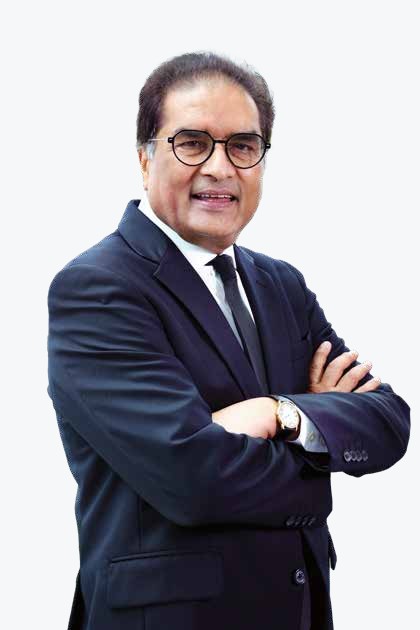
| Key facts | |
|---|---|
| Born | c. 1956, Nagpura, a village near Raipur (now Chhattisgarh); Forbes gives his age as 70 in October 2026 [23] [46] |
| Family roots | Farming family; his father, the late Dau Ram Gopal Agrawal, farmed about 100 acres [23] [33] |
| Education | Schooling in Raipur; B.Com (he studied in Nagpur); Chartered Accountant, 1983 [32] [33] [34] |
| Family | Wife Suneeta Agrawal; son Vaibhav Agrawal, a director of Motilal Oswal Financial Services [3] [21] |
| Company | Co-founder (1987) and non-executive chairman, Motilal Oswal Financial Services Ltd [30] [20] |
| Wealth | About US$2.1 billion (real-time, 23 October 2026), and No. 2,274 on the Forbes 2026 Billionaires list [46] |
| Known for | The annual Wealth Creation Study since 1996, the QGLP investing framework and “Buy right, sit tight” [29] [64] |
In 1994 a friend gave Raamdeo Agrawal a homework assignment. Read the annual report of a company called Berkshire Hathaway, the friend said. Agrawal was then in his late thirties. He was a chartered accountant who had built a broking business on Dalal Street, made Rs 30 crore in the Harshad Mehta bull run, and watched two-thirds of it vanish when the bubble burst. He thought of himself as a smart investor. Then he read about 30 pages of Warren Buffett.
“When I studied those 30 pages, it opened my eyes. I realised I knew little of investing. Buffett became my guru,” he said later [34]. He went back and read every Berkshire letter from 1965 to 1994, cut a sprawling portfolio down to a handful of companies, and in a slide deck he presented two decades later gave his honest verdict on his first seven years in the market: “1987-94: Only luck, no skill” [31].
That willingness to call his own early success luck runs through the whole life. A farmer’s son from a village near Raipur that had no electricity, who failed his CA exams again and again because of his handwriting, Agrawal co-founded what became Motilal Oswal Financial Services (MOFSL), a financial group worth around Rs 56,000 crore on the stock market in October 2026 [69]. He has written India’s longest-running study of which companies create wealth for shareholders and why, and he became a dollar billionaire on Forbes’ list [29] [46]. He and his partner of four decades, Motilal Oswal, have also pledged 10% of the company’s shares to charity [2].
This is how he got there, what went wrong along the way, and what the record shows.
Where it began
Raamdeo Agrawal grew up in Nagpura, a village near Raipur in what is now Chhattisgarh, according to a 2025 release from his own group’s foundation [23]. “As a farmer’s son, I grew up close to this land,” he said on that occasion [23]. His exact date of birth does not appear in the public records we could check. Forbes listed his age as 70 in October 2026, and a 2017 Mint report called him 60, which puts his birth around 1956 [46] [36].
He describes a childhood without modern comforts. “I grew up in a village where there was no electricity, no pakka road,” he told the Blume podcast in 2023 [32]. In a 2025 interview with Value Research he put the village 20 to 30 kilometres from Raipur and described conditions as “primitive”. The single-teacher school sometimes could not run when a stream flooded and the teacher could not reach it [33].
The family was not poor. His father, Dau Ram Gopal Agrawal, farmed roughly 100 acres and supported six or seven children, Value Research reported [33]. He “was from a well-off family, even though his parents were farmers,” The Economic Times wrote in 2020, adding that he “had no connection with the stock market whatsoever” [34].
After Class 5 he was sent to Raipur for proper schooling. He topped his class in Class 6, a result he says gave his confidence a lift it needed [33]. College was harder. He moved to Nagpur for a B.Com and had to switch from Hindi-medium to English-medium teaching. He says he “barely passed”. Value Research puts his score at 42%, below the 50% then needed to register for the chartered accountancy course, so he had to clear an entrance test instead [32] [33]. (Forbes lists his degree as from the University of Mumbai; we follow his own account.)
The CA exams that nearly broke him
Mumbai came next, for CA articleship. He says he approached about 130 companies before getting a place [33]. Then he failed the CA Intermediate exam. Four times.
“Four times I failed and the reason I failed was my handwriting was bad,” he said on the Blume podcast [32]. He fixed his handwriting, then failed again because he was too slow, and spent six months training himself to write faster [32]. “I’ve never faced a challenge bigger than passing the CA exam,” he told Value Research. What kept him going was simple: “The fear of returning to farming kept me pushing forward” [33].
He qualified in 1983 [34] [32]. He still calls the CA degree, “earned through persistence”, his “greatest asset” [33].
Falling for the market
The stock market got under his skin during audit work. As a trainee he audited companies such as Century Textiles. “I had fallen in love with stock market in Mumbai by doing audits of Century Textiles,” he recalled [32]. He read finance novels from a lending library and annual reports by the dozen.
When he qualified he had job offers but did not go to the interviews. “I knew I wanted to die in the stock market,” he told The Economic Times [34]. He answered an advertisement for an analyst placed by the late Ram K. Piparia, and was the only applicant. He carried his own collection of some 200 balance sheets to the interview [34] [32]. The pay was about Rs 3,000 a month [32]. “In my first two years of research, I used to go to office at 10 am and leave at 10 pm. Many times, I used to skip lunch… That was the basic foundation,” he said [34]. With Piparia he co-wrote a book, Corporate Numbers Game, published in 1986 [20].
He had knowledge but no capital. “I was knowing everything about the stock market, but I had no money, not a penny in my pocket,” he said [32].
The first break
A bike, a hostel and a partner
The partnership that would define his life started with free rides on a motorbike. In Mumbai, Agrawal stayed at the Rajasthan Vidyarthi Griha, a hostel for students from Rajasthan, in Andheri. Another CA student there was Motilal Oswal, a grain trader’s son from Barmer district in Rajasthan and a few years younger [35] [32]. Agrawal had a bike; Oswal needed to get to Andheri station from the then-new Lokhandwala area. “So I had a bike. So I started giving him ride from there, free ride,” Agrawal said [32]. By the third day, Outlook Business reported, Oswal was coming to his room for a lift [37].
“I realised both of us were equally passionate about stock markets,” Agrawal said [37]. Oswal remembered his friend as someone who “was always reading balance sheets and doing research and calculating numbers” [35]. The roles settled early. Agrawal did research; Oswal handled clients and relationships [37].
1987: a business that needed no money
They chose broking for a reason Agrawal still repeats: it was a business you could start without capital. “Doing business without money is important,” he said. “If you fail, you go to the gutter. If you win, you become Motilal Oswal” [34]. In 2026 he summed it up: “We started in 1987 with almost zero capital” [38].
The firm began as a sub-broker on the Bombay Stock Exchange, at first under the name Prudential Portfolio Services, working through an established broker, Sunder Iyer [32] [37]. The company’s own history describes it as “a 3-member sub-broking firm in 1987” [1]. When the floor badge was made, it was in Oswal’s name. The name stuck [35]. Until 1996 rules required partners in a broking firm to be relatives, so Oswal was the proprietor and Agrawal was formally a “consultant” [37].
The first client was family. “Our first client was the elder brother of Motilal,” Agrawal told Business Standard [38]. Oswal’s brothers traded in Ahmedabad and Chennai and used the gaps in share prices between India’s many regional exchanges. Agrawal fed them Mumbai quotes, and the young firm earned about 0.75% brokerage on the trades [37] [32]. He calls Oswal’s brother “our real godfather” [32]. Profits were small. Agrawal says the firm earned about Rs 15 lakh after tax over its first five years [32]. “We started to make few lakhs rupees so that we can justify to our parents that why I’m not doing a job,” he said [32].
One of Agrawal’s brothers lent him Rs 4-5 lakh to start investing on his own account, and he says that loan is what let him into the market [34].
1990: the BSE card
In 1990, with the Sensex near 700, the pair bought a full BSE membership [38] [1]. Accounts of the price differ. Agrawal has said about Rs 25 lakh, and “again, we were back to zero” [32]. Outlook Business quoted him saying they “borrowed Rs 10 lakh from his brother and somehow arranged for another Rs 23 lakh”, about Rs 33 lakh in all [37]. “This singular decision played a big role in shaping our future,” he said [37].
Rs 30 crore, then Rs 10 crore
The timing was lucky. From 1991 the Harshad Mehta boom carried the Sensex from about 700 to over 4,000. “We made 30 crores, no speculation,” Agrawal said [32]. Then the securities scam broke in 1992. “The boom lasted exactly 19 months. After that our portfolio crashed 67 per cent to ₹10 crore… I had many sleepless nights during that period,” he told Business Standard [38]. His own slides track the swing: zero in March 1987, Rs 30 crore in March 1992, Rs 10 crore in April 1993 [31]. “We pretended we knew everything, but we didn’t know what was happening,” he said of those years [37].
There were real winners in that period too. He bought Vysya Bank around Rs 22 a share in 1991 and sold at about Rs 2,200-2,300 within roughly two and a half years, a hundredfold gain on a small holding [43]. But the crash taught him he had no method.
1994: finding the guru
That is where the Berkshire assignment comes in. After 1994 he rebuilt his approach around Buffett’s letters, focusing on return on equity rather than just earnings per share. He had once held “225 stocks in a Rs 10 crore portfolio”; he cut that to 15-20 [44] [34]. “Full credit goes to Warren Buffett’s philosophy,” he said [44]. He began making the trip to Berkshire’s annual meeting in Omaha. “I started attending them in 1995,” he told Business Standard in 2025, saying he had been to at least 25 [39]. (A 2014 Outlook Business account dates his first visit to 1996 [40].)
Building the empire
Research as the product (1994-2006)
The same year, 1994, the firm joined the new National Stock Exchange and entered institutional equities [1]. Agrawal calls the NSE’s creation “the biggest measure” of the reform era. “Without it the capital market would have been very different,” he said [38]. Foreign institutions were arriving, and Morgan Stanley made the small firm one of its brokers on the strength of its research, Outlook Business reported [37]. Forbes India later reported that research came to take about 30% of gross revenue [41].
In 1996 Agrawal published the first Motilal Oswal Wealth Creation Study, an annual attempt to identify “the biggest, fastest and the most consistent wealth creating companies” [1]. The first covered 1991-96. The 30th, released in December 2025, covered 2020-25 [29]. Over the years the studies built his framework, QGLP: Quality of business, Growth, Longevity of growth, and a favourable Price. If any one is missing, he passes [29] [44].
His own portfolio showed the method working. In 1995 he put about Rs 10 lakh into Hero Honda at around Rs 30 a share and held for 20 years until the shares reached about Rs 2,600 [38] [42]. By the time he sold in 2015, the holding paid him Rs 3-4 crore a year in dividends alone, Forbes India reported [42]. He bought HDFC Bank in the mid-1990s when, he says, “you could buy the entire bank for less than ₹1,000 crore” [38]. His slides chart the personal portfolio at Rs 100 crore in February 2000, back down to Rs 30 crore in April 2003 after the dot-com bust, and Rs 500 crore by January 2008 [31]. “I have never seen markets cheaper than in 2003,” he said later [45].
The company grew alongside. In 1996 the partners incorporated together [37]. Forbes India reported that the firm adopted a simple rule in 2003: one-third of revenue for operating costs, one-third for staff, one-third for profit [41].
2006-07: private equity, ESOPs and the IPO
In 2006 the firm moved into investment banking, private equity and wealth management. It sold 10.75% to two private equity investors, Bessemer Venture Partners and New Vernon, at a post-money valuation of Rs 1,200 crore. It also gave about 13% of its equity to employees as stock options [1]. Its first private equity fund, India Business Excellence Fund, launched with commitments of US$125 million [1].
In August 2007 Motilal Oswal Financial Services went public. The issue was priced at Rs 825 a share and raised about Rs 246 crore [47]. The company says it was subscribed 26.4 times; the IPO tracker Chittorgarh records 27.15 times [1] [47]. The shares listed on 11 September 2007 [47]. In 2008 the stock was split and the company crossed US$1 billion in market value, according to its own timeline [1]. Then the global financial crisis arrived (see setbacks below).
2010-11: asset management and a first for India
Motilal Oswal Asset Management began with an ETF as its maiden fund, which the company called “India’s first fundamentally enhanced ETF” [1]. In March 2011 it launched India’s first ETF tracking the US NASDAQ-100 index, which listed on 1 April 2011 [48] [1]. The asset management arm later added active equity funds, portfolio management services and alternative funds, and became one of the group’s biggest profit engines. In FY26 the asset management business earned Rs 798 crore after tax on fee-earning assets of Rs 1.76 lakh crore [68].
2013-19: housing finance, and a hard lesson
In 2013 the group entered home loans through Aspire Home Finance [41]. It grew fast and then ran into serious bad-loan trouble (see setbacks). The group recapitalised it, replaced its top management and in 2019 renamed it Motilal Oswal Home Finance [22] [49]. By FY26 the unit was profitable again, earning Rs 159 crore on a Rs 5,829 crore loan book [68].
The group today
From an appointed date of 1 April 2017, the broking company, Motilal Oswal Securities, was merged into the listed parent [75]. In FY17 the group had revenue of Rs 1,818 crore and profit of Rs 360 crore, Forbes India reported [41]. The growth since has been steep. In FY25 the company reported operating revenue of Rs 5,161 crore and operating profit of Rs 2,016 crore, each up 31% [18]. In FY26 operating profit hit a record Rs 2,360 crore. Reported profit fell about 18%, to roughly Rs 1,870 crore, because of a Rs 317 crore mark-to-market loss on the company’s own investments [68]. Private wealth assets were Rs 1.97 lakh crore [68]. In April 2024 the board approved a 3:1 bonus issue [67].
The partners have told the press they want profits to grow about 25% a year for a decade, roughly tenfold [63].
How the wealth is held
Agrawal’s fortune is almost entirely his stake in MOFSL. At 31 March 2026 he personally held 20.87% of the company. His son Vaibhav held 5.13%, his wife Suneeta 4.23% and the Raamdeo Agarwal HUF 2.99%. With smaller family holdings, the Agrawal side owned more than a third of the company, and he declared no pledged shares [3]. After a transfer of shares to the group’s foundations in June 2026, his personal holding was 20.71% [4]. The Oswal family holds most of the rest of the promoter stake; total promoter holding was 66.70% in September 2026 [69].
Forbes estimated his real-time net worth at about US$2.1 billion on 23 October 2026, roughly Rs 20,000 crore, and ranked him No. 2,274 on its 2026 Billionaires list [46]. The 360 ONE Wealth Creators List 2026 valued him at Rs 9,288 crore, which appears to count a narrower set of holdings [70]. The M3M Hurun India Rich List 2026, released in September, used a Rs 1,000 crore cut-off [76]; we could not confirm his rank or figure on it from a published source, so we do not give one.
The setbacks and failures
2008: an 83% fall
A year after the IPO, the shares were in free fall. From Rs 454 in January 2008 the stock dropped to about Rs 78 by mid-October, Business Standard reported, a fall of about 83% [56]. Agrawal’s own portfolio, by his slides, went from Rs 500 crore in January 2008 to Rs 225 crore a year later [31].
The long slump of FY12-14
The recovery stalled. Outlook Business reported in 2013 that revenue had shrunk from Rs 692 crore in FY08 to Rs 330 crore in the first nine months of FY13, and the stock was more than 80% below its 2008 peak. The promoters used the slump to buy more shares [57]. In the March 2014 quarter profit fell 66% to Rs 12.6 crore [58].
Aspire Home Finance
The home-loan business was the biggest operating mistake. Bad loans rose from 0.6% of the book in FY17 to an estimated 9.6% in FY19, according to HDFC Securities. The CEO, risk chief and CFO were replaced [50]. In the December 2018 quarter Aspire lost Rs 97 crore after provisions and write-offs of Rs 178 crore, and the parent had by then invested Rs 850 crore of capital in it [49]. “We went wrong in terms of scaling very fast,” management told analysts on the earnings call [15]. MOFSL’s reported FY19 profit fell 53% [16]. The unit returned to profit in FY20 [17].
Treasury swings
Because the company invests heavily from its own balance sheet, its reported profits jump with the market. In the March 2020 quarter, as Covid hit markets, it posted a net loss of about Rs 254 crore [59]. In the March 2025 quarter it lost Rs 63 crore, its first quarterly loss in five years, on a negative fair-value change [60].
The fund slump
From 2018 the flagship equity funds lagged. The Multicap 35 fund trailed its benchmark badly over one year, and its founding fund manager resigned in May 2019 [71].
His own bad calls
Agrawal is unusually open about his mistakes. In 2000, after the IT boom, he held Mastek and other technology stocks that collapsed; he lists Mastek among his “misses” [31] [44]. His most painful lesson was Financial Technologies, the company behind MCX and NSEL. He says he bought after a long meeting with its founder, against Oswal’s warning, at about Rs 1,000 a share, and sold within six months at Rs 155, around the time the NSEL crisis broke [37] [31]. He says the episode taught him to stay away from managements he does not trust, whatever the numbers say [37] [32].
In 2023 he admitted to buying Zomato shares in 2021 under pressure: “I wouldn’t have bothered about Zomato but fund managers were on my head.” He also said, “In 2008, I got sucked into Central Bank of India” [65].
Controversies and allegations
We found no regulatory order, prosecution or court finding against Raamdeo Agrawal personally, and no insider-trading case. The matters below concern companies in the group he co-founded and chairs. Settlement orders are passed “without admitting or denying” the findings.
The NSEL crisis and the commodity broking arm
Allegation: After the National Spot Exchange (NSEL) defaulted on payments of about Rs 5,600 crore in 2013, SEBI examined five large brokers, including Motilal Oswal Commodities Broker Pvt Ltd (MOCBPL). Charges recorded in SEBI’s 2019 order alleged that brokers had promoted NSEL’s “paired contracts” with “false / misleading presentation in respect of assured / risk free return”, that MOCBPL had changed client codes and failed to report suspicious transactions, and that it had funded clients through a group NBFC [5]. In February 2019 SEBI’s whole-time member declared MOCBPL “not a fit and proper person” to be a commodity derivatives broker. The order rested on the firm’s “close association” with NSEL and the damage to its reputation, not on a finding on each alleged violation [5]. MOFSL shares fell about 5% that day [51].
Response: MOCBPL told SEBI it was itself a victim of NSEL’s default, with Rs 58.7 crore of group money and Rs 6.69 crore of VAT blocked, against about Rs 2.77 crore of brokerage earned [5]. It said nothing appeared amiss at the time, given regulators’ silence [5]. After a later order, MOFSL told the exchanges it saw “no impact” on its business, as MOCBPL had “stopped operating as a commodity broker in 2018” and had “no intention to file a fresh application” [6].
What happened next:
- In June 2022 the Securities Appellate Tribunal set aside the 2019 orders and sent the five brokers’ cases back to SEBI [7].
- In November 2022 SEBI barred MOCBPL from applying for registration for three months; three other brokers got six months [52] [7].
- In February 2025 the Enforcement Directorate filed a prosecution complaint against 19 broking entities in the NSEL case. Its press release did not name the brokers, and we found no credible report that a Motilal Oswal entity was among them [14].
Status: The group’s disclosures list an appeal by MOCBPL against the 2022 order as pending before the tribunal; we found no final ruling as of 24 October 2026 [12].
SEBI penalties on the broking business
Allegation: SEBI inspections of the broking arm led to a string of penalties. The largest was an April 2022 order for Rs 25 lakh over lapses found for 2018-19, including misuse of client funds and incorrect margin reporting [10]. Later orders included Rs 7 lakh in January 2025 over unresolved complaints and Rs 3.5 crore of 39 clients’ funds held back without proper reasons [53]; Rs 5 lakh in March 2025 for weak supervision of an authorised person caught up in the Hemant Ghai front-running case, in which MOFSL itself was not found to have taken part [54]; Rs 3 lakh in June 2025 over terminals and authorised persons [55]; and Rs 11 lakh in August 2025 for settlement and reporting lapses [12].
Response: MOFSL told the NSE that the 2022 observations were “technical and operational in nature” and not material to its business [10]. The penalties were paid [12].
Status: Paid and closed. Group disclosures also list further SEBI show-cause notices still pending, including one dated 30 September 2026 alleging a client was allowed to trade without KYC validation [13].
SEBI settlements (2025-26)
Allegation: In a matter about suspected front-running of a large client’s trades by others, SEBI alleged that MOFSL failed to keep evidence of the client’s order instructions and tried “to create the supporting documents at a later date”. MOFSL was not accused of front-running [8]. Separately, SEBI found that a Motilal Oswal alternative investment fund had kept Rs 8.69 crore of penal exit loads from 109 investors who defaulted on commitments, money the investment manager took instead of crediting the scheme [9].
Response: The companies settled both matters without admitting or denying the findings: Rs 34.85 lakh in September 2025 and Rs 38.76 lakh in April 2026 [8] [9]. In a third, smaller settlement in March 2026 over links to algorithmic-trading platforms advertising assured returns, MOFSL said it “is not associated with such Algo vendors” [11].
Status: Settled.
The 2024 ransomware claim
Allegation: In February 2024 the LockBit ransomware gang listed Motilal Oswal on its leak site and claimed to have stolen data. India’s cyber agency CERT-In said it was taking action [73].
Response: The company did not comment to TechCrunch at the time [73].
Status: The extent of any data theft has not been publicly established.
The partnership “split” talk
Allegation: In 2018 market talk suggested the founders were drifting apart.
Response: “No truth in split-up rumour; no break-up in my lifetime at least,” Motilal Oswal said [72]. In 2025 he called their disagreements “healthy differences” [62].
Status: The two remain chairman and MD & CEO respectively, as of October 2026 [20] [19].
Giving back
The 10% pledge
On 28 July 2023 Agrawal and Oswal told the stock exchanges that each would donate 5% of the company’s equity, 10% between them, through their families and foundation. “It will be our endeavor to spend the entire donation amount in next 10 years or preferably earlier,” the filing said. Agrawal added: “I would like to see that the donation amount is being spent in our own life time” [2] [66]. Depending on the share price, the pledge has been valued at Rs 4,000-5,000 crore. Business Standard reported in August 2025 that about Rs 800 crore had been deployed [62]. The founders have been moving shares to the Motilal Oswal Foundation and selling them; in June 2026 the foundations sold 18.2 lakh shares in block deals [4].
His motto for it is “Giving while Living” [26].
Where the money has gone
- IIT Bombay, September 2024: Rs 130 crore for a knowledge centre and a centre for capital markets [24].
- Plaksha University, November 2024: Rs 45 crore for a girls’ hostel [25].
- Indian School of Business, May 2025: Rs 100 crore for an executive education centre, the largest gift in ISB’s history [26].
- Balotra, Rajasthan (Oswal’s home region), July 2025: about Rs 100 crore over five years for rural education and livelihoods [28].
- Rajasthan Vidyarthi Griha, July 2025: Rs 100 crore for a hostel for CA students, at the institution where the two founders met [27].
- IIM Raipur and NIT Raipur, August 2025: Rs 172 crore, with buildings named after his late father and mother [23].
The RVG gift was personal. “When I walked into RVG as a young CA student, I had big dreams but limited means. That place gave me more than a roof; it gave me purpose,” he said [27]. In Raipur he called the gift “life coming full circle” and said: “My dream is to see world-class institutions rise from this region” [23].
Earlier, the income tax department awarded him the Rashtriya Samman Patra for being among the highest taxpayers in 1995-99 [20].
Succession
Agrawal has stepped back from day-to-day management. He is non-executive chairman of MOFSL and also chairs the asset management company, while Motilal Oswal was re-appointed MD & CEO until January 2031 [20] [19]. Day-to-day businesses are run by professional CEOs [62].
In October 2025 the board inducted the founders’ sons. Vaibhav Agrawal, educated at the University of Pennsylvania and London Business School and formerly at CRISIL, runs the alternates platform at the asset manager. Pratik Oswal heads passive and quant funds [21]. “We’ve inducted them onto the board because succession is very important,” Motilal Oswal said in 2026, adding that their future roles would be “their own choice” [63]. Group MD Navin Agarwal, who holds about 5-6% through stock options, has been described as “promoter-equivalent” [63]. “We’ll be around another 10-12 years, hopefully,” Oswal said in 2025 [62].
After four decades, the partnership is the group’s real succession plan: two founders who say they still agree on values. “It’s a miracle, isn’t it? These days, even marriages don’t last this long,” Oswal said [62].
His view of India and investing
Agrawal remains a public optimist on Indian equities and a teacher by temperament. In the 30th Wealth Creation Study he reported that India’s top 100 wealth creators added Rs 148 lakh crore of value between 2020 and 2025, and argued that “India is entering its most powerful compounding era” [61]. “When you find a real compounder, hold on to it. Don’t trade it away. Most investors cannot see beyond quarters. Compounding works like magic — but it needs time,” he told Business Standard [61]. He also warns about expectations: “Around 12–15 per cent CAGR is sustainable… If you buy at peaks, expect around 10 per cent” [61].
His one-liners travel: “Bad companies never make good stocks” [74]; “The best time to buy is when you have the money. The best time to sell is when you need the money” [45]; “Price everybody knows, value nobody knows” [32]. In June 2026, amid war-driven market jitters, he insisted that “Buy right, sit tight” still works, but that “the noise around that is so much that taking a long-term view becomes very difficult” [64]. (For more on why investors give up on long-term plans, see our look at the SIP stoppage ratio, and on what safer savings really earn, bank FD real returns.)
He cares about reputation above returns. “I’m most worried about my reputation because it’s a financial sector, and trust is very important,” he said [32].
What their journey teaches
Pick a business your skill can fund. With no capital, Agrawal and Oswal chose broking, where knowledge and relationships could earn money before any balance sheet existed. “Anything multiplied by zero is zero,” he says of trying to invest without capital [32].
Call luck what it was. Making Rs 30 crore in 19 months could have convinced him he was a genius. Instead he labelled 1987-94 “only luck, no skill” and rebuilt his method from Buffett’s letters [31]. Readers who did well in a bull market can ask the same question of their own results.
Write it down every year. The Wealth Creation Study, now 30 editions old, forced him to test his ideas publicly against data, and it became the firm’s best advertisement for research [29].
Know where your edge ends. The Aspire housing finance losses came from growing a lending business very fast, far from the research desk where the founders’ expertise lay [15] [50].
Back the person, then the stock. His worst investment, by his own account, came from ignoring a partner’s warning about a promoter; his best ones, like Hero Honda, rested on faith in the management family [37] [42].
Divide the work and keep the friendship. One partner ran research, the other ran clients; the bike rides of the early 1980s became a partnership that has outlasted four decades of booms and crashes [37] [62]. Other long partnerships in this series, such as Narayana Murthy and Nandan Nilekani at Infosys, show the same pattern. So does the career of another investor-entrepreneur in this series, Radhakishan Damani, who started on Dalal Street too.
A profile for general reading, based on public records and reporting as of 24 October 2026. Not investment, tax or legal advice.
Sources (76)
- Motilal Oswal Financial Services Annual Report 2011-12 (company timeline) - MOFSL, Jul 2012
- Intimation of donation of 10% equity by promoters - MOFSL filing to BSE, Jul 2023
- Annual disclosure of shareholding by Raamdeo Agarawal and persons acting in concert - NSE filing, Apr 2026
- Disclosure under SEBI insider trading regulations, inter-se transfer of shares - NSE filing, Jun 2026
- Order in the matter of Motilal Oswal Commodities Broker Pvt Ltd (fit and proper) - SEBI, Feb 2019
- Disclosure on SEBI order against Motilal Oswal Commodities Broker - MOFSL letter to BSE/NSE, Nov 2022
- Disclosure on SAT remand and SEBI order in NSEL matter - IIFL Securities letter to BSE, Dec 2022
- Settlement order in the matter of suspected front running of trades of Big Client by Chaturvedi Group - SEBI, Sep 2025
- Settlement order in respect of Motilal Oswal Alternative Investment Trust and Motilal Oswal AMC - SEBI, Apr 2026
- Clarification on SEBI adjudication order - MOFSL letter to NSE, May 2022
- Intimation of SEBI settlement order (algo platforms) - MOFSL filing to NSE, Mar 2026
- Disciplinary history of the sponsor and group companies - Motilal Oswal Mutual Fund, Nov 2025
- Pending inquiry and proceedings by SEBI - Motilal Oswal research analyst disclosures, Oct 2026
- Prosecution complaint filed in NSEL case - Directorate of Enforcement press release, Feb 2025
- Q3FY19 earnings conference call transcript - MOFSL, Jan 2019
- Q4FY19 earnings conference call transcript - MOFSL, Apr 2019
- Q4FY20 earnings conference call transcript - MOFSL, May 2020
- Motilal Oswal Financial Services FY25 performance - MOFSL press release, Apr 2025
- Notice of the 20th Annual General Meeting - MOFSL, Jun 2025
- Profile of Directors - MOFSL, Oct 2026
- Motilal Oswal strengthens board with four new directors - MOFSL press release, Oct 2025
- Motilal Oswal receives NHB approval to change name of Aspire Home Finance - MOFSL press release, May 2019
- Motilal Oswal Foundation commits Rs 172 crore to IIM Raipur and NIT Raipur - MOFSL press release, Aug 2025
- Motilal Oswal Foundation donates Rs 130 crore to IIT Bombay - MOFSL press release, Sep 2024
- Motilal Oswal Foundation commits Rs 45 crore to Plaksha University - MOFSL press release, Nov 2024
- ISB receives largest philanthropic contribution from Motilal Oswal Foundation - Indian School of Business, May 2025
- Motilal Oswal Foundation disburses Rs 100 crore to RVG Educational Foundation - MOFSL press release, Jul 2025
- Motilal Oswal Foundation rolls out Rs 100 crore rural programme in Balotra - MOFSL press release, Jul 2025
- Wealth Creation Study archive - Motilal Oswal, Oct 2026
- About MOFSL - Motilal Oswal, Oct 2026
- 0 to 1,000 crores: You too can do it - Raamdeo Agrawal presentation, PPFAS October Quest, Oct 2016
- Raamdeo Agrawal on investing frameworks (podcast transcript) - Blume Ventures, Aug 2023
- Price comes last for me: Raamdeo Agrawal interview - Value Research, Jun 2025
- What made Raamdeo Agrawal enter stocks, adopt Buffettology - The Economic Times, Nov 2020
- Motilal Oswal: When everyone knows your name - Mint, Nov 2008
- Raamdeo Agrawal, self-made $900 million man, says India must... - Mint/Bloomberg, Jun 2017
- Motilal Oswal and Raamdeo Agrawal (Best Buddies) - Outlook Business, Jan 2017
- Setting up NSE was the biggest reform in the capital markets: Raamdeo Agrawal - Business Standard, Sep 2026
- Staying disciplined as Warren Buffett is incredibly tough: Raamdeo Agrawal - Business Standard, May 2025
- A weekend in Omaha - Outlook Business, Jun 2014
- Motilal Oswal Financial Services: The house that Raamdeo Agrawal and Motilal Oswal built - Forbes India, Jul 2017
- India is the next trillion dollar opportunity: Raamdeo Agrawal - Forbes India, Nov 2016
- Pathbreakers: Raamdeo Agrawal's timeless investing tips - Forbes India, Jun 2023
- Excellence in a business tells you about its success - Value Research, Oct 2017
- The best time to buy is when you have the money - Value Research, Mar 2022
- Raamdeo Agrawal real-time net worth profile - Forbes, Oct 2026
- Motilal Oswal Financial Services IPO subscription status - Chittorgarh, Sep 2007
- Motilal launches India's first NASDAQ 100 ETF - Cafemutual, Mar 2011
- Aspire Home Finance's net loss at Rs 97 cr in third quarter - Business Standard, Jan 2019
- Motilal Oswal Financial Services: initiating coverage - HDFC Securities, Mar 2019
- Motilal Oswal, IIFL Holdings shares fall after SEBI order in NSEL scam - Business Today, Feb 2019
- SEBI bars five brokerage houses in NSEL case - Outlook Business, Nov 2022
- Sebi imposes Rs 7 lakh fine on Motilal Oswal for violating broker rules - Business Standard, Jan 2025
- Sebi bans Hemant Ghai; fines Motilal Oswal for lax supervision - The Week/PTI, Mar 2025
- SEBI fines Motilal Oswal Rs 3 lakh for regulatory violations - Bar & Bench, Jun 2025
- Motilal Oswal bearing up - Business Standard, Oct 2008
- When the chips are down - Outlook Business, May 2013
- Motilal Oswal reports 66% drop in Q4 net - Business Standard, Apr 2014
- Motilal Oswal Financial declines after Q4 net loss - Business Standard, May 2020
- MOFSL logs Rs 63 cr loss in Q4 - Business Standard, Apr 2025
- India is just getting started on wealth creation: Motilal Oswal chairman - Business Standard, Dec 2025
- Motilal Oswal explains why stock market investing is about trust, not fear - Business Standard, Aug 2025
- Motilal Oswal, Raamdeo Agrawal map succession, set sights on 10X profit growth - Business Today, Jul 2026
- Buy right, sit tight still works, but investors need more patience: Raamdeo Agrawal - Business Today, Jun 2026
- Raamdeo Agrawal regrets buying Zomato stock in 2021 - Business Today, Jan 2023
- Motilal Oswal Financial Services promoters to donate 10% stake for charity - Outlook Business/PTI, Jul 2023
- Motilal Oswal Financial Services jumps after Q4 PAT climbs 66%; board okays 3:1 bonus - Business Standard, Apr 2024
- Motilal Oswal posts record operating PAT of Rs 2,360 crore in FY26 - Indian Television, Apr 2026
- Motilal Oswal Financial Services consolidated financials and market data - Screener, Oct 2026
- Raamdeo Ramgopal Agrawal - 360 ONE Wealth Creators List, Oct 2026
- Gautam Sinha Roy quits Motilal Oswal MF - Value Research, May 2019
- No truth in split-up rumour: Motilal Oswal - Cafemutual (from The Economic Times), Aug 2018
- LockBit claims cyberattack on Indian broker Motilal Oswal - TechCrunch, Feb 2024
- Session by Raamdeo Agrawal, Masters at Work, Kolkata - CFA Society India, Jul 2019
- Analysing the scheme of amalgamation of Motilal Oswal Financial Services - iPleaders, Oct 2026
- Hurun India Rich List 2026: Adani reclaims top spot - Business Today, Sep 2026