
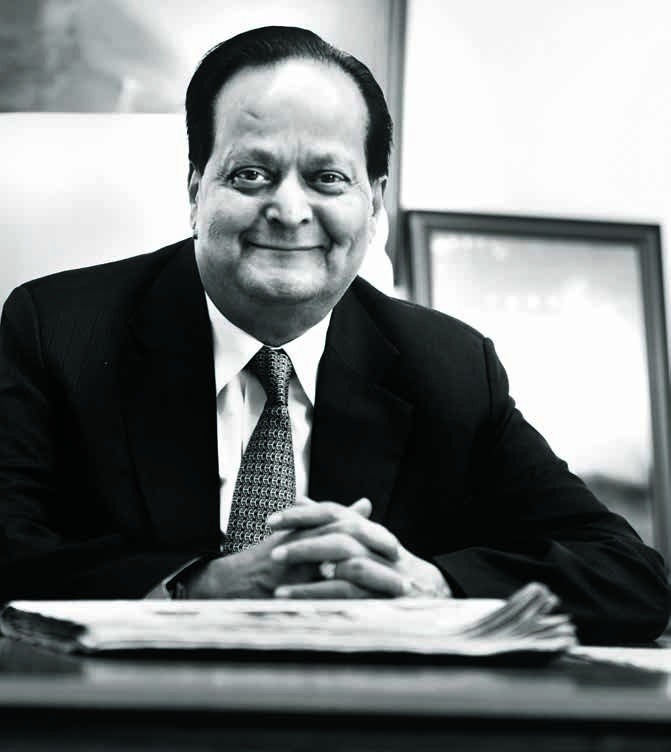
| Key facts | |
|---|---|
| Born | 30 November 1944, Jhansi, Uttar Pradesh [13] [15] |
| Died | 12 April 2017, Ahmedabad, aged 72 [18] [13] |
| Family roots | Jhansi; father Dwarka Prasad Agarwal ran a books and notebook business; family moved to Bhopal in 1956 [13] [12] [10] |
| Education | Higher secondary in Jhansi; MA in political science, Bhopal University [1] [13] |
| Family | Sons Sudhir, Girish and Pawan Agarwal, who run the group [13] [5] |
| Company/Group | Dainik Bhaskar Group; D.B. Corp Ltd (Dainik Bhaskar, Divya Bhaskar, Divya Marathi, MY FM) and family businesses in power, real estate and more [7] [68] |
| Wealth | No. 95 on Forbes “India’s Richest”, 2012, about US$580 million [45] [46] |
| Known for | Turning a small Bhopal paper into India’s largest-circulated daily with door-to-door surveys and “No. 1 from day one” launches |
On 19 December 1996, the morning a new Hindi paper hit the streets of Jaipur, its print order was about 1.72 lakh copies [25] [9]. Rajasthan Patrika, the city’s proud, long-established daily, was printing roughly 1.4 to 1.5 lakh [25] [9]. An outsider from Bhopal had become the biggest paper in the city on its first day.
The man behind it, Ramesh Chandra Agarwal, had spent about Rs 5 crore earned in Madhya Pradesh on the bet. He had paid Rs 84 lakh for land the government valued at Rs 21 lakh, and orders had passed 1.5 lakh before launch, so he bought a third printing press overnight [25]. His team had not just advertised. They had knocked on the doors of more than 2 lakh families, asked them what they wanted in a newspaper, and then gone back to the same homes to sign them up [25] [21].
That “Jaipur model” would carry Dainik Bhaskar from one state to more than a dozen, and from Hindi into Gujarati and Marathi. By the time Agarwal died in 2017, his group published 62 editions in 14 states [12] [15], and its flagship had been ranked among the most-circulated dailies in the world [38] [39].
This is the story of a book-dealer’s son from Jhansi who refused to accept that a regional paper had to stay small, what that ambition built, the battles and controversies that came with it, and what his journey teaches.
Where it began
Ramesh Chandra Agarwal was born on 30 November 1944 in Jhansi, in today’s Uttar Pradesh [13] [15]. His father, Dwarka Prasad Agarwal, ran a books business there [13] [12]; other accounts describe a small press that bound books and made notebooks, and a trade in printing paper [24]. His son Sudhir later summed up the family’s beginnings simply: “We were having book binding and copy making business” [10]. His mother was Kasturi Devi Agarwal [1].
Business Standard’s obituary called him “a book lover”, drawn to books as a child in his father’s shop [12]. He finished higher secondary school in Jhansi [13]. In 1956 the family moved to Bhopal, the new capital of the newly formed state of Madhya Pradesh [13] [14]. He went on to take a postgraduate MA in political science from Bhopal University, according to D.B. Corp’s 2007 offer document [1]. One trade journal says he started work at 15, printing papers and making notebooks; we found that claim in only one source [17].
Whose newspaper was it?
Many obituaries say Ramesh Chandra Agarwal “founded” Dainik Bhaskar in 1958 [15] [18]. That year is the company’s official founding date [7] [1], but he was only 13 then. Forbes India wrote that he “took over a newspaper his father started in 1958” [33], and Sudhir Agarwal told IIM Indore that “my grandfather started this business in 1958. It was a very small business till 80s” [10]. Some accounts trace the paper further back, to a 1948 Bhopal daily called Subah Savere that was renamed Dainik Bhaskar in 1958 [65]; we could not confirm that date in a primary document. Even the company’s own 2007 prospectus is inconsistent, giving 1958 in one place and “the late sixties” in another [1].
What is not in doubt is how the business was structured. Court records show that in 1972 a partnership, M/s Dwarka Prasad Agarwal & Brothers, was formed by Dwarka Prasad and his brothers Bishambhar Dayal and Mahesh Prasad, all sons of Keshav Dev Agarwal, along with young Ramesh Chandra [2]. Different branches of the family ran Bhaskar editions in different cities: a 1992 record cited in the prospectus shows the Bhopal and Indore titles with companies of Ramesh’s line, Gwalior with another family company, and Jhansi and Jabalpur with relatives [1]. That patchwork would later turn into one of the longest family legal fights in Indian publishing (see Controversies).
The first break
For its first two decades the paper was, in Girish Agarwal’s words, “like one of the family businesses” [21]. Sources disagree on the exact year Ramesh took charge: Sudhir dates it to 1977 [10], Girish to 1978 [21], and Business Standard to 1980, when he “decided to make the struggling family newspaper financially independent” [11]. The intent, as Sudhir put it, was clear: “my father took over from my grandfather and he said that I want to build newspaper as the business and not as one of the businesses” [10].
The first moves were practical. Girish recalled that they relaunched the Bhopal edition and “became the first paper to get into web offset printing in Bhopal” [21]. Then came the first real test outside home.
Indore, 1983
In 1983 the family closed its Ujjain edition and launched in Indore [21]. Indore was the stronghold of Nai Dunia, then one of the most respected Hindi papers in the country [24] [23]. Bhaskar started with a print run of about 30,000 against Nai Dunia’s 1.2 lakh, and Agarwal later claimed the paper reached No. 1 “within months” [23]. Whatever the exact timing, Indore became the template: go into a rival’s home market, study the reader, and fight for the top spot instead of settling for second.
The gas tragedy
The night of 2-3 December 1984, when gas leaked from the Union Carbide plant in Bhopal, became a defining moment for the paper. Bhaskar’s building was in a badly affected area, yet DNA reported that it was the only paper in the city that kept its presses running [14]. Agarwal told his team: “Death spares none, and neither does it discriminate against or for anybody” [14].
A former senior editor, Somdutt Shastri, told Newslaundry that “the success story of Bhaskar began after the Bhopal tragedy when they did some sharp reporting” [24]. The same report says Agarwal was pressed by the state government of the day to go soft on the story and kept covering it; that account rests on former staff and the authorised biography rather than a public record [24]. By 1995 Dainik Bhaskar was the No. 1 newspaper in Madhya Pradesh [9] [33].
Building the empire
In 1995 the business was, as the company later described it, a “single state, 5-edition newspaper business” [1] [34]. Over the next two decades Agarwal and his three sons turned it into a national group. The approach rested on a few ideas he repeated often: enter a market only after studying it door to door, launch big, price aggressively, and aim to be “No. 1 from day one” [64].
He was candid about what he wanted the group to be: “Bhaskar (group) should be professional, like the Tatas, and aggressive, like the Ambanis” [11]. (For the story of the Ambani family’s own rise, see our profiles of Dhirubhai Ambani and Mukesh Ambani.)
The survey method
The Bhaskar launch method was unusual for Indian publishing. Before entering a city, the group sent hundreds of surveyors to homes to ask what people read, what they disliked about it, and what they would pay. “Our surveys are not mere consumer research,” Agarwal told Business Today in 2004. “For that you need to cover just 3-4 per cent of your target audience” [22]. The surveys were meant to reach most of the market, collect advance bookings, and design a paper around what readers said.
Before committing to a market, he said, he looked at the size of the advertising market and the competition [22]. And he insisted the paper had to be local: “Newspaper is a completely city-to-city product and we need to stay there to understand the reader” [22]. D.B. Corp credits his eldest son Sudhir with conceiving and implementing the door-to-door launch process [8], and his youngest son Pawan ran the first big survey in Jaipur [25].
Rajasthan, 1996: the Jaipur model
Jaipur was the first time Bhaskar left Madhya Pradesh in a big way. The first survey round covered more than 2 lakh families and finished on 16 October 1996, after 54 days [25]. A second round went back to the same homes to take subscriptions [25]. Pre-launch subscribers were offered the paper at Rs 1.50 for six months [21]; the IIM Bangalore case study notes Patrika was then priced at Rs 2.25 [9].
The launch on 19 December 1996 is the best-documented moment in the group’s history. Bhaskar was the first colour regional paper in Rajasthan [25]. Its day-one figure of about 1.72 lakh copies against Patrika’s 1.4-1.48 lakh appears across sources [25] [9] [21]. The company’s prospectus says the paper was No. 1 in Jaipur within three months, by the National Readership Survey of 1997 [1]. Editions in Alwar and Sikar followed three days later, and Ajmer, Jodhpur and Bikaner about a year later [25].
Rajasthan also showed the limits of the model. Patrika fought back and regained the No. 1 position in the state in 2004 [25]. Its Nihar Kothari later admitted: “We never imagined that a rupee would make so much difference” [25].
Chandigarh and Haryana, 2000
In late 1999 the group began more than six months of door-to-door research in Chandigarh, covering over 2 lakh households [26]. “We estimated that there was a market of about 7 lakh households which did not subscribe to a newspaper,” Girish Agarwal said [26]. Priced at Re 1 against Punjab Kesari’s Rs 2, Dainik Bhaskar became the city’s No. 1 paper within six months, with circulation of 1.66 lakh against Amar Ujala’s 46,000 and Punjab Kesari’s 37,000 [26]. Haryana editions followed the same year [9].
Breaking the language barrier: Gujarat, 2003
Gujarat meant publishing in a new language. On 22 June 2003 the group launched Divya Bhaskar, a Gujarati daily, in Ahmedabad [27]. The groundwork was the biggest yet: 1.2 million homes surveyed by more than 1,450 trained researchers, plus 54 focus groups, with price options of Rs 3, Rs 2.50, Rs 2 and Rs 1.50 tested [28]. Launch-day sales were reported at about 4.5 lakh copies [28]; Business Standard reported “over four lakh” [27].
“Having broken the geographic barrier, we now wanted to break the language barrier,” Girish said [28]. Agarwal put it more bluntly: “For us now, the language barrier is over” [22]. Readers in Gujarat, he noticed, wanted a mix of English and Gujarati, for example stock quotes listed under English company names. “That’s what we gave them,” he told Knowledge@Wharton, adding that “now everybody does that” [23]. The group acquired Saurashtra Samachar in 2004 [17] and added a Mumbai edition of Divya Bhaskar the same year [9].
DNA, Warburg Pincus and the IPO
In 2005 the group went into English-language publishing in Mumbai. DNA was launched on 30 July 2005 through Diligent Media Corporation, a 50:50 joint venture with Subhash Chandra’s Essel/Zee group [23] [36]. Its first-round survey reached about 6 lakh people [23]. The venture never became the money-spinner the Hindi and Gujarati papers were; Bhaskar cut its stake around 2009 and agreed in May 2012 to exit, keeping the Ahmedabad, Jaipur and Indore editions while Essel took the rest [36].
In 2006 the private equity firm Warburg Pincus bought about 7% of the publishing company for Rs 150 crore [11] [1]. “Warburg invested in us almost five years back, so we are used to having investors on board,” Agarwal said at the time of the IPO [11].
An IPO planned in 2007 was shelved after markets fell [1]. The second attempt came in December 2009. D.B. Corp’s issue opened on 11 December at a price band of Rs 185-212 and was priced at the top, Rs 212 [35] [34]. Subscription on the first day was a modest 2.02 times [66]; by the close it had raised about Rs 384 crore, including a fresh issue of about Rs 269 crore and Rs 115 crore sold by Warburg’s affiliate Cliffrose [34]. Business Standard reported it was subscribed 39.52 times [35]. The shares listed on 6 January 2010, opening at Rs 250 on the BSE [35]. Promoter holding fell from 92.86% to 86.34% [35].
At the time, D.B. Corp published seven newspapers with 48 editions and 128 sub-editions in 11 states, and its FY09 turnover was about Rs 960 crore, up from Rs 674 crore in FY07 [34]. The wider family group was much bigger: Knowledge@Wharton put total group revenue in 2008 at about Rs 3,000 crore, with publishing at Rs 782 crore, solvent extraction at Rs 1,289 crore and textiles at Rs 228 crore. Agarwal personally oversaw the non-media businesses [23].
MY FM radio
The group entered FM radio with MY FM in Jaipur in 2006 [37]. The network added 16 stations across seven states, became the fourth-largest radio network in India, broke even in about three years and turned profitable in about four and a half [37]. By his death it had about 28-30 stations [16] [68].
Jharkhand, Maharashtra and Bihar
The expansion did not slow after the IPO. Dainik Bhaskar entered Delhi in 2007, Uttarakhand and Himachal Pradesh in 2008 and Jammu in 2010 [9]. Punjab came in 2006, starting with Amritsar [29]. In Ranchi, on 23 August 2010, the group launched with 1.35 lakh pre-booked paid copies after surveying about 1.35 lakh households [30].
In May 2011 it launched Divya Marathi in Aurangabad, its first Marathi daily and 60th edition, after surveying 1.4 lakh households [31]. It could not use the Dainik Bhaskar name in Maharashtra because of the family title agreement [34] [33]. Within six months, the ABC circulation of rival Lokmat in Aurangabad fell from 73,158 to 59,548 [9].
In Patna, on 18 January 2014, Dainik Bhaskar launched with an initial print run of 1.7 lakh copies at Rs 2.50, taking on Dainik Jagran and Hindustan in their strongest market [32].
The editor in every city
Agarwal’s management ideas went beyond launches. He introduced a rule that every edition of Bhaskar would have its own editor, and editors had to meet at least five readers a week [16]. A newspaper, he said, “should be a reader’s delight, not an editor’s delight” [16]. Shekhar Gupta said he “set a culture of paying journalists well” [15]. The veteran editor Shravan Garg called him a “risk taker” who “did not care for losses” [63]. His sons insisted the papers were professionally run: “No family member holds any editorial posts,” Sudhir said in 2004 [65].
The numbers at their peak
The results showed up in the circulation tables. WAN-IFRA’s World Press Trends ranked Dainik Bhaskar fourth in the world by circulation in its 2015 report, with about 3.6 million copies [38]. The Audit Bureau of Circulations’ January-June 2016 figures made it India’s largest-circulated daily, with 62 editions across 14 states [39]. In 2019 WAN-IFRA ranked it third in the world, with 4.3 million copies, behind only two Japanese papers [40].
D.B. Corp’s revenue grew from about Rs 1,265 crore in FY11 [9] to Rs 2,275 crore in FY17, the year he died, with a net profit of about Rs 375 crore [41].
How the wealth was held
Agarwal’s wealth sat mainly in the family’s controlling stake in D.B. Corp and in private family companies. After his death, ownership passed to his three sons [68]. The promoter group held 71.93% of D.B. Corp at 31 March 2024, with a holding company, DB Consolidated Pvt Ltd, alone owning 54.46% [5]; by June 2026 the promoter stake was 74.5%, with none of it pledged [67].
The family’s other businesses have included DB Power, a 1,200 MW coal-fired power plant in Chhattisgarh, along with mining, real estate (including DB Mall in Bhopal), hotels and food processing [68] [57]. In August 2022 Gautam Adani’s Adani Power agreed to buy DB Power at an enterprise value of Rs 7,017 crore, but the deal lapsed in February 2023 after the deadline expired without completion [57]. A month later DB Power bought out the minority stake held by Global Infrastructure Partners [58].
Forbes ranked Agarwal at No. 95 on its “India’s Richest” list in 2012, with a net worth of about US$580 million [45]. BestMediaInfo reported that he was No. 85 in 2011 with US$585 million [44]. He dropped off the list in 2013 [46]. We found no reliable figure for later years.
The setbacks and failures
The Bhaskar story is often told as an unbroken winning streak. It was not.
Rajasthan slipped back. The Jaipur launch was a triumph, but Patrika recovered and took back the No. 1 spot in Rajasthan by 2004 [25]. Being No. 1 on day one was easier than staying there.
DNA never paid off as hoped. The Mumbai English daily was the group’s most expensive experiment outside its comfort zone. Bhaskar cut its stake and then exited entirely in 2012, keeping only a few non-Mumbai editions [36].
A shelved IPO. The group’s 2007 plan to go public was put aside when markets fell; it listed only in 2010 [1].
A brand he could not use everywhere. Because of a family agreement over the title, the group cannot use the “Dainik Bhaskar” name in Maharashtra, western Uttar Pradesh and some districts of Madhya Pradesh [34] [33]. That is why its Marathi paper is called Divya Marathi.
Power and coal. The diversification into power ran into protests, court action and the Supreme Court’s 2014 cancellation of coal block allocations (see below), and the 2022 sale of DB Power to Adani Power fell through [57].
Bad years after him. In the Covid year FY21, D.B. Corp’s revenue from operations fell to about Rs 1,508 crore from about Rs 2,463 crore two years earlier, a reminder of how exposed print is to advertising cycles [69]. The business has since recovered: FY26 revenue was about Rs 2,441 crore, with net profit of about Rs 332 crore [43].
Controversies and allegations
Agarwal himself was not named as an accused in any criminal case we could verify. The matters below involve his family and group, and two of them came after his death. They are included because they are documented by courts, government bodies or at least two major publications.
The family fight over the Bhaskar title
Allegation: From the 1980s, branches of the extended Agarwal family fought in court over who owned the Bhaskar title in different cities and over the assets of the old family partnership. The cases involved suits filed in 1988, a settlement recorded by the High Court on 29 June 1992, and later challenges by relatives, including a case between Dwarka Prasad Agarwal and his son Ramesh Chandra and others [2] [3] [47].
Response: Ramesh Chandra Agarwal’s side maintained that the businesses it ran were its own. In 2003 Girish Agarwal told afaqs: “All the companies were controlled by Ramesh Chandra Agrawal and family” [47].
What happened next:
- On 7 July 2003 the Supreme Court ruled on appeals in the dispute and sent parts of it back for fresh consideration [2] [3] [47].
- In August 2010 the Delhi High Court heard a related petition by a relative, Sanjay Agarwal, against the Registrar of Newspapers for India over the registration of Bhaskar titles [4].
Status: The practical outcome is a division of the title. The group’s prospectus and later reports say Dainik Bhaskar cannot be used in Maharashtra, western Uttar Pradesh and parts of Madhya Pradesh, where it remains with other family members [34] [33]. We found no later dispute after the 2010 ruling in major sources.
DB Power’s coal block in Chhattisgarh (2011-2014)
Allegation: DB Power, a group company, was allotted the Durgapur-II/Sariya coal block at Dharamjaigarh in Raigarh district to feed its power plant [49] [51]. At a public hearing on 28 February 2011, 438 people registered opposition and none spoke in support, The Hindu reported [48]. A writ petition by local residents claimed that Dainik Bhaskar’s coverage, including articles attacking a petitioner, was used to sway the hearing [48]. Business Standard reported in 2013 that 34 million tonnes of the block’s 91 million tonnes of reserves lay inside Dharamjaigarh town limits [49].
Response: D.B. Corp denied any link between its journalism and the mining project; its spokesperson told The Hindu that the newspaper operates separately from the mining business [48]. DB Power did not respond to Business Standard’s questions in 2013 [49].
What happened next:
- In December 2011 the Chhattisgarh High Court ordered that no further steps be taken towards environmental clearance while the petition was heard [48].
- Clearance from the environment ministry was later granted in July 2013 [51].
- In August 2014 the Supreme Court held that coal block allocations since 1993 were illegal, and on 24 September 2014 cancelled 214 blocks [50]. Global Energy Monitor lists the DB Power block among those cancelled [51]. The cancellation applied across the board and was not a finding against DB Power in particular.
Status: The block was cancelled with the others in 2014 and has not been mined by the group [51]. We found no criminal case against DB Power over the block.
Cobrapost’s “Operation 136” sting (2018)
Allegation: In 2018 the investigative website Cobrapost released “Operation 136”, in which a reporter posing as a religious figure allegedly got executives of several media houses to agree to run paid political and communal content. Cobrapost said Dainik Bhaskar executives were among those recorded [55] [54].
Response: Dainik Bhaskar sued. Its lawyers argued that the film aimed to “sully” its reputation, that Cobrapost had tried to “arm-twist” it, and that remarks by employees to an undercover reporter could not be attributed to the company [54].
What happened next:
- On 24 May 2018 the Delhi High Court granted an ex parte injunction stopping the release of the Bhaskar portions; Cobrapost released Part II the next day without them [54] [55].
- On 28 September 2018 a division bench set the injunction aside, holding that an unreasoned ex parte injunction for the whole duration of a suit was impermissible, and sent the matter back to the single judge [56]. Cobrapost then put the Bhaskar videos online [56].
Status: We found no final court ruling on the merits of the defamation suit in major sources, and no regulatory finding against the group arising from the sting.
The Income Tax searches (July 2021, after his death)
Allegation: On 22 July 2021 the Income Tax Department searched 32 premises of a media group in nine cities, which media identified as the Dainik Bhaskar Group [6] [52] [53]. The Central Board of Direct Taxes alleged income escapement of about Rs 700 crore over six years, about Rs 2,200 crore of “fictitious” circular transactions among group companies, companies run in employees’ names, and the diversion of Rs 408 crore of a Rs 597 crore bank loan to a sister concern [6] [52]. These were the department’s claims; its statement said investigations were continuing [6].
Response: The group said the searches were retaliation for its reporting on the second Covid wave, including death counts and bodies in the Ganga, and ran the line “Main swatantra hoon kyunki main Bhaskar hoon” (“I am free because I am Bhaskar”) [53]. Opposition leaders condemned the searches; Information and Broadcasting Minister Anurag Thakur said agencies did their own work and the government did not interfere [53]. D.B. Corp disclosed the search to the stock exchanges [5].
Status: As of 12 November 2026 we found no public assessment order, prosecution or court ruling arising from the searches. The allegations remain unproven.
Giving back
Agarwal’s public causes were mostly run through his newspapers. From around 2000 Bhaskar ran water-conservation campaigns such as “Jal Satyagraha” and “Jal Hai To Kal Hai” across Madhya Pradesh, Chhattisgarh and Rajasthan [59]. In 2007, 4.75 lakh schoolchildren in Madhya Pradesh pledged support [59]. In 2015 the paper began “No Negative News on Mondays” across 58 editions, filling Monday front pages with positive stories [60].
He was chairman of FICCI’s Madhya Pradesh chapter and received the Rajiv Gandhi Lifetime Achievement Award in journalism [15]. India Today named him among India’s 50 most powerful people in 2003, 2006 and 2007 [15].
Since his death, the family has given through the Ramesh and Sharda Agarwal Foundation, which receives CSR money from D.B. Corp, Rs 1.15 crore in FY23 and Rs 40 lakh in FY24 [5]. To mark his 75th birth anniversary in 2019, the group set up the Dainik Bhaskar Merit-cum-Means Scholarship at IIM Ahmedabad [61]. In December 2020 India Post issued a commemorative postal stamp in his honour [62].
His death
On the morning of 12 April 2017, Agarwal flew from Delhi to Ahmedabad. As he stepped off the aircraft he collapsed with a cardiac arrest [13]. He was taken to a nearby Apollo hospital, which said he arrived at 11:25 am and was declared dead at 12:05 pm after resuscitation attempts [18]. He was 72, though many reports said 73 [12] [13].
Prime Minister Narendra Modi said he was “saddened by the passing away of Shri Ramesh Chandra Agarwal” [20]. He was cremated at Bhadbhada in Bhopal on 13 April, with Sudhir lighting the pyre; Chief Minister Shivraj Singh Chouhan, Digvijaya Singh, Ashok Gehlot and other leaders across party lines attended, and some Bhopal markets stayed shut until noon [19].
Succession
The handover had been planned for years. All three sons had worked in the business for decades. Sudhir joined in 1980 [10], Girish was on the board from 1995 and Pawan from 2005 [68]. Each had a domain: Sudhir editorial and strategy, Girish marketing and operations, Pawan production, technology, radio and digital [68] [23].
After his death, the board chose not to name a new chairman. D.B. Corp’s 2023-24 annual report says the post “has been rendered vacant and has not been filled by the Board thereafter since the same is not mandatory” [5]. Sudhir Agarwal is managing director, Pawan Agarwal deputy managing director and Girish Agarwaal a non-executive director [5]. We found no public dispute over the succession.
In FY25 the company earned a net profit of about Rs 371 crore on revenue of about Rs 2,421 crore [42]. In FY26, D.B. Corp reported revenue of about Rs 2,441 crore and added seven MY FM stations, taking the network to 37 cities [43]. Sudhir summed up the year: “Print continues to demonstrate resilience with sustained advertising demand and stable circulation” [43].
What their journey teaches
Ask the customer before you build. Bhaskar surveyed lakhs of homes before printing a single copy in a new city. The surveys gave the team a product, a price and paying subscribers before launch day [25] [28]. Most businesses guess; Agarwal paid to know.
A local business can be scaled if it stays local. He called the newspaper “a completely city-to-city product” and gave every edition its own editor [22] [16]. Growth came from repeating a method, not from forcing one paper on every city.
Go after the leader in its home market. Indore, Jaipur, Chandigarh, Ahmedabad and Aurangabad were all strongholds of entrenched rivals. Bhaskar entered with a plan to be No. 1, not to pick up leftovers [21] [26] [31].
Winning once is not winning forever. Patrika took Rajasthan back in 2004, and DNA never worked as hoped [25] [36]. Price cuts can buy readers but not loyalty; the rival who responds well can recover.
Build a team that can run without you. Agarwal brought his sons into distinct roles years before he died. When he collapsed at an airport in 2017, the company carried on without a public fight and without even needing a new chairman [5].
Diversification brings risks your core business never taught you. The move into power and coal brought protests, court stays, a Supreme Court cancellation and a failed sale, far from the newspaper business where the family had its edge [48] [50] [57].
To read more stories of Indian founders and how they built their businesses, browse the CapitalVia Stories section and our Insights pages.
A profile for general reading, based on public records and reporting as of 12 November 2026. Not investment, tax or legal advice.
Sources (69)
- D.B. Corp Ltd Draft Red Herring Prospectus - SEBI, 2007
- Dwarka Prasad Agarwal (D) by LRs v. B.D. Agarwal - Supreme Court of India, Jul 2003
- Supreme Court judgment in the Bhaskar family dispute - Supreme Court of India, Jul 2003
- Sanjay Agarwal vs Registrar of Newspapers for India - Delhi High Court, Aug 2010
- D.B. Corp Ltd Annual Report 2023-24 - D.B. Corp, Aug 2024
- Income Tax Department conducts searches PAN-India in a prominent group - PIB / CBDT, Jul 2021
- About Us - D.B. Corp Ltd, 2026
- Director profiles - D.B. Corp Ltd, 2026
- Dainik Bhaskar Group: Aspiring Growth (case study) - IIM Bangalore, 2012
- Interview with Sudhir Agarwal, Dainik Bhaskar - Indore Management Journal, IIM Indore, 2012
- Newsmaker: Ramesh Chandra Agarwal - Business Standard, Dec 2009
- Ramesh Chandra Agarwal (1944-2017): A book lover who created a media empire - Business Standard, Apr 2017
- Dainik Bhaskar Group chairman Ramesh Chandra Agarwal passes away - DNA, Apr 2017
- Bhopal & beyond, with an ear on the ground & a vision - DNA, Apr 2017
- Remembering the Czar of Regional Journalism: Late Ramesh Chandra Agarwal - exchange4media, Apr 2017
- Obituary: Ramesh Agarwal, Dainik Bhaskar Group - afaqs, Apr 2017
- DB chairman Ramesh Agrawal passes away - PrintWeek India, Apr 2017
- Dainik Bhaskar group chairman Ramesh Agrawal passes away - Deccan Chronicle (PTI), Apr 2017
- Media baron Ramesh Agrawal laid to rest - Business Standard (PTI), Apr 2017
- PM expresses grief on passing away of Shri Ramesh Chandra Agarwal - narendramodi.in, Apr 2017
- The way we operate: we go all out, or we just don't (Girish Agarwal interview) - afaqs, Aug 2001
- Dainik Bhaskar: Circulation Pasha - Business Today, Mar 2004
- Newspapers: Indian Language Readers Are Making Their Voices Heard - Knowledge at Wharton, Oct 2008
- Dainik Bhaskar: A story of Big Media, Big Business and Big Bucks - Newslaundry, Aug 2021
- Who Owns Your Media: How Rajasthan Patrika bounced back to pole position - Newslaundry, Dec 2023
- Dainik Bhaskar moves to the top - afaqs, Dec 2000
- Gujarati daily Divya Bhaskar launched - Business Standard, Jun 2003
- Customised from day one - Business Today, May 2010
- Dainik Bhaskar enters Punjab - afaqs, Jun 2006
- It's official: Dainik Bhaskar group enters Ranchi today - afaqs, Aug 2010
- Divya Marathi debuts in Aurangabad - afaqs, May 2011
- Print war intensifies as Dainik Bhaskar enters Patna - exchange4media, Jan 2014
- The Dainik Bhaskar Group's fight in Maharashtra - Forbes India, Apr 2011
- DB Corp ventures into the capital market with its initial public offering - afaqs, Dec 2009
- DB Corp to list on Jan 6; issue price at Rs 212 - Business Standard, Jan 2010
- Essel Group to become sole owner of DNA - exchange4media, May 2012
- Tier II-III is MY FM's secret weapon - exchange4media, Jul 2015
- WAN-IFRA's World Press Trends 2015 ranks Dainik Bhaskar as world's 4th largest circulated daily - exchange4media, Jan 2016
- Dainik Bhaskar becomes India's largest circulated daily - exchange4media, Dec 2016
- Dainik Bhaskar is world's third largest circulated newspaper with 4.3 mn copies: WAN-IFRA - BestMediaInfo, Feb 2020
- DB Corp grows by 28% to Rs 374.8 million in FY 2016-17 - BestMediaInfo, May 2017
- DB Corp FY25 net at Rs 3,710 mn - BestMediaInfo, May 2025
- DB Corp posts 6.3% print ad revenue growth and 28% EBITDA margin for FY2026 - medianews4u, May 2026
- Four media barons in Forbes India's top 100 rich list - BestMediaInfo, Oct 2011
- Ramesh Agarwal profile - Forbes, 2012
- India Rich List 2013: the drop-outs - Forbes India, Oct 2013
- Fresh twist to family dispute over Dainik Bhaskar - afaqs, Jul 2003
- Report on the DB Power coal block hearing and High Court stay - The Hindu (republished by Mines and Communities), Dec 2011
- Black hole - Business Standard, Apr 2013
- Supreme Court cancels allotment of 214 coal blocks - Down To Earth, Sep 2014
- Durgapur-II/Sariya coal mine - Global Energy Monitor, 2024
- Fictitious transactions of Rs 2,200 cr detected, CBDT claims after Dainik Bhaskar raids - ThePrint, Jul 2021
- Income Tax raids on Dainik Bhaskar across the country - The Quint, Jul 2021
- Delhi HC restrains Cobrapost from releasing Operation 136 Part II - LiveLaw, May 2018
- What the Cobrapost sting reveals about Indian media - Scroll, May 2018
- Cobrapost 136: Delhi High Court allows publication of Dainik Bhaskar sting - Newslaundry, Sep 2018
- Adani Power's Rs 7,017 crore acquisition deadline of DB Power expires - Business Today, Feb 2023
- DB Power buys out investor GIP's stake - Business Standard, Mar 2023
- Dainik Bhaskar saves water in thirsty Bhopal - afaqs, Oct 2008
- Dainik Bhaskar says no to negative news on Mondays - afaqs, Feb 2015
- Dainik Bhaskar Group sets up scholarship in memory of Ramesh Chandra Agarwal - PrintWeek India, Nov 2019
- Dainik Bhaskar Group chairman's legacy honoured with commemorative postal stamp - medianews4u, Dec 2020
- Industry leaders pay tribute to Ramesh Chandra Agarwal - exchange4media, Apr 2017
- RIP Ramesh Chandra Agarwal - MxMIndia, Apr 2017
- Leading From The Front: Sudhir Agarwal - exchange4media, Jun 2023
- DB Corp: Regional edge - Business Standard, Dec 2009
- D.B. Corp shareholding pattern, June 2026 - Trendlyne, Jun 2026
- The Agarwal Family - Media Ownership Monitor India (RSF), 2019
- D.B. Corp consolidated financials - Screener, Nov 2026