
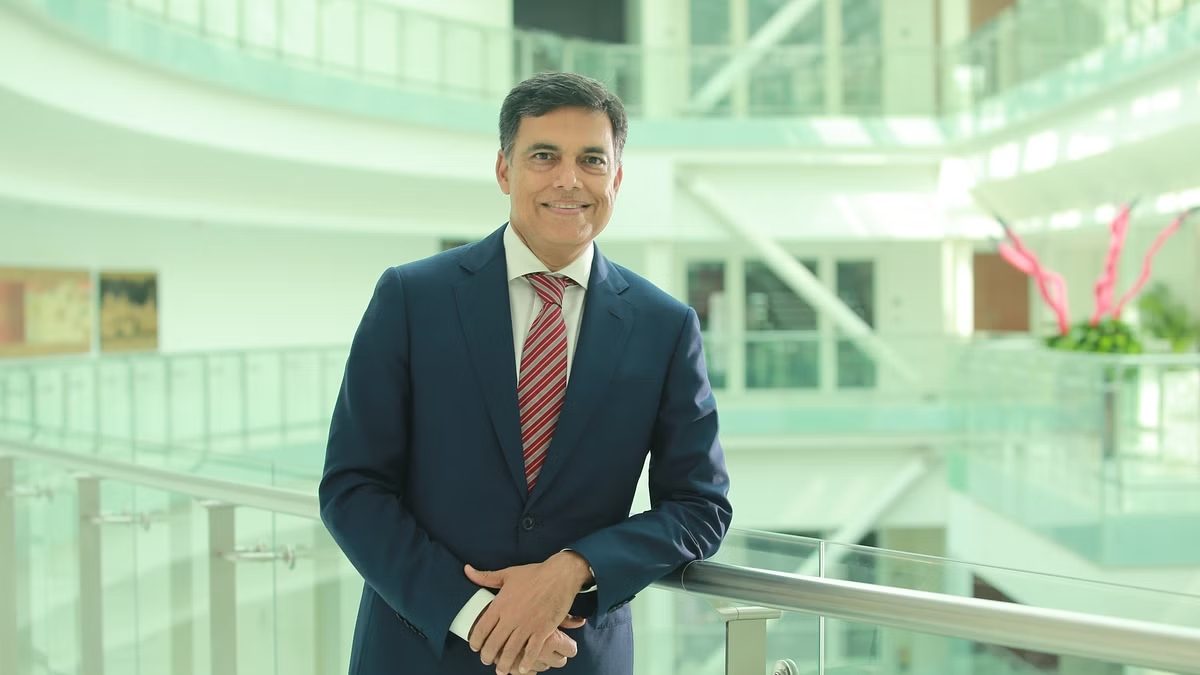
| Key facts | |
|---|---|
| Born | 5 December 1959 [88][89] |
| Family roots | Hisar, Haryana, where he was raised; based in Mumbai since the early 1980s [21][87] |
| Education | B.E. in Mechanical Engineering, M.S. Ramaiah Institute of Technology, Bengaluru [8][21] |
| Family | Son of O.P. Jindal (1930–2005) and Savitri Jindal; brothers Prithviraj, Ratan and Naveen; married to Sangita Jindal, chair of the JSW Foundation; children Tarini, Tanvi and Parth [6][23] |
| Company | Chairman and Managing Director, JSW Group (JSW Steel, JSW Energy, JSW Infrastructure, JSW Cement, JSW Dulux, JSW MG Motor India) [6] |
| Wealth | Rs 1,43,330 crore with family, No. 13 on the M3M Hurun India Rich List 2025 (October 2025) [80][81]. Forbes counts the whole O.P. Jindal family together: US$38.3 billion on 17 October 2026 [82] |
| Known for | Turning a small, loss-making cold-rolling unit into one of India’s largest steel groups; first Indian chairman of the World Steel Association [50][9] |
In 1982 a 22-year-old mechanical engineer from Hisar arrived in Bombay with a test set by his father. The O.P. Jindal Group had just taken over a small steel unit at Tarapur, north of the city, and was setting up another at Vasind [26]. The business that the young man was asked to run made about Rs 9 crore a year in sales and lost about Rs 3 crore [16]. His father gave him a house and an office. He also gave him a warning. “My father was very clear that I could not go back to him if I failed,” Sajjan Jindal later recalled [22].
He did not fail. Within about 18 months, according to Business Standard, he had changed the product mix, the marketing and the sourcing, and turned the unit around [16]. Forty-four years later that unit is the seed of the JSW Group, a conglomerate with roughly US$23 billion in annual turnover. Its listed companies were together worth about US$50 billion in May 2026 [3]. JSW Steel alone has 37.9 million tonnes a year of steelmaking capacity in India and the US, counting its joint venture with Japan’s JFE [2].
The road between those two points ran through a near-bankruptcy, a debt restructuring and a costly overseas mistake. It also passed through some of India’s most contested legal fights over mining, land and insolvency. This profile tells the whole story: the grit, the bets, the failures and the allegations, with what courts and regulators actually found.
Where it began
Sajjan Jindal was born on 5 December 1959 [88][89]. He was one of four sons of Om Prakash Jindal, a self-made industrialist from Haryana, and grew up in Hisar, a town about 160 km from Delhi [21]. Hisar has produced a surprising number of business families. Business Standard columnist Bhupesh Bhandari once grouped the Jindals with Subhash Chandra of Zee and the Goenkas of Welspun as “the heroes from Hisar” [87].
His father’s story set the template. O.P. Jindal was born in 1930 in Nalwa village in Hisar district to a farming family, and had little formal schooling. By 1952 he had set up a small unit at Liluah near Calcutta making pipe bends [90]. He started pipe production as Jindal India Ltd in 1964 and later built steel and stainless-steel plants in Hisar. He also went into politics, becoming an MLA, an MP and a Haryana minister [90]. (For his life and his widow’s, see CapitalVia’s profile of Savitri Jindal.)
The son watched the father closely. A 2011 study of Indian business leaders noted that he was “inspired by watching him work in the factory” while still in school [22]. Asked decades later about his father’s philosophy, Sajjan Jindal summed it up in one line: “You have to work with passion, honesty, and take care of your people” [21].
He went south for college. He earned a bachelor’s degree in mechanical engineering from M.S. Ramaiah Institute of Technology in Bengaluru, then affiliated to Bangalore University [8][21]. He has never been shy about his ambitions in those years. “I always knew I’d work very hard and become pretty successful in life,” he told YPO in 2023 [21].
The family also had a plan of its own. O.P. Jindal had four sons, and he did not want them fighting over one company. Over the 1990s he gradually gave each son his own set of businesses, with the family keeping cross-holdings in all of them [23]:
- Prithviraj Jindal, the eldest, took the pipes business, Jindal SAW.
- Sajjan Jindal took the western-India steel operations that became JSW.
- Ratan Jindal took Jindal Stainless.
- Naveen Jindal, the youngest, took Jindal Steel & Power (JSPL).
That arrangement still shapes the family. In 2010 Business Today reported that Sajjan’s side held about 18% of JSW Steel, including 9% held by his mother, while each brother held about 9% [23]. “We are one family, we share a good equation and support each other,” Sajjan Jindal told the magazine. He also added a line that captured the brothers’ relationship: “There is no written rule that we cannot compete” [23].
The first break
The Bombay test
Sajjan Jindal joined the O.P. Jindal Group in 1982, straight out of college [88][21]. That year the group bought Piramal Steel’s mini mill at Tarapur in Maharashtra, renamed it Jindal Iron and Steel Company (JISCO), and set up a plant at Vasind near Bombay [26]. His father told him the business “was not very successful but had strong potential”. “He told me if I worked diligently and with passion, I could turn it around and then grow it however I wanted,” Jindal recalled [21].
Accounts differ slightly on his age when he took charge. He has said he was made “the CEO of small plant in Bombay at the age of 24” [22]. Business Standard puts it at 25 [16]. Either way, he was very young and on his own. In 1984 he married Sangita, who would later lead the group’s foundation, heritage and arts work [89][6].
The turnaround he engineered was the first proof that he could run a business. JISCO moved into cold-rolled and galvanised steel sheet, value-added products sold to makers of everything from roofing to appliances [89]. By the early 1990s the Mumbai business had grown to about Rs 250 crore in turnover and Rs 15 crore in profit after tax [16].
The big idea
A small profitable processor was not what Sajjan Jindal wanted. He wanted to make steel from iron ore, not just process steel made by others. In 1993, according to Business Standard, he walked into the office of N. Vaghul, chairman of the lender ICICI. He carried a project report for a 2 million-tonne integrated steel plant costing about Rs 4,000 crore [16]. That was a huge sum for a company of his size.
India had just opened its economy. Steel had been delicensed, and private companies could at last build large plants. Jindal chose a site at Toranagallu in Bellary (now Ballari) district of Karnataka, in the middle of one of India’s richest iron ore belts. Jindal Vijayanagar Steel Ltd (JVSL) was incorporated in March 1994, promoted by JISCO with the Karnataka State Industrial Investment and Development Corporation [26][18].
He also made a technology bet. Vijayanagar would use Corex, a process from Austria’s VAI that makes iron without coking coal ovens. It had never been used in an Indian flat-steel plant at that scale [26]. By June 1998 the plant’s capacity had been raised to 1.6 million tonnes a year, and its cost had grown from Rs 3,300 crore to nearly Rs 5,000 crore [18]. The hot strip mill started in 1997 [26]. The first Corex module began trial runs in late 1998 and was running steadily by 1999.
Building the empire
Near-death at Vijayanagar (1998–2004)
The timing could hardly have been worse. Vijayanagar came on stream as the Asian financial crisis hit and steel prices collapsed. Cheap steel from Korea and the former Soviet states flooded India. In October 1998 the rating agency Crisil cut JVSL’s Rs 635 crore debenture issue from BB to D, its default grade. Analysts pointed to an Rs 830 crore cost overrun, dumping, and the risks of the new Corex technology [19]. Corex also had months of teething trouble [16].
“It was a difficult period where everybody thought that we were going to go bankrupt,” Jindal said later [21]. In July 2002 the JVSL board approved a financial recast. Interest on rupee loans was cut to 14%, repayments were rescheduled and part of the debt was converted into equity [20]. The RBI-backed Corporate Debt Restructuring cell approved JVSL’s package in February 2003. One condition was that the promoters pledge enough shares to give lenders 60% of voting rights, later cut to 51% [4]. Business Standard reported that leverage hit 8.6 times in FY03, and that the promoters’ stake was cut to about 40% as lenders turned debt into equity [17][16].
For a founder, handing lenders control of his shares is close to the bottom. Jindal has always credited his team for getting through it. “We made it through because of our perseverance, hard work and the confidence we had in ourselves,” he said. “The team believed in me, and I believed in them” [21].
The cycle turned in his favour. From 2003 Chinese demand drove a global steel boom, and Vijayanagar, sitting on top of cheap ore, began to make money. In November 2004 the group took over a steel works in Salem, Tamil Nadu, which became its special-steel unit [26]. On 20 January 2005 the Karnataka High Court approved the merger of JISCO into JVSL [25]. The merged company was renamed JSW Steel, and the JSW Group took its name. Two months later, on 31 March 2005, O.P. Jindal died in a helicopter crash [90].
The deal-maker years (2005–2015)
With his father gone and the group split along clear lines, Sajjan Jindal began to expand fast. Business Today later called him a “value hunter”: a builder who preferred to buy assets cheaply in downturns rather than build everything from scratch [86]. Business Standard described him as “cautiously opportunistic” [17].
Key moves in that decade:
- 2007, Baytown, Texas. JSW Steel bought 90% of three US units, a plate mill, a pipe mill and a coating plant, from companies controlled by his elder brother Prithviraj, at an enterprise value of about US$900 million [24]. This would prove his costliest mistake (see the setbacks section).
- 2009. India’s largest blast furnace at the time was commissioned at Vijayanagar [26].
- 2010, JFE. In July 2010 JSW agreed to sell 14.99% to JFE Steel of Japan for about Rs 4,800 crore, within a wider fund-raise of about Rs 5,700 crore [27]. JFE brought cash and automotive-steel technology. It remains JSW Steel’s largest single shareholder, with about 15% [10].
- 2010, Ispat. In December 2010 JSW agreed to put Rs 2,157 crore into Ispat Industries, the debt-laden company of Pramod and Vinod Mittal, younger brothers of Lakshmi Mittal, for control of its Dolvi plant on the Maharashtra coast [28]. Dolvi was later merged into JSW Steel. In October 2021 its capacity doubled from 5 to 10 million tonnes a year [34].
By FY18, JSW Steel had 18 million tonnes of capacity and produced a record 16.27 million tonnes [86].
Energy, ports and cement
Alongside steel, Jindal built businesses to feed and serve it.
JSW Energy began with power plants for the group’s own needs. Its IPO in December 2009 raised Rs 2,700 crore at Rs 100 a share, the bottom of the price band. It was subscribed only 1.67 times, a tepid start, and listed in January 2010 [36]. The company did not raise equity again until a Rs 5,000 crore QIP in April 2024 [37]. It then bought aggressively. It completed the purchase of the bankrupt 3,600 MW KSK Mahanadi power plant for Rs 16,084 crore in March 2025, taking capacity past 10 GW [38]. Its subsidiary also bought renewable developer O2 Power. By September 2026 JSW Energy had 15,025 MW operating, about 9,000 MW of it renewable [39].
JSW Infrastructure grew out of the jetty at Jaigarh, built to bring coal and ore to the group’s plants. Its IPO in September 2023 raised Rs 2,800 crore and was subscribed about 39 times [40]. It now has 186 million tonnes a year of port capacity across 13 concessions in India, plus assets in the UAE [5].
JSW Cement was set up in 2009 at Vijayanagar to use slag, a by-product of steelmaking. Its Rs 3,600 crore IPO in August 2025 was priced at Rs 139–147 a share [41]. By FY26 it had 24.1 million tonnes of grinding capacity [3].
Buying out of insolvency (2018–2025)
India’s Insolvency and Bankruptcy Code (IBC) of 2016 forced dozens of over-borrowed steel companies onto the block. Jindal, who had survived his own debt crisis, was one of the most active buyers.
- Monnet Ispat (2018). A JSW-AION consortium won the Chhattisgarh company with a Rs 2,875 crore plan. Monnet owed lenders more than Rs 11,000 crore [29].
- Overseas, 2018. JSW bought Acero Junction in Ohio for about US$81 million [30], and the Aferpi steelworks and port at Piombino in Italy [26].
- Bhushan Power & Steel (BPSL), Odisha. JSW’s plan of about Rs 19,700 crore beat Tata Steel’s bid. It was approved by the National Company Law Tribunal (NCLT) in September 2019 and by the appellate tribunal (NCLAT) in February 2020 [31]. JSW paid creditors about Rs 19,350 crore in 2021 [26]. The deal went through a dramatic Supreme Court fight in 2025, covered in the controversies section below, before it was finally upheld [12].
He also went after raw materials. In 2024–25 JSW invested in an Australian company that holds part of the Illawarra coking coal mines in New South Wales, eventually lifting its effective interest to about 30% [35].
The consumer turn: paints, cars and Dulux
The newer bets are aimed at Indian consumers, and many carry the mark of the next generation.
JSW Paints launched in 2019, run by his son Parth. In June 2025 it agreed to buy a majority of Akzo Nobel India, maker of Dulux, in a deal worth up to Rs 8,986 crore [42]. The company was renamed JSW Dulux Ltd in March 2026 [43].
Cars. In November 2023 JSW agreed to take 35% of MG Motor India from China’s SAIC [44]. In May 2026 SAIC agreed to sell a further 10%, which would take JSW to 45% [45]. In February 2024 the group signed an agreement with Odisha for Rs 40,000 crore of electric-vehicle and battery projects [47].
The group today
As of mid-2026, JSW Steel reported:
- Capacity: 37.9 million tonnes a year, including 4.5 million tonnes in the Bhushan joint venture with JFE [2].
- Target: 54.8 million tonnes within four years [2].
- Quarterly results: revenue of Rs 47,364 crore in the June 2026 quarter [2].
- The JFE deal: in December 2025 JFE agreed to invest Rs 15,750 crore for half of the Bhushan steel business [32]. The one-time gain lifted JSW Steel’s March 2026 quarter profit to Rs 16,370 crore [33].
How the wealth is held. Sajjan Jindal owns almost nothing in his own name. JSW Steel’s promoter group held 44.29% in June 2026 [10]. That stake sits mainly in a web of investment companies such as JSW Techno Projects Management, JSW Holdings, Vividh Finvest and Sahyog Holdings. Personal stakes are tiny: Parth Jindal 0.07%, and the Sangita Jindal Family Trust 0.04% [10]. Part of the promoter holding, about 11.6% according to the same data, was pledged [10].
He was reappointed Managing Director of JSW Steel for five years from 7 July 2022. The terms allow pay of up to Rs 1.5 crore a month plus commission of up to 0.5% of net profit [1]. That term runs to mid-2027. (For the wider investment boom that JSW’s spending is part of, see CapitalVia’s insight One rupee in every three is now being built, not spent.)
In 2021 he became chairman of the World Steel Association, the first Indian to hold the post [50][9]. EY named him its Entrepreneur of the Year 2022 [9]. He has also been a loud voice for protection against cheap Chinese steel. “We have been very patient with the steel ministry,” he said in November 2024, pushing for curbs on imports [85].
The setbacks and failures
The Vijayanagar debt crisis was the biggest setback, described above. JSW lost money for several years in the early 2000s, and the founder had to pledge control to lenders [17][4].
Baytown, Texas has been the longest-running disappointment. The US plate and pipe mills bought from his brother Prithviraj in 2007 ran at very low utilisation, at times 8–15% at the pipe mill. JSW booked a Rs 334 crore impairment in FY15. Business Standard reported that the US assets had “never been profitable except in the year they were acquired”. It called the original deal a “bailout” of a brother’s business [24].
Coal blocks. In September 2012 the Coal Ministry de-allocated the Gourangdih ABC coal block held jointly by JSW Steel and Himachal EMTA for not developing it on time [63]. (The better-known coal-scam prosecutions involve his brother Naveen’s company JSPL, not JSW.)
Mozambique coal. JSW’s plan to buy the Minas de Revuboè coal concession was frozen after Mozambique revoked the concession in 2024. Bloomberg reported that four of the five directors of the rival applicant came from JSPL. Those directors said they acted in a personal capacity [72].
Weak starts. The 2009 JSW Energy IPO priced at the bottom of its band and drew little demand [36]. The early JSW Cement business lost money for years before Parth Jindal turned it around [79].
Controversies and allegations
Sajjan Jindal has been personally named in three of the matters below. The others concern JSW companies. Each is set out with the allegation, the response, and where things stand as of 19 October 2026.
The 2023 rape complaint (closed)
Allegation: A Mumbai-based woman alleged that Sajjan Jindal raped her at JSW’s Bandra Kurla Complex office building in January 2022. She said she had approached the police in February 2023 without an FIR being registered. After she petitioned the Bombay High Court, police registered an FIR in December 2023 [51][52].
Response: Jindal said in a statement that he “denies these false and baseless allegations”. He promised full cooperation with the investigation and asked for privacy for his family [52].
What happened next:
- Mumbai Police filed a closure report. It said the complaint was not supported by evidence, citing the delay, the complainant not recording a statement before a magistrate, and travel and hotel records [53].
- In April 2024 a Bandra magistrate accepted the closure report. The complainant had filed an affidavit saying she did not object [53].
- She later asked the High Court to reopen the case. On 24 December 2025 a division bench led by the Chief Justice dismissed her petition, finding no legal basis to reopen it [11].
Status: Closed. We found no report of a further appeal.
The Karnataka mining and “Prerana Trust” case (acquitted)
Allegation: In July 2011 Karnataka Lokayukta Justice N. Santosh Hegde’s report on illegal mining raised two payments. One was Rs 10 crore given by a JSW-linked company to the Prerana Education Trust, run by the family of then Chief Minister B.S. Yeddyurappa. The other was a Rs 20 crore purchase of land from Yeddyurappa’s sons, which Hegde said was far above its guidance value [54]. On a Supreme Court direction, the CBI registered a corruption case. In October 2012 it filed a chargesheet alleging Rs 40 crore in kickbacks, including Rs 20 crore paid to the trust by JSW and its affiliates. Reuters reported that Sajjan Jindal and then CEO Vinod Nowal were named [55]. Business Today listed the JSW executives named as Nowal and a senior vice-president [56].
Response: JSW said the donation was a legitimate social contribution and the land was bought at a market price. It said the CBI’s conclusions were “without basis” and that it would present its case in court [54][56].
Status: On 26 October 2016 a special CBI court acquitted all 13 accused, including Yeddyurappa, his family members, JSW Steel and its affiliates. It found no “meeting of minds” and treated the donations as social spending [57][58][59].
The Ballari land deal (approved, politically contested)
Allegation: The dispute was over about 3,667 acres in Ballari district, leased to JSW in 2006–07 under lease-cum-sale agreements. In 2019 the Karnataka cabinet decided to sell the land outright at about Rs 1.22 lakh an acre. Opposition leaders, including Yeddyurappa, called this a “throwaway price” and protested. Activists filed complaints with the Lokayukta and the courts, with one lawyer putting the land’s value at about Rs 1 crore an acre [60].
Response: The state’s position was that JSW had used the land for its steel plant, as the agreements required, and had paid the agreed price. Industries Minister M.B. Patil said there were “no concessions” [61][62].
What happened next:
- The Yeddyurappa government itself approved the sale in April 2021, causing a revolt among some BJP MLAs [60].
- After JSW went to the High Court to enforce the agreement, the Siddaramaiah cabinet again approved an absolute sale deed in August 2024, citing legal compulsion [61][62].
Status: Sale approved by three successive governments. We found no court ruling against it.
The Bhushan Power & Steel ruling (reversed, plan upheld)
Allegation: BPSL’s former promoter and some operational creditors challenged JSW’s takeover of BPSL. On 2 May 2025 a two-judge Supreme Court bench rejected JSW’s resolution plan as illegal and ordered BPSL liquidated. It held that JSW had delayed implementing the plan for about two years without any legal bar and had made misrepresentations to creditors [13].
Response: JSW sought a review. The court ordered status quo, and on 31 July 2025 recalled its own judgment [31].
Status: On 26 September 2025 a three-judge bench led by Chief Justice B.R. Gavai dismissed the appeals and upheld JSW’s plan. It found that the delay was not attributable to JSW or the creditors [12]. Resolved in JSW’s favour.
The ED money-laundering case over Obulapuram ore (pending)
Allegation: The Enforcement Directorate (ED) alleges that JSW bought ore illegally mined in 2009–12 by a company linked to former Karnataka minister G. Janardhana Reddy. It treats about Rs 33.8 crore owed by JSW for that ore as proceeds of crime, provisionally attached Rs 24.37 crore in JSW bank accounts, and filed a prosecution complaint [66].
Response: JSW argues that it was owed money by the mining firm, which had defaulted on supplies, and that the CBI did not name JSW in the underlying case [66].
What happened next:
- In October 2025 the Supreme Court declined to quash the proceedings [66].
- Around 1 October 2026 the Karnataka High Court dismissed JSW’s challenge to the ED attachment, calling it a “gross abuse of the process of the Court” given the Supreme Court’s earlier refusal [14].
Status: Pending. No court has convicted JSW or its officers in this matter.
The steel price-collusion finding (pending)
Allegation: Reuters reported in January 2026 that a Competition Commission of India (CCI) investigation report dated 6 October 2025 found that Tata Steel, JSW Steel, SAIL and 25 others had colluded on prices at various times between 2015 and 2023. It held 56 executives liable, including Sajjan Jindal [64]. The evidence cited included WhatsApp chats seized from smaller firms and trade groups, and what investigators called coordinated production cuts in 2020–21 [65].
Response: JSW declined to comment publicly. Reuters’ sources said it had denied the allegations to the CCI. Tata Steel said it “categorically denies any wrongdoing” [64][65].
Status: These are investigation-stage findings. As of 19 October 2026 we found no final CCI order or penalty.
Mining dues and environmental orders (mixed)
Allegation: JSW companies have faced several state and tribunal actions:
- In August 2025 Odisha demanded Rs 1,472.69 crore over a dispatch shortfall at the Jajang iron ore mine [67].
- Karnataka sought Rs 127.66 crore for minimum-production shortfalls at a mine [15].
- In April 2025 the National Green Tribunal (NGT) found a conveyor belt at Dolvi had been built too close to mangroves and ordered Rs 1.61 crore in CSR spending [68].
- In March 2023 the NGT suspended the environmental clearance for JSW’s proposed Paradip plant in Odisha [69].
Response: JSW said it would pursue legal remedies against the Odisha demand [67] and denied violating mangrove rules at Dolvi [68].
Status: In February 2026 the Supreme Court dismissed JSW’s challenge to the Karnataka demand [15]. The Odisha demand is being contested. Construction of the Odisha project has since moved ahead [2].
The Nawaz Sharif meetings (political row, no wrongdoing found)
Allegation: In April 2017 Jindal met then Pakistan Prime Minister Nawaz Sharif at Murree. Pakistani opposition politicians claimed the visit was a secret back-channel. Some alleged, without evidence, that he carried messages on the case of Kulbhushan Jadhav, an Indian sentenced to death in Pakistan [70][71].
Response: Sharif’s daughter Maryam Nawaz said Jindal was “an old friend of the prime minister”. She said there was “nothing ‘secret’ about the meeting” and it “should not be blown out of proportion” [70][71].
Status: No official finding of any wrongdoing. The episode is mainly a reminder of how closely political and business worlds meet at his level.
Giving back
The JSW Group’s social work is run through the JSW Foundation, which Sajjan Jindal founded and his wife Sangita chairs [6]. Their daughter Tanvi oversees its education work [6].
Heritage. Sangita Jindal took up restoration work at Hampi, near Vijayanagar, in 2000. JSW has since restored temples at Hampi and Anegundi, and supported reconstruction at Kedarnath under a 2017 agreement with Uttarakhand [7].
Sport. JSW Sports, founded in 2012, set up Bengaluru FC in 2013. In 2018 it bought 50% of the Delhi Daredevils IPL franchise (now Delhi Capitals) from GMR for Rs 550 crore [48]. Its Haryana Steelers won the Pro Kabaddi League in December 2024 [49]. The larger social bet is the Inspire Institute of Sport, opened at Vijayanagar in August 2018 on 42 acres for Olympic disciplines [75]. When javelin thrower Neeraj Chopra needed elbow surgery in 2019, JSW arranged the operation and ran much of his rehabilitation, though the government’s TOPS scheme was his main backer on the road to Tokyo gold [76].
Covid-19. In April 2021, during India’s devastating second wave, JSW cut steel output to divert liquid oxygen to hospitals. It expected to supply more than 20,000 tonnes that month. “Saving lives is more important than producing steel,” Jindal said [73]. The group also planned a 1,000-bed Covid hospital at Toranagallu, fed by an oxygen pipeline from the plant [74].
Personal giving. The EdelGive Hurun India Philanthropy List 2022 ranked Sajjan Jindal and family 25th, with Rs 37 crore given in a year, mainly to education [77]. In July 2026 Assam Chief Minister Himanta Biswa Sarma revealed that Jindal had quietly sent Rs 5 crore to the state’s flood relief fund. “We came to know of this noble gesture only when our team was reviewing the Fund’s bank statements,” Sarma said [78].
Succession
Sajjan Jindal is 66 and has not announced a formal succession plan. His three children all work in the group [6]:
- Parth Jindal, a Harvard MBA, is Managing Director of JSW Cement and JSW Paints, chairs JSW Dulux, founded JSW Sports, and in August 2026 became chairman of JSW MG Motor India [6][46][79].
- Tarini Jindal Handa is Managing Director of JSW Realty and founded JSW Living [6].
- Tanvi Jindal Shete founded the Museum of Solutions in Mumbai and is a director of the JSW Foundation [6].
The way the family business was split in his father’s lifetime is a model he knows well. Whether he repeats it, with each child running separate companies, or keeps one group under a single head, is the biggest open question for JSW. His current term as JSW Steel’s Managing Director runs to July 2027 [1].
What their journey teaches
Prove yourself on something small before asking for something big. Jindal’s pitch to ICICI for a Rs 4,000 crore plant worked because he had already turned a loss-making Rs 9 crore unit into a profitable Rs 250 crore one [16]. A track record is the best collateral.
A downturn is when assets are cheapest, if you have survived it. Having nearly gone under himself in 1998–2004, he spent the next 20 years buying distressed assets, from Ispat to Monnet to Bhushan [86][17]. The lesson is double-edged: you only get to be the buyer if you control your own debt first.
Build the supply chain around your core. Ports to bring in coal, power plants to run furnaces, cement to use slag: each JSW business started as a way to make steel cheaper, and later became a listed company in its own right [40][41].
Family deals need clear lines. O.P. Jindal divided his businesses while he was alive, which helped the brothers avoid a public split [23]. But Baytown shows the cost when family and business decisions blur [24].
Keep a brake on your own optimism. “It is the CFO who holds me back from getting exposed to too much risk,” Jindal once told young entrepreneurs [83]. For a man famous for big bets, it is a revealing admission. At a 2026 convocation he put it another way: “India does not need people who can see the future; it needs people willing to build it correctly” [84].
A profile for general reading, based on public records and reporting as of 19 October 2026. Not investment, tax or legal advice.
Sources (90)
- JSW Steel 28th AGM notice: re-appointment of Sajjan Jindal as Managing Director - BSE filing, May 2022
- JSW Steel Q1 FY27 results press release - JSW Steel, Jul 2026
- JSW Cement investor presentation (group overview) - JSW Cement, May 2026
- JVSL: CDR package and JISCO amalgamation, press release - NSE, Apr 2004
- JSW Infrastructure Q1 FY27 press release - NSE filing, Jul 2026
- Our leadership - JSW Group, Oct 2026
- Cultural heritage initiatives - JSW Energy, Oct 2026
- Sajjan Jindal, Governing Council profile - Krea University, Oct 2026
- Man of Steel Sajjan Jindal wins the EY Entrepreneur of the Year Award 2022 - EY India, Feb 2023
- JSW Steel shareholding pattern, June 2026 - MarketsMojo, Jul 2026
- Bombay High Court rejects plea to reopen rape case against JSW MD Sajjan Jindal - Bar & Bench, Dec 2025
- Supreme Court upholds JSW resolution plan for Bhushan Power and Steel - Bar & Bench, Sep 2025
- Supreme Court rejects JSW's resolution plan for Bhushan Steel as illegal, orders liquidation - LiveLaw, May 2025
- Karnataka High Court rejects JSW Steel's challenge to ED attachment orders - Bar & Bench, Oct 2026
- Supreme Court dismisses SLP filed by JSW Steel against recovery demand by Karnataka government - LiveLaw, Feb 2026
- In the big league - Business Standard, Jan 2019
- Sajjan Jindal: Cautiously opportunistic - Business Standard, Feb 2015
- Jindal steel project ties up 80% of funding - Business Standard, Jun 1998
- Jindal Vijaynagar debenture issue in default grade - Business Standard, Oct 1998
- JVSL board nods financial recast plan - Business Standard, Jul 2002
- How Sajjan Jindal is building up India - YPO, May 2023
- In search of change maestros: Sajjan Jindal - People Matters, May 2011
- Jindal vs Jindal... or Jindal plus Jindal? - Business Today, Oct 2010
- Sajjan Jindal's JSW still struggling with earlier bailout for another brother - Business Standard, May 2016
- High Court certifies JISCO-JVSL merger - SteelOrbis, Feb 2005
- History of JSW Steel - Steel on the Net, Oct 2026
- JSW to raise Rs 5,700 cr from JFE stake sale - Business Standard, Jul 2010
- JSW Steel to buy stake worth Rs 2,157 cr in Ispat - Business Today, Dec 2010
- JSW Steel promoters acquire around 88% stake in Monnet Ispat - BloombergQuint, Aug 2018
- JSW acquires Acero Junction for almost $81 million - SteelOrbis, Mar 2018
- Eight years, many judgements later, Bhushan Power stays with JSW - BasisPoint Insight, Sep 2025
- JFE to invest Rs 15,750 crore for 50% in JSW's Bhushan steel business - The Week (PTI), Dec 2025
- JSW Steel Q4 PAT surges nearly 10x to Rs 16,370 crore - Business Standard, May 2026
- JSW Steel lights up second blast furnace at Dolvi - Refwin, Oct 2021
- JSW Steel gets board nod to invest $120 million in Australian firm M Res NSW - Outlook Business, Aug 2024
- JSW Energy listing tomorrow, issue price at Rs 100 - Business Standard, Jan 2010
- JSW Energy completes Rs 5,000 crore QIP, its first equity raise since 2010 - Business Today, Apr 2024
- JSW Energy completes KSK Mahanadi acquisition, crosses 10 GW - FilingReader, Mar 2025
- JSW Energy crosses 15 GW capacity - Angel One, Sep 2026
- JSW Infrastructure IPO details - Finology Ticker, Oct 2023
- JSW Cement sets price band for Rs 3,600 crore IPO - Business Standard, Aug 2025
- JSW Paints snaps up Akzo Nobel India in Rs 8,986 crore deal - The Week, Jun 2025
- Akzo Nobel India renamed JSW Dulux Limited - Storyboard18, Mar 2026
- Sajjan Jindal-led JSW Group to hold 35% stake in MG Motor India - Business Today, Nov 2023
- China's SAIC plans to divest another 10% stake in Indian JV to partner JSW - Autocar Pro (Reuters), May 2026
- Parth Jindal takes charge as chairman at JSW MG Motor India - Business Today, Aug 2026
- JSW Group to invest Rs 40,000 crore in EV and battery plant in Odisha - YourStory, Feb 2024
- JSW Sports buys 50% stake in Delhi Daredevils - ESPNcricinfo, Mar 2018
- PKL Season 11 final: Haryana Steelers vs Patna Pirates - Pro Kabaddi League, Dec 2024
- JSW managing director Jindal elected World Steel chairman - Steel Market Update, Oct 2021
- JSW Group's Sajjan Jindal accused of rape; Mumbai Police registers FIR after Bombay HC's order - Business Today, Dec 2023
- Rape case against steel magnate Sajjan Jindal - Deccan Herald (PTI), Dec 2023
- Rape case against JSW chairman Sajjan Jindal: High Court on police closure - LawChakra, Dec 2025
- Hegde questions JSW Steel's defence on mining report - Business Today, Aug 2011
- CBI names JSW chairman, CEO - Deccan Herald (Reuters), Oct 2012
- JSW Steel: Sajjan Jindal needs to come clean - Business Today, Oct 2012
- Why the court acquitted BS Yeddyurappa in the mining case - The News Minute, Oct 2016
- Yeddy, 3 of family acquitted in Rs 40-crore mining bribery case - The Tribune, Oct 2016
- Ex-Karnataka chief minister acquitted in Bellary mining bribery case - Down To Earth, Oct 2016
- Yediyurappa's U-turn on selling land to JSW and its fallout within BJP - The News Minute, May 2021
- Karnataka cabinet again decides to sell 3,667 acres to JSW Steel - Deccan Herald, Aug 2024
- Karnataka cabinet approves sale of 3,666 acres to JSW Steel amid controversy - BusinessWorld, Aug 2024
- JSW Steel plunges on coal block de-allocation buzz - Business Standard, Sep 2012
- India watchdog finds top steelmakers colluded on prices - BusinessDay (Reuters), Jan 2026
- India antitrust probe links Tata, JSW to steel cartel - TimesLIVE (Reuters), Jan 2026
- SC refuses to quash money laundering case against JSW Steel in Obulapuram mining scam - BasisPoint Insight, Oct 2025
- JSW Steel receives Rs 1,473 crore demand notice from Odisha government - Business Today, Aug 2025
- NGT asks JSW Steel to spend Rs 1.61 crore on CSR projects - The CSR Journal, Apr 2025
- Environmental clearance for JSW's Paradip project in Odisha scrapped by NGT - Down To Earth, Mar 2023
- Jindal's meeting with Nawaz Sharif - Dawn, Apr 2017
- Sajjan Jindal's meeting with Nawaz Sharif - The Quint, Apr 2017
- Indian steel titans' coal deal frozen amid Mozambique legal row - Mining.com (Bloomberg), Jan 2025
- India's JSW reduces steel output to divert oxygen to fight Covid-19 - Fastmarkets, Apr 2021
- JSW Steel to set up 1,000-bed Covid hospital in Toranagallu - Deccan Herald, May 2021
- JSW Group launches Inspire Institute of Sport in Vijayanagar - Business Standard (PTI), Aug 2018
- How JSW Sports helped Neeraj Chopra after his elbow surgery - The Quint, Aug 2021
- EdelGive Hurun India Philanthropy List 2022 - Hurun, Oct 2022
- Assam floods: Sajjan Jindal quietly donates Rs 5 crore - Business Today, Jul 2026
- Parth Jindal didn't train as an engineer, yet he's rebuilding the foundations of his father's empire - Outlook Business, Aug 2025
- Hurun Rich List India 2025: list of 50 richest Indians and their net worth - Daily Jagran, Oct 2025
- Hurun India Rich List 2025: top 100 richest Indians - Trak.in, Oct 2025
- Savitri Jindal & family profile - Forbes, Oct 2026
- Steel man Sajjan Jindal's message to young entrepreneurs - Entrepreneur India, Dec 2017
- Execution turns vision into reality: Sajjan Jindal - The Hitavada, May 2026
- India studying temporary tax plea on China steel imports: JSW Group chief - Business Standard (Reuters), Nov 2024
- Value hunter: Best CEOs 2019 - Business Today, Feb 2019
- The heroes from Hisar - Business Standard, Dec 2010
- Sajjan Jindal - Outlook Business, Oct 2026
- Sajjan Jindal - Wikipedia, Oct 2026
- Om Prakash Jindal - Wikipedia, Oct 2026