
| Key facts | |
|---|---|
| Born | 26 November 1921, Calicut (now Kozhikode, Kerala) [5][69] |
| Died | 9 September 2012, Nadiad, Gujarat, aged 90 [61][62] |
| Family roots | A Syrian Christian family; father P.K. Kurien, a civil surgeon; John Matthai, later India’s finance minister, was a relative he called his uncle [23][5][68] |
| Education | BSc, Loyola College, Madras (1940); BE Mechanical, College of Engineering, Guindy (1943); TISCO Technical Institute, Jamshedpur; MS Mechanical Engineering, Michigan State (1948) [5][8] |
| Family | Wife Molly (married 1953); daughter Nirmala [23] |
| Company/Group | Kaira District Co-operative Milk Producers’ Union (Amul); Gujarat Co-operative Milk Marketing Federation (chairman 1973-2006); National Dairy Development Board (chairman 1965-1998); Institute of Rural Management Anand (founded 1979) [1][32] |
| Known for | The “father of the White Revolution”: Amul, Operation Flood, and India becoming the world’s largest milk producer [15][2] |
On a Friday in May 1949, a 27-year-old engineer with an American master’s degree stepped down at Anand, a small, dusty town in the Kaira district of Gujarat. The date was 13 May [5][24]. He had not chosen to be there. The Government of India had paid for his studies abroad, and in return it had posted him to a run-down government research creamery to work off his bond [5][28].
He hated it. “I had always imagined that I was cut out for ‘bigger and better things’,” he wrote more than half a century later, “for a glamorous, fast-paced life in a big city, a job with a prestigious firm… Anand did not figure anywhere in my scheme of things… here I was in Anand, a fish out of water.” [28] Every month he wrote to Delhi offering his resignation, “saying that I was drawing a salary of Rs 350 for doing no work and instead of wasting government money I should be allowed to go.” [28]
He stayed for 63 years.
The man was Verghese Kurien. He did not own a factory, a brand or a single share in the business he built. He was, as he liked to say, “an employee of farmers” [29]. Yet the cooperative he managed became Amul, and the national programme he designed, Operation Flood, helped turn a milk-short country into the world’s largest milk producer [15][10]. In 2025-26, the federation he chaired for 33 years reported sales of Rs 73,450 crore, and the Amul brand as a whole passed Rs 1 lakh crore, owned by about 36 lakh farmers [58][59].
He was also stubborn, combative and, by the end, accused of refusing to let go. A Gujarat High Court judge called one of his decisions “most arbitrary” [14]. His own board pushed him out in 2006 [34]. This is the whole story: the grit, the genius, and the fights.
Where it began
A surgeon’s son from Calicut
Verghese Kurien was born on 26 November 1921 in Calicut, then in the Malabar district of the Madras Presidency and now Kozhikode in Kerala [5][69]. His family were Syrian Christians and comfortably off. His father, P.K. Kurien, was a civil surgeon [23][5]. Much of his schooling was in Gobichettipalayam, in today’s Tamil Nadu, where his father was posted [5].
The most powerful man in the wider family was John Matthai, an economist who became a Tata director and then independent India’s railway and finance minister. Kurien always called him his uncle; a 2025 biography of Matthai describes Kurien as the grandson of Matthai’s sister, which would make him a grand-nephew [28][68]. Either way, the connection mattered, and Kurien spent much of his youth trying to escape it.
Loyola, Guindy and a Tata apprenticeship
He took a BSc from Loyola College, Madras, in 1940, and a degree in mechanical engineering from the College of Engineering, Guindy, in 1943 [5][69]. He then joined the Tata Iron and Steel Company’s technical institute in Jamshedpur as a graduate apprentice [5][30].
He was good at it. In a 1998 interview he described himself as “the best apprentice Tata had in many years” [30]. But once colleagues learned that “my uncle (John Mathai) was the big boss there”, the special treatment became unbearable, and he left [30][68]. (The Tata group in that era is a story of its own; see our profile of Ratan Tata.)
“What is pasteurisation?”
In 1946 he applied for a Government of India scholarship to study abroad [66]. He wanted metallurgy. The interview, as he told it in his memoir, lasted one question.
“What is pasteurisation?” asked the chairman of the selection committee. “I don’t know the process but I think it has something to do with sterilising milk,” Kurien replied. “Correct. You are selected for a scholarship in dairy engineering.” Kurien was appalled. “Dairy engineering? Can’t you give me metallurgy or nuclear physics?” “No. It’s either this or nothing. Make up your mind.” [28]
He took it. After training at the Imperial Institute of Animal Husbandry and Dairying in Bangalore, he went to Michigan State College in the United States [5]. Michigan State’s own records show a master’s degree in mechanical engineering in 1948 [8]. Kurien later joked that he had “cheated” the government by studying metallurgy and nuclear physics there rather than dairying [30]. Among his fellow Indian students was a dairy technologist named H.M. Dalaya, who would matter a great deal later [6].
Rs 350 a month, “to see cows”
He came home in 1949. The government made him a Class I gazetted officer and, in his words, “packed me off to a dump called Anand… on ₹350 salary, to see cows!” [30] The government research creamery there had been built in 1914 and, he wrote, had once made cheese for British troops in Mesopotamia during the First World War [28]. Now it was nearly idle. “They employed twenty people to run two small roller-dryers when in any other country twenty such roller-dryers were run by one man,” he wrote [28].
Anand did not welcome him either. A bachelor, a Malayali, a Christian and a meat-eater in a vegetarian Gujarati town, he lived for a while in a converted garage near the creamery [73]. He also described himself plainly in his memoir: “I was an atheist.” [28]
But he did something that shaped the rest of his life. “Since I found myself placed in this unhappy situation, I must find something to do,” he wrote. “This is what anyone with a good education would do; otherwise the so-called good education is worthless.” [28]
The first break
The farmers who had already rebelled
Across town was a small farmers’ cooperative that was struggling with broken machinery. It had a history Kurien had walked into by chance.
In the 1940s the milk of Kaira district went to Bombay through a private dairy, Polson, which held a monopoly under the Bombay Milk Scheme [3][4]. Farmers said they were badly paid. Sardar Vallabhbhai Patel told them to form their own cooperative with its own processing plant, and sent Morarji Desai to organise it [4][66]. At a meeting in Samarkha village on 4 January 1946, farmers resolved to act, and a 15-day milk strike followed in which they refused to sell to the dairy [4][9]. The government gave in. The Kaira District Co-operative Milk Producers’ Union was registered on 14 December 1946 [4][20].
Its chairman was Tribhuvandas Patel, a Congress worker and freedom fighter from Anand [66]. In June 1948 the Union began pasteurising milk for the Bombay Milk Scheme. It started with about 250 litres a day from two village societies [4][17].
“Stay a few days”
Bored at the creamery, Kurien began helping the Union with its equipment in the evenings [5][9]. After about eight months of monthly resignation letters, the government finally let him go [28]. He planned to leave for Bombay. Tribhuvandas Patel asked him to stay a few more days to help set up new machinery. He agreed, and never left [5][17]. Government records date his joining the Union as manager to 1 January 1950 [17].
Patel taught him something he never forgot. “Working with Tribhuvandas and Kaira’s dairy farmers, I saw that when you work merely for your own profit, the pleasure is transitory,” Kurien wrote, “but if you work for others, there is a deeper sense of fulfilment and if things are handled well, the money, too, is more than adequate.” [28]
By 1952 the Union was handling about 20,000 litres a day [66][24].
The winter milk problem
Growth brought a new crisis. Buffaloes give far more milk in winter than in summer, and the Bombay Milk Scheme would not take the extra [4][28]. Kurien went to Bombay’s Milk Commissioner, D.N. Khurody, who was importing milk powder at the time. “Mr Khurody, are you the Milk Commissioner of Bombay or of New Zealand?” he asked. “Why are you importing milk powder from another country instead of taking milk from our own farmers?” “How dare you?” Khurody shouted back [28].
The answer was to turn the winter surplus into milk powder and butter. That needed a factory, about Rs 50 lakh, raised with help from UNICEF, New Zealand under the Colombo Plan and technical aid from the UN’s Food and Agriculture Organization [4][7]. President Rajendra Prasad laid the foundation stone on 15 November 1954 [4][24].
Doing what the experts said could not be done
There was one problem: the world’s dairy technology was built for cow’s milk. “Without exception, technical experts from England and New Zealand told us that buffalo milk could not be converted to milk powder,” Kurien wrote. “We showed them how it could be done.” [28]
The man who did it was his Michigan friend H.M. Dalaya, who came to Anand “for a week or so” and stayed his whole career [6]. In 1955 Dalaya installed what Amul describes as the world’s first spray-dryer for buffalo milk [6]. The Magsaysay Foundation’s citation later described the plant as “the first in the world to convert buffalo milk into powdered milk” [7].
Prime Minister Jawaharlal Nehru opened the factory on 31 October 1955, Sardar Patel’s birthday [4][66]. The products needed a name that was short and easy to say. The one chosen was Amul, from the Sanskrit amulya, “priceless”, and also read as Anand Milk Union Limited [4][69].
Building the empire
Kurien did not build a company in the usual sense. He built a system, and then copied it across a country. Nobody owned it except the farmers. Each step below grew out of the one before.
The Anand pattern
The model that grew up in Kaira had three tiers. At the bottom was the village dairy cooperative, where farmers poured milk twice a day and were paid by its fat content. Above it was the district union, which collected, processed and sold. At the top, later, came a state marketing federation [3][9]. The farmers elected the boards. The boards hired professionals.
Kurien saw that second part as his own job. “I am not sent by the government; I am an employee of this cooperative,” he wrote in a 2004 paper for the World Bank. “They can hire me, they can fire me.” [9] In a 1988 speech he said the Union succeeded “because these elected representatives had the good sense to employ competent professionals to manage their business.” [21]
He put the idea most memorably in his memoir: “What if we mobilised them, if we combined this farmer power with professional management? What could they not achieve? What could India not become?” [28]
By 1962 the Kaira Union had 219 village societies and 46,400 members [7]. A year later, in 1963, Kurien, Tribhuvandas Patel and Khurody shared the Ramon Magsaysay Award for Community Leadership [7]. In his response Kurien described the cooperative’s aim as “the service of the common man through the common man” [7]. The Padma Shri followed in 1965 and the Padma Bhushan in 1966 [26][15].
A prime minister spends the night in a village
On 31 October 1964, Prime Minister Lal Bahadur Shastri came to Anand to open Amul’s cattle-feed plant [4][20]. He did something unusual: he spent a night in a Kaira district village. “He spent a night in a Kaira district village as the guest of a farmer,” Kurien recalled [21][67]. Shastri wanted, in Kurien’s words, to “transplant the spirit of Anand in many other places” [21].
The result was the National Dairy Development Board, set up in 1965 with Kurien as chairman [1][21]. He agreed on one condition: the board would sit in Anand, not New Delhi, and he would keep his job at the Kaira Union [67]. “In Kheda, I am an employee of the farmers,” he is quoted as saying [67]. He chaired NDDB for 33 years, until 1998 [1][26]. Parliament made it a statutory body in 1987 [16][67].
Operation Flood: paying for India’s dairies with Europe’s butter mountain
The problem in the late 1960s was simple to state. Cities like Bombay, Delhi, Calcutta and Madras were short of milk and partly fed by imported powder. Villages had milk but no way to sell it reliably. Kurien’s answer, Operation Flood, launched in 1970, was one of the cleverest financing designs in Indian development [2][15].
Europe in those years had huge surpluses of skimmed milk powder and butter oil. Kurien proposed that these be gifted to India, through the World Food Programme, and sold to city dairies. The money raised would build cooperative dairies in the villages [2][9]. In a 1971 answer in the Lok Sabha, the government said the first gift would be 1,26,000 tonnes of skim milk powder and 42,000 tonnes of butter oil, worth Rs 38.11 crore, and that selling it was expected to raise Rs 95.40 crore [12]. A public-sector body, the Indian Dairy Corporation, was set up in 1970 to receive and sell it [12][17].
In other words, foreign surplus that could have flattened Indian farmers’ prices was used to build the very network that would replace it.
Operation Flood ran in three phases:
| Phase | Years | Cost (Kurien’s figures) | What it did |
|---|---|---|---|
| I | 1970-1980 | Rs 116.5 crore | Linked 18 milksheds to the four metro cities [2][9] |
| II | 1981-1985 | Rs 277.2 crore | 136 milksheds; about 43,000 village societies and 42.5 lakh producers by 1985 [2][15] |
| III | 1985-1996 | Rs 1,303.1 crore | About 73,000 village societies; World Bank credits of US$360 million [2][9] |
NDDB puts the total at about Rs 1,700 crore over 25 years [1]. The National Milk Grid that resulted connected producers to consumers in more than 700 towns and cities [2][15].
The World Bank’s own evaluators, writing in 1998, said Operation Flood had raised the growth of Indian dairy output from 0.7% a year to about 4.3%, an impact “comparable to the Green Revolution in India” [10]. Milk available per person rose from 107 grams a day in 1970 to 193 grams in 1994, by the same evaluation’s figures [10].
India produced about 21.2 million tonnes of milk in 1968-69 [15]. By 1989-90 it was 51.4 million tonnes, and by 2001-02 about 84.6 million [15][9]. Around 1997-98, India overtook the United States to become the world’s largest milk producer [15][17]. In 2024-25 it produced more than 247 million tonnes, about a quarter of world output [18].
GCMMF and the butter girl
In 1973 Kurien set up the Gujarat Co-operative Milk Marketing Federation (GCMMF) to market the products of Gujarat’s district unions under one brand, Amul, and he chaired it from 1973 to 2006 [1][32].
Marketing was always part of his genius. In 1966 Amul hired the advertising man Sylvester daCunha, whose agency created, with art director Eustace Fernandes, the chubby girl in the polka-dot dress who still comments on the news from Amul hoardings [55]. A product that farmers made had a voice that city people loved.
Kurien was frank about whom he served. “I have to milk the consumer,” he once said. “And milk them I will, but gently.” [25] He was equally frank about multinationals. When a foreign company could not beat Amul, he said, its problem was “that there is a Kurien here and you are unable to find out what his price is… But you can’t buy me out; you can’t buy off Amul.” [28]
By 2005-06, his last year at GCMMF, the federation’s turnover was Rs 3,774 crore [60].
Manthan: a film paid for by 5 lakh farmers
In 1976 the director Shyam Benegal made Manthan (“The Churning”), a feature film about a young vet who tries to set up a milk cooperative in a Gujarat village. It was paid for by about 5 lakh dairy farmers, each giving Rs 2 [53][54]. Britannica credits Kurien with co-writing the story [69]. A restored print was shown at the Cannes Film Festival’s classics section in 2024 [54].
Mother Dairy, IRMA and many chairs
The empire spread in several directions:
- Mother Dairy, Delhi, an NDDB-run dairy created under Operation Flood to supply the capital; Kurien chaired its management committee until 1981 [13].
- Edible oil. In 1979 NDDB began a cooperative project for oilseed growers, later called Operation Golden Flow, and launched the Dhara brand of cooking oil on 23 August 1988 [1][52].
- The Institute of Rural Management Anand (IRMA), founded in 1979 with support from NDDB, the Swiss government and the governments of India and Gujarat, to train professional managers for cooperatives [27][1].
- Fruits and vegetables. A Delhi fruit and vegetable project in the 1980s, which became Safal [1][21].
By 1981 Kurien was chairing four government-linked bodies at once: NDDB, the Indian Dairy Corporation, and the management committees of the Delhi Milk Scheme and Mother Dairy, according to a Lok Sabha answer that year. He asked to be relieved of the last two [13]. The Indian Dairy Association lists 16 chairmanships across his career [26].
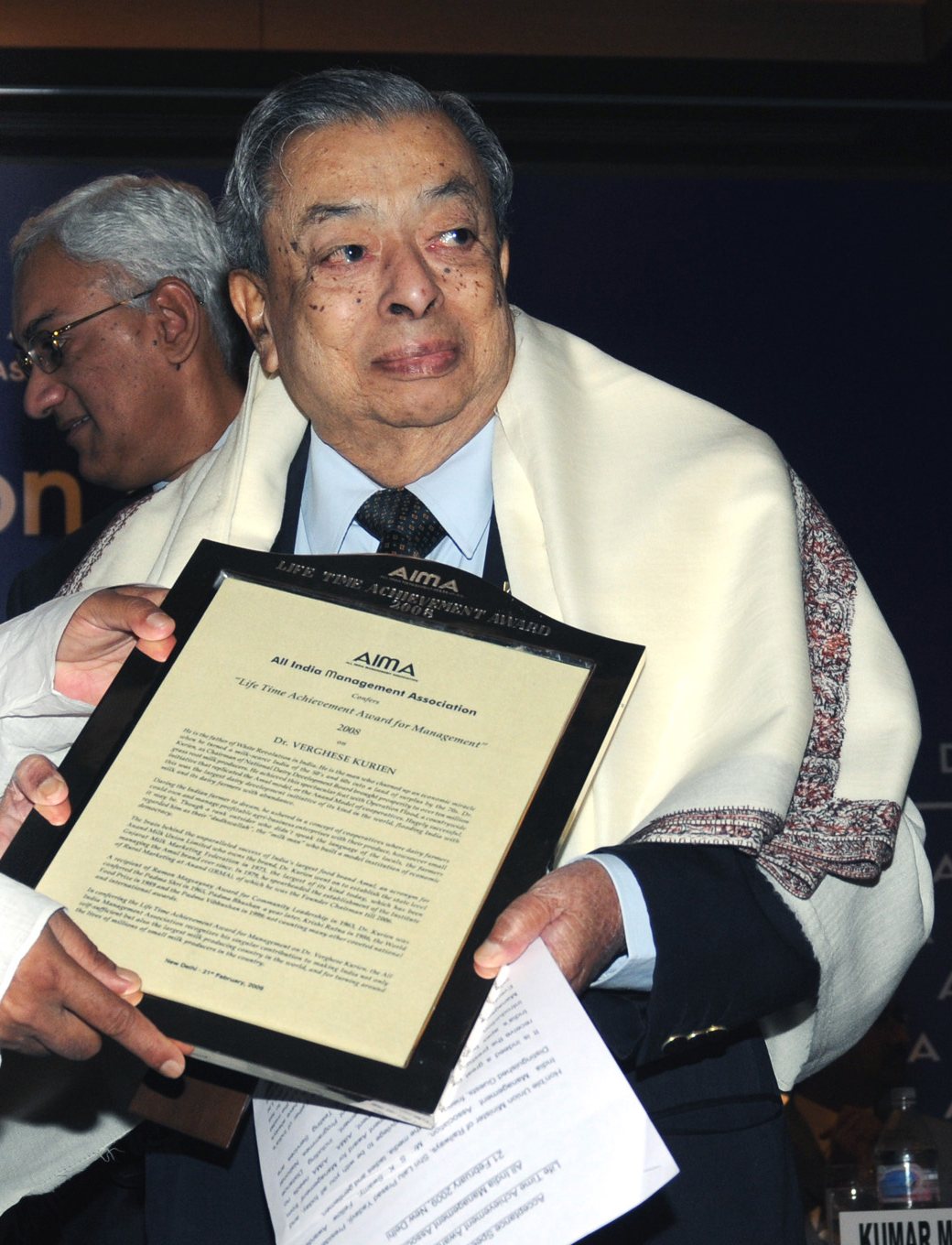
The honours kept coming: the Wateler Peace Prize and the Krishi Ratna in 1986, the World Food Prize in 1989 and the Padma Vibhushan in 1999 [26][15].
Selling the model abroad
In a 1988 speech Kurien said 86 countries in Asia, Africa and Latin America wanted to follow the Anand Pattern [21]. Not every attempt worked. In Sri Lanka, a US$20 million NDDB joint venture announced in 1997 at the invitation of President Chandrika Kumaratunga ran into union opposition and never really got off the ground [72].
How was the wealth held? It wasn’t his
This is where Kurien differs from almost everyone else in this series. He owned none of what he built. The village societies own the district unions, and the unions own GCMMF [3]. NDDB is a statutory body [16].
He drew a salary. According to M.V. Kamath’s review of his memoir, his highest pay was Rs 5,000 a month as GCMMF chairman, and he “never felt underpaid” [29]. There is no credible published estimate of his personal net worth. Business Today put it this way at his death: had Kurien been a private equity investor, “he would have retired as one of the richest men in India.” [77]
His own view was blunt. “It is only when you get less than you are worth, that you can look for respect,” he wrote. “If you are paid much more than you are worth you will get no respect.” [28]
The setbacks and failures
Phase I ran late
Operation Flood did not start smoothly. The first phase, meant to finish in the mid-1970s, ran to 1980 [2][11]. In a 1983 speech Kurien blamed officials who had resisted his plans for bulk milk vending in the cities, saying “the blame lies with those who said that bulk vending would not succeed”, though he still accepted responsibility [22].
The edible oil war
Kurien’s attempt to do for cooking oil what he had done for milk was his biggest commercial setback. It began well. Dhara grew quickly and, by the early 1990s, held about half the organised market, according to The Better India [52]. But the oil trade was a rougher world. In 1988 Kurien said a cooperative oil mill had been set on fire seven times [21].
Then the economics changed. Imports of edible oil were opened up in the 1990s, with duties cut sharply in 1998. That same year an adulteration scare in Delhi hit mustard oil sales across the market, and NDDB had to tell consumers not to buy its own Dhara mustard oil [51]. Business Standard later wrote that Dhara “rapidly declined when imports were permitted in 1998.” [50] Many cooperative oil mills shut [51]. Editorials in Business Standard argued that his monopoly-seeking style worked less well in oil than in milk [37][36].
The model did not travel everywhere
Amul thrived in Gujarat. Elsewhere, results were patchy. Economist Sudha Narayanan wrote in 2019 that the failure to recreate Anand’s success in many states, because of politics, caste and weak institutions, was “one of the more disappointing aspects of Operation Flood” [49]. The World Bank’s evaluators had earlier criticised states that interfered in cooperatives’ appointments and prices [10].
The battles of his eighties
His last decade in office was marked by fights he lost: with the successor he chose at NDDB, with the board of IRMA and in court, and finally with his own GCMMF board. These are set out below, because each was a public dispute.
Controversies and allegations
Kurien faced no criminal case, no regulatory penalty and no finding of personal financial wrongdoing that this profile could find in court records or major publications. His controversies were about how Operation Flood worked, how he ran institutions, and, after his death, about his religion and his share of the credit.
Did Operation Flood really help India’s poorest? (1980s onwards)
Allegation: From the early 1980s, a group of researchers and activists argued that Operation Flood was oversold. The researcher Shanti George’s 1985 book Operation Flood: An Appraisal of Current Indian Dairy Policy and the writer Claude Alvares’s Another Revolution Fails were the best known [48][49]. They asked whether donated European dairy products had undercut Indian producers, whether the gains went to richer households rather than the landless, and whether city consumers benefited more than village children [48]. The European Community’s own auditors, in Special Report 6/87 published in February 1988, were sharply critical of the second phase. They found long delays, very large sums from the sale of donated food sitting unused, probably no appreciable effect on average herd yields, and little gain for the poorest farmers [11].
Response: Kurien answered critics directly. In a December 1983 speech he argued that “malnutrition is the function of poverty and the cure for it is to increase the income,” and that dairy incomes had risen sharply in villages [22]. He also accepted that “Operation Flood is not an all purpose poverty removal program” [9]. He could be scathing: in 1984, according to his EPW obituarist Tushaar Shah, he told a gathering of economists, “May your tribe perish. You are never there where the action is.” [31]
What happened next:
- The World Bank’s Operations Evaluation Department reported in 1998 that Operation Flood had raised dairy growth to about 4.3% a year, that 60% of the producers it served were marginal, small or landless, and that its impact was comparable to the Green Revolution [10].
- The same evaluation criticised states that did not adopt the full Anand model and recommended no further dairy lending to them [10].
Status: An academic and policy debate, not a legal matter. Official verdicts differ: the European auditors (1988) were critical of Phase II, while the World Bank (1998) was strongly positive overall. Researchers still argue over how much of the gain reached the poorest [49].
The IRMA chairmanship fight and the Gujarat High Court (2004-2005)
Allegation: Kurien had chaired IRMA since founding it in 1979. In 2004-05 the Assistant Charity Commissioner approved changes to IRMA’s rules but rejected a clause that would have let Kurien stay chairman indefinitely, and the rejection was upheld on appeal [39][14]. On 7 April 2005 Kurien removed IRMA’s director, K. Pratap Reddy, and had his office sealed [39][14]. Business Standard described it as the first time in decades that his standing in Anand had been questioned [40]. A Business Standard editorial said his insistence on a life chairmanship “violates the democratic spirit that should govern all elective posts” [37]. His opponents’ line was: “Public institutions are not permanent parking places.” [39]
Response: Kurien called it “a conspiracy by outsiders against me and the institute.” [39]
What happened next:
- On 30 August 2005 the Gujarat High Court quashed Reddy’s removal. Justice M.R. Shah held that Kurien’s action was “without any authority, jurisdiction, contrary to IRMA Rules, most arbitrary and with a view to retain the control of the management of the institution,” and said the court “deprecated” the infighting [14].
- Kurien left the IRMA chair in 2006; PTI later reported that he was forced to step down [75][43].
Status: Concluded. The 2005 judgment is the clearest adverse court finding about his conduct as an administrator. This profile could not confirm whether it was appealed.
The 2006 exit from GCMMF and the feud with Amrita Patel
Allegation: In 1998 Kurien handed NDDB to his chosen successor, Amrita Patel [1]. They later fell out bitterly over NDDB’s plans to turn cooperatives into “producer companies” and over NDDB’s own businesses, which Kurien saw as competing with the cooperatives [35][42]. “The NDDB is building its own empire,” he said [42]. At GCMMF, 11 of the 12 district union chairmen moved a no-confidence motion against him in March 2006, only about three months after re-electing him unanimously [34]. A Business Standard editorial called him “as autocratic as they come”, and the historian Ramachandra Guha wrote that he had “stayed on far too long” [36][38].
Response: Kurien resigned on 20 March 2006 at a press conference at IRMA. He said his decision was “in deference to the recent order of the Gujarat High Court” on co-opted members of cooperative boards [33][32]. He said he was “anguished by a recent move of the GCMMF board against me” and “I did my best, in my small way, to fulfill the dreams of Indian farmers.” [33][32] Amrita Patel said: “I am truly saddened that it has happened in this way,” and “We cannot take away the credit of Kurien’s contribution to the cooperative movement.” [35] She said NDDB was making cooperatives more professional [35].
What happened next:
- Parthi Bhatol was elected GCMMF chairman in April 2006 at a stormy board meeting [41].
- Kurien stayed on as an adviser to the Mehsana union but never returned to office at GCMMF [41].
- After his death, Amrita Patel said the dream he pursued “will live as an eloquent memorial to him for years to come.” [65]
Status: Concluded in 2006. Outlook reported that the no-confidence motion, rather than the court order, was the real reason for his exit [34].
Friction with the Gujarat government (2004-2012)
Allegation: In January 2004, at a farm fair in Anand, Kurien criticised the state government, saying “a government is best that governs the least”. Chief Minister Narendra Modi replied on the spot: “The people (Congressmen) with whom you (Kurien) have been for years, are responsible for this,” according to a PTI report [43]. In 2009, PTI reported, the state registrar of cooperatives asked GCMMF to withdraw facilities it gave Kurien, such as a car and security; they continued after GCMMF officials took it up with the chief minister [43]. ThePrint also reported that Kurien clashed with the state government from 2004 over political control of dairy cooperatives [44].
Response: No formal response from Kurien was reported on the 2009 notice.
What happened next:
- When Kurien died in 2012, Modi paid tribute, calling his life “One life - One mission” [71]. He did not attend the funeral; PTI reported that one minister of state attended from the state government [43][44].
Status: A political dispute, not a legal one. There is no record of a formal boycott.
The 2018 conversion allegation
Allegation: On 24 November 2018, six years after Kurien’s death, Gujarat BJP leader and former state minister Dileep Sanghani alleged at a rally in Amreli that Kurien had given Amul’s money to Christian missionaries for religious conversions in the Dangs district [44][45]. He said details were in Amul’s records but produced no evidence [44].
Response: GCMMF chairman Ram Singh Parmar said, “We don’t want to reply to such a bogus statement.” [44][45] Kurien’s daughter Nirmala said, “My father was an atheist and (despite being a Christian) was cremated as per his wishes.” [46] Amul’s then managing director R.S. Sodhi said Kurien’s religion “was that of the religion of each farmer of India”, and noted that he was cremated where Tribhuvandas Patel was [47].
Status: An unproven claim. No inquiry, record or evidence supporting it has been published as of October 2026.
Who deserves the credit for Amul? (2018-2025)
Allegation: Some politicians have argued that Kurien was given too much credit and Tribhuvandas Patel too little. In 2018 Sanghani called Kurien “only an employee” of the cooperative Patel founded [44]. The debate returned in 2025, when Parliament passed a law creating a national cooperative university at Anand, built around IRMA, and named it Tribhuvan Sahkari University [57].
Response: In the Rajya Sabha, opposition members argued Kurien should be included. CPI(M) MP V. Sivadasan said: “He (Kurien) has been neglected by this government. I suggest the name should be Tribhuvan Kurien University.” [56] Home and Cooperation Minister Amit Shah defended the name in the Lok Sabha [57].
Status: A political and historical debate, with no formal finding either way. Kurien and Patel shared the 1963 Magsaysay Award, and Kurien was cremated where Patel was [7][47].
All matters above are stated as of 25 October 2026.
Giving back
Kurien’s giving was not a foundation with his name on it. It was a set of institutions that he built and then, at least in theory, handed to others.
The most deliberate was IRMA, founded in 1979 to train managers who would work for farmers’ organisations rather than corporations [27]. Its graduates went on to run cooperatives; R.S. Sodhi, later Amul’s managing director, was from its first batch [75][47]. NDDB also credits him with starting a school in Anand, the Anandalaya Education Society [1].
He also gave his name and fame to farmers’ causes. In 1963 he shared the Magsaysay prize with Tribhuvandas Patel and Khurody rather than claiming it alone [7]. This profile found no reliable record of what he did with the prize money from the Magsaysay or the World Food Prize, so it makes no claim about it.
His ideas were his biggest gift. “True development is not the development of land, or of cows; it is the development of men and women,” he said [25]. And: “I am in the business of empowerment. Milk is just a tool in that.” [25]
He also never drank much of the product. “I do not drink milk as I don’t like it,” he was quoted as saying at his death [64][63].
Later life and death
After 2006 he lived quietly in Anand [26]. He died after a short illness at about 1:15 am on 9 September 2012, at a hospital in Nadiad, near Anand. He was 90 [61][62]. His body lay at Amul Dairy so that farmers could pay their respects, and he was cremated in Anand, as he had wished [62][46].
Prime Minister Manmohan Singh called him “an outstanding and innovative manager and an exceptional human being” and “an icon of India’s cooperative movement and the dairy industry”, whose greatest achievement was giving “a position of pre-eminence to the farmer” [19]. For the first time in its history, the Amul girl was shown crying on a hoarding [76].
In 2014 India’s dairy industry, led by the Indian Dairy Association, began marking his birthday, 26 November, as National Milk Day [15][69]. Google ran a Doodle in his honour on 26 November 2015 [70]. NDDB held centenary events in Anand in 2021 [74].
Succession
Kurien owned no business to pass on to his family. The succession was institutional.
- NDDB: Amrita Patel, his chosen successor, in 1998 [1].
- GCMMF: Parthi Bhatol, elected in April 2006 after Kurien’s resignation [41].
- IRMA: Kurien left the chair in 2006 [75].
In April 2026 GCMMF, now chaired by Ashokbhai Chaudhary, reported 2025-26 sales of Rs 73,450 crore, up 11.4%, with 18 member unions, about 36 lakh farmer members and about 3.1 crore litres of milk collected a day [58][59]. The institutions he feared would be captured by bureaucrats or politicians have, so far, outlived the fights over them.
What his journey teaches
An accidental posting can become a life’s work, if you look for something to do. Kurien was sent to Anand against his will and spent eight months trying to leave. In those same months he found a struggling cooperative and made himself useful to it. The job he hated was the doorway to the one he loved [28].
Let the people who produce own it, and hire professionals to run it. The Anand pattern’s lasting idea was the split: farmers own and elect, managers manage. Kurien called himself an employee and meant it: “They can hire me, they can fire me.” [9] It is a useful test for any founder or family business deciding who should own and who should run.
When the experts say it can’t be done, check whose interests they serve. Western experts said buffalo milk could not be made into powder. Dalaya and Kurien proved otherwise, and the lesson Kurien drew was that “technical advice of ‘experts’ is all too often dictated by the economic interests of the advanced countries.” [28]
Turn a threat into the funding for your own capacity. Europe’s surplus milk powder could have crushed Indian dairy prices. Operation Flood sold it and used the money to build village dairies that eventually made the imports unnecessary [2][12]. Founders today face the same choice with cheap foreign competition or subsidised rivals.
Find the market before you build the factory. Kurien put it simply: “In order to create an Anand (milk production system) it is important to first find a Bombay (milk demand system).” [9] Kaira’s farmers succeeded because Bombay was hungry for milk.
Know when to leave. The man who built institutions to outlast him spent his eighties fighting to stay in charge of them, and lost. A court called one decision “most arbitrary” [14], and even admirers wrote that his record was “somewhat sullied by his refusal to retire” [38]. The best builders plan their own exit.
Kurien once described the cost of standing out: “When you stand above the crowd, you must be ready to have stones thrown at you.” [28] He had plenty thrown at him. Every morning, in thousands of Indian villages, farmers still pour milk into cans for cooperatives he designed, and are paid within days. That is the part of the story that has lasted.
A profile for general reading, based on public records and reporting as of 25 October 2026. Not investment, tax or legal advice.
Sources (77)
- Dr. Verghese Kurien, Founder Chairman - National Dairy Development Board, Oct 2026
- Operation Flood - National Dairy Development Board, Oct 2026
- Cooperative Dairying Movement - National Dairy Development Board, Oct 2026
- Milk, the inspiration behind a revolution (history) - Amul Dairy / Kaira District Co-operative Milk Producers' Union, Oct 2026
- Dr. Verghese Kurien 1921-2012 - Amul Dairy, Oct 2026
- Dr. H M Dalaya 1921-2004 - Amul Dairy, Oct 2026
- Kurien, Verghese: 1963 Ramon Magsaysay Award for Community Leadership - Ramon Magsaysay Award Foundation, Oct 2026
- Verghese Kurien ('48) - Michigan State University College of Engineering, Sep 2017
- India's Milk Revolution: Investing in Rural Producer Organizations, by Verghese Kurien - World Bank, May 2004
- India's Dairy Revolution (OED Precis No. 168) - World Bank Operations Evaluation Department, Jun 1998
- Special Report No 6/87 on food aid supplied to India 1978-1985 (Operation Flood II) - European Court of Auditors, Feb 1988
- Lok Sabha Question 1467: Indian Dairy Corporation and Operation Flood - Lok Sabha Debates, Jul 1971
- Lok Sabha Unstarred Question 3693 on Dr V. Kurien's chairmanships - Lok Sabha Debates, Mar 1981
- K. Pratap Reddy vs Institute of Rural Management Anand and Ors, Gujarat High Court - Indian Kanoon, Aug 2005
- National Milk Day backgrounder - PIB, Ministry of Fisheries, Animal Husbandry and Dairying, Nov 2021
- National Milk Day: Honouring the White Revolution - PIB, Nov 2025
- New India Samachar, 16-30 November 2022 (Verghese Kurien feature) - Government of India, Nov 2022
- India consistently retained its top position globally in milk production - All India Radio News, Mar 2026
- PM condoles the passing away of Dr. Kurien - Prime Minister's Office (archive), Sep 2012
- Speech by President Pranab Mukherjee at inauguration of Amul's cattle feed plant - President of India, Nov 2015
- Opposition to Change: The Anand Pattern, a case study (speech by Dr V. Kurien) - drkurien.com, Mar 1988
- Keynote speech by Dr V. Kurien at IDA symposium on Operation Flood - drkurien.com, Dec 1983
- Biography of Dr Verghese Kurien - drkurien.com (tribute by Amul), Oct 2026
- Timeline 1920-1957 - drkurien.com (tribute by Amul), Oct 2026
- His Thoughts - drkurien.com (tribute by Amul), Oct 2026
- Dr. Verghese Kurien: The Man, the Vision, the Legacy - Indian Dairy Association, Oct 2026
- Knowing IRMA - Institute of Rural Management Anand, Oct 2026
- I Too Had a Dream (Verghese Kurien as told to Gouri Salvi, Roli Books, 2005): quotations - Goodreads, Oct 2026
- I Too Had A Dream, review by M.V. Kamath - Free Press Journal, Jun 2019
- Remembering India's milkman: Verghese Kurien (Rasheeda Bhagat) - Rotary News, Dec 2021
- Remembering Verghese Kurien (Tushaar Shah) - Economic and Political Weekly, Sep 2012
- Kurien quits GCMMF - Business Standard, Mar 2006
- Kurien resigns as GCMMF chief - The Tribune, Mar 2006
- Spilt Milk All Over The Floor (R.K. Misra) - Outlook, Mar 2006
- Kurien v/s Amrita: Is the war over? - Business Standard, Mar 2006
- The milkman goes (editorial) - Business Standard, Mar 2006
- Time to go (editorial) - Business Standard, Apr 2005
- Calling it quits (Ramachandra Guha) - The Telegraph, Apr 2006
- Kurien faces siege from within at Anand institute - Gulf News, Apr 2005
- Kurien-Reddy spat seen tarnishing IRMA image - Business Standard, Mar 2005
- Kurien's successor elected - DNA, Apr 2006
- Kurien calls it quits, finally - exchange4media, Mar 2006
- Modi had a public spat 8 years ago with V Kurien (PTI) - India TV News, Sep 2012
- India's milkman Verghese Kurien donated Amul profits for Christian conversions: BJP leader - ThePrint, Nov 2018
- BJP leader targets Kurien: 'Amul's profits funded conversions' (PTI) - The Quint, Nov 2018
- My father was atheist: Kurien's daughter on conversion charge (PTI) - Business Standard, Nov 2018
- Amul MD rejects BJP leader's 'conversions' charge against Verghese Kurien - The Week, Nov 2018
- Operation Flood: Reviving Debates (B.S. Baviskar and Shanti George) - Economic and Political Weekly, Jan 2011
- After the Flood (Sudha Narayanan) - The India Forum, Dec 2019
- Dhara plans a comeback - Business Standard, Sep 2013
- How India was stripped of its atmanirbharta in the edible oil industry (B.M. Vyas) - The Wire, Nov 2020
- Operation Golden Flow: the success story that gave birth to Dhara - The Better India, Dec 2020
- The making of Manthan - The Better India, Apr 2022
- The return of Manthan - Deccan Herald, Jun 2024
- Sylvester daCunha, the man behind the Amul girl, no more - exchange4media, Jun 2023
- Opposition members demand Verghese Kurien's name be added to cooperative university's title (PTI) - The Week, Apr 2025
- Lok Sabha passes bill for Tribhuvan Sahkari University, Amit Shah defends name - Business Standard, Mar 2025
- Amul brand turnover hits one trillion rupees and 11% growth - Dairy Industries International, Apr 2026
- Amul brand turnover crosses Rs 1 lakh crore with 11% growth - DeshGujarat, Apr 2026
- Amul posts highest ever turnover at Rs 3,774 cr - Business Standard, Jun 2006
- Kurien, father of the White Revolution, dies - The Tribune, Sep 2012
- Father of White Revolution Kurien dead - BusinessWorld, Sep 2012
- Verghese Kurien, led India's dairy industry revolution (AP) - The Boston Globe, Sep 2012
- Verghese Kurien: India's cooperative dairy movement founder - Oneindia, Sep 2012
- Amul man Kurien no more - Deccan Herald, Sep 2012
- Polson to Amul: Gujarat farmers helmed the White Revolution (T.R. Vivek) - ThePrint, May 2023
- Real White Revolution: Shastri's NDDB, farmers-first economy (Sanjeev Chopra) - ThePrint, Jun 2025
- John Matthai: a biography of courage and honesty (review of Honest John) - The Week, Jul 2025
- Verghese Kurien - Britannica Money, Oct 2026
- Google Doodle pays tribute to Verghese Kurien (press clippings) - Amul, Nov 2015
- CM pays tribute to late Dr. Verghese Kurien - narendramodi.in, Sep 2012
- Why Lanka's failed dairy experiment is glass half full (Nirupama Subramanian) - Daily FT, May 2022
- Utterly Butterly: review of I Too Had a Dream (Khushwant Singh) - Outlook, Feb 2022
- Union Minister presents Gopal Ratna Award on National Milk Day at NDDB, Anand - NDDB, Nov 2021
- Remembering Dr. V. Kurien, the Father of the White Revolution (Katar Singh) - IRMA Network, Dec 2012
- Iconic ads of Amul celebrating Dr Verghese Kurien - Amul, Oct 2026
- Round-up: people who made news last fortnight - Business Today, Sep 2012