
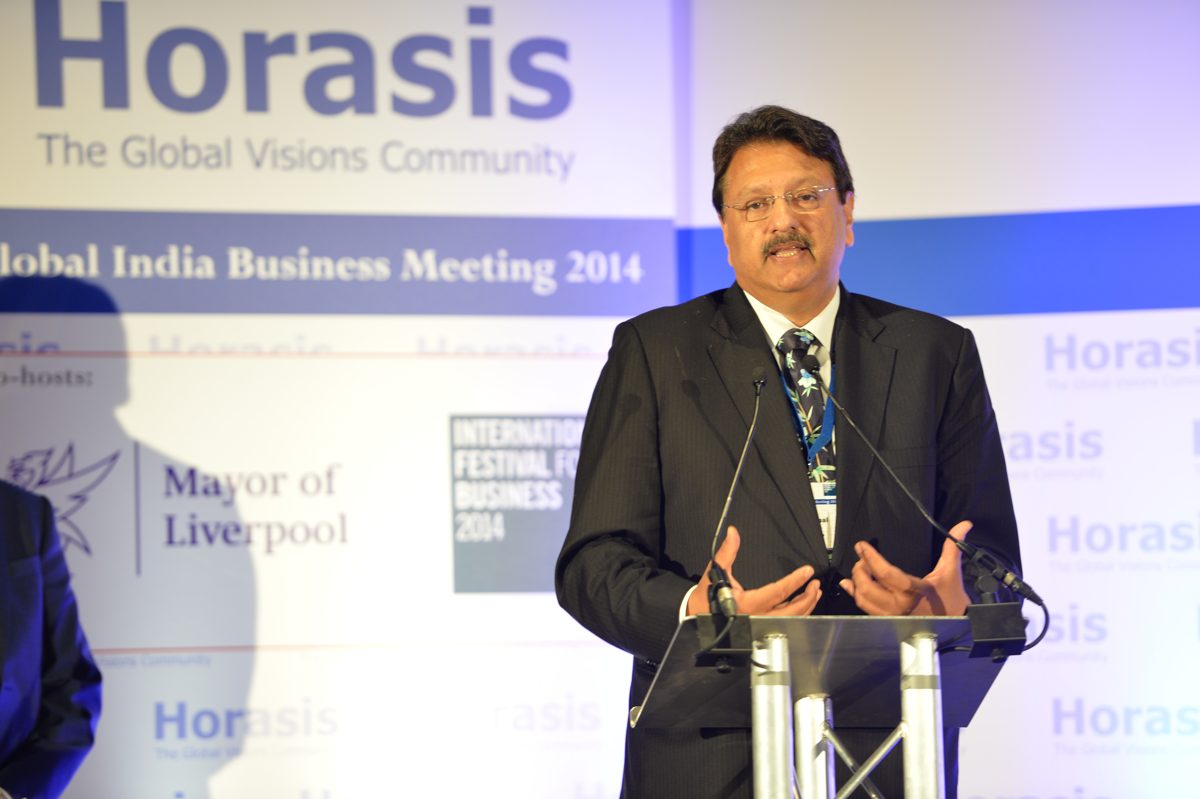
| Key facts | |
|---|---|
| Born | 3 August 1955, Rajasthan [24][25] |
| Family roots | Bagar, Shekhawati (Jhunjhunu district), Rajasthan; grandfather Seth Piramal Chaturbhuj Makharia traded in Bombay and later ran Morarjee Mills [26][27] |
| Education | B.Sc., Bombay University (1975); Master’s in Management Studies, Jamnalal Bajaj Institute (1977); Advanced Management Program, Harvard Business School [1][24] |
| Family | Wife Dr Swati Piramal (vice-chairperson, Piramal Group); son Anand Piramal (chairman, Piramal Finance); daughter Nandini Piramal (chairperson, Piramal Pharma) [2][28][29] |
| Group | Piramal Group: Piramal Finance (lending), Piramal Pharma (contract manufacturing, critical care, consumer health), Piramal Realty, Piramal Foundation [3] |
| Net worth | About US$4.1 billion (Forbes real-time, 21 October 2026); Forbes lists him at No. 64 on its 2026 India’s Richest list [30] |
| Known for | Turning a sick textile family business into a pharma, finance and real-estate group through deals, and selling his Indian drug business to Abbott for US$3.72 billion in 2010 |
One Sunday in 1988, over lunch, a 32-year-old textile mill owner from Bombay made up his mind to buy a drug company. He knew almost nothing about medicines. “I knew nothing about the pharma business, just that the family once had a drug store,” Ajay Piramal later recalled. “Right there, I made up my mind” [31]. The company was Nicholas Laboratories India, the maker of the heart drug Sorbitrate, then ranked around No. 48 in the Indian market. He paid about Rs 16 crore for it [31][32].
He wrote himself a target that sounded absurd at the time: take Nicholas from No. 48 into India’s top five drug makers by 2000. “All I have is a dream, an impossible dream,” he told his colleagues [31].
Twenty-two years later, in May 2010, the American healthcare giant Abbott agreed to pay US$3.72 billion, about Rs 17,300 crore, for the Indian formulations business he had built out of that purchase, at roughly nine times its annual sales [33]. It was one of the richest prices ever paid for an Indian pharma business, and it turned Ajay Piramal from a respected industrialist into one of the country’s best-known dealmakers.
What came after was harder. He bought into telecom, a US data business, the Shriram finance group and real-estate lending. He rescued the collapsed mortgage lender DHFL through India’s insolvency court in a deal that went all the way to the Supreme Court. He saw his finance company’s shares fall by about two-thirds after 2018, and wrote off thousands of crores in bad property loans. By 2025 he had handed the top jobs to his children.
This is the story of how a young man who inherited a dying mill at 29 built a multi-billion-dollar group, the bets that worked, the ones that hurt, and the questions his critics have asked along the way.
Where it began
The Piramal story starts in the semi-desert Shekhawati region of Rajasthan. Ajay’s grandfather, Seth Piramal Chaturbhuj Makharia (1892-1958), came from Makhar village and settled in the town of Bagar, in what is now Jhunjhunu district [26]. Like many Marwari traders of his generation, he went to Bombay to make his fortune. Business Today reported that he arrived with Rs 50 [27]. He traded cotton, silver and other commodities, and in 1928 built a grand haveli back in Bagar, now a heritage hotel [26].
When the ruler of Jaipur, Maharaja Sawai Man Singh II, honoured him, the family took “Piramal” as its surname [26]. The grandfather’s other legacy mattered more to Ajay. He “started a school in Rajasthan that gave admission to Harijans,” Ajay has said. “That’s the legacy I want to carry forward” [34].
The family’s big asset in Bombay was Morarjee Mills, a textile company incorporated in 1871 as Morarjee Goculdas Spinning & Weaving [35]. Sources disagree on exactly when the Piramals took control: Business Today put it in 1920, while Forbes says the grandfather founded the family’s textile business in 1934 [27][36]. Either way, by the time Ajay was born, the Piramals were an established mill-owning family.
Ajay Gopikisan Piramal was born on 3 August 1955 in Rajasthan, the youngest of three sons of Gopikisan and Lalita Piramal [24][36]. His elder brothers were Ashok and Dilip. His father, he says, set the tone at home. “My father was quite a successful businessman, but he never gave the impression that he was successful… He was very humble, and that’s how I’ve grown up” [37].
As a teenager he spent school holidays touring the Morarjee mill floor, an informal apprenticeship in how a factory works [38]. He studied science, graduating from Bombay University in 1975, and then took a Master’s in Management Studies from the Jamnalal Bajaj Institute of Management Studies (JBIMS) in 1977 [1]. He married Swati, a doctor, before finishing the course, and remembers being “the only one in the entire class who was married” [39].
The first break
Two deaths and a strike
Ajay joined the family business in 1977, at 22 [36]. A year or so after his MBA, his father asked him to run Miranda Tools, a small cutting-tools company the family had acquired [39][38].
Then, in 1979, his father died suddenly while in the United States. Ajay was 24 [25][38].
The brothers soon went separate ways. In Ajay’s own account, Dilip wanted to strike out on his own, and “we split on January 1, 1982”. Dilip took the luggage and plastics business that became VIP Industries, while Ajay and Ashok kept Morarjee Mills and Miranda Tools [39]. (Some accounts date the split to 1980.)
Then came the worst possible timing. In January 1982, the trade unionist Datta Samant led the Great Bombay Textile Strike. Around 2.5 lakh workers at more than 60 mills walked out, and the strike dragged on for well over a year; dozens of mills never reopened [40]. Ajay remembers it lasting 18 months and “shredding the value of the textile sector” [39]. Morarjee began losing money every day [25].
In August 1984, his eldest brother Ashok died [38][39]. At 29, Ajay became chairman of what he called “the century-old flagship business that had turned sick” [39].
He has described those years with a phrase he still repeats: “Every crisis is also an opportunity” [39]. He stayed close to the workforce. After a fire at the mill, he says, “the workers stood by us,” and Morarjee later paid workers more compensation than other mills did [39]. Business Today credited him with returning Morarjee to profit [32].
Looking beyond textiles
The strike taught him a lesson about concentration risk. Textiles in Bombay were a sunset industry, with powerlooms eating the big mills’ business [32]. He started looking elsewhere. In 1984 the group bought Gujarat Glass, a maker of glass bottles for medicines and cosmetics [41][42]. That business would grow for 36 years before being sold for close to US$1 billion.
The bigger bet came in 1988. Nicholas Laboratories India had a history going back to 1947, when it was set up as Indian Schering [43]. Its foreign parent wanted out. Reckitt & Colman had signed to buy it first but pulled out over a disputed excise-duty liability, Ajay later said [31]. Most people advised him against stepping in [32].
Ajay’s reasoning was simple. “Nobody was interested in the industry, and the multinationals wanted to get out. We saw a huge opportunity” [41]. India’s patent law then allowed local companies to make and sell drugs patented abroad, multinationals were leaving, and a well-run Indian company could buy brands cheaply.
Getting government approval was its own education. “I am a straight guy, speaking in a simple language, but convincing the bureaucrats in those days was tough,” he told India Today [38]. Nicholas was his for about Rs 16 crore, with brands including Sorbitrate and Genticyn [31][38]. In 1992 the company was renamed Nicholas Piramal India [43]. Around the same time, by then in his mid-thirties, he went to Harvard Business School for its Advanced Management Program [1][31].
Building the empire
The acquisition machine (1988-2009)
The 1990s became a decade of shopping. Ajay’s strategy was to buy what multinationals no longer wanted, at prices that reflected how little they wanted it. “M&A was the fastest growth option open to us. Organic growth has its limitations,” he told Business Today in 2001 [44].
- 1991: Nicholas Piramal commissioned its first formulations plant at Pithampur, Madhya Pradesh [4].
- 1993: It bought control (74 per cent) of Roche Products India, with brands such as Valium and Supradyn, and started an eye-care joint venture with Allergan [44][4]. “We got the brands, real estate, everything for Rs 20 crore – it was almost free,” Ajay said later [31].
- 1994-96: It acquired Boehringer Mannheim’s Indian operations in stages, starting with its Mahad plant [4][43].
- 1998: It bought Hoechst Marion Roussel’s research centre in Mulund, Mumbai, for about Rs 20 crore [44].
- 2000: It bought Rhone-Poulenc India from Aventis for Rs 236 crore [44].
- 2002-03: It added ICI India’s pharma business and Global Bulk Drugs [4].
Ajay credits banker Narayanan Vaghul, the former ICICI chairman, as a key influence on how he approached deals: “The biggest learning in this area came from Vaghul” [34]. Warburg Pincus invested in the pharma company in 1997, beginning a relationship that would recur [45].
By 2000-01 the group was projecting turnover of about Rs 2,300 crore, while the old textile company, Morarjee, was still losing money [44]. Nicholas Piramal had become one of India’s larger drug makers, and in 2006-07 group revenue passed Rs 3,000 crore [46].
Going global: the contract-manufacturing bet
In the 2000s Ajay made a second, quieter bet that outlasted the first. Western drug companies were outsourcing manufacturing, and he wanted plants abroad that could make medicines for them.
In 2005 Nicholas Piramal bought the pharmaceuticals business of Avecia of the UK for £9.5 million, which brought sites in Huddersfield and Grangemouth in Britain and Torcan in Canada [47]. In 2006 it bought Pfizer’s plant at Morpeth in north-east England, with a supply contract potentially worth more than US$350 million. “We plan to use our European assets to manufacture niche high-value drugs,” the company said at the time [48].
These plants became the core of today’s Piramal Pharma Solutions, a contract development and manufacturing (CDMO) business that later added Coldstream Labs in Kentucky (2015), Ash Stevens in Michigan (2016) and other sites [4]. In 2008 the listed company was renamed Piramal Healthcare [43].
The Abbott deal (2010)
On 21 May 2010, Ajay announced the deal that defined his career. Abbott would buy Piramal Healthcare’s domestic formulations business, about 350 brands, roughly 5,500 employees and a plant at Baddi, for US$3.72 billion. Abbott would pay US$2.12 billion upfront and US$400 million a year for the next four years [33]. The business had sales of about Rs 2,000 crore, so the price was around nine times sales [33]. Piramal kept its research arm, overseas operations and active pharmaceutical ingredient (API) business, and agreed not to compete in Indian generics for eight years [49].
The price shocked the industry. Business Today compared it with Daiichi Sankyo’s purchase of Ranbaxy at about four times sales [50]. Cipla’s Yusuf Hamied joked that drug company valuations were going up like Mumbai flat prices [50].
Why sell the crown jewel? Ajay’s answer was frank. “I don’t think we were in a position to take the company global… Abbott has the strength and aspirations to do that” [33]. Years later he added a lesson on timing: “You should know the right time either to enter or exit. Frankly, when we sold, the whole world was willing to come and buy” [51].
After taxes and expenses, the company was left with about Rs 15,000 crore [51]. The family, which owned about 54 per cent, returned part of the money through a share buyback of up to 20 per cent of the company at Rs 600 a share, worth more than Rs 2,500 crore [52].
What to do with Rs 15,000 crore
Ajay now had something rare in Indian business: a mountain of cash and no core business to spend it on. He became, in effect, an investor.
Vodafone India. In August 2011 and February 2012, Piramal Healthcare bought 11 per cent of Vodafone’s Indian business in two tranches for about Rs 5,864 crore [53][54]. Analysts were sceptical of a pharma company buying a telecom stake. In April 2014 Vodafone bought the stake back for Rs 8,900 crore. “We invested Rs 5,863 crore in two tranches and realised Rs 8,900 crore,” Ajay said [54][51].
Decision Resources Group. In 2012 the company, renamed Piramal Enterprises (PEL) that year, bought the US healthcare data and analytics firm Decision Resources Group for about US$635 million [55][43]. It sold the business to Clarivate in January 2020 for US$950 million, and said it had made 2.3 times its equity investment in rupee terms [5].
The Shriram group. In 2013-14 PEL bought 9.9 per cent of Shriram Transport Finance for Rs 1,636 crore and 20 per cent of the holding company Shriram Capital for Rs 2,014 crore, along with a stake in Shriram City Union Finance [56]. Ajay became chairman of Shriram Capital [6].
Financial services and real estate. Here lay the biggest pivot. Piramal began lending to real-estate developers, building platforms with global pension funds: a US$500 million venture with Canada’s CPPIB in 2014, and a US$1 billion infrastructure-lending platform with the Dutch pension manager APG the same year [57][58]. “This is an opportune time to be creating an aligned pool of capital,” he said of the APG deal [58]. His son Anand, meanwhile, started Piramal Realty; Warburg Pincus invested Rs 1,800 crore in it in 2015 [45].
By 2016, financial services made up about 28 per cent of revenue, and Ajay said the business “has become large enough to be independent on its own” [51].
Breaking up and selling down (2019-2022)
After 2018 Ajay began simplifying. He sold the glass business, by then Piramal Glass, to Blackstone in 2020 for US$800 million upfront plus up to US$200 million more, tied to future performance [59]. In June 2020 the US private equity firm Carlyle agreed to invest about US$490 million for 20 per cent of the pharma business [7].
Then in October 2022 PEL demerged its pharma arm. Shareholders got four Piramal Pharma shares for each PEL share, and Piramal Pharma listed on 19 October 2022 [60][61]. The pharma company was now run by Ajay’s daughter, Nandini.
DHFL: buying a collapsed lender (2021)
The boldest late-career bet was Dewan Housing Finance Corporation (DHFL). The mortgage lender collapsed in 2019 with about Rs 90,000 crore of debt, and its former promoters, the Wadhawans, faced fraud charges [8]. It became the first financial company to be resolved under the Insolvency and Bankruptcy Code (IBC) [62].
Piramal fought off Oaktree and the Adani Group to win [63]. When Adani signalled a late, revised bid in November 2020, Piramal formally protested, calling the move disruptive [63]. The National Company Law Tribunal (NCLT) approved Piramal’s plan in June 2021 [64].
On 29 September 2021 Piramal completed the acquisition for Rs 34,250 crore: Rs 14,700 crore in cash and Rs 19,550 crore in 10-year bonds. Creditors recovered about Rs 38,000 crore, including DHFL’s own cash, or about 46 per cent of what they were owed [65]. “We knew from day one that we would get it,” Ajay said [66]. DHFL’s branches and retail mortgage book gave Piramal what it badly needed: a large base of small, everyday borrowers to replace its risky developer loans.
The handover and the new Piramal Finance (2025-2026)
In 2025 the group reorganised again. Piramal Enterprises was merged into its lending subsidiary, which by then had converted to a non-bank lending licence and been renamed Piramal Finance [62]. The merger took effect on 16 September 2025 [67]. Anand Piramal became chairman of Piramal Finance, with Jairam Sridharan as managing director and CEO; Ajay stayed on as chairman of the Piramal Group [28]. Piramal Finance shares listed on 7 November 2025 [68].
The numbers since then show the turnaround. For the year to March 2026, Piramal Finance reported assets under management of Rs 1,01,230 crore, up 25 per cent, and a profit of Rs 1,506 crore. Retail loans made up 85 per cent of the book [9]. In the April-June 2026 quarter, assets under management rose to Rs 1,06,940 crore [10]. In August 2026 the company raised Rs 2,100 crore from institutions and planned to issue Rs 1,750 crore of warrants to a promoter-group entity [69].
Piramal Pharma has had a bumpier ride. In the year to March 2026 its revenue fell 3 per cent to Rs 8,869 crore and it reported a net loss of Rs 326 crore after an impairment. Nandini Piramal called it “a transitional year” [70].
How the wealth is held
Ajay Piramal’s fortune is mostly in listed shares held through the promoter group: about 46 per cent of Piramal Finance and about 35 per cent of Piramal Pharma, as of mid-2026, according to exchange shareholding data compiled by market data sites, plus the unlisted Piramal Realty [71][72]. Forbes put his real-time net worth at about US$4.1 billion on 21 October 2026 [30]. The figure moves with share prices.
He is wary of fortunes that simply sit in investment portfolios. “It’s businesses who create wealth, and then you can invest,” he said in September 2026. Wealth management for its own sake, he added, “makes you lazy” and “gives you the wrong habits” [73].
The setbacks and failures
The real-estate loan crisis (2018-2024)
Piramal’s move into developer lending looked brilliant until September 2018, when the collapse of IL&FS froze credit for non-bank lenders across India. Piramal had lent heavily to builders: by mid-2019, developer loans of Rs 40,160 crore made up more than 70 per cent of its loan book, and its top ten developer borrowers accounted for 31 per cent [74]. PEL’s share price fell about 65 per cent from its August 2018 peak, and gross bad loans nearly tripled in a year [74].
Funding became tight. In July 2019 Business Today reported that LIC had extended a Rs 1,500 crore credit line and the World Bank’s IFC also backed the company, while Piramal decided to sell its Shriram stakes [75].
The clean-up was long and expensive. In the July-September 2022 quarter PEL reported a net loss of Rs 1,536 crore after Rs 3,311 crore of provisions and fair-value losses. Ajay said the company was “focused on making the wholesale book more granular” [76]. In December 2023 the RBI tightened rules on lenders’ investments in alternative investment funds (AIFs), aimed at stopping the “evergreening” of bad loans. PEL set aside Rs 3,540 crore and reported a quarterly loss of Rs 2,378 crore [77][11]. When the RBI eased the rule in March 2024, PEL reversed Rs 1,517 crore of those provisions [78]. In a March 2026 filing, Piramal Finance said its assessed tax losses added up to about Rs 24,600 crore, a sign of the scale of the losses it had absorbed [12].
The Shriram partnership that never quite gelled
The Shriram investment was meant to make Piramal a financial-services heavyweight. Instead, Business Today reported cultural mismatches, leadership churn and a failed merger plan with IDFC [79]. Ajay maintained the investment had “worked out reasonably well” [79]. Piramal sold out in stages, including its 8.34 per cent of Shriram Finance for Rs 4,824 crore in June 2023 [80]. No reliable source has published its overall return, so it cannot fairly be called a loss, but it did not become the platform Ajay had hoped for.
Regulatory knocks at the pharma plants
Like most global drug makers, Piramal Pharma faces regular US Food and Drug Administration (FDA) inspections. In 2024 its Riverview, Michigan plant received a Form 483 with three observations, which the company said did not relate to data integrity; in February 2025 an Indian API plant received six observations on quality control [81][82]. These are observations, not warning letters, and no FDA warning letter against Piramal Pharma was found in our research.
A pharma company in transition
The pharma business Ajay rebuilt after the Abbott sale has also struggled to grow profits since its 2022 listing. FY26 brought falling revenue and a loss [70]. The group is betting on a recovery, and Nandini Piramal has set a goal of US$2 billion of revenue with a 25 per cent EBITDA margin by FY2030 [29].
Controversies and allegations
Our research found no criminal case, and no adverse finding by a regulator, against Ajay Piramal personally. The matters below concern companies he controls or led.
The DHFL resolution and the “Re 1” recoveries
Allegation: Piramal’s DHFL plan valued potential recoveries from legal cases over DHFL’s suspect past transactions, put at more than Rs 45,000 crore, at a nominal Re 1, and gave those recoveries to Piramal rather than to creditors [8][83]. 63 Moons Technologies, which held Rs 200 crore of DHFL bonds, challenged this, arguing that money allegedly siphoned out by the former promoters should go back to the lenders who lost it [84]. Critics, including the financial publication Moneylife, argued that the deal favoured the Piramals over small investors [85]. Separately, DHFL’s fixed-deposit holders objected to their low recovery: in June 2021 the committee of creditors (CoC), led by banks, rejected by 89 per cent a suggestion to raise their payout, and Business Standard estimated they would get back about 23 per cent of their claims [86].
Response: Piramal argued before the tribunal that such recoveries were unlikely [84]. After the appellate tribunal ruled against it in 2022, the group said: “The DHFL acquisition by Piramal Group remains unaffected and the business integration continues as envisaged” [87]. How the recovery was shared among creditors was the decision of the CoC, not of Piramal [86].
What happened next:
- 7 June 2021: the NCLT approved Piramal’s plan with conditions [64].
- 27 January 2022: the National Company Law Appellate Tribunal (NCLAT) set aside the clause giving the recoveries to Piramal and sent the plan back to the creditors [84][87].
- 2022: the Supreme Court stayed the NCLAT order [8].
- 1 April 2025: the Supreme Court set aside the NCLAT ruling and upheld the plan. It held that recoveries from “avoidance” applications (preferential and undervalued deals under Chapter III of the IBC) go to the creditors, while recoveries from fraudulent and wrongful trading applications under Section 66 can go to Piramal, as the plan provided. It also held 63 Moons bound by its creditor class’s vote, and said depositors had no legal right to full repayment [8][13].
Status: The resolution plan is final after the Supreme Court’s April 2025 judgment. The NCLT was asked to separate the two types of recovery in pending cases. We found no published total for amounts actually recovered as of October 2026.
Insider trading by a former Piramal Capital executive
Allegation: SEBI alleged that Khushru Jijina, former managing director of Piramal Capital & Housing Finance, had unpublished price-sensitive information about PEL’s June 2018 quarter results, and that a firm managed by his wife traded PEL shares, making an alleged unlawful gain of Rs 15.32 crore [88]. Ajay Piramal was not accused.
Response: Jijina, his wife and the firm settled with SEBI without admitting or denying the allegations [88][14].
Status: Settled in July 2024: they paid Rs 43.55 crore in settlement charges, disgorged Rs 24.74 crore and accepted a six-month voluntary market ban [88].
SEBI disclosure case against Piramal Pharma
Allegation: SEBI examined whether Piramal Pharma failed to tell investors about a Rs 8.32 crore National Green Tribunal penalty and a roughly 44-day pollution-related closure of its Digwal plant in Telangana in 2018-19 [89].
Response: The company argued the events were not material to investors.
Status: In November 2024 a SEBI whole-time member exonerated Piramal Pharma, finding the events were not material [89][15].
The Rs 1,502 crore GST demand
Allegation: In February 2025, Maharashtra’s tax department alleged that the Rs 4,487 crore transfer of PEL’s pharma business to Piramal Pharma in 2020 was an itemised sale, not a slump sale, and demanded GST, interest and penalty totalling Rs 1,502 crore [90][91].
Response: Piramal Enterprises called the demand “unjustified” and appealed [90].
Status: On 29 May 2025 the GST appellate authority cut the demand to Rs 9.22 crore, according to the company’s stock exchange filing [16].
Position as of 21 October 2026.
Giving back
Ajay Piramal treats philanthropy as part of the business, not a sideline. “We make bold, courageous decisions in business. Why can’t we do the same in philanthropy?” he asked in a 2023 interview [92]. He prefers a different word to giving: “Actually, giving is not the right word, it is really sharing” [92].
The Piramal Foundation was set up in the mid-2000s; sources variously give 2005, 2006 and 2007 [25][17]. Its main programmes include:
- Piramal Swasthya, which began as a pilot in Andhra Pradesh in 2007 and runs health helplines and mobile medical vans; by 2019 it reported working in 20 states [18].
- Sarvajal, a clean-drinking-water venture seeded in 2008 in Bagar, the family’s ancestral town [18].
- Education leadership and the Gandhi Fellowship, started in 2008 with 11 fellows, which trains young people to work with government schools [19]. The Piramal School of Leadership opened in Bagar in 2013 [93].
- Aspirational districts: from 2018 the Foundation worked with NITI Aayog in 25 of India’s poorest districts, later expanding into a collaborative covering all 112 [19][20].
By 2022 the Foundation said it had reached 113 million people over 15 years, and set a goal of reaching 100 million people in poverty by 2030 [17]. It works closely with government systems, and Ajay says he wants officials, not his foundation, to take the credit: “I don’t want credit, I want the government officer to get credit” [92].
His outlook draws heavily on the Bhagavad Gita, which he has called “the greatest management book ever written” [25]. “The best advice I ever got is from the study of the Bhagwad Gita,” he said. “The concept of Trusteeship means that all we have here is given to us by the Lord” [94]. The group’s motto is “Doing Well and Doing Good” [3].
He chaired the board of Pratham, one of India’s largest education NGOs, from 2006 to 2025 and is now its chairman emeritus [21]. He joined the board of Tata Sons in August 2016 and was due to retire from it in August 2025 [95][96]. (See our profile of Ratan Tata.) He served 12 years on the board of the State Bank of India, co-chairs the UK-India CEO Forum, and in 2022 received an honorary CBE for services to UK-India trade [22][97].
Succession
Ajay Piramal has handed over the operating businesses to his children while staying on as group chairman.
His son Anand Piramal, an economics graduate of the University of Pennsylvania with an MBA from Harvard Business School, joined the group’s board, founded Piramal Realty and led the DHFL acquisition [23]. He became chairman of Piramal Finance in September 2025 [28]. In December 2018 he married Isha Ambani, daughter of Reliance chairman Mukesh Ambani [24].
His daughter Nandini Piramal is chairperson of Piramal Pharma; in April 2026 the board re-appointed her as executive director and chairperson for three years from April 2027 [29][98]. His wife, Dr Swati Piramal, is vice-chairperson of the group and received the Padma Shri in 2012 [2].
Ajay has said that “as the next generation takes more and more responsibility”, he would like to spend less time on business and more on “making a difference” [99].
What their journey teaches
Buy what others are desperate to sell. Nicholas, Roche India and Boehringer’s Indian arm came cheap because multinationals were leaving India. Ajay saw a market others had given up on, and paid as little as Rs 16 crore and Rs 20 crore for brands that grew into a business Abbott valued at US$3.72 billion [31][33].
Selling at the right price can be as important as building. Few Indian founders sell their crown jewel. Ajay did, because he judged Abbott could take it further than he could, and because “the whole world was willing to come and buy” [51]. The same discipline showed in the Vodafone, DRG and glass exits.
Concentration is the real risk. The 1982 strike wiped out the value of a textile-only family. Decades later, a loan book that was 70 per cent developer loans brought PEL close to the same lesson in finance [74]. Both times the fix was to diversify: into pharma then, into retail lending through DHFL later.
A crisis can be a buying opportunity, if you have the balance sheet. Ajay took over a sick mill at 29 and bought DHFL out of insolvency at 66. “Every crisis is also an opportunity” is his favourite line, but it only works when you keep the cash and patience to act [39].
Plan the handover while you are still in charge. By breaking the group into focused listed companies and giving each child a clear domain, he settled succession while he was still around to oversee it. Plenty of Indian family businesses have learned the hard way what happens otherwise.
A profile for general reading, based on public records and reporting as of 21 October 2026. Not investment, tax or legal advice.
Sources (99)
- Ajay G. Piramal - World Economic Forum, accessed Oct 2026
- Dr Swati Piramal, Vice-Chairperson - Piramal Group, accessed Oct 2026
- Ajay Piramal, Chairman, Piramal Group - Piramal Group, accessed Oct 2026
- History - Piramal Pharma Solutions, accessed Oct 2026
- Piramal divests its DRG business for US$950 million - Piramal Enterprises press release, Jan 2020
- Board and governance - Piramal Enterprises Annual Report 2018-19, accessed Oct 2026
- Carlyle to acquire 20% stake in Piramal Pharma - Piramal Enterprises press release, Jun 2020
- Supreme Court Upholds Piramal's Resolution Plan For DHFL, Sets Aside NCLAT Order - LiveLaw, Apr 2025
- Piramal Finance Q4 and FY26 results press release - NSE filing, Apr 2026
- Piramal Finance Q1 FY27 results press release - NSE filing, Jul 2026
- Piramal Enterprises Q3 FY24 press release and investor presentation - Piramal Enterprises, Jan 2024
- Piramal Finance Regulation 30 disclosure on tax assessment - NSE filing, Mar 2026
- Read why Supreme Court upheld Piramal Capital's resolution plan for DHFL - SCC Online, Apr 2025
- Settlement order in the matter of Piramal Enterprises Limited - SEBI, Jul 2024
- Order under Section 15-I of SEBI Act in the matter of Piramal Pharma Limited - SEBI, Nov 2024
- Intimation of GST appellate order - Piramal Enterprises NSE filing, May 2025
- Piramal Foundation commemorates 15 years, has impacted 113 million lives - Piramal Foundation, Jul 2022
- Piramal Foundation profile - Piramal Foundation, accessed Oct 2026
- Journey - Piramal Foundation, accessed Oct 2026
- Delivering to Our Society: Piramal Foundation - Piramal Enterprises Annual Report 2022-23, accessed Oct 2026
- Ajay G. Piramal - Pratham, Dec 2025
- Ajay Piramal, Board of Directors - Tata Sons, accessed Oct 2026
- Anand Piramal - Piramal Group, accessed Oct 2026
- Ajay Piramal - Wikipedia, accessed Oct 2026
- Ajay Piramal (The Boss) - Outlook Business, Jul 2015
- The Piramal Haveli: History - Neemrana Hotels, accessed Oct 2026
- The Piramal principle - Business Today, Aug 2008
- Anand Piramal takes charge as Piramal Finance chairman, Sridharan named MD & CEO - Storyboard18, Sep 2025
- How young scions are redefining Indian business - The Week, Jan 2026
- Ajay Piramal profile and real-time net worth - Forbes, Oct 2026
- No matter how sincere your efforts, the competition will never let go of things easily - Outlook Business, Mar 2018
- Taking contrarian bets (From the Editor) - Business Today, Jul 2016
- Abbott snaps up Piramal's formulations biz for $3.7 bn - Business Standard, May 2010
- If you are dispassionate, you'll win: that's my greatest lesson from Bhagwad Gita - Outlook Business, Mar 2018
- Morarjee Textiles: a growth story based on rich legacy - Indian Textile Magazine, Apr 2022
- Piramal family profile - Forbes, Nov 2017
- Ajay Piramal on the importance of timing - BCG, Nov 2015
- Ajay Piramal: Life changing moments - India Today, Jan 2021
- Every crisis is also an opportunity - Outlook Business, Mar 2018
- Great Bombay textile strike - Wikipedia, accessed Oct 2026
- Five lessons in the life of 'India's Warren Buffett' - Asia Society, accessed Oct 2026
- Piramal Group - Wikipedia, accessed Oct 2026
- Piramal Enterprises company history - IndiaInfoline, accessed Oct 2026
- Nicholas Piramal's acquisition strategy - Business Today, Feb 2001
- Warburg to invest Rs 1,800 cr in Piramal Realty - Business Standard, Jul 2015
- The Alchemist - Business Today, Mar 2008
- Avecia sells its pharma business unit to Nicholas Piramal of India - Manufacturing Chemist, Oct 2005
- India's Nicholas Piramal buys Pfizer's UK manufacturing plant - Outsourcing-Pharma, Jun 2006
- Abbott buys Piramal's domestic formulations business - The Tribune, May 2010
- Takeover therapy - Business Today, Jun 2010
- Piramal is now targeting a four-fold jump in the value of his business empire - Business Today, Jul 2016
- Piramal to buy back 20% shares - Business Standard, Oct 2010
- Piramal Healthcare buys another 5.5% in Vodafone for Rs 3,007 cr - Business Standard, Feb 2012
- Piramal agrees to sell Vodafone India stake for Rs 8,900 cr - Business Today, Apr 2014
- Piramal Healthcare to acquire Decision Resources Group - FierceBiotech, May 2012
- Piramal enlarges financial play, buys 20% in Shriram Capital - Business Standard, Apr 2014
- Piramal, Canada's CPPIB form $500 million realty investment fund - Reuters via Business Standard, Feb 2014
- Piramal, Dutch APG tie up for $1 bn infra investment - BusinessWorld, Jul 2014
- Piramal Glass sold to Blackstone for $1 billion - Glass International, Dec 2020
- Piramal Pharma to list on bourses on October 19 after demerger - Business Today, Oct 2022
- Piramal Pharma ends at Rs 192 on debut, valued at Rs 22,882 cr - Business Standard, Oct 2022
- Piramal Finance - Wikipedia, accessed Oct 2026
- Adani seeks to bid for all of DHFL's assets, Piramal protests - BloombergQuint, Nov 2020
- DHFL insolvency: NCLT approves Piramal Group's plan - BloombergQuint, Jun 2021
- Piramal Group acquires DHFL for total consideration of Rs 34,250 cr - Business Standard, Sep 2021
- We knew we would clinch the deal: Ajay Piramal on DHFL acquisition - Business Today, Sep 2021
- Piramal Enterprises rises on merging its subsidiary Piramal Finance - Business Standard, Sep 2025
- Piramal Finance aims AUM of Rs 1.5 trillion by 2028 - Business Standard, Nov 2025
- Piramal Finance QIP and promoter warrants capital raise - Business Standard, Aug 2026
- Piramal Pharma announces results for Q4 and full year FY26 - PR Newswire via TechNode, Apr 2026
- Piramal Finance shareholding pattern - Trendlyne, accessed Oct 2026
- Piramal Pharma shareholding pattern - Upstox, Oct 2026
- India competitively better placed amid uncertain times, says Ajay Piramal - Business Today, Sep 2026
- Outlook for Piramal Enterprises is not bright; stock falls over 3% - Business Standard, Jun 2019
- LIC, IFC come to aid of Ajay Piramal's financial services business - Business Today, Jul 2019
- Piramal Enterprises posts net loss of Rs 1,536 cr on higher provisions - Business Standard, Nov 2022
- NBFCs begin provisioning for AIF exposure after RBI tightens norms - Business Standard, Dec 2023
- Piramal Enterprises Q4 results: PAT at Rs 137 cr on AIF provisions reversal - Business Standard, May 2024
- Hello, goodbye: Piramal and Shriram - Business Today, Jun 2019
- Piramal Enterprises exits Shriram Finance, pares entire stake for Rs 4,824 cr - Outlook Business, Jun 2023
- Piramal API plant in Michigan hit with FDA Form 483 - Fierce Pharma, Feb 2024
- FDA dings Piramal API plant with Form 483 detailing quality-control problems - Fierce Pharma, Feb 2025
- SC sets aside NCLAT order on DHFL resolution plan dispute - ETV Bharat/PTI, Apr 2025
- NCLAT asks CoC to reconsider avoidance transaction terms of DHFL resolution plan - Insolvency Tracker, Jan 2022
- DHFL resolution: Piramals profit plentifully, pittance for the rest - Moneylife, Oct 2021
- CoC rejects DHFL's proposal for raising payout to small investors - Business Standard, Jun 2021
- DHFL acquisition unaffected, says Piramal Group after NCLAT directive - Business Today, Jan 2022
- Piramal Capital former MD, 2 others settle insider trading case with SEBI by paying Rs 43.55 crore - Outlook Business, Jul 2024
- SEBI clears Piramal Pharma Limited of alleged LODR violations - SCC Online, Nov 2024
- India's Piramal Enterprises hit with nearly $172 million tax bill for pharma deal - Reuters via MarketScreener, Feb 2025
- Piramal Enterprises gets Rs 1,502 cr tax notice - Business Standard, Mar 2025
- Interview: Ajay Piramal - Alliance magazine, Jul 2023
- Piramal Foundation - Wikipedia, accessed Oct 2026
- Best advice I ever got: Ajay Piramal - Business Today, Aug 2012
- Venu Srinivasan, Ajay Piramal join Tata Sons board - Business Standard, Aug 2016
- Tata Sons AGM to vote on Noel Tata, other board seats - Business Standard, Aug 2025
- Ajay Piramal receives honorary British award from Queen Elizabeth - Business Today, May 2022
- Piramal Pharma Q4 FY26 results and board appointments - Investywise, Apr 2026
- Transformations, pivots and change: the evolution of Piramal Group - YourStory, Sep 2021