
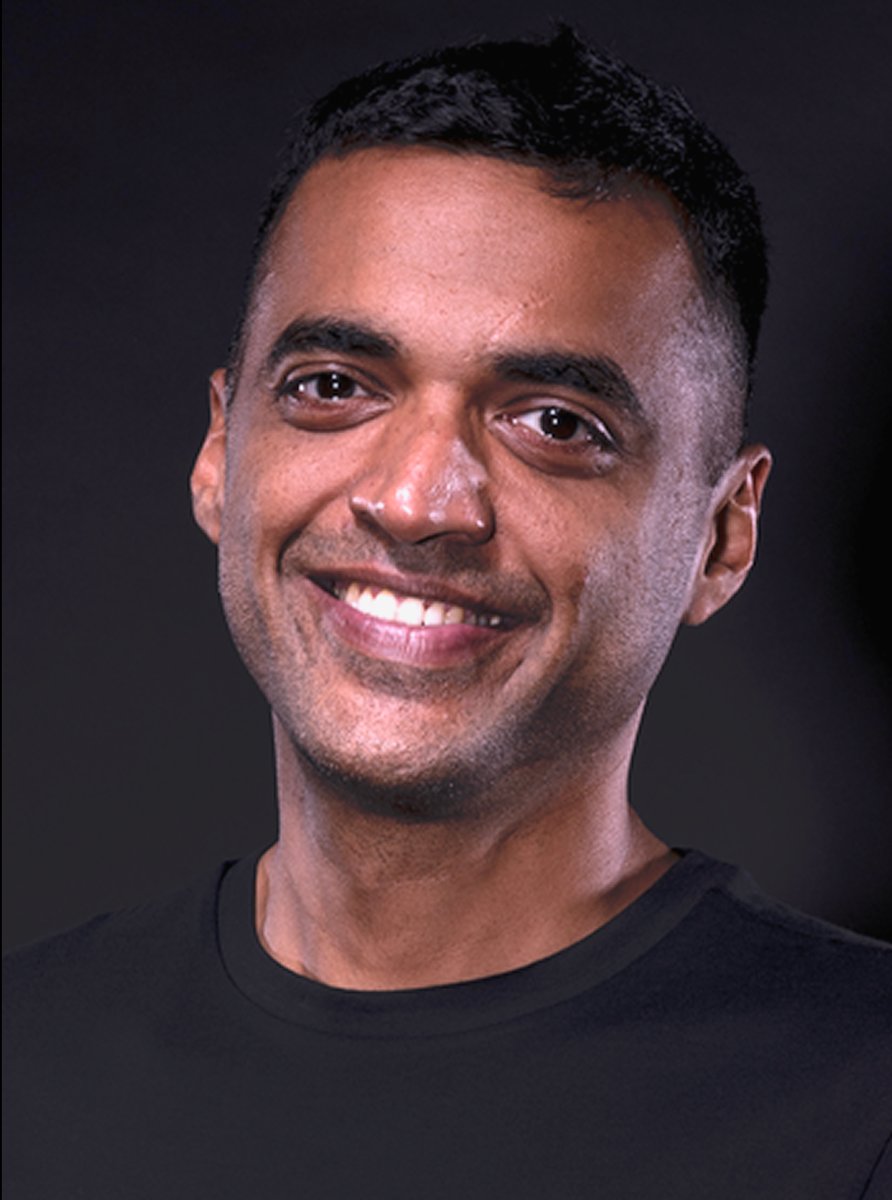
| Key facts | |
|---|---|
| Born | 26 January 1983 [1], Muktsar (Sri Muktsar Sahib), Punjab [23] (Wikidata lists 1985; the 2021 IPO prospectus says 1983) |
| Hometown/Family roots | Small-town Punjab; Bloomberg describes him as “the son of two teachers” [22] |
| Education | Integrated M.Tech, Mathematics and Computing, IIT Delhi (2005, per IIT Delhi alumni records) [2][3] |
| Family | Married to Grecia Muñoz, a Mexican-born former model and entrepreneur (reported in March 2024) [109] |
| Company/Group | Eternal Ltd (formerly Zomato Ltd), which owns Zomato, Blinkit, District and Hyperpure. Vice Chairman and non-executive director since February 2026; Group CEO until 31 January 2026 [9][10][55]. Also co-founder of LAT Aerospace and Temple [69][70] |
| Wealth | About US$1.8 billion (Forbes real-time, 5 October 2026) [11]; Rs 9,300 crore (Hurun India Rich List 2024) [60] |
| Known for | Turning a folder of scanned menus into a food-delivery and quick-commerce group used by more than 10 crore Indians; buying Blinkit; renaming Zomato as Eternal |
Where it began
The menus were the problem. In the cafeteria of Bain & Company’s New Delhi office, there were about fifty takeaway menus, filed and stapled. Nobody was allowed to take one back to their desk. “We couldn’t risk losing them — then we wouldn’t have anything to order from,” Deepinder Goyal recalled in 2012 [18]. So hungry consultants, young and working late, crowded around the menu cards every evening. “We were bachelors, worked late hours and didn’t get home-cooked food,” he said [18].
One day Goyal scanned the cards and put them on the office intranet. People used it. “It started from there essentially,” he told Mint in 2015, “and a lot of people at Bain started using the service and then we eventually expanded it to Delhi NCR” [19].
Those scanned menus became Foodiebay, then Zomato, and then Eternal Ltd. In the year to March 2026 the group recorded operating revenue of Rs 54,364 crore [52], and its Sensex-listed shares were worth over Rs 3 lakh crore in October 2026 [113]. Its founder had once barely scraped through school.
A paradox of a childhood
Deepinder Goyal was born on 26 January 1983, according to the prospectus Zomato filed for its 2021 share sale [1]. He grew up in Muktsar, a small town in Punjab [23]. Bloomberg describes him as the son of two teachers [22]. A 2025 authorised biography, Unseen by former Zomato executive Megha Vishwanath, follows his parents’ lives in Punjab through the 1980s and sums him up in one line: “Deepi’s childhood was a paradox” [26].
He had a hard time at school, and says so plainly. “I was a terrible student during school, used to be at the bottom of class. I used to fail,” he said on Netflix’s The Great Indian Kapil Show in 2024 [24]. YourStory reported that in Class 5 his father had to ask the principal to promote him [23].
He tells the turning point with unusual candour. In Class 8, he said, a teacher gave him exam answers. His marks shot up, and the praise he got from family and friends was something new [24]. When the help stopped, he tried to get question papers in advance from a printing press in Muktsar. “But I didn’t get anything,” he said. “I started working hard and ended up coming fifth in the second semester. That gave me some confidence that I can do something if I want to. Life has been a treadmill ever since.” [24] YourStory’s 2023 version calls the helper an invigilator rather than a teacher [23].
He slipped again in Class 11. The Economic Times reported that he “barely managed to pass with 39% marks” [24]. He moved to Chandigarh for coaching for the IIT entrance exam and felt lost among the state’s toppers. “I was with the smartest kids in the state, and that depressed me,” he told YourStory [23]. A friend he met there helped him through his board-exam studies: Albinder Dhindsa, who would later found Blinkit and, in 2026, succeed him as chief executive [23][55]. Goyal took the JEE almost as a trial run, after a late interest in physics [23][26], and got into IIT Delhi.
IIT Delhi and a first failed idea
At IIT Delhi he studied for an integrated M.Tech in Mathematics and Computing [1]. The institute’s alumni records list him as a 2005 graduate [3]. Some online profiles give other years, but the institute’s own record is the most reliable.
The campus gave him two things. One was an interest in building online products. During a summer internship he worked on a collaboration tool and called it “a great opportunity to learn about the nuts and bolts of designing an online product for the first time” [118]. The other was his first startup failure. In his final year he tried an online food-ordering site called Foodlet, which would run restaurants’ promotions and take orders online. It lasted about nine months. Customers would not order online, and running it took too much time [13]. “It did not work; 2005 was way too early,” he later said [21].
The first break
From cafeteria to Foodiebay
After IIT, Goyal joined Bain & Company as a consultant in New Delhi. No primary source gives his start date. “Consulting teaches you how to think and talk,” he said later [24]. In July 2007 a younger IIT Delhi graduate, Pankaj Chaddah, joined Bain and met him there [17]. Goyal had already been working on the menu idea for a few months when Chaddah joined him in mid-2008 [17].
They bought the domain in April 2008 and began operating as Foodiebay.com in July 2008 [13]. The first product was crude. “It had blue HTML links; there was no search, but you could use a browser search bar to look for a restaurant,” Goyal said [21]. About a hundred Bain colleagues used it every day at first. Within months it listed around 1,200 Delhi restaurants [119]. By December 2008 the team of six covered about 1,400 restaurants in the National Capital Region and had spent nothing on marketing [13][21].
For more than a year they ran it alongside their Bain jobs, often at weekends [17][19]. Restaurants began approaching them to advertise in 2009, and that money paid the rent [21]. By the time they quit, Foodiebay was live in Delhi NCR, Kolkata, Mumbai and Pune [17].
Quitting a safe job
They quit Bain in late 2009 [19]. Their families were not pleased. “Our parents did not want us to quit Bain. It was a stable job… many people aspired to work at Bain,” Chaddah said [19]. Goyal later described his father’s reaction with a line that went viral in 2024: “When I told my dad about starting Zomato, he said, ‘Janta hai tera baap kaun hai?’” — in effect, people like us don’t start companies [25]. Bloomberg reported that he left Bain once his then wife, whom he had met while both studied mathematics at IIT Delhi, got a teaching job at Delhi University, which gave the household a steady income [22][26].
The company was incorporated on 18 January 2010 in New Delhi as DC Foodiebay Online Services Pvt Ltd, with a share capital of just Rs 1 lakh. Goyal took 75,000 shares and Chaddah 25,000, at Rs 1 each [1]. For the first months, Mint reported, they lived on help from their brothers and a few Bain friends [19].
The WHOIS email
The money that changed everything came from a reader. Sanjeev Bikhchandani, founder of Naukri.com’s parent Info Edge, and his colleague Hitesh Oberoi had each been using the site for months. “I went to network solutions and did a WhoIs search and found out Deepinder Goyal’s name in the admin contact. I sent a cold email to him,” Bikhchandani recalled. The message said, in effect: we use your site, we are fans, call us if you want money [20]. Goyal replied within 24 hours. “We shook hands (for a deal) in 72 hours,” Bikhchandani said [20].
Goyal remembers the meeting as even quicker: “The day we went to meet him, he asked if we were looking for money. We told him yes and within 15 minutes he promised a $1 million cheque for a 33% stake in the company.” [19] In August 2010 MediaNama reported that Info Edge was investing up to Rs 4.7 crore in Foodiebay [14]. Info Edge kept investing: Rs 13.5 crore in September 2011, Rs 12.86 crore in September 2012, and Rs 55 crore in February 2013. That took its stake to 57.9% [27].
Foodiebay becomes Zomato
In November 2010 Foodiebay was renamed Zomato [15][19]. There were two reasons. The founders wanted a name that was not tied to food listings alone; at the time they were eyeing nightlife too [15]. And “Foodiebay” sounded uncomfortably like eBay once they planned to take payments [15][17]. Goyal later said that “one should not build a business on a name which has 5% chance of getting screwed in the future” [125]. The new name rhymed with tomato. “We wanted ‘tomato dot com,’ but it was taken,” he joked on the Kapil Sharma show [24]. The company’s legal name changed to Zomato Media Pvt Ltd later, in May 2012 [1].
At the rename the site had more than 20 lakh monthly users across five cities [15]. By May 2012 it had 35,000 menus in 10 cities, 8.5 lakh app downloads, and revenue of about Rs 60 lakh a month that was doubling every quarter [16].
Building the empire
Going global, too fast (2012-2015)
From 2012, Zomato went abroad. It started with the UAE, then Sri Lanka, Qatar, the UK, the Philippines and South Africa. New Zealand, Turkey, Brazil and Indonesia followed in 2013 [122][121]. It bought local listing sites in Turkey, Italy, Poland, New Zealand, the Czech Republic and Slovakia [28][32].
Bigger investors arrived. Sequoia Capital joined Info Edge in a US$37 million round in November 2013 [122]. Vy Capital co-led a US$60 million round in November 2014 [28]. In January 2015 Zomato made its boldest bet: it bought Seattle-based Urbanspoon from IAC for US$52 million in cash. Goyal said most of the latest round had gone into the deal, which took Zomato to more than 500 cities in 22 countries [28]. Another US$50 million round, led by Info Edge in April 2015, valued Zomato at more than US$1 billion [29][32]. In September 2015 Temasek and Vy Capital added US$60 million [32].
In February 2015 Mint called Zomato “India’s first global app” [19]. Under the surface it was burning cash fast.
“Unicorn to unicorpse” (2015-2016)
By early 2015 Zomato was spending about US$9 million a month, Goyal told Info Edge investors in May 2016 [5]. In October 2015 it laid off about 300 people, just under a tenth of its roughly 3,000 staff. Most worked on US teams that had collected restaurant data in person [29]. Goyal’s memo said the cuts would “help bring our burn rate down… The time has come for us to focus deeply on transactions in countries where it matters” [29].
2016 was worse in public. In April 2016 HSBC analysts valued Zomato at about US$500 million, half its 2015 round valuation, and headlines turned from “unicorn” to “unicorpse” [30][31]. Goyal pushed back on his blog. In January 2016 he had called 2015 “truly our year of learning”. His listed lessons included not scaling too fast, not picking fights with everyone, and never losing sight of revenue [30].
He did fix the business. By May 2016, he said, the burn was down to about US$1.6-1.7 million a month. Zomato had about US$35 million in the bank, enough for about 18 months, and “we do not need to raise another round”. It had cut its focus to 14 countries and left nine, and staff numbers were down to about 1,900 [5]. In the same call he called a Rs 104 crore write-off on Urbanspoon an accounting adjustment [5]. By October 2017, Nomura valued Zomato at US$1.4 billion and Open magazine was calling Goyal one of the “comeback kids” [30].
The delivery pivot (2015-2020)
The bet that saved Zomato was one it nearly missed. It started food delivery in India in March 2015, using outside logistics firms [121]. In 2017 it moved to its own fleet of riders and launched a paid dining membership, Zomato Gold [121]. In 2018 it bought a small Bengaluru supplier and turned it into Hyperpure, a business that supplies ingredients to restaurants [123].
The delivery war with Swiggy needed huge amounts of money, and China’s Ant Financial supplied much of it. It invested about US$150 million in February 2018 and a further US$210 million in October 2018, roughly doubling Zomato’s valuation to about US$2 billion. By then Zomato was handling 2.1 crore orders a month [33]. Losses widened. In 2018-19 Zomato lost Rs 1,013 crore on revenue of Rs 1,398 crore. In 2019-20 it lost Rs 2,363 crore on Rs 2,743 crore of revenue [115]. Co-founder Pankaj Chaddah left in 2018 [124].
In January 2020 Zomato bought Uber Eats’ India business in an all-stock deal valued at nearly Rs 2,500 crore. In return Uber took 9.99% of Zomato [34]. Two months later COVID-19 shut restaurants. On 15 May 2020 Goyal cut 13% of staff and imposed pay cuts of up to 50% on senior employees. Those let go got half their salary for six months. “We need to make sure that we preserve as much cash as possible,” he wrote [35]. Investors came back: in February 2021 Zomato raised US$250 million at a US$5.4 billion valuation [36].
The IPO (2021)
Zomato was one of the first of India’s big consumer-internet start-ups to list. Its Rs 9,375 crore IPO, priced at Rs 72-76 a share, opened on 14 July 2021 [37]. It was subscribed 38 times. On 23 July the shares listed at Rs 115-116, more than 50% above the Rs 76 issue price, and the company’s market value crossed Rs 1 lakh crore during the day [38]. The shares closed the first day about 65% higher [39].
“Today is a big day for us. A new Day Zero,” Goyal wrote that morning. “I don’t know whether we will succeed or fail – we will surely, like always, give it our best.” [39]
Before the listing he owned 5.51% of the company [115]. The board had also granted him 36.85 crore stock options [1]. He waived his salary of Rs 3.5 crore a year from April 2021, and later extended the waiver to 31 March 2026 [58].
The fall and the Blinkit bet (2021-2023)
The first year as a listed company was rough. Co-founder Gaurav Gupta resigned in September 2021 [40], and Zomato shut its remaining overseas units one by one [40][121]. After the pre-IPO investors’ lock-in ended, the share price fell to a low of Rs 40.55 on 27 July 2022 [42]. A week later Uber sold its whole 7.8% stake for about US$390 million [43].
In the middle of that slump, Goyal made the decision that defines his business career. On 24 June 2022 Zomato’s board approved buying Blinkit, the quick-commerce company formerly called Grofers, for Rs 4,447 crore in shares [41]. Blinkit’s founder was Albinder Dhindsa, his friend from coaching days [41]. The deal was paid for in Zomato shares at a time when those shares traded far below their listing-day highs [38][42].
He also tried 10-minute food delivery. Zomato Instant was announced in March 2022 and drew criticism over rider safety [68]. It never took off. Zomato kept experimenting and later dropped its “Quick” and “Everyday” tabs. “We did not see any incrementality in demand while we ran Quick,” Goyal said in 2025 [67].
The turnaround showed up in the numbers. In the April-June 2023 quarter Zomato reported its first net profit, Rs 2 crore [44]. In 2023-24 it made a full-year profit of Rs 351 crore on revenue of Rs 12,114 crore [45].
From Zomato to Eternal (2024-2025)
The next two years were Goyal’s victory lap:
- July 2024: with the shares at a record Rs 232, his stake of about 4.19% made him a dollar billionaire [59].
- August 2024: Zomato bought Paytm’s movie and events ticketing business for Rs 2,048 crore in cash. It became the District “going-out” app [46].
- November 2024: Zomato raised Rs 8,500 crore from institutions through a qualified institutional placement (QIP) [47]. It was also chosen for the Sensex, effective 23 December 2024 — the first of the new-age tech companies to join the index [48].
- February 2025: the board approved renaming the listed company Eternal Ltd, with four businesses: Zomato, Blinkit, District and Hyperpure. “When we acquired Blinkit, we started using ‘Eternal’ internally… Today, with Blinkit, I feel we are there,” Goyal wrote [49]. The name changed on the exchanges in April 2025 [50].
- April 2025: the board moved to cap foreign ownership at 49.5% [51]. Staying “Indian-owned and controlled” allowed Blinkit to start owning its own stock, which it did from September 2025 [51].
In 2024-25 Eternal’s revenue was Rs 20,243 crore [117] and its profit Rs 527 crore [52]. In 2025-26, after Blinkit began booking full product sales as revenue, operating revenue jumped to Rs 54,364 crore, but net profit fell to Rs 366 crore [52]. Eternal says 10.9 crore Indians transacted more than US$10 billion on its apps that year [6]. In the April-June 2026 quarter it reported a profit of Rs 92 crore on revenue of Rs 20,211 crore. Blinkit alone brought in Rs 15,664 crore and ran 2,443 stores [53][54].
How the wealth is held
Goyal’s fortune is almost entirely his shares in Eternal. Eternal has no promoter group, so he is classed as a public shareholder [51][114]. His stake has shrunk as the company issued shares for deals and fund-raising, from 5.51% before the IPO [115] to about 4.18% in November 2024 [58] and 3.83% in January 2026 [114]. On 5 October 2026 Forbes estimated his net worth at US$1.8 billion and listed him as self-made [11]. The Hurun India Rich List 2024 valued him at Rs 9,300 crore, the second-richest person in Gurugram [60]. In December 2025 Hurun ranked him first on its list of India’s top self-made entrepreneurs of the millennia. That list ranks companies by value, not personal wealth; it put Eternal at Rs 3.2 lakh crore, ahead of Radhakishan Damani’s DMart (read Damani’s story) [61].
Handing over (2026)
On 21 January 2026, in a letter to shareholders, Goyal said he would step down as Group CEO from 1 February 2026. Albinder Dhindsa would take over. “He has the DNA of a battle-hardened founder and his ability to execute far exceeds mine,” Goyal wrote [55]. He gave two reasons. The “expectations, legal and otherwise, of a public company CEO in India demand singular focus” [55]. And he wanted to chase riskier ideas, which “are better pursued outside a public company like Eternal” [56]. He returned his unvested stock options to the company’s pool [57]. The board made him Vice Chairman and non-executive director on 10 February 2026 [9], and shareholders approved this in a postal ballot that closed on 13 March 2026 [10]. Weeks later he received the EY Entrepreneur of the Year 2025 award [12].
By then he was also a familiar face outside business circles. He had been a judge on Shark Tank India in its third season [106], and left before the fourth, joking that rival Swiggy had sponsored the show “and kicked me out” [107]. In a marathon podcast with Raj Shamani in January 2026 he defended the 10-minute model (“ten minutes is enabled by density of orders”) and admitted that in disputes between customers and riders, “50% to 70% of the time, we take the hit” [108].
New bets
His new ventures are bets on aviation and on ageing:
- LAT Aerospace. Co-founded with former Zomato chief operating officer Surobhi Das, it is building small short-take-off-and-landing aircraft for regional routes [69]. In February 2026 it bought a defence-robotics start-up, Sharang Shakti [111].
- Continue Research. In October 2025 he committed US$25 million of his own money to this open-source longevity research project [71].
- Temple. This wearable, which measures blood flow to the brain, grew out of Continue. It raised US$54 million in February 2026 at about a US$190 million valuation, with Goyal leading the round and the Kamath brothers among the angel investors (read Nithin Kamath’s story) [70]. Some doctors questioned the science; one doctor formerly with AIIMS said it had “0 (zero) scientific standing”. Goyal replied that Temple is first a measurement project [72].
The setbacks and failures
Goyal’s career has as many failures as wins, and he has usually admitted them in public:
- Foodlet (2005): his first food idea died within a year because customers were not ready to order online [13][21].
- The global bet (2012-2016): Urbanspoon and two dozen countries nearly sank the company. The 2015 layoffs and the 2016 “unicorpse” headlines came from that overreach [28][29][31]. By 2025 Zomato had wound up almost all its foreign subsidiaries [121].
- Years of losses: Zomato did not make a full-year profit until 2023-24 [45]. Its loss for 2019-20 alone was Rs 2,363 crore [115], and it still lost Rs 971 crore in 2022-23 [116].
- Products that did not work: Zomato Instant (10-minute food) [68]; Intercity Legends, which shipped famous dishes between cities and was shut in August 2024 for “not finding product market fit” [66]; the Quick and Everyday tabs [67]; and earlier grocery and alcohol delivery experiments in 2020-21 [121].
- The 2022 crash: the shares fell to Rs 40.55, about half the IPO price, and several senior executives left that year [42][124].
- Restaurant revolt (2019): restaurants’ anger over deep discounts led to the #Logout campaign. Goyal admitted, “Somewhere, we have made mistakes and things haven’t gone as planned.” [83]
Controversies and allegations
Zomato and Eternal have faced regulatory cases, tax disputes and public rows. No court or regulator has found wrongdoing by Goyal personally, and we found no SEBI, ED or FEMA proceedings against the company or Goyal in public records. The main matters, as of 16 October 2026:
Restaurants’ antitrust case (CCI)
Allegation: In 2021 the National Restaurant Association of India (NRAI) complained to the Competition Commission of India (CCI) about Zomato and Swiggy. It alleged that the platforms tied restaurants to exclusive deals, imposed price-parity clauses, hid customer data, and favoured their own brands. In April 2022 the CCI found a prima facie case on conflicts of interest, exclusivity and price parity, and ordered its Director General (DG) to investigate. The CCI stressed that this was not a final view [4]. In November 2024 Reuters reported that the DG’s investigation had found that Zomato entered “exclusivity contracts” in return for lower commissions, and that both platforms pushed price parity [73].
Response: Zomato declined to comment on the Reuters report [73]. In July 2026 a source told Business Standard that Zomato had dropped price-parity requirements by April 2026 and that its standard contracts contain no exclusivity [74].
What happened next:
- In April 2025 the Delhi High Court sought responses from the CCI and Zomato on NRAI’s plea against its removal from the group allowed to see confidential probe documents [75].
- In July 2026 NRAI asked the CCI for interim orders barring Zomato from enforcing exclusivity or price parity [74].
- In a separate matter, in July 2026 the CCI dismissed a consumer’s complaint about Zomato’s platform fees, finding no prima facie violation [76].
Status: Pending. The DG’s findings are investigative, not a ruling. The CCI has not issued a final order or penalty.
GST demands
Allegation: Tax authorities say Zomato owed GST on the delivery charges it collected. A Rs 401.7 crore show-cause notice in December 2023 [77] became a demand of Rs 803.4 crore, including interest and penalty, in December 2024 [78]. State tax offices have since issued smaller orders, such as Rs 128.4 crore in Uttar Pradesh in October 2025 [80] and orders in Andhra Pradesh, Haryana and Jharkhand [7][8].
Response: Zomato says it collects delivery fees on behalf of delivery partners and “strongly believes that it is not liable to pay any tax” [77]. On the Rs 803 crore order it said, “We believe that we have a strong case on merits,” and that it would appeal [78]. For several smaller orders it told the exchanges it expects no financial impact [7][8].
What happened next:
- In September 2025 the GST Council clarified that food platforms’ delivery fees attract 18% GST from then on, ending the dispute for future periods [79].
Status: Under appeal. No final appellate ruling on the large delivery-fee demand has been reported.
The 2017 data breach
Allegation: In May 2017 a hacker offered about 1.7 crore Zomato user records — email addresses and hashed passwords — for sale online [81].
Response: Zomato confirmed the breach, blamed a compromised employee development account, said payment data was stored separately and not affected, and reset affected users’ passwords [81][82].
Status: Closed. We found no regulatory penalty.
Delivery workers’ pay and the 10-minute promise
Allegation: Riders and unions have protested about pay and safety several times. In September 2019 riders in Mumbai and Bengaluru struck over cuts in per-order pay [84]. In December 2025 unions called strikes demanding an end to 10-minute delivery, a minimum payment per order, and social security. One union leader called the platforms’ record-order claims a “lie” [87]. In January 2026 Labour Minister Mansukh Mandaviya urged quick-commerce companies to drop “10-minute” branding, citing the health and welfare of delivery workers [88].
Response: Goyal said “our 10 minute delivery promise is enabled by the density of stores” and that riders see no countdown timers. He said local police helped keep “the small number of miscreants in check” — a word critics seized on [85][112]. He gave company figures: average earnings of Rs 102 an hour, excluding tips, in 2025, and more than Rs 100 crore spent on insurance. “Now tell me, is this unfair?” he wrote [86]. These are the company’s own numbers; they have not been independently checked.
What happened next:
- Blinkit dropped the “10-minute” tagline in January 2026 [89].
- Karnataka’s gig-workers law, which charges platforms a welfare fee, is being challenged in court by industry bodies and companies including Zomato and Swiggy. In July 2026 the Karnataka High Court refused to stay it and told the platforms to deposit the fee [90].
Status: The challenge to the Karnataka law is pending. The wider debate over gig workers’ rights continues.
The “pure veg” green uniform (March 2024)
Allegation: On 19 March 2024 Zomato launched a vegetarian-only delivery fleet in green uniforms. Critics warned that riders in the usual red could be treated as carrying non-vegetarian food and turned away by housing societies [92].
Response: Goyal said the fleet served “a dietary preference”, not a religion. The next day he reversed course: “our riders’ physical safety is of paramount importance to us” [91][92].
Status: Closed. All riders wear red; the vegetarian fleet is identified only inside the app [91].
Language and advertising rows
Allegation: In October 2021 a support agent told a Tamil Nadu customer that Hindi was the “national language”, setting off a #RejectZomato campaign [93]. Separately, a 2022 ad featuring Hrithik Roshan upset priests at Ujjain’s Mahakaleshwar temple [96], and a 2023 recycling ad was criticised as casteist [97][98].
Response: Zomato apologised and first fired the agent. Goyal reinstated her within hours: “this alone is not something she should have been fired for”, adding that “the level of tolerance and chill in our country needs to be way higher” [93][94]. Both ads were withdrawn with apologies [96][98].
In 2019, when a customer cancelled an order because the rider was not Hindu, Zomato replied publicly: “Food doesn’t have a religion. It is a religion.” [95]
Status: Closed.
Food-safety action at Blinkit stores
Allegation: In August 2026 the Maharashtra Food and Drug Administration (FDA) suspended the food licence of a Blinkit facility in Malad, Mumbai. It cited “extremely unhygienic” conditions and a cockroach infestation [102]. In a statewide drive it suspended 14 dark-store licences across Blinkit, Zepto and Instamart, five of them Blinkit’s [103]. Separately, traders’ and distributors’ bodies have complained to the government and the CCI that quick-commerce firms use deep discounts and foreign capital unfairly against small shops [104][105].
Response: No Blinkit response to the FDA action was reported [102].
Status: No restoration of the suspended licences has been reported. On the distributors’ complaint, the CCI has sought replies but has not ordered a formal investigation [104].
The “pay Rs 20 lakh” job post (November 2024)
Allegation: Goyal advertised a chief-of-staff job in which the chosen candidate would get no salary for a year and would pay Rs 20 lakh, to be donated to Feeding India. Many on LinkedIn and X called it exploitative [99].
Response: He said the fee “was merely a filter” and that the right person would be paid [99]. In February 2025 he said “nobody paid anything”, and that 18 of the 30 people offered jobs had joined [100].
Status: Closed.
Shareholder pushback on stock options
Allegation: In 2024 shareholders approved a new stock-option pool of 18.26 crore options, but about a quarter of votes, mostly from institutions, went against it [101].
Response and status: The plan passed. When he stepped down in 2026, Goyal returned his unvested options to the pool [57].
Giving back
In May 2022, with Zomato’s shares falling, Goyal announced that he would give all the post-tax proceeds of the stock options vesting that year — about Rs 700 crore, roughly US$90 million at the time — to the new Zomato Future Foundation [62][110]. The foundation was set up to pay for the education of delivery partners’ children. It offered up to Rs 50,000 a child a year, for up to two children of riders with five or more years on the platform (a shorter period for women riders), rising to Rs 1 lakh after ten years. It also promised extra rewards for daughters who finish school and college, and support for families after on-the-job accidents [62][63]. “I believe that education is the one and only thing that can give them…” he said [62]. He said he would sell the shares over several years [62].
Not everyone applauded. The Telangana Gig and Platform Workers Union said riders needed labour-law protection, “not Mr. Goyal’s charity”, and asked how many riders actually stay five years [64]. We could not find public figures on how much the foundation has paid out so far, so the Rs 700 crore is best read as a pledge.
Zomato also took over Feeding India, a volunteer food-redistribution charity, in 2019 and funds its programmes [65]. Goyal’s US$25 million Continue fund is meant to share longevity research openly [71].
Succession
Goyal has already planned his own succession. Albinder Dhindsa runs Eternal as Group CEO. Aditya Mangla has run the Zomato food business since July 2025 [120]. Goyal remains Vice Chairman and has said he will keep working with the leadership on strategy, culture and governance [56]. Eternal has no promoter family [51], so control does not pass by inheritance. Goyal’s influence now comes from his roughly 3.8% stake and his board seat.
What their journey teaches
Bad grades are not a verdict. A boy who passed Class 11 with 39% and felt “depressed” among toppers went on to build one of India’s most valuable consumer companies [23][24]. What changed was not his talent but one small proof — coming fifth — that effort worked.
Solve the problem in front of you. Zomato did not begin with a business plan. It began with a crowd around a menu folder in an office cafeteria [18]. The first users were his colleagues.
Build something people find on their own. Info Edge found Foodiebay by using it, then looked up the founder through a domain search [20]. Real use, not pitching, raised the first crore.
Cut early and say it out loud. In 2015-16 Goyal brought monthly burn down from about US$9 million to under US$2 million, left nine countries and wrote openly about his mistakes [5][30]. That candour helped Zomato survive “unicorpse”.
The biggest bet can come at the worst time. He bought Blinkit when Zomato’s shares were near their lowest [41][42]. By 2026 Blinkit was the largest part of the group [53].
Know when to step back. Goyal handed the CEO job to a friend whose execution he said “far exceeds mine” and returned his unvested options [55][57]. Stepping aside from the top job while the business was still growing fast, he kept a board seat but let a stronger operator run it.
For more on how founders build and investors read businesses, see CapitalVia Insights.
A profile for general reading, based on public records and reporting as of 16 October 2026. Not investment, tax or legal advice.
Sources (125)
- Zomato Limited - Red Herring Prospectus - SEBI, Jul 2021
- Deepinder Goyal - Governance - Eternal Ltd, Oct 2026
- Distinguished Alumni Award: Deepinder Goyal - IIT Delhi Alumni, 2020
- Order under Section 26(1), Case No. 16 of 2021 (NRAI v Zomato and Swiggy) - Competition Commission of India, Apr 2022
- Info Edge - Zomato investor call transcript - Info Edge, May 2016
- Q4FY26 shareholders' letter - Eternal Ltd, Apr 2026
- Regulation 30 intimation: GST order, Andhra Pradesh - Eternal Ltd / NSE, Dec 2025
- Regulation 30 intimation: GST orders, Haryana and Jharkhand - Eternal Ltd / NSE, Mar 2026
- Outcome of board meeting - Eternal Ltd / NSE, Feb 2026
- Postal ballot voting results - Eternal Ltd / NSE, Mar 2026
- Deepinder Goyal profile - Forbes, Oct 2026
- Deepinder Goyal awarded the EY Entrepreneur Of The Year 2025 - EY India, Feb 2026
- Deepinder Goyal and Pankaj Chaddah, Founders, FoodieBay.com - YourStory, Dec 2008
- Foodiebay raises up to Rs 4.7 crore from Naukri/Info Edge - MediaNama, Aug 2010
- Foodiebay rebranded as Zomato.com; plans to enter nightlife business - YourStory, Nov 2010
- How Foodiebay became Zomato - Business Today, May 2012
- Interview with Zomato co-founder Pankaj Chaddah - YourStory, Jul 2012
- Menu and restaurant listing sites search for scale in India - Knowledge at Wharton, Sep 2012
- Zomato: India's first global app - Mint, Feb 2015
- The email that led to Zomato's first investment - OfficeChai, Jul 2018
- From Foodiebay to Zomato: the 12-year journey - Inc42, Jun 2021
- Zomato IPO vaults 38-year-old founder among India's super rich - Bloomberg via Gulf News, Jul 2021
- Deepinder Goyal: the kid who shouldn't have made it, but did - YourStory, Jun 2023
- Delhi IIT with 39% marks in class 11? Kapil Sharma gets Deepinder Goyal to share his winning mindset - The Economic Times, Nov 2024
- 'One's surname doesn't matter': PM Modi praises Deepinder Goyal's journey - Business Today, May 2024
- Unseen captures the behind-the-scenes evolution of Zomato's Deepinder Goyal - Business Standard, Dec 2025
- Info Edge invests Rs 55 crore in Zomato, has 57.9% stake - MediaNama, Feb 2013
- Zomato acquires Urbanspoon, enters US and Australia - MediaNama, Jan 2015
- Zomato lays off 300 employees - TechCrunch, Oct 2015
- Deepinder Goyal, 34, founder-CEO, Zomato: comeback kids - Open Magazine, Oct 2017
- Should we be worried about Zomato? - Quartz, May 2016
- Temasek, Vy Capital lead $60m round for India's Zomato - AVCJ, Sep 2015
- Zomato raises an additional $210 million from Ant Financial - YourStory, Oct 2018
- Zomato acquires UberEats India for nearly Rs 2,500 crore - Moneylife, Jan 2020
- Zomato lays off 13% of staff, announces pay cuts - MediaNama, May 2020
- Zomato raises $250 million at $5.4 billion valuation - MediaNama, Feb 2021
- Zomato's Rs 9,375 crore IPO to open on July 14 - Onmanorama, Jul 2021
- Zomato makes strong debut on bourses - Business Today, Jul 2021
- Food delivery firm Zomato surges in key India debut - TechCrunch, Jul 2021
- Zomato co-founder Gaurav Gupta quits - MediaNama, Sep 2021
- Zomato to acquire Blinkit in Rs 4,447 crore all-stock deal - Inc42, Jun 2022
- Zomato stock rebounds 73% from record low - Business Standard, Oct 2022
- Uber sells stake in Zomato for $390 million - Bloomberg via BNN Bloomberg, Aug 2022
- Zomato turns profitable, reports Rs 2 crore PAT in Q1 - Inc42, Aug 2023
- Zomato logs fourth profitable quarter; Blinkit turns profitable - YourStory, May 2024
- Zomato to acquire Paytm's ticketing business for Rs 2,048 crore - Inc42, Aug 2024
- Zomato raises Rs 8,500 crore via QIP - Inc42, Nov 2024
- Zomato gains momentum with Sensex inclusion - Restaurant India, Nov 2024
- Zomato board approves renaming company to Eternal - Entrackr, Feb 2025
- Zomato's name changed to Eternal on stock exchanges - The Week (PTI), Apr 2025
- Eternal to cap foreign ownership at under 50% - Inc42, Apr 2025
- Eternal Q4 profit surges 4.5x year on year to Rs 174 crore - Inc42, Apr 2026
- Eternal Q1 profit rises 3x year on year to Rs 92 crore - Inc42, Jul 2026
- Eternal Q1 FY27 profit rises fourfold to Rs 92 crore on Blinkit growth - Business Standard, Jul 2026
- Deepinder Goyal steps down as Eternal Group CEO - Inc42, Jan 2026
- Eternal founder Deepinder Goyal steps down as Group CEO, names Albinder Dhindsa as successor - Business Today, Jan 2026
- Deepinder Goyal to return unvested ESOPs as he steps down as CEO - Business Today, Jan 2026
- Zomato CEO Deepinder Goyal will not take salary till FY26 - Business Today, Nov 2024
- Zomato market cap reaches Rs 2 trillion, Deepinder Goyal becomes a billionaire - Business Standard, Jul 2024
- Deepinder Goyal becomes Gurugram's second-richest person: Hurun - Indian Startup News, Sep 2024
- Deepinder Goyal pips DMart's Damani to lead 2025 self-made list - Business Standard, Dec 2025
- Zomato's Goyal to donate Rs 700 crore ESOP proceeds to Zomato Future Foundation - Business Standard, May 2022
- Deepinder Goyal pledges ESOP proceeds to Zomato Future Foundation - YourStory, May 2022
- Response to Deepinder Goyal's announcement of the Zomato Future Foundation - Telangana Gig and Platform Workers Union, May 2022
- Zomato takes over Feeding India - exchange4media, Jul 2019
- Zomato discontinues Intercity Legends citing market fit - MediaNama, Aug 2024
- Zomato steps back from ultra-fast food delivery on core app - Storyboard18, May 2025
- Backlash against Zomato's plan to deliver food in 10 minutes - Onmanorama, Mar 2022
- Zomato co-founder Goyal ventures into regional aviation with LAT - Business Standard, Jun 2025
- After Zomato, Deepinder Goyal returns with a $54M brain-monitoring bet - TechCrunch, Feb 2026
- Continue Research launches $25 million Continue Fund - PR Newswire, Oct 2025
- Deepinder Goyal's Temple device is the talk of the town, but does it work? - The Week, Jan 2026
- India's probe finds Zomato, Swiggy breached antitrust laws, documents show - Reuters via MarketScreener, Nov 2024
- Restaurant association urges CCI to stop Zomato from imposing price parity - Business Standard, Jul 2026
- Delhi High Court seeks response from CCI and Zomato on NRAI plea - Business Standard, Apr 2025
- CCI dismisses complaint against Zomato over platform fees and pricing - MediaNama, Jul 2026
- Zomato slapped with Rs 402 crore tax notice, says it is not liable - Inc42, Dec 2023
- Zomato gets GST demand notice of Rs 803 crore - The News Minute, Dec 2024
- What GST on delivery fees means for Zomato and Swiggy - Business Today, Sep 2025
- Tax heat rises for Zomato-Blinkit parent as UP slaps Rs 128 crore GST order - Outlook Business, Oct 2025
- Zomato data breach: 17 million user records stolen - The Hacker News, May 2017
- In a massive data breach, 17 million Zomato accounts compromised - HuffPost India, May 2017
- This is a wake-up call, says Deepinder Goyal after restaurants de-list from Gold - MediaNama, Aug 2019
- Zomato delivery executives strike in Mumbai, Bengaluru after incentive cuts - Business Today, Sep 2019
- Deepinder Goyal pushes back on gig worker strike calls, defends 10-minute delivery - Deccan Herald, Jan 2026
- Rs 102 an hour: Goyal responds to gig work criticism - People Matters, Jan 2026
- Gig workers' unions say strike was a success, dismiss sales claims - The News Minute, Jan 2026
- Labour minister urges quick-commerce firms to drop 10-minute delivery claim - Scroll, Jan 2026
- Blinkit drops '10-minute delivery' claim after government push - Inc42, Jan 2026
- Karnataka High Court refuses to stay Gig Workers Act but grants platforms interim protection - Bar & Bench, Jul 2026
- Zomato rolls back green uniform for pure veg fleet - Onmanorama, Mar 2024
- Will roll back pure veg mode in case of negative social repercussions: Zomato CEO - ETV Bharat, Mar 2024
- Zomato customer care staff fired and reinstated in the same day - Inc42, Oct 2021
- Hindi-Tamil row: Zomato reinstates employee it sacked - Deccan Herald, Oct 2021
- Indian police warn Hindu man for rejecting Muslim Zomato driver - Al Jazeera, Aug 2019
- Amid backlash, Zomato withdraws Mahakal ad featuring Hrithik Roshan - The Tribune, Aug 2022
- Zomato deletes ad after backlash over portrayal of Kachra - The Wire, Jun 2023
- Zomato withdraws its 'casteist' commercial - exchange4media, Jun 2023
- Deepinder Goyal walks back on 'Rs 20 lakh fee for job' caveat - afaqs!, Nov 2024
- 'Nobody paid anything to us': Goyal on Zomato chief-of-staff hires - Business Today, Feb 2025
- Zomato ESOP plan receives shareholders' nod, 25% voted against it - The News Minute, Jul 2024
- Blinkit's Mumbai facility licence suspended after FDA finds cockroach infestation - Inc42, Aug 2026
- Maharashtra FDA suspends licences of 14 dark stores of Blinkit, Zepto, Instamart - Inc42, Aug 2026
- FMCG distributors give CCI fresh evidence against quick-commerce firms - Business Standard, Aug 2025
- Quick commerce under fire over 'FDI rules violation'; CAIT demands action - Outlook Business, Dec 2024
- Zomato's Deepinder Goyal joins Shark Tank India 3 - Business Today, Oct 2023
- Deepinder Goyal leaves Shark Tank as Swiggy becomes sponsor - Entrackr, Oct 2024
- What Deepinder Goyal revealed about Zomato on Raj Shamani's podcast - exchange4media, Jan 2026
- Zomato CEO Deepinder Goyal marries Mexican model Grecia Munoz: report - Business Today, Mar 2024
- As Zomato stock tumbles, Deepinder Goyal donates ESOPs worth $90 million to delivery partners - Inc42, May 2022
- Deepinder Goyal's LAT Aerospace acquires Sharang Shakti - Outlook Business, Feb 2026
- India curbs 'grocery under 10 minutes', but riders must still race - Al Jazeera, Jan 2026
- Eternal Ltd share price and market capitalisation - Business Standard, Oct 2026
- Eternal shares jump 7%, Deepinder Goyal gains Rs 600 crore within minutes - Business Today, Jan 2026
- 9 takeaways from Zomato's IPO prospectus - Inc42, Apr 2021
- Zomato Q4 results: net loss falls to Rs 188 crore - Business Standard, May 2023
- Zomato's parent Eternal: revenue grows 64% in Q4 FY25 - Entrackr, May 2025
- Interview: Deepinder Goyal, Zomato - Internshala, Sep 2012
- Zomato: entrepreneurs under 30 - Outlook Business, Aug 2012
- Zomato parent Eternal elevates Aditya Mangla to CEO of food delivery - Outlook Business, Jul 2025
- Zomato - Wikipedia, accessed Oct 2026
- Walk down memory lane: from Foodiebay to Zomato's IPO - YourStory, Jul 2021
- Hyperpure: Zomato's B2B farm-to-fork model - YourStory, Apr 2019
- A look at top-level exits at Zomato - Inc42, Jan 2023
- Deepinder Goyal: the Zomato CEO's story - Global Indian, 2021