
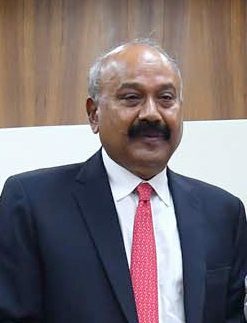
| Key facts | |
|---|---|
| Born | 14 July 1950, Rajam, Srikakulam district, Andhra Pradesh [24][1] |
| Family roots | Small-town trading family; father G. China Sanyasi Raju traded commodities and gold [1][16][17] |
| Education | Mechanical engineering, Andhra University College of Engineering, Visakhapatnam; first graduate in his family [16][17] |
| Family | Wife G. Varalakshmi; sons G.B.S. Raju and Kiran Kumar Grandhi; daughter Ramadevi, married to Srinivas Bommidala [1] |
| Company | GMR Group, Bengaluru/New Delhi: founder and Group Chairman [7][8] |
| Wealth | About US$3.7 billion (Forbes real-time, 11 November 2026); No. 86 on Forbes India’s Richest 2026 at US$3.57 billion [64]; Rs 37,136 crore for “G M Rao and family” (360 ONE Wealth Creators List 2026) [65] |
| Known for | Building Delhi’s and Hyderabad’s modern airports and turning a village jute mill into one of Asia’s largest private airport operators |
In January 2006 a committee of Union ministers met to decide who would rebuild Delhi’s crumbling airport. On paper, the GMR-Fraport consortium was an outsider. Its leader had grown up in a small town near the Andhra-Odisha border, failed his school-leaving exam, and spent his twenties running a jute mill. The rival bid came from Anil Ambani’s Reliance group, and the commercial offers were level: both promised to hand the Airports Authority of India 45.99% of the airport’s revenue for decades [27].
GMR won Delhi; GVK took Mumbai [27]. Reliance went to court, and lost in the Supreme Court that November [28]. Within four years GMR had built Delhi’s Terminal 3 in 37 months, at a cost that rose to Rs 12,857 crore [20]. In the year to March 2026 the airports GMR runs handled a record 121.6 million passengers [52].
The man behind it is Grandhi Mallikarjuna Rao, known everywhere by his initials. GMR is also the name of his group. His own summary of his life is a list of five jobs: “student leader, trader, manufacturer, banker and infrastructure developer” [19]. This is the story of each of them, and of the years the business nearly sank under its debts.
Where it began
G. M. Rao was born on 14 July 1950 in Rajam, in Srikakulam district of north coastal Andhra Pradesh [24]. His age in GMR’s 2006 IPO prospectus, 56, fits that year [1]. He has described Rajam as “a small village … 100km from Vishakapatnam” [16]. Forbes called it a town known for its jute mills and a Navadurga temple [20].
The 2006 prospectus lists him as the son of G. China Sanyasi Raju [1]. “My father was a very small time trader in the village,” Rao said at a convocation at UPES, “and even for education I had to fight with my father” [23]. Accounts of the family trade differ. Rao told Moneylife the family bought jute and grain from farmers and sold it to mills [16]. Business Standard described “a family of gold merchants” [17]. He was the third of four brothers and also had three sisters [16].
He was not a model student. “I had failed in my SSLC … exam,” he recalled [16]. Business Standard’s Sanjaya Baru, who interviewed him over breakfast in 2010, reported that after Rao failed Class 10 his father told him to give up studying and join the family’s gold business. Two years later his mother persuaded his father to send him back [17]. Rao remembered that period without much pride: “We had a gang of students who would get on to our bicycles and go away to watch movies” [17].
The second attempt went better. He says he “stood first in the school,” then topped his pre-university college at Bobbili [16]. He studied mechanical engineering at Andhra University’s engineering college in Visakhapatnam, where he was also a student leader [16][19]. “I was the first graduate in the family, passing out in 1972,” he said [16]. Some magazine profiles give 1974; we use his own date [18][16].
The salary he did not keep
Within a month of his graduation, Rao told Moneylife, his father divided the family’s assets. Each son received Rs 3 lakh and a house [16]. Forbes India later reported that the share was Rs 3 lakh in cash, five acres of land and a truck [21]. Speaking to graduates years later, he described his start as “just three lacs rupees, in a remote village of Andhra Pradesh” [23].
He first took salaried work. He was a shift engineer at Andhra Pradesh Paper Mills in Rajahmundry. He then spent a few months as a junior engineer in the state Public Works Department [16][21]. Accounts of the order and rank of these jobs vary [17][18].
What pulled him out of government service was his mother. “My father wanted me to look for a job, but my mother wanted us to do business,” he said. “My mother kept insisting that I must do business … I finally left the job and joined the trading business with my brothers” [16]. Business Today reported that he had concluded nobody gets rich on a salary [18].
The brothers traded sesame seeds and black gram and sold them in Chennai, Nagpur and other markets. Rao said he cycled 25 to 30 km a day to collect payments and chase bad debts [16].
The first break
A secondhand jute mill
The first factory was a jute mill. According to Rao, the brothers bought the licence and machinery of a closed mill in Chennai and moved the plant to their part of Andhra. Permissions took six to eight months, and production began in 1978 as a small-scale unit costing about Rs 40 lakh [16]. The 2006 prospectus says the group started “a small jute unit in 1977” [1]. Business Today named the first mill Vasavi Mills and a second, set up in 1978, Varalakshmi Mills [18]. GMR’s own website dates the start to 1978 [7].
The mill taught him something besides manufacturing. “There was a strike but I refused to compromise and eventually resolved the problem,” he said. “It taught me how to deal with politicians” [16].
Twenty-eight businesses
Rao became, in GMR’s words, a “serial entrepreneur” who ran 28 businesses before settling on infrastructure [7]. They included:
- an oil mill, a steel-rolling mill and a bus business. The buses were lost when transport was nationalised: “we lost three buses,” he said [16]
- cotton buds [17][22]
- a soft-drinks company, incorporated in 1982 [1]
- a ferro-alloys plant at Tekali, in the same district. The prospectus dates this expansion to 1983 [1][16]
- sugar and a brewery, which came later [1]
The brewery shows how much depended on politics. Rao told Moneylife that “just before I could start the brewery, the NT Rama Rao government came to power and introduced prohibition” [16]. Business Today reported that GMR had raised about Rs 50 crore for a brewery around 1994, and that once Andhra Pradesh banned alcohol the money went into power instead [26]. The brewery was later sold to Vijay Mallya’s United Breweries [1][17]. The sugar business went to EID Parry [17].
The banker from Rajam
The step that changed his standing was a bank. In 1985, says the prospectus, Rao “bought a small stake in the Vysya Bank” [1]. This was a Bengaluru-based private bank with roots in the Arya Vysya trading community. Rao said he subscribed heavily to its rights issues in the late 1980s: “my shareholding went up to 12% and I became a major shareholder.” By 1994 he held 18% to 20% [16]. “There was no game plan at any point to take over the bank,” he told Business Today [18].
In 1994 the bank’s chairman, Ramesh Gelli, left to found Global Trust Bank. Forbes reported that about 180 staff went with him [20]. Rao took charge of Vysya and became its chairman [17][18]. Asked whether Gelli’s exit was a betrayal, he said: “There is no question of betrayal … Everybody does what is in their own interest” [18].
The bank also moved him to Bengaluru. “With great difficulty, I convinced my wife and we shifted to Bangalore,” he recalled [16].
Running a lender taught him about family businesses, from the outside. “Almost every one of our NPAs owed its failure to family problems,” he told Baru [17]. Years later he made his own family sign a constitution.
The bank also paid for his next move. In June 2002 Business Standard reported that ING, through Bank Brussels Lambert, would buy 23.99% of Vysya Bank from the GMR group at Rs 626.92 a share, about Rs 340.8 crore [25]. The bank became ING Vysya. Later magazine profiles put the group’s total proceeds from Vysya at about Rs 560 crore [21][22]. We could not reconcile the two figures from public documents.
Building the empire
Power: the first bet on infrastructure (1995-2006)
In 1991 India opened power generation to private companies, and Rao moved in early. GMR Vasavi Power Corporation was incorporated in January 1995. The company now listed as GMR Airports began in May 1996 as Varalakshmi Vasavi Power Projects. The power purchase agreement for a plant at Basin Bridge in Chennai was signed in September 1996 [1]. GMR’s company brochure lists that 200 MW plant, which burned low-sulphur heavy stock, as commissioned in November 1999 [11].
In November 2001 a 220 MW barge-mounted power plant began work at Tanir Bavi near Mangalore [11]. Forbes later reported that lenders would not release finance until GMR had won a court battle for an escrow guarantee on its payments [20]. The barge was later towed to Kakinada and converted to natural gas [11]. A 388 MW gas plant at Vemagiri followed in 2006 [11].
Over the same years Rao began selling the businesses that had got him there: banking, insurance, software, breweries, jute and sugar. The group wanted to concentrate on infrastructure [7].
Highways
In 2001 GMR won two of the first annuity-based highway projects under the Golden Quadrilateral programme: Tambaram-Tindivanam in Tamil Nadu and Tuni-Anakapalli in Andhra Pradesh [6]. By May 2015 the group had nine road assets totalling about 3,170 lane-km [12]. Roads also showed the limits of aggressive bidding. Forbes reported that GMR had bid for 24 road projects in a year and won only one [20].
Hyderabad: the first airport
The defining bet came in 2003, when GMR won the right to build a new greenfield airport for Hyderabad at Shamshabad [6]. GMR calls it India’s first greenfield airport built under a public-private partnership [6]. The airport cost about Rs 2,470 crore. It was inaugurated on 14 March 2008 and began commercial operations nine days later with a Lufthansa flight from Frankfurt. GMR then held 63%, Malaysia Airports 11%, and the Airports Authority of India and the Andhra Pradesh government 13% each [31].
Rao admitted he knew little about airports at the start, and said that is how he approaches every new field. “I then discovered that an airport is about people, not buildings,” he told Business Standard [17]. Baru reported that GMR tested new terminals with about 3,000 paid “dummy passengers” before opening [17].
Delhi, 2006
Delhi was the prize. In January 2006 an empowered group of ministers awarded Delhi’s airport to the GMR-Fraport consortium and Mumbai’s to GVK [27]. GMR-Fraport had matched the top revenue-share offer of 45.99% [27]. The new company, Delhi International Airport Ltd (DIAL), was originally owned 54% by GMR, 26% by the Airports Authority of India, 10% by Fraport and 10% by Malaysia Airports [82].
The award had to survive a strike and a lawsuit. Airports Authority unions stopped work in February 2006 to protest privatisation, and the Air Force put controllers on standby [79]. Reliance Airport Developers argued that the tender rules had been bent, and lost: on 8 November 2006 the Supreme Court dismissed its appeal. It did criticise the evaluation committee for changing its scoring norms midway [28].
GMR’s Terminal 3 in Delhi, with capacity for 34 million passengers a year, was built in 37 months [20]. Over the next two decades GMR bought out its partners in DIAL. It took Malaysia Airports’ 10% for US$79 million in 2015 [82], and in September 2024 agreed to buy Fraport’s 10% for US$126 million, which took its stake to 74% [81].
Going public, and going global
GMR Infrastructure’s IPO opened on 31 July 2006. It was priced at Rs 210, the bottom of its band, and raised about Rs 795 crore [30][29]. Business Standard reported the issue was subscribed 6.5 times [29]. The shares listed on 21 August 2006 [30].
Then GMR expanded abroad:
- Istanbul (2008). A 40% stake in Sabiha Gokcen airport, with Turkey’s Limak and Malaysia Airports [32].
- Male, Maldives (2010). A 25-year concession to modernise and run Ibrahim Nasir International Airport [33].
- Indonesia. Coal mines, including 30% of PT Golden Energy Mines in 2011, to feed its power plants [11].
- InterGen. Half of the international power company, bought for about US$1 billion and later sold to China Huaneng for about US$1.2 billion, according to Forbes [20].
- Cebu, Philippines (2014). With partner Megawide, the Mactan-Cebu airport [49].
Back home, GMR built coal plants at Kamalanga in Odisha (1,050 MW) and Warora in Maharashtra (600 MW), a 1,370 MW supercritical plant at Raikheda in Chhattisgarh, and a 768 MW gas plant at Rajahmundry [11][14].
By 2010 Rao was among India’s richest people. Forbes put him at US$3.2 billion in March 2010 [64]. The next decade would be much harder.
Sport
In January 2008 GMR paid US$84 million at the first IPL auction for the Delhi franchise, the Delhi Daredevils [56]. In March 2018 it sold half to JSW Sports, owned by Sajjan Jindal’s family, for Rs 550 crore, and the team was renamed Delhi Capitals [57]. GMR also owns the Dubai Capitals in the UAE’s ILT20 league [58]. In September 2024 it agreed to take over England’s Hampshire County Cricket Club, in a deal reported at close to GBP 120 million [58].
Selling to survive, then a second wind (2013-2026)
The debt years, covered in the next section, forced a long series of sales:
- 2013. The Istanbul stake went to Malaysia Airports for EUR 225 million [32].
- 2016. Malaysia’s Tenaga bought 30% of GMR Energy for US$300 million [44].
- 2019. Tata group, Singapore’s GIC and SSG Capital agreed to invest Rs 8,000 crore in GMR Airports [45]. The Chhattisgarh plant went to Gautam Adani’s Adani Power at an enterprise value of about Rs 3,530 crore [14][71].
- 2020. France’s Groupe ADP, which runs the Paris airports, agreed to buy 49% of GMR Airports in a deal headlined at Rs 10,780 crore. Covid forced a renegotiation, and the payment was restructured into firm amounts plus earn-outs [46][47]. GMR also agreed to sell its 51% of Kakinada SEZ and its port to Aurobindo Realty for Rs 2,610 crore [48].
- 2022. The Cebu stake was sold to the Aboitiz group, with Rs 1,330 crore paid upfront [49].
The structure changed as well. In 2020 GMR announced that its energy, highways and urban businesses would be separated from the airports [77]; they were demerged into a new listed company, GMR Power and Urban Infra. In September 2022 the listed parent became GMR Airports Infrastructure [78]. After the unlisted airport holding company was merged into it in 2024, it took the name GMR Airports Ltd, effective on the exchanges from 11 December 2024 [3][4].
The airports kept growing while the group shrank elsewhere:
- Goa. The new airport at Mopa, Manohar International Airport, cost about Rs 2,870 crore and opened to flights on 5 January 2023 [5].
- Crete, Greece. GMR holds 21.64% of the new Heraklion airport at Kastelli, being built with the Greek state and construction group Terna and due to open in 2027 [6][83].
- Medan, Indonesia. A 49% stake in Kualanamu airport alongside Angkasa Pura II, from December 2021 [84].
- Bhogapuram (Visakhapatnam). The new airport, named after Alluri Sitarama Raju, was inaugurated by Prime Minister Narendra Modi on 1 August 2026 [54].
- Nagpur. Rights won after a long legal fight, with the concession signed in October 2024 [55].
In FY26 GMR Airports reported total income of about Rs 15,201 crore and, according to trade reports, an annual net profit for the first time in more than a decade [52]. In the July-September 2026 quarter its airports handled 28 million passengers: 18.1 million at Delhi and 6.5 million at Hyderabad [53].
How the wealth is held
Rao’s fortune sits mostly in GMR Airports Ltd, held through the family holding company GMR Enterprises and related entities. Individual family members own very little directly [13]. Groupe ADP is a co-promoter. In April 2026 a Rao family vehicle agreed to buy part of ADP’s holding and subscribe to convertible bonds, in a deal reported at up to EUR 924 million [50][51]. Forbes reported that once it is complete, the GMR Group’s stake will rise to 43.3% and ADP’s will fall to 22.7% [50]. Bloomberg put GMR Airports’ market value at about US$10.7 billion at the time [51].
The setbacks and failures
The power plants that ran out of fuel
GMR came close to collapse because of its power plants, not its airports. In 2011 Forbes India ran a cover story on Rao titled “Build, Operate, and be Damned” [20]. Gas from Reliance’s KG-D6 field, which was supposed to run GMR’s new plants in Andhra Pradesh, fell sharply. Coal was scarce and expensive, and state electricity boards paid late.
The 768 MW Rajahmundry gas plant was completed with almost no gas to burn. In 2016 lenders converted Rs 1,414 crore of its debt into a 55% stake [70].
The Chhattisgarh plant cut Rs 516 crore from GMR Infrastructure’s FY19 profit before lenders and GMR sold it to Adani [71].
In 2020 JSW Energy pulled out of a Rs 5,321 crore deal to buy the Kamalanga plant, citing Covid [72].
The debt mountain
In November 2012 GMR Infrastructure took a Rs 1,450 crore hit on dues from Air India and Tamil Nadu [73]. By December 2012 its net debt was about Rs 37,682 crore, 3.5 times its net worth, and its shares were 76% below their 2009 peak [42]. Reuters put the group’s net debt at about Rs 41,000 crore (US$6.15 billion) in December 2015 [43].
Rao’s personal fortune fell with the shares. Forbes valued him at US$3.2 billion in 2010 and US$1.1 billion in 2013 [64].
GMR’s management described its response as “asset-light and asset-right”, and its CFO said the group would not “sell in desperation” [42]. It sold anyway, and kept selling for nearly ten years. The airports survived. Much of the rest did not.
Losing Male
The single worst week came in November 2012, when the Maldives government cancelled GMR’s Male airport contract and gave it seven days to leave. Male had been GMR’s most profitable airport [34]. That story, which ended in GMR’s favour four years later, is told in the next section.
Controversies and allegations
We found no criminal conviction, regulatory finding of fraud or court judgment of personal wrongdoing against G. M. Rao himself. The matters below concern GMR companies or the promoter group. They are documented by courts, regulators, government auditors or at least two major publications.
The Delhi airport award (2006)
Allegation: Reliance Airport Developers, part of Anil Ambani’s group, alleged that the tender rules for Delhi and Mumbai were changed to favour GMR and GVK. It said GMR was allowed to choose Delhi after the financial bids were opened, and that the technical qualifying bar was lowered [28].
Response: GMR and the government defended the process. The Delhi High Court dismissed Reliance’s challenge in April 2006 [28].
Status: On 8 November 2006 the Supreme Court dismissed Reliance’s appeal as “sans merit”. It did criticise the evaluation committee for changing its scoring norms [28]. The matter is closed.
The CAG report on Delhi airport (2012)
Allegation: In a report tabled on 17 August 2012, the Comptroller and Auditor General (CAG) said DIAL had leased airport land for Rs 100 a year and could earn Rs 1,63,557 crore from it over 60 years. It also said that allowing a “development fee” on passengers after the bid had “vitiated” the bidding process and given DIAL an undue benefit of Rs 3,415.35 crore. It asked the government to fix responsibility [37].
Response: DIAL said a private-public partnership was outside the CAG’s remit, that the land terms had been open to every bidder, and that the Supreme Court had upheld the award. It called the Rs 1.63 lakh crore figure “theoretical and grossly misleading” because it counted gross revenue over 60 years without discounting and ignored the 45.99% revenue share paid to the Airports Authority [38]. A Business Standard editorial called the headline figure an “accounting fiction”, but said the post-bid development fee was a real departure from the bid terms [39].
What happened next:
- In April 2011 the Supreme Court had already set aside the airport development fees charged by the private operators, on a petition by a consumer group [76].
- In May 2015 Business Standard, citing unnamed sources, reported that the CBI had opened a preliminary enquiry into an additional land allotment to DIAL. DIAL said it had received no communication and called the allegations “baseless” [40].
- In May 2019 the CBI sought the airport’s concession papers and the CAG report for what IANS described as a Supreme Court-monitored investigation [41].
Status: As of 12 November 2026 we found no public report of a charge sheet, prosecution or closure report arising from these enquiries. No court has found wrongdoing by GMR or DIAL over the CAG’s findings.
The Male airport cancellation, Maldives (2012-2016)
Allegation: After President Mohamed Nasheed was replaced in February 2012, the new Maldives government declared GMR’s 2010 concession void in late November 2012. The President’s Office said the contract “was not acceptable to the public” and claimed the bid committee had qualified GMR “under pressure from Nasheed”. A US$25 airport development charge had also drawn criticism [34].
Response: GMR denied any impropriety. Its airport finance chief said the bidding was open and supervised by the World Bank’s International Finance Corporation [34]. GMR went to court in Singapore, but on about 6 December 2012 a Singapore court lifted an earlier stay and allowed the takeover [35].
What happened next:
- In June 2014 an arbitration tribunal held that the Maldives government and its airport company had wrongfully repudiated the contract [33].
- On 27 October 2016 the tribunal awarded GMR about US$270 million (about Rs 1,780 crore) [33].
- The Maldives paid about US$271 million in November 2016 [36].
Status: Settled in GMR’s favour. The original allegations of impropriety were never proved.
Hyderabad airport security fund (2013)
Allegation: A CAG audit tabled around August 2013 found that GMR Hyderabad International Airport had spent Rs 100.40 crore from the passenger security-fee escrow on items it called “inadmissible”, including CISF staff quarters, land and interest. It reported that the civil aviation ministry had told the airport to reverse the spending in July 2012 [80].
Response: We found no public statement from GMR on the specific findings.
Status: As of 12 November 2026 we found no report of a penalty or court order on this audit observation. It is an audit finding, not a finding of fraud.
SEBI takeover-code penalties on the promoter company
Allegation: In February 2013 SEBI fined the promoter company GMR Holdings Rs 1.5 lakh for failing to disclose a stake above 5% in a group company acquired in 2000 [68]. In a separate order on 23 December 2015, a SEBI adjudicating officer found that GMR Holdings and Srinivas Bommidala, Rao’s son-in-law, had bought shares of Parrys Sugar Industries in 2009 without making the mandatory open offer under the takeover rules [2].
Response: In the 2015 case the two argued that the “creeping acquisition” proviso of the takeover rules allowed the purchases. The adjudicating officer rejected that reading [2].
Status: SEBI imposed a penalty of Rs 25 lakh, payable jointly by GMR Holdings and Bommidala [2]. We found no public report of a successful appeal. Both matters concern disclosure and takeover procedure. Neither involves allegations of fraud.
The airport fee and tariff fights (2020-2026)
These are commercial disputes with the government, not allegations of wrongdoing, but they matter to readers because they decide how much passengers pay.
Allegation: The Airports Authority of India (AAI) argued that DIAL owed its monthly revenue-share fee through the Covid lockdowns. It also contested DIAL’s narrower reading of the revenue on which that fee is calculated [15][69].
Response: DIAL invoked force majeure and went to arbitration. On 6 January 2024 a tribunal excused DIAL from the fee for most of the Covid period, ordered a refund with interest and extended the concession [15]. A 2022 award also backed DIAL’s narrower definition of revenue in a claim of about Rs 10,537 crore [69].
What happened next:
- On 7 March 2025 the Delhi High Court upheld the Covid award [15].
- The revenue-definition award was upheld by a single judge in October 2024. AAI appealed, and the operators agreed not to enforce the award while the appeal was pending [69].
- On a separate track, the Supreme Court ruled in October 2024 that the airport regulator AERA could appeal tariff rulings and regulate ground- and cargo-handling charges. Business Standard called this a “setback” for GMR and Adani [66]. In 2025 a further tariff ruling was challenged by airlines in the Supreme Court [67].
Status: As of 12 November 2026 we could not confirm final outcomes of AAI’s appeal or of the tariff litigation in the Supreme Court. Both should be treated as pending.
Kakinada SEZ land
Allegation: Farmers and opposition parties in Andhra Pradesh protested for years against land acquisition for the Kakinada special economic zone, in which GMR held 51% [48].
Response: SEZ management said it held the land legally and that most farmers had accepted enhanced compensation [86].
Status: GMR sold its entire stake to Aurobindo Realty in 2020 [48], so it no longer controls the SEZ.
Giving back
In March 2011, as Warren Buffett was visiting Bengaluru, Rao pledged his entire personal stake in the group, 12.5% of the family holding, to the GMR Varalakshmi Foundation. It was valued at about US$340 million, or Rs 1,540 crore [59]. “Since my initial years in business, I have believed that we have a responsibility to give back to the society,” he said [59]. The shares stay in the foundation’s corpus and only the dividends are spent. If the shares ever have to be sold, the other family members have the first right to buy them [60].
He dislikes the word philanthropy, which he told Knowledge at Wharton “gives a sense of being on a pedestal”. “I get inner peace in giving in a world where far too many people need a break in life” [60]. He also objected to India’s mandatory corporate social responsibility spending: “Only taxation can be mandated; not charity” [60].
The foundation’s community work started in Rajam in 1991 [9]. In 1997 it set up the GMR Institute of Technology there, an engineering college that now holds NAAC “A” accreditation [10]. The foundation also runs schools, a hospital and skills centres in Rajam [24]. Ratan Tata was chief guest at its silver jubilee, where Rao said: “Providing skill and imparting education are the best tools for eradicating poverty” [24]. The foundation says it reached more than 4 million people in FY26 [9].
Rao has received an honorary doctorate from Amity University, conferred in 2019 alongside Ratan Tata, whom he called his “role model” [75]. We found no record that he has received a Padma award.
Succession
Rao’s answer to the problem he saw at Vysya Bank was a written family constitution. It was signed on 3 March 2007 at Sariska Palace in Rajasthan, and its stated aim is for the group “to be an institution in perpetuity” [61]. “To succeed, a business family must practice the family constitution, and not let it remain on the bookshelf,” he said. His formula: “manage the family like a business, and the business like family” [61].
The constitution covers who can join the business, with what qualifications and pay. Business Standard reported that it specified even “the car they would drive” [61]. A family council of Rao, his sons and his son-in-law meets regularly, and business roles have been rotated among the three younger men in 2007, 2011 and 2013 [62][63]. In 2011 Business Standard reported that the constitution allowed Rao to remain chairman until 70 [59]. He turned 70 in 2020 and remains Group Chairman [8]. We found no public explanation for the change.
As of November 2026, GMR’s group leadership page lists [8]:
- G. M. Rao, Group Chairman
- G.B.S. Raju (elder son), Business Chairman, Airports
- Srinivas Bommidala (son-in-law), Business Chairman, Energy and International Airports
- Kiran Kumar Grandhi (younger son), Corporate Chairman. He is also MD and CEO of GMR Airports, reappointed in 2024 [85]
- B.V.N. Rao, a non-family executive, Business Chairman for transport and urban infrastructure
Rao, now 76, was still setting direction in 2026. In August he spoke of bidding for airports in West Asia, Central Asia, Eastern Europe and South-East Asia [74].
What his journey teaches
Failing an exam is not a verdict on a life. Rao failed his school-leaving exam and spent two years drifting before his mother got him back into a classroom. He went on to top his college and become his family’s first graduate [16][17].
Your first business only has to teach you the next one. The jute mill taught him labour and politics. The bank taught him finance and why family firms fail. Power taught him how to get projects financed. Each of the 28 ventures paid for the one after it [7][16][17].
Specialists can be hired; nerve cannot. He knew nothing about airports when he bid for Hyderabad and Delhi. He brought in partners such as Fraport and Malaysia Airports and later bought them out [27][82][81].
Debt can turn a good asset into a forced sale. Plants that were well built still nearly sank the group because their fuel and payments did not arrive. Rao spent most of a decade selling stakes in assets he had chosen carefully [42][43][71].
Write the family rules down while everyone is still talking. GMR’s constitution was signed in 2007, long before any succession fight, and three heirs now run separate businesses [61][8].
In regulated businesses, the contract is only the start. From the Supreme Court in 2006 to the Maldives arbitration and the Delhi fee disputes, much of GMR’s value has depended on lawyers and regulators [28][33][15].
For more on how infrastructure and markets shape Indian businesses, see CapitalVia’s Insights.
A profile for general reading, based on public records and reporting as of 12 November 2026. Not investment, tax or legal advice.
Sources (86)
- GMR Infrastructure Ltd, IPO Prospectus - SEBI, Aug 2006
- Adjudication order against GMR Holdings Pvt Ltd and Srinivas Bommidala in the matter of Parrys Sugar Industries - SEBI, Dec 2015
- Name and symbol change of GMR Airports Infrastructure Limited, Circular 16426 - Metropolitan Stock Exchange of India, Dec 2024
- GMR Airports press release on merger and results - NSE filing, Oct 2024
- Manohar International Airport, Mopa, begins operations - Press Information Bureau, Jan 2023
- Our Legacy - GMR Group, Nov 2026
- G M Rao, Founder Chairman - GMR Group, Nov 2026
- Group Holdings leadership - GMR Group, Nov 2026
- GMR Varalakshmi Foundation - GMR Group, Nov 2026
- About GMRIT - GMR Institute of Technology, Nov 2026
- GMR Energy corporate brochure - GMR Group, Jan 2016
- GMR Group Profile - GMR Group, May 2015
- Shareholding pattern, quarter ended 31 March 2025 - GMR Airports Ltd, Apr 2025
- Adani Power completes acquisition of GMR Chhattisgarh Energy Ltd - Adani Group, Aug 2019
- Delhi High Court upholds arbitral award exempting Delhi Airport from fee payments during COVID - Bar & Bench, Mar 2025
- Interview with GM Rao of the GMR Group (undated; accessed) - Moneylife, Nov 2026
- Breakfast with BS: G M Rao - Business Standard, Jul 2010
- The Reclusive GMR - Business Today, Apr 2004
- India's new business families: GM Rao - Business Today, Apr 2011
- G.M. Rao: Build, Operate, and be Damned - Forbes India, Jun 2011
- For GM Rao, family legacy matters - Forbes India, Nov 2015
- GM Rao: The return of the infra king - Forbes India, Dec 2024
- Convocation speech by G M Rao at UPES's 12th convocation (page updated) - MBA Universe, Jul 2024
- In Srikakulam's Rajam, it's GMR everywhere - The Hans India, Dec 2018
- ING to buy 24% Vysya stake for Rs 340.8 crore - Business Standard, Jun 2002
- Who Are GMR And GVK? - Business Today, Apr 2006
- GMR wins Delhi, GVK gets Mumbai - Business Standard, Jan 2006
- SC upholds award of airport projects - Business Standard, Nov 2006
- GMR IPO subscribed 6.5 times - Business Standard, Aug 2006
- GMR Infrastructure IPO details - Chittorgarh.com, Aug 2006
- Shamshabad airport commences operations - domain-b, Mar 2008
- GMR Infra to exit Istanbul airport - Business Standard, Dec 2013
- GMR wins $270 million arbitration award in Maldives airport dispute - Business Standard, Oct 2016
- Male setback could make things worse for GMR's airport business - Business Today, Jan 2013
- Singapore SC allows Male takeover - Deccan Herald, Dec 2012
- Maldives govt pays up GMR - Observer Research Foundation, Nov 2016
- CAG slams development fee, concessional land to Delhi airport - Business Standard (PTI), Aug 2012
- DIAL questions CAG audit, says land sops available to all - Business Standard (PTI), Jun 2012
- Not such a massive rip-off (editorial) - Business Standard, Aug 2012
- Delhi airport land deal under CBI scanner - Business Standard, May 2015
- CBI calls for DIAL papers in alleged airport scam - Business Standard (IANS), May 2019
- Sell assets: GMR Infra's mantra to fight debt - Business Standard, Jun 2013
- GMR Group plans to raise $1 billion as it eyes turnaround - Business Standard (Reuters), Dec 2015
- GMR Energy seals 30% stake sale to Tenaga for $300 million - BloombergQuint, Nov 2016
- GMR ropes in Tata Group, GIC, SSG Capital as investors in its airports business - Business Insider India, Mar 2019
- France's Groupe ADP to buy 49% in GMR airport business for Rs 10,780 cr - Business Standard, Feb 2020
- GMR completes stake sale in airport biz to Groupe ADP, gets Rs 4,565 cr - Business Standard, Jul 2020
- GMR to sell 51% stake in Kakinada SEZ to Aurobindo Realty at Rs 2,610 crore - Business Standard, Sep 2020
- GMR Group to divest entire 40% stake in Philippines' Cebu airport - Business Standard, Sep 2022
- Billionaire G.M. Rao to buy part of Groupe ADP's stake in India's GMR Airports - Forbes, Apr 2026
- Paris airport operator ADP to sell up to 7.3% stake in GMR Airports - ThePrint (Bloomberg), Apr 2026
- GMR Airports posts record Rs 152 bn revenue, returns to profit in FY26 - ITLN, Jun 2026
- GMR Airports Q2 FY27 results: total income rises 12% to Rs 4,188 crore - Choice India, Oct 2026
- Alluri Sitarama Raju International Airport begins commercial operations - ITLN, Aug 2026
- Cabinet clears PPP-led upgrade of Nagpur airport - ITLN, May 2026
- IPL franchise auction results - ESPNcricinfo, Jan 2008
- JSW Sports buys 50% stake in Delhi Daredevils - ESPNcricinfo, Mar 2018
- Hampshire sell majority stake to GMR Group, owners of Delhi Capitals - ESPNcricinfo, Sep 2024
- GMR's Rao starts with a Rs 1,500-crore pledge - Business Standard, Mar 2011
- GMR Group's G.M. Rao: 'Only Taxation Can Be Mandated; Not Charity' - Knowledge at Wharton, May 2011
- Family business: GMR Group - Business Today, Aug 2011
- GMR rejig makes youngest son corporate chairman - Business Standard, Jul 2013
- GMR firms up process for succession - Business Standard, Dec 2011
- G. M. Rao profile and real-time net worth - Forbes, Nov 2026
- G M Rao and family, Wealth Creators List 2026 (accessed) - 360 ONE, Nov 2026
- Supreme Court upholds AERA's powers in setback to GMR, Adani groups - Business Standard, Oct 2024
- Delhi, Mumbai airport fee hikes: TDSAT/HRAB/UDF tariff dispute explained - Business Standard, Dec 2025
- Sebi slaps fine on GMR Holdings - Business Standard, Feb 2013
- HC notice to Delhi, Mumbai airports on AAI pleas against arbitral award - Business Today, Nov 2024
- GMR Infra announces SDR of GMR Rajahmundry Energy - Business Standard, May 2016
- GMR sells Chhattisgarh plant to Adani Power in order to pare debt - Business Standard, Jul 2019
- JSW Energy terminates Rs 5,321 crore acquisition of GMR Kamalanga power plant - Business Today, Jul 2020
- GMR Infra takes Rs 1,450-cr hit on Air India, TN dues - Business Standard, Nov 2012
- GMR Group sets sights on overseas airport expansion - The Hans India, Aug 2026
- Honorary doctorates for Ratan Tata, GM Rao - Business Standard (PTI), Nov 2019
- SC quashes levying of airport development fee on passengers - Business Today, Apr 2011
- GMR Infra zooms 10% on proposal to list airport business - Business Standard, Aug 2020
- GMR Infrastructure Limited is now GMR Airports Infrastructure Limited - ACI Asia-Pacific, Sep 2022
- IAF on standby as strike looms - Business Standard, Feb 2006
- CAG raps airport operator for using security fee funds - Deccan Herald, Aug 2013
- GMR Airports Infrastructure to acquire Fraport's 10% stake in DIAL - Indian Infrastructure, Sep 2024
- GMR to up stake in DIAL to 64% as Malaysia Airports exits - Business Standard, Mar 2015
- Kastelli International Airport, Crete - Airport Technology, Nov 2025
- GMR partners with Angkasa Pura II for Medan airport in Indonesia - Business Standard, Dec 2021
- GMR Airports reappoints Kiran Grandhi as MD and CEO - Board Stewardship, May 2024
- Kakinada SEZ: Angry Andhra farmers attempt to reclaim land, police foil protest - The News Minute, Oct 2018