
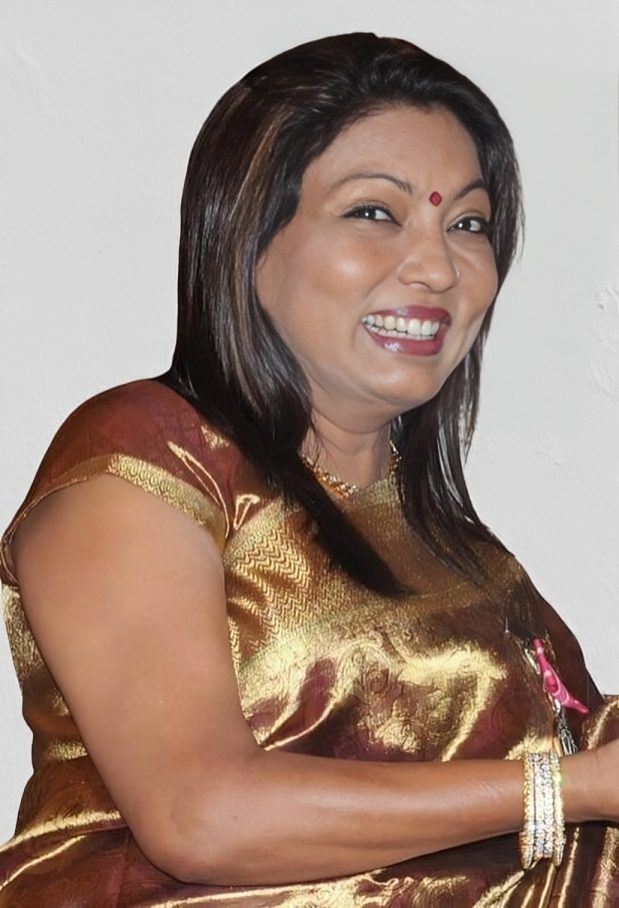
| Key facts | |
|---|---|
| Born | c. 1958-1961, Roperkheda village, Murtizapur taluka, Akola district, Maharashtra (sources differ on the year; no exact date is on public record) |
| Family roots | Dalit Buddhist family; grandfather a farm labourer, father a police constable |
| Education | Left school around Class 7-9 after being married at 12 |
| Family | Two children, Amar Saroj and Seema Saroj, both directors of Kamani Tubes |
| Company/Group | Kamani Tubes Ltd (CEO and Managing Director; chairperson since 2006); Kalpana Builders & Developers; Kalpana Saroj Global Aviation |
| Known for | Reviving the bankrupt, worker-owned Kamani Tubes; Padma Shri for Trade and Industry (2013); Nari Shakti Puraskar; board of IIM Bangalore |
One day in the late 1990s, a woman walked into a police station on the edge of Mumbai and asked the officers to summon the men who had been hired to kill her. When they arrived, she put a revolver on the table. “Before you kill me, I have six bullets in the revolver,” she told them. “After the sixth gets over, then someone can kill me.” [18]
The woman was Kalpana Saroj. A few years earlier she had bought a disputed plot of land that nobody else would touch, cleared its legal tangles one government office at a time, and watched its value multiply. Local goons wanted it. According to her account, a contract of about Rs 5 lakh was put out on her life; one of the hired men warned her, the police arrested the gang, and she got a gun licence within a day [18][23][19].
It is the kind of scene that would be dismissed as melodrama in a film. In her life it was one episode among many. Kalpana Saroj was married off at 12, lived in a slum in a room shared with more than a dozen people, came back to her village shamed for leaving her husband, reached a point where she did not want to live, and then went to Mumbai to cut threads in a garment unit for Rs 2 a day [18][20][31]. Three decades later she was chairperson of Kamani Tubes, an old Mumbai engineering company that had collapsed under Rs 116 crore of debts and 140 lawsuits, and which she turned around [18][19]. In 2013 the President of India gave her the Padma Shri [11].
This is the story of how she did it, what is documented and what rests on her own word, and the disputes that still follow the company she rescued.
Where it began
Kalpana Saroj was born in Roperkheda (also spelt Repatkhed or Roparkheda in different reports), a village in Murtizapur taluka of Akola district in the Vidarbha region of Maharashtra [19][18][27]. Her year of birth is not settled. Some profiles say 1958 [31][33]; most of the ages quoted to reporters between 2009 and 2016 point to about 1960-61 [23][21][30]. No exact birth date appears in any reliable record we could find.
Her family was Dalit and Buddhist, followers of B.R. Ambedkar - a fact she has spoken about all her life [19][27]. “My grandfather was a labourer, working in the fields,” she told Open magazine. “He somehow educated my father to the level that he could become a constable.” [18] Her father was a police constable, and the family lived in police quarters [18][20]. She was the eldest daughter in a family of several children [21][30].
Her father wanted her to study. School, though, was where she first met caste. She has described being kept apart by classmates’ parents and teachers because of her caste [20][30]. “In our samaj, girls weren’t allowed to go to school,” she told Outlook Business. “Since I was a Dalit Buddhist, there was even more resistance. My own family would say, ‘Usko chulha chakki hi chalani hai’” - she only has to run the kitchen [19].
Married at 12
Around 1969-70, when she had just entered Class 7, she was married to a man about ten years older who lived in a slum near Mumbai [18][20]. A relative persuaded her parents; in her words, he told them, “You are lucky, how will you ever get a boy from Mumbai? Mumbai then was thought like America is now. My father agreed.” [18]
The marriage was a disaster. She has said she was mistreated by her in-laws in the slum home, which Open places in Ulhasnagar [18][20][21]. After about six months her father came to visit, saw the state she was in, and took her home. “He was in police uniform and took me away,” she recalled [18].
Back in the village, the girl who had left her husband was treated as a disgrace. She went back to school for a while, studying up to about Class 8 or 9, but never finished [18]. The taunts did not stop. By her own account, as a teenager she tried to take her own life, and was found and saved by a relative [20][18][21]. She has called that moment the turning point of her life. “I decided to live my life, and do something big, and then die,” she told the BBC in 2012 [20]. To the Los Angeles Times she put it more bluntly: “I realized, whether I live or die, I’ll get blamed. So I might as well go for it.” [21]
The first break
Rs 2 a day in Lower Parel
At around 16 she went to Mumbai and stayed with an uncle in a slum in Dadar [20][18]. The reports differ on the year she arrived - 1972 in one, 1975 in another [31][19]. Through the uncle she found work in a hosiery and garment unit in Lower Parel, then the heart of Mumbai’s mill district.
She had learnt to stitch, but in front of an industrial sewing machine she froze. “He gave me a job as a helper, which meant that I would have to cut threads,” she said. “I would get Rs 2 per day. But I was relieved that I had a job at least.” [18] She watched, practised, and was soon moved up to work as a tailor. Her first full month’s pay at the machine was, by her telling, Rs 225 [18]. “It was the first happiness in 15 years,” she told the LA Times. “I’ve earned millions. But that initial $5 was the most satisfying.” [21]
Soon her family needed her. Her father lost his police job, and she rented a room in Kalyan for Rs 40 a month and brought her parents and siblings to live with her, taking extra tailoring orders - Rs 10 for a blouse, Rs 60-70 for a dress - to keep everyone fed [18][19][30]. Then a younger sister died because the family could not raise the money she needed - about Rs 2,000, according to Outlook Business [19][18]. “I learnt how much value money holds in this world,” Saroj said later [19].
A Rs 50,000 loan and a furniture shop
She heard on the radio about government schemes that helped people from Scheduled Castes start businesses. She applied under a scheme named after the social reformer Mahatma Jyotiba Phule, which put up margin money towards a bank loan. It took persistence - she has said she had to “run around for two to three years just to get a Rs 50,000 loan from a bank” - but she eventually got Rs 50,000 from Allahabad Bank [18]. (Accounts differ on the year, from 1975 to 1984, and on the amount, which some reports put at Rs 40,000 [31][19][23].)
She had planned a tailoring boutique. She ended up in furniture as well. Branded steel cupboards then cost Rs 8,000-9,000; local copies cost Rs 2,500-3,000 [18]. “I hired a couple of carpenters and we would make imitations of high-end furniture and sell at cheap prices,” she said [30]. The furniture business in Ulhasnagar grew, and she repaid the loan [19][31].
The loan taught her something else: that people like her did not know how to reach the money the government had set aside for them. She started a group called Sushikshit Berozgar Yuvak Sanghatana (roughly, “organisation of educated unemployed youth”) to help young people fill in forms and apply for scheme loans. Outlook Business reports it helped disburse about Rs 4 crore in loans [19][18]. The young people she helped began calling her Tai - elder sister. The Indian Express reports the group is now known as the Kalpana Saroj Foundation [27].
In her early twenties she married again, to a furniture businessman, and had two children, Amar and Seema [20][31][29]. She also took on her husband’s steel-cupboard business, which was struggling [29].
The plot nobody wanted
The deal that changed her life came in the mid-1990s. A man in Kalyan who urgently needed Rs 2.5 lakh offered her a 2.5-acre plot. She paid Rs 1 lakh at once and the rest later [18]. Then she found out why it had been so cheap: a deputy collector told her the land was caught under the Urban Land Ceiling Act and had other legal problems [18].
From 1995 to 1998, by her account, she walked the plot through the system - the talathi, the tehsildar, the collector - until the title was clean [18][19]. Its value rose, she says, to about Rs 50 lakh. With no money to build, she took on a builder partner, Anil Hotchandani, who took 65% of the profits [19][24]. The building, Kohinoor Plaza in Kalyan, was completed in 1999 under the name Kalpana Builders and Developers and, by her account, made her a profit of about Rs 4-4.5 crore [19]. Part of it went into a sugar mill venture, Sai Krupa [19].
This was also the land that brought the contract killers. These episodes rest largely on her own account, as told to Open magazine and Outlook Business [18][19]. She has spoken of carrying a licensed revolver, a detail that later earned her the nickname “Revolver Rani” in a business magazine headline [19].
Building the empire
The company she was asked to save
Kamani Tubes had once been a name to reckon with. It was incorporated on 20 June 1959 as part of the group built by Ramjibhai Kamani, an industrialist who also founded Kamani Engineering and Kamani Metals [14][18]. The company made non-ferrous tubes - copper and brass - at a factory in Kurla.
By the 1970s the business was coming apart. A 114-day strike began in August 1975, and the Kamani family was soon locked in disputes among its own members [18][28]. Production stopped in August 1985. About 600 workers had not been paid since December 1984 [1].
Then came one of the most unusual experiments in Indian industrial history. In 1988 the Board for Industrial and Financial Reconstruction (BIFR) approved a scheme proposed by the Kamani Employees Union: the family would hand its shares to the workers at Re 1 each, and the workers would run the company. The Supreme Court upheld the scheme in September 1988, calling it the first of its kind [1]. Each worker put in about Rs 12,000 for the equity, wages were frozen at 1985 levels, and workers lent part of their pay to the company interest-free [25].
The experiment did not save Kamani Tubes. By 1994 it was losing crores; by 1997 wages had stopped again, power to the Kurla plant had been cut, and bank debts stood at about Rs 14 crore [25]. Business Standard headlined its 1998 account “A revolution that went wrong.” [25] The workers’ union split [18].
“Like wading through a river of fire”
Around 2000, a group of Kamani workers came to see the woman in Kalyan who was known for helping people with loans and paperwork. Union leader Ramesh Bondkar told Open that she was a relative of one of the workers [18]. Reports differ on the year, from 1999 to 2002 [31][24].
What they showed her was grim. The company had debts of about Rs 116 crore - much of it interest and penalties - and was a party to some 140 court cases, with two rival unions [18][19][23]. Open reported that its assets would have fetched only Rs 3-4 crore if sold at the time [18]. Workers were driving autorickshaws and selling incense sticks to survive [24].
Advisers told her to stay away. “Everyone told me that it was suicide - but 500+ families were starving!” she later wrote [36]. “I wanted to give justice to the people who were working there,” she told the BBC. “I could relate to the staff who needed to put food on the table for their family.” [20]
She joined the company’s board and became its president around 2000 [18][27]. Then she did what she had done with the Kalyan plot: she went from office to office. She met the Union finance minister and the chairmen of the lending banks - Dena Bank, Canara Bank and Bank of India among them [19][32]. Her pitch was simple: the banks would get nothing if the company was liquidated, and something if it was revived.
The lenders agreed to waive interest and penalties and to cut the principal by about a quarter if the rest was repaid quickly [19][32][18]. She also settled with a member of the Kamani family and with the Mumbai Port Trust, which owned land the company leased [18]. “This journey was like wading through a river of fire,” she told Open. “The court gave me seven years to make payments to the lenders. I paid them off in one year.” [18]
On 21 March 2006, BIFR approved her revival scheme, and she became chairperson of Kamani Tubes [28][32]. Her son Amar joined the board in April 2006 [14][15]. According to DNA, workers’ dues were paid within months, along with an ex-gratia payment, although the scheme allowed more time [28]. Open reported that individual workers received between Rs 2.5 lakh and Rs 5 lakh [18].
Moving to Wada
The Kurla site was old and hemmed in by the city. She moved manufacturing to Wada in what is now Palghar district, outside Mumbai; Open dates the move to 2009 [18], and The Weekend Leader reports production restarted around 2010 after an investment of about Rs 5 crore [31]. She has described floods damaging the new plant during the move [32].
The company was discharged from the sick-company regime under SICA on 2 June 2011, according to an order of the Delhi High Court that records the date [6][18]. That was the formal end of 26 years of sickness.
Some of the money for the revival came from property. In 2010, a committee set up under BIFR auctioned a large Kamani Tubes land parcel in Mahadevapura, Bengaluru. Brigade Enterprises was the highest bidder at about Rs 25.2 crore, but the sale was cancelled after Brigade failed to meet the terms, a decision later upheld by the Delhi High Court [6]. Kamani Tubes signed a joint development agreement for the land with another developer in 2011 [8]. The land would later become the scene of one of her sharpest legal fights (see below).
Fame, a bank board and a Padma Shri
By 2011 the story had travelled. The Wall Street Journal, The National in Abu Dhabi, the BBC and the LA Times all profiled the “Dalit millionaire” from Akola [22][23][20][21]. Few women in Indian business had travelled so far from where they started; the best-known names of the time, such as Kiran Mazumdar-Shaw, came from educated, middle-class homes, and Anu Aga took over a company her husband had built. In 2013 the Government of India gave her the Padma Shri in the Trade and Industry category; President Pranab Mukherjee presented it at Rashtrapati Bhavan on 20 April 2013 [11][27].
The same year, when the government set up Bharatiya Mahila Bank, a public-sector bank for women, she was appointed to its first board - one of a few directors from outside banking [26][24]. For a woman who once spent years chasing a Rs 50,000 loan, it was a striking turn. (The bank was merged into State Bank of India in 2017.)
She later joined the Board of Governors of IIM Bangalore, where she is listed as “Chairperson, Kamani Tubes” [12]. In March 2019 President Ram Nath Kovind presented her with the Nari Shakti Puraskar, the national award for women’s achievement [13].
She also tried other things. In 2014 she produced a Marathi film about the 2006 Khairlanji massacre of a Dalit family in Bhandara district, Khairlanjichya Mathyawar, under KS Film Production [40]. A Hollywood studio approached her about a biopic of her own life; she told Business Standard in 2015 that she had turned it down for want of time [24].
How big is Kamani Tubes today?
This is where the numbers in popular articles need care. Kamani Tubes is not listed on any stock exchange. Its corporate identity number begins with “U”, which marks an unlisted company, and data services that compile its filings with the Registrar of Companies describe it as an unlisted public company [15][14]. That means there is no share price and no market value, and figures come only from annual filings.
According to those filings, as compiled by the data service QorpIQ, Kamani Tubes reported revenue of about Rs 193 crore and a net profit of about Rs 30 crore in 2023-24, and revenue of about Rs 290 crore with a net profit of about Rs 49 crore in 2024-25 [14]. We could not check these against the original filings, and the figures in media profiles vary widely - from “Rs 68 crore” to a “Rs 2,000 crore” group - usually without any source [27][31]. Treat any round number about her group with caution. (For how to read a company’s revenue and profit, see CapitalVia’s Insights.)
Company records show Kalpana Saroj as CEO and Managing Director of Kamani Tubes since November 2021, with her son Amar and daughter Seema on the board since 2006 and 2009 [14][15]. The registry lists her as a director of newer companies too: Kalpana Saroj Global Aviation (2021), Kagad Udyog (2024), Kamani Realties (2025), and a hotels partnership set up in 2025 [16]. She has spoken about plans for an aviation and pilot-training project near Nagpur [32].
Her net worth
There is no independent estimate of Kalpana Saroj’s wealth. She has never appeared on the Hurun, Forbes or Bloomberg rich lists. The figure repeated across the internet - “US$112 million” - comes from a January 2011 Wall Street Journal blog post, in which she said her assets totalled about Rs 500 crore (then roughly US$112 million) [22]. It was her own estimate, it is now more than 15 years old, and later articles that cite it, or convert it to “Rs 900 crore”, rarely say where it came from [37]. If you read a precise net-worth figure for her in 2026, it is not backed by a credible published valuation.
The setbacks and failures
Her life story is often told as a straight climb. It was not.
The first marriage ended in abuse and flight. The second business years were spent juggling a furniture shop, a struggling steel-cupboard unit and the needs of a large family that depended on her [29][31]. The family tragedy of losing a sister for want of a few thousand rupees stayed with her [19].
The Kalyan plot nearly sank her: three years of clearances, a builder taking almost two-thirds of the profits, and threats to her life [18][19]. The Kamani turnaround took six years from the day she became president to the day BIFR approved her plan, and another five before the company left the sick list [18][6]. The move to Wada was hit by flooding [32].
Not every plan worked. In 2015 she told Business Standard that a law college she wanted to start had not received Bar Council approval [24]. And the Kamani deal itself left a long legal tail, as the next section shows.
Controversies and allegations
Kalpana Saroj has not faced any action by SEBI, the RBI, the Enforcement Directorate or other regulators that we could find, and there is no insolvency case against Kamani Tubes on record. The matters below come mainly from court records. Some have received little press coverage; we include them because they are documented by courts.
The Kamani workers’ dues dispute
Allegation: Not everyone at Kamani accepts the rescue story. In 2017 Gautam Mody, general secretary of the Kamani Employees’ Union, told The Indian Express that the deal “was not such a fair deal for the workers as painted by Mrs Saroj.” He said the union held an Industrial Tribunal award “for payment of Rs. 22.5 crores to 97 workers”, and that she was “dragging her feet on implementing the award, trying to get it stayed by the HC.” [27] The union had also challenged the BIFR revival scheme in the Supreme Court [2].
Response: Saroj told the Indian Express: “I paid off all the workers more than what was due.” She said union leaders resented her [27]. Other union figures have praised her; Business Standard quoted one saying she had paid some workers from her own pocket [24].
What happened next:
- Kamani Tubes challenged the award in the Bombay High Court (Writ Petition 1709 of 2015). In November 2022 the High Court directed that money deposited by the company be kept in a fixed deposit, and referred the parties to mediation [4].
- On 6 November 2025 the Supreme Court disposed of the union’s appeal against the BIFR scheme, noting that the union had obtained “an award in favour of the workers’ Union”, which the company was contesting in the High Court. It left all contentions open and asked for the High Court case to be decided quickly [2].
- On 23 June 2026 the Bombay High Court allowed the union’s application, filed against “Kalpana Saroj, President, Kamani Tubes”, for an early hearing, and listed the petition for final hearing [3].
Status: Pending in the Bombay High Court as of 11 November 2026. No final judgment has been reported.
The Bengaluru land and the complaint against Brigade’s chairman
Allegation: In July 2015 Kalpana Saroj filed a police complaint in Bengaluru against M.R. Jaishankar, chairman of Brigade Enterprises, and others. She alleged that at a meeting in March 2015 she had been pressured and “blackmailed” into a joint venture over the Kamani land in Mahadevapura. Police registered a case under several sections of the Indian Penal Code, including cheating and criminal intimidation, and the SC/ST (Prevention of Atrocities) Act [5].
Response: Jaishankar and the other accused asked the Karnataka High Court to quash the case. They argued it was a commercial dispute dressed up as a crime [5].
What happened next:
- Brigade had separately fought the 2010 cancellation of its winning bid for the same land. The Delhi High Court dismissed its petition in November 2015, and the Supreme Court dismissed Brigade’s appeal as not pressed in January 2024 [6][7].
Status: Closed. On 26 September 2018 the Karnataka High Court quashed her complaint. It pointed to the four-month delay, her continued negotiations after the alleged incident, and her failure to appear, and held that the complaint was “malafide in nature” and “purely civil in nature and between the two corporate entities” [5]. On the land sale itself, the courts ruled in favour of the BIFR process and against Brigade [6][7].
The Khairlanji film
Allegation: In 2014 Bhaiyyalal Bhotmange, the surviving member of the family killed in the 2006 Khairlanji massacre, and the Akhil Bhartiya Dhamma Sena went to the Bombay High Court against Khairlanjichya Mathyawar, the film Saroj produced. He argued that it portrayed him and his murdered daughter in a defamatory and false way [9][40].
Response: Saroj, a respondent in the case, told the court she had not damaged anyone’s reputation, that the film had been certified on 31 December 2013, and that Bhotmange had signed a declaration saying he did not object to its release [9].
Status: On 21 February 2014 the Nagpur bench of the Bombay High Court cancelled the film’s censor certificate and told the Central Board of Film Certification to examine it again after hearing Bhotmange [9]. We could not find a later record of what happened to the film’s certification.
A flat buyer’s complaint
Allegation: A flat buyer at Kohinoor Plaza in Kalyan filed a consumer complaint against Kalpana Builders & Developers, in which Saroj was a partner, before the Maharashtra State Consumer Commission in 2003 [10].
Response: The firm appealed to the National Consumer Disputes Redressal Commission in January 2018 [10].
Status: Settled. The parties reached a compromise before the National Consumer Disputes Redressal Commission on 16 May 2018, and the flat was handed over [10].
Questions about the numbers
Allegation: No regulator or court has questioned her life story. But the numbers attached to it - wealth, turnover, debts, years - vary so much between articles that readers should be wary. Debts are reported as Rs 107 crore, Rs 110 crore, Rs 116 crore and Rs 160 crore; turnover from Rs 11 crore to Rs 500 crore; and her net worth figure is her own 2011 estimate [32][22][28][27][23].
Response: Most of these figures come from her own interviews and speeches, which she has given over more than 15 years, and from journalists converting them.
Status: Unresolved. Company filings are the best guide to Kamani Tubes’ current size; there is no audited figure for her personal wealth in the public domain.
As of 11 November 2026, none of these matters has resulted in any finding of wrongdoing against Kalpana Saroj personally. The one adverse judicial observation - the Karnataka High Court’s description of her complaint as mala fide - concerned a complaint she had filed, not a case against her.
Giving back
Her social work began before her business took off. The youth group she founded to help unemployed people get government loans is now the Kalpana Saroj Foundation, run from Kamani Chambers at Ballard Estate in Mumbai [27][17]. The foundation says it runs loan and mentoring programmes for women, business-registration drives, health camps, school kits for children and online learning for rural youth, inspired by Ambedkar’s teachings [17]. Those figures are its own.
She has spoken of low-rent housing, low-cost workspace for Ganpati idol makers and a beauty-training parlour for poor girls [24]. “If Babasaheb (Ambedkar) can go on to do what he did without the support that I had, I can do at least a percentage of what he accomplished,” she told The Indian Express [27]. She has also said she wants to invest in farming and jobs for girls in her home district [27], and the BBC reported that she regularly does charity work in her village [20].
Much of her influence is as a speaker. At a 2022 summit in Nagpur she told the audience: “I could taste success only because I have seen hunger and poverty from close quarters.” [34] She was honoured there with a “Global Nagpuri Star” award [35]. Her story is one of 15 in Milind Khandekar’s book Dalit Millionaires (Penguin) [38][39].
Succession
Kalpana Saroj is still CEO and Managing Director of Kamani Tubes, according to company records [14]. Her son Amar Saroj, who trained as a pilot, and her daughter Seema Saroj have been directors of the company since 2006 and 2009 [15][24][31]. There has been no public announcement of a succession plan. The newer companies registered in her name - in aviation, paper, real estate and hotels - suggest the family business is still widening rather than settling into a handover [16].
What their journey teaches
Learn the system that is meant to help you. Her first loan came from a government scheme most of her neighbours did not know how to use. She learnt it, and then taught it to others - and the same skill, patiently working through talathis, collectors and BIFR hearings, built her fortune [18][19].
Distress is where the bargains are, but only if you can fix the problem. The Kalyan plot and Kamani Tubes were both cheap because they were legally broken. Her edge was not capital but the willingness to spend years untangling paperwork that scared off richer buyers [18].
In a turnaround, make the lender an ally. She did not fight the banks over Kamani’s Rs 116 crore; she showed them that a living company could repay more than a dead one, and won waivers of interest and penalties [19][32].
Take the workers’ side, then keep proving it. She won Kamani by speaking for its unpaid workers. A decade later a section of those same workers took her to court over dues. A rescue that starts with a promise to workers has to be honoured to the last rupee, or it becomes a dispute [27][2].
Check the numbers behind any legend. Her story is real and documented in court records and government honours. But the wealth and turnover figures that circulate about her mostly come from interviews. Admire the journey; verify the numbers [22][15].
A profile for general reading, based on public records and reporting as of 11 November 2026. Not investment, tax or legal advice.
Sources (40)
- Navnit R. Kamani & Ors v. R.R. Kamani - Supreme Court of India judgment, Sep 1988
- Kamani Employees Union v. Kamani Tubes Ltd - Supreme Court of India order, Nov 2025
- Kamani Employees Union v. Kalpana Saroj, President, Kamani Tubes - Bombay High Court order, Jun 2026
- Kamani Employees Union v. K.G. Patkar, Director, Kamani Tubes - Bombay High Court order, Nov 2022
- M.R. Jaishankar v. State of Karnataka (Crl. P. 4926/2015) - Karnataka High Court judgment, Sep 2018
- Brigade Enterprises Ltd v. Kamani Tubes Ltd & Anr - Delhi High Court judgment, Nov 2015
- Brigade Enterprises Ltd v. Kamani Tubes Ltd - Supreme Court of India order, Jan 2024
- Navkesh Batra v. Kamani Tubes Ltd - Bangalore City Civil Court judgment, Oct 2016
- Akhil Bhartiya Dhamma Sena v. Union of India (WP 695/2014) - Bombay High Court, Nagpur Bench, Feb 2014
- Kalpana Builders & Developers v. Vidya Vinod Gade - National Consumer Disputes Redressal Commission order, Dec 2018
- President Pranab Mukherjee presents the Padma Shri to Kalpana Saroj - President's Secretariat / PIB, via Wikimedia Commons, Apr 2013
- Board of Governors - IIM Bangalore, Aug 2026
- 'Nari Shakti Puraskar' for IIMB Board Member Kalpana Saroj - IIM Bangalore, Mar 2019
- Kamani Tubes Limited company profile (MCA filings) - QorpIQ, Nov 2026
- Kamani Tubes Limited: directors and company information (MCA data) - Tofler, Nov 2026
- Kalpana Saroj (DIN 02309195) director profile - QorpIQ, Nov 2026
- Kalpana Saroj Foundation - official website, 2025
- She Who Broke Two Glass Ceilings - Open magazine, Dec 2014
- Revolver Rani - Outlook Business, Dec 2018
- From child bride to multi-millionaire in India - BBC News, May 2012
- India woman is an 'untouchable,' with a Midas touch - Los Angeles Times, Apr 2012
- A Remarkable Climb for a Self-Made Dalit Millionaire - The Wall Street Journal (India Real Time), Jan 2011
- A triumph over the caste system - The National, May 2011
- The road to riches - Business Standard, May 2015
- A revolution that went wrong - Business Standard, Mar 1998
- 7 things to know about India's first women's bank - Business Standard, Nov 2013
- Meet Kalpana Saroj, Dalit entrepreneur who broke corporate hegemony - The Indian Express, Jun 2017
- Saga of steely resolve - DNA, Jul 2006
- Totally Filmi - Outlook Business, Apr 2012
- From a child bride to an entrepreneur - Gulf News, Jul 2016
- How a child worker built a business empire - The Weekend Leader, May 2018
- Padmashri Dr Kalpana Saroj shares her journey - Rotary Club of Bombay, Dec 2020
- Journey of grit and determination - The Himalayan Times, Sep 2019
- Saroj's refusal to quit in adverse cases impresses audience - The Hitavada, Dec 2022
- Padma Shri Dr Kalpana Saroj conferred with the Global Nagpuri Star Award - Nagpur Today, Dec 2022
- My Story: I Have Had An Unbelievable Journey From A Dalit Child Bride To An Owner Of A Multi-Million Dollar Company - The Logical Indian, Sep 2018
- Dalit child bride to $112 million CEO: The wonder story of Kalpana Saroj - YourStory, Feb 2015
- Dalit Millionaires: 15 Inspiring Stories by Milind Khandekar - Penguin India, Dec 2013
- Inspiring stories of Dalit millionaires - Business Standard (PTI), May 2014
- Khairlanjichya Mathyawar - Wikipedia, Nov 2026