
| Key facts | |
|---|---|
| Born | 2 November 1969 [8][105] |
| Hometown/Family roots | Grew up on the Bajaj Auto factory campus at Akurdi, Pune; family roots in Wardha, Maharashtra [30][40] |
| Education | BE (Mechanical), College of Engineering Pune (University of Pune); MSc, Manufacturing Systems Engineering, University of Warwick; MBA, Harvard Business School (1997) [21][8][35] |
| Family | Son of the late Rahul Bajaj and Rupa Bajaj; younger brother of Rajiv Bajaj; great-grandson of Jamnalal Bajaj; married to Shefali Bajaj [34][22] |
| Company/Group | Chairman and Managing Director, Bajaj Finserv; Chairman, Bajaj Finance; Managing Director, Bajaj Holdings & Investment [21] |
| Wealth | About US$5.6 billion (Forbes real-time estimate, 10 November 2026). The wider Bajaj family: US$19.8 billion, No. 12 on Forbes India’s Richest 2026 [32][33] |
| Known for | Turning a loss-making spin-off into one of India’s largest financial-services groups; Bajaj Finance and the EMI card; buying out Allianz [34][20] |
In 2007, Sanjiv Bajaj was 37, an executive director of Bajaj Auto, and comfortable in a world he knew: costs, exports, treasury, factories. Then he and his father began talking about spinning the family’s money businesses off into a company of their own.
He said he would take it on. It was not because he felt ready. “The one thing that I knew was that I knew nothing about financial services,” he recalled years later, “so I knew I needed a good team.” [30]
What he took over did not look like much. The new company, Bajaj Finserv, held a small consumer-finance lender, two insurance joint ventures with Germany’s Allianz, a wind-power project and some cash. Taken together, the business was losing money [38][39]. “When I moved from Bajaj Auto in 2007 with a small team to build Bajaj Finserv, our market cap was just about ₹2,000 crore,” he said in 2025 [41].
By November 2026, Bajaj Finserv was worth roughly Rs 2.9 lakh crore on the stock market. Its main subsidiary, Bajaj Finance, was worth roughly Rs 6.6 lakh crore on its own [62]. Bajaj Finance’s loan book grew from about Rs 2,500 crore in 2008 to more than Rs 5.8 lakh crore, and its customer base from 0.8 million to almost 129 million [9].
This is the story of how the quieter Bajaj son did that. It covers the bets that worked, the mistakes regulators caught, and what his journey says about building in a business where trust is the product.
Where it began
A Gandhian family, a factory town
Sanjiv Bajaj was born on 2 November 1969 [8][105]. He was the younger son of Rahul Bajaj, who ran Bajaj Auto for four decades, and his wife Rupa [105][30]. His roots go back to Wardha in central India. There his great-grandfather, Jamnalal Bajaj, built a trading business, gave money and years to the freedom movement, and was called Mahatma Gandhi’s “fifth son” [28][34].
Most heirs to a business family in the 1970s grew up in south Bombay. Sanjiv did not. In 1965 his father had moved from Bombay to Pune to run the Bajaj Auto plant at Akurdi, then on the edge of the city [5]. The family lived in the factory colony. “We grew up on the factory campus outside of Pune, which is where the first Bajaj factory came up,” Sanjiv said in a 2023 conversation with Sunil Munjal. “My father moved from Mumbai and set up house in the colony.” [30][40]
The convent school next to the plant
His school was a convent run by Swiss missionaries near the factory. Most of his classmates were the children of drivers, security guards and junior staff at Bajaj Auto, SKF and Tata Motors [30][34]. That was deliberate. “My mother and father were both very clear that that is the school we must go to, because that is the India that we live in,” Sanjiv said [30]. Rahul Bajaj put it more bluntly in a 2014 Harvard oral history: “My children went to school where my managers’ children did not go… My workers’ children went to the same school and I am proud of that.” [28]
One story from those years sums up the household. For a few days the children took the family Ambassador to school. Then one morning their father, by Sanjiv’s account “always a late riser”, was up and waiting for them. “You will walk to school,” he told them. They arrived late and were punished by the nuns [30][37].
“It was a fairly simple, middle-class experience,” Sanjiv told Forbes in 2017. “It created a very solid foundation.” [34] He still meets school friends, some he has known since he was three, about once a month [30].
Engineer first
The school went only up to Class 10, so he moved to a junior college in Pune [30]. He then studied mechanical engineering at the College of Engineering, Pune (COEP), taking a BE from the University of Pune with distinction [8][102]. He also played basketball seriously. Accounts differ on the level: Forbes says varsity, Business Standard says state, and another Business Standard piece says national [34][37][36].
His first industrial training was on the shop floor of Tata Motors, not Bajaj Auto. His first project there was to design a new mechanism for delivering fuel to a vehicle’s fuel-piping system [36][39].
He then went to the University of Warwick in England for an MSc in Manufacturing Systems Engineering, which he also passed with distinction [8][21]. His brother Rajiv had done the same course a few years earlier [28]. Sanjiv remembers the pace: “we were taught 12 subjects between 9 am and 9 pm without any break.” [36]
The first break
On the rolls at Bajaj Auto, then Harvard
Sources disagree on when Sanjiv joined the family company. The company’s own 1999-2000 annual report gives a precise answer. In its statutory list of employees, it shows “Bajaj Sanjiv” as General Manager (Corporate Finance), with a “date of commencement” of 1 August 1994 [5].
He did not stay long at first. He went to Harvard Business School and finished his MBA in 1997, 33 years after his father had graduated from the same school [28][35]. “He joined later after he did his MBA in 1997,” Rahul Bajaj said in 2014 [28]. Sanjiv himself counts his years at Bajaj Auto as “97 to 2007” [30]. The likeliest reading is that he was on the rolls from 1994 and worked there full time from 1997.
Ten years learning the family business from the inside
Sanjiv’s first decade at Bajaj Auto taught him how a large company is run, from cost control on the shop floor to managing investments [34]. He was General Manager (Corporate Finance), then Vice President (Finance) [38][5]. In April 2004 he became an Executive Director, and later that year he joined the board [38][6]. Rahul Bajaj’s letter to shareholders that year said day-to-day management was now with Rajiv, “along with the newly appointed Board member and Executive Director, Sanjiv Bajaj.” [6]
The brothers split the work. Rajiv, the engineer, led product development and the motorcycle push that produced the Pulsar [28]. Sanjiv took finance, costing, audit, legal, IT and, later, the international business [38]. Business Today credited him with four things:
- cleaning up the company’s accounts;
- setting up a treasury operation to manage Bajaj Auto’s large cash reserves;
- leading the 2001 insurance joint ventures with Allianz;
- pushing exports into Southeast Asia and Latin America. By 2007-08, exports had passed 600,000 vehicles a year [38].
He also learned how to work with a famously forceful father. “Being the younger brother, having a father as aggressive as mine, you learn very quickly that it is better to first listen, let some of the steam blow off and then present your point of view,” he said [30].
The demerger that changed his life
On 17 May 2007, the Bajaj Auto board approved a plan to split the company into three [7][42]:
- Bajaj Auto Ltd, a new company that took over the motorcycle and three-wheeler business;
- Bajaj Finserv Ltd, which got the stake in Bajaj Auto Finance, the two Allianz insurance joint ventures, a wind-power project and about Rs 800 crore in cash;
- Bajaj Holdings & Investment Ltd (BHIL), the old company under a new name, kept as the investment company that held about 30% of each of the other two.
The Bombay High Court approved the scheme on 18 December 2007, and it took effect on 20 February 2008. Shareholders received one new Bajaj Auto share and one Bajaj Finserv share for every share they held. Both companies listed on 26 May 2008 [7]. Rajiv became managing director of Bajaj Auto and Sanjiv managing director of Bajaj Finserv [7].
Rahul Bajaj insisted this was not about dividing the family. “I will be the chairman of all the three companies. It is not a split of Bajaj Auto,” he said on the day of the announcement [42]. Business Standard saw it as a first step towards giving each son his own domain [43]. Years later Rahul said unlocking value for shareholders was the aim and the sons’ separate businesses were a “by-product” [35]. Sanjiv’s version is simpler: “It was my decision to move to financial services.” [37] “When my father and I spoke about spinning off financial services, I was happy to take that on and build it up.” [35]
He did have one person to lean on: his uncle Nanoo Pamnani, a long-time Citibank banker who was married to his mother’s sister. Forbes describes Pamnani as a key mentor in the early years [34].
Building the empire
Step one: hire someone who knows more than you
The most important decision came before the demerger was even complete. On 7 September 2007, Bajaj Auto Finance appointed Rajeev Jain as chief executive [44]. Jain had been deputy CEO of AIG’s consumer-finance business in India. Before that he spent about four years at GE and about eight at American Express [44].
The lender he inherited was small and messy. Bajaj Finance’s own records put its loan book (assets under management, or AUM) at about Rs 2,500 crore in FY2008, with profit of Rs 21 crore and 0.8 million customers [9]. Business Today later reported that 85% of revenue then came from financing Bajaj two-wheelers and three-wheelers, and that gross bad loans were about 10% [46]. Jain said “the first two to three years were spent on cleaning the book of bad assets.” [46] The company pulled out of most of the roughly 200 cities it was in and focused on 54 [45].
Sanjiv’s job was different. He set the direction, raised capital and protected the long-term view. “The plan is to become the financial partner to the Indian consumer across his major needs,” he told Business Standard in December 2009 [45].
Step two: finance the fridge, then sell the next loan
Their big early bet was consumer durables. Bajaj Finance placed its staff inside electronics shops such as Croma and offered instant no-cost EMIs on televisions, fridges and phones. By the 2009 festive season it was financing about one in three TVs bought on instalment in India [45].
The clever part came after the first loan. A customer who repaid well got an “EMI card”, a pre-approved card that made the next purchase a matter of minutes [46]. By February 2019, 12.9 million EMI cards were in use [47]. Every repaid loan gave the company more data, and every new product, from personal loans to fixed deposits, could be offered to customers it already knew. In 2010 the company dropped “Auto” from its name and became Bajaj Finance [103].
The numbers show how well this worked. Bajaj Finance’s consolidated profit rose from Rs 898 crore in FY2015 to Rs 3,995 crore in FY2019, and to Rs 19,332 crore in FY2026 [62][9]. Its market value crossed Rs 1 lakh crore on 8 August 2017 [48] and Rs 4 lakh crore on 18 August 2021 [50]. Bajaj Finserv itself crossed Rs 1 lakh crore on 25 June 2018 [49].
As India’s household borrowing grew, Bajaj Finance captured a large share of the rise (see CapitalVia’s look at how household borrowing outpaced savings in FY26 and at India’s household debt).
Step three: break things up before they get too big
Sanjiv has a management rule he repeats often. “When we think a business line is getting too big, we break it up,” he told McKinsey in July 2026 [29]. Over the years, Bajaj Finserv carved out a string of separate companies:
- Bajaj Housing Finance, the home-loan arm. Its September 2024 IPO raised Rs 6,560 crore, was subscribed 63.61 times, and listed on 16 September 2024 at Rs 150, more than double its issue price of Rs 70 [51].
- Bajaj Finserv Asset Management, a mutual fund business licensed by SEBI in March 2023 [52]. By March 2026 it managed Rs 26,819 crore and was still loss-making, as new fund houses usually are [16].
- Bajaj Finserv Health, which bought the health-insurance administrator Vidal Health in 2024 [53][16].
- Bajaj Finserv Direct (Bajaj Markets), a digital marketplace for financial products [16].
- Bajaj Financial Securities, a broking subsidiary of Bajaj Finance [10].
His view on ownership explains why he keeps control while handing out independence. “As a promoter with adequate control, we can ensure short-term profit chases don’t destroy that culture,” he said at a 2025 Rotary Club of Bombay event. He wants his credit teams to understand that “their job is not to say no — it’s to evaluate and find the best way to say yes.” [31]
Step four: take the insurers back from Allianz
The insurance companies were the other half of what Sanjiv inherited. Bajaj Allianz Life and Bajaj Allianz General were set up in 2001, 74% owned by the Bajaj side and 26% by Allianz [104][38]. In 2016 reports said the partners had fallen out over the price at which Allianz could raise its stake to 49% [54]. Nothing changed for almost a decade.
On 17 March 2025 the two sides signed agreements for the Bajaj group to buy Allianz’s 26% in both companies for Rs 24,180 crore: Rs 13,780 crore for the general insurer and Rs 10,400 crore for the life insurer [20][55]. The insurers were renamed Bajaj General Insurance and Bajaj Life Insurance on 8 October 2025 [56].
On 8 January 2026 the group completed the purchase of a 23% stake for Rs 21,390 crore, which it said was funded “with no leverage” [17][57]. Reuters called it the largest deal ever in Indian insurance [58]. Allianz sold its last 3% back in March 2026 [18]. “The transaction is transformative for the Bajaj Group,” Sanjiv said. “We begin our new chapter from a position of strength.” [57] In his FY2026 letter to shareholders he wrote simply: “Both insurance companies are now 100% Bajaj.” [11]
In FY2026, Bajaj General wrote Rs 23,326 crore in gross premium and earned Rs 1,942 crore in profit. Bajaj Life wrote Rs 32,896 crore in premium [10].
Step five: become a “FinAI” company
His latest bet is artificial intelligence. “We embarked on a transformative journey to become a FinAI (Financial AI) enterprise,” he wrote in the FY2026 annual report [11]. By the September 2026 quarter, Bajaj Finance said it had 130 AI agents running. Bots handled 75% of self-service customer requests, and leads from AI bots had produced Rs 2,744 crore of loans in that quarter [9].
Sanjiv rejects the idea that this is fashion. “To a lot of people, it is hype… We think for our industry, it is very very real,” he said in March 2025 [59].
Where the group stands today
For the quarter ended 30 September 2026, Bajaj Finance reported [9]:
- loans under management of Rs 5,84,624 crore, up 26%;
- 128.85 million customers;
- quarterly profit of Rs 6,367 crore, up 29%;
- gross bad loans of 1.06%.
Bajaj Finserv’s consolidated revenue in FY2026 was Rs 1,50,530 crore, and its profit attributable to shareholders was Rs 9,801 crore [10].
How the wealth is held
Sanjiv’s fortune is almost entirely in the listed group companies, mostly held through family-controlled holding companies. As of September 2026, promoter entities held 58.65% of Bajaj Finserv. BHIL alone held 38.38%, with smaller stakes held by Jamnalal Sons, Maharashtra Scooters and Bajaj Sevashram. Sanjiv held about 0.23% directly [61]. Bajaj Finserv in turn owns 51.3% of Bajaj Finance [9]. “Our family only invests in Bajaj Group shares,” he said in 2025 [60].
His pay comes from Bajaj Finserv’s annual reports. For FY2024 he was paid about Rs 31.67 crore as chairman and managing director, plus about Rs 4.3 crore as chairman of Bajaj Finance [63]. In FY2025 his Bajaj Finserv pay rose 18.3% [13].
Forbes estimated his personal net worth at about US$5.6 billion on 10 November 2026 [32]. It values the wider Bajaj family at US$19.8 billion, No. 12 on its India’s Richest 2026 list [33]. Those figures move with the share prices of the group companies.
The setbacks and failures
A messy start
The business he took over in 2008 was loss-making. Business Today put the consolidated loss for 2007-08 at Rs 32 crore [39]. Bajaj Auto Finance’s two-wheeler loan book was full of bad debt, and the first years went into cleaning it up rather than growing [46]. The insurers were young and heavy on capital.
COVID-19 and the first profit fall in six years
The pandemic was the hardest test. In the March 2020 quarter, Bajaj Finance set aside Rs 900 crore for expected COVID-19 losses and took a Rs 390 crore accelerated charge on two large troubled accounts, IL&FS and Karvy. Its profit fell 19%, the first fall in six years [64][65]. About 27% of its loan book was under the RBI-allowed repayment moratorium in April 2020. “Growth isn’t our immediate priority,” Rajeev Jain said [65]. Consolidated profit for FY2021 fell to Rs 4,420 crore from Rs 5,264 crore the year before [62].
A related fight dragged on for years. Bajaj Finance had lent against client shares that the broker Karvy had pledged. In 2019 SEBI and the depositories returned those shares to Karvy’s clients. Bajaj Finance and other lenders went to court. The Securities Appellate Tribunal ruled for the lenders in December 2023, and the Supreme Court stayed that ruling in January 2024 [66][67][68]. No final Supreme Court decision has been reported.
Leadership wobble and a guidance cut (2025)
In 2025 the group tried to plan a handover at the top of Bajaj Finance. From 1 April 2025, Rajeev Jain moved up to vice chairman and Anup Saha became managing director [69]. Four months later Saha resigned, citing personal reasons, and Jain was reappointed managing director until March 2028 [69][70]. In November 2025, Bajaj Finance cut its growth forecast for the year after stress in small-business and two- and three-wheeler loans, and its shares fell about 7.5% that day [71].
Businesses still finding their feet
Not every new company has taken off. Bajaj Housing Finance’s shares fell to record lows after Bajaj Finance announced a stake sale in December 2025, and by March 2026 were about 60% below their post-listing peak [72][73]. The health, asset-management and digital-marketplace businesses were all still loss-making in FY2026 [16]. The Ken described the Vidal Health deal as buying a “wobbly ship” [53]. These are setbacks of execution, not of honesty, but they show that the Bajaj Finance formula does not copy easily.
Controversies and allegations
Sanjiv Bajaj has not been found guilty of, or charged with, any wrongdoing by any court or regulator. The matters below involve companies he leads, or remarks he made. Each is set out with what was alleged, the response and where it stands.
RBI ban on the eCOM and Insta EMI Card products (2023-24)
Allegation: On 15 November 2023 the Reserve Bank of India used its powers under Section 45L(1)(b) of the RBI Act to order Bajaj Finance to stop sanctioning and disbursing loans under two products, “eCOM” and “Insta EMI Card”, with immediate effect. The RBI said the company had not followed its digital lending guidelines. In particular, it had not issued Key Fact Statements to borrowers under these two products, and the statements it issued for other digital loans were deficient [1].
Response: Bajaj Finance said it would comply. It would “undertake a detailed review of the KFS” and correct the gaps, and it expected no material financial impact. It also stopped issuing new EMI cards for a while [74][75].
What happened next:
- The shares fell as much as 4.1% the next morning before recovering [74][75].
- Business Standard later reported that the curbs cut profit before tax by about 4% in the January-March 2024 quarter [77].
- The RBI lifted the restrictions by a letter dated 2 May 2024, after what the company called “remedial actions taken by the Company.” [76]
Status: Closed. The ban was lifted in May 2024.
RBI penalties over recovery agents, fair practices and fraud reporting
Allegation: The RBI has fined Bajaj Finance or its subsidiaries several times:
- January 2019: Rs 1 crore for breaching the Fair Practices Code for non-bank lenders [78].
- January 2021: Rs 2.5 crore. The RBI said the company had not ensured that its recovery agents “did not resort to harassment or intimidation of customers”, after “persistent/repeat complaints” about its recovery practices. The RBI had issued a show-cause notice and heard the company before fining it [2][80].
- October 2023: Rs 8.5 lakh for not reporting some frauds to the RBI and reporting others late [3].
- February 2024: Rs 5 lakh on Bajaj Housing Finance for changing more than 30% of its non-independent directors without the RBI’s prior approval [4].
Response: No detailed public response from the company was reported for these penalties [79][80]. Each RBI order states that the action “is not intended to pronounce upon the validity of any transaction or agreement” with customers [2].
Status: All penalties were imposed and the matters are closed. In September 2025, in a separate case, the Madhya Pradesh High Court asked police to hold a preliminary inquiry into a borrower’s complaint of threats by Bajaj Finance recovery agents. The court made no finding against the company [81].
IRDAI actions against the insurers and Bajaj Finance
Allegation: In August 2013 the insurance regulator, then called IRDA, fined Bajaj Allianz Life Rs 3.1 crore. It said the company had deliberately refused to settle claims, including 78 death claims rejected because the policy had not reached the policyholder before death, and had paid intermediaries more than allowed. It ordered the 78 claims settled with interest [82][83]. In April 2021 Bajaj Allianz General was fined Rs 10 lakh over motor policies sold through unregistered entities [84]. In July 2024, IRDAI fined Bajaj Finance, acting as a corporate agent selling insurance, Rs 2 crore over commission reconciliation and customer records [85].
Response: Bajaj Finance said the 2024 penalty had no material impact [85]. No response to the 2013 order was found in the coverage.
Status: The penalties were imposed. No further IRDAI action against the insurers after 2021 was found.
Tax demands on Bajaj Allianz General and Bajaj Finance
Allegation: In September 2023, GST intelligence officers in Pune issued a demand of about Rs 1,010 crore to Bajaj Allianz General over co-insurance and reinsurance commission for 2017-2022 [86]. In January 2025, the GST authorities confirmed a demand on Bajaj Finance of Rs 341.28 crore in tax, plus interest and an equal penalty, about Rs 863 crore in all. They had treated part of the upfront interest it collected as a fee [19][87].
Response: Bajaj Allianz said the co-insurance issues affected the whole industry and that it would respond as its tax advisers recommended [86]. Bajaj Finance called the demand “untenable” and said it would appeal [19].
Status: Pending. No final outcome had been reported as of November 2026.
The “right to be forgotten” remark (2023)
Allegation: At the launch of the group’s mutual fund in June 2023, Sanjiv was asked about Bajaj Finance’s unwanted marketing calls. He said customers could opt out, but then “you’ll have the right to be forgotten by us” and could not come back for its products. Many people on social media called the remark arrogant [88][89]. Asked about it, RBI Deputy Governor M. K. Jain said marketing calls were the telecom regulator’s job, but “we will look into it.” [90]
Response: In the same remarks Sanjiv said the company’s aim was “to get to zero complaints.” [88] No further statement was found.
Status: No regulatory action followed the remark.
The RBI draft on revolving credit (2026)
Allegation: This is a regulatory risk, not a charge of wrongdoing. On 6 August 2026 the RBI published draft rules that would bar most non-bank lenders, except credit-card issuers, from offering revolving credit. That would hit Bajaj Finance’s “Flexi” loans. Bajaj Finance shares fell about 6% and Bajaj Finserv about 4.7% the next day [91].
Response: Rajeev Jain said he hoped the RBI would find a middle path, and that there could be a temporary hit to loan growth, margins and profit. The company began offering term-loan versions of the product. RBI Governor Sanjay Malhotra said the framework was “not a new restriction.” [92]
Status: As of 10 November 2026 the rules were still a draft.
The family feud of the 2000s
Allegation: From 2002, Rahul Bajaj and his cousin Shishir Bajaj fought over control of family holding companies, and Shishir’s side went to the Company Law Board in 2003 [93].
Response: The two sides reached a settlement in December 2008 and withdrew their petitions [94]. Shishir’s branch took Bajaj Hindusthan and Bajaj Consumer Care. Rahul’s side kept Bajaj Auto, Bajaj Finserv and other companies [93].
Status: Settled in 2008. Sanjiv was not named as a party in any of the reports. A later family settlement in 2018-19 set out ownership and succession among the branches [95].
Criminal complaint against “the MD of Bajaj Finserv” (2025-26)
Allegation: A borrower in West Bengal filed a criminal complaint alleging cheating, breach of trust and forgery over a Rs 69,000 personal loan, and a magistrate issued summons. The petitioners named in the High Court case were the “Managing Director of Bajaj Finserv” and another; the reports do not name Sanjiv Bajaj [97].
Response: The petitioners asked the Calcutta High Court to quash the case, arguing it was a civil loan dispute [97].
Status: Quashed in July 2026. The court held that the dispute was civil in nature and that the summons had been issued without application of mind [97].
The two brothers have very different public styles: Rajiv often criticises government policy, and Sanjiv rarely does. No credible report shows a rift between them. In June 2026 Rajiv said he would not stand for re-election to the Bajaj Finserv board, citing his heavier workload at Bajaj Auto [96].
This section reflects the record as of 10 November 2026. None of these matters involves a finding of personal wrongdoing against Sanjiv Bajaj.
Giving back
The Bajaj group’s charity goes back to Jamnalal Bajaj’s days in the freedom movement. Most of it today is run by the family companies.
- The Rs 5,000 crore pledge. On 22 March 2024 the group committed Rs 5,000 crore over five years to social programmes under a new name, “Bajaj Beyond”. The focus is skills for young people [26]. The group said it had spent close to Rs 4,000 crore on social causes in the previous 10 years. “Skilling has been at the heart of our social impact initiatives,” Sanjiv said [26].
- Training graduates for finance jobs. The flagship programme, the Certificate Programme in Banking, Finance and Insurance (CPBFI), had trained more than 53,000 graduates in 140 towns by March 2024 [26]. Bajaj Finserv’s FY2025 report says 68% of participants were first-generation graduates and about 61% were women [14].
- Rising spending. The Bajaj Finserv group’s reported CSR spending rose from Rs 201.94 crore in FY2024 to Rs 335.73 crore in FY2025 and about Rs 416 crore in FY2026 [14][15]. Most of it is legally required CSR spending; the growth tracks profits.
- COVID-19. In March 2020 the group committed Rs 100 crore for hospital upgrades, rural health and relief [25].
- Education. In 2023, COEP Technological University, his old college, renamed its mechanical engineering school the Bajaj School of Mechanical Engineering [102].
He frames business itself as service. “Business was never just business. It was the means to serve,” he wrote in the FY2026 ESG report [15].
Public roles
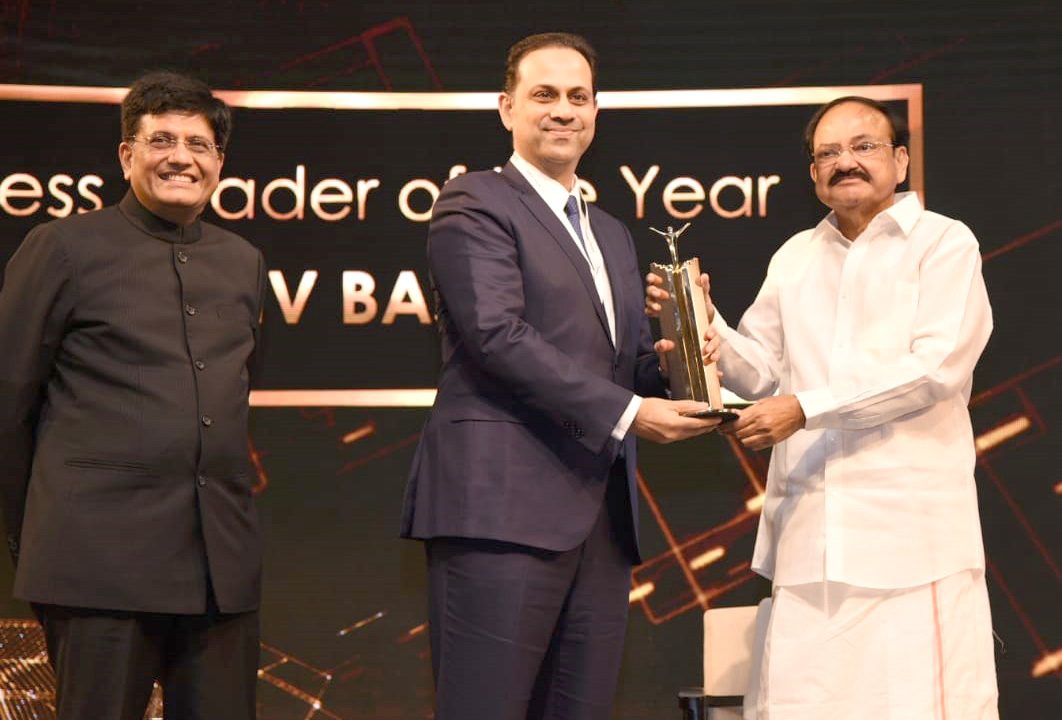
Sanjiv was President of the Confederation of Indian Industry (CII) for 2022-23 [27]. On taking over he said: “The real opportunity that India has is of becoming a factory to the world especially over the next 10 years.” [98] He was named EY Entrepreneur of the Year 2017 [99] and ET Business Leader of the Year 2018 [21]. He sits on the board of the Indian School of Business and chairs CII’s India@100 Foundation [21].
Succession
Rahul Bajaj died on 12 February 2022 [24]. “My father was unique and special. He was my mentor, counsellor and friend,” Sanjiv wrote in that year’s annual report [12]. He had already succeeded his father as chairman of Bajaj Finance in August 2020 [100].
The group no longer has a single patriarch. Under the family settlement reached in 2018-19, the Bajaj branches agreed formal rules for ownership, succession and disputes [95]. Since Rahul Bajaj’s death there has been no group chairman. The family runs things by consensus through a family council, and Sanjiv is responsible for the financial-services companies [23].
For the next generation of managers, Sanjiv relies on spotting talent early and moving it around. “We identify them early. We move them around various jobs and to various businesses,” he told Mint in 2025 [101]. Rajeev Jain, a professional manager rather than a family member, is to run Bajaj Finance until at least March 2028 [69]. The Saha episode showed how hard it is to plan a handover from a long-serving chief.
What his journey teaches
Admit what you don’t know, then hire for it. Sanjiv said he “knew nothing about financial services”. So he hired Rajeev Jain, whose experience at AIG, GE and American Express covered those gaps, and backed him for nearly two decades [30][44]. The founder’s job became choosing people and protecting the long view.
Clean up before you grow. The first two to three years at Bajaj Finance went into clearing bad loans and leaving cities that did not pay [46][45]. That slow start made the fast years possible.
The first sale buys you the second. The EMI card turned one fridge loan into a relationship. Each repaid instalment was data that lowered the risk of the next product [46][47].
Split what grows too big. Housing finance, asset management, health and broking each became a separate company with its own management and capital. “When we think a business line is getting too big, we break it up.” [29]
In finance, trust has to be earned again and again. The RBI’s 2023 ban and its fines over recovery agents show that rapid growth in digital lending can run ahead of customer protection [1][2]. Sanjiv’s own line, “Trust is the foundation upon which innovation must be built,” is a test the group will keep facing [15].
Patience is a strategy. He waited almost two decades with Allianz before buying it out for Rs 24,180 crore, and did it without borrowing [20][57].
A profile for general reading, based on public records and reporting as of 10 November 2026. Not investment, tax or legal advice.
Sources (105)
- Action against Bajaj Finance Ltd. under Section 45L(1)(b) of the RBI Act - Reserve Bank of India, Nov 2023
- RBI imposes monetary penalty on Bajaj Finance Limited - Reserve Bank of India, Jan 2021
- RBI imposes monetary penalty on Bajaj Finance Limited, Pune - Reserve Bank of India, Oct 2023
- RBI imposes monetary penalty on Bajaj Housing Finance Limited - Reserve Bank of India, Feb 2024
- Fifty-Fifth Annual Report 1999-2000 - Bajaj Auto Ltd, 2000
- Sixtieth Annual Report 2004-05 - Bajaj Auto Ltd, 2005
- Demerger of erstwhile Bajaj Auto Ltd: shareholder notices and news - Bajaj Auto, Apr 2008
- Notice of 13th Annual General Meeting (director profile) - Bajaj Housing Finance, Jun 2021
- Investor Presentation Q2 FY27 - Bajaj Finance (NSE filing), Oct 2026
- FY2026: The Numbers that Defined the Year - Bajaj Finserv Annual Report, 2026
- Chairman's Letter FY2026 - Bajaj Finserv Annual Report, 2026
- Chairman's Letter, Annual Report 2021-22 - Bajaj Finserv, Jul 2022
- Directors' Report FY2025 - Bajaj Finserv Annual Report, 2025
- Our Commitment to Society: CSR (Annual Report FY25) - Bajaj Finserv, Jul 2025
- ESG Report FY26 - Bajaj Finserv, Jul 2026
- Bajaj Finserv Investor Presentation - Bajaj Finserv, May 2026
- Intimation on completion of acquisition of 23% stake from Allianz - Bajaj Finserv (BSE filing), Jan 2026
- Allianz transaction completion intimation - Bajaj Finserv (NSE filing), Mar 2026
- Intimation of GST order - Bajaj Finance (NSE filing), Jan 2025
- Allianz to sell stake in Indian non-life and life insurance joint ventures - Allianz SE, Mar 2025
- Sanjiv Bajaj, Chairman and Managing Director - Bajaj Finserv, Nov 2026
- Shefali and Sanjiv Bajaj - Bajaj Group, Nov 2026
- Bajaj After Rahul - Bajaj Group, Jul 2024
- Shri Rahul Bajaj's Demise - Bajaj Group, Feb 2022
- Bajaj Group commits Rs 100 crore for the fight against COVID-19 - Bajaj Group, Mar 2020
- The Bajaj Group commits Rs 5,000 crore over the next five years towards CSR initiatives - Bajaj Auto, Mar 2024
- CII announces office bearers for 2022-23 - Confederation of Indian Industry, May 2022
- Rahul Bajaj, Creating Emerging Markets oral history - Harvard Business School, Jul 2014
- Break to grow: Sanjiv Bajaj's guiding business principle - McKinsey & Company, Jul 2026
- Building the future of digital payments: Sanjiv Bajaj in conversation with Sunil Munjal - CS Conversations, May 2023
- Sanjiv Bajaj in conversation with Vineet Bhatnagar - Rotary Club of Bombay, Aug 2025
- Sanjiv Bajaj profile - Forbes, Nov 2026
- Bajaj family profile - Forbes, Sep 2026
- All In The Family: Meet The 4th-Generation Scion Behind India's Bajaj Finserv - Forbes, Aug 2017
- How Sanjiv Bajaj turned Bajaj Finserv into a financial powerhouse - Forbes India, May 2016
- Lunch with BS: Sanjiv Bajaj - Business Standard, Jul 2008
- Breakfast with BS: Sanjiv Bajaj - Business Standard, Oct 2010
- Sanjiv's Bajaj - Business Today, Jun 2008
- In five years, Sanjiv Bajaj comes into his own - Business Today, Jan 2013
- The Naya Bajaj - Business Today, Jan 2019
- How Bajaj Auto shaped Sanjiv Bajaj's entrepreneurial journey - CNBC-TV18, Mar 2025
- Demerger not to accommodate sons: Bajaj - Business Standard (PTI), May 2007
- Bajaj splits on way to succession - Business Standard, May 2007
- Rajeev Jain appointed CEO of Bajaj Auto Finance - Business Standard, Sep 2007
- Money trail - Business Standard, Dec 2009
- The Start-up CEO - Business Today, Dec 2015
- The Risk Manager - Business Today, Feb 2019
- Bajaj Finance m-cap touches Rs 1 lakh crore mark - DSIJ, Aug 2017
- Bajaj Finserv market cap crosses Rs 1 trillion as stock hits new high - Business Standard, Jun 2018
- Bajaj Finance joins the Rs 4 trillion market cap club - Business Standard, Aug 2021
- Bajaj Housing Finance more than doubles on debut - Business Standard, Sep 2024
- Bajaj Finserv gets Sebi's approval to foray into mutual fund business - Business Standard, Mar 2023
- Bajaj Finserv wanted to make waves in healthcare, so it bought a wobbly ship - The Ken, Sep 2024
- Bajaj Finserv soars after reports of likely buyout of Allianz's stake in insurance arms - Business Standard, Jun 2016
- Bajaj Finserv to acquire Allianz's 26% stake in insurance JVs - Business Standard, Mar 2025
- Bajaj rebrands insurance businesses after final approvals for Allianz buyout - Reinsurance Asia, Oct 2025
- Bajaj Group completes 23 pc stake acquisition from JV partner Allianz for Rs 21,390 cr - The Week (PTI), Jan 2026
- India's Bajaj Group completes acquisition of 23% stake in insurance companies from Allianz - Reuters via MarketScreener, Jan 2026
- AI not hype, helping Bajaj Fin write over 10,000 loans a month: Sanjiv Bajaj - The Week (PTI), Mar 2025
- This decade belongs to India, no room for mistakes - Lokmat (Vijay Darda), Mar 2025
- Bajaj Finserv shareholding pattern - Trendlyne, Nov 2026
- Bajaj Finance consolidated financials and market data - Screener, Nov 2026
- Bajaj Finserv chairman Sanjiv Bajaj's salary was 105 times the median - Benzinga India, Jul 2024
- Bajaj Finance Q4 PAT tumbles 19% on higher provisioning - Business Standard, May 2020
- Bajaj Finance: Focus shifts from growth to capital preservation - Business Standard, May 2020
- Bajaj Finance gains after SAT suspends transfer of securities in Karvy case - Business Standard, Dec 2019
- Karvy broking case: SAT directs Sebi, NSE, NSDL to compensate lenders - Business Standard, Dec 2023
- Karvy Stock Broking case: Supreme Court stays SAT order - Bar & Bench, Jan 2024
- Bajaj Finance MD Anup Kumar Saha resigns, Rajeev Jain reappointed as MD till 2028 - Business Today, Jul 2025
- Anup Saha resigns as Bajaj Finance MD - Business Standard, Jul 2025
- Bajaj Finance shares plummet over 7% as it cuts growth forecast for FY26 - Business Standard, Nov 2025
- Bajaj Housing shares hit record low after Bajaj Finance's stake sale plan - Business Today, Dec 2025
- Bajaj Housing Finance shares hit record low, crash 60% from peak - Free Press Journal, Mar 2026
- eCOM, Insta EMI Card ban may hit Bajaj Finance for 1-2 quarters: Analysts - Business Standard, Nov 2023
- India's Bajaj Finance reverses course after dropping 4% on RBI ban order - Reuters via Yahoo Finance, Nov 2023
- Bajaj Finance to resume lending via eCOM, Insta EMI Card as RBI lifts curbs - Business Standard, May 2024
- Bajaj Finance jumps 8% intraday after RBI lifts ban - Business Standard, May 2024
- RBI slaps Rs 1 cr penalty on Bajaj Finance - Business Standard (PTI), Jan 2019
- RBI fines Bajaj Finance Rs 2.5 crore for recovery agent harassment - Business Standard, Jan 2021
- RBI slaps Rs 2.5 crore fine on Bajaj Finance for violating recovery practices - Business Today, Jan 2021
- MP High Court orders preliminary inquiry into Bajaj Finance coercive recovery complaint - LiveLaw, Sep 2025
- Bajaj Allianz Life fined Rs 3.10 crore - Business Standard (IANS), Aug 2013
- Bajaj Allianz charged Rs3.1 crore penalty for rejecting claims and overpaying agents - Moneylife, Aug 2013
- IRDAI slaps Rs 51 lakh fine on SBI General Insurance, 3 others - Business Today, Apr 2021
- Irdai imposes penalty of Rs 2 crore on Bajaj Finance, Aegon Life Insurance - Business Standard, Jul 2024
- Bajaj Allianz gets Rs 1,010 crore tax demand from GST intelligence - Business Standard, Oct 2023
- Bajaj Finance receives show cause notice for Rs 342 cr GST demand - Business Standard, Aug 2024
- Getting pesky loan calls from Bajaj Finance? Here's what Chairman Sanjiv Bajaj has to say - Business Today, Jun 2023
- Bajaj Finserv MD Sanjiv Bajaj faces Twitter backlash over pesky calls remark - Business Today, Jun 2023
- After Twitterati scream foul about pesky calls, RBI says 'will look into it' - Business Insider India, Jun 2023
- Why Bajaj Finance and Bajaj Finserv shares fell: RBI's draft proposal triggers sell-off - IIFL, Aug 2026
- RBI's proposed curbs on revolving credit push NBFCs back to the drawing board - Mint via TradingView, Nov 2026
- Warring Bajaj brothers reach truce - Business Standard, Dec 2008
- Bajaj bros withdraw CLB petition, settlement sealed - Business Standard, Dec 2008
- Bajaj plans for Gen Next with a family settlement - Hindustan Times, Jan 2019
- Bajaj Auto chief Rajiv Bajaj exits Bajaj Finserv board - Outlook Business, Jun 2026
- Calcutta High Court quashes criminal case against Bajaj Finserv MD over loan dispute - Bar & Bench, Jul 2026
- India's GDP growth expected between 7.4 to 8.2% in FY23: New CII President Sanjiv Bajaj - Business Today, May 2022
- Sanjiv Bajaj, MD Bajaj Finserv, is EY Entrepreneur of the Year 2017 - Business Standard, Feb 2018
- Rahul Bajaj steps down as Bajaj Finance chairman; son Sanjiv to take over - Business Standard, Jul 2020
- Bajaj Finserv spots, grooms talent early for succession - Mint, Mar 2025
- COEP Technological University's mechanical engineering institute renamed Bajaj School of Mechanical Engineering - Punekar News, Jun 2023
- Bajaj Finance - Wikipedia, Nov 2026
- Bajaj Finserv - Wikipedia, Nov 2026
- Sanjiv Bajaj - Wikipedia, Nov 2026