
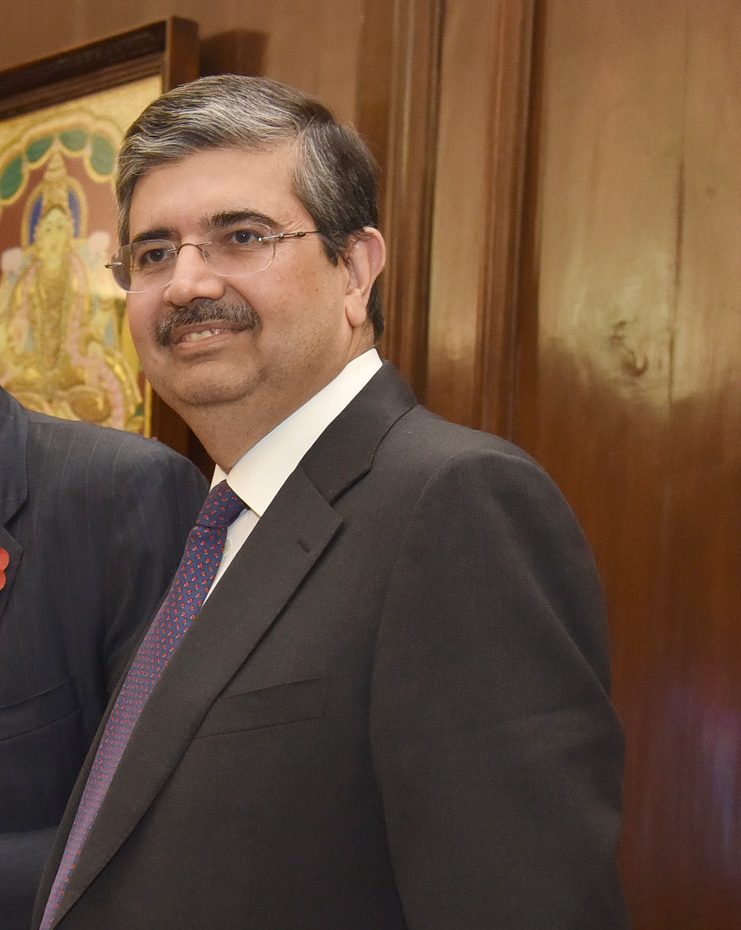
| Key facts | |
|---|---|
| Born | 15 March 1959, Mumbai (then Bombay) [19][26] |
| Family roots | A Gujarati joint family of cotton traders in Babulnath, Mumbai; his father came to the city from Karachi after Partition [26][29] |
| Education | Hindi Vidya Bhavan, Marine Drive; B.Com, Sydenham College; MMS, Jamnalal Bajaj Institute of Management Studies, 1982 [25][1][27] |
| Family | Son of cotton trader Suresh Kotak; married to Pallavi Kotak since 1985; two sons, of whom Jay Kotak works at the bank [26][32][43] |
| Company | Founder and non-executive director, Kotak Mahindra Bank; holds 25.69% of it personally (31 March 2026) [5][4] |
| Wealth | About US$14.4 billion (Forbes estimate, 8 October 2026; No. 14 on its 2026 India list). Reported at Rs 1.18 lakh crore, rank 15, on the M3M Hurun India Rich List 2026 [43][44] |
| Known for | Building the first Indian finance company to become a bank; chairing SEBI’s 2017 corporate governance committee and the IL&FS rescue board; Padma Bhushan, 2026 [2][16][75][18] |
On a September day in 1979, a twenty-year-old batsman set off for a run at Azad Maidan in Bombay. Uday Kotak had captained his school and college sides, played in the Kanga League and wanted to play cricket for a living. [25][29] A fielder’s throw struck him on the head. Within the hour he was unconscious. He was rushed to hospital and operated on within hours. [33][25]
“So it was like a second life for me,” he said decades later. “But since then my grandfather particularly said no more cricket.” [33]
The injury cost him the game and, by his own account, a year of his MBA. It also sent him, while he recovered, to his family’s cotton-trading office, where he learnt something that shaped everything after. “For every decision, I had to deal with fourteen family members,” he told the journalist Vir Sanghvi, “and the one thing it taught me was to never do business with family.” [25]
Six years later he started a finance company with three employees and Rs 30 lakh of capital in a 300 sq ft room. [79][25][32] That firm is today Kotak Mahindra Bank, a group with a balance sheet above Rs 10 lakh crore and 5.2 crore customers. [3][41]
It is an inspiring story, and an unfinished one. The same man took his own regulator to court, saw it bar his bank from signing up customers online, and has watched the outsider hired to succeed him leave after a single term.
Where it began
Uday Suresh Kotak was born in Bombay on 15 March 1959 into a household that was a small economy in itself. [19] About sixty relatives lived under one roof and ate from a single kitchen in a large house at Babulnath. [26][34] “It was capitalism at work and socialism at home,” he has said, “but with solid middle class values at heart.” [26]
The family traded cotton and other farm commodities through Kotak & Company. [29][36] His father, Suresh Kotak, had come to Bombay from Karachi after Partition and became one of the best-known names in the Indian cotton trade. [29] His grandfather, born in 1906, left a different mark. He would tell the boy, “beta, tum ne 1930 ki mandi nahi dekhi”: son, you did not see the Depression of 1930. [35]
The family chose Hindi Vidya Bhavan on Marine Drive, which had been inaugurated by Morarji Desai, because they believed in its nationalist principles. [25] The boy learnt cricket at Azad Maidan under Ramakant Achrekar, years before Achrekar coached Sachin Tendulkar. [33] “Cricket was very much in the blood for me,” he has said. “Studies was a byproduct.” [33]
The byproduct was impressive: he topped Bombay University in his B.Com at Sydenham College. [25][29] He wanted to study abroad but, he recalled, “overheard a conversation between my father and grandfather who thought that if I went overseas, I would not come back at all. So I stayed on in India.” [26] He joined the Jamnalal Bajaj Institute of Management Studies in Bombay instead. [25]
Then came the ball at Azad Maidan. Sanghvi dates it to September 1979 and says he missed a semester; Kotak says he lost a year. [25][33] Either way, the idle months in the family office at Navsari Building taught him that seniority there outranked merit.
He graduated in 1982 with a job offer from Hindustan Lever. [27][26] His father made a counter-offer. He recalled: “He said what if I convince the family to give you 200 square feet of office space at Flora Fountain and you start on your own?” [33] (Other accounts put the room at 300 sq ft.) [25] He took the room.
The first break
India in the early 1980s had a banking system that was almost wholly state-owned, with interest rates fixed by regulation. Banks paid depositors about 6% and lent to companies at about 17%. [26][34] “Nobody asked the common sense question, ‘Why?’” Kotak said. [27]
A batchmate from Bajaj gave him the opening. The friend had joined the finance department of Nelco, a Tata company short of working capital. If the Kotak family could spare even Rs 2-3 lakh, he suggested, it could pay Nelco’s suppliers now and collect from Nelco in 90 days, with interest. [26] Kotak went to people with savings and offered them 12%, twice what a bank paid, on paper that carried a Tata name. He charged 16%. [26][33]
That spread of four percentage points was the seed. He doubled his staff from three to six without getting a bigger room. “We doubled the working area by cutting all the desks in half.” [25]
Two people then changed the scale of his ambition. The first was Sidney Pinto, a veteran of Grindlays Bank, who urged him to set up a proper company and, Kotak has said, to “ensure that whatever you do is within the framework of the law”. [27][31] Kotak Capital Management Finance Ltd was incorporated on 21 November 1985. [6][36]
The second was a client. Anand Mahindra had just returned from Harvard to a job at Mahindra Ugine Steel when Kotak pitched him bill finance delivered within 48 hours. [26][27] In early 1986 Mahindra invested personally and his father, Harish Mahindra, became chairman. [25] How much Mahindra put in is told differently: Kotak told Sanghvi it was “four or five lakh”, while Business Today has reported Rs 1 lakh. [25][31]
What Kotak wanted as much as the money was the name. On 8 April 1986 the company became Kotak Mahindra Finance. [36] “And let’s be honest. The Kotak name meant nothing. But the addition of Mahindra gave the company instant credibility.” [25]
The starting capital was Rs 30 lakh. His family put in Rs 13 lakh, college friends and the Mahindras made up most of the rest, and Kotak borrowed to buy his own shares. [32][26][25] He was 26 and had married Pallavi that same year. [26]
His first hire, Shivaji Dam, came from the client side at Nelco. “He convinced me that I was a small cog in the wheel at Nelco, but could be the wheel itself at Kotak,” Dam recalled. [28]
Building the empire
Cars and a listing (1987-1992)
Bill discounting led to leasing and hire purchase in 1987, and in 1988 to a proper office at Nariman Point. [7][25]
The next idea came from watching Citibank, which had begun financing cars at rates that worked out to a return of nearly 30% a year, at a time when buyers waited six months for delivery. [26][25] Kotak’s twist was to solve the waiting. As he tells it, he went to Maruti and offered to book cars in bulk and pay in advance, so that anyone who took a Kotak loan could drive away at once. [33][27]
Investment banking began in 1991. [7] The company went public at the turn of 1991-92, through an issue of partly convertible debentures worth Rs 13.95 crore that effectively priced its shares at Rs 45. [36]
Learning from Goldman Sachs and Ford (1993-2001)
In 1993, at a Euromoney conference in Delhi, Kotak met bankers from Goldman Sachs and, in his own phrase, “just chipkoed to them”, stuck to them. [25] In July 1995 Goldman announced a 28% stake in a new investment bank, Kotak Mahindra Capital, and a similar stake in Kotak Securities. [20] In 1996 came a car-finance venture with Ford Credit, owned 60:40. [21]
Around then he also bought a newspaper. Business Standard was losing Rs 1.5 crore a month and its owners were ready to close it. Kotak paid, he recalled, “only a crore or so”; the turnaround took Rs 60 crore, three times his budget. [25] Entities controlled by the Kotak family still hold a significant stake in the paper, as it discloses in its coverage of the group. Business Standard is among the sources for this profile. [84]
A mutual fund followed in 1998 and life insurance, with Britain’s Old Mutual, in 2001. [7]
Becoming a bank (1999-2006)
One morning in December 1999, Outlook Business has reported, Kotak rang a colleague at 7 am. A banking licence would need a net worth of Rs 500 crore; his company had about Rs 400 crore and roughly three months. His team pushed a rights issue through in time. [28]
The licence came in February 2003, and Kotak Mahindra Finance became the first non-banking finance company in India to convert into a bank. [2]
Then he bought out his teachers. In October 2005 the group acquired Ford Credit’s 40% of the car-finance venture, renamed Kotak Mahindra Prime. [21] In March 2006 it paid Rs 333 crore for Goldman Sachs’s stakes in the investment bank and the brokerage. [37]
The ING Vysya leap (2014-2015)
The biggest move came on 20 November 2014: an all-share merger with ING Vysya Bank, valued at about Rs 15,000 crore, at 725 Kotak shares for every 1,000 of ING Vysya. [8][38] The combined bank had 1,214 branches, against Kotak’s own 641. [8] The merger took effect on 1 April 2015. [7]
The promoters’ stake fell from 40.12% to about 34%. [38] That was still far above what the Reserve Bank of India (RBI) wanted, an argument that would end in court.
811 and after (2017-2026)
Demonetisation, announced on 8 November 2016, gave the bank a product name. On 29 March 2017 it launched “811”, a zero-balance account opened on a phone, and set out to double its customer base in 18 months. [39]
When Kotak stepped down as chief executive in 2023 he offered his own summary of the journey: “An investment of Rs 10,000 with us in 1985 would be worth around Rs 300 crore today.” [80] That is his figure, not an audited one. It implies growth of roughly 39% a year for 38 years.
Under his successor, Ashok Vaswani, the group sold 70% of its general insurance arm to Zurich Insurance for about Rs 5,560 crore. [40] On its 40th anniversary, 21 November 2025, the board approved a one-into-five share split. [10] In June 2026 the bank agreed to buy Deutsche Bank’s retail and wealth business in India, with loans of about Rs 29,000 crore; the deal awaits regulatory approval. [11]
For the year to March 2026 the group reported a consolidated profit of Rs 19,288 crore and total assets of Rs 10,03,353 crore, with 2,276 bank branches. [3][41] Forbes describes it as one of India’s top four private-sector banks. [43]
How the wealth is held
On 31 March 2026 Uday Kotak personally held 25.69% of Kotak Mahindra Bank, and the promoter group as a whole 25.87%. [4]
Outside the bank there is Infina Finance, an investment company. In March 2026 the bank’s subsidiary sold nearly 31% of it for about Rs 1,294 crore, with a Kotak family trust among the buyers. [42] There is also a low-profile family office, USK Capital. [32]
Forbes put Kotak’s net worth at US$14.4 billion on 8 October 2026 and ranked him 14th on its 2026 list of India’s richest. [43] The M3M Hurun India Rich List 2026, headed by Gautam Adani and Mukesh Ambani, was reported to place him 15th, at Rs 1.18 lakh crore. [44]
The setbacks and failures
The setback that nearly took everything came after the CRB scam of 1996, when credit dried up for finance companies. “99 per cent of the NBFC are going to die. Only 1% will survive. We should be that 1%,” Kotak told his team. [28] He ordered lending cut by half. [25] “I told my people not to focus on return on equity but to just focus on equity,” he said. “We took a hit of Rs 100 crore in bad debts but by then, we were strong enough to manage.” [25]
Caution cut both ways. In 1999 the group sold its stake in Mahindra & Mahindra Finance, a joint venture it had started with M&M and some dealers, after bad loans piled up among rural borrowers. “The biggest financial mistake we made was probably our decision to exit Mahindra & Mahindra Finance,” Dam said in 2015. “If we had that stake today, we would be sitting on some ₹4,000 crore. We exited at under ₹100 crore in 1999.” [28] Kotak has made a similar admission about the years after the global financial crisis: “It was a mistake not to aggressively grow our business after the 2008 crisis.” The reason, he said: “We were too scared.” [30]
The hardest stretch for the bank has come since he left the corner office. The RBI’s curbs of 2024 hit its digital business, and the next day Axis Bank overtook Kotak in market value for the first time since 2016. [54] Veterans left: joint managing director KVS Manian after 29 years, and by January 2025 Outlook Business counted six top-level exits in about 15 months, Kotak’s own included. [45][46]
Controversies and allegations
The stand-off with the RBI over his shareholding (2018-2020)
Allegation: The RBI required the promoters of Kotak Mahindra Bank, chiefly Uday Kotak, to cut their holding to 20% of paid-up capital by 31 December 2018 and 15% by 31 March 2020. In August 2018 the bank issued Rs 500 crore of perpetual non-convertible preference shares and said this had brought the promoter holding down from 30.03% to 19.70% of paid-up capital. The RBI told the bank the issue did not meet the requirement, and its counsel later told the Bombay High Court: “We want them to reduce their voting rights and not merely cut their stake through issuance of preference shares.” The analyst Hemindra Hazari called it “misgovernance” by a man who had chaired SEBI’s corporate governance committee a year earlier. [47][50][48]
Response: The bank said: “We continue to believe that we have met the requirement and will engage with the RBI in this behalf.” In court it argued that the RBI had changed the yardstick from paid-up capital to paid-up voting equity capital. [47][50]
What happened next:
- December 2018: the bank filed a writ petition against the RBI in the Bombay High Court, which on 17 December declined to stay the deadline. [49][50]
- June 2019: the RBI fined the bank Rs 2 crore for not furnishing details of promoter shareholding and of its plan to dilute it. [12]
- 30 January 2020: the bank disclosed a settlement and withdrew the petition. The promoters would cut their holding to 26% within six months, with voting rights capped at 20% until 31 March 2020 and 15% after that. [51]
- 2 June 2020: Uday Kotak sold 5.6 crore shares, 2.83% of the bank, in a block deal priced to raise Rs 6,804-6,944 crore, taking his stake from 28.93% to about 26.1%. [52]
Status: Closed by settlement in 2020. No court ruled on the merits, and the Rs 2 crore penalty stood.
The RBI’s technology curbs (2024-2025)
Allegation: On 24 April 2024 the RBI, acting under Section 35A of the Banking Regulation Act, ordered Kotak Mahindra Bank to stop taking on new customers through online and mobile channels and to stop issuing new credit cards. It cited its IT examinations for 2022 and 2023, which found serious deficiencies in areas including patch and change management, vendor risk management and data security, said the bank had not fixed them adequately, and pointed to frequent outages. [13]
Response: The bank said it had taken measures to adopt new technology and would work with the RBI to resolve the remaining issues. [53] Uday Kotak had been chief executive for most of the period the RBI examined. By April 2024 he was a non-executive director, and no public comment from him appears in the reports reviewed for this profile. Hazari argued in The Wire that the board and the former chief executive should be held accountable. [55]
What happened next:
- 25 April 2024: the shares fell as much as 13% during the day. Bloomberg estimated that Kotak’s own fortune dropped US$1.2 billion, to US$13.1 billion. [54]
- 12 February 2025: the RBI lifted the restrictions, saying it was satisfied after the bank’s remedial work and an external audit. [14]
Status: Closed. The curbs lasted nearly ten months and carried no monetary penalty.
Hindenburg, Kingdon and a Kotak-managed offshore fund (2024 onwards)
Allegation: In July 2024 the short-seller Hindenburg Research disclosed that SEBI had sent it a show-cause notice over its January 2023 report on the Adani Group. According to reports of the notice, SEBI alleged that Hindenburg shared the report in advance with a client, the hedge fund Kingdon Capital, which bet against Adani group stocks through K India Opportunities Fund (KIOF), a Mauritius vehicle managed by Kotak Mahindra International Ltd (KMIL), a subsidiary of the bank. The trades are said to have made about US$22.25 million. [56][58] Hindenburg, in turn, accused SEBI of shielding Kotak. The notice, it wrote, “conspicuously failed to name the party that has an actual tie to India: Kotak Bank”. It added: “We suspect SEBI’s lack of mention of Kotak or any other Kotak board member may be meant to protect yet another powerful Indian businessman from the prospect of scrutiny.” [22] That second claim is a stated suspicion. Hindenburg offered no evidence for it beyond the notice’s use of the abbreviation “KMIL” and Uday Kotak’s past role on a SEBI committee.
Response: KMIL said: “KMIL and KIOF unequivocally state that Hindenburg has never been a client of the firm nor has it ever been an investor in the fund. The fund was never aware that Hindenburg was a partner of any of its investors.” [57]
What happened next:
- September 2026: Reuters reported that SEBI had begun hearings in its effort to recover the alleged gains. Kotak did not respond to Reuters. [58]
Status: Pending before SEBI as of 8 October 2026. The fund is reported to be among the recipients of SEBI’s notice. [57] No order or finding against Kotak Mahindra Bank, KMIL or Uday Kotak has been reported.
Electoral bonds bought by Infina Finance (2019-2021)
Allegation: Data published in March 2024, after the Supreme Court struck down the electoral bond scheme, showed that Infina Finance, then owned jointly by the Kotak family and a subsidiary of the bank, bought bonds worth Rs 60 crore in October 2019, January 2020 and April 2021. [59][60] All were encashed by the BJP. [60] A reporting consortium of Newslaundry, Scroll and The News Minute noted that the January 2020 purchase came about two weeks before the RBI accepted the shareholding settlement, and the April 2021 purchase under three weeks before an RBI circular on bank chief executives’ tenure that let Kotak complete his term. [60]
Response: Kotak Mahindra Bank and the RBI did not answer the consortium’s questions. The consortium’s own report quoted a former finance secretary, Subhash Chandra Garg, calling a link “far-fetched”. [60]
Status: The purchases are a matter of record. Any connection between them and regulatory decisions is an inference from timing. It is unproven, and no court, regulator or agency has made any finding on it.
SEBI’s action against Kotak Mahindra AMC (2019-2026)
Allegation: In August 2021 SEBI held that Kotak Mahindra Asset Management Company had failed in due diligence and disclosure over six fixed maturity plans that held debt of Essel group entities. In April 2019 the fund house had agreed to extend the borrowers’ repayment date, so investors were not paid in full when the schemes matured. SEBI imposed a Rs 50 lakh penalty, barred the AMC from launching new fixed maturity plans for six months and ordered a part-refund of fees. In 2022 it added penalties totalling Rs 1.6 crore on the trustee company and six executives. Uday Kotak was not a party to either order. [61][62]
Response: The Kotak group said all investors had been fully repaid, with interest, in September 2019. [61]
What happened next:
- March 2026: the Securities Appellate Tribunal upheld the findings and penalties but set aside the fee refund. [63]
- 13 July 2026: the Supreme Court dismissed the appeals and imposed costs of Rs 30 lakh on the AMC and Rs 20 lakh on the trustee company. “Mandate first, gains later; Sebi compliance, never falter,” the bench wrote. [15][64]
Status: Final. The violations and penalties stand. There is no finding against Uday Kotak personally.
The Panchkula fixed-deposit fraud (2026)
Allegation: In March 2026 the Municipal Corporation of Panchkula, in Haryana, found that fixed deposits it believed it held at a Kotak Mahindra Bank branch, with a principal of about Rs 145 crore, could not be reconciled. [66] The state’s anti-corruption bureau registered a case against unnamed bank officials. The Enforcement Directorate (ED) alleges that a branch manager, other employees and a corporation official opened unauthorised accounts with forged documents and diverted about Rs 107 crore. [17][68]
Response: The bank said that, on the records reviewed, account-opening procedures, KYC documents and signatory instructions were in order, and that it was cooperating with investigators. [65] On 30 March 2026 it returned Rs 127 crore to the corporation. [66]
What happened next:
- 8 April 2026: Haryana de-empanelled the bank from government business in the state “with immediate effect and until further orders”. [67]
- By August 2026: the ED had attached assets of Rs 131.13 crore and filed a prosecution complaint against nine accused. [68]
Status: Under investigation and prosecution as of 8 October 2026; the allegations have not been tested at trial. Reports of the ED’s complaint name individuals and firms, not the bank, and Uday Kotak is not named in the case.
Questions about the founder’s continuing role
When the board decided in 2023 that Kotak would stay on as a non-executive director after leaving the chief executive’s office, Reuters Breakingviews argued that the arrangement “is at odds with the regulator’s own aim to improve governance”. [69] The bank’s position was that the appointment was in accordance with law and regulation. [70] This is a debate about governance design, not an allegation of wrongdoing.
As of 8 October 2026, none of the matters above has produced a court or regulatory finding against Uday Kotak personally. The SEBI proceedings over KIOF and the Panchkula case are still running.
Giving back
Kotak’s main philanthropic vehicle is the Kotak Education Foundation, set up in 2007, which the government’s Padma citation credits him with founding. [23][19] Run by Shivaji Dam, his first employee, it works with schools, funds scholarships and trains young people from low-income families for jobs. [23]
The one year for which a figure could be verified is 2022, when the EdelGive Hurun India Philanthropy List recorded donations of Rs 17 crore, mainly to education, and ranked him 46th on a list led by Shiv Nadar. [24] In March 2020 he committed Rs 25 crore of his own money to the PM CARES fund, alongside Rs 25 crore from the bank, and took a salary of Re 1 for 2020-21. [71][72]
His most consequential public roles have been for the state. In 2017 he chaired SEBI’s Committee on Corporate Governance; in March 2018 SEBI accepted a number of its recommendations, among them separating the roles of chairperson and chief executive at the 500 largest listed companies. [16][19][73] In October 2018, when the government superseded the board of the collapsing infrastructure lender IL&FS, it made him chairman. The group owed more than Rs 99,000 crore. By the time he left in April 2022, about Rs 55,000 crore had been resolved and the board estimated an eventual recovery of Rs 61,000 crore, or 62%. [19][75] Timelines slipped along the way, a delay Business Standard attributed largely to Covid and the courts. [74]
He was president of the Confederation of Indian Industry in 2020-21 and in February 2026 was named chairman of GIFT City. The Padma Bhushan was announced in January 2026 and conferred that May. [19][1][18]
In December 2023 he wrote that India was turning from a nation of savers into one of investors, a shift that shows up in the SIP data. [76]
Succession
In April 2021 the RBI capped the tenure of a bank’s managing director at 15 years. [77] Kotak had run the bank since 2003, and his term was due to end on 31 December 2023. [81]
On 1 September 2023, four months early, he stepped down with a handwritten letter to the chairman. “It is now time to move on,” he wrote, and described himself as standing “in a lonely place of being a founder, promoter and significant shareholder of this great institution”. [79] The RBI approved Ashok Vaswani, a former Barclays and Citigroup executive, who took charge on 1 January 2024. [9][84]
The handover has not been smooth. On 27 June 2026 the bank said Vaswani would not seek reappointment when his term ends on 31 December 2026, for personal reasons. [83] On 1 October 2026 it announced the RBI’s approval of Anup Kumar Saha, 56, a former ICICI Bank executive who briefly led Bajaj Finance and joined Kotak in January 2026, as managing director for three years from 1 January 2027. [84] A bank that had one chief executive for two decades will be on its second successor barely three years after he left.
Jay Kotak, a Harvard Business School graduate, is co-head of the 811 digital bank. [43] In 2022 Manian told Bloomberg that Jay was not in contention for the top job: “Jay is still young. He will have to work his way up on merit.” [78] His father said in October 2023: “If he performs, he may have an opportunity.” [82]
Uday Kotak remains the largest shareholder, with a board seat and the chairmanship of five group subsidiaries. [5] “Founders go away,” he wrote on the day he stepped down, “but the institution flourishes into perpetuity.” [80]
What their journey teaches
1. Big opportunities hide in numbers nobody questions. Everyone in the 1980s knew banks paid 6% and charged 17%. Kotak asked why, and stood in the middle at 12% and 16%.
2. Borrow credibility until you have earned your own. His first investors trusted a Tata name on the bill, not him. His company borrowed the Mahindras’ standing because, as he admitted, “The Kotak name meant nothing.”
3. In a crisis, protect the capital and let the profit go. In 1997 he halved lending while rivals chased growth, and told his team to “just focus on equity”. Most finance companies of that era did not survive. His did.
4. Caution has a cost too. The exit from Mahindra Finance and the timid years after 2008 were mistakes he and his colleagues have owned in public.
5. Meeting the letter of a rule is not the same as honouring it. The preference-share manoeuvre of 2018 met the wording of the RBI’s condition and brought a year and a half of conflict.
6. The real test of an institution is the handover. “You must create things to last, because if what you build does not outlast you, you will have failed,” Kotak has said. [34] Two successors in a little over three years show how hard that is.
A profile for general reading, based on public records and reporting as of 8 October 2026. Not investment, tax or legal advice.
Sources (84)
- Integrated Annual Report 2025-26: Report on Corporate Governance - Kotak Mahindra Bank, Jul 2026
- Standalone Financial Statements 2025-26 - Kotak Mahindra Bank, Jul 2026
- Media release: FY26 audited results - Kotak Mahindra Bank, May 2026
- Shareholding pattern as on 31 March 2026 - Kotak Mahindra Bank, Apr 2026
- Board of Directors - Kotak Mahindra Bank, Oct 2026
- Investor Information - Kotak Mahindra Bank, Oct 2026
- Our Journey: milestones timeline - Kotak Mahindra Bank, Oct 2026
- Kotak Mahindra Bank and ING Vysya Bank merger: press release - Kotak Mahindra Bank (BSE filing), Nov 2014
- RBI approves appointment of Ashok Vaswani as MD and CEO: press release - Kotak Mahindra Bank, Oct 2023
- Press release on stock split - Kotak Mahindra Bank, Nov 2025
- Kotak Mahindra Bank to acquire Deutsche Bank's retail business in India: press release - Kotak Mahindra Bank, Jun 2026
- RBI imposes monetary penalty on Kotak Mahindra Bank Limited - Reserve Bank of India, Jun 2019
- Supervisory Action against Kotak Mahindra Bank Limited - Reserve Bank of India, Apr 2024
- Removal of Supervisory Restrictions: Kotak Mahindra Bank Limited - Reserve Bank of India, Feb 2025
- Nilesh Shah and Others v SEBI, 2026 INSC 681 (judgment) - Supreme Court of India, Jul 2026
- Report of the Committee on Corporate Governance - SEBI, Oct 2017
- Press release: searches in the Kotak Mahindra Bank and Municipal Corporation Panchkula case - Enforcement Directorate, Apr 2026
- Padma Awards 2026: list of awardees - Ministry of Home Affairs, Jan 2026
- Padma Bhushan citation: Shri Uday Sureshkumar Kotak - Padma Awards, Government of India, May 2026
- Goldman Sachs Announces Joint Venture in India, 1995 - Goldman Sachs, Oct 2026
- About Us - Kotak Mahindra Prime, Oct 2026
- Adani Update: Our Response To India's Securities Regulator SEBI - Hindenburg Research, Jul 2024
- About us - Kotak Education Foundation, Oct 2026
- EdelGive Hurun India Philanthropy List 2022 - Hurun Report, Oct 2022
- Uday Kotak: a profile - Vir Sanghvi, Sep 2005
- I love to hire entrepreneurs: Uday S. Kotak - People Matters, Oct 2014
- The man who saw tomorrow - Outlook Business, Jul 2013
- Uday Kotak: The Boss - Outlook Business, Jul 2015
- Uday Kotak: The 'nationalist' banker - Mint, Aug 2018
- The Prudent Banker - Outlook Business, Jul 2019
- Institution builder, visionary: Deciphering Uday Kotak's incredible legacy - Business Today, Mar 2024
- Asia's Richest Banker - Brunswick Review, Oct 2024
- Transcript: Uday Kotak's Interview On 'Legends' With Arnab Goswami - The Singju Post, Aug 2025
- How Uday Kotak uses dreams to manage risk and build value - McKinsey & Company, Aug 2025
- Uday Kotak on history, Indian economy, growth and more - Governance Now, Sep 2026
- Company History: Kotak Mahindra Bank Ltd - The Economic Times, Oct 2026
- David On Dalal Street - Business Today, Apr 2006
- Kotak Bank buys ING Vysya for Rs 15,000 cr in biggest merger - Business Standard (PTI), Nov 2014
- Kotak Mahindra Bank launches '811' zero-balance app - Business Today, Mar 2017
- Zurich completes 70% stake buy for Rs 5,560 cr in Kotak General Insurance - Business Standard, Jun 2024
- Kotak Mahindra Bank FY2025-26 Annual Report: Consolidated Balance Sheet Crosses Rs 10 Lakh Crore - ScanX, Jul 2026
- Kotak Mahindra Capital divests nearly 31% stake in Infina Finance - Business Standard, Mar 2026
- Uday Kotak: billionaire profile - Forbes, Oct 2026
- Gautam Adani Overtakes Mukesh Ambani To Top Hurun India Rich List 2026 - Swarajya, Sep 2026
- Kotak Mahindra Bank joint MD KVS Manian steps down with immediate effect - Business Today, Apr 2024
- Kotak Bank faces 6th C-suite exit in just over a year - Outlook Business, Jan 2025
- RBI turns down Kotak Bank's stake dilution plan - Business Standard, Aug 2018
- In Back-and-Forth Between RBI and Uday Kotak, a Rs 15,000-Crore Lesson in Misgovernance - Hemindra Hazari / The Wire, Aug 2018
- Kotak Bank moves HC against RBI over promoter shareholding dispute - Business Standard, Dec 2018
- Bombay HC Refuses To Stay RBI Deadline To Kotak Mahindra Bank To Dilute Promoter Stake - LiveLaw, Dec 2018
- RBI accepts Kotak Bank promoters' plan to cap voting rights, reduce stake - Business Standard, Jan 2020
- Uday Kotak ends long stand-off with RBI, sells stake in Kotak Mahindra Bank - Business Today, Jun 2020
- RBI action on Kotak Bank: Stock plunges 12% as analysts turn bearish - Business Standard, Apr 2024
- Kotak Shares Tumble After Ban on Cards and New Online Clients - BNN Bloomberg, Apr 2024
- Who's Accountable for Kotak Mahindra Bank's IT Fiasco? - The Wire, May 2024
- New twist in clash between US short seller Hindenburg and India's Adani - Al Jazeera (Reuters), Jul 2024
- 'Hindenburg has never been a client of the firm', clarifies KMIL - Business Standard, Jul 2024
- SEBI begins hearings to recover gains linked to Adani-Hindenburg trades: Report - Business Today (Reuters), Sep 2026
- Uday Kotak questioned electoral bonds; later his group donated through the scheme - The Reporters' Collective, Mar 2024
- Kotak firm's Rs 60 crore donation to BJP coincided with crucial RBI decisions on Kotak Mahindra Bank - Scroll, Mar 2024
- Sebi bars Kotak AMC from launching FMPs for six months, slaps fine - Business Standard, Aug 2021
- SEBI slaps penalty of 1.6 crores on Kotak Mahindra's MD Nilesh Shah and 6 others - Bar and Bench, Jul 2022
- SAT Sets Aside SEBI Disgorgement Order Against Kotak AMC - LiveLaw, Mar 2026
- SC upholds Sebi action against Kotak AMC, MD Nilesh Shah, and others - Business Standard, Jul 2026
- After IDFC First Bank, Kotak Mahindra Now Caught in Haryana's Rs 160 Cr Banking Fraud - Outlook Business, Mar 2026
- Kotak Mahindra Bank scam explained: Anatomy of Rs 150-crore fraud - The Tribune, Apr 2026
- Rs 150 crore scam: Haryana Government de-empanels Kotak Mahindra Bank - The Tribune, Apr 2026
- Rs 107 crore Panchkula fraud: ED files chargesheet - Business Today, Aug 2026
- Asia's richest banker will loom over his successor - Reuters Breakingviews (via Kitco), Apr 2023
- Kotak Mahindra Bank Says Uday Kotak's Appointment As Non-Executive Director In Accordance With Law - Outlook Business, Apr 2023
- Kotak Mahindra Bank, CEO commit Rs 50 cr to PM-CARES Fund - The News Minute, Mar 2020
- Coronavirus Lockdown: Kotak Mahindra Bank leadership take pay cuts - Business Today, Apr 2020
- SEBI's move towards bringing a balanced Board Structure - Vinod Kothari Consultants, Mar 2018
- IL&FS board faces challenges as resolution takes a Covid-19 knock - Business Standard, Sep 2020
- IL&FS resolves Rs 55,000 cr debt till March-end, chairman Uday Kotak's term ends - Business Today, Mar 2022
- India transforming from nation of savers to that of investors: Uday Kotak - Business Standard (PTI), Dec 2023
- RBI caps bank CEO tenure at 15 years, policy to be effective Oct 1 - Business Standard, Apr 2021
- India: Billionaire-run Kotak Mahindra bank rules out CEO's son as boss - Gulf News (Bloomberg), Nov 2022
- Full text of Uday Kotak's resignation letter as he steps down as MD & CEO - Business Standard, Sep 2023
- Uday Kotak steps down as MD & CEO of Kotak Mahindra Bank - National Herald (PTI), Sep 2023
- Billionaire Uday Kotak resigns as bank CEO earlier than expected - Gulf News (Bloomberg), Sep 2023
- 'If my son performs, he may have an opportunity to head Kotak Mahindra Bank': Uday Kotak - Business Today, Oct 2023
- Kotak Bank's MD&CEO Ashok Vaswani to step down at end of Dec 2026 - Business Standard, Jun 2026
- Kotak Mahindra Bank appoints Anup Saha as MD & CEO for three-year term - Business Standard, Oct 2026