
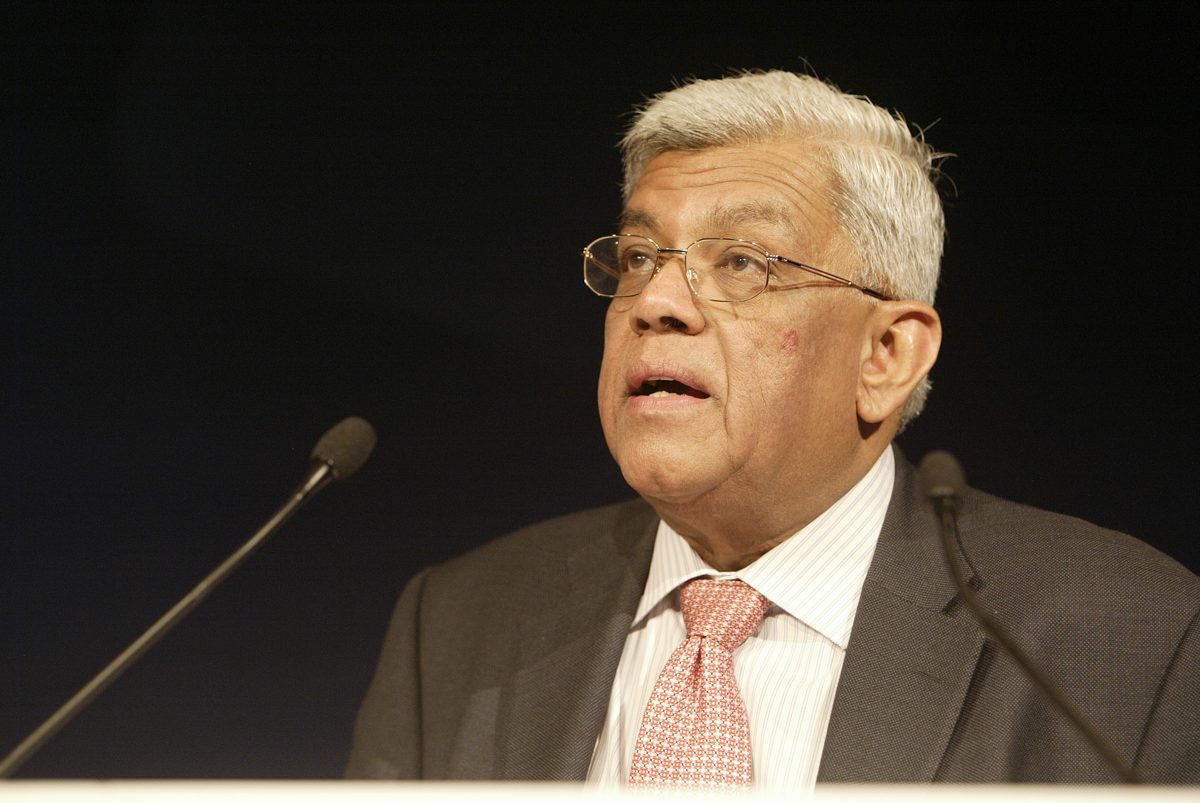
| Key facts | |
|---|---|
| Born | 18 October 1944 [10][57] |
| Family roots | A Gujarati banking family in Bombay; grandfather Thakordas Parekh was the Central Bank of India’s first employee; uncle H.T. Parekh founded HDFC [11][12][13] |
| Education | St Xavier’s High School, Fort; B.Com, Sydenham College, University of Bombay; chartered accountant, ICAEW (England and Wales) [10][57][68] |
| Family | Nephew of HDFC founder H.T. Parekh; married to Smita Parekh [14][77] |
| Company | HDFC Ltd (1978-2023): managing director from 1985, chairman 1993-2023; chairperson of HDFC Asset Management Company and Siemens Ltd [4][6][23] |
| Known for | Building India’s first home-loan company and the HDFC group; the HDFC-HDFC Bank merger of 2023; the government-appointed Satyam rescue board in 2009; Padma Bhushan (2006) [1][28][34][5] |
In the summer of 1978, a 33-year-old banker with a comfortable job at Chase Manhattan received a typed offer letter from a company that was barely nine months old. The post was Deputy General Manager. The basic pay was Rs 3,500 a month, with a fixed Rs 500 dearness allowance and a telephone at home paid for by the company. [17]
By most accounts it was about half of what he was earning. [10][11] The company, Housing Development Finance Corporation, wanted to do something no one in India had tried: lend money to ordinary salaried people so that they could buy a home. Its founder was the banker’s uncle, a retired ICICI chairman who was 65 when he started it. [9][14]
“How long will you continue to go round the world?” Deepak Parekh recalls his uncle asking. “Come and settle down, this is an Indian organisation.” He did. “I chucked up my multinational job and came to HDFC,” he said in 2004. “And I have been here ever since.” [12]
Forty-five years later, on 30 June 2023, he wrote his last letter to HDFC’s shareholders. By then the company had financed more than 9.3 million homes, had a loan book of more than Rs 6.2 lakh crore, and was about to merge into HDFC Bank in a US$40 billion all-share deal that created one of the world’s most valuable banks. [25][3][28] “It is my time to hang my boots,” he wrote, “with both anticipation and hope for the future.” [26]
What makes his story unusual among India’s business giants is what it is not. Parekh is not a founder-promoter or a billionaire, and he never owned more than a sliver of the companies he ran. He is a professional manager who turned a fragile idea into an institution and spent a large part of his working life being called in to clean up messes that other people made.
Where it began
Deepak Shantilal Parekh was born on 18 October 1944 into a family whose working life revolved around one bank. [10][11] His grandfather, Thakordas Parekh, is described as the first employee of the Central Bank of India. [11][12] His father spent 40 years at the same bank, was posted for a time in Burma, and retired as its deputy managing director. [11][12][20]
“I have a special affection for the Central Bank of India,” Parekh said in a 2004 interview. “I had wanted to join the Central Bank of India, but I couldn’t make it.” [12]
The most important figure in his early life was his father’s brother, Hasmukhbhai Thakordas Parekh, known in the family as “Hasmukh Kaka”. [13][14] H.T. Parekh had studied at the London School of Economics, worked as a stockbroker, taught at St Xavier’s College and then joined ICICI in 1956, rising to become its chairman. [14][15] He had no children of his own, and he treated his nephew as a son. [14]
Deepak went to St Xavier’s High School in Fort, Bombay, and then to Sydenham College, where he took a B.Com degree in 1965. [10][57] That same year he left for England to train as a chartered accountant, serving his articles with the London firm Whinney, Smith & Whinney, which later became part of Ernst & Young. [57][68]
He was not a rich student. In a talk to Indian students at the LSE in 2017, he described celebrating his 21st birthday in London by budgeting two shillings and sixpence per friend for a dinner for three friends. The drinks pushed the bill to 13 shillings, and the friends had to pay the difference. “Till date, they still hold me ransom for that party of mine,” he joked. He called the London years among the best of his life and said they made him independent. [16]
The Institute of Chartered Accountants in England and Wales would later call him one of its own. In 2010 he became the first person outside the UK to receive its Outstanding Achievement Award, and he described the institute as “my alma mater”. [56]
A banker’s apprenticeship abroad
After qualifying, Parekh went to work for the consulting arm of Ernst & Ernst in New York. [57][20] He then moved through Grindlays Bank and, for the longest stretch, Chase Manhattan Bank, where he rose to Assistant Representative for South Asia. [5][20] Profiles describe him working across New York, Hong Kong, Singapore and the Middle East in those years. [12][20]
There is no single, detailed record of every post and year in that decade, and accounts differ on whether his Chase role was based in New York or Bombay. [11][12][18] What is clear is the outcome: by the late 1970s, he was an internationally trained banker in his thirties, used to how large Western banks were run, and very well paid by Indian standards. He left Chase in October 1978. [19]
The first break
An idea nobody wanted to fund
H.T. Parekh had been writing proposals for a housing finance institution since the early 1950s. [15] In 1977, after retiring from ICICI, he finally got one off the ground. Housing Development Finance Corporation was incorporated on 17 October 1977, promoted by ICICI, the International Finance Corporation (the World Bank’s private-sector arm) and His Highness the Aga Khan, with no money from the Government of India. [1]
It raised Rs 10 crore through its first public equity issue in 1978. [1] The issue did not go well. According to one detailed account, the shares listed at about a 20% discount and the large state-run investor UTI initially stayed away. [20] HDFC did not pay its first dividend, of 5%, until 1981. [1]
“HDFC was set up in 1977 as India’s first retail housing finance company,” Parekh later wrote. “No one in India had so far attempted to finance individuals for their housing needs.” [9]
The first loan went out in 1978 to a Bombay customer, D.B. Remedios: Rs 30,000 at a fixed 10.5%, towards a house that cost him Rs 70,000 to build in Malad. [13] For years HDFC’s lending limit was Rs 70,000. [15] There was no law that let a lender repossess a home quickly, so a default meant a civil suit that could cost more than the loan itself. [13]
What HDFC had was a belief, which H.T. Parekh pressed on everyone: “you can trust a middle-class person to repay.” [15]
Joining the family start-up
Deepak Parekh’s offer letter is dated 19 July 1978; the letter surfaced publicly only in 2023, when it went viral after his retirement. [17] He joined as Deputy General Manager later that year, at the age of 33 or 34 depending on the account, and became, by one report, the company’s tenth employee. [10][33][14]
Why did he do it? He has given different emphases over the years. He has said that his uncle “did not pressurize me; he persuaded me”, and that family duty played a big part. [68] He has also said he “saw an opportunity and the job was also challenging as there were no housing finance companies then.” [18] Both can be true.
Learning to borrow, then to borrow from savers
For the first decade, HDFC lived on wholesale money. [9][13] The IFC gave the first line of credit, and its first US$1 million was disbursed in 1980. USAID followed with a US$30 million guarantee in 1981 and further agreements in 1983 and 1984. [1] HDFC launched its first deposit product for retail savers in 1981 and a German-style Home Savings Plan in 1985. [1] Annual loan approvals crossed Rs 100 crore in 1984. [1]
“The business of HDFC was a simple one,” Parekh wrote: “borrowing wholesale funds and lending them to retail customers”, typically at a modest spread of around 2%. [9] The trust it built with borrowers then let it raise money directly from the public. “HDFC decided to capitalise on this goodwill by raising retail deposits,” he wrote. [9]
In 1985 Parekh became managing director. [23][20] Three years later HDFC signed a US$250 million loan with the World Bank, a sign of how far the company had come from its failed share issue. [1]
Building the empire
Chairman of a monopoly that knew it would not last
HDFC had the formal housing finance market almost to itself for its first 10 to 12 years. [13][9] “When we started 36 years ago, HDFC was a solitary player in the formal housing market,” Parekh said in 2014. [13]
He used that head start to build a lending culture that would outlast the monopoly. Loans were judged on the borrower’s ability to repay out of income rather than on the value of the property, and loans against property, the riskier product many lenders chased, stayed at only around 2% of the book. [68][20] HDFC also helped set up other housing finance companies, including Gruh Finance in Gujarat and partnerships with state-run banks. [9][20]
In 1993 Parekh succeeded his uncle as chairman. [10][23] H.T. Parekh became chairman emeritus and died in November 1994. [24][60] At the time Deepak took over, HDFC’s market value was about Rs 315 crore. [9]
The bank that almost did not happen
The turning point, Parekh has written, was 1993, when the Reserve Bank of India opened banking to private players. [9] More than 40 groups applied. Minimum capital was Rs 100 crore, against HDFC’s net worth of about Rs 300 crore. [9]
His own board was the first obstacle. A housing lender had no banking experience, and directors initially turned the idea down. Parekh won them over on one condition: the bank would be run by professionals hired from outside. [20] The RBI then preferred new banks to have their head offices outside Mumbai. HDFC “took its chances” and asked for Mumbai anyway. “To our surprise, it was the first to receive a bank licence,” he wrote. “HDFC Bank almost did not happen, but that is history now.” [9]
HDFC Bank was incorporated in August 1994 and began operations in January 1995. [24] Its shares were offered to the public at par, Rs 10, and the issue was oversubscribed 55 times. [20] Parekh’s advice on pricing became one of his best-known rules: “leave some money on the table. Investors will reward you in the future for doing so.” [20]
HDFC remained the bank’s largest shareholder for almost three decades but never ran it day to day. The bank grew partly through acquisitions; Parekh has listed Times Bank and Centurion Bank among the deals the group did. [10][22]
From one company to a financial group
Through the 1990s and 2000s Parekh built a full financial-services group around the mortgage business, usually by bringing in a foreign partner with expertise and keeping HDFC in control.
- Mutual funds. HDFC Asset Management Company was set up in 2000 with the UK’s Standard Life. Parekh has chaired it since 4 July 2000, and was still its chairperson in 2026. [4][20] When it listed in August 2018, its Rs 1,100-a-share IPO, worth about US$408 million, was subscribed 83 times and the stock rose as much as 67% on its first day. [31]
- Life insurance. HDFC Standard Life, now HDFC Life, was registered in 2000 as India’s first private-sector life insurer. [24] Its November 2017 IPO raised Rs 8,695 crore at Rs 290 a share, with HDFC selling 9.55% of the company. [30]
- General insurance. HDFC began in general insurance in 2002 with Chubb and later bought Chubb out. [20] In October 2007 Parekh signed an agreement under which ERGO, part of Germany’s Munich Re group, took 26% of the business, renamed HDFC ERGO, in the presence of Angela Merkel and Manmohan Singh. [7]
- Education loans and real estate funds. HDFC Credila lent to students, and HDFC Capital invested in affordable housing projects. [24]
Parekh also had a hand in building institutions outside the group. He was the founding chairman of IDFC (Infrastructure Development Finance Company) from 1997 and stepped down in 2013 after 15 years. [10]
Stepping back from the executive chair
In December 2009, at 65, Parekh did something few Indian business leaders do: he gave up executive power while still at the top. HDFC announced that from January 2010 he would be non-executive chairman. Keki Mistry became vice-chairman and CEO, Renu Sud Karnad managing director, and V. Srinivasa Rangan joined the board as executive director. [21] At the time HDFC’s group assets stood at Rs 1,04,544 crore. [21]
“My biggest challenge now is how to be a non-executive chairman of a company that I have run for so many years,” he said then. [22] In 2023 he said his board and family had opposed the move and he still had mixed feelings about it, having drawn no salary or stock options for 13 years. “Had I stayed on, it would have closed the door on my next-in-line leadership to grow,” he said. “But that was a conscious call and I am happy that I did what I did.” [33] Annual reports compiled by Trendlyne show his pay as non-executive chairman in FY23, mostly commission, at about Rs 5.5 crore. [67]
The numbers at the end
By its final year, HDFC was one of the most valuable financial companies in India. In 2022-23 its loan book was Rs 6,20,507 crore, assets under management were Rs 7,23,988 crore (83% of it loans to individuals), deposits were Rs 1,52,111 crore and standalone net profit was Rs 16,239 crore. [3] Gross bad loans were 1.18% of the book. [3]
Between June 1993 and June 2023, roughly Parekh’s 30 years as chairman, HDFC’s share price compounded at about 19.45% a year, according to Business Standard. [25] Consolidated net profit rose from Rs 627 crore in 2001-02 to Rs 26,161 crore in 2022-23. [25]
The merger: “As the son grows older”
On 4 April 2022, Parekh announced that HDFC would merge into HDFC Bank, the company it had created. HDFC shareholders would get 42 HDFC Bank shares for every 25 HDFC shares. [2][75] That day HDFC’s shares rose 13.49% and HDFC Bank’s 9.62%. [75]
“It’s a merger of equals,” he said. [27] He also offered a more personal image: “As the son grows older, he acquires his father’s business.” [71] The logic was that tighter rules for large non-bank lenders had narrowed the gap between HDFC and a bank, while a bank had access to cheaper deposits and HDFC Bank could sell home loans to its tens of millions of customers. [24][28]
The approvals took more than a year. The RBI gave its no-objection on 4 July 2022, and the National Company Law Tribunal in Mumbai approved the scheme on 17 March 2023. [76][24] Not everything went HDFC’s way. The RBI declined to exempt the merged bank from key reserve and liquidity requirements, granting only limited relief. [70] HDFC had to sell about 90% of HDFC Credila for Rs 9,060 crore, because, Parekh said, the RBI gave it a choice to sell or merge it and merging was “not worth the effort”. [69][24]
The merger took effect on 1 July 2023. [24][28] CNBC valued the deal at about US$40 billion, and the merged bank’s total business was put at over Rs 41 lakh crore. [28][29] Parekh did not join the merged bank’s board. “The RBI does not allow anyone above the age of 75 years to be on the board of a bank,” he had explained. “I have already crossed that age.” [27]
His farewell letter ended an era. “HDFC will always have the distinction of being the institution that introduced retail housing finance to the country,” he wrote. “Our history cannot be erased and our legacy will be taken forward.” [26]
After HDFC
Retirement has been partial. Parekh stepped down as chairman of HDFC Life at the close of business on 18 April 2024, with Keki Mistry succeeding him. [32] He remained chairperson of HDFC Asset Management Company in its filings for the year to March 2026. [4] Siemens Ltd lists him as chairman of its Indian board, a role he has held since 2003, and Leela Palaces Hotels & Resorts lists him as its chairman and an independent director. [5][6][72]
He still speaks often on the economy. At a CII summit in May 2026 he backed REITs and life insurance for every family: “Developers want to sell, users want to rent. REITs help bridge this gap.” [62] In June 2026 he was elected vice-president of Bharatiya Vidya Bhavan, where he has long chaired the governing council of its business school, SPJIMR. [61]
How his wealth is held
Unlike most people profiled in this series, Parekh is not a promoter. He built HDFC as a salaried professional, and a 2023 DNA report, citing an earlier interview, put his personal stake at only about 0.04% of the company. [68] Forbes, Hurun and Bloomberg have not published a net worth estimate for him, so this profile does not give one.
The setbacks and failures
The share issue that flopped
HDFC began life with a public issue that did badly and a stock that listed below its offer price. [20] It went three years without paying a dividend. [1] For a company whose whole business depended on trust, this was a weak start. Its answer was slow, conservative lending and a fixation on repayment.
The UTI warning that went unheeded
In 1999 Parekh chaired an expert committee on US-64, the giant UTI scheme that millions of small investors treated as safe. [37] It recommended cutting the scheme’s equity holdings from about 70% to about 40% and moving it to market-linked pricing (net asset value) within three years. [37] UTI did not act quickly enough. When US-64 collapsed in July 2001, committee members publicly said their advice had been ignored. “The basic error committed is that UTI should have taken early steps to move US-64 towards net asset value,” said one member, Jagdish Capoor. [37] The failure was UTI’s, but it showed the limits of a committee chairman’s power.
The 2018 NBFC scare
When IL&FS defaulted in 2018, investors fled lenders that were not banks, and HDFC was caught in the panic. HDFC itself held 9.02% of IL&FS. [42] Its share price hit a 52-week low of Rs 1,646 on 23 October 2018, even though it reported zero net bad loans, before recovering. [65] HDFC Mutual Fund, run by the asset management company Parekh chaired, marked down its exposure to an IL&FS road project, the Hazaribagh Ranchi Expressway, by a total of 37%. [43]
Parekh later admitted mistakes in a letter to shareholders: “we did make a few wrong calls and underestimated certain risks.” But he argued that HDFC had held its ground “by consciously staying away from funding what we perceived were riskier assets.” [66]
Letting go
The hardest setback, by his own account, was personal. He has called the decision to step back from executive control in 2009 his biggest challenge, and has said he “still regrets” it in some ways, even though he believes it was right. [33]
Controversies and allegations
This research found no court judgment, regulator’s order, police complaint or ED or CBI case naming Deepak Parekh personally. The matters below concern companies he chaired or was connected with, or public criticism of his choices. Each is set out with the response and the current status.
Cobrapost’s “Operation Red Spider” sting, 2013
Allegation: On 14 March 2013 the news website Cobrapost released hidden-camera footage in which mid-level staff at HDFC Bank, ICICI Bank and Axis Bank appeared to offer ways to convert unaccounted cash, often through the banks’ insurance arms. [44] HDFC Life was among the insurers whose chief executives the insurance regulator IRDA called in. [44] Parekh was not on HDFC Bank’s board and was not accused of anything.
Response: HDFC Bank said it was “concerned at the allegations”, that “the matter is being investigated”, and that it had “a well-defined KYC and AML policy”. [44]
What happened next:
- On 10 June 2013 the RBI fined HDFC Bank Rs 4.5 crore, Axis Bank Rs 5 crore and ICICI Bank Rs 1 crore for lapses in know-your-customer and anti-money-laundering rules. [45]
- The RBI said it found no prima facie evidence of money laundering. [45]
Status: Closed in 2013 with the RBI penalties.
Shareholder vote on too many board seats, 2018
Allegation: At HDFC’s annual meeting on 30 July 2018, two US proxy advisers, ISS and Glass Lewis, advised investors to vote against a special resolution allowing Parekh, then over 75, to continue as a director. ISS cited his seats on more than six listed company boards; Glass Lewis questioned his independence. [47] 22.64% of votes were cast against him. [46]
Response: Parekh said US proxy advisers “vote against all directors who continue on the boards of more than five listed firms” and listed his seven listed-company boards, including HDFC, HDFC Life, Siemens, Indian Hotels and Vedanta. [47][46]
Status: The resolution passed with 77.36% in favour and he was reappointed. [46] The matter is closed, though “over-boarding” remained a recurring criticism of him in governance circles.
The Tata-Mistry fight at Indian Hotels, 2016
Allegation: After Tata Sons removed Cyrus Mistry as its chairman in October 2016, Parekh and the other independent directors of Indian Hotels publicly backed Mistry on 4 November 2016. [48] The proxy firm SES then questioned their role, asking why long-serving independent directors such as Parekh, on the board since 2000, had not raised concerns earlier if Mistry’s complaints were valid. [49] (For the Tata side of the story, see our profiles of Ratan Tata and N. Chandrasekaran.)
Response: In a statement to the stock exchanges, the independent directors said that because IHCL was a listed company, “it was imperative for the independent directors to state their views to the investors and public at large”. [48]
Status: No regulatory action followed. The question became moot when Mistry stepped down from the Indian Hotels board, with immediate effect, on 19 December 2016. [50]
HDFC Mutual Fund and the Essel group debt, 2019-2020
Allegation: In April 2019 some of HDFC Mutual Fund’s fixed maturity plans could not repay investors in full on time because they held debt of companies in Subhash Chandra’s Essel group under a “standstill” arrangement. SEBI issued show-cause notices to HDFC Asset Management Company, which Parekh chaired, in May 2019. [51][4]
Response: HDFC AMC took about Rs 500 crore of Essel exposure onto its own books so that investors would not lose money. [51]
What happened next:
- HDFC AMC paid about Rs 4.4 crore in compensation to unitholders. [52]
- In April 2020 it settled the SEBI proceedings by paying Rs 4,20,46,420 (about Rs 4.2 crore) towards the settlement terms. [52]
Status: Settled and closed in April 2020. Parekh was not named personally.
Small regulatory penalties on HDFC Ltd
Allegation: Regulators fined HDFC Ltd twice in its final years: the National Housing Bank imposed Rs 4.75 lakh in July 2021 for “technical non-compliance with certain provisions” of its rules, and the RBI imposed Rs 5 lakh in March 2023 for failing to transfer matured deposits to designated bank accounts as the rules required. [53][54][8]
Response: The penalties were small. The RBI said its action was “based on the deficiencies in regulatory compliance” and was “not intended to pronounce upon the validity of any transaction or agreement” HDFC had with its customers. [8]
Status: Closed.
A misused quote, 2024
Allegation: During the 2024 general election, social media posts circulated a quote from Parekh praising the BJP’s manifesto as if it were new. [64]
Response: Fact-checkers, including ThePrint, found the quote dated from the 2014 election campaign and was being shared out of context. [64]
Status: Misinformation, not a controversy of his making.
Status of all matters as of 10 November 2026.
Giving back
Rescues for the public good
Much of Parekh’s public reputation comes from work he did without pay, often at the government’s request.
- Satyam, 2009. On 7 January 2009, B. Ramalinga Raju confessed that Satyam Computer Services had faked its accounts. The government had the old board removed, and on 11 January Parekh, Kiran Karnik and C. Achuthan were named to a new one. [34][35] Within three months the board ran an auction in which Tech Mahindra won with a bid of Rs 58 a share, beating L&T and Wilbur Ross. [34] By July 2009 the government had withdrawn four of its six nominees, its job done. [35] Raju and others were sentenced to seven years in prison in 2015. [36] Parekh later blamed the auditors: “It (Satyam scam) was really a failure of CAs who audited accounts of Satyam Computer Services.” [73]
- Infrastructure finance. In December 2006 the finance minister asked him to chair a committee on long-term funding for infrastructure. Its recommendations, including deeper bond markets and wider use of insurance money, were only partly implemented. [38][39]
- Yes Bank, 2020. When Yes Bank collapsed in March 2020, HDFC joined the State Bank of India’s rescue with Rs 1,000 crore. [40] “We have to co-operate, we have to support, we have to help,” Parekh said. He said that without the intervention “there would have been a run on Yes Bank”. [41]
He also served on landmark reform committees, including the Malhotra committee on insurance reform and the Narasimham committee on banking reform, and in 2014 he advised the BCCI’s interim leadership on the IPL. [18][74]
Speaking up for savers
Parekh has been one of the few senior financiers to speak bluntly about who pays for India’s financial failures. After the PMC Bank collapse in 2019 he said: “There is no greater cardinal sin in finance than misuse of the common man’s hard-earned savings.” He added: “It seems brutally unfair that we have allowed a system of loan waivers and write-offs every now and again.” [55]
Philanthropy and institutions
HDFC’s charitable work runs mainly through the H T Parekh Foundation, set up in 2012 in his uncle’s name. It began operating as HDFC’s philanthropic arm in 2014. [59] HDFC spent about Rs 573.5 crore on CSR in the three years to 2020-21 alone, on health, education, livelihoods, Covid relief and disability, much of it through the foundation. [58] In June 2023, days before the merger, HDFC opened the H T Parekh Legacy Centre at Ramon House in Mumbai. Parekh called his uncle “a soft-spoken giant” and the centre “a humble attempt to tell his story”. [60]
Parekh sits on the boards of the Breach Candy Hospital Trust and the Indian Institute for Human Settlements. [5] He has not appeared on the Hurun India Philanthropy List, which tracks personal giving.
Honours
He received the Padma Bhushan in 2006, was made a Knight of the French Légion d’honneur in 2010, and received Germany’s Cross of the Order of Merit in 2014. [5][57] Business India named him Businessman of the Year in 1996. [57]
Succession
Parekh planned his own succession at HDFC years before most Indian chairmen think about it. He handed executive control to Keki Mistry and Renu Sud Karnad from January 2010 and stayed on as non-executive chairman. [21] The 2023 merger was, in effect, the final step: HDFC ceased to exist as a separate company, and its business passed to HDFC Bank under CEO Sashidhar Jagdishan, who Parekh said would “forge an era of new opportunities”. [26][24] Mistry, Karnad and Rangan joined the HDFC Bank board, and Mistry replaced Parekh at HDFC Life in 2024. [32]
He has spoken about succession to family businesses too. “It is important to be able to prioritise what is good for the company over what is good for the self,” he told an SPJIMR event on family firms in 2023. [63]
What their journey teaches
Trust can be a business model. HDFC began with no repossession laws and a failed share issue. It survived by believing that middle-class borrowers would repay and by lending carefully enough to prove it. Decades of low bad loans became the asset that let it raise money from savers. [15][3]
A pay cut can be the best investment of a career. Parekh gave up about half his salary at Chase to join a nine-month-old company. Most of what he built came from that decision, not from the comfortable job he left. [10][17]
Professional managers can build institutions as large as founders do. Parekh owned a tiny stake, yet he built a group that spanned a bank, an insurer, a fund house and a mortgage lender. He did it by hiring outside talent, giving it room, and backing partners with expertise. [20][68]
Plan your exit while you are still strong. He gave up executive power at 65, and later said he did it so that the next generation could grow. Thirteen years later, HDFC was able to merge into its own offspring without a leadership crisis. [21][33]
Reputation is a public resource. Governments called on him for Satyam, UTI and infrastructure finance because markets trusted him. That trust was built over decades of conservative choices, and it was what made the Satyam sale work in three months. [34][18]
Leave something on the table. His advice on pricing the HDFC Bank IPO, that investors reward you for leaving them some gain, is a lesson about long relationships as much as about share prices. [20]
For another story of a finance professional who turned a small firm into a bank, read our profile of Uday Kotak, who later led the government’s IL&FS rescue board. More stories about how India’s companies were built are at CapitalVia Insights.
A profile for general reading, based on public records and reporting as of 10 November 2026. Not investment, tax or legal advice.
Sources (77)
- Our Story: HDFC corporate timeline - HDFC Bank (HDFC home loans), Nov 2026
- Mr. Deepak Parekh's Speech, HDFC Ltd - HDFC Bank merger announcement (stock exchange filing) - MarketScreener, Apr 2022
- HDFC Ltd Directors' Report FY2023 (46th Annual Report) - IIFL, May 2023
- HDFC Asset Management Co, Integrated Filing (Governance) FY2025-26 - NSE, Apr 2026
- Deepak Parekh Profile (board biography) - Siemens Ltd, Nov 2026
- Board of Directors, Investor Relations India - Siemens, Nov 2026
- Joint press release issued by HDFC and ERGO - Munich Re, Oct 2007
- RBI imposes monetary penalty on Housing Development Finance Corporation Limited, Mumbai - Reserve Bank of India, Mar 2023
- Deepak Parekh: Long before it became a bank, HDFC was one of India's earliest startups (excerpt from India Transformed) - Quartz, Aug 2017
- 40 years ago and now: Deepak Parekh, the man with a penchant for doing things right - Business Standard, Mar 2015
- Newsmaker: Deepak Parekh - Business Standard, Feb 2008
- The man who built HDFC (interview) - domain-b, Mar 2004
- 40 Years Ago and now: Home loan, a tale of three institutions - Business Standard, Sep 2014
- How the Parekhs helped build HDFC Bank into India's second-largest company - Forbes India, Apr 2022
- Remembering HT Parekh: The man who brought home loans to India - Moneylife, Mar 2011
- When friends had to pay for Deepak Parekh's party! (PTI) - Business Standard, Mar 2017
- Rs 3,500 basic salary: Former HDFC Chairman Deepak Parekh's offer letter from 1978 goes viral - Business Today, Jul 2023
- The crisis manager - Business Today, Mar 2009
- Alliances: Why did the HDFC Bank chase Chase? - Business Today, Feb 1999
- India's Kings of Capital, Part II: Deepak Parekh - Marcellus Investment Managers, May 2020
- HDFC rejigs top; Parekh to step down on Dec 31 - Business Standard, Dec 2009
- Coffee with BS: Deepak Parekh - Business Standard, Oct 2009
- Deepak Parekh: The man for all seasons - Business Standard, Sep 2012
- HDFC-HDFC Bank merger: The story behind success of housing finance behemoth - Business Standard, Jun 2023
- Home loan pioneer HDFC finds a new home - Business Standard, Jun 2023
- It is time to hang my boots: HDFC chairman Deepak Parekh a day ahead of merger - Business Today, Jun 2023
- HDFC Bank-HDFC Merger: Deepak Parekh won't be on merged company board - BQ Prime, Apr 2022
- India's HDFC Bank completes $40 billion takeover of the country's largest mortgage lender - CNBC, Jul 2023
- Merger raises HDFC Bank's total business to over Rs 41 lakh cr (PTI) - Outlook Business, Jul 2023
- HDFC Life IPO mops up Rs 8,695 crore (PTI) - Business Standard, Nov 2017
- HDFC AMC soars in blockbuster trading debut (Reuters) - Business Standard, Aug 2018
- HDFC Life Q4 results: Profit rises 15%; Deepak Parekh steps down as chairman - Business Today, Apr 2024
- Choosing to be non-executive HDFC chair my biggest challenge: Deepak Parekh (PTI) - Business Standard, Sep 2023
- 'Satyam saga' ends on a happy note - Business Standard, Apr 2009
- Govt withdraws four directors from Satyam board - Business Standard, Jul 2009
- Satyam founder Raju sentenced to seven years in jail in fraud case (Reuters) - Business Standard, Apr 2015
- Deepak Parekh panel members blast UTI - Business Standard, Jul 2001
- Parekh to head panel on core sector funds - Business Standard, Dec 2006
- FinMin to act on Parekh report in steps - Business Standard, Aug 2007
- HDFC to invest Rs 1,000 cr in Yes Bank (PTI) - Business Standard, Mar 2020
- Yes Bank crisis: Will cooperate with efforts to keep financial system safe, Deepak Parekh and Uday Kotak tell CNBC-TV18 - BloombergQuint, Mar 2020
- Central Bank of India may not participate in rights issue of IL&FS - Business Standard, Oct 2018
- HDFC MF marks down another 12% on exposure to IL&FS SPV - Business Standard, Apr 2019
- Top banks come under black money cloud - Business Standard, Mar 2013
- RBI fines Axis, HDFC and ICICI banks - Business Standard, Jun 2013
- Parekh re-appointed as director even as 22.64% HDFC shareholders voted against (PTI) - Business Standard, Jul 2018
- Two US advisory firms asked investors to vote against Parekh's reappointment - BloombergQuint, Aug 2018
- Indian Hotels board backs Cyrus Mistry - Business Standard, Nov 2016
- Proxy firm questions role of IHCL independent directors - Business Standard, Nov 2016
- Mistry quits Tata group director roles but vows to fight on (Reuters) - Business Standard, Dec 2016
- HDFC Mutual Fund takes Rs 500 crore of Essel group exposures on books - Business Standard, Jun 2019
- To avoid Sebi action, HDFC AMC pays Rs 4 cr to settle Essel case - Business Standard, Apr 2020
- NHB imposes monetary penalty on HDFC - Business Standard, Jul 2021
- RBI imposes fine of Rs 5,00,000 on HDFC over transfer of deposits - Business Standard, Mar 2023
- No way to protect normal savings, system brutally unfair: HDFC Chairman - Business Standard, Oct 2019
- ICAEW felicitates Deepak Parekh with Outstanding Achievement Award - Moneylife, Mar 2010
- Deepak Parekh - Wikipedia, Nov 2026
- Housing Development Finance Corporation spent Rs 573.52 crore towards CSR in last three years - India CSR, Aug 2021
- H T Parekh Foundation - India Development Review, Nov 2026
- Ahead of merger, HDFC opens legacy centre on founder HT Parekh - Outlook Business, Jun 2023
- Bharatiya Vidya Bhavan elects Banwarilal Purohit as President, Deepak Parekh as V-P - The Hitavada, Jun 2026
- No major impact on BFSI sector despite global uncertainty: former HDFC chairman Deepak Parekh - Lokmat Times, May 2026
- As HBO's Succession returns to TV, Deepak Parekh offers tips to avoid squabbling among business families - Free Press Journal, Apr 2023
- Fact-check: Ex-HDFC chairman's praise for BJP manifesto came in run-up to 2014 Lok Sabha polls - ThePrint, Apr 2024
- Riding the wave - Outlook Business, Mar 2019
- HDFC chairman Deepak Parekh pens letter to shareholders - Zee Business, Jul 2019
- Deepak Parekh: director salary history - Trendlyne, Nov 2026
- Deepak Parekh: family founded Rs 5 lakh crore firm, owns only 0.04% stake, joined at half salary - DNA India, Apr 2023
- Credila sold as merger required lengthy regulatory approval process: Parekh - Business Standard, Sep 2023
- RBI gives selective regulatory relief to HDFC Bank post merger (PTI) - The Tribune, Apr 2023
- Deepak Parekh: Looking back at the man who transformed HDFC - The Week, Jul 2023
- Board of Directors - The Leela (Leela Palaces Hotels & Resorts), Nov 2026
- Why HDFC Chairman Deepak Parekh believes Satyam scam was failure of chartered accountants - Zee Business, Nov 2022
- HDFC supremo to advise Gavaskar for IPL (IANS) - Business Standard, Apr 2014
- HDFC Bank and mortgage lender HDFC Ltd announce 'merger of equals' - Business Standard, Apr 2022
- HDFC-HDFC Bank merger gets no objection from RBI after BSE, NSE nod - Business Today, Jul 2022
- He won me over with ABBA's Fernando: Smita Parekh - DNA, Jan 2015