
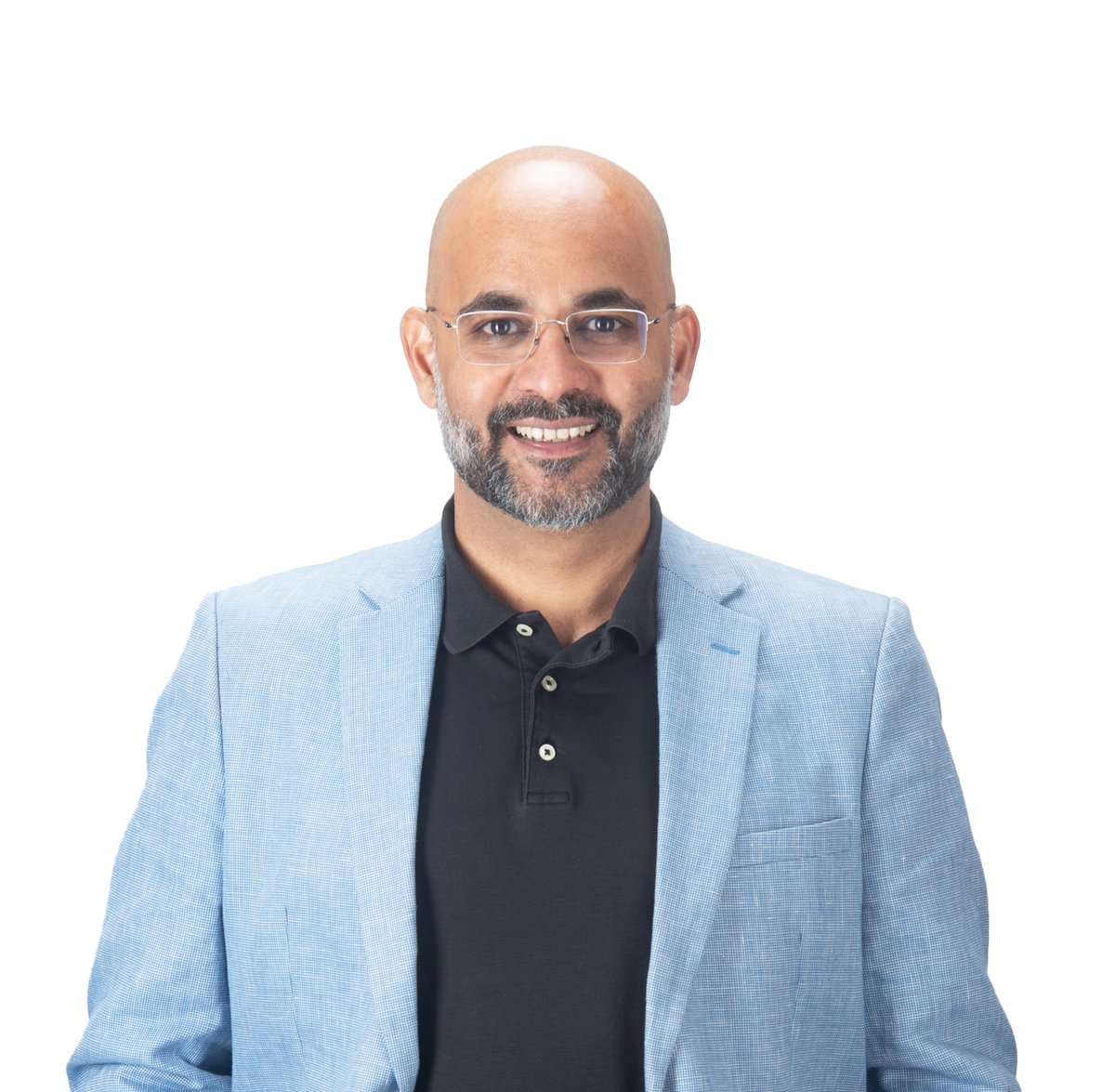
| Key facts | |
|---|---|
| Born | c. 1977-78 (he said he was 46 in July 2024) [51] |
| Hometown/Family roots | Father served in the Indian Navy; grew up in several states; studied and started his first company in Mumbai; has lived and worked in Bengaluru since 2011 [51][10] |
| Education | B.E. Computer Engineering, Sardar Patel Institute of Technology, Mumbai (1999 batch); MS Computer Science, University of Arizona; MBA, Wharton [20][8][22] |
| Family | Has spoken publicly of his father’s Navy career; keeps his own family private [51] |
| Company/Group | Co-founder and CEO, PhonePe Ltd (majority-owned by Walmart) [1][8] |
| Wealth | Rs 5,504 crore (about US$589 million), 360 ONE Wealth Creators List 2026, July 2026 [9][67] |
| Known for | Building PhonePe into India’s largest UPI app, handling about 46% of UPI payment volume [46] |
On a weekday in 2016, a handful of engineers walked into a cheap office on the edge of Bengaluru’s HSR Layout. Some days, Sameer Nigam later recalled, people would come in and find the tyres of their vehicles let down [10]. Upstairs, the team was building an app for a payments system that most of India’s big banks thought would never work. Nigam put the odds of success at about one in a hundred.
“Rahul and myself were knocking on 40, Burzin was knocking on 50,” he said of himself and his co-founders Rahul Chari and Burzin Engineer. “We’d tasted some success in our previous ventures, we had the luxury of taking that one percent punt for a very, very large opportunity… we could afford to fail, we knew what it looked like.” [10]
The punt paid off. Ten years later, PhonePe processes close to 11 billion UPI transactions a month, about 46% of all payments made through UPI apps [46]. Its blue icon sits on phones across India - it had more than 50 crore registered users by 2023 [7] - and “PhonePe karo” is as common at a chaiwalla’s stall as in a mall. The company has been valued at more than US$12 billion by private investors [26] and has SEBI’s clearance for one of the largest tech IPOs India has seen [76].
Nigam’s own story is different from the usual Indian start-up legend. He is no college dropout. He did not start young, and at the start he turned down venture capital. He is the son of a Navy family, a trained engineer with a Wharton MBA, and a man who sold two companies to Flipkart before building his biggest one. His story is about patience, partnership, and the strange business of making money from a product the government says should be free.
Where it began
Sameer Nigam has kept his early life largely private. What he has said in public is brief and telling. “I am 46 years old. Never lived in a state for 15+ yrs,” he wrote in July 2024. “My father worked in the Indian Navy. Got posted all over the country.” [51][70] Like many children of service families, he grew up moving between postings, changing schools and cities.
There is no reliable public record of his exact date or place of birth. Various websites give 1978, and some say he was born in Delhi or went to school in Noida. None of these claims is backed by a primary source, so this profile does not repeat them as fact. What his own words and the record show is a birth year around 1977-78: he was 40 in late 2017, according to Forbes India [15], and 46 in July 2024 [51].
Bombay, and a friend for life
The anchor of his story is Mumbai. In 1995, Nigam began an undergraduate engineering course in the city. In his first year he met Rahul Chari, the man who would be his co-founder for the next three decades. “Chari and I went to undergrad in Bombay so we’ve known each other since 1995,” Nigam said in 2021. “His wife was a junior of ours in college. I mean literally the families have known each other.” [10]
The college was Sardar Patel Institute of Technology (SPIT) in Andheri, on the Bharatiya Vidya Bhavan campus. In December 2024, Nigam and Chari returned for the 25-year reunion of their 1999 batch. They received the institute’s distinguished alumni award and pledged a US$1 million grant to their old college [20][21]. Some older profiles name its sister college, Sardar Patel College of Engineering, on the same campus [15]. The 2024 award and the fact that SPIT opened in 1995, the year Nigam began college, both point to SPIT.
After graduating, the two friends went to the United States. Both studied for a master’s in computer science at the University of Arizona in Tucson, and they shared a room there [10][8].
A career in Los Angeles
Nigam started work in Los Angeles around 2000-2001 [10]. He joined Shopzilla, a comparison-shopping website, and rose to director of product management. He helped build its in-house shopping search engine, according to his Walmart leadership biography [8]. In Los Angeles he met Burzin Engineer, an engineer almost ten years older than him, who would become the third member of the team [10].
He then went to the Wharton School of the University of Pennsylvania for an MBA. In 2009 he won the Wharton Venture Award, a prize for student entrepreneurs [8]. Forbes India reported that he won about US$15,000 in a business-plan contest, money that “gave me play money” [15]. YourStory has described it as a US$25,000 grant for an online-music idea [16]. The amount differs between sources; the award itself is recorded by Walmart.
The first break
A music company that made no money
The music idea became his first company. In early 2009, after Chari quit his job at Cisco, the friends started a venture called Manoramic. Nigam and Chari had met again at a friend’s wedding in Mumbai, and Chari dropped a real-estate idea of his own to join [16][15]. The company soon took the name Mime360 - short for “Manoramic International Media Exchange” [16]. Chari has said its first office was inside their old college, SPIT [21].
Mime360 was a business-to-business platform for digital music. It took catalogues from labels such as Saregama and Universal and supplied them to online services, including Gaana [13]. Technically it worked. Commercially it struggled. “We had this really cool platform that was powering Gaana and a bunch of startups, it made no money,” Nigam said later. “We were just married to the IP, we were just having fun.” [10] His lasting lesson: “We were working in the music industry and learned the very hard way you don’t make money in the music industry easily.” [10]
Joining the Flipkart floor
In 2010-11, the three founders met Flipkart’s young leaders. Nigam remembers Sachin Bansal spending half an hour at a whiteboard explaining why Indian e-commerce would become a US$25-30 billion business by 2020. Binny Bansal, asked about rumours that Amazon might buy Flipkart, said he wanted people to one day ask whether Flipkart was buying Amazon [10]. On leaving that meeting, Burzin Engineer turned to his younger partners. “Either these guys are just crazy or they’re just going to change the world,” Nigam recalls him saying, “and I think we should join.” [10]
In October 2011, Flipkart bought 100% of Mime360 in a deal that MediaNama reported as part stock and part cash [13]. Forbes India later described it as all-stock [15]. About a dozen engineers moved to Bengaluru. The deal itself was quick. “We met for half a day, we shook hands, we kind of moved in and then completed the deal, paperwork ages later,” Nigam said [10]. (For the Flipkart founders’ own stories, see our profiles of Sachin Bansal and Binny Bansal.)
The Mime360 platform became Flyte, Flipkart’s MP3 store, launched in early 2012. It closed in June 2013 after Flipkart concluded India’s paid-download market would not scale [14]. Chari blamed the cost and friction of tiny online payments, not piracy [15]. That failure planted an idea: if paying Rs 10 online was this painful, someone needed to fix payments.
Four years in the crucible
Nigam joined Flipkart as vice-president of business development for digital content. Within two years he ran online and mobile marketing. By 2014 he was a senior vice-president, and by 2015 he headed engineering [17][19]. He has called those years “one of the most exciting parts of my career”, “equal parts heady, equal parts just stressful” [10].
At Flipkart he saw a problem close up. During the Big Billion Day sales, “the payment rails were just falling apart”, and about 70% of shoppers still chose cash on delivery because paying online - with OTPs, card details and failed transactions - was “such a nightmare” [10].
On 9 July 2015, Flipkart’s Mukesh Bansal told staff that Nigam, then senior vice-president of engineering, was leaving “to start his own venture in the technology space” [18][19]. Chari followed in October [16].
Building the empire
The one-percent bet (2015-2016)
The three partners first explored building a “brokering layer” on IMPS, the bank-to-bank instant transfer system, but felt they had “no prayer” of convincing big banks to disrupt themselves [10]. Then came the first hackathons for UPI, the Unified Payments Interface designed by the National Payments Corporation of India (NPCI). There Nigam heard Nandan Nilekani and the iSPIRT volunteers explain it. What convinced him was who was behind it: “the regulator was very, very excited, NPCI was very, very excited,” and banks such as Axis and ICICI had signed up [10].
UPI promised something new. Any app could link to any bank account and move money instantly using a simple address, with no card, no wallet top-up and no fee. Most large banks, Nigam recalled, were “pooh-poohing it” [10]. He saw a once-in-a-generation shift: “If a brokering layer is connecting a hundred banks without me putting in that effort, as long as I can build a mind-blowing interface and keep it really simple, I have an opportunity to… say a billion people can make payments using an app.” [10]
PhonePe was founded in December 2015 by Nigam, Chari and Engineer [12][11]. No figure for its starting capital has ever been made public.
The hardest decision: selling early
Investors came calling. Matrix Partners and Norwest were among those offering to back the team [10]. But Paytm, Freecharge and others were raising large sums for wallets, and Nigam knew a UPI app would need a “capital war chest” to grab the market if UPI took off [10]. He chose a different route. On 1 April 2016, Flipkart announced it was acquiring PhonePe, the trio’s second sale to the company [11][12]. Terms were not disclosed; The Economic Times reported it was not a cash deal [12]. “We are really excited to merge with Flipkart and get access to one of the largest consumer bases in the country,” Nigam said at the time [11].
He called it “one of the hardest [decisions] in life” [10]. The deal was not a soft landing. Flipkart’s money came “over a three-year committed model based on targets… all the risk was ours”, and Binny Bansal promised PhonePe would run independently with its own culture. “I think we’d passed the age in life where we’re willing to inherit culture and not build it our way,” Nigam said [10].
First to UPI (2016-2017)
In August 2016, PhonePe launched what it describes as the first Android app for UPI-based services. It was also the first UPI app on iOS, in January 2017, and the first to cross 10 million downloads [6]. In October 2016, UPI payments went live on Flipkart and Myntra [6].
Then came the shock. On 8 November 2016 the government withdrew Rs 500 and Rs 1,000 notes. Overnight, Indians needed another way to pay. “Without de-mon, the urgency for people to find an alternative to cash… would not have happened,” Nigam said in 2021. The Prime Minister and NITI Aayog “putting their name and face behind UPI” built trust that “no amount of money can buy” [10]. Paytm’s wallet won the first rush (see our profile of Vijay Shekhar Sharma), but UPI was the system that lasted, and PhonePe was built on it from day one. Nigam himself has called Paytm “the most innovative by far and away” in the sector [63].
PhonePe’s other early bet was the shopkeeper. While rivals chased online use, it signed up neighbourhood merchants in large numbers with free QR codes. By December 2022 PhonePe had more than 35 million offline merchants in 99% of India’s pin codes [3].
In 2017 it moved into financial services, beginning with digital 24-carat gold [3]. Insurance, mutual funds and bill payments followed.
Walmart, and a company of its own (2018-2022)
In 2018, Walmart bought 77% of Flipkart for US$16 billion. PhonePe came along as part of the package [23]. Walmart’s chief operating officer at the time singled out PhonePe as something Walmart could learn from [23].
For several years PhonePe lived inside Flipkart, which funded its losses. A partial separation was announced in December 2020. By December 2022, ownership was fully separated, with Walmart remaining the majority owner of both [3]. At that point PhonePe had more than 40 crore registered users [3].
The separation came with a large cost. PhonePe had been owned through a Singapore company, as many Indian start-ups were. In October 2022 it moved its home, or “domicile”, to India. That meant a fresh market valuation and tax on the gain. “Our investors have paid almost Rs 8,000 crores in taxes just to allow us to come back to India,” Nigam said in January 2023 [24][25]. More than 3,000 employees’ stock options had to be re-issued with a fresh one-year waiting period. “It’s very hard for startups, particularly early-stage startups,” he said [24]. The move made PhonePe an Indian company that could list in India.
Raising money, building beyond payments (2023-2024)
In 2023 PhonePe raised US$850 million at a pre-money valuation of US$12 billion. General Atlantic and co-investors led with US$550 million; Walmart, Ribbit Capital, Tiger Global and TVS Capital put in about US$300 million [26]. In April 2023 PhonePe handled 47.4% of UPI transactions by volume and just over half by value [26].
With fresh capital, Nigam went after the “bunch of other stuff” he had wanted to build from the start - including, as he admitted, an app store and a browser that investors once thought “nuts” [10]. In 2023 PhonePe launched a payment gateway, merchant lending, an account aggregator and Pincode, a shopping app built on the government-backed ONDC network [7]. On 30 August 2023 it launched Share.Market, a stockbroking app, taking on Zerodha and Upstox [27]. (See our profile of Nithin Kamath for that rival’s story.)
On 21 February 2024 came the boldest launch: the Indus Appstore, an Android app store meant to rival Google Play. It launched with more than 200,000 apps in 12 Indian languages. It charged no commission when developers used their own payment systems [4]. “Indus Appstore challenges the status quo, ushering in an era of more healthy competition,” Nigam said [4]. Developers, he argued, were “desperate for an alternative” [28].
The money machine (FY23-FY26)
Revenue grew quickly, though losses stayed large because of heavy stock-option costs:
| Financial year | Operating revenue | Net loss | Source |
|---|---|---|---|
| FY23 | about Rs 2,914 crore | Rs 2,795 crore | [30] |
| FY24 | Rs 5,064 crore | Rs 1,996 crore | [30] |
| FY25 | Rs 7,115 crore | Rs 1,727 crore | [31] |
| FY26 | Rs 7,920 crore | Rs 2,792 crore | [32] |
Much of the loss was a non-cash charge for employee stock options: about Rs 2,358 crore in FY25 by Entrackr’s count (Inc42 reports Rs 2,283 crore) [31]. Excluding such items, PhonePe reported an adjusted profit of Rs 630 crore in FY25 and Rs 1,202 crore of operating cash flow [31]. The FY26 loss widened partly because of one-off write-downs on the Indus Appstore (Rs 685 crore) and on Pincode (Rs 365 crore), and because marketing spend nearly doubled to Rs 956 crore [32].
The business mix also changed. Consumer payments made up 83% of revenue in FY23 but only 56% in the first half of FY26, as merchant payments, lending, insurance and other services grew [33].
The road to the stock market (2025-2026)
In September 2025, PhonePe filed confidential draft IPO papers with SEBI [38]. SEBI approved them in January 2026 [76], and on 21-22 January 2026 the company filed its updated draft prospectus (UDRHP) [1][37]. The offer was entirely a sale by existing shareholders. Walmart would sell about 4.6 crore shares, about 9% of the company, while Microsoft and Tiger Global would exit fully. The founders would sell nothing [1][37]. Reported valuation hopes were about US$15 billion [37].
The filing also showed what Nigam owned. He and Chari each held about 2.55% of PhonePe; Walmart held about 72% and General Atlantic about 9% [36]. Nigam and Chari are not classified as “promoters” in the filing [33][36].
The filing revealed another detail. In September 2025, each founder was allotted about 2.16 crore shares under founder award schemes. Days later, each sold about 84.2 lakh shares to General Atlantic at Rs 2,338.60 a share - together worth about Rs 3,937 crore [34][35]. PhonePe said the money went to pay tax due on exercising those awards, not to cash out [34][35]. That share price valued PhonePe at roughly Rs 1.2 lakh crore; at that price, a rough calculation puts a 2.55% stake at about Rs 3,000 crore.
Then the world intervened. On 16 March 2026, with war in West Asia shaking markets, PhonePe paused its IPO. “We remain committed to a public listing in India,” Nigam said [39][40]. Reuters had reported a target valuation of US$9-10.5 billion only days earlier [41].
MDR, the UAE and the next decade (2026)
For years Nigam argued that UPI’s zero-fee rule for merchants was unsustainable. “Why should UPI be free to merchants?” he asked in September 2026. “It’s never going to be sustainable over the long run.” [44] He told reporters PhonePe had spent about US$1.7-1.8 billion building its UPI business over a decade [45].
In September 2026 the government announced a merchant fee (MDR) of 0.4% on merchant UPI payments above Rs 2,000, capped at Rs 300, from 15 October 2026 [44][42]. Nigam said it “definitely will push us closer to a filing” [43]. He also insisted consumers would not be charged [44]. The rollout was later deferred until after Diwali, and as of early November 2026 no new date had been set [74][75]. Inc42 reported, citing unnamed sources, that PhonePe may refile and target a listing in February-March 2027 at about US$10 billion; PhonePe declined to comment [42].
PhonePe also went abroad. At the Global Fintech Fest in 2026, Nigam said it had a licence from the Central Bank of the UAE and would launch local operations there - its first foreign market [65]. In his keynote he set out a 10-year plan built on UPI for feature phones (UPI 123Pay), small “sachet” products such as daily fixed deposits from Rs 100 and SIPs from Rs 10, and AI-driven lending. “True progress isn’t measured by how fast the top 10% move; it is measured by whether we leave anyone behind,” he said [66].
The setbacks and failures
Mime360 never made money. Nigam’s first company built good technology but had no business model. The Flipkart sale gave its founders a soft landing, but its main product, the Flyte music store, closed within about 16 months [14].
Some big bets misfired. The Pincode consumer app, launched in 2023, was wound down on 4 December 2025 to focus on helping stores, with Nigam saying quick commerce had become a distraction [29]. The Indus Appstore led to a Rs 685 crore goodwill write-down in FY26 [32].
Regulation removed revenue. Two lines of business disappeared in 2025. Credit-card rent payments stopped in September 2025 after RBI communication, and real-money gaming payments ended after the Online Gaming Act of August 2025. Together they had brought in about Rs 1,500 crore in FY25 revenue [34].
The 30% cap still hangs over the company. In November 2020, NPCI said no single UPI app could have more than 30% of transactions. The deadline has been pushed back three times, most recently to 31 December 2026 [50][73][72]. In August 2024 Nigam said the uncertainty was holding back the IPO: “I feel nervous going to the market and asking investors if there is a 30 per cent market cap lurking.” [48] In October 2026 he questioned a rule designed six years earlier, when WhatsApp was entering payments. He noted that more than 100 UPI apps now operate, and said PhonePe would comply with any order to stop adding customers, though it opposed one [45]. PhonePe’s share has eased to about 45.6% of app volume in September 2026, from 46.3% in October 2025 [46][47].
People leave. The IPO filing showed employee attrition of 34% in FY25 and 22% in the first half of FY26, among a workforce of about 12,300 [68].
The IPO has waited. After the domicile move, a SEBI approval and an updated filing, PhonePe still had not listed by November 2026. Each delay has come with a lower reported valuation than the US$15 billion talked about in January [37][41].
Controversies and allegations
The Karnataka job-quota row (July 2024)
Allegation: In July 2024, the Karnataka cabinet approved a bill to reserve private-sector jobs for local people. Industry leaders, including Kiran Mazumdar-Shaw, objected [70]. On 17 July Nigam wrote on X: “My father worked in the Indian Navy. Got posted all over the country. His kids don’t deserve jobs in Karnataka? I build companies. Have created 25000+ jobs across India! My kids don’t deserve jobs in their home city? Shame.” [51][70] Some pro-Kannada activists and users said the post insulted Karnataka, and #BoycottPhonePe and #UninstallPhonePe trended on X [52].
Response: PhonePe gave “no official comment” at first [52]. On 21 July Nigam apologised: “It was NEVER my intention to insult Karnataka and its people… I am truly sorry and would like to offer you an unconditional apology… I have the highest regard for Kannada, and all other Indian languages.” He pointed to PhonePe’s Bengaluru roots [53][54].
Status: The state put the bill on hold after the industry backlash [53][70]. No measurable effect on PhonePe’s business was reported. The matter is closed as far as PhonePe is concerned.
PhonePe v. BharatPe over “Pe” (2019-2024)
Allegation: In 2019, PhonePe went to court claiming rights over the suffix “Pe” (in English and Devanagari) and asked for an order against BharatPe using it. The cases ran for about five years in the Delhi and Bombay High Courts and before the trademark registry [55].
Response: BharatPe contested the claims. Both sides called the eventual settlement good for Indian fintech; BharatPe’s chairman Rajnish Kumar called it “a positive development for the industry” [55][56].
Status: Settled on 26 May 2024. All court cases were withdrawn, both sides dropped their objections at the trademark registry, and no money terms were disclosed [55][56].
RBI penalties on PhonePe’s wallet business
Allegation: The Reserve Bank of India has fined PhonePe three times over its prepaid wallet business:
- May 2019: Rs 1 crore for not following prepaid payment instrument (PPI) rules [57].
- November 2020: Rs 1.39 crore for “non-compliance of regulatory guidelines” [58].
- September 2025: Rs 21 lakh. RBI found that on some days the money in PhonePe’s escrow account was less than what it owed wallet holders and merchants, and that PhonePe did not report the shortfall promptly. The finding came from an inspection covering October 2023 to December 2024 [2][59].
The IPO filing also listed other RBI inspection observations. These included more than one wallet issued against a single ID document, delays in updating customer KYC, video-KYC deviations, and gaps in transaction monitoring [60].
Response: In its IPO filing PhonePe said the RBI’s inspection findings were routine and that corrective steps had been completed internally [60].
Status: The penalty orders stand; no appeal against them has been reported. RBI fines of this kind relate to compliance lapses and do not amount to a finding of fraud. None of the actions names Nigam personally.
Enforcement Directorate information requests (2024-2026)
Allegation: PhonePe’s January 2026 updated IPO filing disclosed that the Enforcement Directorate’s Bengaluru office had sent it notices under the money-laundering law (PMLA). The notices were dated 1 December and 28-29 December 2025 and sought transaction and settlement data relating to WinZO Games and another gaming company [61]. Reports also said ED offices in Mumbai and Delhi had summoned PhonePe between June 2024 and April 2025 for information about two third-party merchants [61].
Response: PhonePe said it had replied, and that the companies concerned have no link to PhonePe, its promoters or senior management. A spokesperson said: “Our limited role is that of a third-party information provider aiding the investigation in accordance with the law.” [61]
Status: Pending as of the filing. None of the reports accuses PhonePe or Nigam of wrongdoing; the requests are for information about other companies’ transactions.
Market dominance and the UPI “duopoly”
Allegation: NPCI, which runs UPI, and some critics have said that two apps - PhonePe and Google Pay - control too much of UPI, which is national infrastructure. Together they handled about 82% of UPI app volume in September 2025 [46]. NPCI proposed the 30% cap in 2020 to reduce this concentration risk [50].
Response: Nigam has argued that the market, not regulation, should decide market share. He has said more than 100 UPI apps compete and that the cap was designed for a different market [45][49]. He has said PhonePe would comply with whatever is decided [45].
Status: The cap’s deadline is 31 December 2026. NPCI had not announced its final decision by 11 November 2026 [50][45].
There are no court findings, regulatory orders or major investigations alleging personal wrongdoing by Sameer Nigam. This section is current as of 11 November 2026.
Giving back
Nigam’s best-known personal gift is to his college. In December 2024, he and Rahul Chari pledged US$1 million to Sardar Patel Institute of Technology for infrastructure, innovation and student entrepreneurship. “It was here that my cofounder Nigam and I truly began our entrepreneurial journey,” Chari said [20].
During the first Covid-19 lockdown in March 2020, PhonePe ran the #100CrorePledge. The company promised Rs 10 for every user who gave at least Rs 1 to PM CARES, up to Rs 100 crore. Nigam called it “an attempt to lift the mood of the country in this period of crisis” [5]. This was company money, not his own.
He also gives time to public-interest work. He sits on the board of the Mojaloop Foundation, a non-profit that builds open-source payment software for poorer countries. “If we want to make the world a more financially inclusive place, we need to work together,” he said [69]. He is treasurer and a governing council member of the Internet and Mobile Association of India for 2025-27 [71].
Unlike some founders, he has not made public a large personal donation pledge. Most of his wealth is tied up in PhonePe shares that have not yet been listed.
Succession
In his late forties, Nigam is not near retirement, and PhonePe is not a family business. Control lies with Walmart, which owns about 72% [36]. The founders run the company under a professional board. His pay is modest for a company of PhonePe’s size: Rs 2.6 crore in FY25, the same as Chari, with approved pay of up to Rs 4.33 crore a year (excluding perquisites) for three years from May 2025 [62].
The founding trio itself is the clearest succession plan. Nigam has said the three can speak for each other: “having the luxury of having three founders where anyone can answer that on behalf of the others… literally we complete our sentences” [10][64]. Chari serves as chief technology officer [16]. Engineer works mostly from the United States [10].
What their journey teaches
Late starts can be an advantage. Nigam started PhonePe at nearly 40, after one company that made no money and four years at Flipkart. Age let him take a “one percent punt” calmly, because he knew what failure looked like and could survive it [10].
Pick partners by shared history, not just shared excitement. Nigam and Chari have known each other since 1995, and Nigam has known Engineer since 2000-01. Nigam warns that “too many founders, young folks, confuse bonding with trust” [10]. Trust, he argues, comes from transparency - PhonePe has shared its monthly profit-and-loss figures with all employees since its first month [10].
Bet on who is pushing the change, not just the change. Nigam backed UPI because the RBI, NPCI and the government were behind it, even while most big banks dismissed it [10]. In regulated sectors, the regulator’s direction is often the most important early signal.
Selling early can be a growth move. Turning down venture money to sell to Flipkart within four months looked like giving up control. In practice it gave PhonePe the capital and customers to be first to UPI, along with an agreed right to run independently [10].
Free products need a plan for profit. PhonePe won India’s biggest payments market on a product that earned almost nothing from merchants. Its growth into lending, insurance, broking and merchant services, and its long fight for MDR, show that market share alone does not pay the bills [33][44].
Apologise quickly and plainly when you get it wrong. The 2024 Karnataka post hurt many people in PhonePe’s home state. Nigam’s unconditional apology four days later, and his statement of respect for Kannada, ended the row [53].
A profile for general reading, based on public records and reporting as of 11 November 2026. Not investment, tax or legal advice.
Sources (76)
- PhonePe Limited Updated Draft Red Herring Prospectus (UDRHP-I) - PhonePe/Morgan Stanley, Jan 2026
- RBI imposes monetary penalty on PhonePe Limited - Reserve Bank of India, Sep 2025
- Flipkart completes full separation of PhonePe - PhonePe press release, Dec 2022
- PhonePe unveils Indus Appstore - PhonePe press release, Feb 2024
- PhonePe's #100CrorePledge challenge goes viral - PhonePe press release, Mar 2020
- PhonePe's 1st Birthday - Our Story Thus Far - PhonePe blog, May 2017
- PhonePe 2023 Recap - PhonePe blog, Dec 2023
- Sameer Nigam - Walmart corporate leadership, 2026
- Sameer Nigam - 360 ONE Wealth Creators List, Jul 2026
- The PhonePe journey with Sameer Nigam (podcast transcript) - Z47/Matrix Partners India, Aug 2021
- Flipkart acquires payment firm PhonePe - Business Standard (PTI), Apr 2016
- Flipkart acquires former executives' startup PhonePe for payments push - The Economic Times, Apr 2016
- Flipkart acquires Mime360 - MediaNama, Oct 2011
- India's Flipkart shutters its digital music store - The Next Web, May 2013
- Flipkart's PhonePe calculations - Forbes India, Dec 2017
- Techie Tuesday: PhonePe CTO Rahul Chari - YourStory, Dec 2019
- Meet the people who built Flipkart - YourStory, Aug 2018
- Flipkart's CTO Amod Malviya, engineering head Sameer Nigam quit - Inc42, Jul 2015
- Top-level exits at Flipkart - Business Standard, Jul 2015
- PhonePe cofounders announce $1 Mn grant for alma mater SPIT - Inc42, Dec 2024
- SPIT alumni association hosts 1999 batch's 25-year reunion - Deccan Chronicle, Dec 2024
- Sameer Nigam - EY Entrepreneur Of The Year finalists 2024 - EY India, 2024
- Walmart-Flipkart deal done - TechCrunch, Aug 2018
- Investors forked out Rs 8,000 cr to shift base from Singapore to India, says Sameer Nigam - Business Today, Jan 2023
- PhonePe investors had to pay Rs 8k cr to move domicile to India: CEO - Business Standard, Jan 2023
- PhonePe raises $100 Mn more from General Atlantic, total fundraise reaches $850 Mn in 2023 - Inc42, May 2023
- PhonePe takes on Zerodha, Upstox, unveils stock broking platform - Business Standard, Aug 2023
- PhonePe aims to be a top Google Play alternative in India - TechCrunch, Feb 2024
- Walmart-backed PhonePe winds down its Pincode app - TechCrunch, Dec 2025
- PhonePe crosses Rs 5,000 Cr revenue in FY24, losses dwindle - Entrackr, Oct 2024
- PhonePe posts Rs 7,115 Cr revenue and Rs 630 Cr adjusted PAT in FY25 - Entrackr, Sep 2025
- IPO-bound PhonePe posts Rs 2,792 Cr loss in FY26, revenue up 11.5% - Inc42, Jul 2026
- PhonePe files UDRHP, cites payment processing charge as risk - MediaNama, Jan 2026
- PhonePe pre-IPO reset: Rs 3,937 Cr founders' secondary, Rs 1,500 Cr hit from credit card rent, RMG exits - Entrackr, Jan 2026
- PhonePe cofounders sold shares worth INR 4,000 Cr to General Atlantic in September - Inc42, Jan 2026
- PhonePe DRHP: A look at shareholding pattern and key executives - Inc42, Jan 2026
- Tiger Global and Microsoft to fully exit Walmart-backed PhonePe via its IPO - TechCrunch, Jan 2026
- PhonePe files confidential draft papers ahead of IPO - Business Standard, Sep 2025
- Walmart-backed PhonePe shelves IPO as global tensions rattle markets - TechCrunch, Mar 2026
- PhonePe pauses IPO plans amid market turmoil and geopolitical tensions - BusinessDay (Reuters), Mar 2026
- PhonePe IPO: Fintech major eyes up to $10.5 billion valuation, says report - Business Today, Mar 2026
- With UPI MDR clarity, PhonePe eyes IPO by March 2027 - Inc42, Sep 2026
- PhonePe's Sameer Nigam says UPI MDR move brings IPO filing closer - The Hans India, Sep 2026
- Why PhonePe, Paytm and MobiKwik CEOs back UPI MDR above Rs 2,000 - MediaNama, Sep 2026
- 'Lowest in world': PhonePe CEO Sameer Nigam backs 0.4% MDR - Free Press Journal, Oct 2026
- PhonePe and Google Pay's combined UPI app share fell to 77.8% in Sept 2026 - MediaNama, Oct 2026
- UPI in October: PhonePe, Google Pay's lead softens amid record volumes - Inc42, Nov 2025
- PhonePe CEO says UPI market cap overhang holding back company from going public - Business Standard, Aug 2024
- India's mobile payments dilemma - TechCrunch, Dec 2024
- NPCI extends 30% UPI market share cap deadline to December 2026 - Business Today, Dec 2024
- 'Shame': PhonePe CEO Sameer Nigam on Karnataka's private sector quota bill - Business Standard, Jul 2024
- Boycott PhonePe trends after CEO's remarks against now-stalled jobs quota bill - Deccan Herald, Jul 2024
- Never my intention to insult Karnataka: PhonePe CEO apologises - Business Today, Jul 2024
- PhonePe CEO Sameer Nigam apologises for comments on Karnataka's job reservation bill - The News Minute, Jul 2024
- BharatPe, PhonePe settle all trademark disputes over 'Pe' suffix - Entrackr, May 2024
- BharatPe, PhonePe settle trademark disputes over 'Pe' suffix - Outlook Business, May 2024
- RBI slaps penalty on PhonePe, Vodafone m-pesa for violating norms - The Week, May 2019
- RBI imposes over Rs 5.78 crore fine on six entities including PNB, Sodexo, PhonePe - Business Today, Nov 2020
- RBI fines PhonePe Rs 21 lakh for escrow shortfall, PPI norms violation - Business Standard, Sep 2025
- PhonePe IPO: 100% OFS, continued losses and regulatory scrutiny in focus - Entrackr, Feb 2026
- PhonePe discloses ED inquiry into WinZO transactions in updated DRHP - Storyboard18, Feb 2026
- PhonePe discloses CXO pay ahead of IPO; CEO, co-founder drew Rs 2.6 crore each in FY25 - Storyboard18, Sep 2025
- Here's what PhonePe's CEO thinks about rivals Paytm and CRED - Storyboard18, May 2025
- Matrix Moments: PhonePe CEO Sameer Nigam, from Flipkart to PhonePe - YourStory, Jul 2021
- PhonePe to launch operations in UAE in first global foray - The Pioneer, 2026
- PhonePe's Sameer Nigam unveils vision for next decade of financial inclusion at GFF 2026 - Outlook Business, 2026
- India now has 3,040 individuals with a combined wealth of Rs 104 lakh crore - Business Today, Jul 2026
- PhonePe IPO: employee exits rise to 22% in H1 FY2026 - Storyboard18, Jan 2026
- PhonePe and the Mojaloop Foundation: building cross-platform payment systems - Mojaloop Foundation, Sep 2020
- 'Shame': PhonePe founder Sameer Nigam joins the chorus against Karnataka's reservation bill - Free Press Journal, Jul 2024
- Our leadership - Internet and Mobile Association of India, 2025
- India again delays rules to break PhonePe-Google Pay duopoly - TechCrunch, Dec 2024
- NPCI extends market cap deadline for UPI apps for another two years till 2026 - ThePrint (PTI), Jan 2025
- UPI MDR charges after Diwali: NPCI defers Oct 15 rollout - Daily Jagran, Nov 2026
- NPCI delays UPI MDR rollout - MediaNama, Oct 2026
- PhonePe gets SEBI nod for IPO - Inc42, Jan 2026