
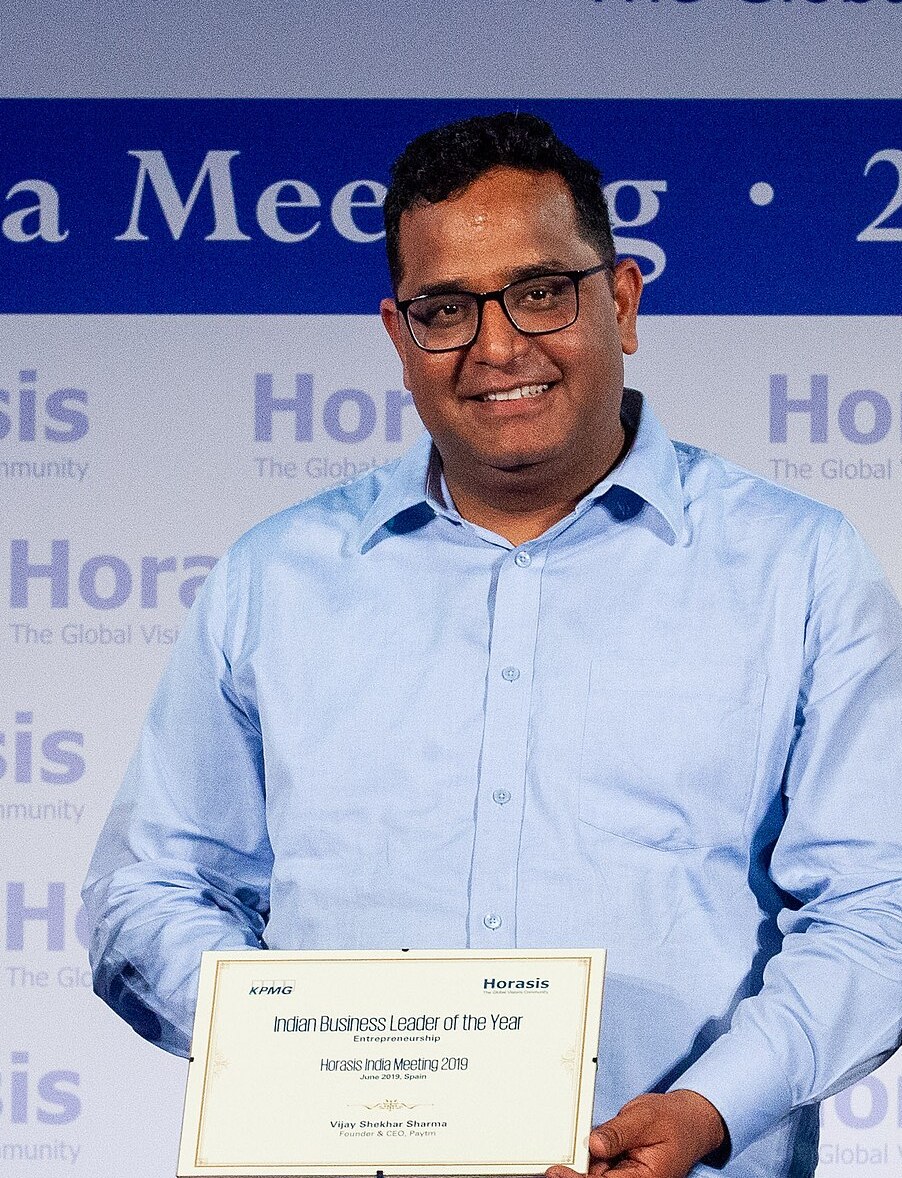
| Key facts | |
|---|---|
| Born | 1978, Aligarh district, Uttar Pradesh. Paytm’s 2021 IPO prospectus gives 15 July 1978 [1]; many popular profiles say 7 June 1978 |
| Hometown/Family roots | Harduaganj, near Aligarh; father a schoolteacher, mother a homemaker; third of four children [14][17] |
| Education | Hindi-medium school in Harduaganj; B.E. in Electronics and Communication, Delhi College of Engineering (1998) [12][1] |
| Family | Married since 2005 [15] |
| Company/Group | Founder, MD and CEO of One 97 Communications Ltd (Paytm) [1][94] |
| Wealth | About US$1.7 billion (Forbes real-time estimate, October 2026) [57]; Rs 11,813 crore on the 360 ONE Wealth Creators List 2026 [61] |
| Known for | Building Paytm, the QR-code and wallet app that put digital payments in the hands of India’s small shopkeepers; India’s biggest IPO of its time (2021) |
On the morning of 18 November 2021, Vijay Shekhar Sharma stood on the stage at the Bombay Stock Exchange in a blazer and a broad grin. Paytm was about to list after raising Rs 18,300 crore, then the largest share sale in Indian history [34]. The ceremony opened with the national anthem. Halfway through, the boy from a Hindi-medium school in a small town near Aligarh began wiping his eyes. “The words ‘Bharat Bhagya Vidhata’ overwhelm me,” he told the audience. “Uttering these words brings tears to my eyes.” He added a line that has stayed with many people since: “Today is the day when a commoner surname seems an outlier in this country.” [36]
By the closing bell, Paytm’s shares were down 27%. About Rs 38,000 crore of investors’ money had vanished on day one [35].
That single day holds the whole Vijay Shekhar Sharma story: an outsider who got further than almost anyone expected, a showman who wears his heart on his sleeve, and a founder whose ambition has repeatedly run ahead of what markets and regulators were willing to accept. In the five years since, he has lived through a share-price collapse, a central bank shutting down the bank he chaired, a SEBI case over his stock options, and then, against most predictions, Paytm’s first full year of profit.
This is the story of how a teenager who struggled to understand his English-medium engineering lectures built the app that taught a nation’s chaiwallas to say “Paytm karo”.
Where it began
Sharma grew up in Harduaganj, a small town in Aligarh district of western Uttar Pradesh. His father was a schoolteacher, Open magazine says he taught biology [20], and the family’s only earner. By Sharma’s own telling, his father refused on principle to give private tuitions, the usual way small-town teachers topped up their pay. The family of six had no savings, and raising Rs 2 lakh for his sister’s wedding was a struggle [14]. His mother ran the home. He was the third of four children.
He studied in a Hindi-medium government school in Harduaganj and raced through it. He was moved up grades and finished Class 12 at about 14, according to the journalist Suveen Sinha’s account [17]. Colleges would not admit anyone under 15, so he spent a gap year, part of it building his own Hindi-English dictionary from NCERT and UP Board textbooks [14].
He did not get into IIT Roorkee or a Regional Engineering College. His father pushed him to sit the Delhi College of Engineering (DCE) entrance test; father and son left Aligarh at 2 am to reach the 9:30 am exam [14]. In 1994 he joined DCE’s Electronics and Communication course with special permission from the university, the youngest in his batch [17]. Delhi University’s alumni records list him as “BE DCE 1998” [12].
The English problem
The lectures were in English, and he could not follow them. He went from front-bencher to back-bencher, and sometimes out of the class altogether. “Well, I knew scientific terms such as volts and amperes, but I did not know that pratirodh meant resistance in English,” he told Man’s World India in 2015 [19]. He later called English “my Achilles heel” [14], and almost a decade after Paytm became a household name he was still telling the story on national television, on Netflix’s The Great Indian Kapil Show in August 2025 [96].
He taught himself the language in unusual ways: by reading rock lyrics side by side with their English, and by buying second-hand copies of Fortune magazine at the Sunday book market in Daryaganj [14][17]. Those magazines were where he met Silicon Valley. “I used to read a lot about Steve Jobs and Apple,” he said in 2015. “I won’t say that I was dreaming that big but I wanted to do something on my own as futuristic as Apple.” [20]
He has also been candid that he was not driven by some grand plan. “I wasn’t a man on a mission,” he said in 2016. “I was a son running away from his father.” [14]
XS Corp: the first company
While still at DCE, around 1997, he and college friends started a small web company, XS Corp. Accounts differ on how many partners there were and in which year it began [17][12][18]. Its tagline was “XS Corp - The internet giant”, and it built content-management tools for media groups including Living Media and the Express Group [12]. When he went hunting for clients as a student, he would say: “I’m not here for the job. But I have a company that can do this job for you.” [17]
Company biographies say XS Corp was sold to Lotus Interworks of New Jersey in 1999 [11]. Sharma has described an offer worth about US$1 million, roughly Rs 1 crore in cash plus stock, paid in instalments, with a salaried job attached. He was about 20. He left about 11 and a half months later, two weeks before his shares would have vested [14][15]. Business Today’s 2009 profile gives a slightly different version of the buyers [18], so the details of the sale should be read with some caution.
After graduating he briefly took a well-paid campus job at Riverrun Software and left after about six months [14][12]. He was not cut out to be an employee.
The first break
One97: a company named after a helpline
One 97 Communications Private Limited was incorporated in New Delhi on 22 December 2000 [1]. The name came from 197, the MTNL telephone directory helpline [19]. According to the IPO prospectus, the company began with 20 shares of Rs 10 each, 10 for Sharma and 10 for a co-founder, Rakesh Shukla: a paid-up capital of Rs 200 [1]. Sharma has said he put in about Rs 2 lakh of his own savings [18].
The first idea, a “people search” phone directory, failed because telecom operators would not share their data [18][15]. Then came the dot-com bust and the 11 September 2001 attacks. Investors vanished, his two partners left, and Sharma ended up owning 100% of a company that was barely alive [15].
The lean years
What followed is the part of the story Sharma tells most often. He borrowed Rs 8 lakh from a relative at 24% interest [15] (Business Today mentions a Rs 15 lakh bank loan from the same period [18]). He dodged the landlord, slept at friends’ homes, and took small jobs setting up email systems and teaching IT courses for a few hundred rupees a day. For about a year he walked from Priya Cinema in south Delhi to East Delhi to save the bus fare. “Those few hundred bucks in the pocket do mean a lot when, otherwise, dinner is two cups of chai,” he said [15].
In 2004-05 he was earning around Rs 10,000 a month. His father told him to take any job, “even if it was for 30,000 rupees”. Marriage proposals dried up. “Families of prospective brides would never call us back after finding out that I earn around 10,000 rupees a month,” he told Reuters. “I had become an ineligible bachelor for my family.” [22] He married in 2005 [15].
Mobile content saves the company
The rescue came from India’s mobile phone boom. One97 began selling value-added services (VAS) such as cricket scores, ringtones and music to telecom operators, starting with Airtel in Punjab on a 50:50 revenue share. For a while it even ran a live astrology service for Bharti, with about 40 astrologers working in three shifts [18][15]. (Sunil Bharti Mittal’s Airtel, whose story we tell here, was One97’s first big customer.) Sharma has said that Bharti managers sought bribes to release his dues and that he refused [15].
The turning point was a bargain he later admitted he regretted. Peeyush Aggarwal, a businessman, put in about Rs 8 lakh in cash and Rs 8 lakh in office space and technology in return for 40% of One97 [15]. The IPO prospectus confirms the shape of the deal: share allotments in 2004-05 left Aggarwal and Sharma holding exactly 40% and 60% [1].
With working capital, the VAS business took off. Revenue reached about Rs 5 crore in 2006 and Rs 11 crore in 2007 [16]. In March 2007 SAIF Partners (now Elevation Capital) and Silicon Valley Bank invested; the prospectus shows SAIF’s allotment alone at about Rs 23.7 crore [1][13]. When the venture firm Helion met him in November 2006, he arrived at the Nehru Place office in a Maruti 800 and pitched in Hinglish [23]. In December 2008, in the middle of the global financial crisis, Intel Capital came in as well [1].
By about 2010 One97 had revenue of around Rs 200 crore, and Sharma was preparing to take it public. The IPO was shelved [16]. “Sometimes, a failure is a blessing in disguise,” he later said. “Failure to launch an IPO gave birth to Paytm.” [21]
Building the empire
2010: Pay Through Mobile
Sharma saw that smartphones and cheap data would make the phone itself a payment device. Paytm, short for “Pay Through Mobile”, grew inside One97 from late 2009 and went public in August 2010 as a site for prepaid mobile and DTH recharges [13]. (The company’s own prospectus dates the launch to 2009 [1].) Recharges led to bill payments and bus tickets. Refunds through banks were slow, so Paytm built its own closed-loop wallet to hold customers’ money [16]. In 2013 it got an RBI licence for a semi-closed wallet, and in 2014 it launched the Paytm Wallet app for Android and iOS [1].
2015: Jack Ma, Ratan Tata and a bank licence
In February 2015 Jack Ma’s Ant Financial, the company behind Alipay, announced it was taking a 25% stake in One97. Media reports put the figure at around US$575 million, though neither side confirmed it [24]. In September 2015 Alibaba itself agreed to invest US$500 million, and the Alibaba group became the largest shareholder with about 40% [25]. In March 2015 Ratan Tata made a personal investment of an undisclosed amount. “There is no better advisor than him,” Sharma said [26]. (Read Ratan Tata’s own life story.)
The same year, Paytm received an in-principle RBI licence for a payments bank and started taking payments at offline shops [28]. The QR code stuck to the shop counter was to become Paytm’s signature.
November 2016: the demonetisation moment
On the night of 8 November 2016, Prime Minister Narendra Modi announced that Rs 500 and Rs 1,000 notes would no longer be legal tender. Cash disappeared overnight. Paytm was ready. Traffic jumped 435% within 24 hours, and new sign-ups doubled [27][29]. Euromoney estimated that Paytm’s wallet base went from about 125 million before demonetisation to 185 million three months later, and 280 million by November 2017 [28]. Sharma said the team did “600 days of work in 60 days” [28]. “I don’t need to sleep; I am living a dream,” he said in a TV interview at the time [21].
Paytm also ran front-page newspaper ads with Modi’s photograph, congratulating him on “the boldest decision in the financial history of independent India” [28]. The ads became a controversy of their own, discussed below.
2017-2019: SoftBank, Berkshire and a US$16 billion valuation
The money now poured in:
- May 2017: SoftBank invested US$1.4 billion, at the time SoftBank’s largest cheque in any Indian startup. Paytm said it had about 220 million users [31].
- May 2017: Paytm Payments Bank began operations, with about 218 million wallets moved into it [30]. Sharma personally owned 51% of the bank and One97 owned 49% [63].
- 2017: Sharma made the Forbes billionaires list for the first time, at US$1.3 billion [58]. TIME named him among its 100 most influential people; Nandan Nilekani wrote his entry [62]. By March 2018 Forbes put him at US$1.7 billion and called him India’s youngest billionaire [59].
- 2018: Warren Buffett’s Berkshire Hathaway invested about Rs 2,179 crore, one of its very few bets on an Indian tech company [42].
- November 2019: Paytm raised US$1 billion at a valuation of US$16 billion, making it India’s most valuable startup at the time [32].
Paytm also spread into almost everything: Paytm Mall (e-commerce), Paytm Money (stockbroking and mutual funds, 2018), gaming, insurance, ticketing, and a joint venture in Japan with SoftBank that became PayPay. The new products sat on top of the same idea: millions of users and merchants already in the app.
Sharma was publicly cautious about listing. After WeWork’s failed IPO in 2019 he said: “Once we are profitable, we will think about an IPO”, and called WeWork “a lesson for everyone in the industry” [33]. Two years later, Paytm went public while still losing money.
Shareholding: how Sharma held his stake
Paytm was unusual. At its IPO it declared that it had no identifiable promoter, and Sharma, the founder and CEO, was classed as a public shareholder [77]. Before the IPO filing he moved about 5% of the company into a family trust. That brought his direct stake below 10%, from about 14.6% to 9.6% according to SEBI’s later allegation [78]. In October 2021 the board granted him 2.1 crore stock options [77]. Both points would come back to haunt him.
November 2021: the IPO
The IPO raised Rs 18,300 crore: Rs 8,300 crore in new shares and Rs 10,000 crore sold by existing investors, at Rs 2,080-2,150 a share [34]. Sharma himself sold shares worth up to about Rs 403 crore [34]. Bloomberg reported that he had pushed for the issue to beat Coal India’s 2010 record as the biggest in India [37].
It listed on 18 November 2021 at a 9% discount, closed down 27% at Rs 1,564, and kept falling [35]. By January 2022 the stock was half its issue price. Sharma said Paytm’s shares had fared no worse than global tech peers, and that he would have bought more himself, “It is just that my compliance team says I cannot buy back for six months.” [99] In April 2022 he wrote to shareholders that his own stock grants would vest “only when our market cap has crossed the IPO level on a sustained basis” [100]. The shares hit a record low of Rs 438.35 in November 2022, after SoftBank started selling [38]. Hurun’s 2022 India Rich List put Sharma’s wealth at Rs 4,900 crore, down 74% in a year [60].
Fighting for profit
The next three years were about cutting losses. In the December 2022 quarter Paytm reported its first operating profit (EBITDA before ESOP costs) of Rs 31 crore, three quarters ahead of its own target [8]. Revenue rose from about Rs 4,974 crore in FY22 to Rs 9,978 crore in FY24, while the net loss narrowed to Rs 1,422 crore [52].
Sharma also reshaped his own holding. In August 2023 Ant’s investment arm Antfin transferred 10.3% of One97 to Resilient Asset Management BV, a Dutch company owned by Sharma, worth about US$628 million at the time [44]. No cash changed hands: Resilient issued optionally convertible debentures to Antfin instead, which meant Antfin kept the economic value of those shares while Sharma gained the votes [44]. With that deal Sharma’s group became Paytm’s largest shareholder [45]. Antfin sold the rest of its direct holding in 2025 and fully exited on 5 August 2025 [46]. In August 2026 Resilient sold about 3% of Paytm in a block deal worth about Rs 2,949 crore; under the debenture agreement, the money went to Antfin, not to Sharma [47][48].
That arrangement matters for anyone trying to work out how rich Sharma really is. His direct stake in Paytm was about 9% in mid-2026 [48]. He also owns 51% of the now-closed Paytm Payments Bank, a portfolio of startup investments, and investment companies such as VSS Investco [90].
2024-2026: shrink, refocus, turn a profit
After the RBI acted against Paytm Payments Bank in January 2024 (see below), Paytm reorganised fast. The National Payments Corporation of India allowed Paytm to keep running UPI as a third-party app through Axis Bank, HDFC Bank, SBI and Yes Bank [7]. Paytm sold its movie and events ticketing business to Zomato for Rs 2,048 crore in August 2024 [40], and its stake rights in Japan’s PayPay to SoftBank for Rs 2,364 crore that December [41]. The old big investors left at a loss: Berkshire sold its last shares in November 2023 [42], and SoftBank had fully exited by 2024 [43].
The share price hit an all-time intraday low of Rs 310 on 9 May 2024 [39]. Then the turnaround began to show. Paytm posted its first quarterly profit without one-off gains, Rs 122.5 crore, in April-June 2025 [49]. In November 2025 the RBI gave Paytm Payments Services its final licence as a payment aggregator, after a long wait that followed restrictions on onboarding new merchants from 2022 [53]. In FY26 Paytm reported its first full year of profit: Rs 552 crore on revenue of Rs 8,437 crore [50]. Inc42 noted that interest and other income was larger than the pre-tax profit, so the core business was only just in the black [51].
The scars remain. Paytm’s share of UPI payments fell from about 12.9% in January 2024 to 7.4% in October 2025, far behind PhonePe and Google Pay [54]. The share recovered to about Rs 1,350 by November 2025, its highest level since December 2021 [97]. In August 2026 Resilient’s block deal was priced at Rs 1,535 a share [47], still well below the Rs 2,150 IPO price.
Sharma’s latest bet is artificial intelligence. On the May 2026 earnings call Paytm said every new investment was “ring-fenced for AI”. Sharma said: “I feel lucky that we did not dump a lot of money earlier, because in the AI world, everything resets.” [55] At the October 2026 annual general meeting he called AI “a once in a lifetime opportunity for our country” [56].
The setbacks and failures
Sharma’s career has had more falls than most billionaires’.
- The dot-com crash (2001): One97’s first product failed, his partners left, and he spent years in debt [15].
- The shelved IPO (around 2010): One97’s first attempt at listing never happened [16].
- The overreach years: Paytm Mall was meant to take on Amazon and Flipkart and faded away. Paytm’s general insurance plan was dropped in 2024, saving about Rs 950 crore of planned capital [101].
- The 2021 listing: Investors who bought at the IPO price were still underwater five years later.
- Paytm Payments Bank (2022-2026): The bank he chaired was barred from taking new customers in 2022, stopped from taking deposits in 2024, lost its licence in 2026 and is now being wound up [4][76].
- Losing the UPI lead: Paytm was the first name in digital payments, but PhonePe and Google Pay won the UPI race [54].
In a speech in July 2024 he was unusually frank about the bank: “At a professional level, we should have done better and there is no secret about it. … We learnt our lesson.” [72] He also described Paytm as being like his daughter, one who had met with an accident [73].
Controversies and allegations
Paytm has handled large sums of ordinary people’s money, so it has drawn more regulatory attention than most startups. What follows sets out each matter, who raised it, how Sharma or Paytm responded, and where it stands as of 16 October 2026. A show-cause notice or a settlement is not a finding of guilt.
RBI action against Paytm Payments Bank
Allegation: On 11 March 2022 the RBI barred Paytm Payments Bank (PPBL) from adding new customers, citing “material supervisory concerns”, and ordered an IT audit [63]. In October 2023 it fined the bank Rs 5.39 crore for lapses including failing to identify the beneficial owners of some business customers and accepting video-KYC connections from outside India [5]. On 31 January 2024 the RBI said an audit had found “persistent non-compliances and continued material supervisory concerns”, and ordered the bank to stop taking deposits, wallet top-ups, FASTag recharges and most transactions after 29 February 2024 (later extended to 15 March) [2][3]. The RBI did not publish further details. Reuters, citing unnamed sources, reported that hundreds of thousands of accounts had been opened without proper identification, with many linked to the same ID [65]; PTI reported, also citing sources, that a single PAN was linked to many accounts in thousands of cases [66]. In March 2024 the Financial Intelligence Unit fined PPBL Rs 5.49 crore under anti-money-laundering law, over accounts allegedly used by entities linked to illegal online gambling [67].
Response: Paytm denied any money-laundering allegation and said it would work with the RBI. Sharma posted that “for every challenge, there is a solution and we are sincerely committed to serve our nation in full compliance” [69]. On 26 February 2024 he stepped down as PPBL’s part-time chairman and from its board, and four independent directors were appointed [68]. He later said: “We should have done better.” [72]
What happened next:
- 14 March 2024: NPCI approved Paytm to run UPI through partner banks [7].
- February 2024: Reuters reported that the Enforcement Directorate had begun a preliminary review of PPBL’s foreign-exchange dealings [70]; days later, reports citing sources said the ED had found no FEMA violation [71]. No formal ED order has been published.
- 24 April 2026: The RBI cancelled PPBL’s banking licence, citing grounds including that its affairs were conducted in a manner detrimental to depositors and the “general character of the management”. It said the bank had enough cash to repay all depositors in full [4][74]. Paytm said it had no exposure to the bank and had already written off its investment [75].
- July 2026: The Delhi High Court ordered PPBL to be wound up and appointed an official liquidator [76].
Status: Licence cancelled; the bank is in court-supervised liquidation. Paytm’s main payments business continues under separate licences.
The 2022 report about data and China
Allegation: In March 2022 Bloomberg reported, citing unnamed sources, that the RBI’s ban on new PPBL customers followed concerns that the bank’s data was flowing to China-based entities that indirectly owned a stake in Paytm [64].
Response: PPBL called the report “false”, saying it was fully compliant with data-localisation rules and that “all of the Bank’s data resides within the country”. Sharma said the RBI’s notice did not mention data access or servers outside India [64]. In 2020 he had publicly called Paytm “proudly Indian” when India banned Chinese apps [95].
Status: The RBI has never named data-sharing with China as a reason for its actions. Ant Group’s investment arm Antfin, once Paytm’s largest Chinese shareholder, sold its last direct stake in August 2025 [46].
SEBI case over promoter status and ESOPs
Allegation: In a show-cause notice dated February 2024 and reported publicly in August 2024, SEBI alleged that Sharma should have been named a promoter in Paytm’s IPO documents. It argued that he controlled the company through his role and special rights, and that moving shares to a family trust to fall below 10% did not change that. Since SEBI rules bar promoters from receiving employee stock options, it alleged that the 2.1 crore ESOPs granted to him in 2021 broke the rules [78][6]. The proxy adviser IiAS had flagged the issue in January 2023 [77].
Response: Paytm said it believed it had complied with the law. On 16 April 2025 Sharma gave up all 2.1 crore options, valued at around Rs 1,800 crore; Paytm booked a one-time non-cash charge of Rs 492 crore [79][98].
What happened next:
- January 2025: Eight former directors and a former compliance officer settled related proceedings for a combined Rs 3.32 crore [81].
- 8 May 2025: SEBI’s settlement order. Paytm and Sharma each paid about Rs 1.11 crore, the 2.1 crore options were cancelled, and Sharma was barred from accepting stock options from any listed company for three years. Settlement was without admission or denial of the findings [6][80].
Status: Closed by settlement in May 2025.
Enforcement Directorate notice over foreign investment (Rs 611 crore)
Allegation: In March 2025 the ED issued a show-cause notice under FEMA to One97, its subsidiaries Little Internet and Nearbuy, and others including the managing director, over transactions totalling about Rs 611 crore. It alleged that One97 failed to report an overseas investment correctly to the RBI and that foreign investment was taken in without following pricing rules [82][83].
Response: Paytm said most of the alleged breaches happened at Little Internet and Nearbuy before it acquired them in 2017, and that it would pursue legal remedies [82].
What happened next:
- February 2026: The RBI issued compounding orders to settle the subsidiaries’ parts of the case for small sums, including Rs 18.76 lakh for Little Internet [84].
Status: The subsidiaries’ parts have been compounded. As of October 2026 no public decision had been reported on the portion relating to One97 itself.
SEBI notice on disclosure timing (2026)
Allegation: On 11 August 2026 SEBI issued a show-cause notice to Paytm’s key managerial personnel. It questions whether Paytm’s December 2023 announcement that it would scale back small personal loans was disclosed on time, and whether it counted as unpublished price-sensitive information under insider-trading rules [9].
Response: Paytm said it was reviewing the notice, would respond, and did not expect any financial impact [9].
Status: Pending. A show-cause notice is an allegation, not a finding.
The 2016 demonetisation ads
Allegation: Paytm’s newspaper ads after demonetisation used Prime Minister Modi’s photograph without permission. In February 2017 the Consumer Affairs Ministry issued notices to Paytm and Reliance Jio under the Emblems and Names (Prevention of Improper Use) Act [86].
Response: Both companies apologised, calling it an inadvertent mistake [86].
Status: Closed. No fine was reported.
Google Play removal (2020)
Allegation: On 18 September 2020 Google removed the Paytm app from its Play Store for a few hours, saying a cricket-themed cashback promotion breached its gambling policy [85].
Response: Paytm dropped the feature and the app was back the same evening. Sharma accused Google of being unfair to Indian startups [85].
Status: Resolved the same day.
Delhi traffic incident (2022)
Allegation: In February 2022, a Land Rover linked to Sharma allegedly hit a car assigned to a Delhi Police deputy commissioner on Aurobindo Marg and drove on. A case for rash driving was registered. Delhi Police said Sharma was arrested and released on bail the same day, a routine step for a bailable offence [87].
Response: Paytm called it a “minor motor vehicle incident” with no harm to any person or property and said the reports were exaggerated [87].
Status: No later court outcome has been reported.
IPO pricing and investor losses
Allegation: Analysts and investors criticised the IPO as overpriced. On listing day the brokerage Macquarie rated the stock “underperform”, citing the valuation and a lack of market leadership outside wallets [35]. Bloomberg reported that Sharma’s push for a record-sized issue contributed to the poor debut [37].
Response: Sharma said in January 2022 that the shares had moved in line with global tech peers [99], and told shareholders his own stock grants would vest only once Paytm’s market value sustainably crossed its IPO level [100].
Status: Not a legal matter. As of October 2026 the stock had recovered from its 2024 low but remained below its IPO price [47].
Giving back
Sharma’s philanthropy has been run mainly through Paytm and its foundation, rather than through large personal pledges.
- COVID-19 (2020): Paytm said it would contribute Rs 500 crore to the PM CARES Fund, largely by adding money to donations made through its app [88][89].
- Oxygen (2021): During the second wave the Paytm Foundation raised money to import oxygen concentrators, with Paytm matching donations [89]. “India needs your help with oxygen shortage,” Sharma posted.
- Education: In December 2020 he made a personal gift, amount undisclosed, to Harvard’s Lakshmi Mittal and Family South Asia Institute to fund two scholarships a year for South Asian scholars. “I believe that good education can change an individual’s life in the most profound ways,” he said [10].
- Founders: He is one of India’s most active angel investors. In 2020 he set up personal investment companies VSS Investco and VSS Holdings [90]; in 2023 he launched a Rs 30 crore fund for AI and electric-vehicle startups [91]. At a Bengaluru conference in October 2026 he offered Rs 1-2 crore of his own money to Indian founders building AI models, saying: “We’re unambitious.” [92]
He has not appeared in the ranked Hurun philanthropy lists, so his giving should not be compared with the country’s largest donors, such as Azim Premji.
Succession
Sharma is still in full control at Paytm. His term as MD and CEO runs to December 2027 [94]. The company has not announced a successor. Madhur Deora, president and group CFO, runs finance and stepped off the board in July 2025 while staying in his executive role [93]. Because Paytm has no promoter on paper and Sharma’s direct stake is about 9%, the question of who controls Paytm after him is a corporate-governance question rather than a family one.
What their journey teaches
Your weakness can become your story. Sharma did not hide his poor English; he made it part of his public identity. Millions of first-generation professionals see themselves in him.
Fix the boring problem first. Paytm did not start with a grand vision of a cashless India. It started with mobile recharges and slow refunds, and the wallet grew from that small irritation [16].
Be ready before luck arrives. Demonetisation helped many payment apps, but Paytm had its wallet, merchants and QR codes in place. Preparation turned a policy shock into 435% growth in a day [27].
Cheap capital in a crisis can be very expensive. Giving away 40% of One97 for about Rs 16 lakh saved the company, but it was a lesson in how much desperation costs [15][1].
In finance, compliance is the product. Paytm’s technology was rarely the problem. Its bank was closed over governance and compliance, and Sharma himself admitted it should have done better [72][4].
Listing is not the finish line. The IPO was a celebration, but the hard work came afterwards: cutting losses, selling businesses and, five years later, posting a first full-year profit [50].
You can read the life stories of other founders who built fintech and finance businesses, such as Nithin Kamath of Zerodha and Uday Kotak, or browse more CapitalVia insights.
A profile for general reading, based on public records and reporting as of 16 October 2026. Not investment, tax or legal advice.
Sources (100)
- One 97 Communications Ltd: Red Herring Prospectus - SEBI filing, Oct 2021
- RBI action against Paytm Payments Bank Ltd (press release 2023-2024/1774) - Reserve Bank of India, Jan 2024
- RBI extends timeline for Paytm Payments Bank customers - Reserve Bank of India, Feb 2024
- RBI cancels the licence of Paytm Payments Bank Ltd - Reserve Bank of India, Apr 2026
- RBI imposes monetary penalty on Paytm Payments Bank Ltd - Reserve Bank of India, Oct 2023
- Settlement order in the matter of One 97 Communications Ltd - SEBI, May 2025
- One 97 Communications Q3 FY23 results filing - BSE, Feb 2023
- Disclosure of SEBI show cause notice - One 97 Communications via NSE, Aug 2026
- Vijay Shekhar Sharma provides new fund - Lakshmi Mittal and Family South Asia Institute, Harvard University, Dec 2020
- One97 Communications: Leaders of Tomorrow Awards profile - IndiaMART, Dec 2010
- Vijay Shekhar Sharma: The 'no cash' champion of Paytm - University of Delhi Alumni e-zine, Dec 2016
- The Paytm story - Elevation Capital, accessed Oct 2026
- Go Big Or Go Home (Secret Diary of an Entrepreneur, part 1) - Outlook Business, Aug 2016
- Defying conventional wisdom is what sets an entrepreneur apart (part 2) - Outlook Business, Aug 2016
- Entrepreneurship is only successful when you have no other alternative (part 3) - Outlook Business, Aug 2016
- How PayTM's Vijay Shekhar Sharma chased his dream instead of a degree - Scroll.in, Aug 2016
- Ringing in change - Business Today, Mar 2009
- The Billion-Dollar Savant - Man's World India, Sep 2015
- Vijay Shekhar Sharma, Founder & CEO, Paytm - Open, Nov 2015
- The unstoppable VSS - YourStory, Nov 2016
- Paytm's Sharma goes from 'ineligible' bachelor to billionaire (Reuters) - Business Today, Nov 2021
- This is the business that Vijay Shekhar Sharma ran before building Paytm into a giant - Scroll.in, Oct 2019
- Jack Ma's Alibaba enters India by buying 25% stake in Paytm - YourStory, Feb 2015
- Paytm raises $500 million in a new tranche, Alibaba becomes official investor - YourStory, Sep 2015
- Ratan Tata invests in m-commerce platform Paytm - Business Today, Mar 2015
- E-wallets see a surge after demonetisation - Inc42, Nov 2016
- How Paytm went big on Indian demonetization - Euromoney, Nov 2017
- Paytm's Vijay Shekhar Sharma, the poster boy of India's rising cash-less economy - Quartz, Nov 2016
- Paytm to start payments bank from May 23, Renu Satti to be CEO - Business Standard, May 2017
- Paytm raises $1.4 billion from SoftBank - MediaNama, May 2017
- Paytm raises $1 billion to become India's most valued startup at $16 billion - Business Today, Nov 2019
- WeWork IPO debacle a lesson, says Paytm founder - Business Standard, Oct 2019
- Paytm IPO price band set at Rs 2,080-2,150 - Business Standard, Oct 2021
- Paytm wipes out Rs 38,000 crore in investor wealth on market debut - Business Standard, Nov 2021
- Paytm listing day: Vijay Shekhar Sharma turns emotional - Inc42, Nov 2021
- Paytm CEO's fixation on record India IPO led to first-day flop - Bloomberg, Nov 2021
- Paytm rebounds 19% from record low amid heavy volumes - Business Standard, Feb 2024
- Paytm shares rebound 8% from all-time low - Business Today, May 2024
- Zomato to take over Paytm's entertainment ticketing business for Rs 2,048 crore - Business Today, Aug 2024
- Paytm Singapore arm to sell stake in Japan's PayPay for Rs 2,364 crore - Business Standard, Dec 2024
- Berkshire Hathaway sells remaining 2.46% in Paytm for Rs 1,371 crore - Business Standard, Nov 2023
- SoftBank fully exits Paytm at a net loss - YourStory, Dec 2024
- Paytm founder gets 10.3% stake from Ant Group - TechCrunch, Aug 2023
- Paytm CEO Vijay Shekhar Sharma becomes its biggest shareholder - Outlook Business, Aug 2023
- Antfin sells remaining stake in Paytm (PTI) - The Week, Aug 2025
- Resilient's block trade trims Antfin's remaining link to Paytm - ANI, Aug 2026
- Vijay Shekhar Sharma-controlled Resilient may sell up to 4.98% Paytm stake - Business Standard, Aug 2026
- One 97 Communications Q1 FY26 result: Paytm reports profit - Business Standard, Jul 2025
- Paytm share price jumps 5% on first full-year profit in FY26 - Bajaj Broking, May 2026
- Paytm's Profitability Milestone Comes With Caveats - Inc42, May 2026
- Paytm net loss narrows to Rs 1,422.4 crore in FY24 - Free Press Journal, May 2024
- Paytm shares rise as RBI gives final nod to operate as payment aggregator - Business Standard, Nov 2025
- Paytm UPI volumes and market share - Business Standard, Nov 2025
- From losses to profits to AI: Paytm writes new playbook for Indian fintech - Outlook Business, May 2026
- From fintech to AI: Vijay Shekhar Sharma at Paytm's AGM - The Week, Oct 2026
- Vijay Shekhar Sharma - Forbes profile (real-time net worth), accessed Oct 2026
- Paytm's Vijay Shekhar Sharma makes Forbes billionaires list - Inc42, Mar 2017
- Paytm founder is youngest Indian billionaire - Business Standard, Mar 2018
- IIFL Wealth Hurun India Rich List 2022 - Hurun, Sep 2022
- Vijay Shekhar Sharma - 360 ONE Wealth Creators List 2026
- VSS and Modi on TIME 100 most influential list - YourStory, Apr 2017
- RBI bars Paytm Payments Bank from onboarding new customers - Business Standard, Mar 2022
- Paytm Payments Bank denies report on data sharing with China - TechCrunch, Mar 2022
- Thousands of accounts at India's Paytm Payments Bank set up improperly - sources (Reuters) - Investing.com, Feb 2024
- Paytm bank: KYC non-compliance, single PAN linked to multiple accounts (PTI) - The Week, Feb 2024
- Govt imposes Rs 5.49 crore fine on Paytm bank for flouting anti-money laundering rules - The Week, Mar 2024
- Vijay Shekhar Sharma steps down from board of Paytm Payments Bank - Business Today, Feb 2024
- Vijay Shekhar Sharma thanks users after RBI action - Inc42, Feb 2024
- India agency seeks overseas transaction details from Paytm Payments Bank (Reuters) - Gulf News, Feb 2024
- Paytm crisis: ED hasn't found any FEMA violation, says report - Business Today, Feb 2024
- We could have done better, no secret about it: Paytm's Vijay Shekhar Sharma - Business Standard, Jul 2024
- Vijay Shekhar Sharma on Paytm Payments Bank - YourStory, Jul 2024
- RBI cancels Paytm Payments Bank licence, cites governance lapses - Business Standard, Apr 2026
- RBI cancels Paytm Payments Bank licence - Inc42, Apr 2026
- Delhi HC orders winding up of Paytm Payments Bank - Business Today, Jul 2026
- Paytm founder may not be eligible for stock options: proxy firm (Bloomberg) - Gulf News, Jan 2023
- SEBI notice to Paytm CEO over misrepresentation of facts - MediaNama, Aug 2024
- Vijay Shekhar Sharma forgoes 2.1 crore Paytm ESOPs amid SEBI notice - Business Today, Apr 2025
- Vijay Shekhar Sharma barred from accepting ESOPs for 3 years - Business Standard, May 2025
- Paytm top officials pay Rs 3.32 crore to settle SEBI norms violations - Business Today, Jan 2025
- Paytm parent failed to file required reports to RBI: ED on Rs 611 cr notice - Business Standard, Mar 2025
- Rs 611 cr FEMA violations: ED issues notice to Paytm's parent firm, MD - DD News, Mar 2025
- Paytm receives RBI compounding order, to pay Rs 18.76 lakh - Business Standard, Feb 2026
- Paytm app back on Google Play Store after being pulled down - The Week, Sep 2020
- Paytm and Reliance Jio apologise for PM ad - Newslaundry, Mar 2017
- Paytm CEO Vijay Shekhar Sharma arrested for ramming car into DCP's car, later released on bail (IANS) - The Tribune, Mar 2022
- Coronavirus: Paytm looks to contribute Rs 500 crore to PM CARES Fund - Deccan Herald, Mar 2020
- Paytm Foundation to import oxygen concentrators - Inc42, Apr 2021
- Paytm founder Vijay Shekhar Sharma sets up new investment companies - YourStory, Jul 2020
- Vijay Shekhar Sharma launches maiden fund VSS Investments - Outlook Business, Oct 2023
- Vijay Shekhar Sharma offers Rs 1-2 crore to AI model builders - Entrepreneur India, Oct 2026
- Paytm overhauls board; Madhur Deora steps off - YourStory, Jul 2025
- Paytm reappoints Vijay Shekhar Sharma as MD and CEO for five years - Inc42, May 2022
- Paytm isn't a Chinese app, founder calls it 'proudly Indian' - ETV Bharat, Jun 2020
- Paytm founder to appear on The Great Indian Kapil Show - Deccan Chronicle, Aug 2025
- Paytm hits highest level since December 2021 - Business Standard, Nov 2025
- Paytm CEO Vijay Shekhar Sharma surrenders 2.1 crore ESOPs - Inc42, Apr 2025
- Macro factors have spooked Paytm's market performance: Vijay Shekhar Sharma - Business Standard, Jan 2022
- Will get stock grants only when m-cap crosses IPO level, says Paytm CEO - Business Standard, Apr 2022
- Paytm withdraws general insurance licence application to focus on distribution - Entrackr, May 2024