
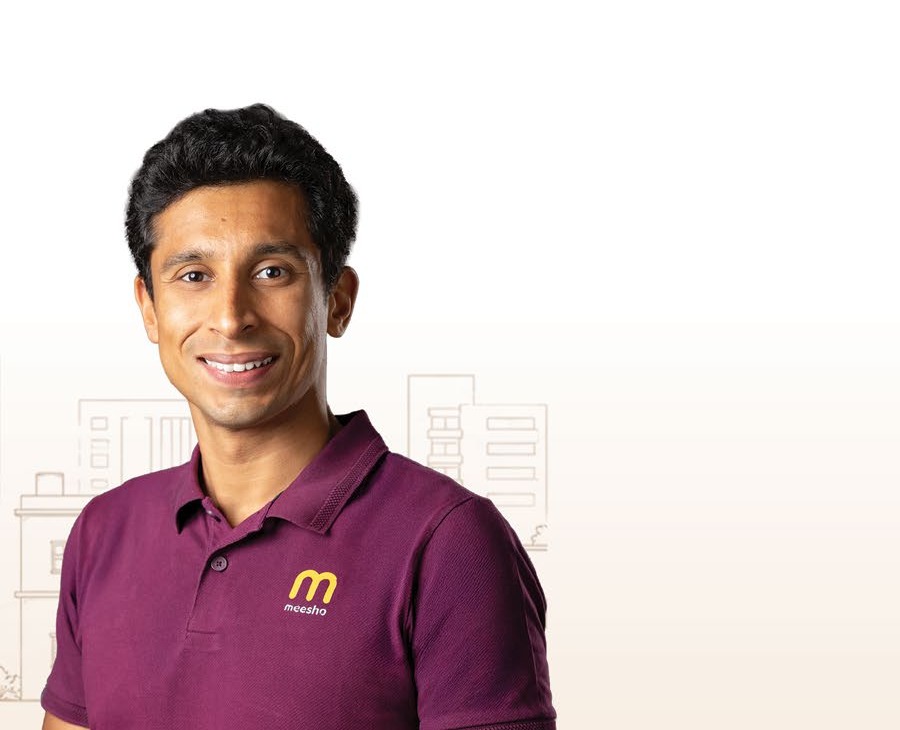
| Key facts | |
|---|---|
| Born | 20 June 1990 [1]; in Meerut, Uttar Pradesh, by his own account [5] |
| Family roots | Sugarcane-farming family from western Uttar Pradesh; raised in Rohini, Delhi [6][7] |
| Education | B.Tech, Electrical Engineering, IIT Delhi (class of 2012) [1][17] |
| Family | Father Ravi Datt Sharma worked at the Delhi Jal Board [6][7]; married to Minu Margeret [2] |
| Company | Meesho Ltd - co-founder, chairman, managing director and CEO [3] |
| Wealth | About US$1.2 billion (Forbes real-time, 9 November 2026) [53] |
| Known for | Building Meesho, the low-price online marketplace for small-town India, and taking it public in December 2025 |
In June 2017, Vidit Aatrey had a choice between two meetings. His two-year-old startup had about two months of money left. One investor looked likely to write a cheque. The other, Mukul Arora of SAIF Partners, had only asked to meet at a restaurant in Bengaluru. Aatrey cancelled the likelier one and went to the restaurant [12].
It was an odd bet for a founder who had already spent more than a year failing to raise a Series A [14]. Venture capitalists, he later recalled, thought Meesho “sounded like a marketing gimmick, a fad that exists this year and will go away tomorrow” [15]. An app for housewives to resell kurtis on WhatsApp did not look like a venture-scale business.
SAIF signed a term sheet the next month [12]. Eight and a half years later, on 10 December 2025, Meesho listed on the stock exchanges at a 46% premium, closed its first day worth about Rs 76,800 crore, and within a week had made its 35-year-old co-founder a dollar billionaire [48][51].
This is the story of how a Delhi Jal Board officer’s son, who grew up expecting a government job, built the shopping app that much of small-town India now opens first - and of the tax demands, regulator fines and hard questions that came with it.
Where it began
Vidit Aatrey was born on 20 June 1990, according to Meesho’s IPO documents [1]. In an October 2026 interview with McKinsey he said, “I was born in Meerut, Uttar Pradesh” [5]. Some profiles call him a “Delhi man”; he was raised in Delhi, in Rohini, but the roots are in western UP [7].
His family were sugarcane farmers. His father, Ravi Datt Sharma, worked as a quality control officer at the Delhi Jal Board [6][7]. “Probably working hard is what I got from my farming genes,” Aatrey told Outlook Business in 2022 [6].
Nothing in the household pointed towards business. “I grew up thinking I would get a government job and stay there all my life,” he said in the same interview [6]. His father’s ambition for him was the Indian Administrative Service, an exam the father had hoped to clear himself [6][7].
IIT Delhi
Aatrey went to a trust-run school in Delhi and cleared the IIT entrance examination; Business Standard has reported a rank of 182, a figure we could not confirm in a second source [7]. He joined IIT Delhi for a B.Tech in Electrical Engineering and graduated in 2012 [1][17].
Two things from those four years mattered later. The first was a hostel wingmate from Hazaribagh in Jharkhand, Sanjeev Barnwal, whose room was diagonally opposite his and who studied the same branch [5][9]. They did projects and competitions together [8]. (Company filings call him Sanjeev Kumar; the press has always used Barnwal [1].)
The second was a first taste of building something. In his final year, Business Standard reported, Aatrey and friends built a platform called Pledge to connect underprivileged students with jobs [7]. It went nowhere, but the IAS plan had started to fade. Even so, in 2012, as he later told Y Combinator, “starting startups was not a cool thing to do” [8].
Two jobs
He took the safe route first. Aatrey joined ITC as a management trainee and worked at its packaging business in Chennai, on procurement [6][7]. After about two years he moved to InMobi, the Bengaluru mobile-advertising company, where he worked for roughly a year in the office of the chief revenue officer [7][9]. “My role was truly horizontal,” he said of it [7].
InMobi put him in Bengaluru just as the city’s startup wave was rising. Barnwal, meanwhile, was in Tokyo writing camera software for Sony [18].
The first break
In 2015 Barnwal called from Japan. He was bored of corporate life and had an offer from a startup in Mumbai; he wanted Aatrey’s view of the company [5][8]. Aatrey’s answer changed both their lives: “If you want to work with a startup, let’s do something ourselves first” [8]. They opened a shared spreadsheet of ideas the next day [8].
By July 2015 both had quit [10]. They were about 24 [16]. Aatrey’s parents were dismayed; by one account his father did not speak to him for weeks [7]. The two friends made a pact, Aatrey has said, not to even discuss shutting down for two years [5]. On 13 August 2015 they incorporated FashNear Technologies Private Limited in Bengaluru [1].
FashNear: the idea that failed
FashNear was a “Swiggy for fashion”. Shoppers in Koramangala and HSR Layout could browse the stock of nearby clothing shops on an app, pick up to three items and have them brought home to try [10][13]. The founders photographed the inventory themselves. Aatrey rode the scooter. “I also worked as the delivery person in the beginning, because I wanted to hear my customer’s feedback first hand,” he wrote later [10].
What he heard was not encouraging. Shoppers wanted selection more than speed, and compared every price with the discounts on the big fashion sites [8][11]. Local shops could match those only at end-of-season sales [10]. Depending on which telling you read, FashNear lasted between two and five months [8][13][18].
The WhatsApp insight
The failure produced the insight. While signing up shops, the founders noticed owners sending photos of new stock to customers on WhatsApp and taking orders by chat. One told them it brought in 30-40% of his monthly business [8]. “Nobody, anywhere else in the world, was selling products on WhatsApp,” Aatrey said later [6].
So in late 2015 they built a free tool that let a small shop set up an online store through its phone and share it on WhatsApp and Facebook. They called it Meesho, short for “meri shop” - my shop [10]. About 10,000 shops signed up in six months or so [10].
It was enough to get noticed. Angel investors including Rajul Garg, Kashyap Deorah and VH Capital put in a small round in 2016, and Meesho was selected for Y Combinator’s Summer 2016 batch in California, whose standard deal then was US$120,000 for 7% [19][9]. Aatrey has said the two applied because they were fans of YC founder Paul Graham’s essays [9].
The second pivot
Then the money stopped. The tool was free, and after YC’s Demo Day investors kept asking for milestones. Aatrey has said the pair “wasted four months” chasing them [8]. “We spent more than a year raising Series A,” he told YourStory [14].
The way out came, again, from watching users. “In 6-9 months, we realized more than half our users were not from a segment we had intended to go after,” he recalled [11]. They were not shopkeepers at all. They were homemakers running informal “boutiques” out of WhatsApp groups, with no shop and no stock of their own.
One of them, a Bengaluru homemaker named Anu, was travelling to Surat every month with her husband to find suppliers, then selling to her contacts from photographs [10][14]. What women like her needed was not a storefront tool. It was supply: a catalogue of products they could share, with someone else handling payment and delivery.
A small team built exactly that, a marketplace called Meesho Supply, alongside the old app. It grew about 100% a month for six months [8]. In June 2017 the founders dropped the original product and made Supply the whole company [8][10].
That was the business Mukul Arora heard about at that restaurant. SAIF Partners (now Elevation Capital), with YC and Venture Highway, led a Series A reported at between US$3 million and US$3.4 million, announced in October 2017 [20][21]. “I don’t remember any other fund that went so deep in speaking to our resellers, speaking to our users,” Aatrey said years later [12].
Of Barnwal, he has been blunt: “I would have shut down the company soon if I’d started it with anyone other than my college roommate Sanjeev” [5].
Building the empire
The reseller years (2017-2020)
The model was simple. A reseller, usually a woman at home in a small town, picked products from Meesho’s catalogue, shared them in her WhatsApp groups, added her own margin and placed the order. Meesho collected the money, shipped the parcel and paid her the difference. She needed no capital and no inventory.
Investors who had passed now queued up. Sequoia India led an US$11.5 million round in June 2018; Shunwei Capital, DST Partners and RPS Ventures led US$50 million that November, when Meesho claimed 2 million sellers in 500 towns [19]. In June 2019 Facebook made what was reported as its first investment in an Indian startup [22]. Two months later Naspers led a US$125 million round [23].
For many resellers it was a first income of their own, and that story - of women entering paid work in India - became Meesho’s public identity. Forbes Asia and Forbes India both put the founders on their 30 Under 30 lists in 2018 [3].
Unicorn, and a change of customer (2021)
In April 2021 SoftBank’s Vision Fund 2 led a US$300 million round that valued Meesho at US$2.1 billion [24]. Five months later Fidelity and B Capital led US$570 million at US$4.9 billion [25].
Behind the headline numbers, Aatrey was changing the business. Data showed that the reseller’s own customers could simply order for themselves. Through 2021 Meesho opened up to direct shoppers, knowingly undercutting the resellers who had built it; some protested on social media [26]. It was the third time in six years he had walked away from his own product.
In 2021 Meesho also stopped charging sellers any commission [48]. It would earn instead from services such as logistics and from advertising that sellers buy to be seen [68]. “Zero commission is core to our philosophy,” Aatrey said on the eve of the IPO [43]. Sellers of unbranded clothes and household goods poured in.
The result was a different kind of e-commerce company. About 88% of its users in FY25 lived outside India’s eight biggest cities, and the average order was under Rs 300 [69]. Around three in four shipped orders that year were cash on delivery [41]. Meesho was not competing with malls. It was competing with the weekly bazaar. (Others chased the same shopper: see our profiles of Kunal Bahl of Snapdeal and Flipkart’s Binny Bansal.)
The reset (2022-2023)
Then the funding boom ended. Meesho lost about Rs 3,248 crore in FY22 on revenue of Rs 3,359 crore [31]. The next year was spent cutting: the grocery business was shut and jobs were cut (see below).
By August 2023 Aatrey announced that Meesho had turned profitable on a consolidated basis as of July, and claimed it was the first horizontal Indian e-commerce company to do so. Orders had crossed 1 billion over the previous twelve months and marketing spending had been cut sharply [31]. The audited picture was less tidy: the restated accounts in the IPO documents show a FY24 loss of Rs 328 crore, down from Rs 1,672 crore in FY23 [41].
Valmo: owning the last mile
The biggest lever was delivery cost. On a Rs 270 order, a few rupees of shipping decide whether a sale makes money. In February 2024 Meesho formally launched Valmo, a technology platform that stitches together smaller logistics firms instead of relying only on big national couriers [32]. By March 2025 it carried half of Meesho’s orders [33].
Growth came at a price. In its first results as a listed company, Meesho admitted that expanding the Valmo network too fast had cut its contribution margin by about one percentage point a quarter. “We will not sacrifice platform health for quarterly optics,” the shareholder letter said [56].
Coming home
Like many Indian startups of its generation, Meesho’s parent was a US company, Meesho Inc., registered in Delaware. To list in India it had to come back. The National Company Law Tribunal’s Bengaluru bench approved the merger in an order dated 27 May 2025 [36]. The move triggered a one-time tax charge of about Rs 2,487 crore (roughly US$288 million), which is the main reason the FY25 loss ballooned to Rs 3,942 crore [1][36]. Before exceptional items, the loss that year was about Rs 108 crore, and the business generated free cash flow of Rs 591 crore excluding interest income [41][42].
FashNear Technologies was renamed Meesho and converted into a public company in mid-2025 [1][37]. A confidential draft prospectus went to SEBI in early July [39]. A 2024-25 funding round of about US$550 million, largely existing shares changing hands, had valued the company near US$3.9 billion, below its 2021 peak [34][35].
The IPO (December 2025)
The issue opened on 3 December 2025 at Rs 105-111 a share: Rs 4,250 crore of new money and an offer for sale of about Rs 1,171 crore, valuing Meesho at roughly Rs 50,100 crore [43][47]. It was subscribed about 79 times [47].
On 10 December the shares opened at Rs 162.50 on the NSE and closed the day above Rs 170 [47][48]. “Bharat today has arrived on Dalal Street,” Aatrey said at the listing ceremony [49]. On 18 December the market value briefly crossed Rs 1 lakh crore [50].
Early backers did spectacularly. Elevation’s shares sold in the offer returned about 37 times their cost and Y Combinator’s about 108 times, going by the prospectus figures reported in the press [44].
Life as a listed company (2026)
The first year was a lesson in public markets. The stock hit a lower circuit when the one-month anchor lock-in ended in January [55], fell again after a wider third-quarter loss [56], and touched a low of Rs 143.20 on 9 March 2026 after a large tax demand [57]. When the six-month lock-in on pre-IPO shares expired on 9 June, about two-thirds of the company became free to trade [87]. Elevation and Peak XV sold shares worth Rs 1,949 crore in August, SoftBank Rs 1,650 crore in September, and RPS Rs 900 crore later that month [63][64][88].
The business kept growing through it, quarter after quarter [65]. FY26 revenue rose to Rs 12,626 crore from Rs 9,390 crore, with a net loss of Rs 1,358 crore; 264 million people bought something on Meesho during the year [60][59]. In the September 2026 quarter, revenue was Rs 4,132 crore, up 34%, the net loss narrowed to Rs 132.5 crore, and annual transacting users reached 284 million [66].
By 12 October 2026 the shares were at a ten-month high, up 34% for the year in a falling market [67]. On 28 October the company was valued at about Rs 1.05 lakh crore [66]. Broker views remain split, with some analysts pointing to rising competition from Amazon’s and Flipkart’s own low-price pushes and from quick commerce [68]. We take no view on the stock.
Aatrey’s new bets since listing are small and close to home: a voice shopping assistant called Vaani, launched in March 2026 [62], and the Rs 202 crore purchase of Kirana Club, a network of small grocers, in June - a cautious return to grocery [61].
Asked what the listing meant to him, he told McKinsey: “For me, the IPO wasn’t the milestone… It was a necessary step but it is not what gives me energy” [5].
How the wealth is held
Aatrey’s fortune is one asset. Before the IPO he held 47.25 crore Meesho shares, or 11.1% [40]. Part of that came from stock options: on 31 March 2025 the board accelerated the founders’ unvested options, both exercised them, and the company paid the resulting perquisite tax - about Rs 578 crore on Aatrey’s behalf and Rs 156 crore on Barnwal’s - as disclosed in the prospectus [1][38].
In the offer for sale each founder sold 1.6 crore shares, about Rs 177 crore each before tax [44]. Aatrey’s shares had cost him an average of six paise apiece [44].
That left him with about 45.65 crore shares, 10.12% of the listed company. He has not sold since. New share issuance had diluted the stake to 9.86% by the September 2026 quarter, and none of it was pledged [54]. Barnwal held 6.47% [54].
Several outlets declared him a billionaire on 16 December 2025 [52]; Forbes did so a day later, with the stock at Rs 216 [51]. Forbes’s real-time tracker put his net worth at about US$1.2 billion on 9 November 2026 [53]. The M3M Hurun India Rich List 2026 was released in September, but we could not verify an entry for him and so cite no Hurun figure. His pay as chief executive was Rs 5.4 crore in FY25 [40].
The setbacks and failures
FashNear (2015). The first product died within months, and the second, the shop-owner tool, never made money [8][10].
Indonesia (2020-21). Meesho tried to copy its reseller model in Indonesia and shut operations there about a year later, by March 2021 [27]. The Indonesian subsidiary was finally liquidated in October 2025 [1].
Grocery (2021-22). Farmiso, a community grocery business started during the pandemic, was at one point described by Aatrey as Meesho’s fastest-growing line [24]. Renamed Meesho Superstore in April 2022, it was shut in more than 90% of its cities that August, with over 300 jobs lost; Inc42 reported that some contract staff were let go abruptly through an agency, and that Meesho did not respond to its questions [29].
Layoffs. More than 200 people were let go in April 2020 as the lockdown hit [28]. In May 2023 Meesho cut 251 employees, 15% of its staff. Aatrey’s email took the blame: “As leaders, we made judgement errors in over-hiring ahead of the curve.” Severance ran from 2.5 to 9 months’ pay, with faster vesting of stock options [30].
The down round. The 2024-25 fundraise valued Meesho about a fifth below its 2021 peak [35].
Senior exits. In 2026 the head of business, Megha Agarwal, and the human-resources chief, Ashish Kumar Singh, both resigned within seven months of the listing [79].
The same company also made news in 2022 for closing entirely for 11 days after the festive sale so employees could rest. “Even astronauts need breaks,” Aatrey said [83].
Controversies and allegations
No court or regulator has found wrongdoing by Vidit Aatrey personally. Meesho’s prospectus reported no regulatory, SEBI or tax actions against its promoters, and we found no Enforcement Directorate or FEMA proceedings [1]. Most of what follows concerns the company, and much of it turns on one question: how far a marketplace answers for what its sellers list. The position below is as of 9 November 2026.
Income-tax demands of about Rs 2,072 crore
Allegation: The Income Tax Department issued an assessment order and demand of Rs 572.07 crore for assessment year 2022-23 on 13 March 2025, proposing among other things to disallow advertising expenses and to tax mark-to-market gains on forward contracts [1]. On 5 March 2026 it raised a second demand of about Rs 1,499.7 crore, including interest, for assessment year 2023-24; the detailed grounds are not public [57][58].
Response: Meesho told the exchanges it does not agree with the 2026 order, has “adequate legal and factual grounds to contest the same”, and expects no major impact on its finances [57]. On the earlier demand, management said in the prospectus that, on independent advice, it was confident the adjustments “will not be sustained”; it has made no provision [1].
What happened next:
- April 2025: the Karnataka High Court granted an interim stay on the first demand on Meesho’s writ petition [1][57].
- 9 March 2026: the shares fell 10% to their then record low on news of the second demand [57].
- Meesho filed a rectification request and an appeal before the faceless appeal centre against the second order [59].
- April 2026: separately, a GST appellate authority upheld a Rs 14.29 crore demand relating to tax collection at source in 2018-20; Meesho said it would appeal to the GST tribunal [86][1].
Status: Pending. The FY26 annual report put total disputed income tax at about Rs 2,072 crore [59]. No final ruling has been reported on either demand.
Consumer regulator penalties (CCPA)
Allegation: The Central Consumer Protection Authority found that 85 sellers had listed nearly 1,900 walkie-talkies on Meesho between January 2023 and May 2025 without required licensing details [70]. In a second case, begun on a complaint from the Crop Care Federation of India, it found that 282 sellers had sold more than 93,000 units of an unregistered herbicide on the platform between July 2025 and March 2026 [72].
Response: Meesho said sellers had miscategorised the walkie-talkies as toys and that it delisted them after the regulator’s notice [70]. In the herbicide case it argued that it is an intermediary protected by the IT Act’s safe-harbour provision and that its platform “was deliberately misused by this dishonest seller” [72].
What happened next:
- 2 December 2025: the CCPA fined Meesho Rs 10 lakh in the walkie-talkie case, holding that checks “must operate before listings are published”. Amazon, Flipkart and Meta received the same penalty [70][71].
- October 2026: it fined Meesho Rs 10 lakh in the herbicide case and rejected the intermediary defence: “A platform cannot profit from the transaction while simultaneously disclaiming every corresponding responsibility.” Amazon and Flipkart had been fined the same amount in the same matter [72].
- Earlier CCPA actions also named Meesho among several platforms: a December 2022 notice over the online sale of acid, and a 2023 order to delist car seat-belt alarm stoppers, of which 21 of 13,118 removed listings were Meesho’s [85][84].
Status: Both penalty orders are final at the regulator’s level; no appeal has been reported. A separate CCPA proceeding begun in 2022 over alleged spurious and counterfeit goods was pending as of the prospectus [1].
Abortion kits and the Maharashtra FDA (2022)
Allegation: In April 2022, drug inspectors of Maharashtra’s Food and Drug Administration lodged four FIRs, in Navi Mumbai, Mumbai, Thane and Nagpur, against the company and sellers, alleging abortion kits were sold on the platform without a prescription. One inspector had placed a decoy order [1][73].
Response: Meesho has submitted that it “operates solely as an intermediary” and that it promptly delisted the products [1].
Status: Pending, according to the prospectus. We found no later report.
Look-alike brands and the Jockey case
Allegation: Brand owners have complained of counterfeits and imitations on Meesho. In May 2026 Jockey International sued sellers using marks such as “Joyke” and “Joysky” on innerwear, naming Meesho as a defendant as the platform [75][76].
Response: The order was passed without hearing the defendants, and no public response from Meesho was reported. In its prospectus the company described programmes to detect and deactivate counterfeit listings [1].
What happened next:
- 29 May 2026: the Delhi High Court granted an interim injunction, directed Meesho to take down 12 listings within 36 hours and to disclose the sellers’ details [75][76].
Status: Pending before the Delhi High Court.
Lawrence Bishnoi T-shirts (2024)
Allegation: In November 2024 a journalist posted screenshots of T-shirts on Meesho glorifying a jailed gangster, some in children’s sizes [74].
Response: “We have taken immediate action to deactivate the products,” the company said [74].
Status: Closed. No regulatory action was reported.
Seller disputes, and two complaints naming the founders
Allegation: Sellers have at times accused Meesho of unfair returns rules and unpaid reimbursements. In January 2023 merchants in Surat protested a tighter returns policy [78]. In September 2024 one Surat seller lodged an FIR against Aatrey and Barnwal, as directors, over about Rs 1.33 crore of claimed reimbursements; another seller filed a private complaint in a Meerut court over about Rs 20,000 [1].
Response: Meesho said its returns policies were “fair and competitive” [78] and called the Surat seller’s claims “false and without merit” [1].
What happened next:
- In the Surat case the police filed a closure report before the magistrate concluding that the complaint was false, the prospectus says [1].
- In the Meerut case the founders filed preliminary objections in May 2025 [1].
- Meesho has itself been a victim: on its complaint, Bengaluru police investigated a group of sellers accused of using fake buyer accounts and doctored videos to claim about Rs 5.5 crore in refunds, and arrested three men in Surat [77][1].
Status: Both complaints against the founders were listed as pending in the December 2025 prospectus, the Surat one awaiting formal closure. We found no later report.
The IPO anchor-book row (December 2025)
Allegation: SBI Mutual Fund was allotted about a quarter of Meesho’s Rs 2,439 crore anchor book. Outlook Business and Mint reported that several large funds protested and some pulled out; a prominent fund manager called for regulators to step in [45][46].
Response: Neither Meesho nor its bankers commented in the reports we read.
Status: No regulatory action was reported. Anchor allotments are at the issuer’s discretion under SEBI rules.
Giving back
There is little to report yet, and it is better to say so plainly. We found no public record of personal philanthropy by Aatrey: no pledge, no foundation in his name, no reported donation.
At company level, Meesho’s board has a corporate social responsibility committee on which both founders sit [4]. A 2026 job posting for a “Head of Meesho Foundation” in the chief executive’s office describes a planned “platform-adjacent social venture” in digital literacy and seller training that “takes a 20-year view”; it gives no budget or launch date [82].
Aatrey’s own answer to the question has always been the business. Meesho had about 9.6 lakh sellers transacting in FY26 [59]. Outside it, he has sat on the board of Navi, the financial-services company of Flipkart co-founder Sachin Bansal, since 2022 [81]. IIT Delhi gave him its award for distinguished graduates of the last decade in 2021, and EY named the two founders its start-up Entrepreneurs of the Year the same year [17][80].
Succession
At 36, Aatrey holds all three top titles: chairman, managing director and chief executive [3]. Barnwal, his partner of eleven years, is whole-time director and chief technology officer [4]. There is no announced succession plan and, given their ages, no reason to expect one.
The more relevant question is control. Together the founders own about 16% of Meesho [54]. Venture funds that once held about half the company are steadily selling [40][63][64]. Like Deepinder Goyal at Zomato’s parent, Aatrey runs a company in which founders are minority owners and public shareholders decide.
What their journey teaches
1. The users you did not plan for are often the business. Meesho was built for shopkeepers. More than half its users turned out to be homemakers [11]. Aatrey rebuilt the company around them instead of steering them back to the plan. “Whenever we have found some very powerful insight, it has always come from the users,” he has said [13].
2. Do the unglamorous job yourself, at least once. He delivered parcels by scooter to hear complaints first-hand [10]. The lesson about selection and price that killed FashNear came from doorsteps, not dashboards.
3. Be willing to cannibalise your own success. Dropping the shop tool in 2017 and opening to direct shoppers in 2021 both hurt people who had backed Meesho early [8][26]. Each time, the larger market was on the other side.
4. Pick a co-founder you can fail with. “We were 24-year-olds who had never run a company, failing every day,” Aatrey told McKinsey [5]. The two-year no-quit pact with a friend he trusted is, by his own account, why the company survived to find its idea.
5. Cost structure is strategy. Zero commission, Valmo and negative working capital all exist to serve a Rs 270 order profitably [68]. Serving price-sensitive customers needs a cheaper machine, and a founder willing to cut - including 251 jobs he admitted he should never have added [30].
6. Scale brings the bill for trust. The tax demands, CCPA fines and trademark suits are the cost of running a bazaar with nearly ten lakh sellers. How well Aatrey polices it will shape Meesho’s second decade as much as growth shaped its first.
For more on the forces behind stories like this one, see CapitalVia Insights, including how Indian startups raised US$5.2 billion in the first half of 2026.
A profile for general reading, based on public records and reporting as of 9 November 2026. Not investment, tax or legal advice.
Sources (88)
- Meesho Limited Red Herring Prospectus - Meesho Ltd via Kotak Investment Banking, Nov 2025
- Meesho Limited Updated Draft Red Herring Prospectus-I - Meesho Ltd via MediaNama, Oct 2025
- Vidit Aatrey, Board of Directors profile - Meesho Investor Relations, Nov 2026
- Governance: Board and Committees - Meesho Investor Relations, Nov 2026
- Meesho: Making e-commerce everyone's business - McKinsey & Company, Oct 2026
- Taking Bharat's Business To India - Outlook Business, Aug 2022
- Mistakes make a Meesho: What founder Vidit Aatrey learned from failed ideas - Business Standard, Jul 2022
- Vidit Aatrey on Building Meesho, India's Top Reselling Platform, with Adora Cheung - Y Combinator, May 2019
- Meesho company profile - Y Combinator, Nov 2026
- Meesho turns 5 - Meesho Blog, Aug 2020
- Meesho: a masterclass - Elevation Capital, Nov 2026
- Back To The Beginning With Vidit Aatrey: Celebrating Meesho IPO - Elevation Capital, Dec 2025
- Vidit Aatrey, Founder and CEO, Meesho: Building a category-defining startup - Prime Venture Partners Podcast, Sep 2021
- UpClose: From housewives to entrepreneurs, Meesho's Vidit Aatrey - YourStory, Sep 2019
- Meesho's business model and Vidit Aatrey - YourStory, Mar 2020
- IIT Delhi Alumni Association launches Unicorn Series with Meesho's Vidit Aatrey - YourStory, Oct 2022
- Graduates of Last Decade (GOLD) Awards: Vidit Aatrey - IIT Delhi Alumni Affairs, Nov 2026
- Meesho revamps India's unorganised retail by empowering resellers - Inc42, Oct 2019
- Meesho raises $50 million - MediaNama, Nov 2018
- Meesho raises Series A funding led by SAIF Partners - MediaNama, Oct 2017
- Why we invested in Meesho - Arjun Malhotra (Investopad) on Medium, Oct 2017
- In its first investment in India, Facebook puts an undisclosed amount into Meesho - MediaNama, Jun 2019
- Meesho raises $125 million funding from Naspers, Facebook and current investors - exchange4media, Aug 2019
- Indian social commerce Meesho raises $300M at $2.1B valuation - TechCrunch, Apr 2021
- Social commerce startup Meesho raises $570 Mn, takes valuation to $4.9 Bn - Inc42, Sep 2021
- Meesho, SoftBank and the shift from reselling to e-commerce - The CapTable, Aug 2021
- India's Meesho shuts Indonesia operations - DealStreetAsia, Mar 2021
- Social commerce startup Meesho lays off 200 employees as COVID-19 stresses business - KrASIA, Apr 2020
- Meesho shuts grocery vertical Meesho Superstore in most cities - Inc42, Aug 2022
- Meesho fires 251 employees in third round of layoffs - Inc42, May 2023
- Meesho claims to be profitable as of July 2023 - Inc42, Aug 2023
- Meesho launches tech platform Valmo to fill gaps in India's supply chain - Inc42, Feb 2024
- IPO-bound Meesho's own logistics platform Valmo now handles 50% of its orders - Outlook Business, Mar 2025
- Ecomm startup Meesho raises $275M as part of larger round - YourStory, May 2024
- Meesho closes another $250-270 Mn funding round: report - Inc42, Jan 2025
- Meesho gets NCLT nod to relocate base to India - Entrackr, Jun 2025
- NCLT approves Meesho's reverse flip to India - Inc42, Jun 2025
- Exclusive: Meesho co-founders exercise 27 lakh options ahead of IPO - Entrackr, Apr 2025
- Meesho files confidential draft IPO papers with SEBI - Business Standard, Jul 2025
- Meesho DRHP: a look at shareholding pattern and key executives - Inc42, Oct 2025
- Meesho files IPO draft with SEBI: key numbers - MediaNama, Oct 2025
- Meesho a free cash flow leader ahead of IPO - Business Standard, Nov 2025
- Meesho files RHP, issue to open on December 3 - Inc42, Nov 2025
- Meesho IPO to unlock Rs 1,020 crore bonanza for founders, early backers - Business Standard, Dec 2025
- Meesho's pre-IPO storm: who pulled the plug on some anchor investors - Outlook Business, Dec 2025
- Meesho under fire from investors over SBI fund's allotment - Mint via Magzter, Dec 2025
- Meesho debuts on stock exchanges at 46% premium to issue price - Entrackr, Dec 2025
- Meesho ends first trading session 53% above IPO price - Inc42, Dec 2025
- Meesho IPO: from a Koramangala flat to a Dalal Street debut - YourStory, Dec 2025
- Meesho stock dips 10% after hitting new high, surpassing Rs 1 lakh crore market cap - Business Standard, Dec 2025
- Meesho Becomes India's Best IPO This Year, Mints New Billionaire - Forbes, Dec 2025
- Meesho founder Vidit Aatrey joins billionaire club - Business Today, Dec 2025
- Vidit Aatrey: real-time net worth profile - Forbes, Nov 2026
- Meesho Ltd shareholding pattern, September 2026 quarter - Trendlyne, Oct 2026
- Meesho hits 5% lower circuit on one-month lock-in expiry - Business Standard, Jan 2026
- Meesho's post-IPO reality check - Inc42, Feb 2026
- Meesho freezes in 10% lower circuit, hits record low: here's why - Business Standard, Mar 2026
- Meesho gets Rs 1,500 Cr demand notice from Income Tax Dept - Inc42, Mar 2026
- Meesho tax dispute swells to over threefold to Rs 2,072 crore in FY26 - Outlook Business, Aug 2026
- Meesho posts Rs 166 crore loss in Q4 FY26, revenue jumps 47% - MediaNama, May 2026
- Meesho acquires Kirana Club in Rs 202 crore deal to expand grocery presence - Business Standard, Jun 2026
- Meesho bets on voice AI to bring conversational shopping online - Business Standard, Mar 2026
- Elevation Capital, Peak XV Partners sell 2.3% stake in Meesho for Rs 1,949 crore - Outlook Business, Aug 2026
- Meesho's stock gains over 3% as investors absorb SoftBank's Rs 1,650 crore stake sale - Outlook Business, Sep 2026
- Meesho reports narrower loss, says AI is becoming core to business - Business Standard, Jul 2026
- Meesho Q2 FY27 results: net loss narrows to Rs 132 crore, net merchandise value grows 23% - Upstox News, Oct 2026
- Meesho share price rallies 5%, nears record high in weak market - Business Standard, Oct 2026
- Rising competition, premium valuations may cap gains in Meesho stock - Business Standard, Sep 2026
- Meesho rides high on e-commerce boom in non-metros - Deccan Herald, Jan 2026
- CCPA fines Meesho Rs 10 lakh for unapproved walkie talkies - MediaNama, Dec 2025
- CCPA fines Amazon, Flipkart, Meesho for illegal walkie-talkies sales - Inc42, Jan 2026
- CCPA fines Meesho Rs 10 lakh over sale of unregistered herbicide, rejects intermediary defence - MediaNama, Oct 2026
- FDA Maharashtra files FIR against Meesho for selling abortion pills - Inc42, May 2022
- Meesho removes products with Lawrence Bishnoi's images after backlash - ThePrint, Nov 2024
- Delhi High Court restrains Meesho sellers from using Joyke, Joysky marks in Jockey trademark suit - LiveLaw, Jun 2026
- Delhi High Court orders Meesho to delist products violating Jockey trademark - Bar and Bench, Jun 2026
- Gang registers as seller with e-commerce company, exploits returns policy, swindles Rs 5.5 crore - Deccan Herald, Dec 2024
- Meesho sellers protest change in return policy - Inc42, Jan 2023
- Meesho CHRO Ashish Kumar Singh resigns after six-year stint, second senior exit this year - Outlook Business, Jun 2026
- Entrepreneur of the Year 2021: Builders of a better India - EY India, Nov 2026
- IPO-bound Navi appoints Meesho co-founder and CEO Vidit Aatrey to board as independent director - Sakshi Post, May 2022
- Head of Meesho Foundation, CEO Office: job posting - Meesho Careers, Nov 2026
- Meesho announces 11-day Reset and Recharge break for employees post festive season - BestMediaInfo, Sep 2022
- Amazon, Flipkart, Meesho ordered to stop selling seat belt alarm stopper clips - Outlook Business, May 2023
- CCPA issues notices to Flipkart, Meesho for sale of acid on their platforms - Outlook Business, Dec 2022
- Meesho receives Rs 14.29-crore GST notice, says will contest demand - A2Z Taxcorp, Apr 2026
- JM Financial retains Reduce on Meesho, flags pre-IPO lock-in expiry risk - Business Standard, May 2026
- Meesho shares worth Rs 900 crore change hands in mega block deal - Business Standard, Sep 2026