
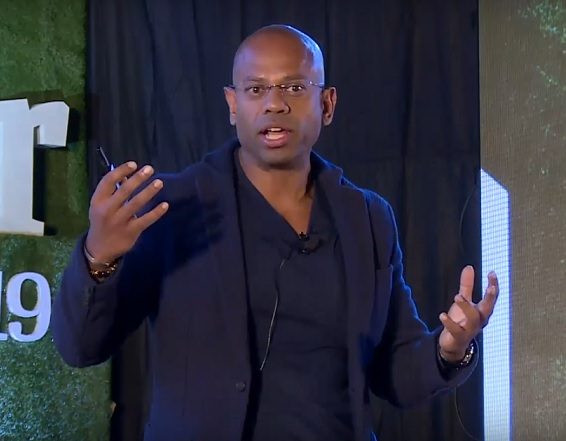
| Key facts | |
|---|---|
| Born | Kolkata, West Bengal; mid-1970s (he was 37 on Fortune’s 2012 “40 Under 40” list; exact date not public) [6][10] |
| Family roots | Bengali family; raised in a government colony in Delhi; father an IAS officer [10][9][13] |
| Education | BA (history), Kirori Mal College; LLB, Faculty of Law, University of Delhi; Advanced Management Program, Harvard Business School [4][10][9] |
| Family | Married to Manavi Ghosh; two children [10][14] |
| Company/Group | Former President, IndiGo (InterGlobe Aviation), 2008-2018; co-founder, Akasa Air; non-executive director, OYO; founder, Homage [1][2][3][69] |
| Known for | Running IndiGo for a decade as it went from 18 aircraft and a not-yet-profitable start to India’s largest and most profitable airline [17][40] |
In August 2008 a lawyer in his early thirties walked into the top job at one of India’s youngest airlines. He had never run an airline. He had never run any business. He did not have an MBA. What Aditya Ghosh had was a seat at the table: for four years he had been the in-house lawyer who wrote IndiGo’s licence application and helped negotiate its first order for 100 Airbus jets [9][12].
When IndiGo’s two founders, Rahul Bhatia and Rakesh Gangwal, picked him to succeed their American chief executive, the airline had 18 planes and was not yet making a full-year profit [12][17]. India’s skies were littered with the wreckage of failed carriers. Fuel was expensive, airports were crowded and fares were a race to the bottom.
Ten years later, when Ghosh announced he was leaving, IndiGo flew 161 aircraft to 50 destinations, carried nearly four of every ten domestic passengers and had just reported a profit of Rs 2,242 crore [27][40][41].
Ghosh liked to deflect the credit. “I am talentless and lazy,” he once told Business Today. “I simply happened to be at the right place at the right time” [12]. This is the story of what he actually did with that luck: the obsession with on-time flights, the “boring” discipline, the 2017 crises that dented his record, his messy exit, and a second act as co-founder of Akasa Air, investor and board member.
Where it began
Aditya Ghosh was born in Kolkata, West Bengal, into a Bengali family, and was raised in Delhi [10]. His father was an officer of the Indian Administrative Service, and the family lived in a government housing colony, the kind of neighbourhood where the children of civil servants grow up together [9][13]. He went to the same school from the age of five until he finished high school [9].
His exact date of birth has not been made public. Reported ages place it in the mid-1970s: Business Today gave his age as 36 in April 2011, Fortune listed him at 37 in 2012, and in September 2019 he joked that he hoped OYO founder Ritesh Agarwal did not think of him “as a 43-year-old” [6][12][14]. These figures do not all fit one birthday, so 1975 is a best estimate rather than a fact.
As a teenager his ambition was medicine. On the Blume Ventures podcast he recalled wanting to become a neurosurgeon after reading about the surgical team that operated on US President Ronald Reagan [9]. Instead he studied history at Kirori Mal College, Delhi University, and then went to the university’s Faculty of Law [4][10][9].
The lawyer’s apprenticeship
His legal career began almost by accident. As a first-year law student he met Jyoti Sagar, the founder of the law firm J. Sagar Associates (JSA) and the father of a family friend. Sagar was impressed enough to take him on as an executive assistant [12]. Ghosh himself remembers starting as an intern at K&S Partners, JSA’s intellectual-property sister firm, before moving across to assist Sagar [9].
At K&S he worked as Sagar’s only junior on India’s high-profile challenges to American patents on basmati rice and turmeric, cases that became symbols of the fight over traditional knowledge in the 1990s [12]. At JSA he moved into corporate and commercial law: acquisitions, joint ventures and cross-border deals [8]. Wikipedia dates his formal start at JSA to 1997 [10], and BW People says he practised law for about six years [13].
One of JSA’s clients was InterGlobe Enterprises, the travel-services group run by Rahul Bhatia in Delhi [9]. Ghosh, then about 24, handled its legal matters. That client relationship would change his life.
The first break
By the early 2000s Bhatia was preparing to do something many people thought was reckless: start an airline. He needed a general counsel, and he wanted the young lawyer who already knew his business. Ghosh says he had been interviewing with General Electric when Bhatia recruited him [9]. BW People dates the move to 2004 [13], and Ghosh himself later spoke of “those days of 2004 when we were building IndiGo” [14].
His first task was to prepare IndiGo’s application for an airline licence [9]. At 28 he was head of legal for the InterGlobe group and worked on the airline’s landmark first order: 100 Airbus A320 aircraft, signed at the Paris Air Show in June 2005 and reported to be worth about US$6 billion at list prices [12][18][19]. For a carrier that did not yet have a single plane, it was a staggering commitment. Every one of those 100 aircraft had been delivered by November 2014, about two years ahead of schedule [19].
IndiGo flew its first flight in August 2006 [17][41]. Ghosh joined its board in May 2007 while remaining InterGlobe’s group general counsel and a member of the group’s executive committee [5][8].
The surprise appointment
On 18 August 2008 IndiGo announced that Ghosh would become President [1][15]. Bruce Ashby, a former US Airways executive who had launched the airline, was leaving at the end of his three-year contract [16]. “This is truly a great opportunity and an honour for me,” Ghosh said in the company’s press release [1].
The choice raised eyebrows. Fortune later noted that the founders had picked their in-house lawyer over an experienced outsider [6]. Sources disagree slightly on his age at appointment: Business Today put it at 32, Entrepreneur India at 33 [12][8]. Either way, he was remarkably young to be running an Indian airline.
The timing was brutal. The global financial crisis hit weeks later. In November 2008 Business Today described IndiGo as an 18-aircraft airline flying to 17 destinations that had some profitable months but had not yet turned a full-year profit [17]. Ghosh’s message even then was unusual: “We are not blind converts to the rules,” he said, and “our revenues per seat have improved as have our costs per seat” [17].
Building the empire
Ghosh did not own IndiGo. The airline belonged to Bhatia’s InterGlobe Enterprises and to Gangwal (see our profiles of Rahul Bhatia and Rakesh Gangwal). Gangwal, a former chief executive of US Airways, designed much of the strategy, and Ghosh himself has called him “the smartest airline brain in the world” [9]. Ghosh’s job was execution: running the airline every day, building the culture, dealing with the government, and making sure the plan actually worked on the ground.
The “boringly consistent” model
The model was simple, and Ghosh’s genius lay in refusing to complicate it. In a 2017 interview with Business Standard he spelled it out [19]:
- one aircraft type, the Airbus A320 family;
- one all-economy cabin, with up to 180 seats;
- no frequent-flyer programme, no free lounges and no free meals for ordinary passengers;
- three promises to customers: on-time flights, courteous and hassle-free service, and low fares.
“From day one, our biggest obsession has been to prove that ‘low cost’ does not imply ‘low quality’,” he said. “Managing cost invariably becomes the key focus, and will always be” [19].
He was proud of how dull it looked from outside. “We decided to move without a vision statement and became consistently boring,” he told Business Standard in 2013. “The brand image must represent the product and nothing else” [25]. In 2015 he told Business Today that “being a pure low-cost carrier sets you on the path of success… it is the discipline with which we have executed to this model” [26].
The engine underneath was financial. IndiGo ordered aircraft in huge batches, which gave it big discounts, and then sold most of them to leasing companies and leased them back, keeping a young, fuel-efficient fleet [20]. Planes were turned around quickly at airports and flown many hours a day [18].
On-time as religion
The most visible part of the IndiGo brand was punctuality. Ghosh pushed “before-time” departures, closing doors early when everyone was on board [8]. “Punctuality cannot be compromised for even 1 per cent,” he said in 2017. “We listen, but we can’t stray from what IndiGo offers — reliability and punctuality” [29].
Critics later questioned how much of this was padding. In January 2018 a parliamentary committee asked whether IndiGo’s on-time ranking was helped by longer scheduled flight times than rivals, citing two hours for Indore-Delhi against 1 hour 35 minutes at other airlines; the DGCA had raised similar concerns earlier [37].
People and culture
Ghosh’s own style was frugal. Fortune reported in 2012 that he kept a small office without a receptionist and stayed in budget hotels on work trips [6]. He says he personally interviewed new hires for IndiGo’s first nine years [9]. “I know most of my people by their names,” he told BW People in 2017. “We have never delayed the salaries even by an hour” [13].
By 2017 IndiGo had about 14,000 employees, and BW People reported that it had never laid anyone off or delayed pay [13]. About 43% of its workforce were women, according to Entrepreneur India [8]. Ghosh later summed up his philosophy in one word: “If you’re forced to define leadership in one word, that is empathy,” he said on the Blume podcast. He told staff he was their “biggest union leader” [9].
The big bets: 100, 180, 250 jets
Under Ghosh the airline kept doubling down on India’s growth with ever-larger Airbus orders:
- June 2011: 180 aircraft, mostly the new fuel-efficient A320neo, valued at about US$15-15.6 billion at list prices, then described as the largest single order in commercial aviation history [6][20].
- October 2014 / August 2015: 250 A320neos, valued at roughly US$25-27 billion at list prices, Airbus’s biggest order ever at the time. It was announced as a memorandum in October 2014 and firmed up in August 2015 [18][20].
“Every time we try and plan something, India grows faster,” Ghosh said when the 250-jet deal was announced [20].
The numbers
The fleet climbed steadily: 18 aircraft in November 2008, 83 by August 2014, 129 by March 2017 and 159 by 31 March 2018 [17][19][20][27].
IndiGo began international flights in September 2011 [28]. In 2012 it became India’s largest domestic airline by market share [28]. Its share rose to 32.6% by August 2014, about 36% by September 2015 and 39.7% by the end of March 2018 [20][21][41].
Profits came every year. IndiGo reported its first full-year profit in 2008-09, Ghosh’s first year in charge, and 2015-16 was its eighth straight year in the black [22]. Revenue and profit figures, in Rs crore, as reported [21][27][28]:
| Year | Revenue from operations | Net profit |
|---|---|---|
| FY2012 | 3,825 | 128 |
| FY2015 | 13,925 | 1,304 |
| FY2016 | 16,140 | 1,986 |
| FY2017 | 18,581 | 1,657 |
| FY2018 | 23,021 | 2,242 |
Business Standard named IndiGo its Company of the Year for 2016, noting that fuel costs had fallen from 46.1% to 34.7% of revenue in a year [18]. “We do not chase market share, and we do not drop fares or go for flash sales,” Ghosh said in 2015 [21].
The IPO
The defining financial moment came in November 2015. InterGlobe Aviation’s initial public offering of about Rs 3,000 crore was priced at Rs 765 a share, the top of its range, and was subscribed 6.15 times, with institutional buyers bidding nearly 18 times their quota [23][24]. It was India’s biggest IPO since Bharti Infratel in December 2012 [23].
On 10 November 2015 the shares listed at Rs 856 on the BSE, nearly 12% above the issue price, and closed about 15% higher, valuing the company at over Rs 31,000 crore [23][24]. The shares, and the wealth they created, belonged mainly to the two founders.
Pay and recognition
Ghosh was rewarded handsomely. His gross pay was about Rs 3.7 crore in 2014-15. In 2015-16, the year of record profit and the IPO, it jumped to over Rs 27 crore, including a one-time incentive of Rs 20.9 crore and 7 lakh stock options [22].
Recognition followed. He was named on Fortune’s global “40 Under 40” list in 2012, at number 27 [6]. Airline Business’s Airline Strategy Awards gave him its Low-Cost Leadership award in 2015, noting he was the first leader to be recognised twice in that category with the same airline [5]. The World Economic Forum named him a Young Global Leader in 2015 [4].
The setbacks and failures
Success at IndiGo was not a smooth line, and Ghosh’s final 18 months were the hardest of his career.
The engine nightmare
IndiGo had bet heavily on the A320neo, many of them powered by Pratt & Whitney’s new PW1100 geared turbofan. The engines proved troublesome. Between May 2016 and November 2017 IndiGo replaced engines on its 32 A320neos at least 69 times, while describing the problems as “non-safety” glitches [37][38]. Planes sat on the ground waiting for spare engines.
In February 2018 Europe’s aviation safety regulator issued an emergency directive on one batch of the engines. On 12 March 2018, after an IndiGo Ahmedabad-Lucknow flight suffered a mid-air engine failure and turned back with 186 people on board, India’s DGCA grounded 11 A320neos with the affected engines, eight of them IndiGo’s, “with immediate effect” [38]. More than 900 flights were cancelled in the second half of March [44].
Losing the airport battle
In late 2017 Delhi airport operator DIAL directed IndiGo to move part of its operations from Terminal 1 to Terminal 2. IndiGo went to court. The Delhi High Court dismissed its plea in December 2017, and on 23 February 2018 the Supreme Court dismissed its appeal and gave it 25 days to shift [39]. Around the same time IndiGo expressed interest in buying Air India’s international business, then withdrew [37].
A crowded cockpit
Inside the company, the management team was changing. From late 2017 IndiGo brought in a series of senior foreign executives, many reportedly picked by Gangwal, including chief operating officer Wolfgang Prock-Schauer, Willy Boulter, Michael Swiatek and Greg Taylor [37][44]. Reporting at the time linked this to plans for a more complex fleet and possible wide-body flying. These were the kinds of changes Ghosh’s “one type, one class” airline had always avoided.
The exit
On 27 April 2018 InterGlobe Aviation told the stock exchanges that Ghosh had resigned as a director with effect from 26 April and would step down as President on 31 July 2018 [40][41]. Rahul Bhatia became interim chief executive, and Greg Taylor was named senior adviser, to be considered for the top job [40]. The shares fell about 6% that day [28].
The filing gave no reason. Bhatia told staff that “Aditya wishes to start a new business venture and we respect his decision” [40]. Ghosh said leading IndiGo had been “the most satisfying task” and that it was time to “step off the treadmill” and think of his “next adventure” [40][42]. “It was not a marathon but a sprint,” he told the Hindustan Times. “It has been a difficult decision. One with mixed emotions” [42].
A few days later Bhatia said Ghosh’s exit was not linked to the engine problems. “He had a phenomenal connect with people,” Bhatia said. “Aditya is still a young man; I wish him well” [43].
Commentators read more into it. A Business Standard column argued that the inflow of senior expatriates had sidelined existing management [44]. In 2019 Business Today described “relieving” Ghosh as one of the decisions the co-founders had agreed on, wording that suggests he was eased out [45]. Neither Ghosh nor the company has ever said so, and no first-hand account of a falling-out has been published.
What followed showed how hard he was to replace. Greg Taylor’s appointment as CEO fell through in December 2018 [47], and in January 2019 IndiGo appointed Ronojoy Dutta, a former President of United Airlines, as its chief executive [48]. Within months the airline was consumed by a public feud between its two founders, which reached SEBI when Gangwal complained about governance in July 2019 [49].
OYO: the stint that “hadn’t worked out”
Ghosh’s next move surprised the industry. On 15 November 2018 OYO Hotels, the budget-hotel startup founded by Ritesh Agarwal, named him CEO for India and South Asia from 1 December 2018, reporting to Agarwal [51]. The 25-year-old founder and the airline veteran in his early forties were an odd couple. “I’m sleeping less but it’s exciting to be back to those days of 2004 when we were building IndiGo,” Ghosh said in 2019. “The free hand concept is overstated. The secret lies in mutual respect for what a person brings to the table” [14].
The role lasted about a year. On 2 December 2019 OYO moved him to its board of directors and made Rohit Kapoor CEO for India and South Asia [52]. Mint, citing an unnamed person, reported that the hire “hadn’t worked out” and that Ghosh had never been part of Agarwal’s inner circle; OYO rejected this, saying “Aditya’s elevation is no exception” [53][54]. In February 2020, as a board member, he publicly denied that SoftBank was behind OYO’s layoffs, saying the company was focused on “building a business that is financially sustainable, that is showing profitable growth” [55]. He remains a non-executive director of Oravel Stays, OYO’s parent company, and sits on its CSR committee [2].
Controversies and allegations
No court, regulator or government body has made any finding of wrongdoing against Aditya Ghosh personally. The matters below concern IndiGo during his presidency, his own remarks, or companies where he is a director. They are presented with each side’s account and the current status.
The Delhi airport tarmac assault (2017)
Allegation: On 15 October 2017 IndiGo ground staff scuffled with a 53-year-old passenger, Rajiv Katiyal, on the tarmac at Delhi airport after he arrived from Chennai. A video of staff pinning him down went viral on 7 November 2017 [30][32]. The video had been shot by an IndiGo employee, who was later dismissed [30][31]. Civil Aviation Minister Ashok Gajapathi Raju sought a probe, and Minister of State Jayant Sinha called the incident “deplorable” [31][32].
Response: Ghosh apologised publicly. “My personal apologies as this does not reflect our culture,” he said, adding that he had personally spoken to the passenger and that “stern action” had been taken against the staff [30]. In a letter to the ministry he accepted that IndiGo “was at fault” and said the staff had been suspended. He also said the employee who filmed the video had “instigated the incident”, a claim that drew heavy criticism [31].
What happened next:
- The DGCA learned of the incident almost a month later through social media and ordered an inquiry [34].
- Katiyal made only a phone complaint to the police, and he and the staff member later reached a compromise [30].
- A Business Standard opinion column later said IndiGo had initially been reluctant to apologise before Ghosh “relented” [44].
Status: Closed. No FIR, prosecution or DGCA penalty against IndiGo or Ghosh over the incident has been reported.
The parliamentary panel’s rebuke and the “village schools” remark (2017-18)
Allegation: In January 2018 Parliament’s Standing Committee on Transport, Tourism and Culture, chaired by Derek O’Brien, tabled a report criticising IndiGo staff for discourteous behaviour and calling the problem “institutional” [34]. According to Scroll’s reporting on the report, Ghosh had told the panel that people who studied in government schools or came from “mohalla/village areas” could not be trained to speak fluent English in four to five weeks, and the committee said it “totally disagrees” [35]. The panel also questioned whether IndiGo padded its schedules to look more punctual [37].
Response: In his testimony, as reported by Business Standard in November 2017, Ghosh had stressed that IndiGo deliberately hired from small towns and government schools [36]. In a separate interview that month he said: “Do we make mistakes? Yes. Are we perfect? No. Are we constantly trying to improve? Absolutely yes” [29].
Status: A parliamentary committee report with recommendations only; no penalty or legal action followed. The remark as quoted is reported by Scroll; the other accounts we checked do not carry it verbatim.
The PV Sindhu complaint (2017)
Allegation: On 4 November 2017 badminton star PV Sindhu tweeted that an IndiGo ground staffer had been rude to her on a Hyderabad-Mumbai flight [33].
Response: IndiGo backed its employee, saying her oversized bag had to go in the hold and that “safety of our operations is paramount” [33].
Status: Closed. Sindhu’s mother later said it was not a serious issue, and no further action was reported [33].
The circumstances of his IndiGo exit (2018)
Allegation: Some commentators and later reports suggested that Ghosh was pushed out amid the 2017-18 crises and the arrival of new executives backed by Gangwal [44][45]. One report linked the start of the Bhatia-Gangwal rift to his departure, citing unnamed sources [46].
Response: Bhatia publicly said the exit had nothing to do with the engine troubles and that Ghosh wanted to start a new venture; Ghosh described the reaction to his exit as “drama” [43][44].
Status: No official reason has ever been given. Ghosh was not named in Gangwal’s July 2019 complaint to SEBI about governance at IndiGo, which concerned related-party dealings with Bhatia’s group [49].
OYO hotel owners’ complaints (2019)
Allegation: In 2019 several hotel owners filed police complaints against OYO over unpaid dues. A November 2019 FIR in Bengaluru, over about Rs 35 lakh of allegedly unpaid minimum-guarantee payments, named founder Ritesh Agarwal and six other executives [56].
Response: OYO called the claims “defamatory” and described the matter as “a regular commercial dispute” [56].
Status: Published reports do not show Ghosh among the executives named, and no case against him personally has been reported.
Akasa Air’s pilot exits, fines and the “Boeing” remark (2023-25)
Allegation: These are matters concerning Akasa Air as a company, where Ghosh is a co-founder and non-executive director. In 2023, 43 Akasa pilots quit without serving their notice periods; Akasa said it was “in a state of crisis” and sued five of them for damages, which the Bombay High Court allowed it to pursue in September 2023 [62]. The DGCA fined Akasa Rs 30 lakh in October 2024 for crew-training lapses and Rs 10 lakh in December 2024 over denied boarding [63][64]. In March 2025 Reuters reported an audio recording of an internal town hall in which Ghosh said “Boeing bloody … retarding our speed”, referring to aircraft delivery delays that left many pilots idle [65].
Response: Akasa told the courts that the abrupt resignations had left it “in a state of crisis” [62]. It did not comment on the town-hall remarks to Reuters [65].
Status: The pilot litigation was a company matter; Ghosh was not a party. The DGCA penalties were regulatory fines on the airline, not findings against any individual.
As of 10 November 2026, we found no pending case against Aditya Ghosh personally.
The second act: Akasa, boards and Homage
Tata Trusts and the arbitration centre
After leaving IndiGo Ghosh took on part-time public roles. He joined the board of the Nani Palkhivala Arbitration Centre in June 2018 [8]. In August 2018 he became senior adviser to Tata Trusts on its cancer-care programme, saying he would give it 20% of his time [50]. (Tata Trusts was then chaired by Ratan Tata.)
Akasa Air: an airline of his own
In July 2021 news broke that the investor Rakesh Jhunjhunwala was backing a new ultra-low-cost airline with Vinay Dube, the former Jet Airways chief executive, and Aditya Ghosh [59][60]. Ghosh says Dube conceived the airline during the Covid lockdown and Jhunjhunwala then came on board [9].
Early reports said Jhunjhunwala would hold about 40%, Dube more than 15% and Ghosh under 10%, with Ghosh on the board as an investor and not part of management [59][60]. Sources differ on his exact stake [11]. In August 2022 Business Standard reported that he held options over 30 lakh shares as a non-executive director, vesting in tranches through 2027 [61].
Akasa flew its first flight, Mumbai to Ahmedabad, on 7 August 2022 [11]. A week later Jhunjhunwala died; his wife, Rekha Jhunjhunwala, and family became the largest shareholders [61]. The airline flies Boeing 737 MAX jets and has placed orders for more than 200 of them, but Boeing’s production problems slowed deliveries [65][11].
Ghosh became one of Akasa’s public voices. “I think at Akasa we are on track to profitability,” he said in June 2024, describing a “textbook style”, “boringly consistent” model that echoed his IndiGo philosophy [66]. In November 2025 company filings still listed him among Akasa’s directors as new investors, including Azim Premji’s Premji Invest, came in [67]. Several other co-founders have since left; in February 2026 co-founder Praveen Iyer resigned [68]. Akasa’s website still shows Ghosh in its founding team [3].
Homage: backing founders
Ghosh invests through Homage, his own investment vehicle. Entrepreneur India reported in 2023 that it had backed close to 20 businesses, nearly 80% of them led by women [69]. Named investments include Akasa Air, Slurrp Farm (Wholsum Foods), CreditEnable, SpeakIn, the publisher Juggernaut, Genepath Diagnostics, Blue Tokai coffee and Burger Singh [69][4]. “Pretending to be someone else is a recipe for disaster, an entrepreneur should be authentic,” he told the magazine. His advice to fellow investors: “Do not micro-manage” [69].
He also co-owns Chourangi, a Calcutta-cuisine restaurant in London’s Marylebone, with restaurateur Anjan Chatterjee; it opened in 2021, and Ghosh says the two are “almost equal owners” [58][9].
Boards and teaching
He joined the board of Fabindia in July 2020, saying he wanted to help “create a socially conscious business that makes a deep positive impact” [57]. Over the years he has also sat on the boards of GreenCell Mobility, The ePlane Company and Ras Al Khaimah International Airport, and on the board of the Wadhwani Foundation [66][7]. He teaches entrepreneurship as visiting faculty at Ashoka University and is a member of its board of management [4][10].
In June 2023 the French ambassador to India, Emmanuel Lenain, presented him with France’s Chevalier de l’Ordre national du Mérite for his contribution to aviation [70].
Giving back
Ghosh has not set up a large personal foundation or announced a major donation, and we found no documented philanthropy of the scale of the founders profiled elsewhere in this series. His giving has mostly taken the form of time and advice: the Tata Trusts cancer-care role, his board seat at the Wadhwani Foundation, his teaching at Ashoka University, and backing non-profits such as SEWA, the TWEET Foundation and Karm through Homage [50][69][7]. At OYO he sits on the board’s corporate social responsibility committee [2].
Wealth
Ghosh is a professional manager turned investor, not a founder-promoter of a listed company, and he does not appear on the Hurun or Forbes India rich lists. There is no credible published estimate of his net worth. His wealth comes mainly from his IndiGo-era pay and stock options, his stakes and options in Akasa Air, and his portfolio of private investments [22][61][69]. Figures on “net worth” websites are not sourced, and we have not used them.
What his journey teaches
Proximity plus competence beats credentials. Ghosh had no MBA and no airline experience. He got the top job because he had spent four years inside the project, knew every contract and had earned the founders’ trust. Being useful to someone building something big can be the best career move there is.
Boring is a strategy. One aircraft type, one cabin, no frills, no flash sales. IndiGo’s profitability came from refusing to add complexity. “We decided to move without a vision statement and became consistently boring,” Ghosh said [25]. Many rivals died trying to be exciting.
Culture is built in small, visible habits. No receptionist, budget hotels, interviewing every hire, never delaying salaries by an hour [6][9][13]. People believe what leaders do, not what they say.
A brand promise is tested at its worst moment. The 2017 tarmac video undid years of goodwill in a day, and the decision to fire the employee who filmed it hurt more than the apology helped [30][31]. How a company treats its whistleblowers and its weakest customer-facing moments matters as much as its on-time record.
Know when the plan has changed. When IndiGo’s owners began to want a different, more complex airline with a new team, Ghosh left, and he has framed it as a choice rather than a defeat [40][42]. Recognising that a role has run its course is a skill.
Second acts can be smaller and still rich. After running India’s biggest airline, he took on a short CEO job that did not work, then chose a portfolio of boards, investments and a co-founder role. Not every career needs to keep climbing the same ladder.
A profile for general reading, based on public records and reporting as of 10 November 2026. Not investment, tax or legal advice.
Sources (70)
- IndiGo appoints Aditya Ghosh as President - IndiGo press release, Aug 2008
- Oravel Stays (OYO) Annual Report 2024-25 - Oravel Stays Ltd, Sep 2025
- Leadership Team - Akasa Air, Nov 2026
- Aditya Ghosh, faculty profile - Ashoka University, Nov 2026
- Low-Cost Leadership award citation: Aditya Ghosh - Airline Business Airline Strategy Awards, Jul 2015
- 40 Under 40: Aditya Ghosh - Fortune, Oct 2012
- Aditya Ghosh, board member - Wadhwani Foundation, Nov 2026
- Aditya Ghosh, Intrapreneur of the Year profile - Entrepreneur India, 2021
- From IndiGo to Akasa: Aditya Ghosh on Winning in Indian Aviation (S3 E06) - Blume Ventures podcast, Nov 2024
- Aditya Ghosh - Wikipedia, Nov 2026
- Akasa Air - Wikipedia, Nov 2026
- Young Indian business leaders: Aditya Ghosh - Business Today, Apr 2011
- Aditya Ghosh: A leader behind IndiGo's flight to triumph - BW People, Jun 2017
- Flying high, feet on the ground - Business Standard, Sep 2019
- Aditya Ghosh appointed IndiGo President - OneIndia, Aug 2008
- IndiGo appoints new President - CAPA Centre for Aviation, Aug 2008
- Blazing a trail - Business Today, Nov 2008
- Company of the Year: Flying high - Business Standard, Mar 2017
- Low cost does not imply low quality: Aditya Ghosh - Business Standard, Mar 2017
- IndiGo makes a massive bet on Indian aviation, worth 250 Airbus jets - Quartz, Oct 2014
- IndiGo profit zooms to Rs 1,304 crore in 2014-15 - Business Standard, Sep 2015
- IndiGo's Aditya Ghosh gets Rs 21-cr incentive after record profit - Business Standard, Aug 2016
- InterGlobe Aviation shares make stellar debut; surge 12% - Business Standard (PTI), Nov 2015
- InterGlobe Aviation, owner of IndiGo, lists on BSE, NSE - Business Today, Nov 2015
- Efficiency: being consistently boring - Business Standard, Dec 2013
- Being a pure low-cost carrier sets you on the path of success: Ghosh of IndiGo - Business Today, Sep 2015
- IndiGo Q4FY18 key takeaways - Zee Business, May 2018
- Aditya Ghosh, a lawyer's journey in India's largest airline IndiGo - Zee Business, Apr 2018
- Are we perfect? No. Are we constantly trying to improve? Yes: Aditya Ghosh - Business Standard, Nov 2017
- IndiGo shocker on video: traveller assaulted by staff at Delhi airport, govt seeks report - The News Minute, Nov 2017
- IndiGo apologises over flyer manhandling, says whistleblower 'instigated incident' - The Asian Age, Nov 2017
- IndiGo assault and the civil aviation ministry - DailyO, Nov 2017
- PV Sindhu alleges mistreatment by IndiGo staff, airline says she had oversized baggage - The News Minute, Nov 2017
- Par panel slams IndiGo for rude behaviour of its staff - Business Standard (PTI), Jan 2018
- It is hard to train students from villages, IndiGo president tells parliamentary panel - Scroll, Jan 2018
- Parliamentary panel quizzes airline bosses over service standard - Business Standard, Nov 2017
- Safety concerns, weakening brand image: Aditya Ghosh's turbulent last months as IndiGo president - Scroll (Quartz), May 2018
- DGCA grounds 11 A320 neo planes with Pratt & Whitney engines - Business Today, Mar 2018
- Supreme Court dismisses IndiGo's plea, asks it to shift to T2 - Business Today, Feb 2018
- IndiGo president Aditya Ghosh quits airline, Rahul Bhatia interim CEO - Business Today, Apr 2018
- India's IndiGo says its president Ghosh resigning - Gulf Times (Reuters), Apr 2018
- Aditya Ghosh interview on leaving IndiGo - Hindustan Times, May 2018
- Ghosh's exit from IndiGo not linked to engine issue: Bhatia - Hindustan Times, May 2018
- The IndiGo drama - Business Standard, May 2018
- Mid-flight turbulence - Business Today, Aug 2019
- IndiGo promoters clash over appointments of key executives, expansion strategy - People Matters, May 2019
- IndiGo's CEO-appointee Taylor quits, Ronojoy Dutta likely to be next CEO - Business Standard, Dec 2018
- Ronojoy Dutta appointed as IndiGo CEO, M Damodaran as chairman - Business Standard, Jan 2019
- Sebi seeks details from IndiGo after promoter Rakesh Gangwal flags governance issues - ThePrint, Jul 2019
- Ex-IndiGo president Aditya Ghosh joins Tata Trusts - People Matters, Aug 2018
- OYO Hotels names Aditya Ghosh as South Asia CEO - Business Standard (IANS), Nov 2018
- Aditya Ghosh joins OYO board of directors - Entrackr, Dec 2019
- Former IndiGo boss Aditya Ghosh left OYO CEO post because hire hadn't worked out: report - OfficeChai, Dec 2019
- OYO Hotels moves Aditya Ghosh to its board - Business Insider India, Dec 2019
- SoftBank not behind OYO's recent layoff decisions, claims Aditya Ghosh - Inc42, Feb 2020
- FIR against OYO CEO, officials over dues; company refutes charge - The Weekend Leader (IANS), Nov 2019
- Fabindia appoints Aditya Ghosh to its board of directors - YourStory, Jul 2020
- Speciality Restaurants to open Chourangi in Marylebone - The Caterer, Sep 2021
- Aviation veteran Aditya Ghosh to help Jhunjhunwala's ultra-low-cost airline take off - Business Today, Jul 2021
- Rakesh Jhunjhunwala brings in veterans Aditya Ghosh, Vinay Dube for Akasa - The Week, Jul 2021
- Before death, Rakesh Jhunjhunwala family became Akasa Air's biggest shareholders - Business Standard, Aug 2022
- Bombay HC says Akasa Air can take legal action against 5 pilots for abrupt exit - Business Today, Sep 2023
- DGCA imposes penalty on Akasa Air for training lapses - Deccan Herald, Oct 2024
- Akasa Air fined Rs 10 lakh by DGCA for denying boarding to passengers - Business Today, Dec 2024
- Akasa Air's growth hit by Boeing delays, idle pilots (Reuters) - Global Banking & Finance Review, Mar 2025
- Akasa on path to profitability, will launch more international flights: co-founder - Business Standard (PTI), Jun 2024
- Akasa Air awaits security approval for inducting new board members - ETV Bharat, Nov 2025
- Another top exit at Akasa Air as co-founder Praveen Iyer resigns - India TV, Feb 2026
- Homage Ventures: Creating a home for founders - Entrepreneur India, Sep 2023
- Akasa Air co-founder Aditya Ghosh gets French medal for contribution to aviation - Aviation A2Z, Jun 2023