
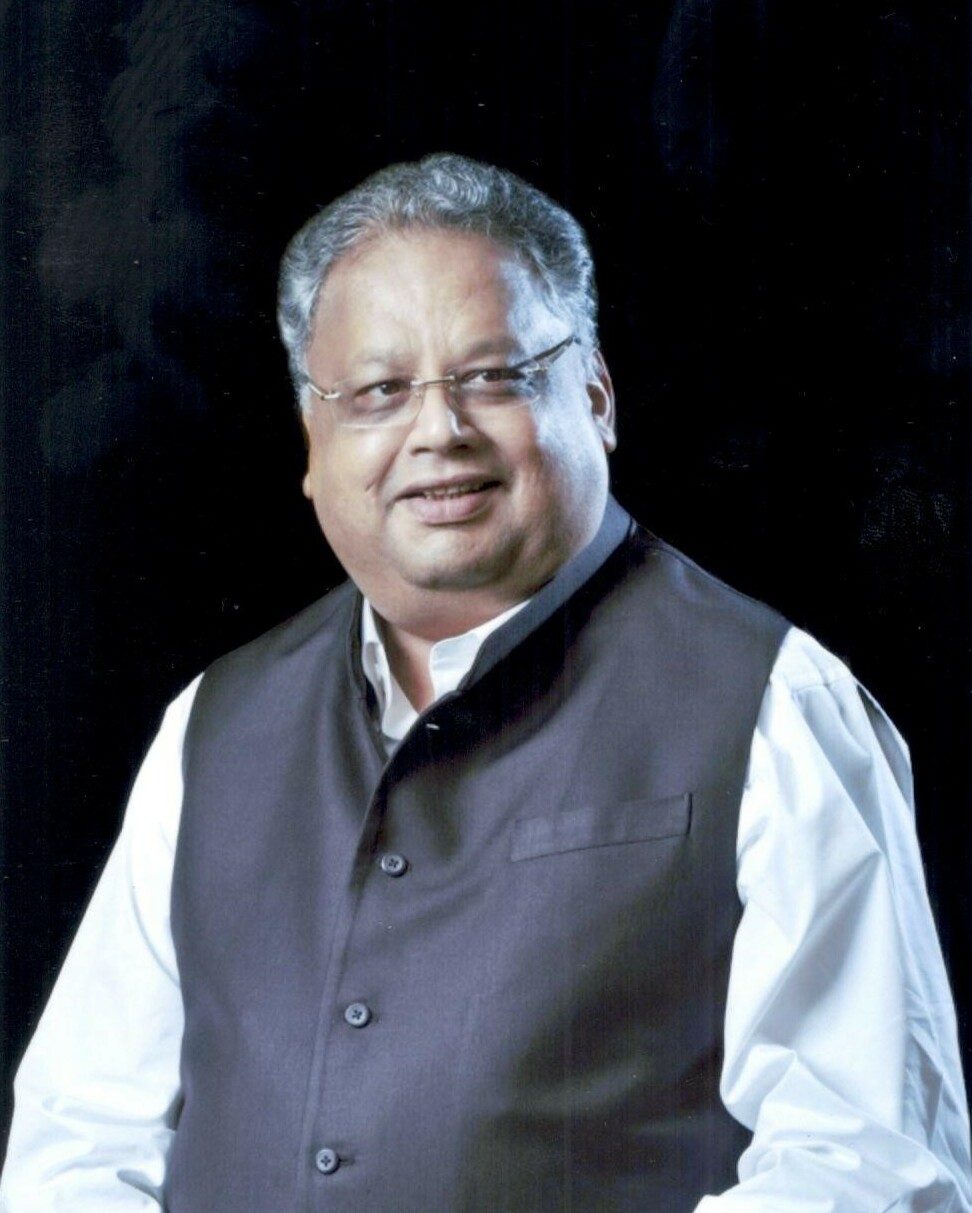
| Key facts | |
|---|---|
| Born | 5 July 1960 (most accounts say Bombay; The Week and a 2023 biography say Hyderabad, with the family moving to Bombay when he was two) |
| Died | 14 August 2022, Mumbai, aged 62 |
| Family roots | A Marwari Agarwal family from Jhunjhunu district, Rajasthan; father Radheshyam Jhunjhunwala was an income tax officer |
| Education | Commerce graduate, Sydenham College of Commerce and Economics, Mumbai; chartered accountant (1985) |
| Family | Wife Rekha Jhunjhunwala (married 1987); three children |
| Company/Group | Rare Enterprises (proprietary investment firm); promoter investor in Akasa Air, Star Health, Metro Brands, Concord Biotech and others; chairman of Aptech and Hungama Digital Media |
| Wealth | Forbes estimated US$5.8 billion at his death in August 2022. The family fortune, now held by “Rekha Rakesh Jhunjhunwala & family”, was Rs 75,800 crore on the M3M Hurun India Rich List 2026 |
| Known for | “India’s Big Bull”: turning Rs 5,000 in 1985 into one of India’s largest personal stock portfolios, led by Titan |
On 7 August 2022, a new airline called Akasa Air flew its first commercial flight, from Mumbai to Ahmedabad. Its largest shareholder was at the launch. He had spent nearly four decades betting on Indian companies, and at 61 he had put his name and his money behind the riskiest business in India, a field littered with dead airlines. “We are not a low-cost airline. We are a frugal airline,” he said that day [42]. When critics asked why a stock market investor would buy into aviation, he had a standard reply: “I am hopeful and prepared for failure” [46].
Seven days later, on 14 August 2022, Rakesh Jhunjhunwala was dead [13].
The news stopped Dalal Street on a Sunday. Prime Minister Narendra Modi called him “indomitable. Full of life, witty and insightful” [67] [21]. Ratan Tata said he would be remembered “for his acute understanding of the stock exchanges of India” and “his foresightedness” [67]. Forbes put his net worth at US$5.8 billion, the 36th-largest fortune in India [11] [37].
He had started in 1985 with Rs 5,000, when the BSE Sensex stood at about 150 [13]. He had no family business, no inheritance and no outside clients. He never ran a fund. He made his money buying and selling shares with his own capital, out loud, in public, for 37 years. That is what made him a folk hero for millions of small investors: he was proof, or seemed to be, that an ordinary middle-class Indian could get very rich simply by believing in India and owning a piece of it.
This is the story of how he did it: the trades that made him, the bets that failed, the regulator who caught up with him, and the family and fortune he left behind.
Where it began
Rakesh Radheshyam Jhunjhunwala was born on 5 July 1960 [27] [12]. Most accounts, including India Today and ThePrint, say he was born in Bombay [27] [16]. The Week reported in 2015 that he was “born in Hyderabad” and had lived in Mumbai “since he was two”, and the journalist Neil Borate’s 2023 biography, The Big Bull of Dalal Street, also gives Hyderabad [17] [29]. Either way, Bombay was the only home he knew.
The family were Agarwals whose roots lay in the Jhunjhunu district of Rajasthan, the Marwari heartland that has produced many of India’s trading families [17] [28]. He was proud of it. The editor T N Ninan recalled him describing himself as from “the Agrawal clan of the Banias” and asking, half in jest, “So, boss, do we own the country or not?” [30].
His father, Radheshyam Jhunjhunwala, was an income tax officer in Mumbai [26] [21]. His mother, Urmila, ran the home. He had an elder brother, Rajesh, also a chartered accountant, and two sisters [28].
The story of how he fell for the market starts at home. His father followed shares and talked about them with his son; the boy learned early that news about a company moves its share price [18] [27]. “My father used to motivate me to read and recommended books,” he later told The Week. Father and son lived together in Mumbai and discussed stocks almost every day until his father’s death [18].
At school and at Sydenham College of Commerce and Economics in Mumbai, where he graduated with honours, he played table tennis and debated [17] [20]. One of his schoolmates, a year behind him, was Uday Kotak, who went on to build Kotak Mahindra Bank (see our profile of Uday Kotak) [14]. After college he toyed with becoming a pilot or a journalist [19]. Instead he qualified as a chartered accountant in 1985 [16].
He never practised. He went straight to the market.
The first break
Rs 5,000 and a lot of nerve
In 1985 the Sensex was about 150 and the Indian stock market was a small, clubby, paper-based world centred on the Bombay Stock Exchange building on Dalal Street. Jhunjhunwala walked in with Rs 5,000 [13]. Sources disagree on where that money came from: some say it was his own savings; Bloomberg reported that he borrowed it from his brother-in-law, and the BBC that it came from “a relative” [20] [21].
Rs 5,000 does not buy much, so he borrowed more. The Week reported that his starting capital was boosted with about Rs 20 lakh of borrowed money [17]. He explained the logic years later: “To invest, you need capital. So how do I get capital? The only way was to borrow or trade” [24].
Tata Tea, 1986
The first trade that people still talk about came in 1986. He bought 5,000 shares of Tata Tea at about Rs 43 each. Within three months they were at Rs 143 [15] [16]. The profit, about Rs 5 lakh [27], was a fortune for a 26-year-old in the mid-1980s. (ThePrint later pointed out that 5,000 shares at Rs 43 would have cost about Rs 2.15 lakh, far more than his starting Rs 5,000; the gap was presumably borrowed money [15].)
Over the next three years he made close to Rs 25 lakh [16] [17]. His biggest early trade was in Sesa Goa, the iron ore miner, in the late 1980s. He has told the story several times with different numbers: in a 2012 interview with Reuters he described buying at around Rs 60-65 and selling at Rs 2,200 [22], while a 2006 Business Standard profile placed his entry much lower [19]. All versions agree on the essentials: he bought a cheap, unloved stock because he believed its profits would surprise the market, and he was right.
The bear of 1992
In the early 1990s, as the broker Harshad Mehta pushed share prices to dizzy heights with money diverted from the banking system, Jhunjhunwala took the other side. Business Standard described him as part of the “so-called ‘bear cartel’” of traders who bet that Mehta’s stocks would fall [13]. For months the bears suffered as prices kept rising. Then, in April 1992, the scam broke, prices collapsed, and the bears were proved right.
“It’s true that I used to be a bear during Harshad Mehta’s time,” he told Business Standard in 2006 [19]. To ThePrint’s reporters he put it more bluntly: “In 1991-92, during the Harshad Mehta scam, I made my biggest wealth” [15]. Short-selling was legal, and we found no case brought against him from that period.
The mentor
Jhunjhunwala always named two people as the source of his success: his father, and Radhakishan Damani, the veteran trader who would later found DMart [50]. They met in the lanes around the BSE in 1985 [50]. “I learnt the maximum about trading from him,” he told The Week [17]. Damani, for his part, said of his protégé: “He saw the future of India” [25]. Behind Jhunjhunwala’s office desk hung a painting of the two men outside the stock exchange [25]. Decades later, the student would ask his teacher to look after his family. (Read our profile of Radhakishan Damani.)
Building the empire
Rare Enterprises: “Ra” plus “Re”
In 1987 Jhunjhunwala married Rekha, a Mumbai girl from a large family [26]. Their investment firm took its name from both of them: Rare Enterprises, “Ra” for Rakesh and “Re” for Rekha [14] [15]. The firm invested only the couple’s own money [15]. “I have no motive, no customers, no clients, except Mrs Jhunjhunwala, and she’s a captive customer,” he joked in 2010 [26]. (Rekha’s own story is told in our profile of Rekha Jhunjhunwala.)
Sources do not agree on when Rare was founded. Some date it to 2003; others say it was built in the 1990s with his long-time partner Utpal Sheth, a former investment banker [70]. Jhunjhunwala described that partnership as “1+1=11” [70]. Amit Goela became his other key partner [50].
Trader and investor, in two separate boxes
Jhunjhunwala was unusual because he was two things at once. He was a fast, aggressive trader who used leverage and technical charts, and a patient investor who held a few companies for decades. He kept the two strictly apart.
“Trading is at the heart of all my wealth,” he said in 2021. “If I didn’t earn in trading how would’ve I invested?” [24]. But he insisted that “I don’t mix my trading with investment” and that “if I buy a stock and it goes down I don’t put it in my investment portfolio” [24]. To ordinary people, he gave the opposite advice to the one he followed: “don’t trade. Out of 10 lakh, 9.99 lakh lose” [24].
Reuters reported in 2012 that he kept two framed sets of rules in his office: “10 Commandments for Investing” and “10 Commandments for Trading”, and employed about a dozen people to place his bets [22]. His friend, the television anchor Udayan Mukherjee, remembered his line: “Investing is like sipping wine slowly, trading like downing Tequila shots” [69].
His approach to picking companies was simple to describe and hard to copy. Look at the size of the opportunity, the quality of the people running the business, and the price. “I have no prejudice that I should buy value or growth stocks,” he told Outlook Business in 2018. “It is more important at what valuation we buy” [25]. Other lines became famous: “You cannot make money on borrowed knowledge”; “Curiosity is the secret of my success”; “When I buy companies, I am adopting them” [25]. On selling, he said in 2021: “I sell for three reasons. If earnings have peaked or the PE has peaked or I feel I can get a better investment… Otherwise, I don’t sell generally” [47].
And on the market itself he was almost religious. “Bhaav bhagwan hai, hum kadradaan hai” (the price is god; we are only its admirers), he once said on television [68].
Titan: the bet of a lifetime
The trade that built his fortune began in 2002-03, when he started buying shares of Titan Industries, the Tata group’s watch company [31]. At the time Titan was best known for wristwatches and was struggling to make its jewellery brand, Tanishq, work.
Accounts of the entry price differ. Business Today puts it at Rs 30-35 a share [31] [32]; Open magazine reported in 2010 that he bought about 6.6 lakh shares at around Rs 50 between March and June 2002 [26]. His friend Raamdeo Agrawal, co-founder of Motilal Oswal (see our profile of Raamdeo Agrawal), has said that a broker had a large block of Titan shares to sell and Jhunjhunwala simply took it [33] [32].
What he saw was India’s middle class. As incomes rose, he reasoned, millions of families would buy branded watches and, above all, trusted gold jewellery. Tanishq, backed by the Tata name, was positioned to win that trust.
He held on through every slump for two decades, often adding more. By June 2022 the family owned 4,48,50,970 Titan shares, a 5.1% stake worth about Rs 11,087 crore. Business Today calculated that the shares had risen more than 82 times from his first purchase [31]. Titan alone made up more than a third of his listed portfolio. (For the Tata side of this story, see our profile of Ratan Tata.)
Crisil, Lupin and the 2003 bull market
Alongside Titan, he built big positions in the rating agency Crisil and the drugmaker Lupin in the early 2000s, when pharma was an “ugly duckling” sector [25] [34]. Borate’s biography calls Titan, Crisil and Lupin “the three stocks that built his fortune” [29]. He also bought Praj Industries in early 2004 at about Rs 100 a share [34].
The bull market of 2003-2007 transformed him. According to Outlook Business, his net worth went from about Rs 250 crore in 2003 to about Rs 5,000 crore by 2007 [25]. Business Standard put the value of the family’s listed holdings at Rs 3,461 crore in December 2007 [36]. He entered the billionaire rankings around this time [23].
One decision he regretted for the rest of his life: in 2006 he sold Crisil shares worth over Rs 20 crore to buy a home. He later said that sale cost him about Rs 1,000 crore in missed gains [35].
The private bets
Jhunjhunwala made some of his largest gains in companies before they listed. He invested early in Concord Biotech, Metro Brands (Metro Shoes), Care Hospitals and the healthcare services firm Inventurus Knowledge Solutions (IKS) [25]. Outlook Business reported in 2018 that the returns from these unlisted bets had grown so large they had reduced the share of profits coming from his trading [25].
In 2018 he joined a consortium with the investment firms WestBridge Capital and Madison Capital to buy control of Star Health and Allied Insurance [78]. By the time of Star Health’s stock market listing in December 2021 he held 14.98% of the company [75]. Metro Brands listed the same month [75]. These were the last two IPOs of companies he had backed during his lifetime.
IKS, where trusts set up for his three children held more than half the company at a negligible cost, listed in December 2024, two years after his death [71].
Board seats, films and a house on Malabar Hill
He chaired the education company Aptech and the digital music company Hungama Digital Media, and sat on the boards of companies such as Prime Focus, Geojit Financial Services and Concord Biotech [74].
He also co-produced Hindi films with Damani and the director R Balki, through a firm called Gutz Feel Film Production: English Vinglish (2012), which grossed over Rs 75 crore, Shamitabh (2015) and Ki & Ka (2016) [64] [17].
In 2013 he bought six flats in Ridgeway Apartments, a building on Mumbai’s Malabar Hill, from Standard Chartered Bank for Rs 176 crore. He later bought the rest of the building, then demolished it and rebuilt it as the family home [66] [74].
The great India bull
Through all this, Jhunjhunwala was the loudest optimist in Indian finance. In December 2008, with markets in free fall, he told Bloomberg that “India will see the mother of all bull runs in the next four or five years” [49]. In June 2021 he said: “We are in the middle of a bull phase which will last for a very, very long time” [48]. At the India Today Conclave in October 2021 he declared: “Earlier I used to say our time will come but now I am saying that our time has already come” [46].
“How can you live in India and buy anything other than stocks?” he once asked Udayan Mukherjee [69]. When Reuters asked in 2012 about the gloom over India’s economy, he said: “When a child is sick, the mother is concerned. It doesn’t mean the child’s going to die” [22]. He also had a clear sense of how much of his success came from timing. “If the Sensex had not gone up 100 times from when I started, I could not have been successful,” he told Reuters [22].
He disliked the comparison with Warren Buffett that newspapers loved. “He’s far, far ahead,” he said [22].
The wealth curve
Forbes figures show how his wealth rose and fell with the market: about US$1.3 billion in 2013, US$3 billion in 2018, US$1.9 billion in 2020 after the Covid crash, US$4.3 billion in 2021 and US$5.8 billion in 2022 [37]. On the IIFL Wealth Hurun India Rich List 2021 his wealth was put at Rs 22,300 crore, up 52% in a year [73].
When he died, his listed holdings were worth more than Rs 30,000 crore across about three dozen companies, according to Business Today and Business Standard [40] [13]. Titan (about Rs 11,000 crore), Star Health (about Rs 7,000 crore), Metro Brands (about Rs 3,350 crore) and Tata Motors (about Rs 1,731 crore) were the largest [40]. He had bought 4 crore Tata Motors shares in 2020, near the Covid low, for about Rs 500 crore [72].
He liked to brush off questions about his net worth. “If you can count it, you don’t have it,” he would say [25]. Another favourite: “I have much less than what most people think, but much more than I need” [23].
The last bet: Akasa Air
In July 2021 Jhunjhunwala announced his most surprising move: up to US$35 million (about Rs 260.7 crore) for a stake of up to 40% in a new low-cost airline [41]. Its founders were Vinay Dube, the former chief executive of Jet Airways, and Aditya Ghosh, the former president of IndiGo [15]. The family’s stake later rose to about 46% [43].
Indian aviation had destroyed Kingfisher, Jet Airways and many others, and critics asked why a stock market investor would go near it. He met Prime Minister Modi in October 2021; Modi tweeted that he was “very bullish on India” [65].
Akasa flew its first commercial flight, Mumbai to Ahmedabad, on 7 August 2022. The launch was his last public appearance [42].
He did not live to see whether the bet worked. By March 2026, Akasa had 37 aircraft, more than 26 million passengers carried and 226 Boeing 737 MAX jets on order [9]. Its domestic market share was about 5.4%, against IndiGo’s 63% [45]. In 2025 it raised fresh capital, reportedly about US$125 million, from investors including Azim Premji’s Premji Invest and Ranjan Pai’s Claypond Capital, with the Jhunjhunwala family also putting in money [43] [44]. (See our profiles of Azim Premji and Ranjan Pai.)
14 August 2022
Jhunjhunwala was brought to Breach Candy Hospital in Mumbai early on Sunday, 14 August 2022, and declared dead following a cardiac arrest, the hospital said [13]. He was 62.
He left a will. Reports at the time said his wife and three children were the main beneficiaries and that a part of the estate was set aside for charity, which he called his “fourth child” [51]. Business Standard reported that Radhakishan Damani was likely to head the trust overseeing the estate, with long-time associates Kalpraj Dharamshi and Amal Parikh as fellow trustees, while Utpal Sheth and Amit Goela would continue to run Rare Enterprises [50].
The setbacks and failures
For all the legend, Jhunjhunwala lost money often, sometimes a lot of it. “I made many mistakes but my triumphs have received far greater publicity than my failures,” he said in a 2014 interview [77].
2008: the crash he did not see coming
He was not as prescient about the 2008 crash as he was about the 2003 boom. “I was caught completely by surprise when the Nifty broke the 4,000 level,” he told Bloomberg in December 2008 [49]. The 31 listed companies where he held more than 1% lost about 60% of their value [23]. Business Standard’s figures show the family’s listed portfolio falling from Rs 3,461 crore in December 2007 to Rs 1,130 crore at the March 2009 low [36].
He did not sell. “I could never lose my conviction about India’s growth,” he said in 2009. “I held on to my stocks, very much so” [23]. By mid-2014 the same portfolio was worth Rs 7,261 crore [36].
A2Z, DB Realty and the duds
His biggest single mistake, by Outlook Business’s reckoning, was A2Z Maintenance & Engineering. He paid about Rs 20 crore for 21% of the company in 2006, sold some shares in its 2010 IPO at Rs 400, then bought more as the price fell. By 2013 the stock was down about 94% from its listing price. Outlook Business called it “the biggest dud in RJ’s portfolio” [38].
Business Standard listed DHFL and DB Realty among his other notable losers [13]. Other bets, such as Bilcare and Prozone, also disappointed [25].
March 2020
The Covid crash was brutal. In March 2020 his listed holdings fell by 36%, from about Rs 12,480 crore to about Rs 8,021 crore. Titan alone lost Rs 2,314 crore in value, and stocks such as NCC, Delta Corp, Karur Vysya Bank, Aptech and Jubilant fell by more than half [39]. Within two years he had recovered all of it and much more.
His attitude to losses was consistent. “You make a lot of mistakes but in the end you have to come back to the stock market; where else you will go,” he once said [76]. At the 2021 Conclave he put it this way: “I am not afraid to make any mistake, only one that I can afford” [46].
Controversies and allegations
Jhunjhunwala’s career was unusually clean for a market figure of his generation. A PTI obituary contrasted him with figures such as Harshad Mehta and Ketan Parekh, “whose rise in fortunes was tainted with scam links” [14]. But he did face regulatory action, and the most important matter, over Aptech, ended in a settlement. All the matters below are closed.
SEBI’s Aptech insider-trading case, 2016-2021
Allegation: The Securities and Exchange Board of India (SEBI) investigated trading in shares of Aptech, the education company of which Jhunjhunwala was chairman and a promoter. Aptech had been working on an entry into the preschool business, which it announced after market hours on 7 September 2016. SEBI treated this as unpublished price-sensitive information from 14 March 2016 until that announcement. It alleged that Jhunjhunwala and Aptech director Utpal Sheth had this information and passed it on, and that six people, including Jhunjhunwala, his wife Rekha, his brother Rajeshkumar and other relatives, traded Aptech shares during that period. Jhunjhunwala was charged with both communicating the information and trading on it [1]. Business Standard reported in January 2020, citing Mint and The Economic Times, that SEBI had summoned him, and that Rekha and Rajeshkumar had bought 7,63,057 Aptech shares in block deals on 7 September 2016 [55]. SEBI issued a show-cause notice on 1 October 2020 [1].
Response: Jhunjhunwala did not contest the case on its merits. In early 2021 he and the others filed settlement applications [56]. They settled under SEBI’s settlement regulations “without admitting or denying the findings of fact and conclusions of law” [1]. His lawyer, Sumit Agrawal, later recalled his view of the regulator: “Right or wrong, you should always defer to them to keep harmony” [57].
What happened next:
- SEBI’s settlement order of 14 July 2021 recorded that Jhunjhunwala paid Rs 18.48 crore: a settlement amount of Rs 9.51 crore, disgorgement of Rs 5.87 crore and interest of Rs 3.11 crore. Rekha paid about Rs 3.19 crore. The seven applicants together paid about Rs 28.5 crore [1].
- The widely reported total of “more than Rs 37 crore” includes separate settlements by other Aptech board members, among them the investor Ramesh Damani [54].
- In February 2023, SEBI barred Lashit Sanghvi, a co-founder of Alchemy Capital, and his wife from the market for a year over Aptech trades in 2016, relying partly on a one-minute phone call with Jhunjhunwala [58]. In May 2025 the Securities Appellate Tribunal set that order aside, holding that SEBI had not shown the couple had access to the information [3].
Status: Closed since July 2021 by settlement, without admission of guilt. SEBI reserved its right to reopen the matter only if any representation by the applicants turned out to be untrue [1].
SEBI disclosure case over Geometric Ltd, 2017-2018
Allegation: A SEBI show-cause notice of March 2017 alleged that Jhunjhunwala had failed to make a required disclosure of a change in his shareholding in Geometric Ltd under the 1992 insider-trading regulations. This was a disclosure lapse, not a charge of trading on inside information [2].
Response: He applied to settle under SEBI’s summary settlement process [2].
Status: Closed. SEBI’s settlement order of 30 November 2018 recorded a payment of Rs 2,48,872 [2].
Income tax search and disputes
Allegation: Income tax tribunal records show that Jhunjhunwala’s residence was covered by an income tax search on 29 August 2011, as part of a search of the Maneesh Pharmaceutical group, of which he was described as an associate. The tax department later made additions to his income for several years [4] [5].
Response: He appealed the additions.
What happened next:
- In October 2017 and January 2018, the Income Tax Appellate Tribunal in Mumbai dismissed the department’s appeals, noting that the assessing officer had conceded that “no incriminating material” was found in the search [4] [5].
- In a separate case, the tribunal upheld a disallowance of Rs 3.53 crore of interest claimed by Rare Enterprises for 2011-12 [6].
Status: The search-related additions we found were decided in his favour. We found no tax prosecution against him.
Talk of trading ahead of news
Allegation: As India’s most-watched investor, Jhunjhunwala was often the subject of market talk. The PTI obituary noted that he “did feature in some cases of insider trading and was also speculated to front-run on stock trades ahead of big news events” [14].
Response: He publicly disclosed his large holdings and described himself as a long-term investor. Raamdeo Agrawal said he was a “perma bull” who was open about his trades [33].
Status: Apart from the Aptech and Geometric settlements above, we found no regulatory finding or court case against him on these grounds. The front-running talk remains unproven speculation.
As of 3 November 2026, we found no pending court, regulatory or tax case against Rakesh Jhunjhunwala or his estate, and no reported dispute over his will. Company matters at businesses he backed, such as Akasa Air’s 2023 lawsuit against pilots who quit without serving notice and later safety penalties by the aviation regulator, arose after his death and did not involve him personally.
Giving back
Jhunjhunwala talked about giving money away more openly than most Indian tycoons of his time, and his pledges changed shape over the years. In August 2011 he said he would donate 25% of his wealth in his lifetime [59]. In 2016 he said he would give 25% of his holdings, or Rs 5,000 crore, whichever was lower [60]. In July 2021 he said he gave about a quarter of his annual income to charity and planned a professionally run foundation with Rs 400-500 crore. “I have the money, but I do not have the will to spend it,” he said. “I don’t ask God for more wealth, but to give me the power to give it away” [61].
He appeared on the EdelGive Hurun India Philanthropy List 2021 with donations of Rs 50 crore in a year, mostly for education [62]. His causes included Agastya International Foundation, which runs science education for rural children and where he was a trustee and committed Rs 50 crore over ten years [63]. He also supported Ashoka University, St Jude India ChildCare Centres, Friends of Tribals Society and eye care [74].
His family has carried this forward. On 20 October 2024 Prime Minister Modi inaugurated the R J Sankara Eye Hospital in Varanasi, built with the Jhunjhunwala family’s support, and paid tribute to both Rakesh and Rekha [8].
In January 2023 the Government of India announced the Padma Shri for Rakesh Jhunjhunwala, posthumously, for trade and industry. Rekha received it from President Droupadi Murmu on 22 March 2023 [7] [53].
Succession
Jhunjhunwala planned for a day he did not expect to come so soon. The estate passed mainly to his wife and to trusts for their three children [51]. The portfolio continued to be run by Rare Enterprises under Utpal Sheth and Amit Goela [50].
The Bombay High Court granted probate of his will on 18 December 2023, and transfers of large holdings into family entities took years. In April 2026 the insurance regulator approved the transfer of more than 8.28 crore Star Health shares to his heirs, and in June 2026 most of these moved to a family partnership, Sitara Partners LLP [52].
The fortune he built has kept growing. The M3M Hurun India Rich List 2026 put the wealth of “Rekha Rakesh Jhunjhunwala & family” at Rs 75,800 crore, the highest of any investor in India [10]. Most of it still comes from the bets he made, above all Titan.
What their journey teaches
Separate the money you trade from the money you invest. Jhunjhunwala’s trading paid for his long-term bets, but he never let a losing trade become an “investment” to avoid booking a loss [24]. Most small investors do the opposite.
A single great company held for 20 years can matter more than a hundred clever trades. Titan went up more than 80 times while he held it [31]. The hard part was not buying it in 2002; it was not selling it in 2008 or 2020.
Big gains need survivable risks. “I am not afraid to make any mistake, only one that I can afford,” he said [46]. He lost heavily on A2Z and others, and his portfolio fell by about two-thirds in 2008-09, but no single bet was big enough to finish him.
The market’s tide matters as much as the swimmer. He was candid that a 100-fold rise in the Sensex made his career possible [22]. Long-term optimism about a growing economy, held through crashes, was his real edge. (CapitalVia’s Insights track how ordinary Indian investors behave through the market’s ups and downs.)
Compliance is not optional, especially for your family. The Aptech case shows how easily relatives can be pulled into insider-trading rules when one person sits on a company’s board. It ended in a settlement of about Rs 28.5 crore for seven people [1].
Plan your exit before you need it. Trustees, partners and family trusts were in place or quickly put in place, and the fortune has passed to the next generation without a public dispute [50] [52].
A profile for general reading, based on public records and reporting as of 3 November 2026. Not investment, tax or legal advice.
Sources (78)
- Settlement Order in the matter of Aptech Ltd (Rakesh Jhunjhunwala and 6 others) - SEBI, Jul 2021
- Settlement Order: Rakesh Jhunjhunwala in the matter of Geometric Ltd - SEBI, Nov 2018
- Lashit Sanghvi and Neha Sanghvi v. SEBI, Appeals 257 and 258 of 2023 - Securities Appellate Tribunal (via Indian Kanoon), May 2025
- DCIT v. Rakesh Jhunjhunwala, ITA 5020-5021/Mum/2016 - Income Tax Appellate Tribunal, Mumbai (via Indian Kanoon), Oct 2017
- DCIT v. Rakesh Jhunjhunwala, ITA 3821/Mum/2016 - Income Tax Appellate Tribunal, Mumbai (via Indian Kanoon), Jan 2018
- Rare Enterprises v. ACIT, AY 2011-12 - Income Tax Appellate Tribunal, Mumbai (via Indian Kanoon), Dec 2018
- President confers Padma Awards at Civil Investiture Ceremony - PIB, Mar 2023
- PM inaugurates RJ Sankara Eye Hospital in Varanasi - narendramodi.in, Oct 2024
- Akasa Air closes FY25-26 with 37 aircraft - Akasa Air press release, Mar 2026
- Top 10 investors by wealth in M3M Hurun India Rich List 2026 - Outlook Money, Oct 2026
- Billionaire investor Rakesh Jhunjhunwala, known as India's Warren Buffett, dies at 62 - Forbes, Aug 2022
- Rakesh Jhunjhunwala (Q7286604) - Wikidata, accessed Nov 2026
- Big bull bows out: Rakesh Jhunjhunwala passes away at 62 in Mumbai - Business Standard, Aug 2022
- Rakesh Jhunjhunwala: the unabashed wealth creator sans big scam shadow - Business Standard (PTI), Aug 2022
- India's Warren Buffett, the man with the Midas touch: who was Rakesh Jhunjhunwala - ThePrint, Aug 2022
- Rakesh Jhunjhunwala was investor with Midas touch who never gave up on Indian markets - ThePrint, Jul 2023
- Bourse boss - The Week, Jul 2015
- A memorable meeting with Rakesh Jhunjhunwala - The Week, Aug 2022
- Lunch with BS: Rakesh Jhunjhunwala - Business Standard, Aug 2006
- Rakesh Jhunjhunwala: the stock market wizard whose 'only client' was his wife (Bloomberg) - Gulf News, Aug 2022
- Rakesh Jhunjhunwala: India's 'Warren Buffett' dies at 62 - BBC News, Aug 2022
- 'I'm Jhunjhunwala, not India's Buffett' (Reuters) - Business Standard, Jun 2012
- Rakesh Jhunjhunwala, star of India's economic bull run - The National, Jul 2009
- Rakesh Jhunjhunwala on why you should be an investor, not a trader - BloombergQuint, Apr 2021
- The oracle of Dalal Street: Rakesh Jhunjhunwala - Outlook Business, Jan 2018
- Jhunjhunwala's Real Bull Run - Open Magazine, Feb 2010
- Birthday special: Rakesh Jhunjhunwala, 5 lesser-known facts about him - India Today, Jul 2021
- Rakesh Jhunjhunwala death: family, wife Rekha and Rare Enterprises - DNA, Aug 2022
- The Big Bull of Dalal Street takes stock of life, success of Rakesh Jhunjhunwala (book review) - The Tribune, Apr 2023
- Family man, confident investor, eternal India optimist: farewell Rakesh Jhunjhunwala - ThePrint (T N Ninan), Aug 2022
- Rakesh Jhunjhunwala's Titan stake: rally in 20 years - Business Today, Aug 2022
- Why Rakesh Jhunjhunwala backed Titan when few did: Raamdeo Agrawal explains - Business Today, Jun 2026
- Rakesh Jhunjhunwala: the bull of all seasons - Business Standard, Aug 2022
- One up on Dalal Street - Business Standard, Oct 2011
- This is where Jhunjhunwala went wrong: legendary investor rues buying house (PTI) - OrissaPOST, Feb 2022
- Rakesh Jhunjhunwala's networth up 55% in a year - Business Standard, Aug 2014
- Rakesh Jhunjhunwala's total net worth: Big Bull in India's stock market - WION, Aug 2022
- Spectacular bust - Outlook Business, May 2013
- Rakesh Jhunjhunwala's portfolio hit 28%; Ashish Dhawan, Dolly Khanna suffer - Business Standard, Mar 2020
- Rakesh Jhunjhunwala owned portfolio of 32 stocks worth Rs 30,000 crore - Business Today, Aug 2022
- Rakesh Jhunjhunwala likely to invest Rs 260.7 crore in Akasa airline - Business Today, Jul 2021
- Akasa's take-off has changed game: Jhunjhunwala in last public appearance - Business Standard, Aug 2022
- Akasa Air raises funds from Azim Premji, Ranjan Pai family offices - YourStory, Feb 2025
- India's Akasa Air completes funding with $125mn investment - ch-aviation, Aug 2025
- Akasa Air challenges IndiGo, Air India duopoly with additional flights (Bloomberg) - ThePrint, May 2026
- Skills, democracy main drivers of growth, says Rakesh Jhunjhunwala (PTI) - Business Standard, Oct 2021
- How India's Big Bull Rakesh Jhunjhunwala remains bullish - Business Today, Oct 2021
- Markets' bull run will last for very, very long time: Rakesh Jhunjhunwala - Business Standard, Jun 2021
- Worst may be over for markets: Jhunjhunwala (Bloomberg) - Business Standard, Dec 2008
- Gurudakshina: DMart's Damani likely to manage Jhunjhunwala's trust - Business Standard, Aug 2022
- Jhunjhunwala left a will to bequeath fortune to family: report (IANS) - Business Standard, Aug 2022
- Rekha Jhunjhunwala's Star Health stake drops to 3.04%; company clarifies promoter reshuffle - Outlook Business, Jul 2026
- Rakesh Jhunjhunwala receives Padma Shri posthumously - ThePrint, Mar 2023
- Rakesh Jhunjhunwala, wife settle Aptech insider trading case with Sebi - Business Standard, Jul 2021
- Rakesh Jhunjhunwala under Sebi probe for insider trading in 2016: reports - Business Standard, Jan 2020
- Aptech insider trading case: Rakesh Jhunjhunwala files consent appeal with Sebi - Business Today, Feb 2021
- 'Right or wrong, keep harmony': when Rakesh Jhunjhunwala compared Sebi to spouse - Business Today, Aug 2022
- Sebi bars Alchemy Capital founder Lashit Sanghvi and his wife from stock market for a year - Business Today, Mar 2023
- Jhunjhunwala pledges 25% of wealth for charity - Business Standard, Aug 2011
- Jhunjhunwala to donate 25% of holdings to charity - Business Standard, Oct 2016
- Rakesh Jhunjhunwala lays down charity plans, to set up foundation with over Rs 500 cr capital - Business Today, Jul 2021
- Zerodha founders, Rakesh Jhunjhunwala and others donate up to Rs 50 crore in FY21 - Business Insider India, Oct 2021
- The Big Bull - Agastya International Foundation, Jul 2024
- Big bulls strike gold on silver screen - Business Standard, Jun 2016
- PM Modi meets noted stock market investor Rakesh Jhunjhunwala - Deccan Herald, Oct 2021
- Mumbai billionaire Rakesh Jhunjhunwala plans to demolish Rs 370 crore property - The Quint, Mar 2017
- Rakesh Jhunjhunwala will be remembered for his foresightedness: Ratan Tata - Outlook Business, Aug 2022
- When Rakesh Jhunjhunwala said 'bhaav bhagwan hai, hum kadradaan hai' - Business Today, Aug 2022
- RIP Rocky: Udayan Mukherjee's tribute to Rakesh Jhunjhunwala - Business Today, Aug 2022
- Investment lessons from Rakesh Jhunjhunwala's '1+1=11' partner Utpal Sheth - Business Insider India, Sep 2022
- IKS Health IPO: how much Jhunjhunwala trusts, other investors can make - Business Today, Dec 2024
- Rakesh Jhunjhunwala picks up 40 mn shares in Tata Motors for Rs 500 cr - Business Standard, Oct 2020
- Byju Raveendran on rich list; Jhunjhunwala's wealth up - Onmanorama, Oct 2021
- Rakesh Jhunjhunwala - Wikipedia, accessed Nov 2026
- Rakesh Jhunjhunwala's last two IPO listings: how they fared - Business Today, Aug 2024
- Love for stock markets - Business Standard, Dec 2017
- Quote of the day by Rakesh Jhunjhunwala: 'I made many mistakes but...' - Business Today, Jun 2026
- WestBridge, Madison, Rakesh Jhunjhunwala to acquire Star Health Insurance - BloombergQuint, Aug 2018