
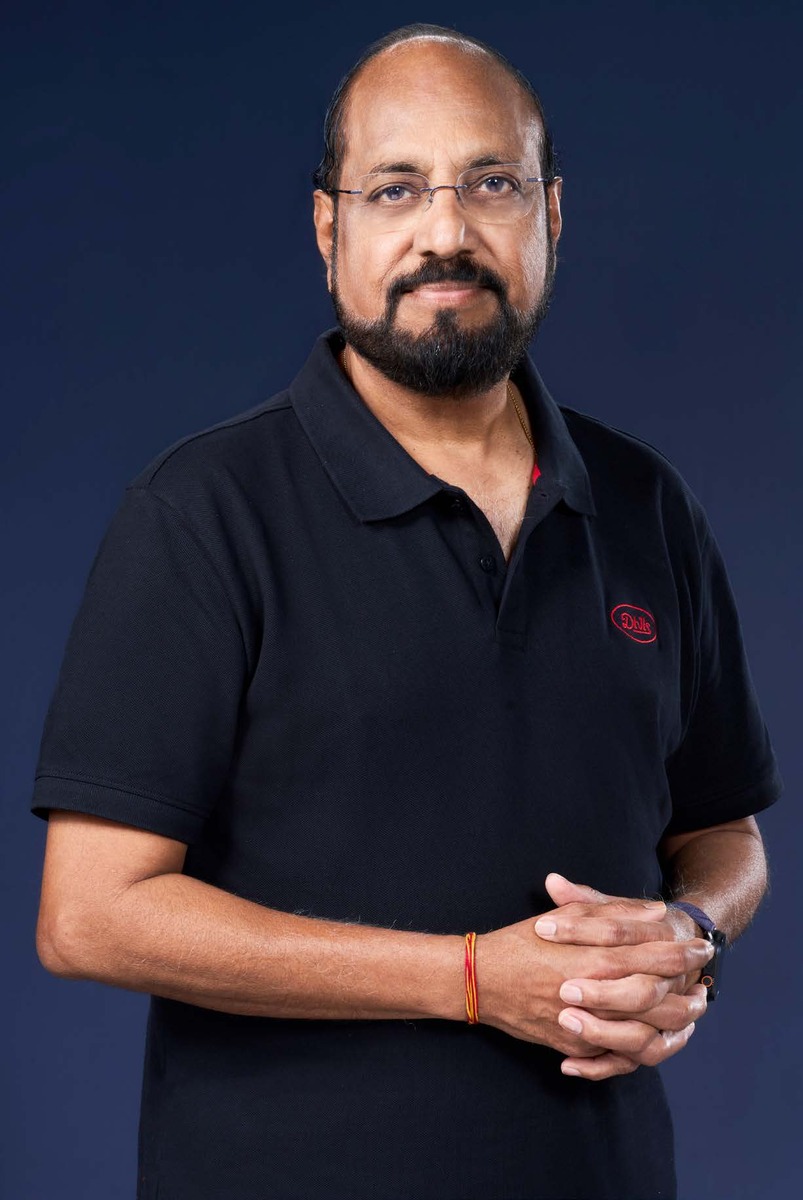
| Key facts | |
|---|---|
| Born | 17 March 1951 (company and MCA records; Bloomberg gives 1957) [67][34] |
| Family roots | Krishna district, Andhra Pradesh; schooled in Machilipatnam; youngest of 13 children of Divi Satyanarayana, a zilla parishad secretary [30][31][34] |
| Education | B.Pharm and M.Pharm, College of Pharmacy, Manipal; PhD in pharmaceutical sciences, Kakatiya University, Warangal [3][2] |
| Family | Married; son Dr Kiran S. Divi (CEO) and daughter Nilima Prasad Divi (Whole-time Director, Commercial) work in the company [2][8][9] |
| Company | Divi’s Laboratories Ltd, Hyderabad: founder (1990) and Managing Director [2][8] |
| Wealth | Rs 1,25,400 crore with family, M3M Hurun India Rich List 2026, richest resident of Hyderabad [60]; about US$13.5 billion on Forbes’s real-time list, October 2026 [61] |
| Known for | Turning process chemistry into one of the world’s biggest makers of drug ingredients, without ever selling a finished medicine of its own |
In the summer of 1969, a Telugu-medium boy from Krishna district opened his results at the College of Pharmacy in Manipal and saw that he had failed again. It was his second failed exam in as many years. The first had been his intermediate exam back home in Machilipatnam [31][34].
He went home expecting the worst. “I expected my father to beat the hell out of me,” he told Forbes India fifty years later [31]. His father, a retired government servant, was raising 13 children on roughly Rs 10,000 a year from his pension and a little farmland [31]. He said nothing. No shouting, no lecture, and no complaint about the fees he had stretched himself to pay.
That silence did what anger could not. “I became more diligent,” Murali Divi recalled. “The trigger was that I saw whatever was happening at home financially and also the fact that my father didn’t say anything” [31]. He topped his class for the rest of his degree and his master’s [31].
Half a century later, the company he founded, Divi’s Laboratories, makes ingredients for medicines sold in about 80 countries [12]. Its revenue crossed Rs 10,500 crore in 2025-26 [57]. In September 2026 the M3M Hurun India Rich List valued Murali Divi and his family at Rs 1,25,400 crore, the largest fortune in Hyderabad [60].
He has managed this while staying almost invisible. He rarely gives interviews. Divi’s sells no branded medicine, runs no advertising, and has never bought a company to grow. Most Indians have never heard of it. Drug companies in America and Europe know it very well.
This is the story of how he did it, where it went wrong, and what the public record says.
Where it began
The youngest of thirteen
Murali Krishna Prasad Divi was born on 17 March 1951, according to company director records and the Telugu daily Andhra Jyothy [67][34]. Bloomberg’s billionaire profile gives his birth year as 1957 [62], but the ages printed in Divi’s own annual reports and AGM notices fit 1951 [3][8].
He was the last of 13 children, nine sons and four daughters, born to Divi Satyanarayana, a secretary of a zilla parishad in Krishna district, Andhra Pradesh [30]. Andhra Jyothy describes his birthplace as “a remote village in Krishna district” [34]. Forbes India calls Machilipatnam, the district headquarters on the coast, his hometown [31]. That is where he went to school.
The family had little money and many mouths to feed. Several of the elder brothers became engineers. Young Murali wanted to be one too. His father had other ideas and steered him into pharmacy [31].
“I didn’t know how to study”
School was in Telugu, and his English was weak. “Having come from a Telugu medium background, my English was poor. I used to mug up, without understanding,” he said [31]. He failed his second-year intermediate exam in Machilipatnam [34]. Then, in 1969, he failed his first-year pharmacy exams at Manipal [31].
He insists that the second failure was not for lack of effort. “I can tell you that I studied most sincerely, honestly. But I didn’t know how to study, how to plan and prepare for an exam” [31].
After his father’s silent reaction he learned. He went on to a bachelor’s and a master’s in pharmaceutical sciences from the College of Pharmacy, Manipal, now the Manipal College of Pharmaceutical Sciences [3][73]. Telugu press accounts say he won gold medals in both [34]. Later he earned a PhD in pharmaceutical sciences from Kakatiya University in Warangal [3][2].
Rs 250 a month
In 1975 he came to Hyderabad and joined Warner Hindustan, a drug company, as a trainee on Rs 250 a month [34]. It was here that he met Kallam Anji Reddy, a chemist then working in the state-run Indian Drugs and Pharmaceuticals Ltd (IDPL), who would later found Dr Reddy’s Laboratories [31]. Reddy later wrote that Divi was one of “two very competent people with whom I had worked earlier” [33].
Divi might have stayed a chemist at Warner Hindustan for life. Instead, almost on a whim, he went to the American consulate in Chennai in 1976 and applied to emigrate [31].
The first break
Seven dollars and a green card
America was short of pharmacists, and the paperwork came through fast. “Within a month or two I got a green card,” he said. “I went to the US with $7, that was all the foreign exchange one could get to travel abroad at that time” [31]. (Andhra Jyothy puts the figure at Rs 600 and the year at 1977 [34]; the $7 is his own account to Forbes India.)
He did not end up behind a pharmacy counter. Over the next seven years he worked in chemical plants across Texas, New Jersey and West Virginia, at Trinity Chemical and Fike Chemical [31]. A Businessworld profile says he rose to production manager and vice-president of R&D at Fike, and later became technical director at a company it calls Schulkill Corporation [32]. At one point he earned as much as US$65,000 a year [31].
The work mattered more than the money. In those plants he learned how to run chemistry at large scale: how to take a reaction that works in a flask and make it work, cheaply and safely, in a plant reactor. Divi’s annual reports later said he “developed efficient processes for speciality chemicals, pharmaceutical intermediates, herbicides and rodenticides and custom synthesis” [3]. That skill, process chemistry, became the foundation of everything he built.
The accident that brought him home
In early 1983, one of his brothers in India was badly hurt in an accident. The news set him thinking about what would happen if something happened to him so far from home. “Somebody would throw me in the hospital and send my wife and children to India,” he said. “Nobody will do more than that because they are working day and night for their own stuff” [31].
By December 1983 he was back in Hyderabad with about US$40,000 in savings and, in Forbes India’s words, “no roadmap for the future” [31]. Most other accounts date his return to 1984 [30][32].
Cheminor: eight reactors, six employees
The roadmap came from his old acquaintance. Anji Reddy was starting what became Dr Reddy’s Laboratories. Divi joined its board in 1984 [30], and Reddy’s memoir names him, along with Purushotama Chary, as a partner in that “third foray as an entrepreneur” [33]. A corporate history compiled from company filings records Cheminor Drugs as incorporated in December 1981, promoted by Reddy and “Murali K. Divi, an NRI” [75].
Divi became Managing Director of Cheminor Drugs, a sickly bulk-drug maker that had, by one account, “only eight reactors and six employees” [30]. He hired fresh graduates and trained them himself. The team developed a low-cost process for the painkiller ibuprofen and scaled it up to 1,200 tonnes a year, about a quarter of world demand [30].
Not everyone believed in it. “When we took [it] over… people laughed,” he wrote later. “They said, ‘This guy comes from the US. Dr Anji Reddy and Murali think they can make it like IDPL.’ We kept quiet. Of course, we turned it around” [30]. Ramesh Babu Potluri, who worked under him, remembered a boss who reached the office at 7.30 am and was often at the plant until midnight [30].
The break-up
In 1990 he left. Potluri said “egos clashed as the next generation of the Reddy family was inducted into the company and it questioned his decisions” [30]. Divi’s own explanation, given in 2014, was gentler: “Perhaps because I was destined to become chairman of my own company rather than remaining managing director elsewhere” [30]. He declined to discuss it in 2019 [31]. There is no record of any legal dispute.
What happened next shows how his staff saw him. “When he left Cheminor in 1990, almost 125 people resigned the same day,” Potluri said [30]. Divi’s own records list several of his first employees, an R&D head, an engineer and a senior chemist, as coming from Cheminor and joining him on 1 November 1990 [3][4].
Building the empire
A research lab, not a factory (1990-1994)
Divi’s Research Centre was incorporated on 12 October 1990 [4][1]. At first it made nothing. It was a consulting lab that worked out better ways to make existing drugs and sold the processes to Indian manufacturers. Businessworld wrote that he hired fresh organic chemistry graduates rather than experienced hands because he wanted “a different mindset”, and personally trained the first two layers of researchers [32]. Forbes India names Natco Pharma, Alembic and Doctors Organic Chemicals among the early clients, for drugs such as ranitidine, naproxen and ibuprofen [31].
He had no plan to run factories again. “Running them is like riding a tiger,” he said. “You have to feed it meat, in this case money, every month and if you don’t, it will wilt. If you are a little less careful, it will eat your feet” [31].
Riding the tiger (1994-1995)
His son changed his mind. Kiran Divi, then a high school student, argued for a full manufacturing company and promised to join it [31]. Divi later described his life as three lines written on his forehead: “Father wrote the first line on my forehead. The second line I wrote by deciding to come back to India. My son wrote the third one” [31].
The third line was expensive. “I took a big risk of buying a 500 acre land parcel and starting the company. I borrowed money, for the first time in my life, about ₹35 crore, from IDBI. Whatever shares I had in Cheminor and Dr. Reddy’s, worth about ₹7.5 crore, were sold” [31].
In 1994 Divi’s Research Centre became Divi’s Laboratories Ltd [70][32]. Its first plant, Unit-I, was built at Lingojigudem village in Choutuppal mandal, then Nalgonda district, about 60 km from Hyderabad. It started operations in 1995 [3][4][1].
The 22nd company into naproxen
The first big product was naproxen, a common painkiller. Divi’s was a latecomer, the 22nd company in the market, behind giants such as Roche and Lonza [30]. Its edge was chemistry: an enzyme-based route that made the drug more cheaply [30]. It became one of the world’s largest naproxen makers, and later took share from Lonza and DSM in the cough-suppressant dextromethorphan [30].
In the early years about 90% of the business was generic APIs, the active ingredients that other companies press into tablets [30]. Divi’s own 2003-04 annual report lists products including naproxen, diltiazem, dextromethorphan, nabumetone and the X-ray contrast agent iopamidol, among “over 77 products” [5].
Winning big pharma’s trust
The real prize was custom synthesis: making ingredients and intermediates for the big Western drug innovators’ patented medicines. Getting in the door was hard. “We repeatedly knocked on their doors, asked them to visit and invest in outsourcing from India,” he said [30].
He worked out what was stopping them. “When we zeroed in on this problem, we realised that intellectual property (IP) was the hurdle” [30]. India had just signed the WTO’s TRIPS agreement on patents in 1994. Divi bet that a company that was “one hundred percent IP compliant” could persuade multinationals to trust it with their chemistry [30].
Two rules followed. Divi’s would never make finished medicines, so it would never compete with its customers [30][31]. And it would guard their secrets. Forbes India says the first big win was a US$2 million contract from GlaxoSmithKline in the mid-1990s [31]. By 2014 custom synthesis was about half the business [30]; by 2025-26 it was 55% [11].
Unit-II and the export machine
The second big site came up at Chippada village in Bheemunipatnam mandal, about 30 km from Visakhapatnam port [5]. Wikipedia dates its start to 2002 [70]. Over time the Vizag complex added an export-oriented unit and three special economic zone units [6].
From the start Divi’s sold mostly abroad. Exports were 91% of sales in 2002-03 [5], 93% in 2010-11 [6], and “nearly 89%” in 2025-26 [11].
The 2003 listing
Divi’s went public in February 2003. The book-built issue was priced at Rs 140 a share and raised about Rs 44.87 crore, of which Rs 17.78 crore was fresh money and the rest an offer for sale by existing investors. The shares listed on 12 March 2003 [53]. Business Standard reported the issue was oversubscribed 19.5 times [53].
The company was already making money. Sales were Rs 152.7 crore with a profit of Rs 16.2 crore in 1999-2000, and Rs 246.5 crore with a profit of Rs 54.9 crore in the IPO year, 2002-03 [5].
The decade of compounding (2003-2015)
Growth then accelerated. Sales crossed Rs 1,000 crore for the first time in 2007-08, at Rs 1,033 crore, with profit of about Rs 354 crore [6]. There was a stumble in 2009-10, when sales fell to Rs 929 crore after the global financial crisis, before recovering to Rs 1,305 crore in 2010-11 [6]. By then the company had 4,500 cubic metres of reactor capacity [6]. By 2014-15 consolidated revenue was about Rs 3,115 crore [68].
Divi’s did this without a single acquisition. Asked about the Indian drugmakers buying companies overseas, he called it “buying inefficiency” [30]. The contrast with Dilip Shanghvi, who built Sun Pharma largely by buying troubled companies, is striking. Both routes worked. Divi’s was slower, cheaper and kept everything under one roof.
Nutraceuticals, contrast media and new chemistry
The company also moved beyond medicines. It began making carotenoids, the natural colouring and nutrient compounds used in food and supplements, in the early 2000s [5]. In 2025-26 its nutraceuticals business earned about Rs 946 crore [11]. It also built a business in iodinated contrast media, the dyes used in X-ray and CT scans, which it now supplies “in several multiples of tons” to innovator companies [11].
The COVID surge and the hangover
The pandemic years were Divi’s biggest. In 2021 it became a supplier of the active ingredient for Merck’s oral COVID-19 antiviral, molnupiravir [50]. On 17 December 2020 Divi’s market value crossed Rs 1 lakh crore for the first time, making it only the second Indian pharma company after Sun Pharma to do so [54].
In 2021-22 consolidated revenue jumped to Rs 8,960 crore and profit to Rs 2,960 crore [55]. Then the COVID demand vanished. Revenue fell to about Rs 7,768 crore in 2022-23, with profit down to Rs 1,823 crore [68]. The story of that fall is told in the setbacks section below.
The billion-rupee bets (2020-2026)
The recovery came from three big investments.
Kakinada. The third manufacturing site, Unit-III at Ontimamidi near Kakinada in East Godavari, had been planned since the mid-2010s [43]. After years of protest (see below), Phase I began commercial operations on 1 January 2025 on about 200 of its 500 acres [58]. The company told investors in May 2026 that the Kakinada plan was a Rs 1,500 crore project, of which Rs 600 crore had been capitalised [11].
A long-term supply contract. In April 2025 Divi’s signed a long-term agreement to supply advanced intermediates to an unnamed global pharmaceutical company. It said it would spend Rs 650-700 crore on capacity, from its own cash [56].
Peptides. The newest bet is peptides, the chain-like molecules behind the new wave of GLP-1 medicines for diabetes and weight loss. “We have several 3,000-liter SPPS, which by far in India nobody has,” Kiran Divi told analysts in May 2026, referring to solid-phase peptide synthesis reactors. He said the business was “supported by long-term agreements” [11].
The numbers have followed. In 2025-26 consolidated revenue from operations rose to Rs 10,560 crore and profit to Rs 2,568 crore, both records [57]. In the June 2026 quarter profit rose about 66% to Rs 902 crore on revenue of Rs 3,080 crore [59][66]. The company had 12,119 employees at the end of March 2026, plus more than 7,000 contract workers [12].
How the fortune is held
Murali Divi’s wealth is almost entirely his family’s stake in Divi’s Laboratories. The promoter group owns about 52% of the company [62][7].
What is unusual is how little of it he owns personally. In 2012 he transferred 20.3% of the company to his daughter and 17.34% to his son, keeping 5.8% [30]. By 2019-20, according to the company’s annual return, son Kiran and daughter Nilima each held 20.34%, a family member named Divi Swarna Latha held 5.27%, the holding company Divis Biotech held 3.01%, and Murali Divi himself held 2.85% [7]. His 2024 AGM notice listed 75,67,000 shares in his own name [8].
He is also among India’s best-paid executives. His 2024 reappointment as Managing Director, for five years from 10 October 2024, set his salary at Rupee One a month plus a commission of 3% of net profits [8]. His pay had already made headlines in 2019, when PTI called him the highest-paid Indian pharma executive at Rs 58.8 crore [63]. He drew Rs 64.06 crore for 2023-24 [8]. Lapaas Voice reported his 2025-26 pay at Rs 100.26 crore, almost all of it commission [77].
In September 2026, Hurun valued the family’s wealth at Rs 1,25,400 crore [60]. Forbes’s real-time tracker put him at about US$13.5 billion in October 2026, and listed him at No. 15 on its 2026 India rich list [61]. Divi’s market value was about Rs 2.2 lakh crore in mid-October 2026 [68].
The setbacks and failures
The failed exams
The first setbacks were personal and he talks about them openly: a failed intermediate exam, a failed first-year pharmacy exam, and the shame of going home to a father who had paid for it [31][34]. The lesson he took was practical. Effort was not enough. He had to learn how to learn.
Leaving Cheminor
At 39, he walked away from a company he had turned around, and from a partner he had worked with for years [30]. He gave up a managing director’s job and a safe salary to start a research lab with no factory.
2017: half the market value gone
The worst year of his business life began on 23 December 2016. After a US FDA inspection of Unit-II found five problems, Divi’s shares fell 21.87% in a day to Rs 866.10, the biggest single-day fall in the company’s history [35]. On 20 March 2017 the FDA put the unit under an import alert and the stock fell another 20% [36]. In late April it hit a 52-week low of Rs 607, down 52% in six months while the Sensex rose 4% [38]. By 29 May 2017 it had touched Rs 533 [39], roughly half its December level. Business Today called it “the first major regulatory hit on the company since inception in 1990” [42]. The details are in the next section.
The COVID cliff
The fall after COVID was quieter but long. In November 2021 the stock dropped more than 6% in a day when Pfizer’s rival COVID pill showed strong results [50]. In February 2023 Divi’s reported that December-quarter profit had fallen 66% to about Rs 307 crore, and the share fell about 13% to a 29-month low [51]. By the June 2023 quarter revenue had fallen for four quarters in a row [52]. It took until 2024-25 for annual revenue to pass the COVID peak [68].
Controversies and allegations
No court or regulator has made any finding against Murali Divi personally in the matters below. They concern the company, its plants and, in one case, one of its officers.
The 2017 USFDA warning letter (Visakhapatnam Unit-II)
Allegation: After inspecting Unit-II at Chippada between 29 November and 6 December 2016, the US Food and Drug Administration issued a warning letter dated 13 April 2017, addressed to Kiran S. Divi [22]. It said an audit trail on laboratory systems had been “enabled only the day before the inspection”, that audit trail files “showed signs of manipulation”, and that a requested record was found “shredded in the trash” [22]. The FDA said the firm had “limited and refused inspection”, which made its drugs adulterated under US law [22]. It had already put the unit under Import Alerts 66-40 and 99-32 on 20 March 2017, exempting ten products [36].
Response: The company said it was “making all efforts to fully meet the compliance requirements” [36]. Murali Divi told reporters that “the two units had undergone 11 inspections in the past without any major observations,” and said there was no clear explanation for an import alert being issued before a warning letter. He said a share buyback was “an option” [37]. Management estimated the revenue impact at about 5% [37].
What happened next:
- 10 July 2017: the company said the FDA would lift Import Alert 99-32; the stock rose up to 20% [39].
- 11-19 September 2017: the FDA re-inspected the unit. The company said earlier observations were confirmed resolved, with six new procedural observations [40].
- 2 November 2017: the FDA told Divi’s it would lift Import Alert 66-40; the stock rose about 21% to Rs 1,117 [41].
- 7 November 2017: the FDA issued a close-out letter saying “it appears that you have addressed the deviations contained in this Warning Letter” [23].
Status: Resolved. The warning letter was closed out in November 2017, and no later warning letter or import alert against Divi’s was found.
Kakinada Unit-III: land, fishermen and the December 2020 clashes
Allegation: In 2015 the Andhra Pradesh government, then led by the Telugu Desam Party, moved to allot about 500 acres near Kakinada to Divi’s for a plant that needed a marine outfall [43][45]. Villagers in Thondangi mandal, fishing communities and prawn hatchery owners opposed it from 2016, saying effluent would harm the sea and their livelihoods [44][71]. Y.S. Jagan Mohan Reddy, then opposition leader, backed the protesters [45][76]. When construction began in December 2020, protesters entered the site at Ontimamidi, damaged property and set part of it on fire [44]. A CPI(M) leader alleged the company had “started construction illegally” in breach of a court order [44]; this claim was not tested in any judgment found for this profile.
Response: On 19 December 2020, the YSRCP state government’s industries minister, Mekapati Goutham Reddy, asked Divi’s to halt construction until “all concerns of the local people were addressed”, to withdraw cases against protesters, to reserve 75% of jobs for locals and to work under Pollution Control Board supervision. The government said “the company responded favourably” [45].
What happened next:
- Police arrested more than 70 people over the December 2020 violence, on charges including rioting [44][46].
- In January 2021 protesters held a hunger strike demanding withdrawal of cases against 172 people [71].
- Phase I of the plant began commercial operations on 1 January 2025 [58].
Status: The plant is operating, and the company says it is expanding. The outcome of the criminal cases against protesters was not found in public reporting as of 15 October 2026.
Pollution complaints at Choutuppal (Unit-I)
Allegation: In 2020 a local group, Kalushya Parirakshana Samithi, went to the National Green Tribunal (Southern Zone) in OA 80 of 2020. It alleged that Divi’s and two other units near Choutuppal had polluted groundwater, land and crops, and asked for a halt to expansion and for compensation [24]. In a separate case, OA 55 of 2022, a farmer from Tangadpalle claimed Rs 52.09 lakh for crop damage from three units within 1.5 km, Divi’s among them [27].
Response: No separate public statement from Divi’s on these cases was found. A Telangana pollution board report filed in January 2024, citing a Central Pollution Control Board team, said groundwater analysis “shows that no impact in the water quality due to operation of these industries”, and found only the two other units “non-complying” [25]. The board did issue directions to Divi’s in March 2020 and December 2023, including to improve its RO plant and connect flow meters to regulators’ servers [25].
What happened next:
- An NGT order of 12 August 2024 recorded that Divi’s and another respondent “had complied with the requirements” [26].
- According to the state pollution board, the NGT disposed of OA 80 of 2020 on 22 October 2024 [26].
Status: OA 80 of 2020 was disposed without any finding of liability against Divi’s. The final outcome of OA 55 of 2022 was not found in public records.
The 2019 income tax search
Allegation: Income Tax officials searched Divi’s head office, research centre and plants under Section 132 of the Income Tax Act from 14 to 19 February 2019 [19][20]. The department made no public statement of findings.
Response: Divi’s told the stock exchanges that it “extended full co-operation” and that the search concluded on 19 February 2019 with “no irregularities” found. That is the company’s own account [20].
Status: No action arising from the search has been publicly reported. Separately, on 20 March 2026 a tax officer issued a draft assessment order for assessment year 2023-24 proposing additions of Rs 570.51 crore, mainly over transfer pricing. The company said it would appeal [18]. That matter is pending.
Insider trading by the CFO (2017 trades)
Allegation: SEBI alleged that the then CFO, L. Kishore Babu, his son and others traded Divi’s shares on 7-10 July 2017, just before the company announced that the FDA would lift one import alert. On 1 July 2020 an interim order impounded about Rs 96 lakh of alleged unlawful gains [47].
Response: The noticees applied to settle.
Status: Settled by a SEBI settlement order dated 21 October 2020, “without admitting or denying the findings” [21]. Murali Divi was not a party.
Electoral bonds
Allegation: After the Supreme Court struck down the electoral bond scheme in February 2024, State Bank of India data released through the Election Commission showed that Divi’s Laboratories had bought Rs 55 crore of bonds [48]. The Hindu reported that it gave Rs 30 crore to the BJP, Rs 20 crore to the BRS and Rs 5 crore to the Congress, listing it among firms that had faced Income Tax or ED action [49]. The Association for Democratic Reforms’ compilation of the official data shows the same split [29]. Neither report alleged that any specific favour was given in return.
Response: No public response from Divi’s to these reports was found.
Status: The purchases were legal under the scheme at the time. No investigation into Divi’s donations has been reported.
As of 15 October 2026, none of these matters has resulted in any court or regulatory finding against Murali Divi personally.
Giving back
Divi’s philanthropy runs mostly through the company, and mostly in the two Telugu states where its plants are.
The flagship water project, Jala Prasadam, installed 44 reverse-osmosis plants, 92 drinking stations and 24 water coolers at seven major Andhra Pradesh temples, including Simhachalam, Annavaram, Srisailam and Srikalahasti. It cost about Rs 6 crore and serves nearly 2 lakh people on an ordinary day [15]. By 2024-25 the company counted 112 RO plants under the programme across the state [64].
In 2024-25 Divi’s spent Rs 49.19 crore on CSR against a legal obligation of Rs 55.40 crore, moving the Rs 6.21 crore balance to an unspent CSR account for ongoing projects, as the law allows [64][74]. Its programmes reached 977 schools and more than 82,000 students, and funded healthcare in 66 villages and analytical chemistry labs at Andhra University [64]. In 2021 he told shareholders that the company’s mission was “Sustaining Growth, with a Purpose” and that CSR spending had been stepped up to about Rs 32 crore [14]. At the 2023 AGM he said CSR spending had reached about Rs 54 crore, reaching more than 8.6 lakh people [13].
In emergencies the company has written large cheques. On 31 March 2020 it gave Rs 10 crore to the COVID relief funds of Andhra Pradesh and Telangana, Rs 5 crore each [16]. During the 2024 Vijayawada floods it gave Rs 5 crore to the state relief effort [17].
The family also gives personally. The EdelGive Hurun India Philanthropy List 2019 showed “Murali K Divi & family” donating Rs 15 crore, mostly to rural development, the most of any Hyderabad donor that year [28]. Siasat reported the 2023 list showed Rs 22 crore from the family [65].
Succession
Murali Divi planned his succession earlier than most Indian founders.
The ownership moved first. In 2012, at 61, he gave most of his shares to his two children [30]. The management followed. Kiran S. Divi joined the company in August 2001 and became CEO in January 2020 [2]. He has a pharmacy postgraduate degree from JNTU and a PhD from GITAM [2]. The board reappointed him Whole-time Director and CEO for five years from 1 April 2025 [10].
Nilima Prasad Divi joined in July 2012 and became a Whole-time Director in 2017. She runs sourcing, procurement, corporate finance and investor relations, and has degrees from GITAM and the University of Glasgow [9][2]. Shareholders re-elected her with 99.59% of votes in August 2025 [72]. Both now present the company’s results to analysts [11].
In April 2020, Divi’s separated the chairman’s job from the founder’s. An independent director, Dr Ramesh B.V. Nimmagadda, became non-executive chairman [2]. Murali Divi remains Managing Director, with a term running to October 2029 [8].
Some long-serving relatives have stepped back. Madhusudana Rao Divi, a director since October 1994, retired in August 2023 [69]. Non-family veterans such as Executive Director N.V. Ramana, with the company since 1994, still hold top jobs [8].
No formal succession announcement has been made, but the pattern is clear: the children own the company, the son runs it day to day, and the founder still holds the title.
What their journey teaches
Failing is information, not a verdict. Murali Divi failed two exams in two years. He did not decide he was stupid. He decided he did not know how to study, and he fixed that. Working out why you failed is worth more than working harder at the same thing.
Your customer’s fear is your business plan. Western drugmakers would not outsource to India because they feared their patents would be copied. Divi built the whole company around removing that fear: full IP compliance, and no finished medicines that could compete with clients. A company that refuses to compete with its customers can become their most trusted supplier.
Late entry is fine if your costs are lower. Divi’s was the 22nd company into naproxen. Better chemistry made it one of the largest. In commodity businesses, being first matters less than being cheapest and most reliable.
Build what you understand before you buy what you don’t. Divi’s has grown for 35 years without a single acquisition. Its founder called buying companies “buying inefficiency”. Organic growth is slower, but it means every plant, process and person is your own.
Trust is the asset, and it can halve overnight. One FDA inspection in 2016 wiped out about half of Divi’s market value within six months. It came back only because the company fixed the problems fast and convincingly. For any business that sells reliability, compliance is not paperwork. It is the product.
Hand over ownership while you are still around to guide it. Divi transferred most of his shares to his children in 2012 and made his son CEO in 2020, while staying on as Managing Director. The transition has happened slowly, in public, and without a family fight.
For more on how India’s pharma founders built their companies, read the profiles of Dilip Shanghvi, Kiran Mazumdar-Shaw and Cyrus Poonawalla, and explore more market explainers on CapitalVia Insights.
A profile for general reading, based on public records and reporting as of 15 October 2026. Not investment, tax or legal advice.
Sources (77)
- Our history (company timeline) - Divi's Laboratories, Oct 2026
- Leadership - Divi's Laboratories, Oct 2026
- 24th Annual Report 2013-14 - Divi's Laboratories, Jul 2014
- 29th Annual Report 2018-19 - Divi's Laboratories, Jul 2019
- Annual Report 2003-04 - Divi's Laboratories, Jul 2004
- Annual Report 2010-11 - Divi's Laboratories, Jul 2011
- Form MGT-9, Extract of Annual Return FY2019-20 - Divi's Laboratories, Jul 2020
- Notice of the 34th Annual General Meeting - Divi's Laboratories, Jul 2024
- Notice of the 35th Annual General Meeting - Divi's Laboratories (NSE filing), Jul 2025
- Outcome of Board Meeting, Q3 FY25 - Divi's Laboratories, Feb 2025
- Transcript of Q4 FY26 earnings call - Divi's Laboratories (NSE filing), May 2026
- Business Responsibility and Sustainability Report 2025-26 - Divi's Laboratories, Jul 2026
- Transcript of the 33rd AGM - Divi's Laboratories, Aug 2023
- AGM speeches 2021 - Divi's Laboratories (NSE filing), Aug 2021
- Jala Prasadam: impact assessment of RO plants at seven temples in Andhra Pradesh - Divi's Laboratories, Jul 2025
- Divi's contributes Rs 10 crore to AP and Telangana CM relief funds - Divi's Laboratories, Mar 2020
- Emergency relief initiatives in flood-affected areas in Andhra Pradesh - Divi's Laboratories, Jul 2026
- Intimation of draft assessment order for AY 2023-24 - Divi's Laboratories (NSE filing), Mar 2026
- Intimation of income tax search - Divi's Laboratories (BSE filing), Feb 2019
- Conclusion of income tax search - Divi's Laboratories (BSE filing), Feb 2019
- Intimation of SEBI settlement order - Divi's Laboratories (BSE filing), Oct 2020
- Warning Letter 320-17-34, Divi's Laboratories Ltd (Unit II) - US Food and Drug Administration, Apr 2017
- Close-out letter, Divi's Laboratories Ltd (Unit II) - US Food and Drug Administration, Nov 2017
- OA 80 of 2020 (SZ): Agriculture Department report on inspection of 29 March 2023 - National Green Tribunal, Mar 2023
- OA 55 of 2022 (SZ): Telangana State Pollution Control Board report - National Green Tribunal, Jan 2024
- OA 80 of 2020 (SZ): compliance report by TSPCB - National Green Tribunal, Jun 2025
- OA 55 of 2022 (SZ): Arige Veeraswamy v. TSPCB, Board report - National Green Tribunal, Feb 2024
- EdelGive Hurun India Philanthropy List 2019 - EdelGive Foundation and Hurun India, Nov 2019
- Electoral bonds: donors and recipient parties - Association for Democratic Reforms (MyNeta), Mar 2024
- Murali Divi: The Accidental Chemist - Forbes India, Oct 2014
- India's Richest 2019: Divi's journey into the elite league of drug makers - Forbes India, Nov 2019
- Who is Murali Divi? (quoting Businessworld, "No Half Measures") - Venture Intelligence, Jan 2009
- Hyderabad Blues (review of K. Anji Reddy's An Unfinished Agenda) - Outlook, Jan 2015
- Pharma King Divi's Murali - Andhra Jyothy, Mar 2025
- Divi's scrip falls 21% on FDA remarks - Business Standard, Dec 2016
- Divis Labs tanks 20% after USFDA issues import alert on Vizag unit - Business Standard, Mar 2017
- Divi's weighs share buyback following sharp fall in share price - Business Standard, Mar 2017
- Divis Labs hits 52-week low - Business Standard, Apr 2017
- Divis Labs surges as USFDA to lift import alert at Visakhapatnam facility - Business Standard, Jul 2017
- Divi's Labs surges 6% on successful USFDA inspection of Unit 2 - Business Standard, Sep 2017
- Divi's Labs surges 21% as USFDA to lift import alert for Visakhapatnam unit - Business Standard, Nov 2017
- Dual Strength - Business Today, May 2017
- AP govt may allot 500 acres to Divi's Labs for greenfield project - Business Standard, Jan 2015
- More than 70 arrested for vandalising pharmaceutical company in East Godavari - The News Minute, Dec 2020
- AP asks Divis lab not to go ahead with facility after clash with locals - The News Minute, Dec 2020
- Police arrest 36 more for violence against Divi's Labs in Andhra Pradesh - The News Minute, Dec 2020
- Sebi fines Divi's Laboratories CFO L Kishore Babu for insider trading - Business Standard, Jul 2020
- Electoral bonds: infra, power, pharma cos among top corporate donors - Deccan Herald, Mar 2024
- Companies under ED, IT scanner donated poll bonds to BJP, BRS, Cong - The Hindu, Mar 2024
- Pfizer's oral Covid-19 drug may hit revenues of Divi's Laboratories - Business Standard, Nov 2021
- Divi's Lab sinks 13%, hits 29-mth low as Q3 profit falls more than expected - Business Standard, Feb 2023
- Divi's stock may underperform on valuations, near term growth concerns - Business Standard, Aug 2023
- Divi's Laboratories Ltd IPO details - Business Standard, Feb 2003
- Divi's Labs surpasses Rs 1 lakh crore valuation for the first time - Goodreturns, Dec 2020
- Divi's Lab Q4 net up 78% at Rs 895 cr, revenue rises 41% to Rs 2,518 cr - Business Standard, May 2022
- Divi's Labs jumps 4% after signing supply agreement with global pharma firm - Business Standard, Apr 2025
- Divi's Laboratories Q4 FY26 results: PAT grows 13% to Rs 751 crore - Groww, May 2026
- Divi's Labs begins commercial operations at Unit-III greenfield project - Angel One, Jan 2025
- Divi's Labs shares surge after Q1FY27 results: net profit jumps 65.5% to Rs 902 crore - Angel One, Aug 2026
- Divis, MEIL top Hurun India Rich List 2026 - Deccan Chronicle, Sep 2026
- Murali Divi & family profile - Forbes, Oct 2026
- Murali Divi - Bloomberg Billionaires Index, Oct 2026
- Divi's Labs chairman Murali K Divi highest-paid Indian pharma executive - Medical Dialogues (PTI), Aug 2019
- Divi's Laboratories CSR spending report FY2025 - India CSR, Sep 2025
- Hurun Philanthropy List: know donations by Hyderabad billionaires - Siasat, Nov 2023
- Divi's Laboratories Q1 FY27 PAT jumps 66% to Rs 902 crore - Indian Pharma Post, Aug 2026
- Murali Krishna Prasad Divi (Q109470051) - Wikidata, Oct 2026
- Divi's Laboratories consolidated financials and market capitalisation - Screener, Oct 2026
- Divi's Laboratories director Madhusudana Rao Divi retires - Board Stewardship, Aug 2023
- Divi's Laboratories - Wikipedia, Oct 2026
- Protests continue against Divi's pharma unit near Kakinada - NewsClick, Jan 2021
- Outcome of the 35th AGM - Divi's Laboratories (NSE filing), Aug 2025
- Divi Murali, Managing Director, Divis Laboratories, an MCOPSean on Forbes List - Manipal Academy of Higher Education, Oct 2026
- Divi's Laboratories CSR: Rs 6.21 crore transferred to unspent CSR account in FY25 - India CSR, Sep 2025
- Cheminor Drugs Ltd company history - Source2Update, Oct 2026
- AP govt does not sympathise with East Godavari villagers: YS Jagan - Sakshi Post, Nov 2016
- Divi's Labs MD Murali K Divi earns Rs 100.26 crore, highest among pharma executives in FY26 - Lapaas Voice, Jul 2026