
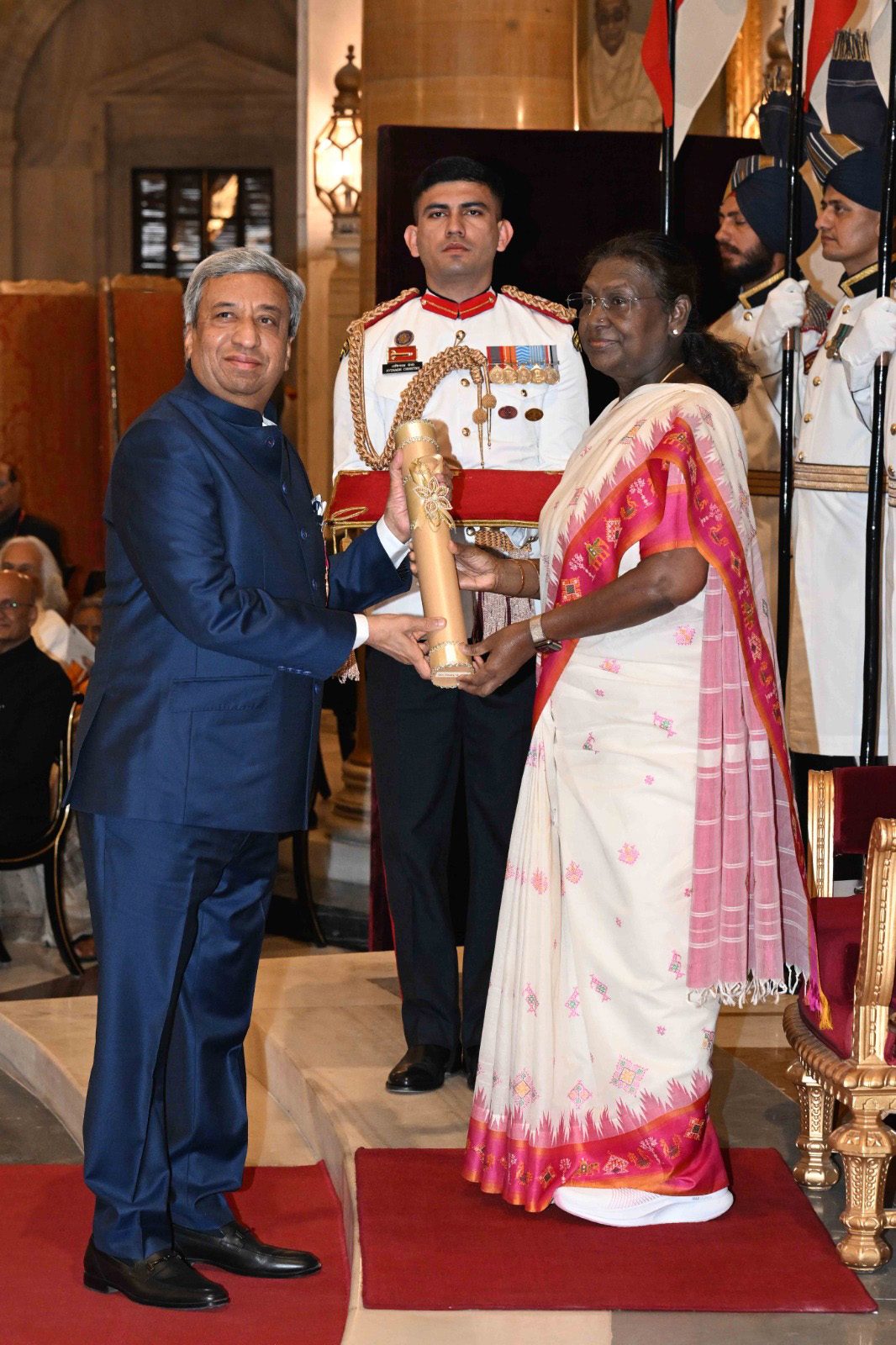
| Key facts | |
|---|---|
| Born | 16 March 1953, Karamsad, Gujarat [1][2] |
| Family roots | Grew up in Ahmedabad; father Ramanbhai B. Patel, a pharmacy lecturer, co-founded Cadila Laboratories [30][23] |
| Education | Master’s in pharmaceutics, L.M. College of Pharmacy, Ahmedabad (1976); executive education, IIM Ahmedabad [1][2] |
| Family | Wife Pritiben; son Dr Sharvil Patel, managing director of Zydus Lifesciences since 2017 [9][42] |
| Company | Zydus Lifesciences (formerly Cadila Healthcare), chairman; the family trust holds 74.96% [9] |
| Wealth | US$9.4 billion, rank 22, Forbes India’s 100 Richest, September 2026 [52]; Rs 84,510 crore, rank 28, Hurun India Rich List 2025 [53] |
| Known for | Rebuilding half of a split family company into a global drugmaker; India’s first home-grown new drug (Lipaglyn) and the world’s first DNA vaccine for Covid-19 (ZyCoV-D) [44][12] |
When Pankaj Patel was a young boy in Ahmedabad, a relative from America came to visit his father. The visitor asked the man who ran the family’s medicine company what worried him most.
Ramanbhai Patel’s answer has stayed with his son for more than six decades. “I have only one concern: ‘chalshe’, ‘chalega’, ‘hota hai’, ‘it’s okay’. These are the kind of words that should not be in our dictionary” [34].
Chalshe. It’ll do. The Gujarati shrug that excuses the slightly dirty machine, the late report, the batch that is nearly right.
Pankaj Patel told that story in 2024, at a quality summit of India’s drug industry [34]. By then he was 71, chairman of a company with a market value above Rs 1 lakh crore [51], and the man who had, in 1995, been handed half of a family business, no banker’s trust and a choice between shrinking and starting again.
He started again. He sold everything the family owned except the house they lived in [30]. Thirty years later, the company he built, Zydus Lifesciences, reported revenue of Rs 27,148 crore for the year to March 2026 [49], and its first Indian-discovered drug was waiting for a decision from the US Food and Drug Administration due on 27 November 2026 [29].
The record is not spotless. American regulators have twice found serious lapses at his flagship plant, and his company has paid to settle US lawsuits. But it is the story of a man who refused to let “it’ll do” become the family motto, and of how a pharmacy teacher’s son took on far bigger rivals. Here is how it happened.
Where it began
A lecturer and his friend
The story starts with his father. Ramanbhai Becharbhai Patel was born on 19 August 1925 in Kathor, a village in south Gujarat [5][23]. He became a lecturer at L.M. College of Pharmacy in Ahmedabad, the state’s leading pharmacy school [23][32].
In the early 1950s, he and a school friend, Indravadan Modi, a chemist who had worked for a Mumbai firm, started a small drug company called Cadila Laboratories [38][30]. The Patel side of the family dates it to 1952; the Modi side says the firm was founded in 1951 and began production in March 1952 [38][4].
How much money they started with depends on who tells it. Business Standard, writing from the Modi family’s history, says the company began in a rented bungalow with Rs 25,000 [38]. Forbes reported that the two “pooled their savings, contributing the equivalent of $110 each” [30]. Either way, it was a shoestring. Forbes adds that Ramanbhai kept his lecturer’s job at first “to help pay both the families’ bills” [30].
India in the 1950s bought most of its modern medicines from foreign companies at foreign prices. Cadila set out to make cheaper versions at home. Its early products included Livirubra, an injection for anaemia, and medicines for tuberculosis [32][33]. “We were the first company to launch a few drugs, which were required [in India], like Vitamin B12, for the first time in the country,” Pankaj Patel later said. “Our founder was a pharmacist and he knew the place of science” [33].
One early story, told by Indravadan Modi and retold by The Better India, captures the times: Cadila priced a prednisolone tablet at one rupee, so far below the foreign brands that a doctor asked whether the company was “selling chalk” [39].
The boy at the factory
Pankaj Ramanbhai Patel was born on 16 March 1953 in Karamsad, the Gujarat town where Sardar Vallabhbhai Patel grew up, according to his official profile on the Reserve Bank of India’s board [2]. (Wikipedia gives his birthplace as Bhadran [85].) He grew up in Ahmedabad [30].
Several accounts say he began going to the factory with his father at around eight, watching tablet machines at work [85]. What is certain is that he chose his father’s field. He studied pharmacy at L.M. College of Pharmacy, the college where his father had taught, and completed a master’s in pharmaceutics in 1976 [1][30]. Much later he attended executive education at IIM Ahmedabad [1].
He has kept his private life out of the news. His wife is Pritiben Patel, who is a trustee, along with him and their son Sharvil, of the family trust that owns the business [9].
The first break
Learning the factory floor
Pankaj Patel joined Cadila Laboratories in 1976 [1][30]. The company was still small: Forbes put its sales at under US$1 million at the time [30], and Forbes India later described it as a Rs 4 crore business when he joined [32].
He was not handed a cabin. Ganesh Nayak, a long-time Cadila executive who joined around the same time as a sales representative, told Forbes the young Patel “was put through the grind”. His first job was to set up a new factory to make ingredients for a diabetes drug. Within six years he was on the board and running operations [30]. He became executive director of Cadila Laboratories [1].
Through the 1980s, Cadila grew into one of India’s bigger drugmakers. By 1994 its annual revenue had reached about US$86 million, according to Forbes [30]. But it was a company with two owners, and the Modis were its public face. “Until the split the Modis had been the face of Cadila, while the Patels had remained in the background handling production and operations. They were virtually unknown to bankers,” Forbes wrote [30].
The split of 1995
The next generation changed the balance. Rajiv Modi, Indravadan Modi’s US-trained son, joined the business in 1991 [30][38]. Forbes described what followed as a “turf war between the two founding families” [30].
It was Pankaj, not his father, who proposed separating, in 1994. “My Dad wasn’t happy at all, but I was able to convince him that we had to go our own way if we wanted to grow,” he told Forbes [30].
In 1995 the company was divided. The Modis took Cadila Pharmaceuticals; the Patels took Cadila Healthcare [38][30]. Both could keep the Cadila name, but neither could use it for new ventures [30]. So Pankaj Patel needed a new brand. He chose Zydus, from Zeus, the king of the Greek gods [30][31].
Sources disagree on how big the Patels’ half was. Zydus’s own history says the group’s turnover was Rs 250 crore in 1995 [4]; Forbes India and Business Today put Cadila Healthcare at about Rs 200 crore [31][35]. No valuation of either half was ever published.
There was no public fight. The only well-known court case between the two Cadila companies, decided by the Supreme Court in 2001, was about two similar-sounding malaria drug brands, Falcigo and Falcitab, not about the split. It became a landmark ruling on confusing drug names [88].
No bank would lend
The hard part came next. “The challenge was starting all over again. I was at the helm of a business, which was much larger and now suddenly it was half,” he told Forbes India in 2019 [32].
Most senior executives chose to join his side, which meant a higher wage bill [30]. He needed a working capital limit of about Rs 20 crore. No bank would give it [35].
“The financial market was ruthless. Every bank I went to rejected me. So I had no option, but to sell all my family assets to generate resources to grow the business,” he said [32]. “We were at ground zero and had to start anew,” he told Business Today years later [36]. Forbes reported that he raised about US$2 million by selling everything “except for the house we were living in” [30].
Then came the break. K.V. Kamath of ICICI agreed to lend against something no Indian drug company had pledged before: its brands. “To me, the brand became an extremely critical collateral, which he was willing to put on the table to make his aspirations come true,” Kamath told Forbes India [31]. To Forbes he said: “Pankaj is a low-key person with a lot of entrepreneurial fire in him. He was willing to hock the family silver to realize his dream” [30]. Accounts differ on the timing: he approached Kamath around 1995, and Forbes dates the loan to 1997 [31][30].
A plant of his own, and a target
Everyone told him to outsource manufacturing and save money. He refused. “I was very clear that, to become a global company, I would need my own plant,” he said. He put about Rs 50 crore into a plant in 1997. “I was not gathering assets, I was building the business. Asset is a consequence of a successful business and not vice versa” [31].
He narrowed the company’s focus. He shut the diagnostics business and concentrated on India. “We were a small company and decided to focus only on the local market with mainly cardiovascular, respiratory and gastroenterology drugs. The plan was to get into exports once we reached a size of Rs 1,000 crore,” he told Business Today [35].
He split the company into nine business units and set a public target of about US$215 million, or Rs 1,000 crore, by 2000 [30]. “I believe in setting a goal and rallying the organization to achieve it,” he said [30]. In an interview quoted by The Better India, he described the split this way: “It was not a crisis, it was an opportunity” [39]. Business Today reports that the company reached the target in 2000 [35].
Building the empire
The 2000 listing and German Remedies
In February 2000, Cadila Healthcare went public. The book-built issue needed about Rs 600 crore and drew bids of about Rs 3,000 crore, even after the price band was widened from Rs 300-350 to Rs 250-350 a share [40]. The Patel family has controlled the company through the Zydus Family Trust since 27 April 2000, according to its shareholding filings [9].
The money went straight to work. In 2001 Cadila bought German Remedies, a respected Indian drugmaker owned by German parents, and made an open offer at Rs 650 a share for a further 27.72%, which the market regulator SEBI cleared in July 2001 [41]. The company calls it the largest merger or acquisition in Indian pharma at the time [6].
The same year, on 19 September 2001, Ramanbhai Patel died [5]. Forbes would later write that his son seemed “on a mission to outdo his contemporaries and just maybe to prove something to his late father” [30].
Going abroad
Then came the hardest market of all. Cadila set up a US subsidiary in New Jersey in November 2003 and launched its first US product, the heart drug atenolol, in 2005 [22]. It bought Alpharma’s French generics business in 2003 [6], and Nikkho in Brazil in 2007 [85].
The early years abroad hurt profits. In 2004-05, consolidated net profit fell 9% to about Rs 121 crore on sales of about Rs 1,310 crore, partly because of losses in France, the US and Brazil [6]. Patel’s letter to shareholders that June called the conditions of the January-March 2005 quarter “an aberration” and set two goals: sales of over US$1 billion by 2010, and becoming a research-driven company by 2020 [6].
He also kept adding partners. By 2010-11 Cadila had joint ventures with Nycomed, with Hospira for cancer injectables, with Bharat Serums and Vaccines and with Bayer, plus a licensing deal with Abbott to sell 24 of its medicines in 15 emerging markets [7].
Into consumer brands
A quieter bet turned into a second business. In 2006 Cadila bought a stake in Carnation Nutra-Analogue Foods, maker of Nutralite, then folded its own consumer brands, Sugar Free and Everyuth, into it. The company was renamed Zydus Wellness in 2009 [85]. Sugar Free, a low-calorie sweetener, became a household name in India.
The billion-dollar year
In the year to March 2011, consolidated revenue reached Rs 4,630 crore, more than US$1 billion, up 26%, and net profit rose 41% to Rs 711 crore [7]. Business Today credits Sharvil Patel’s “Healthy Billion” programme with getting there [37]. Patel immediately raised the bar: “we shall achieve sales of over $3 bn by 2015,” his shareholder letter said [7].
That year Zydus also bought a factory and products from Nesher Pharmaceuticals in the US, completing the deal in August 2011 [10][22]. “We have always looked at value-accruing opportunities,” Patel said [10]. By 2012 Zydus was among the top ten US generic makers by prescriptions, and by 2019 among the top five [22].
The drug India had never made
Copying others’ drugs pays the bills. Patel wanted more. Since the split, he told Forbes India, the company had put about 7-8% of turnover into research on new chemical entities, or NCEs: new molecules nobody had made before [32].
The Zydus Research Centre opened in 2000 [30]. That year its scientists began work on a molecule for people with diabetes and high blood fats. They identified it in 2001 and filed to test it in humans in 2004 [44].
On 5 June 2013, India’s drug regulator approved it as Lipaglyn (saroglitazar), the first new chemical entity discovered and developed in India to reach the market [86][8]. The company said it had spent about US$250 million on the project [44].
“It has always been our dream to take a molecule right from the concept stage up to its launch,” Patel said [86]. He also revealed a choice that tells you about him: “We had an option of outlicensing it a few years ago, but our team was decided against it” [44].
In December 2014 Zydus launched Exemptia, the world’s first biosimilar of adalimumab, the arthritis drug sold globally as Humira [11]. In 2022 came a second Indian-discovered drug, Oxemia (desidustat), for anaemia in kidney disease [87].
By 2014-15 revenue had reached Rs 8,707 crore and net profit Rs 1,150 crore [84].
Handing over the keys
On 13 July 2017, Pankaj Patel stepped down as managing director and his son, Dr Sharvil Patel, took over, with Pankaj staying on as chairman [42]. “We at Zydus have been working on our succession planning programme over the last decade,” he said [42]. At the time, Bloomberg reported, the company was worth almost US$8 billion [43]. More on the succession below.
The Heinz bet
In October 2018 Zydus Wellness and Cadila Healthcare agreed to buy Heinz’s Indian business, including Complan, Glucon-D and Nycil, for about Rs 4,595 crore [45]. It was the group’s biggest deal, and it was paid for partly with debt, which would soon cause trouble (see “The setbacks and failures”).
Covid and the DNA vaccine
When Covid-19 arrived, Zydus decided in February 2020 to build a vaccine on an unusual platform: plasmid DNA. “We realised that there could be a pandemic. We had experience making a vaccine for H1N1,” Patel told The Week [76]. Asked if India was in a race, he said: “I do not think there is a race here. We need good science and a good product for the people of India” [76].
On 20 August 2021, India’s drug controller gave ZyCoV-D emergency approval for people aged 12 and above. It was the world’s first plasmid DNA vaccine for Covid-19, given without a needle, and the company reported 66.6% efficacy against symptomatic disease in a trial of more than 28,000 volunteers [12]. The government ordered one crore doses at Rs 265 a dose plus Rs 93 for the needle-free applicator [67]. The vaccine also drew criticism, covered in the controversies section below.
The same year, Zydus sold its animal health business in India and some other markets to a Multiples-led consortium for Rs 2,921 crore [46]. In February 2022, Cadila Healthcare was renamed Zydus Lifesciences, because the company was already widely known as Zydus [25].
The recent rush of deals
From 2024, the deals came faster. Zydus’s market value crossed Rs 1 lakh crore for the first time on 11 March 2024 [51]. In 2025 it bought 85.6% of the French orthopaedic implant maker Amplitude Surgical for €256 million, creating a medical technology business [47]. Zydus Wellness bought the British supplements seller Comfort Click for £239 million [48]. In January 2026 Zydus completed a US$141 million deal with Agenus that gave it two biologics plants in California [28], and in June 2026 it completed the purchase of the US company Assertio for about US$166 million [49][91].
In 2025-26, Zydus Lifesciences reported revenue of Rs 27,148 crore, up 16.8%, and profit of Rs 5,040 crore, up 11.4% [49][50]. Pharmaceuticals brought in Rs 22,412 crore, consumer products Rs 3,954 crore and medical devices Rs 782 crore [49].
From a business of about Rs 250 crore in 1995 [4], that is more than a hundred-fold rise in revenue in three decades.
The drug waiting for America
Patel has said for years that he wants an Indian-discovered drug approved in the US. “Hopefully, it will also have a USFDA approval one day to prove that ‘Yes, India can develop novel therapies for the world’,” he said in 2024 [34].
Saroglitazar, the Lipaglyn molecule, is now trying. In May 2026 the US FDA accepted Zydus’s application to use it for primary biliary cholangitis, a rare liver disease, and granted priority review. A decision is due by 27 November 2026, and the company has said it aims to launch by March 2027 if the drug is approved [29][27]. In the main trial, 56.7% of patients on the drug met the response goal, against 9.8% on placebo [29]. Two rival drugs were approved in the US first, in 2024 [75].
How the wealth is held
Pankaj Patel’s fortune is almost entirely one shareholding. The Zydus Family Trust owns 74.96% of Zydus Lifesciences; Pankaj, Pritiben and Sharvil Patel are its trustees and are each listed as significant beneficial owners. Pankaj Patel’s personal shareholding is a token 44,326 shares [9]. Zydus Lifesciences, in turn, owns a majority of the listed Zydus Wellness [85].
That is why his net worth moves with the share price. Forbes India’s list of India’s 100 richest, published on 30 September 2026, put him at US$9.4 billion, 22nd in India [52]. The Hurun India Rich List 2025 had valued “Pankaj Patel & family” at Rs 84,510 crore, 28th in India and second in Gujarat after Gautam Adani [53][54].
He has turned down the obvious exit. Asked by Forbes in 2010 whether he would sell, as several Indian drug families had done, he said: “No way. Pharma is my passion. More money wouldn’t give me any satisfaction” [30].
The setbacks and failures
Lost years at Moraiya
Zydus’s biggest problems have come from the same place as its biggest profits: the US market and its regulator. In December 2015 the FDA sent a warning letter covering the company’s Moraiya plant near Ahmedabad, its most important factory for American exports, and an ingredients plant [58]. Cadila’s shares fell nearly 17% in a day [57]. The FDA can hold back new product approvals from a plant under a warning letter, so the company’s US pipeline slowed.
Bloomberg reported in 2017 that the family responded by changing the culture: a “firewall” between manufacturing and marketing “so workers in the factories don’t feel pressured to sacrifice quality to meet commercial deadlines”, quality videos on loop in factory canteens, and daily quality quizzes with prizes. A re-inspection saw the warning letter lifted [43].
Then, in 2019, it happened again (see Controversies).
The debt hangover
The Heinz deal came just as US generic prices were falling. Rating agency CRISIL noted that Cadila’s debt rose to 2.87 times its operating profit in 2019-20 [73]. Net profit fell 36% that year to Rs 1,177 crore [83]. In December 2019, a report cited by Medical Dialogues said the company planned to sell two business units for about Rs 1,200 crore to cut debt, with its shares down nearly a quarter over the year [74]. By the first half of 2025-26, net debt had fallen to 0.3 times operating profit [49].
Being first is not always enough
Lipaglyn made history in India, but more than a decade later it is still waiting for US approval, and rivals reached the American liver-disease market first [75]. ZyCoV-D was a scientific first, but it arrived after other vaccines had already been widely given in India.
And the US patent courts were expensive. Zydus launched a generic of Astellas’s bladder drug Myrbetriq in 2024 after winning at trial, but lost on appeal, and in February 2026 agreed to pay Astellas US$120 million [64][20].
Controversies and allegations
No court or regulator has made a finding of wrongdoing against Pankaj Patel personally, and a search of major publications found no investigation of him personally. The matters below concern his company. Several arose while he was chairman and managing director; later ones arose after his son became managing director.
US FDA warning letters at the Moraiya plant (2015, 2019)
Allegation: In a warning letter dated 29 October 2019, addressed to “Chairman Pankaj R. Patel”, the US FDA said an April-May 2019 inspection at Moraiya had found failures to clean and maintain equipment, cross-contamination, failures to investigate unexplained batch problems and lapses in sterile processes. The FDA wrote: “Repeated failures demonstrate that executive management oversight and control over the manufacture of drugs is inadequate” [55]. An earlier warning letter, dated 23 December 2015, had cited failures to investigate out-of-specification lab results [58].
Response: The company said the 2019 letter “does not affect the existing business of the company in the US” and that it had taken “multiple steps” and would respond within the required time [56]. In 2015 it said it would “revamp our quality systems and processes as the top most priority” [58].
What happened next:
- Shares fell nearly 17% after the 2015 letter [57] and up to 8% after the 2019 letter [56].
- Bloomberg reported in 2017 that a re-inspection had led to the 2015 letter being lifted [43].
- An FDA re-inspection in July-August 2022 ended with the plant classified “Voluntary Action Indicated”, a milder outcome, and the FDA said the inspection was closed [21].
- An FDA inspection of Moraiya from 5 to 13 October 2026 ended with five observations; the company said it would submit a corrective plan [61].
Status: After the 2022 re-inspection the plant was classified “Voluntary Action Indicated”, the milder outcome, and the inspection was closed [21]; we did not find a separate FDA close-out letter for the 2019 warning letter. The FDA’s classification of the October 2026 inspection is pending as of 20 October 2026.
US FDA warning letter at the Jarod injectables plant (2024)
Allegation: After an April 2024 inspection, the FDA classified the Jarod injectables plant near Vadodara “Official Action Indicated” and issued a warning letter on 29 August 2024 [60][18]. Fierce Pharma reported that the FDA’s findings included poor investigation of glass particles in batches of a vitamin B12 injection, cross-contamination from shared equipment and weak sterile technique [59].
Response: Zydus said the letter contained no data integrity violations, that existing supplies were not affected and that it would work with the FDA for the “earliest remediation” [59]. It said it had stopped making the B12 injection in 2022 [59].
Status: Closed. After a follow-up inspection in 2025, the FDA wrote to managing director Sharvil Patel on 9 December 2025 that “it appears that you have addressed the violations contained in this Warning Letter” [18].
US generic drug price-fixing lawsuits (2019 onwards)
Allegation: In May 2019, 44 US states led by Connecticut sued Teva and 19 other generic drugmakers, including Zydus Pharmaceuticals (USA), alleging a conspiracy to fix prices, divide markets and rig bids for more than 100 generic drugs [19]. The states’ press release did not describe specific conduct by Zydus [19].
Response: Zydus has not admitted wrongdoing. In September 2026 its US arm agreed to pay US$5.9 million to settle claims by a proposed class of indirect resellers in the combined US federal case, “without any admission of fault or wrongdoing” [62][63].
Status: That class settlement was announced in September 2026; we could not confirm whether the court has approved it, or what has happened to the states’ claims against Zydus. As of 20 October 2026, we found no report of any criminal charge against Zydus.
The Myrbetriq patent case (2020-2026)
Allegation: Astellas sued Zydus in the US, alleging that its generic version of the bladder drug Myrbetriq (mirabegron) infringed Astellas’s patents [64].
Response: Zydus won at a 2023 trial and launched its generic in 2024. An appeals court reversed that win, and in April 2025 the trial court upheld a key Astellas patent [64][20].
Status: Settled. On 12 February 2026, Zydus agreed to pay Astellas US$120 million plus a per-unit licence fee on US sales until September 2027, ending the case [20][64]. Bloomberg Law reported that Zydus accepted, in a proposed consent judgment, that its tablets infringed four patents that were valid [65]. Zydus continues to sell the generic.
ZyCoV-D and Virafin: questions about Covid approvals (2021)
Allegation: Scientists and doctors writing in The Wire Science criticised India’s drug regulator for approving ZyCoV-D in August 2021 when its 66.6% efficacy figure had been released only in a press statement, without published trial data [66]. Separately, The Wire Science criticised the April 2021 emergency approval of Zydus’s Virafin (pegylated interferon) for moderate Covid-19, saying it rested on a small, open-label 40-patient trial and that phase 3 data had not been published [69].
Response: Neither Zydus nor the regulator responded to The Wire Science [66][69]. Patel had said publicly in 2021 that “we need good science” and that vaccination “should be voluntary” [76].
What happened next:
- ZyCoV-D’s phase 3 results were published in The Lancet in April 2022, about eight months after approval, reporting 66.6% efficacy [68].
- The vaccine’s rollout was slowed by price negotiations and training for the needle-free applicator [67].
Status: No regulatory action was taken against either product. These remain matters of scientific criticism.
Remdesivir quality reports and electoral bonds (2021, 2024)
Allegation: Mint reported, as summarised by The Wire Science in December 2021, that at least 69 Covid patients had severe reactions, and one died, after receiving Zydus remdesivir in mid-2021, and that a central government laboratory found endotoxin contamination in a batch sent for testing by Bihar [70]. In March 2024, the Project Electoral Bond reporting by The News Minute, Newslaundry and Scroll noted that Zydus Healthcare bought Rs 29 crore of electoral bonds in 2022-23, and listed it among drugmakers that had faced quality complaints [71][72].
Response: Zydus denied reports of severe adverse events linked to its remdesivir and replaced unused vials from one batch in Rajasthan at no cost [70].
Status: No recall or penalty over the remdesivir reports was reported. Buying electoral bonds was legal at the time (the Supreme Court struck the scheme down in February 2024). None of the reports cited showed any link between the bonds and regulatory decisions, and they did not name the party that received the money.
Minor matters
The company also has routine tax and drug price-control disputes in India, mostly small and under appeal [89][90]. None involves allegations against Pankaj Patel.
Giving back
A hospital for tribal Gujarat
His largest philanthropic project is in Dahod, a tribal district of eastern Gujarat. The Zydus Foundation, which he chairs, runs the 750-bed Zydus Medical College and Hospital there, a public-private partnership with the Gujarat government under its 2016 health policy. It serves people in eastern Gujarat and neighbouring districts of Madhya Pradesh and Rajasthan, and admitted its first medical students in 2018-19 [24][3].
In 2024-25, Zydus Lifesciences spent about Rs 64 crore on social responsibility, against a legal requirement of Rs 43.4 crore, and about Rs 55 crore of that went to the Dahod hospital, which provides free care. It reported about 4.2 lakh outpatient visits and nearly 49,000 surgeries that year, according to India CSR’s summary of the company’s report [80].
Personal giving
The EdelGive Hurun India Philanthropy List recorded donations by Pankaj Patel and family of Rs 59 crore in its 2021 edition, mostly to healthcare, ranking him 17th [26]. In May 2026 he announced Rs 500 crore for a Zydus Sardardham University in Ahmedabad, at an event attended by Prime Minister Narendra Modi, as reported by DeshGujarat [79]. It is a pledge; the money has not yet been reported as spent.
He is also chairman of the Gujarat Cancer and Research Institute, a regional cancer centre for poor patients, and of a school for deaf and mute children in Ahmedabad [3][1]. The Ramanbhai Foundation, named after his father, runs the Zydus School for Excellence and gives scholarships to pharmacy students [23].
“Wealth is the means, but it’s not the goal,” he told Forbes India [32].
Public life
He has also served in national institutions. He was president of the industry body FICCI in 2016-17 [78]. In June 2022 the government nominated him to the Reserve Bank of India’s central board for four years, alongside Anand Mahindra [15]. In November 2022 he succeeded Kumar Mangalam Birla as chairman of IIM Ahmedabad’s board, after eight years as a board member [14][81]. In 2025 the government awarded him the Padma Bhushan [13][82].
At IIM Ahmedabad’s 2026 convocation, he told graduates: “The most transformative innovations in history were not born from abundance. They were born from limitation” [17]. It is hard not to hear 1995 in that line. A year earlier he had told graduates: “Do not fear failure, as it is a stepping stone to something greater. Setbacks are inevitable, but what matters is how you rise from them” [16].
Succession
Unusually for an Indian family business, the handover happened while the founder was only in his early sixties. Sharvil Patel studied chemical and pharmaceutical sciences at the University of Sunderland in Britain and earned a doctorate there for breast cancer research done at Johns Hopkins Bayview Medical Center in the US [37][31]. He joined as deputy managing director in 2007 and spent years moving across business units [37].
He became managing director in July 2017 [42]. “I think it is right for management and senior people to hand over the baton to the next generation,” Pankaj Patel told Bloomberg. “You lead the organization by example” [43]. Sharvil said of his father: “I was fortunate to have a mentor who believes in giving ample space to learn, make mistakes and learn from them” [37].
Today the roles are clear. Pankaj Patel is non-executive chairman and handles strategy and the board, while Sharvil Patel runs the company and also chairs Zydus Wellness [3][43]. Bloomberg reported that the family still lives together in one house, with a rule of no talking about work at home [43].
What their journey teaches
A split can be a starting line. In 1995 Pankaj Patel lost half a company and the bankers’ trust that came with it. He called it “not a crisis” but “an opportunity” and set a public target he could be measured against [39][30].
Back yourself before others will. When no bank would lend, he sold the family’s assets, keeping only the home. When ICICI did lend, it was against brands he had built [30][31]. For any founder, the lesson is that reputation and owned assets are collateral too.
Own what makes you different. He was told to outsource manufacturing and save money. He built his own plant because “to become a global company, I would need my own plant” [31]. He refused to license out Lipaglyn [44].
Absorb the shocks and keep going. “There are going to be challenges, you are going to see ups and downs, but if you are able to absorb those shocks and continue to work as usual, then success will come,” he told McKinsey in 2023 [77]. Zydus rode out a family split, a debt squeeze and repeated FDA setbacks without changing course on research.
Patient research takes a decade, not a quarter. Lipaglyn took 13 years from the start of research to approval [44]. The same molecule’s US decision is due in November 2026, more than 25 years after the work began [29].
“It’ll do” is the costliest phrase in business. His father’s warning about “chalshe” turned out to be a lesson his own company had to relearn. Two FDA warning letters at Moraiya held back new US approvals from the plant and knocked up to 17% off the share price in a day [57][55].
Hand over while you still can. He made his son managing director at 64, and stayed as chairman to guide rather than run. “You lead the organization by example” [43].
For more on India’s drug industry builders, read the stories of Dilip Shanghvi of Sun Pharma, Murali Divi of Divi’s Laboratories, Cyrus Poonawalla of the Serum Institute, Kiran Mazumdar-Shaw of Biocon and fellow Ahmedabad pharma family Samir Mehta of Torrent. For lessons on markets and money, see CapitalVia Insights.
A profile for general reading, based on public records and reporting as of 20 October 2026. Not investment, tax or legal advice.
Sources (91)
- Padma Awards 2025 citation: Shri Pankaj R. Patel - Government of India, Jan 2025
- Central Board director profile: Shri Pankaj Ramanbhai Patel - Reserve Bank of India, Jun 2022
- Profile - Pankaj Patel (board of directors) - Zydus Lifesciences, Oct 2026
- Company overview and history - Zydus Lifesciences, Oct 2026
- Annual Report 2012-13 (founder tribute and chairman's message) - Cadila Healthcare, Jul 2013
- Annual Report 2004-05 (chairman's letter) - Cadila Healthcare, Jun 2005
- Annual Report 2010-11 - Cadila Healthcare, Jul 2011
- Annual Report 2013-14 - Cadila Healthcare, Jul 2014
- Shareholding pattern as on 31 March 2026 - Zydus Lifesciences, Apr 2026
- Press note: Zydus to acquire Nesher Pharmaceuticals assets - Zydus Cadila, Jun 2011
- Press note: Zydus launches Exemptia, the world's first adalimumab biosimilar - Zydus Cadila, Dec 2014
- DBT-BIRAC supported ZyCoV-D developed by Zydus Cadila receives Emergency Use Authorization - Department of Biotechnology, Government of India, Aug 2021
- Mr. Pankaj R. Patel, Chairman, Zydus Lifesciences Limited conferred with Padma Bhushan - Zydus Lifesciences, Jan 2025
- Appointment of Chairperson, IIMA Board of Governors - IIM Ahmedabad, Nov 2022
- Nomination of part-time non-official directors on the Central Board - Reserve Bank of India, Jun 2022
- Chairperson's address, 60th Convocation - IIM Ahmedabad, Mar 2025
- Chairperson's address, 61st Convocation - IIM Ahmedabad, Mar 2026
- Close-out letter to Zydus Lifesciences Limited (Warning Letter 320-24-58) - US Food and Drug Administration, Dec 2025
- Tong leads lawsuit against generic drug manufacturers in conspiracy to fix prices for over 100 drugs - Connecticut Attorney General, May 2019
- Update on litigation (Astellas settlement) - Zydus Lifesciences stock exchange filing, Feb 2026
- Zydus receives EIR with Voluntary Action Indicated from USFDA for its Moraiya facility - Zydus Lifesciences, Nov 2022
- Company milestones - Zydus Pharmaceuticals (USA), Oct 2026
- Overview: Ramanbhai Foundation and founder biography - Ramanbhai Foundation, Oct 2026
- Vision and about the college - Zydus Medical College and Hospital, Dahod, Aug 2026
- Notice of Extraordinary General Meeting (change of name) - Cadila Healthcare, Jan 2022
- EdelGive Hurun India Philanthropy List 2021 - Hurun Report, Oct 2021
- Press release: EPICS-III saroglitazar analysis - Zydus Lifesciences via NSE, Oct 2026
- Agenus announces closing of $141M strategic collaboration with Zydus Lifesciences - Business Wire, Jan 2026
- Zydus Therapeutics' NDA for saroglitazar to treat PBC granted Priority Review by US FDA - BioSpace, May 2026
- Dark Horse - Forbes, Jun 2010
- For Cadila Healthcare's Pankaj Patel, patents are key to growth - Forbes India, Oct 2014
- India's Richest 2019: Cadila's Patels' quest for the magic pill - Forbes India, Nov 2019
- Zydus Cadila, the rising star of vaccines - Forbes India, Dec 2020
- Pankaj Patel: The last decade was ours, but the next decade will be even brighter for India - Forbes India, Jul 2024
- New Formula - Business Today, Aug 2019
- Leaderspeak: Pankaj R. Patel - Business Today, Apr 2018
- Digging Deep (profile of Sharvil Patel) - Business Today, May 2017
- Carrying the legacy forward: Rajiv Modi - Business Standard, Jan 2014
- In 1952, a swadeshi lecturer laid the foundation of Zydus Cadila's COVID-19 vaccine - The Better India, Jul 2020
- Cadila float gets Rs 3000 cr orders - Business Standard, Feb 2000
- Sebi clears German Remedies offer - Business Standard, Jul 2001
- Pankaj Patel steps down as Cadila MD, son Sharvil to take over - Medical Dialogues (PTI), Jul 2017
- Billionaire father and son duo turned Cadila Healthcare into world beater - Bloomberg via Medical Dialogues, Aug 2017
- It was always our dream to discover a new entity - BioSpectrum India, Jun 2013
- Zydus Wellness to acquire Heinz India business for Rs 4,595 crore - exchange4media, Oct 2018
- Cadila arm completes sale of animal health business for Rs 2,921 crore - Business Standard, Jul 2021
- Zydus completes 256 million euro acquisition of 85.6% stake in Amplitude Surgical - Angel One, Jul 2025
- Zydus Wellness shares jump 10% after 239 million pound Comfort Click acquisition - IIFL / IndiaInfoline, Sep 2025
- Zydus Lifesciences reports Q4FY26 results; profit rises 9% YoY - DSIJ, May 2026
- Zydus Lifesciences Q4FY26 results: profit up 9%, revenue jumps 16% - Business Standard, May 2026
- Zydus Life hits new peak; m-cap hits Rs 1 trn - Business Standard, Mar 2024
- Pankaj Patel profile, India's 100 Richest 2026 - Forbes, Sep 2026
- Hurun Rich List India 2025: list of 50 richest Indians - The Daily Jagran, Oct 2025
- Who is Pankaj Ramanbhai Patel, India's second richest Gujarati after Gautam Adani - DNA India, Oct 2025
- Cadila Healthcare Moraiya plant gets USFDA warning letter for significant violations of CGMP - Medical Dialogues, Nov 2019
- Cadila Healthcare dips 8% as FDA issues warning letter for Moraiya facility - Business Standard, Nov 2019
- Cadila slumps nearly 17% after USFDA warning letter - Business Standard (PTI), Dec 2015
- FDA slaps two Cadila facilities with warning letters - Fierce Pharma, Jan 2016
- India's Zydus hit with warning letter as FDA flags glass contamination concerns and more - Fierce Pharma, Sep 2024
- Zydus Life Vadodara facility gets OAI report from USFDA; stock falls 3% - Business Standard, Jul 2024
- USFDA inspection at Zydus Moraiya plant concludes with five observations - Indian Pharma Post, Oct 2026
- Zydus Lifesciences' US arm agrees to pay USD 5.9 mn to settle generic drug pricing litigation - Medical Dialogues, Sep 2026
- Zydus Pharmaceuticals USA enters into US$5.9 million settlement agreement - Indian Pharma Post, Sep 2026
- Zydus follows Lupin with Myrbetriq settlement deal - pharmaphorum, Feb 2026
- Zydus to pay Astellas $120 million to end Myrbetriq patent fight - Bloomberg Law, Feb 2026
- ZyCoV-D continues India's habit of approving COVID vaccines with invisible data - The Wire Science, Aug 2021
- India to buy one crore Zydus Cadila's Covid shot at Rs 265 each - Scroll, Nov 2021
- ZyCoV-D plasmid DNA COVID vaccine efficacious, safe: Lancet on Phase 3 trials - Business Today, Apr 2022
- DCGI approves Virafin for moderate COVID. Where's the evidence it works? - The Wire Science, Apr 2021
- In May, remdesivir from Zydus Cadila made patients sicker: report - The Wire Science, Dec 2021
- Seven firms that failed drug quality test gave money to political parties through bonds - The News Minute, Mar 2024
- 7 pharma groups accused of substandard drugs got electoral bonds in crores - National Herald, Mar 2024
- Rating rationale: Cadila Healthcare Limited - CRISIL, Aug 2020
- Zydus Cadila to divest two major units for Rs 1,200 crore: report - Medical Dialogues, Dec 2019
- Zydus to file for PBC drug approval, but fierce competition looms - Clinical Trials Arena, Sep 2025
- ZyCoV-D will hit markets in May-June (interview with Pankaj Patel) - The Week, Mar 2021
- Why the next decade in healthcare is India's decade - McKinsey & Company, Dec 2023
- Zydus chairman Pankaj Patel takes over as President of FICCI - Medical Dialogues, Dec 2016
- Zydus's Pankaj Patel announces Rs 500 crore Zydus Sardardham University in Ahmedabad - DeshGujarat, May 2026
- Zydus Lifesciences CSR spending report: Rs 64 crore in FY25 - India CSR, Aug 2025
- IIM Ahmedabad appoints Zydus' Pankaj Patel as Chairperson of the Board of Governors - Business Today, Nov 2022
- Zydus Lifesciences Chairman Pankaj R Patel conferred with Padma Bhushan - Medical Dialogues, Jan 2025
- Cadila Healthcare's Q4 PBT falls 14% to Rs 522 cr - Business Standard, Jun 2020
- Zydus Cadila Q4 net up 46%; revenues jump 16% - Business Standard, May 2015
- Pankaj Patel - Wikipedia, Oct 2026
- Zydus' diabetes drug Lipaglyn becomes India's first NCE to reach the market - The Pharma Letter, Jun 2013
- Zydus receives DCGI approval for new drug Oxemia - Business Today, Mar 2022
- Cadila Health Care Ltd vs Cadila Pharmaceuticals Ltd (Supreme Court, 2001) - LawArticle, Mar 2001
- Zydus faces Rs 1.18 crore GST blow as appellate authority upholds tax demand, penalty - Medical Dialogues, May 2026
- Review order: Zydus Healthcare on NPPA ceiling prices - Department of Pharmaceuticals, Government of India, Oct 2013
- Zydus Lifesciences completes $166m acquisition of US-based Assertio - FilingReader, Jun 2026