
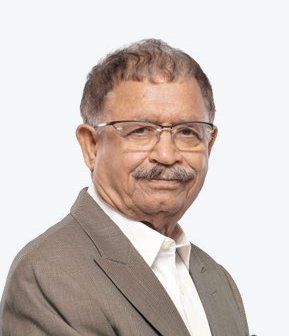
| Key facts | |
|---|---|
| Born | 28 July 1955 [53] |
| Roots | Began his career in western Uttar Pradesh; Mankind was started in Meerut and is now based in Delhi [16] [12] |
| Education | Described himself as “a simple science graduate” [16]; Mankind’s IPO prospectus says he holds no formal educational qualifications [1] |
| Family | Married, two children; son Arjun Juneja is Mankind’s COO; brother Rajeev Juneja is co-founder, Vice-Chairman and MD; nephew Sheetal Arora is CEO [1] [3] [20] |
| Company | Mankind Pharma Ltd (founder and Executive Chairman); revenue Rs 14,278 crore in FY2026 [3] |
| Wealth | About US$3.3 billion (Forbes real-time, November 2026) [20]; with brother Rajeev, US$7.7 billion and rank 34 on the Forbes India 100 Richest list, September 2026 [18] |
| Known for | Building India’s fourth-largest drugmaker by sales value from small-town doctors upwards; consumer brands Manforce, Prega News and Unwanted-72 [3] [1] |
In the late 1970s, a young medical representative named Ramesh Juneja rode the roads of western Uttar Pradesh with a bag of drug samples. His employer, Lupin, wanted him to see doctors. He noticed that the reps from big companies spent their time with the famous specialists in the cities, and hardly ever visited the small-town general practitioner. “I had travelled across UP and knew that medical representatives typically ignore doctors in small towns,” he said years later [12].
He noticed something else too. The patients in those small clinics often had very little money. After paying the doctor’s fee, many could not afford the full course of medicine and bought only part of it [17].
Those two observations became a business. In 1995, Juneja and his younger brother Rajeev started a drug company in Meerut with about Rs 50 lakh and a couple of dozen salesmen [26] [12]. They called it Mankind. Their plan was simple: sell decent medicines at low prices to the doctors everyone else ignored.
Thirty years on, Mankind Pharma is India’s fourth-largest drugmaker by the value of its sales in India and the second-largest by volume [3]. In the year to March 2026 it reported revenue of Rs 14,278 crore [3]. Its condom brand Manforce and its pregnancy test Prega News are household names. Forbes valued Ramesh Juneja’s personal stake at about US$3.3 billion in November 2026 [20].
The man behind it is one of India’s least-known billionaires. Recognition has come mostly late and quietly, such as the Punjab Ratan award he received in April 2026 [50]. He rarely gives interviews, and at the company’s annual meetings his brother and nephew usually do the talking [10]. This is the story of how a medical representative with no famous degree built a giant out of Meerut, and of the questions it has faced along the way.
Where it began
A quiet start
Ramesh Chand Juneja was born on 28 July 1955, according to his Wikipedia biography and the ages given by Forbes [53] [20]. Little is on public record about his parents or his childhood, and he has never spoken about them at length. He grew up in a family of several siblings; his younger brother Rajeev, born ten years later, would become his lifelong business partner [18] [1].
His education is one of the small mysteries of his story. In a 2019 interview with Forbes India, he called himself “a simple science graduate with no fancy degrees or high intellect or intelligence” [16]. Yet Mankind’s IPO prospectus, a legal document filed with the market regulator in April 2023, states plainly that he “does not hold any formal educational qualifications” [1]. The same document says the same of Rajeev [1]. YourStory reported that he left college and started working at 19 [54]. Whichever version is right, his real school was the road.
The medical representative
Juneja began working in 1974 as a medical representative, or MR, with a firm called KEE Pharma, according to his Wikipedia biography [53]. A year later, in 1975, he joined Lupin, then a fast-growing drugmaker [12] [53]. He stayed about eight years [16].
An MR’s job is to visit doctors, explain a company’s medicines and persuade them to prescribe. It is a job of long bus rides, waiting rooms and rejection. Juneja rose to a first-line manager’s role, and The Economic Times later described him as an area sales manager in Meerut [21].
Those years taught him three things that shaped Mankind:
- Where the gap was. Big companies chased a few hundred top doctors in the metros. Thousands of small-town GPs, who saw huge numbers of patients, were barely served [12].
- What patients could pay. Prices set for city patients were too high for many people in smaller towns [17].
- How selling works. “The experience of being a medical representative came handy,” he told Forbes India [16].
The first break
Bestochem: a first company
In 1983 or 1984 (sources differ), Juneja left Lupin to start his own firm, Bestochem, with family members and a partner [16] [12] [53]. Mankind’s own account says it began with seed capital of Rs 1 lakh [12]; Juneja himself remembered it as Rs 1.5 lakh. “We just had ₹1.5 lakh to start,” he told Forbes India [16].
Bestochem did not make medicines. It had painkillers and antibiotics made by contract manufacturers and sold them under its own brand at around half the price of multinational brands [16]. Juneja sold them himself across the towns and villages of Uttar Pradesh, riding a Yezdi motorcycle [16]. “We didn’t have enough money. So we targeted the bottom of the pyramid,” he said [16].
The firm grew to a turnover of about Rs 10 crore, according to an account published on Mankind’s website [12]. Then it broke apart. That account says the Juneja brothers left in the mid-1990s “after disputes with the partner”, taking their share, about Rs 50 lakh, with them [12]. Business Today has described the start of Mankind as following “a rift in the family” [25].
Mankind is born
The legal shell came first. Mankind Pharma Private Limited was incorporated in New Delhi on 3 July 1991, with Ramesh Juneja as one of its first two shareholders [1]. Rajeev joined the company in December 1992 [1]. But the business itself began in 1995, in Meerut [4] [26].
The brothers started with about Rs 50 lakh [26] [12]. Forbes India’s version adds a car: “₹55 lakh, and a Maruti 800 small car” [16]. They hired about 25 medical representatives (some accounts say 20 staff in total) [53] [25]. Rajeev, a decade younger, has said Meerut was “a small city close to capital of India, but even closer to the masses of the country” [10].
Juneja’s view of the risk was clear. An early DNA profile quoted him: “when Lupin can start with a capital of Rs 5,000, I can do much better with Rs 50 lakh” [52].
The formula
The model was Bestochem’s, made bigger and sharper:
- Low prices. Mankind sourced common medicines, mainly painkillers and antibiotics, from contract manufacturers and sold them under its own brands at up to 50% below the big names [12]. In 2010, The Economic Times noted that Mankind’s antibiotic Moxikind CV cost about Rs 11 against roughly Rs 40 for comparable brands from GSK and Ranbaxy [21].
- Forgotten doctors. “We told our medical representatives to tap as many doctors as possible and generate prescriptions,” Juneja said [12]. Rajeev put it more bluntly: “The top doctors in the metros wouldn’t have given us a second glance” [12].
- Lean costs. “We keep our drug prices low because we don’t have highly-paid managers,” Juneja said [12]. Money went instead to sales incentives. “We do not hire managers with fat packages unnecessarily; however we are proud of our salesforce,” he told The Economic Times in 2012 [22].
It worked from the start. Mankind sold about Rs 3.7 crore of medicines in its first year, 1995-96 [12]. Other accounts put it at between Rs 3 crore and Rs 3.8 crore [24] [52].
Rivals were dismissive. “Pehle kehte the Meerut ki company hai, iske standards doosre honge” (people used to say it is a Meerut company, its standards will be different), Juneja recalled [16]. He chose to treat being underestimated as an advantage. “We had nothing to lose as we started from scratch. So why fear,” he told Forbes India [16].
Building the empire
From Meerut to Delhi (2000-2006)
By around 2000, Mankind had moved its base to Delhi [12]; the prospectus shows its registered office moving to Okhla in December 2002 [1]. Business Today reported revenue of about Rs 50 crore in 2000-01 [26]. Outlook Business put it at about Rs 350 crore by 2005 [24].
Two decisions in this period changed the company’s shape.
Chronic medicines (2004). Mankind entered long-term therapies with Amlokind, for blood pressure, and Glimestar, for diabetes [1]. Patients take such medicines for years, which makes the business steadier than selling antibiotics.
Its own factories (2005). Mankind opened its first plant at Paonta Sahib in Himachal Pradesh, according to the prospectus [1]; a company account dates the first plant to 2001 [12]. Making its own medicines gave Mankind more control over quality and cost. Further units at Paonta followed in 2009 and 2014, and a plant in Sikkim in 2017 [1].
The outside money, and the offer he refused (2007)
By 2007, Mankind was big enough to attract investors. On 24 April 2007, private-equity firm ChrysCapital invested Rs 72 crore through its vehicle Monet Ltd [1]. Press reports put the stake at about 11% [24] [27].
Sanjiv Kaul, the ChrysCapital partner behind the deal, had first come across Mankind while working at Ranbaxy. He later recalled Juneja’s argument for why Mankind could go anywhere: “If Coke can be present in a village, so can Mankind” [16].
That same year, a much bigger suitor came. “The first time a big buyout offer was made to us was in 2007 by Pfizer,” Juneja told Forbes India [16]. The American giant wanted control. The brothers said no [16].
Interestingly, Juneja later had second thoughts about taking any outside money. “When I look back, I think we should not have gone for it,” he told Business Standard in 2015, describing Mankind as “a cash-rich company” with “no need to borrow money from outside” [23].
Consumer brands: Manforce, Unwanted-72 and Prega News
The year 2007 also marked Mankind’s move into consumer health. It launched the Manforce brand and the emergency contraceptive Unwanted-72 [1]. Prega News, a home pregnancy test, followed in 2010; the antacid Gas-O-Fast in 2012; and the anti-acne brand AcneStar in 2016 [1].
These were bold bets for a company built on doctors’ prescriptions. Selling to consumers meant television advertising, chemist-shelf space and celebrity faces. Some campaigns stirred controversy (see below). But the brands became category leaders. In the 12 months to December 2022, according to the prospectus:
| Brand | Category | Market share |
|---|---|---|
| Prega News | Pregnancy test kits | 79.7% (No. 1) |
| Unwanted-72 | Emergency contraception | 61.7% (No. 1) |
| Manforce | Male condoms | 29.6% (No. 1) |
| AcneStar | Acne preparations | 13.2% (No. 2) |
Source: Mankind Pharma prospectus, April 2023 [1].
Not every consumer idea worked. Outlook Business reported that a move into deodorants under the Adiction brand did not take off [24].
Climbing the rankings (2007-2015)
When ChrysCapital came in, Mankind was India’s 20th-largest drugmaker. By 2014 it was eighth, according to a company account [12]. Its revenue reached about Rs 2,900 crore in FY2014 [13] and about Rs 3,500 crore in FY2015, with a field force of about 13,000, according to Outlook Business [24].
The company also built depth. It bought Magnet Labs, a maker of psychiatric medicines, in 2007 [12]; opened its first research centre at IMT Manesar in 2012; bought an API (active ingredient) site at Behror in Rajasthan in 2014; and set up Lifestar Pharma in the US in 2015 to sell generics there [1].
In 2015, ChrysCapital sold its stake to Capital International (now Capital Group) for about US$200 million, close to ten times its money [27] [57]. The prospectus records the share transfer in November 2015 at about Rs 5,527 a share [1]. That implied a company value of roughly Rs 11,000 crore, by CapitalVia’s calculation from the filing [1].
The second round and the climb to No. 4 (2015-2022)
In 2018, ChrysCapital came back. A consortium it led bought about 10% from the founding family for about US$350 million, valuing Mankind at about US$3.5 billion, Business Standard reported [28]. The prospectus shows the purchase on 5 June 2018 at Rs 550.44 a share, and that Ramesh Juneja himself sold about 37 lakh shares in that round [1].
Growth was not always smooth. “2018-19 was not very great. We grew by 5-6 percent,” Juneja admitted in 2019 [16]. But the company kept moving into higher-value areas. It launched specialist divisions for heart disease and diabetes in 2020 and for respiratory and nervous-system disorders in 2021 [1]. In 2022 it bought Panacea Biotec’s India and Nepal brands for about Rs 1,808 crore, and the Daffy and Combihale brands from Dr Reddy’s [1].
By the time of its IPO, Mankind’s numbers were striking [1]:
- Domestic sales of Rs 8,390 crore in calendar 2022, making it fourth in India by value and third by volume.
- No. 1 in prescription share, at 15.4%: more Indian prescriptions carried a Mankind brand than any other company’s.
- About 11,700 medical representatives and 25 manufacturing plants.
Mankind also spends heavily to protect its names. Many of its brands end in “-kind”, and the prospectus counted 88 intellectual-property cases filed by the company [1]. In August 2025, the Delhi High Court cancelled a rival’s “UNKIND” trademark, holding that Mankind’s “KIND” family of marks deserved greater protection [40]. In September 2026 it granted Mankind an interim injunction against a firm using names such as Coskind and Florakind [56].
The IPO (2023)
Mankind’s initial public offering opened on 25 April 2023. It was a pure offer for sale: the company raised no new money. Existing shareholders sold shares worth about Rs 4,326 crore at Rs 1,080 each [1].
Ramesh Juneja sold about 37 lakh shares worth about Rs 400 crore, and Rajeev and Sheetal Arora sold smaller amounts. Most of the shares came from the private-equity investors [1]. Anchor investors put in about Rs 1,298 crore before the issue opened [30], and the offer was subscribed about 15 times overall [29].
The stock listed on 9 May 2023 at Rs 1,300, about 20% above the issue price, and closed its first day at Rs 1,430, valuing the company at about Rs 57,000 crore [29]. For a company whose rivals once called it a “Meerut ki company”, it was a remarkable debut. Two days later, though, tax officers arrived (see “Controversies”).
The big bet: Bharat Serums and Vaccines (2024)
In July 2024, Mankind made the largest acquisition in its history. It agreed to buy Bharat Serums and Vaccines (BSV), a Mumbai-based maker of women’s-health, fertility and critical-care medicines, from private-equity firm Advent International, at an enterprise value of Rs 13,630 crore [43]. The deal closed in October 2024 with a cash payment of about Rs 13,768 crore [44].
For a family that had once boasted of never borrowing, it was a turning point. Mankind raised Rs 10,000 crore of debt, through Rs 5,000 crore of bonds and Rs 5,000 crore of short-term commercial paper [9]. In December 2024 it sold new shares to institutions in a QIP (qualified institutions placement) at Rs 2,520 each, raising about Rs 3,000 crore, used to repay part of that debt [8] [9].
The company swung from a net cash position of Rs 3,260 crore in FY2024 to net debt of Rs 5,784 crore in FY2025 [3]. It has since been paying it down: to Rs 3,932 crore by March 2026 [3] and Rs 2,639 crore by September 2026, with the acquisition debt planned to be repaid by FY2028 [49].
Mankind today
In the year to March 2026, Mankind reported [3] [47] [58]:
- Revenue of Rs 14,278 crore, up 17%.
- Net profit of about Rs 1,938 crore, down about 3%, as interest and amortisation costs from the BSV deal weighed on profits.
- Exports of about Rs 2,061 crore, up about 35%.
- 32 manufacturing facilities, seven R&D centres and a field force of more than 18,500.
It has ranked fourth in the Indian market by value every year from FY2017 to FY2026, and climbed to second by volume in FY2025 and FY2026 [3]. Chronic medicines made up 38.5% of domestic sales in FY2026, up from 26.7% in FY2017 [3].
Profits have picked up again in FY2027. Net profit rose about 29% in the April-June 2026 quarter [48]. In the July-September quarter, revenue rose about 17% to Rs 4,338 crore and profit rose about 38% to Rs 716 crore [49].
How the wealth is held
Juneja’s fortune is almost entirely Mankind shares, held mostly through a family trust. At 31 March 2026, according to the annual report [3]:
| Holder | Share of Mankind |
|---|---|
| Ramesh Juneja Family Trust | 20.19% |
| Ramesh Juneja (directly) | 1.66% |
| Poonam Juneja | 2.56% |
| Arjun Juneja | 1.98% |
| Rajeev Juneja Family Trust and Rajeev Juneja | 20.93% |
| Prem Sheetal Family Trust and Sheetal Arora | 19.63% |
| Total promoter group | about 72.7% |
Together, Ramesh Juneja’s immediate family held roughly 26.7% of Mankind, by CapitalVia’s calculation from the annual report [3]. The trustees of the Ramesh Juneja Family Trust are Ramesh, Poonam and Arjun Juneja and a family company [2].
How rich is he? It depends on how the family is counted:
- Forbes (individual): about US$3.3 billion as of 11 November 2026 [20].
- Forbes India 100 Richest, September 2026: Ramesh and Rajeev Juneja together, US$7.7 billion, ranked 34th (down from 26th and US$9.7 billion in 2025) [18] [19].
- M3M Hurun India Rich List 2025: “Ramesh Juneja & family”, Rs 30,680 crore, ranked 97th, as reported by LatestLY [60]. CapitalVia could not confirm his entry in the 2026 Hurun list.
- 360 ONE Wealth Creators List 2026 (a separate ranking of families): “Ramesh Juneja & family”, Rs 60,174 crore, ranked 33rd [59].
The setbacks and failures
Juneja’s story is often told as a straight line. It was not.
- Bestochem’s break-up. His first company, built over a decade, ended in a dispute with a partner [12]. He walked away with about Rs 50 lakh and had to start again at close to 40 [12].
- A family that did not stay together. Mankind’s prospectus discloses that one brother of the promoters refused to consent to being named as part of the promoter group, and lists this as a risk factor [1].
- The “cheap” label. For years, Mankind fought the image of a low-cost company from a small town. “The prevailing view in the industry was that Mankind Pharma was a company known for selling ‘cheap products’ not affordable, but cheap,” Forbes India quoted the company’s leadership in 2025 [17].
- Ideas that failed. The Adiction deodorant brand did not take off, and plans for cancer medicines were shelved after the government capped drug prices, Outlook Business reported [24].
- Slow years. Growth fell to 5-6% in 2018-19 [16].
- A costly acquisition. In FY2026, profit fell for the first time in years as the BSV debt and amortisation hit earnings [3].
- Exports came late. “We are novice in the export,” Juneja admitted in 2015 [23]. It took nearly a decade for exports to become a meaningful business [3].
Controversies and allegations
Mankind’s rise has come with regulatory, tax and advertising disputes. None has led to a finding of wrongdoing against Ramesh Juneja personally, but several are unresolved. As in any business, allegations are not proof.
The 2023 Income Tax searches and tax demands
Allegation: On 11 May 2023, two days after Mankind listed, Income Tax officials began searching its offices, Reuters reported, citing a government source [31]. PTI reported that the searches related to tax evasion allegations [33]. Mankind’s filing to the stock exchange said the search covered offices in New Delhi and Navi Mumbai, plants at Paonta Sahib and in Sikkim, and three subsidiaries [6]. The share price fell as much as 5.5% that day [31].
Response: Mankind described itself as “an ethical and law abiding Company” that “follows the best corporate governance practices”, and said there was “no impact on operational performance” [32] [33]. When the search ended, it told the exchanges it had “cooperated fully” and that business had not been affected [7].
What happened next:
- The department reopened past assessments and issued a string of demand orders, including about Rs 112 crore for AY2021-22 (February 2025) [55], about Rs 183 crore for AY2014-15 to AY2017-18 (March 2025) [34], and about Rs 342 crore for three more years (May 2025) [35].
- Mankind’s FY2026 annual report says assessment orders for all relevant years proposed total additions to income of about Rs 1,869 crore. This includes about Rs 1,574 crore of expenses disallowed under section 37(1) of the Income Tax Act and about Rs 257 crore of tax-holiday deductions for hill-state plants [3]. These are additions to taxable income, not the tax payable.
- The company says the demands are “not tenable in law” and has appealed. Its joint auditors drew attention to the matter in an emphasis-of-matter note but did not qualify their opinion [3].
Status: As of November 2026, appeals are pending before the Commissioner of Income Tax (Appeals). No final ruling has been reported.
Gifts to doctors
Allegation: Gifts by drug companies to doctors have long been a concern in India. In 2022, the Supreme Court ruled in the Apex Laboratories case that such freebies cannot be claimed as business expenses for tax purposes [1]. In November 2022, the Income Tax Appellate Tribunal in Delhi disallowed about Rs 1.07 crore that Mankind had spent on gift cards for doctors in AY2014-15, recorded as “business promotion expenses” [36].
Response: Mankind’s counsel accepted before the tribunal that the issue was covered by the Supreme Court ruling [36]. In its IPO prospectus, the company said it had reviewed its sales-promotion expenses, taken expert advice and believed its tax provisions were adequate, while noting the “ultimate outcome is not reasonably ascertainable” [1].
What happened next:
- The public filings do not say how much of the later section 37(1) disallowances, if any, relates to doctors [3].
- In a separate case brought by a medical representatives’ federation, the Supreme Court in October 2026 directed the central government to form a committee on unethical drug marketing. That case concerns the whole industry and does not name Mankind [37].
Status: The 2014-15 disallowance stands. The larger tax appeals are pending. No regulator has made a finding of improper marketing against Mankind.
Advertising rows
Allegation: In September 2017, Manforce hoardings in Surat featuring actress Sunny Leone with a Navratri-themed line drew protests. The Confederation of All India Traders called it an “irresponsible and immature attempt”, and Surat police had the hoardings taken down, Quartz reported [38]. Separately, in 2018, the Advertising Standards Council of India (ASCI) upheld a complaint against an ad for Mankind’s Kaloree 1 sweetener featuring tennis star Sania Mirza. It found the claim “for controlling your blood sugar” misleading [14].
Response: Mankind did not respond to Quartz’s request for comment [38]. No public response to the ASCI decision has been found.
What happened next:
- In December 2017, the I&B Ministry restricted condom ads on television to between 10 pm and 6 am. Business Standard’s report did not link the order to any one brand [39].
- A Legal Metrology complaint in Muzaffarnagar objected to the “XXL” label on a Manforce product. In 2019 it led to summons naming Ramesh Juneja and other directors; quashing petitions were pending in the Allahabad High Court at the time of the IPO [1].
Status: The ad disputes are closed. The Legal Metrology matter was pending as of the April 2023 prospectus; no later outcome has been reported.
Drug-quality alerts
Allegation: Like most large Indian drugmakers, Mankind has had batches flagged as “not of standard quality” (NSQ) by drug regulators. The prospectus disclosed 20 such notices in 13 proceedings in 2022-23, including a recall of a Telmikind-40 batch [1]. After the IPO, the national drug regulator’s monthly alerts flagged a batch of Rabekind-20 from its Sikkim plant (September 2023) for failing a dissolution test [41], and a batch of a telmisartan combination medicine from Sikkim (November 2025) [42].
Response: The reports carried no company comment [41] [42]. In general, Mankind has said there has “never been any compromise on quality” [12].
Status: These were batch-level alerts. No licence suspension or ban on Mankind products has been reported.
Other regulatory cases disclosed at the IPO
Allegation: The prospectus listed several older cases naming Ramesh Juneja or the company [1]:
- A drug-price-control complaint from Pune (filed 2012) about not displaying a price list; a Sessions Court dropped one charge in 2016 and kept another.
- Two FIRs from 2013 alleging refusal to supply medicines to distributors.
- National Pharmaceutical Pricing Authority (NPPA) demands over condom ceiling prices (2022) and overcharging on Unwanted-21 (2023).
- An Enforcement Directorate summons in February 2023 to Rajeev Juneja seeking details of a Rs 1 lakh company donation made in 2011, which he answered in March 2023.
Response: The company and Juneja challenged the criminal complaints in the Bombay High Court [1].
Status: Pending as of the April 2023 prospectus; no later rulings have been reported. The prospectus recorded no SEBI or stock-exchange action against the promoters in the previous five years [1], and the FY2026 annual report shows no fines or penalties [3].
Controversies section current as of 11 November 2026.
Giving back
Most of the Juneja family’s giving runs through Mankind’s corporate social responsibility (CSR) programme, which Ramesh Juneja chairs [3].
- CSR spending rose from Rs 19.87 crore in FY2020 to Rs 39.78 crore in FY2026, slightly above the legal requirement of Rs 39.44 crore [1] [3]. Partners include LEPRA, Tata Memorial, the Child Heart Foundation and Ekal Vidyalaya [3].
- Covid-19: On 30 March 2020, Mankind pledged Rs 51 crore to the relief funds of several state chief ministers, with Juneja speaking about protective equipment for “medical front-line warriors” [46]. The EdelGive Hurun India Philanthropy List 2020 recorded a commitment of Rs 56 crore in the names of Ramesh and Rajeev Juneja [15].
- The family hospital: Mankind’s CSR plans for FY2026 and FY2027 name support for the JC Juneja Hospital, run by the JC Juneja Foundation, as the first project [11]. The prospectus classes the foundation as a related party controlled by key management [1], so readers should note that part of the company’s giving goes to a family-linked institution.
- Brother’s giving: In May 2026, Rajeev Juneja personally gave about Rs 9.18 crore to the National Defence Fund [51].
There is no record of a large personal pledge by Ramesh Juneja himself, and he has not featured among the leading names on recent Hurun philanthropy lists.
Succession
Mankind is a family company run with professional managers, and the next generation is already in place:
- Rajeev Juneja, the co-founder, is Vice-Chairman and Managing Director [3] [5].
- Sheetal Arora, Ramesh’s nephew (his sister’s son), has been CEO since 20 May 2021 [1] [3]. He joined in 2007.
- Arjun Juneja, Ramesh’s son, is Chief Operating Officer. He joined in 2009, studied at Bradford and Strathclyde, and has led the international and US business [1] [20].
- Chanakya Juneja, Rajeev’s son, is Director - Technology [5].
In FY2026, Ramesh Juneja was re-designated Executive Chairman [3]. No formal succession plan has been announced.
The family has also loosened its grip on the shares. In February 2024, Sheetal Arora, Puja Juneja and Arjun Juneja sold about 1.62% of Mankind for about Rs 1,368 crore to meet minimum public shareholding rules [45]. The family’s stake fell further, to about 72.7%, after the December 2024 share sale [3].
For investors who follow family-run companies, our Insights section explains how promoter holdings and succession are read.
What their journey teaches
Look where everyone else isn’t looking. Juneja’s whole company grew from one observation as a medical representative: the small-town doctor was ignored [12]. A neglected customer can be a bigger market than a crowded one.
Your price is your strategy. Mankind did not just sell cheaper medicines; it built a lean company that could afford to. “We keep our drug prices low because we don’t have highly-paid managers,” he said [12]. Low prices only last if costs are low too.
A failure is also an education. Bestochem ended in a dispute, but it taught the brothers how to source, brand and sell medicines. Mankind was Bestochem’s model done better [12] [16].
Keep control when it matters. He turned down Pfizer in 2007 [16]. The family took outside money only for minority stakes, and kept control into the IPO and beyond [1].
Grow up without forgetting where you started. Mankind moved from antibiotics into chronic medicines, consumer brands, exports and a Rs 13,630 crore acquisition [3] [43]. But its strength is still its huge reach to everyday doctors, where it leads in prescriptions [3].
Growth brings scrutiny. Listing brought tax searches, demand orders and close attention to marketing practices [3] [6]. Clear records and good governance matter more as a company grows.
Ramesh Juneja’s story is not about a famous degree or inherited money. It is about one man who knew his market from the inside, and his brother. They built a company in Meerut, and kept faith in the doctors and patients the big companies had overlooked. If you enjoyed this, read how other pharma founders built their companies: Dilip Shanghvi of Sun Pharma, Pankaj Patel of Zydus, Yusuf Hamied of Cipla, Habil Khorakiwala of Wockhardt and Murali Divi of Divi’s Laboratories.
A profile for general reading, based on public records and reporting as of 11 November 2026. Not investment, tax or legal advice.
Sources (60)
- Mankind Pharma Limited - Prospectus (IPO offer document), Apr 2023
- Mankind Pharma Limited - Abridged Prospectus, Apr 2023
- Annual Report 2025-26 - Mankind Pharma, Jul 2026
- Our Heritage - Mankind Pharma, Nov 2026
- Management - Mankind Pharma, Nov 2026
- Intimation to stock exchanges on Income Tax search - Mankind Pharma (NSE filing), May 2023
- Update on conclusion of Income Tax search - Mankind Pharma (NSE filing), May 2023
- Outcome of fund raising committee meeting on QIP - Mankind Pharma (NSE filing), Dec 2024
- Rating rationale: Mankind Pharma Limited - CARE Ratings, Mar 2025
- Transcript of the 32nd Annual General Meeting - Mankind Pharma, Sep 2023
- CSR Annual Action Plan FY 2026-27 - Mankind Pharma, Jul 2026
- Mankind Pharma formulating strategy to enter the big league - Mankind Pharma (press archive), Apr 2014
- Mankind Pharma eyes turnover of Rs 3,400 crore - Mankind Pharma, Dec 2014
- Consumer Complaints Council recommendations, July 2018 - Advertising Standards Council of India, Nov 2018
- EdelGive Hurun India Philanthropy List 2020 - Hurun India, Nov 2020
- India's Richest 2019: A giant leap for Mankind - Forbes India, Nov 2019
- Mankind Pharma's formula for success - Forbes India, Jan 2025
- India's 100 Richest 2026 - Forbes India, Sep 2026
- India's 100 Richest 2025 - Forbes India, Oct 2025
- Ramesh Juneja profile - Forbes, Nov 2026
- Ramesh Juneja: A journey from medical representative to meteor - The Economic Times, Apr 2010
- How Ramesh Juneja's Mankind Pharma has changed pharma game with pulp marketing - The Economic Times, Jun 2012
- Margins will improve with backward integration: R C Juneja - Business Standard, Aug 2015
- One giant leap for Mankind - Outlook Business, Feb 2016
- Billion dreams - Business Today, May 2017
- Started with Rs 50 lakh, this 4th largest pharma firm is now aiming for IPO - Business Today, Apr 2023
- India's ChrysCapital exits stake in Mankind Pharma - AVCJ, May 2015
- ChrysCapital-led consortium set to buy 10% in Mankind Pharma for $350 mn - Business Standard, Apr 2018
- Mankind Pharma IPO lists at 20.4% premium, closes higher - 5paisa, May 2023
- Mankind Pharma raises Rs 1,298 crore from anchor book - IIFL, Apr 2023
- Income Tax dept searches Mankind Pharma's New Delhi office - Business Standard (Reuters), May 2023
- No impact on operational performance: Mankind Pharma responds to I-T searches - Business Today, May 2023
- I-T dept raids Mankind Pharma premises over tax evasion allegations - The Tribune (PTI), May 2023
- Mankind Pharma hit with Rs 183.11 crore tax demand by IT dept - Medical Dialogues, Apr 2025
- Mankind Pharma hit with over Rs 341 crore additional tax demand - Medical Dialogues, May 2025
- Freebies to doctors illegal: ITAT disallows Rs 1 crore business promotion expenses by Mankind Pharma - Medical Dialogues, Nov 2022
- Supreme Court directs Centre to form committee on pharma marketing practices - Verdictum, Oct 2026
- Sunny Leone draws fire for promoting condoms during Navratri - Quartz, Sep 2017
- Govt imposes restrictions on TV condom ads - Business Standard, Dec 2017
- Mankind Pharma entitled to higher protection over KIND family marks: Delhi High Court - LiveLaw, Aug 2025
- CDSCO drug alert: 62 drug samples flagged - Medical Dialogues, Oct 2023
- 141 medicine samples including Mankind's telmisartan fail CDSCO quality tests - Medical Dialogues, Dec 2025
- Mankind Pharma acquires Bharat Serums and Vaccines for Rs 13,630 crore - Business Standard, Jul 2024
- Mankind completes Rs 13,768 crore acquisition of Bharat Serums and Vaccines - Business Standard, Oct 2024
- Promoters of Mankind Pharma divest 1.6% stake worth Rs 1,367 crore - Business Standard, Feb 2024
- Coronavirus: Mankind Pharma pledges Rs 51 cr for CM relief funds - Business Standard (PTI), Mar 2020
- Mankind Pharma Q4 PAT jumps 30%, FY26 revenue crosses Rs 14,000 crore - Medical Dialogues, May 2026
- Mankind Pharma records over 29% YoY growth in Q1 PAT - Business Standard, Jul 2026
- Mankind Pharma Q2 FY27 results show strong profit growth - Kotak Neo, Oct 2026
- Mankind Pharma founder Ramesh Juneja honoured with Punjab Ratan Award - Medical Dialogues, Apr 2026
- Rajeev Juneja contributes Rs 9.17 crore to National Defence Fund - Mankind Pharma, May 2026
- Mankind on a mission to rewrite the pharma story - DNA, Jul 2007
- Ramesh Juneja - Wikipedia, Nov 2026
- Mankind Pharma: the Juneja family success story - YourStory, Oct 2023
- Mankind Pharma faces tax demand from Income Tax Department - Angel One, Feb 2025
- Delhi HC restrains use of KIND-formative marks - SCC Online, Oct 2026
- ChrysCapital sells entire stake in Mankind Pharma - Private Equity International, Dec 2015
- Mankind Pharma reports Q4FY26 results; revenue crosses Rs 14,000 crore - DSIJ, May 2026
- Ramesh Juneja and family - 360 ONE Wealth Creators List, 2026
- Hurun India Rich List 2025: names of top 100 richest Indian tycoons - LatestLY, Oct 2025