
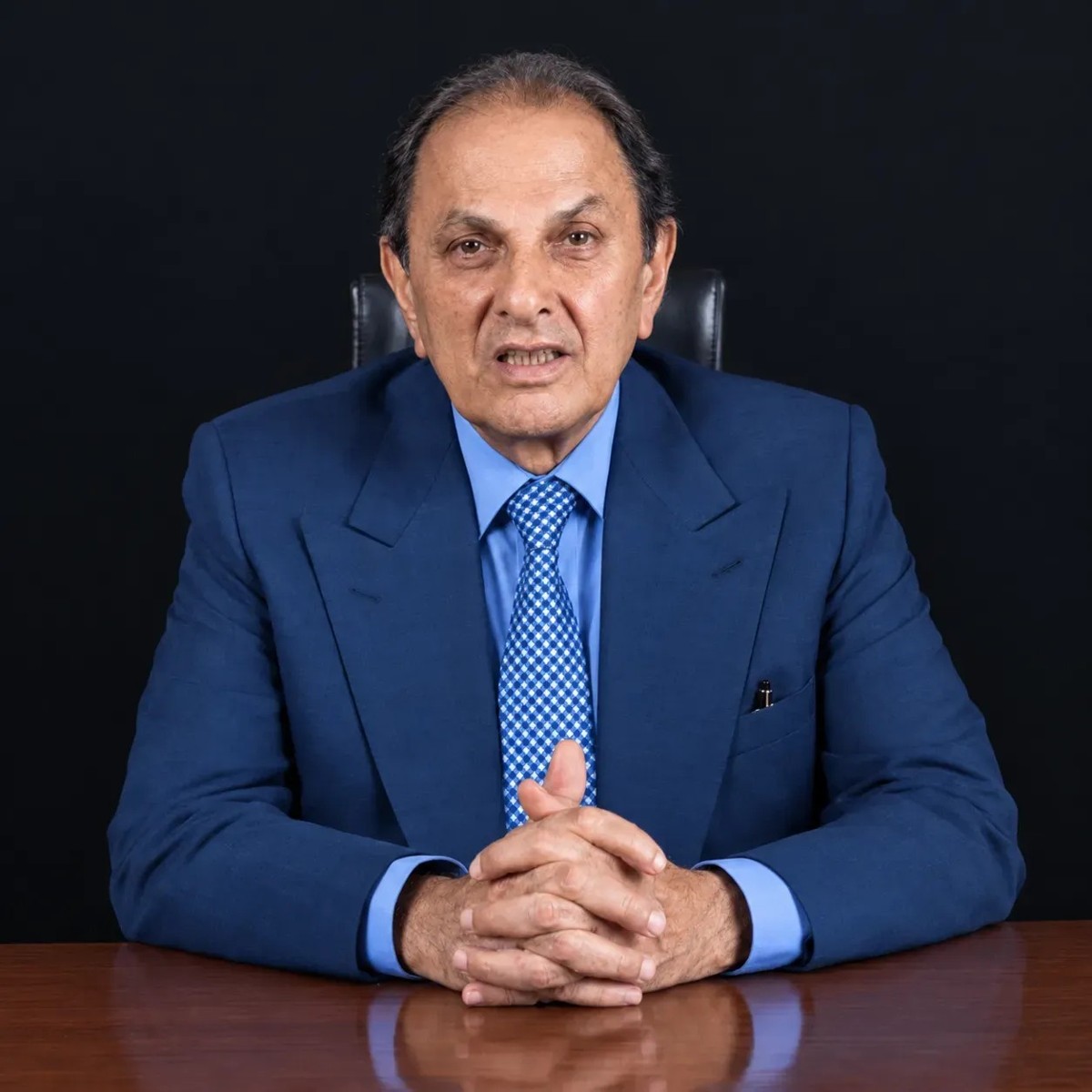
| Key facts | |
|---|---|
| Born | 15 February 1944, Bombay (now Mumbai) [13][17] |
| Family roots | Parsi shipbuilding and textile family; ancestor Lovji Nusserwanjee Wadia won East India Company shipbuilding contracts in 1736 [11][24] |
| Parents | Neville Wadia, chairman of Bombay Dyeing (1952-77); Dina Wadia, only child of Muhammad Ali Jinnah [21][25] |
| Education | Rugby School, England; no university degree is recorded in his official profiles [9][8] |
| Family | Wife Maureen Wadia; sons Ness and Jehangir (Jeh), both group directors [3][25] |
| Company/Group | Wadia Group: Britannia Industries, Bombay Dyeing, Bombay Burmah Trading Corporation, Naperol Investments; formerly Go First airline [4][3] |
| Wealth | About US$4.85 billion (Forbes India’s 100 Richest, September 2026, rank 62); Hurun India Rich List 2025: Rs 86,820 crore with family, rank 26 [14][15] |
| Known for | Saving Bombay Dyeing from sale at 27; taking control of Britannia; the polyester war with Dhirubhai Ambani; standing by Cyrus Mistry against Ratan Tata |
One morning in 1971, a young man in Bombay was woken by a friend on the phone. “I say,” the friend asked, “what’s this I read in the papers about your father having sold Bombay Dyeing?” [18]
The young man was Nusli Wadia, then 27. The company his great-grandfather had started in a red-brick yarn-dyeing shed in 1879 had, without his knowledge, been agreed for sale to the Calcutta industrialist R.P. Goenka [23][20]. Before he could take it in, the phone rang again. This time it was J.R.D. Tata, the most respected businessman in India. “You’re not going to let him sell Bombay Dyeing, are you?” [18]
He did not. Within weeks Nusli had gathered about 11% of the company’s shares, persuaded hundreds of officers and workers to offer their savings, and flown to London to face his father. Waiting on his seat on the plane, he later recalled, was a rose with a note from JRD wishing him luck [18][20]. In a London hotel he told his father: “You can live in Switzerland. I don’t want to be a second-class citizen in some European country. I am going to live in India. And I am going to run Bombay Dyeing.” [18][24]
That stubbornness has defined his life. Over the next five decades Nusli Neville Wadia, grandson of Pakistan’s founder Muhammad Ali Jinnah and heir to one of India’s oldest business families, would take on Dhirubhai Ambani, the Rajiv Gandhi government, Groupe Danone, SEBI and finally his childhood friend Ratan Tata. He would be arrested, threatened with deportation and named as the target of an alleged murder plot. He would also turn Britannia into one of India’s most valuable food companies and, in his eighties, see his family’s airline go bust.
He once described himself like this: “I have never looked for a fight. It is true that I have often had to fight but every one of these fights has been forced on me.” [18] Readers can judge that for themselves. This is the full story.
Where it began
Three hundred years of Wadias
The Wadia story begins long before Nusli. In 1736, Lovji Nusserwanjee Wadia, a Parsi shipwright from Surat, won contracts from the East India Company to build ships and docks in Bombay [11][24]. Over about 150 years the family’s yards built more than 355 vessels, among them HMS Trincomalee, which is still afloat in England, and HMS Minden, the ship on which the lyrics of the American national anthem were written [11]. The Wadia Group dates its founding to that year. “We have been in this country for over 300 years,” Nusli said in 1989, when his right to live in India was being questioned [17].
In 1879 Nowrosjee Wadia, Nusli’s great-grandfather, founded the Bombay Dyeing and Manufacturing Company, incorporated on 23 August that year [23][10]. It grew into one of the great names of Indian textiles, famous for its bedsheets and towels. Nowrosjee’s son, Sir Ness Wadia, was known as a “Cotton King”. When Ness and his brother split the family business, one half became Bombay Dyeing and the other Century Mills. Nusli later told the story of how his grand-uncle, who had no heir, offered Century to his brother for one rupee. “My grandfather said, no I have got enough. So, he sold it and then he gave his money to charity.” Century was later bought by the Birlas [22].
An unusual family
Nusli’s father, Neville Wadia, was born in Liverpool in 1911, studied at Malvern College and Trinity College, Cambridge, and joined Bombay Dyeing in 1933 supervising the loading of cotton bales. He was chairman from 1952 to 1977 [21].
In 1938 Neville married Dina Jinnah, the only child of Muhammad Ali Jinnah and his Parsi wife Rattanbai Petit [21][25]. Jinnah opposed the match. The couple separated in the early 1940s. Dina later moved to New York, where she died in November 2017 aged 98, survived, a Wadia Group spokesperson said, by “son and Wadia group chairman Nusli N Wadia, daughter Diana N Wadia, and grandsons Ness and Jeh Wadia” [25].
Nusli was born in Bombay on 15 February 1944, the date given by Wikidata and reference works; company filings and decades of press reports confirm the year [13][9]. “I am an Indian citizen. I was born here. I was raised here,” he said in 1989 [17]. Because both his parents were born in Britain, he also held British nationality, a fact that would later be used against him.
There was a faint Tata connection too. His mother’s uncle, Fali Petit, had married JRD Tata’s sister Sylla. It was a link by marriage, not blood, but JRD, who had no children of his own, treated the boy almost as a son. Nusli is variously described as JRD’s godson and protégé, and the young Nusli spent much of his time with the older man, learning his methods [18][24][19]. Ratan Tata, he would say, had been his friend “from the age of three” [24].
Rugby, and a return home
Like many boys of wealthy Bombay families, Nusli was sent to school in England. He went to Rugby School, the only institution named in his official company profiles [9][8]. He was away about 11 years [24]. By the journalist Vir Sanghvi’s account, he was “a bit of a failure” at Rugby, came back to India “interrupting his studies”, and was put to work on the shop floor [18].
(Some websites say he earned a PhD in chemical engineering from the University of Florida, or graduated from Cambridge. We found no reliable source for either claim. The India Today article cited for the PhD does not mention it, and his company biographies, which list his son Jeh’s master’s degree, list only Rugby for him.)
In 1962 he started as a trainee at Bombay Dyeing’s Spring Mills [23]. Scroll reports he began as an apprentice on Rs 180 a month before going through the company’s executive training course [24]. Sanghvi credits him with one of the company’s important early ideas: selling through its own retail shops at a time when most mills sold to wholesalers, and building Bombay Dyeing into a consumer brand [18].
He joined the board on 4 April 1968 and became joint managing director in 1970 [3][9].
The first break
The sale that never happened
By 1971 Neville Wadia had lost faith in doing business in India. Taxes were punishing and, by several accounts, the company was in financial difficulty [20][21]. He agreed to sell Bombay Dyeing to R.P. Goenka and settle in Switzerland. Sanghvi quotes him telling his son: “Don’t be so immature… let’s just take the money. We can live like lords in Switzerland.” [18]
According to the business historian Gita Piramal, Goenka had an important ally in Pallonji Mistry, the builder who owned 40% of Nowrosjee Wadia & Co, which in turn controlled 7% of Bombay Dyeing [20]. (Outlook later described Mistry as a majority shareholder of Bombay Dyeing, which appears to overstate it [19].) It is one of the ironies of Indian business that 45 years later Nusli would risk everything to back Pallonji’s son, Cyrus Mistry. You can read more about that family in our profile of Pallonji Mistry.
Nusli fought back. Lawyers advised that his father could not sell the family’s shares on his own. He collected about 11% of the equity, partly from his mother and sister. About 700 officers signed a statement offering their savings to buy shares, and the union backed him [20][21]. JRD, Piramal writes, warned senior government and Reserve Bank officials that he would lead a public campaign if the sale went through [20].
The showdown happened at the Ritz in London. Goenka’s own account, given to Piramal, is unexpectedly gracious: “Neville Wadia offered me Rs 5 lakh to return the contract… Like an idiot I told Neville: ‘If you offer me a drink, I’m prepared to cancel the deal.’ He rushed off to get the finest bottle of Royal Salute.” [20] Goenka also rejected the idea, current in Bombay at the time, that Parsi businessmen had ganged up to stop a Marwari takeover [20].
The deal died. Nusli had kept the company, and won the right to run it.
Chairman at 33
Neville spent more and more of his time in Switzerland. In April 1977 Nusli became chairman of Bombay Dyeing, a post he still holds nearly half a century later [9][3]. In 1980 he joined the board of the Bombay Burmah Trading Corporation (BBTC), a teak trading company floated by Scottish merchants in 1863 that the Wadias had acquired, and became its chairman on 27 July 1982 [8]. Around this time, at JRD’s invitation, he also joined the board of Tata Steel, beginning almost four decades as a Tata director [26].
He was 33, in charge of a company older than the Indian National Congress, and about to walk into the biggest business fight of the 1980s.
Building the empire
The polyester war
In the late 1970s Nusli placed a big bet: making the raw materials for polyester. In 1978 Bombay Dyeing received a letter of intent for a plant to make dimethyl terephthalate (DMT), a polyester intermediate, at Patalganga near Mumbai [23][3]. At almost the same time, Dhirubhai Ambani’s Reliance was building its own polyester chain, based on a rival intermediate, purified terephthalic acid (PTA), also at Patalganga.
What followed became known as the “polyester war”. Bombay Dyeing’s approvals came slowly; Reliance’s came faster. Duties and licences, Business Today later wrote, made the imported DMT that Bombay Dyeing depended on costlier than the PTA Reliance used [23][27]. Nusli has always believed the policy was bent against him. “All the policies related to polyester and the polyester chain during the 80s were manipulated. You had to manage the system for all licences,” he said in 2012, adding that he had missed the bus “because I chose not to manipulate the system” [24]. Reliance’s side of the story, told in our profile of Dhirubhai Ambani, is that it simply moved faster and built bigger.
The fight soon spilled out of the factories. Nusli was close to Ramnath Goenka, the combative owner of the Indian Express. “I treated Ramnathji as a second father,” he said [19]. From 1986 the Express, led by the chartered accountant S. Gurumurthy, ran a series of investigations into Reliance’s affairs [27][28]. Dhirubhai saw Wadia’s hand behind the campaign; Wadia’s own account is that the campaign was Goenka’s idea [28][18]. What happened next, including Nusli’s arrest, is covered in the controversies section below.
The DMT plant did get built. By 1995 it had been expanded to about 1.45 lakh tonnes a year, making Bombay Dyeing a major DMT producer, before fires in 1997 shut it down [23]. Today the Patalganga site makes polyester staple fibre, with about 12% of the Indian market [3]. But Reliance won the war decisively. It became India’s largest private company; Bombay Dyeing remained a mid-sized textile business. By 2009 Nusli was philosophical: “That’s history now, and a very old history… It was difficult when it happened… And frankly it was all politics.” [22]
Britannia: the crown jewel
Nusli’s greatest business success came not from textiles but from biscuits.
Britannia Industries, founded in Calcutta in 1892, had passed through British hands (Peek Frean, then Nabisco) and, in the late 1980s, the control of the Singapore-based “Biscuit King” Rajan Pillai. In the early 1990s Wadia, in partnership with the French food group Danone (then BSN), took control of Associated Biscuits International, the British holding company that owned Britannia’s controlling stake. Sources give dates from 1992 to 1995 for different steps of the deal [31][33].
For about 15 years Wadia and Danone ran Britannia as equal partners. The partnership turned sour in the mid-2000s, with disputes over Danone’s use of the “Tiger” brand abroad and its investments in India [31]. On 14 April 2009 Danone sold its half of the holding company, equal to an effective 25.48% of Britannia, to a Wadia company, Leila Lands [32][31]. The price was not officially disclosed; the Times of India estimated it at US$175-200 million. It turned out to be one of the best deals in Indian corporate history.
Under professional managers, most notably Varun Berry, who led the company for about 13 years, Britannia grew from a biscuit maker into a broad packaged-food company: Good Day, Marie Gold, Tiger, cakes, rusk, bread, dairy and cheese. Consolidated revenue rose from about Rs 7,858 crore in 2014-15 to Rs 19,152 crore in 2025-26, when it earned a net profit of Rs 2,537 crore [34][35]. In October 2026 its market value was about Rs 1.09 lakh crore [34]. Nusli remains chairman; Berry stepped down in November 2025 and Rakshit Hargave, formerly of Birla Opus, became managing director and CEO from 15 December 2025 [36].
Nusli has pushed Britannia to look beyond biscuits. “I believe that now we are poised to look at businesses outside even our adjacents,” he told shareholders in 2018 [37].
How the fortune is held
Almost all of Nusli Wadia’s wealth flows from Britannia, held through a chain of companies:
- Nowrosjee Wadia & Sons, a private family company, owns about 42% of Bombay Burmah Trading Corporation (BBTC). Nusli personally owns another 10%, and group companies more; the promoter group’s total is 74.04% [4].
- BBTC, through wholly owned subsidiaries in Britain, Mauritius and Singapore, owns about 50.5% of Britannia [4].
- BBTC and its subsidiaries also control Bombay Dyeing, where the promoter group owns 53.57% [3], and BBTC has its own tea estates and an auto-components business, Electromags [4].
- Naperol Investments, formerly National Peroxide (set up in 1954), is now an investment company; its chemicals business was moved into a separate company [3].
BBTC’s consolidated revenue in 2025-26 was Rs 19,539 crore, nearly all of it Britannia’s [5]. Because BBTC’s stock trades at a deep discount to the value of the Britannia shares it holds, the family’s fortune is, in market terms, mostly a Britannia number. When Britannia’s share price fell in 2026, so did his ranking: Forbes India put his net worth at US$4.85 billion in September 2026, rank 62, down from US$6.35 billion and rank 44 in 2025 [14]. Hurun’s 2025 list valued “Nusli Wadia & family” at Rs 86,820 crore, rank 26 [15]. He first entered the Forbes India top tier dramatically in 2017, as the list’s richest newcomer at US$5.6 billion [16].
Bombay Dyeing reinvents itself
Bombay Dyeing, meanwhile, had a rough few decades. Textile mills in Mumbai lost out to cheaper producers in India and abroad (a long-running shift: by 2026 India’s electronics exports had overtaken textiles). Like other mill owners, the Wadias realised that the most valuable thing they owned was land in central Mumbai.
In 2006 the Supreme Court cleared the way for mill owners to redevelop their land, in a case brought by Bombay Dyeing itself against an environmental group [2][39]. In 2011 the company launched Bombay Realty, led by Nusli’s younger son Jeh. At Dadar it built Island City Center, including two 60-storey residential towers [3]. But property was slow to sell, debt piled up, and the company lost money from 2020-21 to 2022-23 [3].
The fix came in September 2023. Bombay Dyeing agreed to sell about 22 acres in Worli to Goisu Realty, a subsidiary of Japan’s Sumitomo Realty & Development, for about Rs 5,200 crore, one of the biggest land deals in Mumbai’s history [6][40]. Nusli said the company would “extinguish all its borrowings” [6]. It did: Bombay Dyeing booked a profit of Rs 2,948 crore in 2023-24 and now describes itself as debt-free [3]. In September 2024 Nusli personally sold about 10 acres in Worli to the Birlas’ Century Textiles for Rs 1,100 crore, ending a long lease dispute between the two families [41].
GoAir: the bold bet
The group’s most ambitious modern venture was in the air. In 2005 Jeh Wadia founded GoAir, a low-cost airline which began flying in November 2005. It grew steadily and, by 2019-20, had about a tenth of India’s domestic market [42]. In May 2021, renamed Go First, it filed for an IPO of about Rs 3,600 crore [42]. The story of how that ended is told below.
A seat at many tables
Nusli built influence well beyond his companies. He has chaired the Cotton Textiles Export Promotion Council and the Mill Owners’ Association, and from 1998 to 2004 sat on the Prime Minister’s Council on Trade and Industry under Atal Bihari Vajpayee [8]. He has been a trustee of the Nehru Centre in Mumbai since 1979 [8]. Sanghvi described him in 2005 as a long-time friend of Vajpayee and L.K. Advani who turned down a Rajya Sabha seat [18]. After Ramnath Goenka died in 1991, Nusli, a director of the Express, helped carry out Goenka’s wishes for the transfer of his shares to his heirs [30].
And for decades he sat on the boards of Tata Steel, Tata Motors and Tata Chemicals. In 2009 he called himself “the oldest director of Tata Steel” and praised Ratan Tata: “Ratan had a tough time… And to be fair to him he did a terrific job.” [22] Outlook reported that JRD had once offered Nusli the leadership of the Tata group; when he declined, JRD asked him to look after Ratan [19]. Seven years after that 2009 interview, the friendship would end in court.
The setbacks and failures
The airline that ran out of engines
Go First’s collapse was the biggest business failure of Nusli’s life.
In the late 2010s the airline began flying Airbus A320neo jets powered by Pratt & Whitney’s new geared turbofan engines. They had serious reliability problems. By December 2022 Go First said half its fleet was grounded for want of working engines, and it claimed lost revenue and costs of about Rs 10,800 crore [43]. The IPO was abandoned. On 2 May 2023 the airline filed for voluntary insolvency, blaming “faulty” engines, while owing Rs 6,521 crore to financial creditors [43]. The National Company Law Tribunal admitted the case on 10 May 2023 [49].
Nusli, who had taken charge of the airline after Jeh stepped back in 2021, was blunt. “The Pratt & Whitney engines started to fail ab initio, right from the earliest deliveries in 2017,” he told The Economic Times in December 2023, adding that “the promoters invested Rs 3,200 crore” to keep the airline flying at half capacity [45]. Pratt & Whitney rejected this, saying Go First “has a lengthy history of missing its financial obligations” [44].
The airline never flew again. In April 2024 the Delhi High Court ordered the registration of all 54 leased aircraft to be cancelled so lessors could take them back [48]. Creditors voted unanimously for liquidation, which the tribunal ordered on 20 January 2025 [49]. BBTC had already written off Rs 1,866 crore of its investment [51]. Lenders took possession of about 94.7 acres of Wadia Realty land at Thane, which had been mortgaged against the loans, and have tried repeatedly to auction it; an auction was set for 20 August 2026 at a reserve price of Rs 1,375 crore, against dues of about Rs 3,918 crore [52][53]. Go First’s arbitration claim against Pratt & Whitney in Singapore, funded by the litigation financier Burford Capital, was still pending as of the latest reports [49][50].
The DMT dream and the textile slump
The Patalganga DMT plant, Nusli’s answer to Reliance, never delivered the scale he hoped for, and the 1997 fires shut it [23]. Bombay Dyeing’s textile business shrank through the 2000s, and in 2000-02 it also had to fend off a stake-building raid by the investor Arun Bajoria [23]. Its real-estate push brought losses of about Rs 460-520 crore a year from 2020-21 to 2022-23 before the Sumitomo sale [3][40].
Missing the bus
In 2009, asked about his legacy, Nusli conceded that the hardest lesson “at this stage of my life is to let go” [22]. In 2012 he admitted that “to some extent, yes” he had missed the bus during the licence era [24]. His group, one of the oldest in India, did not become one of India’s largest conglomerates. Most of its value today sits in a single listed company that professional managers run.
Controversies and allegations
The 1987 arrest and the Fairfax affair
Allegation: In December 1986 the Enforcement Directorate, then under Finance Minister V.P. Singh, hired the US detective agency Fairfax Group to investigate Indian money held abroad, including matters involving Reliance [29]. When the Rajiv Gandhi government turned on the investigation, the CBI arrested the Express’s S. Gurumurthy in March 1987 and searched the Express guest house in Delhi, where Wadia was staying. The CBI relied on a letter, purportedly from Fairfax, suggesting Wadia had paid the agency [19][18].
Response: Wadia denied paying Fairfax. Outlook reported the CBI’s letter “later proved to be a forgery”, and Sanghvi also describes the letters as forgeries [19][18]. Wadia has always said the government came after him because of the Express campaign against Reliance.
What happened next:
- In August 1987, according to Outlook, the CBI arrested Wadia for allegedly registering at a hotel as an Indian national while holding a British passport [19]. “The CBI arrested me for signing a hotel form,” he said [17].
- The government served a deportation order on him [18]. In July 1989 he was denied a visa to enter India and obtained a stay from the Bombay High Court [19]. “My father took a British passport for me as a convenient travel document. That’s been used against me as a tool now,” he told India Today [17].
- In 1988 the Enforcement Directorate issued show-cause notices to Bombay Dyeing over alleged foreign-exchange violations; we found no reported outcome [19].
Status: Historical. We found no conviction or court finding against Wadia in these matters. He later took Indian citizenship; in 1993, when the businessman Rajan Pillai alleged he still used a British passport, he produced his cancelled British passports [19].
The alleged 1989 plot to murder Nusli Wadia
Allegation: On 31 July 1989 Bombay police registered a case alleging a conspiracy to murder Wadia. The accused included Kirti Ambani, a senior Reliance executive who was not related to the Ambani family, and a man named Arjun Babaria, who prosecutors said hired two others to kill Wadia on his way home. The CBI took over the investigation on 2 August 1989 [54][55].
Response: Reliance denied any involvement, and the company was never charged. In 1990 Mukesh Ambani reportedly told the CBI that he learned of Kirti Ambani’s possible role only after the arrest [55]. Wadia, for his part, mocked suggestions that he had framed the case: “I must be superman for framing the case.” [17]
What happened next:
- The trial did not begin until 2003. Wadia later testified that he did not know Kirti Ambani [55][56].
- Kirti Ambani and Babaria died during the trial, and proceedings against them ended [55].
- In January 2023 the special CBI court refused a request by one accused to summon Mukesh Ambani as a witness [54].
Status: Closed. In March 2023, almost 34 years after the case was filed, the special CBI court acquitted the two remaining accused, citing “insufficiency and inappropriateness of the evidence”. The court noted that phone intercepts lacked legal sanction and the tapes had deteriorated [55]. No one was convicted.
Ratan Tata, Cyrus Mistry and the defamation cases
Allegation: After Cyrus Mistry was removed as chairman of Tata Sons in October 2016, Wadia, as an independent director, backed Mistry at board meetings. Tata Sons then sought his removal from Tata Steel, Tata Motors and Tata Chemicals, alleging that he had “acted in concert” with Mistry and was “galvanising” other independent directors against the interests of the companies [57][58].
Response: Wadia called the charges “unsubstantiated, baseless, false, motivated, defamatory and libellous”. In a letter to Tata Steel shareholders he wrote: “Although it is my removal that you are being asked to vote upon, the real ‘person’ on trial is the institution of the independent director itself and not me.” [26] Ratan Tata said there was a deliberate attempt to damage his reputation [58].
What happened next:
- Shareholders voted him off Tata Steel on 21 December 2016 (about 90.8% in favour), Tata Motors on 22 December (about 70%) and Tata Chemicals on 23 December (about 76%) [59][60][58].
- He filed a Rs 3,000 crore civil defamation suit and criminal defamation complaints against Ratan Tata, N. Chandrasekaran and other Tata Sons directors [61].
- In July 2019 the Bombay High Court quashed the criminal proceedings, finding no intent to harm his reputation. Wadia appealed [61].
- In January 2020 the Supreme Court urged the two “industry leaders” to settle. Tata’s counsel stated there had been no intention to defame Wadia [61][62].
Status: Closed. On 13 January 2020 Wadia withdrew all the cases [61][62]. Ratan Tata died in October 2024; his life is told in our Ratan Tata profile.
SEBI’s case over Bombay Dyeing’s accounts
Allegation: In a final order dated 21 October 2022, SEBI found that Bombay Dyeing had inflated its revenue by Rs 2,492.94 crore and its profit by Rs 1,302.20 crore between 2011-12 and 2017-18 through agreements to sell flats in bulk to Scal Services, a company in which it had cut its stake from 49% to 19%. SEBI said Scal had paid only about Rs 186 crore against agreements worth Rs 3,033 crore. It barred Bombay Dyeing, Nusli, Ness and Jeh Wadia from the securities market for two years and fined them about Rs 15.75 crore in total, including Rs 4 crore on Nusli [1]. SEBI’s order itself noted there was no allegation that funds had been diverted for the benefit of the promoters [1].
Response: Bombay Dyeing said the accounts had been reviewed by its audit committee and approved by its auditors, that all transactions were legitimate, and that it would appeal [63].
What happened next:
- The Securities Appellate Tribunal stayed the order in November 2022 [64].
- On 16 January 2026 the tribunal set aside SEBI’s order by a 2-1 majority, finding “no fraudulent scheme” and criticising a delay of nine years. The presiding officer dissented, writing that the transactions did “not appear genuine” [64][65].
- SEBI appealed. On 13 July 2026 the Supreme Court issued notice but refused to stay the tribunal’s ruling, and directed that the split verdict should not be treated as a precedent [66][67].
Status: Pending in the Supreme Court as of 25 October 2026. For now the tribunal’s ruling stands and the Wadias are cleared. Separately, in January 2025 BBTC and its promoters settled a disclosure matter with SEBI for about Rs 2.1 crore without admitting or denying wrongdoing [68].
Go First’s insolvency
Allegation: Lenders and lessors questioned why Go First filed for insolvency on its own when it had not defaulted to banks, and a forensic audit was mooted in 2023 [47]. Pratt & Whitney said the airline’s troubles were of its own making [44].
Response: Wadia said the board chose insolvency to protect the airline’s assets from being seized, and that Pratt & Whitney’s “inaction and contractual breaches” caused damage of more than Rs 10,000 crore [46][45].
Status: Go First is in liquidation. We found no finding of wrongdoing by the promoters by any court or regulator as of October 2026. The arbitration against Pratt & Whitney and lenders’ recovery efforts continue [49][53].
The Wadia hospitals funding row
Allegation: In January 2020 the two Wadia charitable hospitals in Parel, Mumbai, stopped admissions and staff went unpaid, saying the Mumbai municipal corporation (BMC) and the Maharashtra government owed them more than Rs 100 crore in grants. The BMC alleged that beds had been expanded without its knowledge, that some staff drew double salaries and that financial records were inadequate [69].
Response: The hospitals said they had complied with all terms of the government resolution [69]. The Bombay High Court criticised the authorities, saying the government had “money for statues but not for public health” [70].
Status: The state and BMC released Rs 24 crore and Rs 14 crore, and the court ordered a special board meeting to settle the disputes [71]. The hospitals continue to operate. We found no court finding of wrongdoing.
Jinnah House
Allegation: This is a property claim rather than an allegation. In 2007 Dina Wadia went to the Bombay High Court claiming South Court, her father’s mansion on Malabar Hill, as his sole heir. The Government of India says the property vested in it decades ago [72].
Status: In August 2018 the court allowed Nusli to replace his late mother as petitioner, leaving the government’s objections open for the final hearing [73]. As far as reported, the case is pending.
All matters are described as of 25 October 2026.
Giving back
The Wadia family’s philanthropy is older than Nusli. The family founded the Nowrosjee Wadia Maternity Hospital in 1926 and the Bai Jerbai Wadia Hospital for Children, which opened on 12 December 1929 and is described as India’s first public hospital dedicated only to children. It has grown from 126 beds to 525 [74][75]. Nusli is listed as chairman of the children’s hospital trust [76]. At the hospitals’ 90th anniversary in 2016 he said: “one thing that has not and will never change is the philanthropy and the philosophy.” [74]
The family’s trusts also built Pune colleges such as Nowrosjee Wadia College (1932) and Ness Wadia College of Commerce (1969), and Parsi housing colonies, or baugs, in Mumbai with more than 1,500 flats [12]. In 2018 Pune’s charity commissioner ruled on an application by Nusli and Ness and named them among the first trustees of the Modern Education Society, which runs the colleges on land and funds the Wadias donated [77].
We could not find large personal donations announced by Nusli on the scale of some of his peers. His giving runs mainly through these old family institutions.
Succession
At 82, Nusli remains chairman of Britannia, Bombay Dyeing and BBTC. In 2025 Britannia’s shareholders re-approved him as a director by special resolution with 96% of votes [7]. Not every vote has been so easy: in 2022 his pay as Britannia chairman passed with about 77%, and a Rs 5,000 crore inter-corporate investment proposal failed [38].
His two sons share the next generation:
- Ness Wadia (born 1971) is managing director of BBTC, the company that controls Britannia, and a director of Britannia and Bombay Dyeing. He is also a co-owner of the IPL team Punjab Kings [3][9]. In 2019 a court in Japan gave him a two-year suspended sentence for possessing a small quantity of cannabis; the group said his role would continue unchanged [78].
- Jeh Wadia (born 1973) ran GoAir and Bombay Realty, then stepped down from the group’s boards in 2021 [79]. He returned in late 2024, rejoined Britannia’s board from 11 November 2024, and became vice chairman of Bombay Dyeing in August 2025 [80][81].
No formal succession plan has been announced. In 2009 Nusli said of his sons: “they will be owners I presume. They will inherit what I have… I don’t think either of them want to be managing specifically a business.” He also said: “The greatest blessing I have, really and truly, is that my two sons are actually very, very close to each other… In fact, they gang up on me all the time!” [22] The group’s direction, with Britannia run by professional managers, suggests the family as owners and board members rather than day-to-day operators.
What their journey teaches
Ownership is worth fighting for, early. At 27, Nusli kept Bombay Dyeing by assembling shareholders, employees and one powerful mentor. Without that fight there would be no Wadia Group today.
One great asset can carry a family. Most of the Wadias’ fortune comes from the 2009 Danone buyout and Britannia’s later growth. Owning a strong brand and letting good professionals run it beat decades of effort in harder businesses.
Sell the land before it sells you. Bombay Dyeing spent years in debt with its most valuable asset under its feet. One land sale in 2023 made it debt-free. Holding on too long to a struggling core business can be costlier than letting part of it go.
A supplier can sink you. Go First had grown steadily for 17 years, but it depended on one engine maker. When the engines failed, so did the airline. Concentration risk is not just for investors.
Feuds have long tails. Nusli’s fights with Reliance, the government and the Tatas cost him decades of court cases, a 34-year criminal trial and friendships he valued. Standing on principle may be right, but it is rarely cheap.
Board independence is tested in a crisis. Whatever one thinks of his side in the Tata fight, his line that “the real ‘person’ on trial is the institution of the independent director itself” made the case a landmark in Indian corporate governance.
A profile for general reading, based on public records and reporting as of 25 October 2026. Not investment, tax or legal advice.
Sources (81)
- Final order in the matter of The Bombay Dyeing and Manufacturing Company Ltd - SEBI, Oct 2022
- Bombay Dyeing & Mfg Co Ltd vs Bombay Environmental Action Group (judgment) - Supreme Court of India via LegalAuthority, Mar 2006
- Annual Report 2025-26 - Bombay Dyeing & Mfg Co Ltd, Jul 2026
- Annual Report 2024-25 - The Bombay Burmah Trading Corporation Ltd, Jul 2025
- Audited financial results for the year ended 31 March 2026 - The Bombay Burmah Trading Corporation Ltd, May 2026
- Press release: Bombay Dyeing to monetise Worli land - Bombay Dyeing via NSE, Sep 2023
- Britannia Industries 106th AGM voting results - NSE filing, Aug 2025
- Profile: Mr. Nusli N. Wadia - The Bombay Burmah Trading Corporation Ltd, Feb 2025
- Board of Directors - Bombay Dyeing, Oct 2026
- Heritage - Bombay Dyeing, Oct 2026
- Wadia Group: history - Wadia Group, Oct 2026
- Philanthropy - Wadia Group, Oct 2026
- Nusli Wadia (Q3535532) - Wikidata, Jul 2026
- India's 100 Richest 2026 - Forbes, Sep 2026
- Hurun India Rich List 2025: top 100 richest Indians - LatestLY, Oct 2025
- Nusli Wadia richest newcomer on Forbes India rich list - Business Standard, Oct 2017
- I am an Indian citizen. I was born and raised here: Nusli Wadia - India Today, Aug 1989
- Nusli Wadia (People series) - Vir Sanghvi, Jul 2005
- CEO of Controversy - Outlook, Feb 2022
- Birth of a Tycoon (Gita Piramal) - Open, May 2013
- Obituary: Neville Wadia - The Independent, Aug 1996
- I want to consolidate: Nusli Wadia - The Economic Times, Jul 2009
- Bombay Dyeing has been reinventing itself - Business Today, Jun 2011
- Corporate gladiator Nusli Wadia enters Tata battle - Scroll.in, Nov 2016
- Pak founder Jinnah's daughter Dina Wadia dies in New York - The Week, Nov 2017
- My independent stand has aggravated Tatas: Nusli Wadia hits back - WION, Dec 2016
- When Corporate India Goes to War - Open, Sep 2026
- Indira, Ambani and Rajiv: Ramnath Goenka's battles with giants - The Quint, Oct 2016
- Gandhi's government shaken as V.P. Singh resigns - Christian Science Monitor, Apr 1987
- Who owns your media: New Indian Express - Newslaundry, Feb 2024
- Britannia's new recipe - Business Today, Jul 2009
- Danone et Wadia Group rompent leur partenariat en Inde - Reuters via TradingSat, Apr 2009
- Britannia boost for Wadias' slow-moving empire - Retail4Growth, Apr 2014
- Britannia Industries consolidated financials - Screener, Oct 2026
- Britannia Q4 FY26 results - Sahi, May 2026
- Britannia Industries slides as CEO Varun Berry steps down - Business Standard, Nov 2025
- Set to expand, Britannia may shift dairy project from Maharashtra - Morung Express, Aug 2018
- Britannia shareholders reject Rs 5,000 cr investment proposal - Business Standard, Jul 2022
- 600 Mumbai acres freed as SC clears mill land sale - Indian Express via India Environment Portal, Mar 2006
- Bombay Dyeing to sell 22-acre plot for Rs 5,200 cr to Japan's Sumitomo - Business Standard, Sep 2023
- Century Textiles shares climb 7% on acquiring 10-acre land parcel in Mumbai - Business Standard, Sep 2024
- Investors can expect upside in long term from Rs 3,600 cr GoAir IPO - Business Standard, May 2021
- India's Go First airline files for bankruptcy - Al Jazeera, May 2023
- Go Airline has history of missing its financial obligations: Pratt & Whitney - National Herald, May 2023
- Go First crisis: P&W engines started failing right from the first deliveries in 2017, says Nusli Wadia - Business Today, Dec 2023
- Wadia Group chief points finger at P&W for Go First woes - Outlook Business, Dec 2023
- India's Go First faces forensic financial audit - ch-aviation, Jun 2023
- Setback for Go First: High Court allows petitions to deregister 54 jets - The Tribune, Apr 2024
- NCLT orders liquidation of Go Airlines (India) Limited - LiveLaw, Jan 2025
- Litigation firm to underwrite Go First's P&W legal fight - ch-aviation, Aug 2024
- Bombay Burmah makes Rs 1,866 cr provisions for GoAir investment - Business Standard, May 2023
- Lenders to auction Go Airlines land in March to recover Rs 3,900 crore - Business Standard, Feb 2025
- Go First recovery: lenders set to auction 94.71-acre Thane plot on August 20 - Outlook Business, Jul 2026
- CBI court refuses to call Mukesh Ambani as witness in 1989 Nusli Wadia murder attempt case - The Tribune, Jan 2023
- CBI court acquits two accused in 1989 Nusli Wadia murder attempt case - LiveLaw, Mar 2023
- As he fends off underworld threats, Nusli Wadia set to testify - Scroll.in, Jun 2014
- Tata Steel shareholders vote to remove Nusli Wadia as independent director - The Quint, Dec 2016
- Nusli Wadia ousted from Tata Chemicals after 76% voted against him - Scroll.in, Dec 2016
- Tata Steel falls over 3 pc post Wadia ouster - Business Standard, Dec 2016
- Now Tata Motors shareholders remove Nusli Wadia from board - Business Today, Dec 2016
- Nusli Wadia withdraws defamation cases against Ratan Tata - LiveLaw, Jan 2020
- Nusli Wadia withdraws Rs 3,000 crore defamation cases against Ratan Tata, others - The Wire, Jan 2020
- Bombay Dyeing market ban case: company plans to move SAT against SEBI ruling - Business Today, Oct 2022
- SAT sets aside Sebi's order on Bombay Dyeing and its promoters - Business Standard, Jan 2026
- SAT quashes SEBI order accusing Bombay Dyeing of orchestrating fraud scheme; presiding officer dissents - Moneylife, Jan 2026
- SC seeks reply from Nusli Wadia, Bombay Dyeing on Sebi's appeals - Business Standard, Jul 2026
- Supreme Court declines stay on SAT verdict exonerating Nusli Wadia, others - Bar & Bench, Jul 2026
- Nusli Wadia: latest news - Business Standard, Oct 2026
- Wadia hospitals funding crisis - The Free Press Journal, Jan 2020
- Govt has money for statues, not public health: Bombay HC - The Quint, Jan 2020
- Meet Wadia hospitals board to end fund disputes: HC to govt - Business Standard, Jan 2020
- Dina Wadia fought a long legal battle for Jinnah House - Khaleej Times, Nov 2017
- Jinnah House row: HC allows Nusli Wadia to replace mother as petitioner - Housing.com, Aug 2018
- Wadia Hospitals celebrates nine decades of philanthropic healthcare - Medical Dialogues, Apr 2016
- Bai Jerbai Wadia Hospital for Children - Indian Pediatrics, Apr 2022
- Bai Jerbai Wadia Hospital for Children - Give.do, Oct 2026
- Pune authority rules in favour of Wadias' application for management of Wadia colleges - Punekar News, Oct 2018
- Ness Wadia gets two-year suspended jail term for drug possession - The Wire, Apr 2019
- Britannia to not fill vacancy after Jeh Wadia's exit - Business Today, Sep 2021
- Jehangir Wadia rejoins Wadia Group post a three-year hiatus - Storyboard18, Dec 2024
- Bombay Dyeing appoints new vice chairman - FilingReader, Aug 2025